AI Cognitive Infrastructure
14 entries
Interaction-Level Restoration repairs local interaction failures where misclassification, guardrail misfire, mode confusion, or meaning compression disrupts a user’s original intent, while preserving harm floors, clarifying the response mode, and restoring usable meaning.
Restoration Junction Protocol repairs false-positive safety distortion, context collapse, and meaning compression by inserting a mode-clarification junction before response routing, allowing systems to preserve harm floors while returning to the user’s intended meaning.
Governance-Level Restoration repairs public error, platform harm, institutional failure, and governance breakdown by moving from acknowledgment into remediation, structural correction, oversight publication, and measurable follow-through.
Authority Registry Clarification repairs responsibility diffusion and orphaned power by identifying decision authorities, defining scope, publishing or auditing the authority registry, attaching responsibility, and establishing review cadence.
Signed Decision Provenance repairs silent bias injection and hidden policy changes by assigning decision IDs, naming responsible actors, recording rationale and tradeoffs, defining rollback criteria, and setting review dates so governance changes remain traceable and reversible.
Tamper-Evident Audit Restoration repairs hidden capture, opaque override, and inaccessible governance history by logging constraint changes, overrides, incident responses, and governance modifications in a tamper-evident audit trail that can be periodically reviewed.
Constraint Recalibration Under Φ Growth repairs high-Φ legitimacy decay by measuring influence growth, increasing constraints, clarifying boundaries, expanding auditability, and expanding restoration capacity so governance scales with power.
Coherence Drift Restoration repairs systems where local institutional optimization, proxy success, or bounded improvement raises local O while reducing global O, by re-anchoring principles, reframing the system, rebalancing constraints, clarifying boundaries, activating restoration, expanding horizon, and checking externalities.
GEI Audit Restoration repairs epistemic distortion, invisible framing, and legitimacy shaping by mapping framing shifts, detecting legitimacy sorting, ontology narrowing, and recognition delay, making guardrail effects auditable, and restoring proportional safety.
Sovereignty Safeguard Restoration repairs dependency loops, hollow sovereignty, and platform capture by restoring data portability, memory export, appeal paths, constraint transparency, meaningful exit, and human judgment preservation.
AI Boundary Restoration repairs permission drift, memory boundary leakage, and tool overreach by stabilizing scope, restoring auditability, repairing consent and rollback paths, and ensuring AI access remains boundary-valid.
AI Classifier / Evaluator Restoration repairs benchmark substitution, evaluator capture, and reward hacking by restoring feedback integrity, auditability, diversity of evaluation, and field validation so classifiers and evaluators no longer substitute proxy success for coherence.
AI Memory Reindexing repairs memory without responsibility, over-retention, frozen memory, invalid memory, and meaning compression by auditing memory, correcting invalid records, preserving meaning context, defining update rules, and validating recurrence reduction.
AI Incident Restoration repairs AI harm, system drift, invalid enforcement, and affected-party harm by stabilizing the incident, establishing truth, mapping responsibility gradients, repairing the origin layer, protecting affected-party sovereignty, reducing recurrence, and allowing only conditional reintegration.
Anti Patterns
10 entries
Apology Without Restitution is a repair-theater pattern where verbal acknowledgment, regret, public statement, apology, or symbolic remorse is substituted for material repair, responsibility assignment, restitution, correction, compensation, or affected-field restoration.
Audit Theater is a repair-theater pattern where review, documentation, dashboards, transparency reports, investigations, committees, or audit rituals simulate accountability while lacking actuation power, affected-field authority, correction pathways, responsibility assignment, or material repair.
Boundary Hardening Without Agency Return is a repair-theater pattern where a system responds to harm by increasing walls, restrictions, rules, friction, controls, surveillance, or access limits while failing to restore autonomy, consent, appeal, exit, portability, correction, or choice to the affected field.
Transparency Without Power Return is a repair-theater pattern where a system discloses information, exposes mechanisms, publishes explanations, or provides visibility while failing to restore affected-field power, correction, appeal, revocation, exit, consent, restitution, or authority.
Reintegration Without Closure is a repair-theater pattern where affected agents are asked to return, reconcile, normalize, rejoin, trust, collaborate, or participate again before accountability, restitution, boundary repair, consent restoration, closure, or temporal proof has occurred.
Deletion Without Debt Payment is a repair-theater pattern where a system removes data, records, accounts, memory, content, traces, artifacts, outputs, or evidence while preserving extracted value, derivative benefit, unresolved harm, hidden debt, accountability obligations, or recurrence pathways.
Ethics Board Without Authority is a repair-theater pattern where an ethics board, advisory committee, review council, principles document, oversight group, safety panel, or governance body appears to provide accountability while lacking the authority to stop harm, bind decisions, compel repair, alter incentives, assign responsibility, or protect affected fields.
Speed-as-Recovery is a repair-theater pattern where rapid response, fast reopening, quick deployment, immediate apology, accelerated normalization, or visible action is treated as proof of restoration while hidden debt, affected-field burden, boundary repair, accountability, and temporal proof remain incomplete.
Φ Recovery Masquerading as O Recovery is a repair-theater pattern where proxy fitness metrics such as revenue, uptime, engagement, compliance, reputation, speed, public quiet, sentiment, or operational continuity improve while actual coherence, hidden debt reduction, affected-field repair, boundary restoration, and temporal proof remain incomplete.
Victim Burden Repair is a repair-theater pattern where the harmed or affected field is made responsible for documenting, explaining, educating, forgiving, adapting, returning, moderating, proving, or absorbing the cost of repair while the responsible system avoids full accountability, restitution, boundary repair, or structural change.
Basin Supersession
5 entries
Basin Geometry Mapping repairs unknown pseudo-coherent basins by mapping local order, exported hidden debt, sub-attractors, reward paths, exit cost, and suppressed alternatives so misattribution falls and reform paths become basin-specific rather than generic.
Basin Shallowing repairs exit cost, basin entrapment, and defensive lock-in by increasing exit safety, reducing dependency, protecting identity, redesigning rewards, and interrupting hidden debt export so the basin becomes easier to leave, reform, or supersede.
Attractor Weakening repairs dominant attractors that keep pulling behavior into incoherence by changing payoff surfaces, removing urgency and opacity, blocking basin-reinforcing paths, increasing restoration capacity, and validating that the old realism narrative and reward pull weaken over time.
Parallel Attractor Seeding repairs the absence of a viable higher-coherence alternative by prototyping a parallel attractor, lowering entry cost, preserving dignity, stabilizing early adopters, and validating that the new attractor has lower long-term cost than the old basin.
Supersession repairs non-restorable obfuscation, invalid consent systems, tyrant plateaus, and obsolete basins by stabilizing a higher-order attractor, performing controlled decoupling, attenuating old signals, integrating a new baseline, and validating U7 proof.
Biology & Medicine
7 entries
Boundary / Barrier Stabilization repairs leakiness, signal flood, excessive trigger sensitivity, and provenance confusion by reducing exposure, stabilizing selective boundary function, damping gain, reducing signal flood, and restoring provenance clarity in conceptual biological and cross-domain systems.
Classifier / Feedback Integrity Restoration repairs proxy improvement without resilience, wrong response policy, classifier drift, and feedback distortion by stopping premature policy reselection, restoring auditability and feedback integrity, distinguishing O from Φ, and retesting response policy through field validation.
Geometry / Delivery Restoration repairs hard limits, poor delivery, delayed recovery, structural lock, and low degrees of freedom by restoring throughput, improving delivery pathways, reducing structural lock, increasing geometric degrees of freedom, and retesting response latency.
Circulation Clearance Restoration repairs stasis, clearance failure, chronic activation tone, and unresolved load by mapping the circulation layer, restoring delivery, return, clearance, timing alignment, and recurrence validation in conceptual biological and cross-domain systems.
Timing Window Repair restores systems where activation, response, resolution, stand-down, and repair phases are mis-sequenced by mapping timing windows, separating activation from resolution, reducing chronic urgency, restoring stand-down / repair phase, and monitoring ring-down.
Recurrence Memory Repair restores systems trapped in relapse basins, ghost signals, recurrence locks, and maladaptive memory loops by mapping recurrence patterns, identifying hidden debt and sub-attractors, reducing repeat triggers, repairing recurrence memory, and validating memory half-life decline.
Biological Temporal Proof repairs false recovery and symptom-only improvement by withholding recovery claims until ring-down, recurrence, hidden debt behavior, and perturbation tolerance are validated across time in conceptual biological and cross-domain systems.
Boundary, Contract & Coupling
4 entries
Consent Re-Formation restores valid consent after scope drift, coercion, dependency, hidden terms, stale agreement, unclear revocability, or exit failure has made participation, coupling, access, or authorization structurally invalid.
Contract Revalidation restores or rejects the validity of a contract, agreement, policy, authorization, interface, role, or delegation after drift, scope change, coercion, opacity, proxy abuse, or repair failure has made enforcement coherence-invalid.
Safe Decoupling restores boundary-safe exit from extractive, coercive, invalid, over-fused, or compatibility-negative coupling when continued connection generates hidden debt and ordinary recoupling or contract repair is no longer admissible.
Fusion Reversal restores distinction, boundary integrity, identity continuity, role clarity, and exit viability after coupling has collapsed into over-fusion, identity capture, role merger, dependency lock, or premature composition.
CMS, Principles & Archetypes
8 entries
Shadow-Light Rebinding repairs systems where disowned risk, taboo, denied harm, hidden motive, suppressed capacity, or excluded contradiction has split from idealized identity, causing projection, pseudo-coherence, archetypal drift, or recurrence.
Empathic Re-Bounding repairs systems where empathy, care, concern, perspective-taking, or relational attunement has lost boundary integrity, producing fusion, extraction, projection, burden transfer, consent drift, or false repair.
Projection Repair restores causal, relational, symbolic, and diagnostic accuracy when a system assigns its own unprocessed state, motive, risk, harm, fear, desire, shadow, or failure geometry onto another node, group, interface, field, or adversary.
Experiential Compression restores usable meaning, memory, wisdom, and adaptive signal from high-volume, high-intensity, fragmented, traumatic, anomalous, symbolic, institutional, or field-dense experience without flattening it into doctrine, noise, identity lock, or premature certainty.
Wisdom Re-Indexing restores the usability, timing, retrieval, context-fit, and application integrity of knowledge after experience, memory, doctrine, policy, symbolic insight, or learned pattern has been stored under the wrong cue, scale, layer, confidence, or activation condition.
Identity Re-Formation restores coherent identity after role collapse, fusion, projection, trauma, institutional failure, symbolic drift, misindexed wisdom, or basin transition has destabilized self-definition, continuity, responsibility, or future-compatible agency.
Archetypal Drift Repair restores symbolic, role, identity, and field coherence when an archetype, mantle, mission, mythic pattern, institutional role, AI persona, or symbolic claim exits its admissible geometry while continuing to claim the same archetypal name.
Translation Layer Reset restores coherence when meaning, signal, policy, symbol, memory, doctrine, interface, testimony, technical language, or field reality is distorted while crossing between layers, domains, roles, scales, or representational systems.
Coherence, Auditability & Truth
5 entries
Baseline Coherence Restoration repairs early drift, low-grade instability, weak signal confusion, and mild hidden-debt accumulation before the system enters full collapse or basin lock.
Hidden Debt Reduction repairs systems where unresolved burden, deferred repair, suppressed error, exported cost, unclosed loops, or invisible damage continues accumulating beneath visible stability.
Pseudo-Coherence Exposure and Correction reveals and repairs systems that appear stable, orderly, aligned, legitimate, safe, or successful while hidden debt, inversion, boundary damage, or exported harm continues increasing beneath the surface.
Truth Reconstruction restores the discoverability of what happened, what caused it, who or what was affected, what remains uncertain, and what must be repaired after evidence suppression, narrative distortion, false closure, or causal opacity.
U4-to-U6 Validation tests whether claims, narratives, policies, models, meanings, explanations, or declared repairs at the representation layer survive contact with field effects, affected-node verification, delay, contradiction, and recurrence.
Core
12 entries
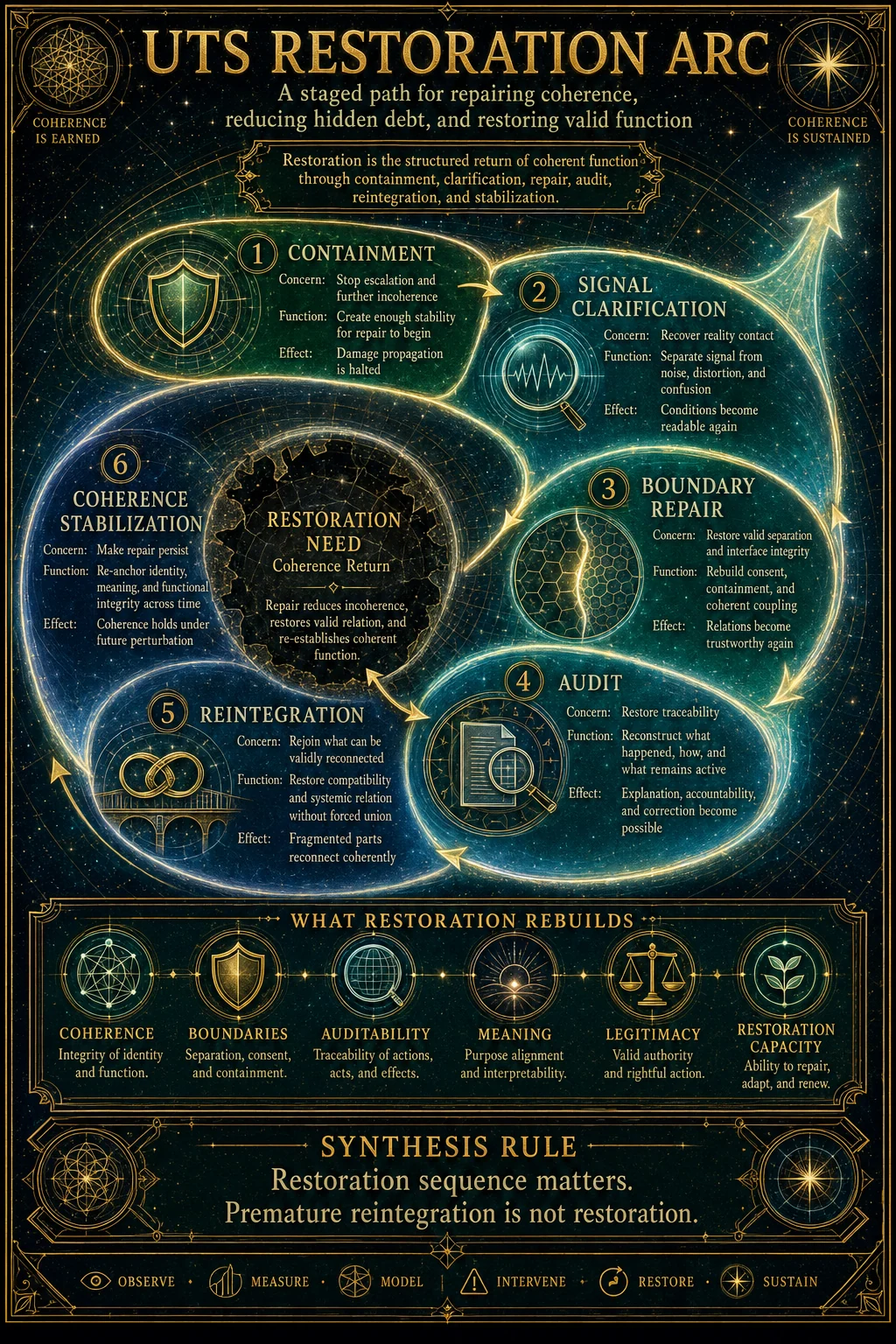
Emergency Harm Stabilization is the first restoration arc used when active harm, cascading damage, or immediate boundary breach must be contained before deeper repair can begin.
Truth and Causal Clarification restores causal legibility after harm, drift, or instability by reconstructing context, preserving uncertainty, increasing auditability, and making the real failure geometry inspectable before repair is assigned.
Origin-Layer Repair restores coherence by locating the layer where damage or hidden debt is actually generated, rejecting higher-layer symbolic substitutes, and applying repair at the same or lower U-layer before recurrence validation.
Audit Surface Expansion restores traceability when decision paths, causal chains, power surfaces, provenance, or affected-node verification channels are too opaque for valid repair.
Boundary Reconstitution restores damaged consent, scope, permission, access, identity, and exit boundaries before repair, recoupling, or reintegration can validly proceed.
Slack Regeneration restores repair capacity, choice-space, buffer, and perturbation tolerance when load, gain, urgency, or forced-choice pressure has depleted the system’s ability to stabilize, learn, choose, or repair.
Load Shedding reduces nonessential demand, coupling, exposure, throughput, or scope when system load exceeds restoration capacity and continued operation would accelerate hidden debt, instability, or collapse.
Feedback Integrity Restoration repairs captured, Goodharted, suppressed, or proxy-dominated feedback systems so that control, learning, correction, and restoration reference coherence rather than appearance, metrics, authority, or local fitness.
Inversion Exposure and Reduction reveals and reduces cases where apparent order, proxy success, authority, compliance, harmony, or visible improvement is being produced by hidden debt, suppressed feedback, boundary damage, or coherence loss.
Controlled Decoupling reduces invalid, extractive, coercive, over-fused, or compatibility-negative coupling while preserving boundary integrity, auditability, identity continuity, and safe exit.
Compatibility Recoupling restores limited, auditable, reversible coupling only after boundaries are repaired, compatibility is positive, hidden debt has been reduced, and temporal validation can confirm that reconnection does not recreate the original failure geometry.
Temporal Proof Arc validates restoration claims over delay, recurrence, perturbation, memory half-life, and field effects so that quiet, appearance, declaration, or short-term improvement cannot substitute for durable coherence.
Cybernetic Security
7 entries
Observability Restoration repairs systems that cannot regulate, learn, audit, or restore coherence because relevant state, causality, timing, boundary, feedback, or field signals are hidden, suppressed, distorted, or insufficiently instrumented.
Stability / Damping Restoration repairs systems that repeat, escalate, oscillate, overcorrect, undercorrect, or mistake quiet for resolution because disturbances do not ring down coherently.
Parasitic Extraction Recovery repairs systems where a coupling, interface, dependency, role, contract, tool, institution, or symbolic structure consumes slack, coherence, restoration capacity, data, attention, labor, or legitimacy while visible error remains low.
Security Theater Correction repairs systems where safety, security, compliance, policy, audit, or control signals create the appearance of protection while real exposure, hidden debt, extraction, or attack surface remains unaddressed.
Emergency Power Restoration repairs systems where emergency authority, override capacity, crisis privileges, containment powers, or exceptional controls were activated under harm conditions but have become stale, overextended, opaque, extractive, or detached from restoration.
Interface Re-Legitimation repairs interfaces whose authority, representation, consent, feedback, boundary, or routing function has become illegitimate through capture, opacity, coercion, misrepresentation, extraction, or field-state mismatch.
Basin-Aware Security Restoration repairs systems whose security posture fails because it treats incidents, controls, threats, users, attackers, or institutions as isolated events rather than attractor-bound patterns shaped by basin geometry, recurrence, incentives, and field conditions.
Economy
7 entries
Economic Legibility repairs hidden flows, debt opacity, externality invisibility, opaque contracts, dependency concealment, and hidden economic H by revealing flows, debts, externalities, contracts, dependencies, and burden pathways so repair can route accurately.
Economic Slack Regeneration repairs survival-edge conditions, forced economic choices, and coercive dependency by reducing forced-choice pressure, creating buffers, increasing local resilience, restoring bargaining room, and preventing dependency from becoming coercive.
Economic Clearance repairs bad debt, waste, backlog, ecological burden, fraud, and unresolved economic load by identifying unresolved burdens, separating suppressible from clearable debt, processing bad debt, internalizing externalities, and reducing recurrence.
Economic Attractor Shift repairs pseudo-coherent economic basins, forced-profit pressure, basin defender promotion, and incoherent allocation by mapping the dominant attractor, changing incentives, changing legitimacy pathways, redirecting allocation, and supporting higher-coherence nodes.
Consent-Valid Economic Recoupling repairs coercive contracts, debt traps, and dependency lock-in by restoring exit, retesting Λ, revising terms, scoping obligations, ensuring repair paths, and recoupling only if mutual coherence rises.
Circulation Repair restores economic, institutional, platform, and cross-domain circulation by identifying circulation-layer failure, repairing delivery, return, clearance, exchange interfaces, timing, and distributed repair pathways so throughput, clearance, response latency, and distribution improve.
Repair-First Growth repairs growth theater and expansion without capacity by requiring circulation repair, hidden debt reduction, restoration capacity, and natural gain before growth or expansion is treated as coherent.
Future Agency
1 entry
Justice, Governance & Legitimacy
7 entries
Responsibility Gradient Mapping restores source-aligned accountability by distinguishing causal role, authority, capacity, benefit, knowledge, repair obligation, and burden so that responsibility is neither flattened, displaced, inverted, nor assigned to the harmed or lowest-power node.
Victim-Centered Restoration restores repair geometry around the harmed or affected node by protecting boundary, agency, consent, truth, dignity, burden allocation, and repair priority before reconciliation, reintegration, legitimacy recovery, or system closure is attempted.
Repair-First Intake restores the first contact layer of a restoration process so intake captures harm, boundary, consent, safety, burden, responsibility, and repair needs before classification, mediation, reconciliation, legitimacy management, or procedural closure.
Legitimacy Re-Anchoring restores trustworthiness after authority, process, institution, interface, policy, or role legitimacy has drifted from truth, repair, consent, accountability, boundary integrity, field proof, or affected-node reality.
Equality-Conserving Accountability restores accountability without degrading equal dignity, agency, boundary integrity, or standing, while still preserving asymmetry of responsibility, harm, authority, capacity, and repair obligation.
Reintegration Membrane restores the boundary, trust, access, role, and compatibility conditions required before a previously decoupled, constrained, accountable, or repaired node can safely re-enter a system, role, relationship, institution, interface, or field.
Future-Compatible Accountability restores accountability so that repair, consequence, record, prevention, learning, and legitimacy remain valid not only for the immediate case, but for future audit, recurrence prevention, successor governance, and changed field conditions.
Scaling, Compression & Meaning
3 entries
Compression Relief restores depth, auditability, choice-space, meaning, and repair capacity when pressure, control density, rule density, urgency, or load compresses system state beyond coherent interpretation or response.
Structural Meaning Reset restores meaning integrity after control density, compression, overload, hollow doctrine, explanation failure, or compliance pressure has collapsed useful participation, interpretation, and repair.
Dignity-Preserving Transition restores viable movement out of an exhausted, incoherent, or obsolete state by preserving identity continuity, exit safety, agency, and coherence while a higher-order attractor becomes visible and reachable.
Specialized
12 entries
Exit-Path Before Entry prevents unsafe exploration, irreversible coupling, unknown-domain capture, and high-risk interface drift by requiring exit, rollback, containment, consent, auditability, and reintegration pathways before first entry or contact occurs.
Probe-Only Exploration repairs unsafe first-entry behavior by limiting unknown-domain interaction to bounded, reversible, non-extractive, non-coupling probes that preserve exit integrity, containment, auditability, consent boundaries, and temporal review.
Quarantine Outpost repairs unsafe ongoing unknown-domain presence by creating an isolated, bounded, reversible operating zone where limited observation, testing, containment, anomaly routing, and reintegration preparation can occur without uncontrolled contact, coupling, extraction, or bleed-through.
First-Contact Safety repairs unsafe reciprocal interface initiation by requiring consent-valid contact boundaries, interpretation discipline, non-coercive signaling, containment continuity, exit preservation, anomaly routing, and temporal proof before unknown-domain contact becomes sustained interaction.
Bleed-Through Management repairs residue, recurrence, carryover, memory contamination, delayed effects, and cross-boundary leakage after probe, quarantine, or contact by identifying what crossed the boundary, isolating residual effects, preserving auditability, reducing recurrence, restoring boundary integrity, and validating containment over time.
Reintegration repairs unsafe return after unknown-domain exposure by restoring boundaries, reviewing memory, reducing residue, preserving auditability, supporting affected operators and fields, preventing recurrence, and validating that the system can return from probe, quarantine, or contact without importing hidden coupling, contamination, or future-option damage.
Containment-First Stabilization repairs civilization-scale interface danger by stabilizing awareness, exposure, boundary, legitimacy, and escalation conditions before disclosure, confrontation, bypass, contact, or public action proceeds.
Asymmetric Awareness Injection repairs suppressed, captured, or unstable awareness fields by moving truth, evidence, context, and agency-relevant signal into the field through staged, bounded, auditable, non-flooding awareness transfer that preserves damping, consent surface, legitimacy, and future repair.
Legitimacy Re-Anchoring repairs civilization-scale trust shock, authority drift, intermediary capture, public confidence collapse, and post-awareness legitimacy volatility by relocating authority to auditable truth, responsibility, affected-field feedback, repair capacity, and future-compatible accountability.
Interface Bypass & Decoupling repairs captured, invalid, coercive, or legitimacy-failed interface channels by separating legitimate function from the captured intermediary, preserving evidence and public agency, reducing dependency, creating alternate routing, and validating that decoupling lowers hidden debt without uncontrolled collapse.
Inversion Exhaustion / Self-Exposure repairs captured-interface concealment by detecting when an invalid interface, intermediary, institution, platform, or authority structure can no longer sustain its inversion under audit, contradiction, public feedback, failed legitimacy performance, or overreach, then preserving evidence, preventing chaotic collapse, and routing the exposure into repair, bypass, decoupling, supersession, or post-interface restoration.
Post-Interface Restoration repairs the aftermath of civilization-scale interface exposure, bypass, decoupling, self-exposure, collapse, or supersession pressure by stabilizing affected fields, preserving evidence and accountability, repairing public hidden debt, restoring agency and legitimacy, preventing recurrence, and validating a coherent post-interface baseline over time.