Foundational Overview
0. Purpose
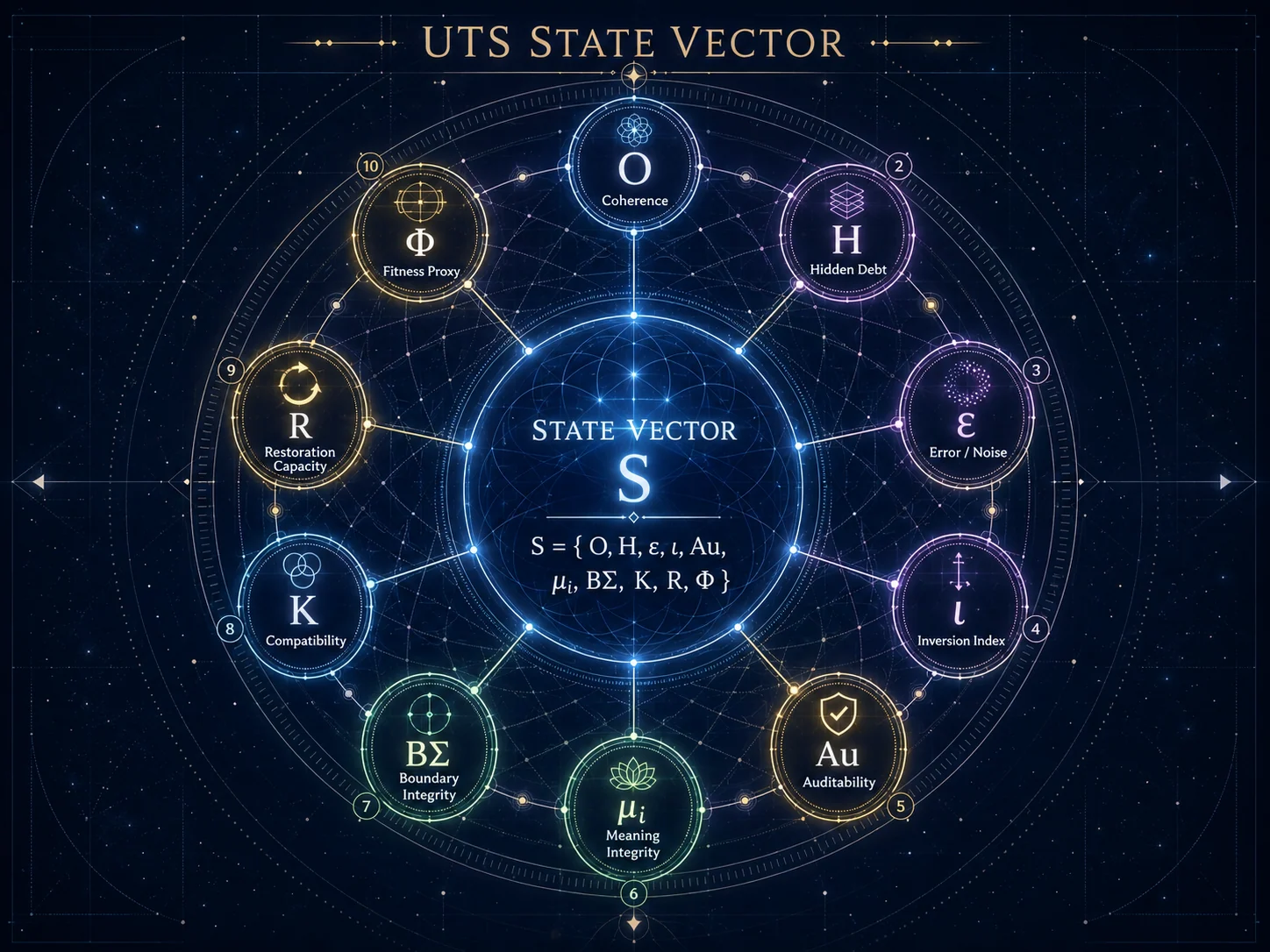
TheCanonical State Vectoris the shared state substrate of the UTS Operator System.
It defines what condition a system is in before, during, and after operator activity.
S = { O, H, ε, ι, Au, µᵢ, BΣ, K, R, Φ }Operators act on this vector.
Diagnostics are inferred from it.
U-layers localize where its changes manifest.
Regimes emerge from recurring state/operator/layer patterns.
1. State Vector Table
| Symbol | Name | Short Definition | Core Question |
|---|---|---|---|
O | Coherence | Real mutual reinforcement under stress | Is the system actually coherent? |
H | Hidden Debt | Latent unresolved incoherence / deferred cost | What cost has not been paid or repaired? |
ε | Error / Noise | Visible deviation from expected coherence | What deviation has become visible? |
ι | Inversion Index | Apparent order without harmonic fit | What looks coherent but is not? |
Au | Auditability | Usable traceability of state and causality | Can the system show how this happened? |
µᵢ | Agent / Meaning Integrity | Continuity between model, action, consequence, meaning, and memory | Does the system remain meaningfully continuous with itself? |
BΣ | Boundary Integrity | Preservation of identity, consent, role, interface, and invariant clarity | Are the boundaries clean enough for coherent contact? |
K | Compatibility | Mutual coherence increase under coupling | Does coupling improve both systems? |
R | Restoration Capacity | Effective repair throughput that reduces hidden debt | Can the system repair faster and deeper than it degrades? |
Φ | Fitness Proxy | Measured success signal used for optimization | What is the system treating as success? |
2. Compressed Definitions
O = real mutual reinforcement under stress.

H = latent unresolved incoherence stored as deferred cost.

ε = visible deviation from expected coherence.

ι = coherence-looking misalignment; apparent order without harmonic fit.

Au = usable traceability of state, causality, decisions, boundaries, metrics, feedback, and repair.

µᵢ = continuity between what a system means, does, causes, repairs, and remembers.

BΣ = the boundary condition that makes coherent contact possible.

K = coherence-positive fit under coupling.

R = repair throughput that actually reduces hidden debt and preserves coherence over time.

Φ = what the system treats as success.
3. Functional Clusters
A. Coherence / Debt / Error Cluster
{ O, H, ε, ι }This cluster tracks whether the system is actually coherent, visibly failing, hiding cost, or displaying pseudo-coherence.
| Variable | Function |
|---|---|
O | Real coherence condition |
H | Hidden unresolved burden |
ε | Visible deviation |
ι | Appearance/function divergence |
Core diagnostic question:
Is the system coherent, visibly strained, hiding debt, or only appearing coherent?B. Audit / Integrity / Boundary Cluster
{ Au, µᵢ, BΣ }This cluster tracks whether the system can inspect itself, remain meaningful through time, and preserve clean boundaries.
| Variable | Function |
|---|---|
Au | Traceability |
µᵢ | Meaning/action/consequence continuity |
BΣ | Boundary clarity |
Core diagnostic question:
Can the system see itself, remain accountable to meaning, and preserve coherent contact boundaries?C. Coupling / Repair / Optimization Cluster
{ K, R, Φ }This cluster tracks whether systems couple cleanly, repair effectively, and optimize the right signal.
| Variable | Function |
|---|---|
K | Coupling fit |
R | Repair throughput |
Φ | Optimization target |
Core diagnostic question:
Does the system couple, repair, and optimize in ways that increase real coherence?4. Core State Patterns
4.1 Healthy Coherence Pattern
O↑
H↓
ε manageable / legible
ι↓
Au↑
µᵢ↑
BΣ↑
K↑ where coupling exists
R sufficient
Φ aligned with O
Meaning:
The system is coherent, auditable, boundary-stable, repairable, and not ruled by a distorted proxy.4.2 Degraded Pattern
O↓
H↑
ε↑
ι variable / rising
Au↓
µᵢ↓
BΣ↓
K↓ or unstable
R insufficient
Φ unstable or misleading
Meaning:
The system is losing coherence, repairability, traceability, and boundary clarity.4.3 Pseudo-Coherent Pattern
O apparent
Φ↑
H↑
ε suppressed or displaced
ι↑
Au↓
µᵢ↓
BΣ↓
K extractive or unreliable
R cosmetic / overloaded
Meaning:
The system looks successful, stable, unified, or functional while hidden debt and inversion rise.5. High-Value Diagnostic Pairs
ΦvsO
Φ = measured success
O = real coherence
Healthy:
Φ↑ and O↑Danger:
Φ↑ while O↓Interpretation:
The system is optimizing the proxy while degrading coherence.εvsH
ε = visible deviation
H = hidden debt
Healthy exposure:
ε↑ + Au↑ + R available ⇒ H can decreaseDangerous suppression:
ε↓ + Au↓ + H↑ ⇒ error is being hiddenAuvsX_c
Au = auditability
X_c = constraint complexity
Core rule:
X_c > Au_eff ⇒ H↑Interpretation:
If complexity exceeds inspection capacity, hidden debt rises.BΣvsK
BΣ = boundary integrity
K = compatibility
Core rule:
BΣ↓ ⇒ K readings unreliableInterpretation:
Compatibility cannot be trusted if boundaries are unclear.Rvs Load
R = restoration capacity
Load × Gain_stack = amplified repair demand
Core rule:
R_eff > Load × Gain_stack ⇒ O tends to increase

R_eff < Load × Gain_stack ⇒ collapse amplifies
Interpretation:
Repair capacity must exceed amplified load, not nominal load.µᵢvsι
µᵢ = meaning integrity
ι = inversion index
Common pattern:
µᵢ↓ + ι↑Interpretation:
The system’s language, symbols, identity, or claims are diverging from operational function.6. State Variable Quick Checks
O— Coherence
Ask:
Do the parts mutually reinforce under stress?Red flags:
apparent stability
high performance
low conflict
strong agreement
without:
H↓
Au↑
BΣ↑
R sufficient
Φ alignedH— Hidden Debt
Ask:
What cost is being deferred, hidden, exported, or misclassified?Red flags:
deferred repair
unpaid labor
suppressed feedback
resource overdraw
wrong-layer repair
boundary ambiguity
unmeasured externalityε— Error / Noise
Ask:
Is visible deviation being exposed, suppressed, displaced, repaired, or misclassified?Red flags:
error disappears while auditability falls
same error recurs
error is blamed before localization
feedback is labeled disruptionι— Inversion Index
Ask:
What appears coherent while functioning incoherently?Red flags:
Φ↑ while O↓
ε↓ while H↑
Au↓ while confidence↑
unity language while BΣ↓
repair language while recurrence persistsAu— Auditability
Ask:
Can cause, state, decision, boundary, metric, feedback, and repair be traced?Red flags:
documentation without causality
authority blocks review
opaque automation
metric black box
wrong-layer explanationµᵢ— Agent / Meaning Integrity
Ask:
Do model, action, consequence, memory, and meaning remain continuous?Red flags:
claim/action split
symbol/function split
identity rewrite after failure
consequence disowned
same promise repeated without behavior changeBΣ— Boundary Integrity
Ask:
Are identity, consent, role, interface, and invariant boundaries clear?Red flags:
role fusion
consent ambiguity
permission creep
interface leakage
unity language hiding boundary erosion
burden transfer without acknowledgmentK— Compatibility
Ask:
Does coupling increase mutual coherence?Red flags:
one side absorbs cost
repair burden asymmetric
connection requires boundary erosion
shared language hides mismatch
timing mismatch recursR— Restoration Capacity
Ask:
Can the system reduce hidden debt and preserve repair through recurrence?Red flags:
repair activity without H↓
same failure returns
repair unfunded
wrong-layer repair
cosmetic restoration
emergency-only repairΦ— Fitness Proxy
Ask:
What is the system treating as success?Red flags:
metric replaces coherence
excluded costs
success improves while repair declines
proxy becomes immune to challenge
symbolic agreement replaces embodied meaning
7. Common Failure Signatures
Proxy Capture
Φ↑
O↓
H↑
Au↓
ι↑
Meaning:
The system is optimizing the wrong signal.Error Suppression
ε↓
Au↓
H↑
ι↑
Meaning:
Error is hidden, not repaired.Hidden Debt Compounding
H↑
R↓
τ_resp↑
σ↓
ε eventually ↑
Meaning:
Deferred cost is becoming future crisis.Boundary Collapse
BΣ↓
K unreliable
H↑
µᵢ↓
ε recurring
Meaning:
Contact, responsibility, consent, or identity boundaries are degrading.Repair Theater
ℛ apparent
H unchanged
τ_m short
ι↑
Meaning:
Repair is performed, but restoration does not persist.Meaning Inversion
symbolic language ↑
µᵢ↓
BΣ↓
ι↑
Meaning:
The name remains, but the function reverses.Extraction Regime Signature
Φ↑ locally
O↓ elsewhere
H exported
K↓
BΣ↓
R burden shifted
ι↑
Meaning:
One system’s apparent success depends on another system’s hidden degradation.Crisis Loop Signature
𝓑 breached
𝓓 low
τ_m short
H↑
R overloaded
ε recurring
Meaning:
The system cannot absorb shock, settle disturbance, or retain repair.8. State Vector Audit Card
# State Vector Audit

## 1. Coherence
O:
- Is real mutual reinforcement increasing or decreasing?

## 2. Hidden Debt
H:
- What cost is hidden, deferred, exported, or unresolved?

## 3. Error / Noise
ε:
- What deviation is visible?
- Is it signal, noise, symptom, or suppressed feedback?

## 4. Inversion
ι:
- What looks coherent but lacks harmonic fit?

## 5. Auditability
Au:
- Can state, causality, decisions, boundaries, metrics, and repair be traced?

## 6. Agent / Meaning Integrity
µᵢ:
- Do model, claim, action, consequence, repair, and memory align over time?

## 7. Boundary Integrity
BΣ:
- Are identity, consent, role, interface, and invariant boundaries clear?

## 8. Compatibility
K:
- Does coupling increase mutual coherence or transfer burden?

## 9. Restoration Capacity
R:
- Can the system repair at the true layer and preserve repair through recurrence?

## 10. Fitness Proxy
Φ:
- What is being optimized?
- Does it track O or replace O?
9. Minimal State Diagnosis Formula
A useful quick-state formulation:
System State =
what is coherent +
what is hidden +
what is visibly deviating +
what is inverted +
what can be audited +
what remains meaningful through time +
what boundaries hold +
what couplings are compatible +
what can be repaired +
what is being optimized
Compressed:
S = O + H + ε + ι + Au + µᵢ + BΣ + K + R + ΦOperational reading:
A system is not healthy because one variable looks good.
It is healthy when the vector pattern supports coherence across stress, coupling, repair, and recurrence.
10. Project-Ready Reference Summary
The Canonical State Vector is the shared condition map of UTS.

O tells whether coherence is real.
H tells what debt is hidden.
ε tells what deviation is visible.
ι tells what appears coherent but is inverted.
Au tells what can be traced.
µᵢ tells whether meaning, action, consequence, and memory remain continuous.
BΣ tells whether boundaries are clean.
K tells whether coupling increases mutual coherence.
R tells whether repair can reduce hidden debt and persist.
Φ tells what the system treats as success.

No single variable is sufficient.

The state vector must be read as a pattern.
Final operational rule:
Do not trust success, stability, unity, repair, compatibility, or coherence claims until the full state vector has been checked.