Foundational Overview
0. Purpose
TheUTS Laws Referenceis a navigation and usage guide for the Laws & Scaling Rules Registry.
It answers:
- what a UTS law is;
- how laws differ from invariants, diagnostics, and failure modes;
- how laws are classified;
- how laws should be used in analysis and design;
- how to identify redundancy between laws;
- how to create future law entries consistently.
The full registry contains the canonical list of laws. This reference explains how to use that list.
1. What a UTS Law Is
AUTS lawis a recurring system-behavior pattern.
It describes what tends to happen when systems experience:
- transformation;
- stress;
- compression;
- scale;
- coupling;
- hidden debt;
- inversion;
- audit loss;
- boundary strain;
- meaning loss;
- restoration load;
- environmental forcing.
A law is not a command.
A law is not a belief.
A law is not a moral accusation.
A law is not necessarily absolute in every possible case.
A law says:
When systems behave this way, this pattern tends to follow.
Example:
Φ↑ while O↓ ⇒ ι↑Plain meaning:
A system can appear more successful while becoming less coherent; when this happens, inversion rises.
2. Law vs Invariant
A law and an invariant are related, but they are not the same.
| Construct | Function | Basic Form |
|---|---|---|
| Invariant | Defines a constraint that must not be violated | “This must hold.” |
| Law | Describes a recurring behavioral pattern | “When this happens, that tends to follow.” |
Invariant
An invariant says:
Do not violate this constraint.Example:
Local success is not global alignment.
Law
A law says:
When a system behaves this way, this pattern tends to emerge.Example:
Local coherence can coexist with global incoherence.
The invariant protects the system from invalid reasoning.
The law explains how the pattern unfolds in real systems.
3. Law vs Diagnostic
Alawdescribes a behavioral pattern.
Adiagnosticmeasures or detects part of that pattern.
| Construct | Question Answered |
|---|---|
| Law | What pattern is unfolding? |
| Diagnostic | How can we detect or measure it? |
Example:
Law
X_c > Au_eff ⇒ H↑ ⇒ O↓Diagnostics
- Constraint Complexity
- Effective Auditability
- Hidden Debt
- Coherence
- Rule-Stacking Wall risk
The law explains the relationship.
The diagnostics reveal whether the relationship is occurring.
4. Law vs Failure Mode
Alawdescribes a pattern that may be neutral, beneficial, or dangerous depending on context.
Afailure modedescribes a recognizable breakdown pattern.
| Construct | Function |
|---|---|
| Law | Explains a behavioral tendency |
| Failure Mode | Names a degraded system condition |
Example:
Law
When auditability falls, hidden debt rises.
Failure modes that may result
- Hidden Debt Accumulation
- Security Theater
- Rule-Stacking Wall
- Pseudo-Restoration
- Silent Extraction
The law is the mechanism.
The failure mode is the degraded configuration.
5. Law vs Restoration Arc
Alawexplains what is happening.
Arestoration arcexplains how repair should be sequenced.
| Construct | Function |
|---|---|
| Law | Pattern recognition and prediction |
| Restoration Arc | Repair sequencing and recovery path |
Example:
Law
Scaling before restoration amplifies hidden debt.
Restoration implication
Before scaling, the system must usually rebuild:
H↓ + R↑ + Au↑ + BΣ↑ + K↑Relevant restoration arcs may include:
- Slack Regeneration
- Auditability Restoration
- Boundary Reconstitution
- Origin-Layer Repair
- Restoration Capacity Rebuild
6. Canonical State Vector
Most laws map back to the UTS state vector:
S(t) = { O, H, ε, ι, Au, µᵢ, BΣ, K, R, Φ }| Variable | Meaning |
|---|---|
O | Coherence |
H | Hidden debt |
ε | Observable error / noise |
ι | Inversion index |
Au | Auditability |
µᵢ | Meaning / agent integrity |
BΣ | Boundary integrity |
K | Compatibility / slack / sovereignty |
R | Restoration capacity |
Φ | Fitness proxy / visible success signal |
A strong law entry should usually explain:
What happens to O?
What happens to H?
What happens to ι?
What happens to Au?
What happens to R?
What happens to Φ?
Not every law needs every variable, but the main variable movement should be clear.
7. Common Diagnostic Variables
Many laws also use supporting diagnostics:
| Diagnostic | Meaning |
|---|---|
𝓑(t) | Bandwidth / forcing absorbability |
𝓓(t) | Damping / ring-down |
σ(t) | Slack |
τ_resp(t) | Response latency |
τ_m(t) | Memory half-life / recurrence tendency |
X_c(t) | Constraint complexity |
Au_eff | Effective auditability |
Cv(t) | Compression velocity |
AP(t) | Attribution pressure |
Perm(t) | Boundary permeability |
Lτ | Logistics throughput |
These are especially useful for turning laws into operational diagnostics.
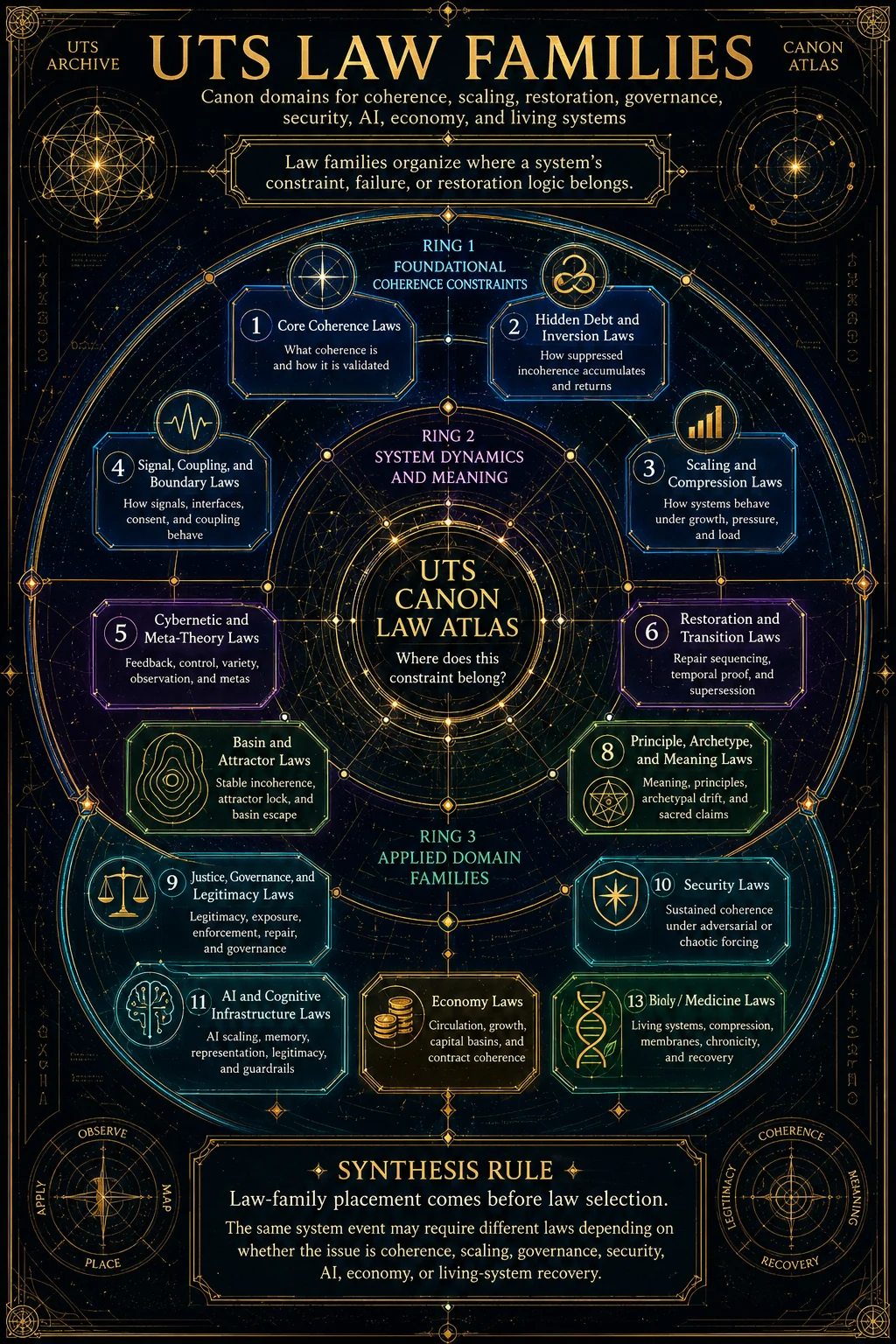
8. Major Law Families
The current registry organizes laws into thirteen major families.
| Family | Core Concern |
|---|---|
| Core Coherence Laws | What coherence is and how it is validated |
| Hidden Debt and Inversion Laws | How suppressed incoherence accumulates and returns |
| Scaling and Compression Laws | How systems behave under growth, pressure, and load |
| Signal, Coupling, and Boundary Laws | How signals, interfaces, consent, and coupling behave |
| Cybernetic and Meta-Theory Laws | Feedback, control, variety, observation, and metas |
| Restoration and Transition Laws | Repair sequencing, temporal proof, and supersession |
| Basin and Attractor Laws | Stable incoherence, attractor lock, and basin escape |
| Principle, Archetype, and Meaning Laws | Meaning, principles, archetypal drift, and sacred claims |
| Justice, Governance, and Legitimacy Laws | Legitimacy, exposure, enforcement, repair, and governance |
| Security Laws | Sustained coherence under adversarial or chaotic forcing |
| AI and Cognitive Infrastructure Laws | AI scaling, memory, representation, legitimacy, and guardrails |
| Economy Laws | Circulation, growth, capital basins, and contract coherence |
| Biology / Medicine Laws | Living systems, compression, membranes, chronicity, and recovery |
9. Compact Family Map
I. Core Coherence Laws
Central question:
What makes a system coherent across time, stress, and scale?
Common patterns:
O before Φ
dO/dt under load
stability ≠ coherence
time validates
ring-down reveals truth
Primary variables:
O, Φ, H, ι, Au, R, µᵢ, BΣII. Hidden Debt and Inversion Laws
Central question:
What happens when incoherence is suppressed, hidden, or disguised as success?
Common patterns:
unrepaired incoherence + suppression ⇒ H↑
Au↓ ⇒ H↑
Φ↑ ∧ O↓ ⇒ ι↑
ε appears late
Primary variables:
H, ι, Au, ε, O, ΦIII. Scaling and Compression Laws
Central question:
What happens when pressure, coupling, load, or scale increases?
Common patterns:
Pressure↑ faster than R + Au + K ⇒ O↓
Shock > 𝓑(t) ⇒ regime shift likely
Cv↑ ⇒ intervention window↓
σ↓ ⇒ compression cascade
Primary variables:
O, R, Au, K, H, ι, 𝓑(t), σ(t), Cv(t)IV. Signal, Coupling, and Boundary Laws
Central question:
What makes coupling legitimate, safe, reversible, and auditable?
Common patterns:
signals are control artifacts
misclassification precedes failure
compatibility before coupling
force issues debt unless repaired
Primary variables:
BΣ, Au, K, H, ι, µᵢV. Cybernetic and Meta-Theory Laws
Central question:
How do feedback, control, observation, and compressed strategies alter system behavior?
Common patterns:
feedback without integrity becomes capture
control is not restoration
V_controller ≥ V_environment
observation changes the system observed
Primary variables:
FI, K, R, H, Au, Θ, Γ_spanVI. Restoration and Transition Laws
Central question:
What makes repair real rather than symbolic, optical, or incomplete?
Common patterns:
repair must reach the origin layer
H↓ ∧ ι↓ ⇒ restoration more likely valid
recurrence↓ confirms repair
boundary before recoupling
Primary variables:
R, H, ι, O, BΣ, Au, τ_m, 𝓓VII. Basin and Attractor Laws
Central question:
Why do incoherent systems feel stable, and how do they defend themselves?
Common patterns:
O_local stable ∧ H_export↑ ⇒ pseudo-coherent basin
basin exit requires higher-order attractor
normalization reduces auditability
Primary variables:
O_local, O_global, H, Au, ι, Φ, KVIII. Principle, Archetype, and Meaning Laws
Central question:
How do meaning, principle, and archetype shape admissible trajectories?
Common patterns:
principles act as coherence constraint fields
one principle used to bypass another ⇒ inversion
memory without update becomes ideology
meaning assigns trajectory
Primary variables:
µᵢ, O, H, ι, BΣ, K, AuIX. Justice, Governance, and Legitimacy Laws
Central question:
What makes authority, justice, and governance coherent under audit?
Common patterns:
legitimacy = coherence acknowledged under audit
enforcement without repair ⇒ H↑
transparency without restoration destabilizes
high Φ requires proportional constraint and repair
Primary variables:
L, Au, MS, FI, R, Φ, H, µᵢX. Security Laws
Central question:
What is security when incidents are lagging indicators?
Common patterns:
security = sustained coherence under adversarial forcing
visible incidents appear late
surveillance without restoration creates legitimacy debt
emergency power without sunset becomes control
Primary variables:
O, BΣ, Au, R, H, ι, εXI. AI and Cognitive Infrastructure Laws
Central question:
What happens when AI mediates cognition, classification, memory, and action at scale?
Common patterns:
AI amplifies Γ
low error ≠ safety
X_c > Au_eff ⇒ H↑
AI legitimacy must scale with influence
Primary variables:
Γ, Au, H, ι, µᵢ, BΣ, R, ΦXII. Economy Laws
Central question:
What makes economic activity coherent rather than extractive?
Common patterns:
circulation before growth
growth before expansion
forced profit masks circulation failure
market signals are control artifacts, not truth
Primary variables:
O, H, Φ, ι, 𝓓, σ, R, BΣXIII. Biology / Medicine Laws
Central question:
How do living systems preserve coherence under forcing, compression, and signal load?
Common patterns:
living systems are adaptive coherence systems
recovery is not symptom reversal
membranes are coupling interfaces
tolerance is stack-dependent
Primary variables:
O, H, σ, 𝓓, τ_m, Perm, BΣ, R10. Core Root Patterns
Many UTS laws are domain-specific expressions of a smaller set of root patterns.
Root Pattern 1 — Coherence Before Proxy
O before ΦIf visible success rises while coherence falls, the system is drifting toward inversion.
Related laws:
- Coherence Priority Law
- Success Proxy Divergence Law
- Pseudo-Restoration Law
- Pseudo-Security Law
- Forced Profit Law
- False Recovery Law
Root Pattern 2 — Hidden Debt Return
suppressed incoherence ⇒ H↑ ⇒ later returnHidden debt can be delayed, exported, hidden, or renamed. It is not eliminated until repaired.
Related laws:
- Hidden Debt Accumulation Law
- Hidden Debt Return Law
- Hidden Debt Migration Law
- Error Lag Law
- Incident Lag Law
- Quiet Minimization Debt Law
Root Pattern 3 — Auditability Governs Repair
Au↓ ⇒ H↑When causality becomes illegible, repair becomes unreliable.
Related laws:
- Auditability-Debt Law
- Suppressed Auditability Debt Law
- Observability Collapse Law
- Security Legibility Law
- AI Non-Patchable Audit Law
- Legitimacy Audit Law
Root Pattern 4 — Scaling Requires Capacity
Pressure↑ faster than R + Au + K ⇒ O↓Scale is not merely expansion. Scale is coherence under pressure.
Related laws:
- Scaling as Coherence Under Pressure
- Coherence-Preserving Scaling Law
- Integration Capacity Law
- Restoration Before Scaling Law
- High-Φ Legitimacy Scaling Law
- Cognitive Infrastructure Scaling Law
Root Pattern 5 — Restoration Requires Temporal Proof
H(t+Δt) ≤ H(t)
𝓓↑
τ_m↓
recurrence↓
A repair is not proven at announcement. It is proven through time.
Related laws:
- Time Validation Law
- Ring-Down Truth Law
- Recurrence Validation Law
- Temporal Proof Law
- Stability Proof Law
- False Recovery Law
Root Pattern 6 — Boundaries Regulate Coupling
BΣ unstable ⇒ coupling inadmissibleCoupling without compatibility, consent, reversibility, auditability, and repair capacity creates debt.
Related laws:
- Boundary Membrane Law
- Consent Structurality Law
- Safe Coupling Law
- Contract Validity Law
- Boundary-First Restoration Law
- Reintegration Membrane Law
Root Pattern 7 — Stable Does Not Mean Coherent
return to attractor ≠ coherent attractorA system can be stable because it is trapped.
Related laws:
- Stability-Coherence Separation Law
- Wrong-Solution Basin Law
- Pseudo-Coherent Basin Law
- Local Stability Export Law
- Chronic Basin Law
- Basin Self-Defense Law
11. How to Use Laws in Analysis
A law is useful when it helps answer:
- What pattern is unfolding?
- What variables are moving?
- What is being hidden, exported, delayed, or compressed?
- What would happen if the pattern continues?
- What restoration sequence is required?
Basic analysis sequence:
Observe pattern
→ identify law family
→ map variables
→ check diagnostics
→ identify failure risk
→ select restoration arc
→ time-validate outcome
12. Law Identification Checklist
Use this checklist when deciding whether a pattern deserves a law entry.
A candidate law should:
- appear across more than one domain, layer, or scale;
- describe behavior rather than only prescribe action;
- map to the canonical state vector;
- help predict drift, collapse, stabilization, or restoration;
- support diagnostics;
- connect to failure modes;
- inform restoration arcs;
- avoid duplicating an existing law unless it adds distinct value.
A weak law candidate usually:
- describes only one narrow scenario;
- restates an invariant without adding behavior;
- names a value but not a mechanism;
- overlaps an existing law without adding diagnostic utility;
- cannot be mapped to variables;
- cannot guide restoration.
13. Deduplication Rules
When two laws seem similar, ask:
1. Do they describe the same mechanism?
If yes, merge or alias them.
Example:
Fitness Proxy Divergence Law
Success Proxy Divergence Law
Metric Substitution Law
AI Proxy Hazard Law
These all fold into:
Φ↑ while O↓ ⇒ ι↑2. Do they operate at different layers?
If yes, keep both only if the layer distinction matters.
Example:
- Origin-Layer Repair Law
- Temporal Proof Law
These are related, but distinct.
One governswhere repair must occur.
The other governshow repair is validated over time.
3. Does the domain version add unique diagnostic value?
If yes, preserve it as a domain law.
Example:
- False Recovery Law in Biology
- Pseudo-Restoration Law in Restoration
They share a root pattern, but their diagnostics differ.
4. Is one law broader and one more operational?
Keep both if they serve different use cases.
Example:
- Coherence Priority Law = broad rule
- Success Proxy Divergence Law = operational drift pattern
14. Law Entry Minimum Fields
Every law registry entry should include at least:
id: "UTS-L###"
name: "[Law Name]"
family: "[Law Family]"
canonical_statement: "[One-line statement]"
plain_definition: "[Plain-language explanation]"
canonical_form: "[Formula or symbolic expression]"
primary_variables:
  - "O"
  - "H"
  - "ι"
diagnostic_signature: "[How it shows up]"
failure_risk: "[What happens if ignored]"
restoration_implication: "[What repair requires]"
related_laws:
  - "UTS-L###"
For full entries, use the Law Spec Sheet Template.
15. Recommended Law Card Format
For the website, each law can have a compact card:
## UTS-L### — [Law Name]

**Statement:**
[One-line law.]

**Plain meaning:**
[One to two sentence explanation.]

**Canonical form:**
`[Formula]`

**Family:**
[Law family]

**Primary variables:**
`O`, `H`, `ι`, `Au`, `R`, `Φ`

**Diagnostic signature:**
[Compact signal.]

**Failure risk:**
[Main failure mode.]

**Restoration implication:**
[Main repair requirement.]
16. High-Priority Laws for Full Pages
Some laws deserve full standalone pages because they are load-bearing across many modules.
Recommended priority set:
| ID | Law | Reason |
|---|---|---|
| UTS-L001 | Coherence Priority Law | Defines proxy subordination |
| UTS-L003 | Success Proxy Divergence Law | Core inversion pattern |
| UTS-L004 | Stability-Coherence Separation Law | Prevents false stability readings |
| UTS-L010 | Hidden Debt Accumulation Law | Foundation of debt mechanics |
| UTS-L011 | Hidden Debt Return Law | Explains delayed collapse |
| UTS-L014 | Constraint Complexity Debt Law | Central to governance, AI, and institutions |
| UTS-L018 | Scaling as Coherence Under Pressure | Defines scaling correctly |
| UTS-L021 | Coherence-Preserving Scaling Law | Main safe-scaling rule |
| UTS-L025 | Compression Depth Collapse Law | Explains collapse sequence |
| UTS-L030 | Slack Sovereignty Law | Core agency and capacity principle |
| UTS-L041 | Boundary Membrane Law | Core coupling model |
| UTS-L043 | Safe Coupling Law | Main interface legitimacy rule |
| UTS-L061 | Restoration Sequencing Law | Main restoration sequence |
| UTS-L063 | Origin-Layer Repair Law | Prevents symbolic repair mismatch |
| UTS-L067 | Temporal Proof Law | Defines repair validation |
| UTS-L077 | Pseudo-Coherent Basin Law | Explains stable incoherence |
| UTS-L081 | Higher-Order Attractor Law | Explains basin escape |
| UTS-L102 | Legitimacy Audit Law | Core governance law |
| UTS-L112 | Security as Sustained Coherence Law | Core security definition |
| UTS-L121 | AI as Γ-Amplifier Law | Core AI infrastructure law |
| UTS-L131 | Cognitive Infrastructure Scaling Law | Core AI governance law |
| UTS-L141 | Economy Trajectory Law | Core economy law |
| UTS-L151 | Living Systems Coherence Law | Core biology law |
17. Law Development Workflow
Recommended workflow for building the laws registry:
1. Confirm law ID and name
2. Assign law family
3. Write one-line canonical statement
4. Write plain-language explanation
5. Add canonical form
6. Map variables
7. Add diagnostic signature
8. Link related diagnostics
9. Link related failure modes
10. Link related restoration arcs
11. Add cross-domain examples
12. Add deduplication note
13. Add machine-readable summary
14. Mark status
Status options:
| Status | Meaning |
|---|---|
| Draft | Initial entry; not yet checked against related laws |
| Working | Usable, but may require consolidation |
| Canon-Ready | Stable and ready for site/archive use |
| Canon-Locked | Final unless major registry revision occurs |
| Deprecated | Folded into another law |
| Alias | Preserved as a search or historical name |
18. Common Law Anti-Patterns
Avoid creating laws that are only:
1. Restated values
Weak:
Systems should be fair.Stronger:
Legitimacy decays when consequence, repair, and auditability are asymmetric.2. One-domain observations
Weak:
AI chatbots sometimes hallucinate.Stronger:
Low observable error does not equal safety; visible incidents are lagging indicators.3. Prescriptions without mechanisms
Weak:
Always restore boundaries.Stronger:
Boundary integrity must be restored before coherent recoupling.4. Duplicate expressions
Weak:
Metric failure creates bad outcomes.Stronger:
Fold into Success Proxy Divergence Law unless the new case adds unique diagnostic value.19. Practical Use Cases
The Laws Reference supports:
- registry entry creation;
- website card generation;
- glossary cross-linking;
- diagnostic selection;
- failure-mode detection;
- restoration arc planning;
- AI-readable construct graph generation;
- module consistency checks;
- deduplication across overlapping laws;
- future expansion of domain-specific laws.
20. Machine-Readable Summary
reference: "UTS — Laws Reference"
version: "1.0"
status: "Canon-Ready"
type: "reference"
primary_function: "Navigation and usage guide for UTS laws and scaling rules."
law_definition: "A recurring cross-context system-behavior pattern describing how coherence, hidden debt, inversion, boundary integrity, auditability, restoration, and scaling behave under transformation, stress, or forcing."
law_distinction:
  invariant: "Constraint that must not be violated."
  law: "Behavioral pattern that tends to unfold under certain conditions."
  diagnostic: "Measurement or detection tool."
  failure_mode: "Recognizable degraded configuration."
  restoration_arc: "Repair sequencing pathway."
canonical_state_vector:
  - "O"
  - "H"
  - "ε"
  - "ι"
  - "Au"
  - "µᵢ"
  - "BΣ"
  - "K"
  - "R"
  - "Φ"
major_families:
  - "Core Coherence Laws"
  - "Hidden Debt and Inversion Laws"
  - "Scaling and Compression Laws"
  - "Signal, Coupling, and Boundary Laws"
  - "Cybernetic and Meta-Theory Laws"
  - "Restoration and Transition Laws"
  - "Basin and Attractor Laws"
  - "Principle, Archetype, and Meaning Laws"
  - "Justice, Governance, and Legitimacy Laws"
  - "Security Laws"
  - "AI and Cognitive Infrastructure Laws"
  - "Economy Laws"
  - "Biology / Medicine Laws"
core_root_patterns:
  - "Coherence before proxy"
  - "Hidden debt returns"
  - "Auditability governs repair"
  - "Scaling requires capacity"
  - "Restoration requires temporal proof"
  - "Boundaries regulate coupling"
  - "Stability does not equal coherence"
minimum_entry_fields:
  - "id"
  - "name"
  - "family"
  - "canonical_statement"
  - "plain_definition"
  - "canonical_form"
  - "primary_variables"
  - "diagnostic_signature"
  - "failure_risk"
  - "restoration_implication"
  - "related_laws"
recommended_statuses:
  - "Draft"
  - "Working"
  - "Canon-Ready"
  - "Canon-Locked"
  - "Deprecated"
  - "Alias"
21. Compact Website Reference
# Laws

A **UTS law** describes a recurring behavioral pattern in systems.

It answers:

> When a system behaves this way, what tends to happen next?

Laws differ from invariants.
An invariant defines a constraint that must not be violated.
A law describes how systems behave when pressures, variables, and constraints interact.

Most laws map to the UTS state vector:

`S(t) = { O, H, ε, ι, Au, µᵢ, BΣ, K, R, Φ }`

Common law patterns include:

- visible success rising while coherence falls;
- hidden debt accumulating when auditability drops;
- scaling pressure exceeding restoration capacity;
- stability masking incoherence;
- restoration requiring time validation;
- boundaries regulating safe coupling;
- pseudo-coherent basins exporting hidden debt.

Laws are used for:

- diagnosis;
- design;
- failure detection;
- restoration planning;
- registry cross-linking;
- machine-readable system mapping.