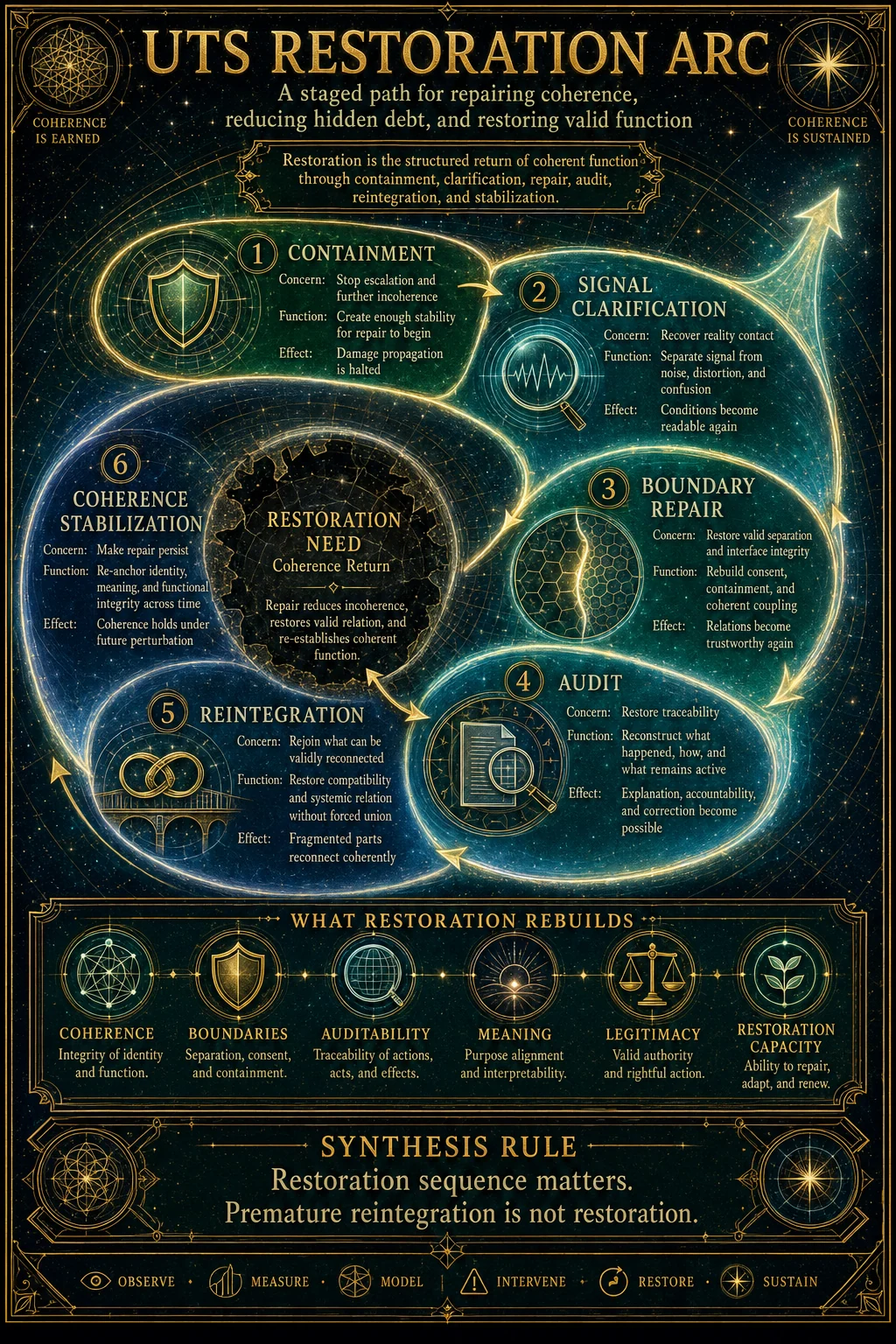
Foundational Overview
UTS — Restoration Arcs
How Coherence Returns
TheUTS Restoration Arc Registryis the companion to theUTS Failure Modes Registry.
Failure modes explain how systems lose coherence.
Restoration arcs explain how coherence returns.
A restoration arc is not a slogan, apology, intervention, punishment, reform package, dashboard update, or symbolic gesture. It is asequenced repair pathwaythat reduces hidden debt, restores auditability, repairs boundaries, rebuilds compatibility, and proves over time that the system is no longer trapped in the same failure geometry.
In simple terms:
A restoration arc is the path a system takes when it repairs the real source of damage instead of hiding, relocating, or renaming it.
The current Restoration Arc Registry preserves named repair pathways across UTS modules, including coherence, cybernetics, security, AI governance, justice, economy, biology / medicine, meaning systems, basin dynamics, and legitimacy repair.
1. Why Restoration Arcs Matter
Many systems can appear repaired without actually being restored.
A company can issue an apology while keeping the same extraction pattern.
An institution can improve its metrics while suppressing the evidence of harm.
An AI system can become more compliant while becoming less meaningful.
A body can quiet symptoms while recurrence risk remains.
An economy can grow while hidden debt accumulates.
A culture can call something “healed” while the same burden has simply moved to a less visible place.
UTS treats these asfalse restorations.
A real restoration arc asks:
Did hidden debt decrease?
Did auditability increase?
Were boundaries repaired?
Was compatibility restored?
Did restoration capacity improve?
Does the repair survive time?
If the answer is no, then the system may have stabilized, concealed, optimized, or rebranded — but it has not restored.
2. What Is a Restoration Arc?
Arestoration arcis a structured repair sequence.
It describes how a system moves from damaged, distorted, overloaded, opaque, or unstable conditions into a more coherent state.
A restoration arc usually includes:
- the damage or failure pattern being repaired
- the U-layer where the failure originated
- the operators required for repair
- the boundaries that must be restored
- the auditability that must be recovered
- the gates that must hold
- the diagnostics that prove the repair is working
- the time window needed to verify that the failure does not recur
A compact definition:
A restoration arc is an operator-sequenced pathway that reduces hidden debt and inversion while restoring coherence, auditability, boundary integrity, compatibility, restoration capacity, and temporal stability.
3. Restoration Is Not the Opposite of Failure
One of the most important ideas in UTS is that restoration isnot merely the reversal of failure.
If a system failed because it became opaque, extractive, over-compressed, or misaligned, repair is not as simple as reversing the visible symptoms.
For example:
Failure:
Auditability falls → hidden debt grows → proxy metrics dominate → coherence collapses
A false repair might try:
Improve the metrics → announce recovery → suppress recurrenceBut real restoration may require:
Stop new harm
→ restore auditability
→ map hidden debt
→ repair at the origin layer
→ restore boundaries
→ recouple only through compatibility
→ validate over time
This is why restoration arcs are not one-to-one mirrors of failure modes.
A single failure mode may require several restoration arcs.
A single restoration arc may repair many different failure modes.
4. The UTS View of Damage
UTS does not define failure only by visible breakdown.
A system can look functional while becoming less coherent underneath.
This is why restoration arcs focus heavily onhidden debt.
Hidden debt is any deferred, displaced, suppressed, unpaid, unprocessed, or unacknowledged incoherence that remains inside or around a system.
Examples include:
- unresolved harm
- suppressed evidence
- boundary violations
- unpaid labor or extracted value
- unprocessed externalities
- audit gaps
- legitimacy debt
- recurrence risk
- memory distortion
- proxy optimization damage
A restoration arc must reduce this hidden debt.
If hidden debt remains, the system may look calm, but it is still carrying the conditions for recurrence.
5. How Restoration Connects to the UTS State Vector
All restoration arcs act on the shared UTS state vector:
S = { O, H, ε, ι, Au, µᵢ, BΣ, K, R, Φ }In ordinary language:
| Variable | Restoration Meaning |
|---|---|
| O — Coherence | The system becomes more internally aligned and stable under stress |
| H — Hidden Debt | Deferred incoherence is surfaced and reduced |
| ε — Error / Noise | Disturbance becomes more visible, bounded, and interpretable |
| ι — Inversion | False order and pseudo-coherence lose stability |
| Au — Auditability | Causality becomes inspectable again |
| µᵢ — Agent Integrity | Actions, claims, roles, and consequences realign |
| BΣ — Boundary Integrity | Identity, consent, permission, and interface boundaries are repaired |
| K — Compatibility | Couplings are tested for mutual coherence |
| R — Restoration Capacity | The system becomes more able to repair future damage |
| Φ — Fitness Proxy | Metrics are subordinated to actual coherence |
A restoration arc is valid only when these variables move in the right direction over time.
The most basic signature is:
H ↓
Au ↑
BΣ ↑
R ↑
O stable or ↑
Φ subordinate to O
6. The Universal Restoration Grammar
Across UTS, many restoration arcs follow a recurring sequence:
(Σ + Θ) → Π → ℛ → (Au + FI) → ⊗_Λ → Τ → Temporal ProofIn plain language:
1. Anchor and Dampen
The system first binds itself to non-negotiable constraints and reduces escalation.
This prevents panic, overreaction, premature certainty, punitive drift, or performative repair.
2. Stabilize Boundaries
The system stops active harm, limits exposure, restores exit, and prevents new hidden debt from forming.
3. Repair at the Origin Layer
Real repair must reach the layer where the failure actually began.
A narrative cannot repair material harm.
A policy cannot repair a broken boundary by itself.
An apology cannot repair extracted value.
4. Restore Auditability and Feedback Integrity
The system must be able to see what happened, how it happened, who was affected, and whether the repair is working.
Without auditability, restoration becomes theater.
5. Recouple Only Through Compatibility
A repaired system should not simply return to the old coupling.
It must test whether the renewed connection actually increases coherence.
6. Shift Trajectory
Restoration is not complete until the system’s future path changes.
The repaired system should be less likely to repeat the same failure.
7. Prove It Over Time
Restoration must survive delay, recurrence, perturbation, and memory.
A quiet symptom is not proof.
A stable trajectory is proof.
7. Restoration Must Reach the Origin Layer
UTS uses U-layers to locate where a failure appears and where repair must occur:
| Layer | Meaning |
|---|---|
| U0 | Substrate / material limits |
| U1 | Energy, time, compute, budgets |
| U2 | Configuration, permissions, gates, boundaries |
| U3 | Execution and runtime behavior |
| U4 | Classification, models, metrics, narratives |
| U5 | Coordination and sequencing |
| U6 | Coherence field and cross-domain coupling |
| U7 | Memory, recurrence, hysteresis |
| U8 | Environment and external shocks |
A central rule:
Repair must occur at the same or lower layer than the failure origin.
If the failure originated in material burden, boundary violation, or hidden extraction, then a purely narrative repair is insufficient.
If the failure originated in memory, recurrence, or institutional habit, then a one-time intervention is insufficient.
If the failure originated in audit collapse, then a dashboard without causal traceability is insufficient.
Wrong-layer repair is one of the most common forms of pseudo-restoration.
8. Common Restoration Arc Families
The registry organizes restoration arcs byhow coherence returns, not merely by what failed.
Major restoration families include:
Emergency Stabilization
Stops active harm and prevents new debt.
Truth and Auditability Restoration
Restores causal visibility, evidence, and traceability.
Boundary Reconstitution
Repairs consent, exit, permission, role, and interface boundaries.
Hidden Debt Reduction
Surfaces and pays down deferred incoherence.
Feedback Integrity Restoration
Realigns metrics with coherence instead of proxy success.
Controlled Decoupling
Safely separates systems whose coupling has become extractive, coercive, or incompatible.
Compatibility Recoupling
Allows renewed connection only after boundaries and compatibility are restored.
Temporal Proof
Validates repair over time, recurrence, and perturbation.
Legitimacy Re-Anchoring
Restores trust through auditability, symmetry, accountability, and repair.
Basin and Supersession Arcs
Create pathways out of pseudo-coherent attractors when direct reform is not enough.
Future-Agency Restoration
Repairs systems where agency, identity, labor, or representation were extracted or delegated without consent.
9. False Restoration and Repair Theater
Restoration arcs also help identify whatdoes notcount as repair.
Common false restorations include:
- apology without restitution
- transparency without power return
- metrics improving while coherence declines
- policy updates without recurrence reduction
- ethics boards without authority
- deletion without debt payment
- boundary hardening without agency restoration
- forced reintegration
- repair burden shifted onto the harmed node
- speed treated as proof of recovery
- silence treated as stability
UTS often summarizes this pattern as:
Φ ↑ while H ↑ and Au ↓Meaning:
The visible success signal improves while hidden debt grows and auditability decreases.
That is not restoration.
That is repair theater.
10. Restoration and Time
Restoration is never proven instantly.
A system may look better immediately after intervention but still collapse later because the underlying recurrence pattern remains.
This is why UTS requirestemporal proof.
A restoration arc must be tested through:
- delayed review
- recurrence monitoring
- perturbation response
- memory half-life
- downstream compatibility
- affected-node verification
- damping and ring-down behavior
A useful restoration test is:
O(t+n) remains stable under Δ
H(t+n) ≤ H(t)
recurrence decreases across U7
In simpler terms:
The system must remain coherent after time, stress, memory, and reality touch it again.
11. Restoration Is Not Always Return
Restoration does not always mean returning to the old baseline.
Sometimes the old baseline was the problem.
Some systems are restored by:
- stabilizing
- repairing
- recoupling
- re-legitimating
- reindexing memory
- changing trajectory
- transitioning to a new basin
- superseding the old structure
In UTS, restoration means:
The re-opening of coherent future trajectories after hidden debt, boundary damage, inversion, or recurrence has been resolved.
It is not nostalgia.
It is not regression.
It is not cosmetic normalcy.
It is coherent future viability.
12. Relationship to Failure Modes
Failure modes and restoration arcs are linked, but not identical.
A failure mode says:
Here is how coherence breaks.A restoration arc says:
Here is how coherence can return.For example:
| Failure Pattern | Possible Restoration Arcs |
|---|---|
| Hidden Debt Accumulation | Hidden Debt Reduction, Audit Surface Expansion, Origin-Layer Repair |
| Boundary Collapse | Boundary Reconstitution, Consent Re-Formation, Safe Decoupling |
| Goodhart Drift | Feedback Integrity Restoration, U4-to-U6 Validation |
| Security Theater | Security Theater Correction, Observability Restoration |
| Victim Burden Inversion | Responsibility Gradient Mapping, Victim-Centered Restoration |
| Legitimacy Collapse | Truth Reconstruction, Legitimacy Re-Anchoring, Temporal Proof |
| Basin Entrapment | Basin Geometry Mapping, Basin Shallowing, Parallel Attractor Seeding, Supersession |
A mature restoration registry does not ask:
“What is the opposite of this failure?”
It asks:
“What repair pathway reduces hidden debt and restores coherent trajectory without generating new debt elsewhere?”
13. Relationship to UTS Operators
Restoration arcs are built from the canonical UTS operators.
They do not introduce new primitives.
A restoration arc might use:
| Operator | Restoration Role |
|---|---|
| Σ — Sacred Boundary | Lock non-negotiable invariants |
| Θ — Humility | Damp gain and premature certainty |
| Π — Constrain | Stabilize boundaries and admissible regions |
| Ψ — Presence | Increase audit resolution through attention |
| Μ — Sensemaking | Reconstruct context and causal meaning |
| Ξ — Invert | Detect pseudo-coherence and false order |
| ℛ — Restore | Repair hidden debt and damaged structure |
| Λ — Compatibility | Test whether recoupling increases coherence |
| ⊗ — Couple | Reconnect systems while preserving identity |
| Τ — Trajectory | Bias future evolution away from recurrence |
The power of the registry comes from sequencing these correctly.
The same operator used in the wrong order can create new hidden debt.
14. What a Restoration Arc Gives the Reader
A restoration arc gives a reader a structured answer to six questions:
What hidden debt must be reduced?
What boundary must be repaired?
What auditability must be restored?
What coupling must be tested?
What trajectory must change?
How is this proven over time?
This makes restoration practical without becoming prescriptive.
It does not tell every system to repair in the same way.
It gives each system a way to determine whether its repair is real.
15. Why the Registry Exists
The Restoration Arc Registry exists because systems often fail not only from damage, but frombad repair.
Bad repair can be worse than no repair because it:
- hides evidence
- preserves illegitimate power
- burns trust
- exhausts the harmed node
- creates false closure
- increases recurrence
- protects the original failure geometry
- makes future repair harder
A restoration registry prevents this by preserving known repair sequences, validation tests, and anti-patterns.
It turns restoration into a disciplined design practice.
16. Final Summary
A UTS restoration arc is not a return to appearances.
It is not a performance of concern.
It is not an institutional reset button.
It is not the reversal of failure.
A restoration arc is:
A sequenced pathway by which coherence returns through hidden-debt reduction, auditability restoration, boundary repair, compatibility testing, trajectory correction, and temporal proof.
The simplest restoration signature is:
H ↓
Au ↑
BΣ ↑
R ↑
K validated
Φ subordinated
O stable under Δ
The governing principle:
Restoration is the re-opening of coherent future trajectories after the real source of incoherence has been repaired.