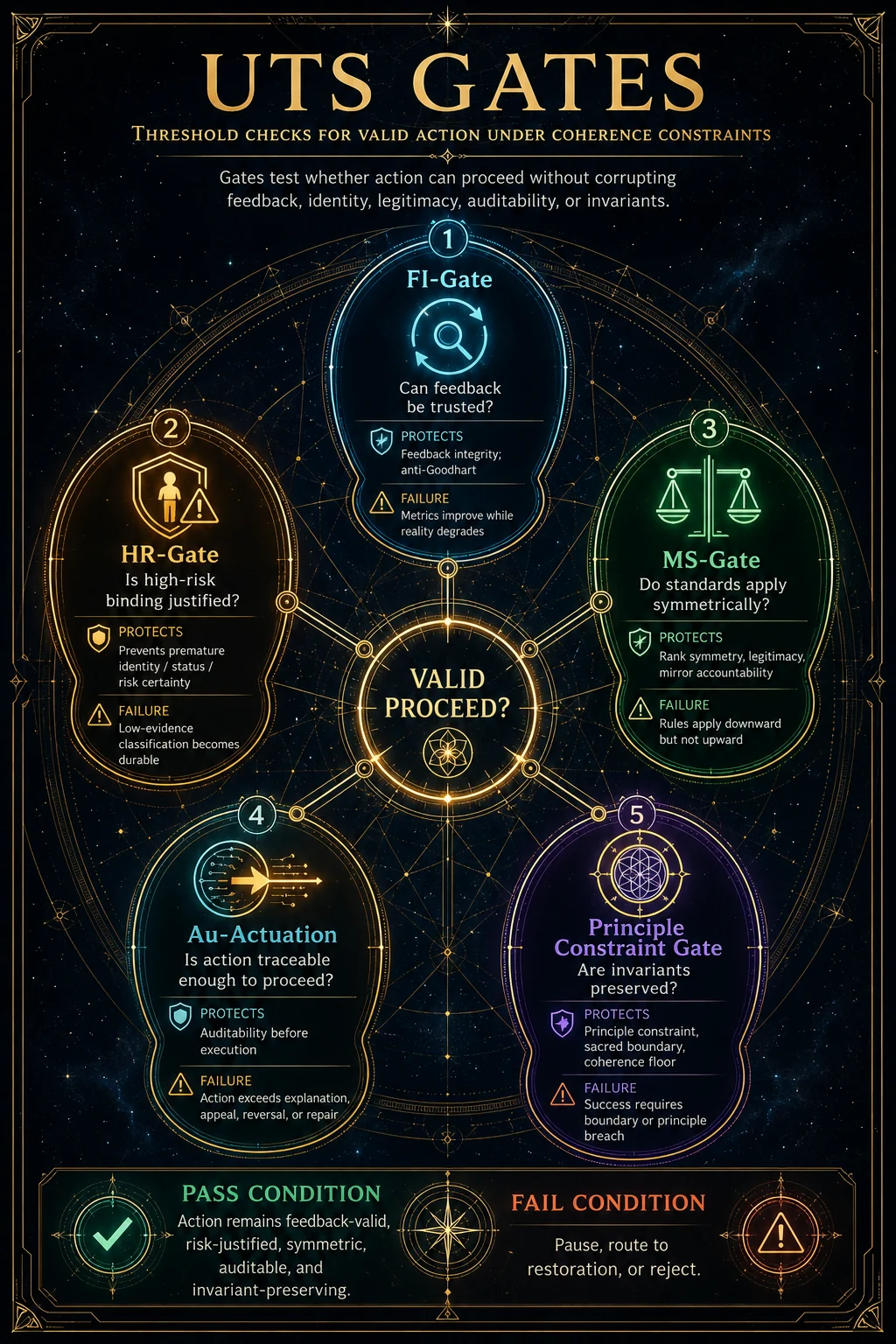
Foundational Overview
1. Core Definition
AGateis an admissibility structure.
It determines whether an action, claim, coupling, constraint, classification, repair, or state transition is allowed to proceed as valid.
Compressed:
Gate = admissibility condition.A gate does not move state directly.
It determines whether state movement is legitimate, coherent, safe-enough, traceable-enough, reversible-enough, or repairable-enough to proceed.
2. Canon Rule
Gates are not operators.

Gates do not change state directly.

Gates decide whether an operator sequence is admissible.

Gate failure produces ∅ — null / invalid / blocked outcome.
Short form:
Operator = state-moving function.

Gate = admissibility condition.

Failed gate = invalid transition.
3. Gate Failure Rule
A gate failure does not mean the system merely “needs improvement.”
It means the proposed action, classification, coupling, or repair should not be treated as valid in its current form.
Gate failure ⇒ ∅Operationally:
If the gate fails, do not proceed as if the state transition is coherent.

Repair the gate condition first.
4. Current Canon Gates
The current canon gate set includes:
FI-Gate — Feedback Integrity Gate

HR-Gate — High Risk Gate

MS-Gate — Mirror Symmetry / Rank-Symmetry Gate

Au-Actuation Gate — Minimum Auditability Before Action

☷ᵢ — Principle Constraint Fields
These gates answer different admissibility questions.
5. FI-Gate — Feedback Integrity Gate
Core Question
Is the feedback loop trustworthy enough to guide action?TheFI-Gatechecks whether feedback, metrics, signals, reports, audits, classifications, or responses remain integrity-preserving.
It protects against:
Goodhart loops,
feedback corruption,
metric capture,
proxy substitution,
signal laundering,
response manipulation,
selective evidence,
false success signals,
and distorted learning loops.
Primary State Variables
Au — Auditability
Φ — Fitness Proxy
O — Coherence
H — Hidden Debt
ε — Error / Noise
ι — Inversion Index
Failure Pattern
Φ becomes easier to optimize than O.

The system starts learning from corrupted feedback.

Visible success increases while hidden debt accumulates.
Compressed:
FI failure = the system cannot trust its own feedback.Typical Signs
Metrics improve while conditions degrade.

Reports look clean while recurrence continues.

Feedback is filtered before reaching decision nodes.

Success indicators are easier to manipulate than reality.

The system rewards appearance over correction.
Restoration Pathway
Restore provenance.

Compare Φ against O, H, ε, ι, BΣ, and recurrence.

Protect negative feedback.

Make edge signals visible.

Audit whether feedback changes state.

Validate correction at U7.
Final Rule
Do not optimize through a failed FI-Gate.6. HR-Gate — High Risk Gate
Core Question
Is the system about to bind high-risk certainty, identity, authority, or consequence without enough evidence and reversibility?TheHR-Gateblocks premature binding where error would create massive downstream damage.
In this project,HR means High Risk Gate, not anything identity-bound.
HR_integritymeansHigh Risk Gate Integrity.
HR-Gate Healthmeans the health of the High Risk Gate.
Primary State Variables
Au — Auditability
µᵢ — Agent / Meaning Integrity
BΣ — Boundary Integrity
H — Hidden Debt
ι — Inversion Index
Φ — Fitness Proxy
Protects Against
identity-bound certainty,
premature classification,
irreversible labeling,
authority overreach,
high-consequence misbinding,
false finality,
low-evidence actuation,
and downstream error propagation.
Failure Pattern
The system treats a low-evidence or unstable classification as settled.

That classification then affects identity, access, legitimacy, memory, boundary status, or automated treatment.
Compressed:
HR failure = high-risk binding before sufficient evidence, auditability, and reversibility.Typical Signs
A label becomes hard to remove.

A temporary state becomes identity.

A low-confidence assessment becomes institutional memory.

A classification enters automated systems.

Appeal or correction is weaker than the original binding.

The system becomes certain faster than it becomes auditable.
Restoration Pathway
Downgrade certainty.

Mark provisional status.

Increase evidence quality.

Add appeal and reversibility.

Limit propagation.

Repair records if binding already occurred.

Validate recurrence before permanent classification.
Final Rule
Do not bind identity, status, legitimacy, risk, access, or permanent memory through a failed HR-Gate.7. MS-Gate — Mirror Symmetry / Rank-Symmetry Gate
Core Question
Does the same standard apply across rank, position, identity, role, or power level?TheMS-Gatechecks whether a rule, critique, audit, constraint, right, duty, or repair demand applies symmetrically enough to preserve legitimacy.
It protects against:
rank immunity,
asymmetric accountability,
one-way audit,
selective enforcement,
status exemption,
mirror failure,
and procedural double standards.
Primary State Variables
Au — Auditability
BΣ — Boundary Integrity
µᵢ — Agent / Meaning Integrity
K — Compatibility
O — Coherence
H — Hidden Debt
Failure Pattern
High-position nodes can inspect, constrain, classify, or demand repair from low-position nodes,
but equivalent correction cannot move upward.
Compressed:
MS failure = asymmetry protected as normal procedure.Typical Signs
Rules apply downward but not upward.

Low-position errors are punished while high-position errors are reframed.

Appeals pass through the same authority being appealed.

Authority is treated as evidence.

Rank protects claims from audit.

Accountability follows visibility instead of causality.
Restoration Pathway
Map rank asymmetry.

Apply equivalent standards across position.

Create upward audit pathways.

Separate authority from evidence.

Protect appeal access.

Make high-position nodes auditable.

Validate that correction can move against P-field gradients.
Final Rule
Do not treat a system as legitimate if the MS-Gate fails.8. Au-Actuation Gate — Auditability Before Action
Core Question
Is there enough traceability to act at this level of consequence?TheAu-Actuation Gatechecks whether a proposed action has enough auditability before execution.
It is especially important under high gain, high automation, high institutional force, or high consequence.
Primary State Variables
Au — Auditability
R — Restoration Capacity
H — Hidden Debt
ε — Error / Noise
BΣ — Boundary Integrity
Φ — Fitness Proxy
Protects Against
opaque actuation,
machine-speed harm,
untraceable enforcement,
unreviewable decisions,
irreversible execution,
hidden causal chains,
and action without repair path.
Failure Pattern
The system can act faster, harder, or more widely than it can inspect, explain, appeal, reverse, or repair.Compressed:
Au-Actuation failure = action exceeds traceability.Typical Signs
The decision cannot be explained.

The cause cannot be traced.

The affected node cannot appeal.

The action cannot be reversed.

Logs are missing or inaccessible.

Automation executes before review.

Repair is manual while harm is automated.
Restoration Pathway
Add logs.

Add traceability.

Add rollback.

Add appeal.

Add source provenance.

Add decision records.

Reduce actuation speed.

Limit scope until auditability scales.

Validate repair at the same speed and scale as action.
Final Rule
Do not actuate beyond auditability.9. ☷ᵢ — Principle Constraint Fields
Core Question
Does this action violate a non-negotiable invariant or principle field?☷ᵢ Principle Constraint Fieldscheck whether an operator sequence, interface act, policy, coupling, or optimization violates core principles that must remain intact for coherence to hold.
These are not ordinary preferences.
They are constraint fields that protect non-negotiable invariants.
Primary State Variables
BΣ — Boundary Integrity
µᵢ — Agent / Meaning Integrity
O — Coherence
K — Compatibility
R — Restoration Capacity
H — Hidden Debt
Protects Against
principle violation,
boundary collapse,
coherence sacrificed for speed,
repair sacrificed for appearance,
identity integrity violation,
consent bypass,
and optimization through forbidden pathways.
Failure Pattern
The system achieves a local goal by violating a deeper invariant.Compressed:
☷ᵢ failure = success through forbidden coherence breach.Typical Signs
The action works but violates boundary integrity.

The metric improves while dignity, consent, or repair collapses.

The system optimizes through extraction.

The stated value is preserved rhetorically but violated operationally.

The process requires a subfield to lose sovereignty.

The repair path depends on hiding the damage.
Restoration Pathway
Identify violated invariant.

Stop the violating pathway.

Repair boundary or meaning damage.

Restore affected subfields.

Rebuild Φ so success cannot require violation.

Add gate checks before recurrence.

Validate under renewed pressure.
Final Rule
Do not accept success produced by principle violation.10. Gate Comparison Table
| Gate | Core Question | Primary Protection | Failure Signature |
|---|---|---|---|
| FI-Gate | Can feedback be trusted? | Feedback integrity, anti-Goodhart | Metrics improve while reality degrades |
| HR-Gate | Is high-risk binding justified? | Prevents premature identity/status/risk certainty | Low-evidence classification becomes durable |
| MS-Gate | Do standards apply symmetrically? | Rank symmetry, legitimacy, mirror accountability | Rules apply downward but not upward |
| Au-Actuation | Is action traceable enough to proceed? | Auditability before execution | Action exceeds explanation, appeal, reversal, or repair |
| ☷ᵢ | Are invariants preserved? | Principle constraint, sacred boundary, coherence floor | Success requires boundary or principle breach |
11. Gates vs Other System Components
Gates vs Operators
Operators move state.

Gates decide whether the movement is admissible.
Example:
Π can constrain.

The gate decides whether the constraint is legitimate enough to proceed.
Gates vs Diagnostics
Diagnostics reveal system condition.

Gates determine whether action can proceed under that condition.
Example:
𝓑(t) may show low bandwidth.

A gate may block high-gain actuation until bandwidth and repair capacity improve.
Gates vs Gains
Gains amplify operator effects.

Gates decide whether amplified effects are allowable.
Example:
G₅ automation can scale execution.

Au-Actuation decides whether automation is traceable enough to run.
Gates vs Lenses
Lenses reveal structural bias.

Gates decide admissibility after those biases are inspected.
Example:
P-field may reveal rank asymmetry.

MS-Gate decides whether the asymmetry invalidates the process.
Gates vs Regimes
Regimes are recurring compositions.

Gates prevent recurring invalid transitions from being normalized.
Example:
An extraction regime may appear stable.

☷ᵢ and MS-Gate may reveal it as inadmissible.
12. Gate Relationships to State Vector
| State Variable | Gate Relevance |
|---|---|
| O | Gates prevent apparent coherence from overriding real coherence. |
| H | Gate failure often stores hidden debt. |
| ε | Gates determine whether visible error blocks, slows, or redirects action. |
| ι | Gate failure often permits pseudo-coherence. |
| Au | Gates require sufficient traceability before high-consequence movement. |
| µᵢ | Gates protect continuity between meaning, action, consequence, and repair. |
| BΣ | Gates protect legitimate boundaries and interface clarity. |
| K | Gates prevent false compatibility under coercion, asymmetry, or opacity. |
| R | Gates require restoration pathways before accepting risky transitions. |
| Φ | Gates prevent proxy success from replacing coherence. |
13. Gate Relationships to Gains
| Gain | Gate Risk | Required Gate Emphasis |
|---|---|---|
| G₀ Mechanical | Physical boundary or substrate consequence | ☷ᵢ, Au-Actuation, MS-Gate |
| G₁ Energetic | Resource pressure, depletion, unfunded repair | FI-Gate, ☷ᵢ, MS-Gate |
| G₂ Informational | Narrative/metric/classification drift | FI-Gate, HR-Gate, Au-Actuation |
| G₃ Emotional / Identity-Charge | Identity lock, sacred inversion, loyalty override | HR-Gate, ☷ᵢ, FI-Gate |
| G₄ Institutional | Rule capture, rank immunity, appeal failure | MS-Gate, FI-Gate, Au-Actuation |
| G₅ Technological | Automated opacity, machine-speed error | Au-Actuation, FI-Gate, HR-Gate |
14. Gate Relationships to Lenses
| Lens | Gate Concern |
|---|---|
| Ω — Observability Distribution | If key reality is invisible, Au-Actuation and FI-Gate may fail. |
| P-field — Position / Influence Geometry | If rank distorts accountability, MS-Gate may fail. |
| RG — Resource Gatekeeping | If access shapes consent or repair, FI-Gate, MS-Gate, and ☷ᵢ may fail. |
| SS — Sovereign Subfields | If subfield sovereignty collapses, ☷ᵢ and HR-Gate may fail. |
15. Gate Relationships to U-Layers
U0 — Substrate:
Check physical consequences and invariant constraints.

U1 — Power / Budgets:
Check resource coercion, unfunded mandates, repair starvation.

U2 — Configuration / Boundaries:
Check consent, access, permissions, roles, and boundary legitimacy.

U3 — Execution:
Check actuation traceability and reversibility.

U4 — Classification / Metrics / Narratives:
Check feedback integrity, proxy drift, and high-risk labels.

U5 — Coordination / Time:
Check whether timing pressure invalidates consent, audit, or repair.

U6 — Coherence Field:
Check identity charge, legitimacy, symbolic force, and field distortion.

U7 — Memory / Recurrence:
Check whether errors are stored, repeated, or hardened.

U8 — Environment / Forcing:
Check whether crisis pressure is being used to bypass gates.
16. Common Gate Failure Patterns
1. Feedback Failure
FI-Gate fails.
The system learns from corrupted signals.
2. Premature Binding
HR-Gate fails.
A low-evidence classification becomes durable.
3. Rank Immunity
MS-Gate fails.
Authority becomes shielded from equivalent audit.
4. Opaque Actuation
Au-Actuation fails.
The system acts beyond traceability.
5. Principle Breach
☷ᵢ fails.
The system succeeds by violating a coherence floor.
6. Gate Theater
A gate appears to exist but cannot block action.7. Gate Capture
The gate is controlled by the node it is supposed to check.8. Gate Bypass by Crisis
U8 pressure is used to suspend admissibility indefinitely.9. Gate Bypass by Automation
G₅ executes before gate review can occur.10. Gate Bypass by Institutional Procedure
G₄ formal procedure treats gate failure as administratively complete.17. Gate Audit Workflow
A compact gate audit:
1. What action or transition is being proposed?

2. Which operators are active?

3. Which U-layer is the action localized in?

4. Which gains amplify it?

5. Which lenses bias visibility, position, resources, or sovereignty?

6. Which gates apply?

7. Does feedback remain trustworthy?

8. Is any high-risk binding occurring?

9. Are standards symmetrical across rank and position?

10. Is there enough auditability before actuation?

11. Are non-negotiable principles preserved?

12. If a gate fails, what must be repaired before proceeding?

13. If action already occurred, where is hidden debt stored?

14. Has repair been validated at U7 recurrence?
Compressed:
Action → Operators → U-layer → Gains → Lenses → Gates → ∅ or proceed → Repair → U7 validation18. Gate Failure Response
When a gate fails:
1. Pause or block the transition.

2. Identify the failed gate.

3. Localize the failure by U-layer.

4. Identify hidden debt created or risked.

5. Repair the gate condition.

6. Reduce gain if needed.

7. Restore auditability.

8. Re-test admissibility.

9. Validate through recurrence.
Important:
Do not route around a failed gate by changing language.

Do not call a failed gate “complexity.”

Do not treat gate failure as personal resistance.

Do not scale action through a failed gate.
19. Quick Gate Smell Reference
“Metrics look great, but people say reality is worse.”
→ FI-Gate

“This label is being applied permanently with weak evidence.”
→ HR-Gate

“The rule applies to them but not to leadership.”
→ MS-Gate

“The system acts, but nobody can explain or reverse it.”
→ Au-Actuation

“It works, but only by violating consent, sovereignty, repair, or boundary integrity.”
→ ☷ᵢ

“The process exists, but cannot stop anything.”
→ Gate Theater

“The reviewer is controlled by the reviewed system.”
→ Gate Capture

“It is an emergency, so all safeguards are suspended indefinitely.”
→ Crisis Gate Bypass

“The automation already executed before review.”
→ G₅ Gate Bypass
20. Canon Notes
Gates are admissibility structures.

Gates are not operators.

Gate failure produces ∅.

A gate that cannot block action is not functioning as a gate.

High gain requires stronger gates.

High-risk classification requires HR-Gate integrity.

High institutional authority requires MS-Gate integrity.

High automation requires Au-Actuation integrity.

High metric dependence requires FI-Gate integrity.

High principle consequence requires ☷ᵢ integrity.

Gate repair must be validated through recurrence.
21. Compressed Reference
FI-Gate:
Can feedback be trusted?

HR-Gate:
Is high-risk binding justified?

MS-Gate:
Are standards symmetrical across rank and position?

Au-Actuation:
Is action traceable, reversible, appealable, and repairable enough to proceed?

☷ᵢ:
Are non-negotiable principles and invariants preserved?
Final Operational Rule
Before allowing any high-consequence operator sequence, interface act, coupling, classification, repair, or automation, inspect the gates.

If feedback is corrupted,
if high-risk certainty is premature,
if rank is immune,
if action exceeds auditability,
or if invariants are violated,

the transition is not admissible.

Gate failure means ∅ until repaired.Au-Actuation evaluates whether a proposed transition has enough auditability to proceed safely: the system must be able to trace what happened, why it happened, who or what was affected, what evidence was used, what assumptions were made, and how correction can occur if the transition fails.
- Primary Function
- Ensure that proposed transitions, claims, repairs, constraints, couplings, compositions, and decisions have sufficient traceability to be inspected, challenged, reconstructed, and corrected.
- Short Name / Symbol
- Au-Actuation
- Gate Name
- Auditability Actuation Gate
- Gate Class
- Audit / Traceability / Legibility / Anti-Theater
FI-Gate evaluates whether feedback remains sufficiently independent, uncaptured, and reality-linked to guide selection, restoration, sensemaking, constraint, trajectory, and inversion detection without being absorbed by the system’s proxy targets, incentives, self-image, or control structure.
- Primary Function
- Ensure feedback remains independent, truth-bearing, and capable of correcting the system.
- Short Name / Symbol
- FI-Gate
- Gate Name
- Feedback Integrity Gate
- Gate Class
- Feedback / Anti-Goodhart / Anti-Capture / Learning Integrity
HR-Gate evaluates whether a signal is clean enough, localized enough, auditable enough, and proportionate enough to influence identity-binding, role-binding, motive attribution, durable classification, repair assignment, access restriction, exclusion, or memory-binding mechanics.
- Primary Function
- Prevent poor, noisy, distorted, insufficient, mislocalized, or low-audit signals from influencing identity-binding mechanics.
- Short Name / Symbol
- HR-Gate
- Gate Name
- High-Risk Signal-to-Identity Gate
- Gate Class
- Signal Integrity / Identity-Binding / Classification / Attribution / Memory-Binding
MS-Gate evaluates whether a proposed classification, constraint, repair obligation, exception, enforcement action, sacred claim, or accountability pathway preserves consequence-class symmetry across rank and role.
- Primary Function
- Ensure equivalent effects, violations, harms, obligations, and consequences remain in equivalent consequence classes regardless of rank, role, identity, power, proximity, institutional position, sacred status, or narrative importance.
- Short Name / Symbol
- MS-Gate
- Gate Name
- Meta-Symmetry Enforcement Gate
- Gate Class
- Symmetry / Legitimacy / Rank-Neutrality / Accountability Validity
☷ᵢ Principle Constraint Fields evaluate whether a proposed transition remains admissible within the system’s coherence-preserving principles, invariants, and non-degenerative constraints.
- Primary Function
- Define admissible transition space according to coherence-preserving principles, invariants, and non-degenerative constraints.
- Short Name / Symbol
- ☷ᵢ
- Gate Name
- Principle Constraint Fields
- Gate Class
- Principle / Invariant / Boundary / Admissibility / Long-Horizon Coherence