Foundational Overview
1. Definition
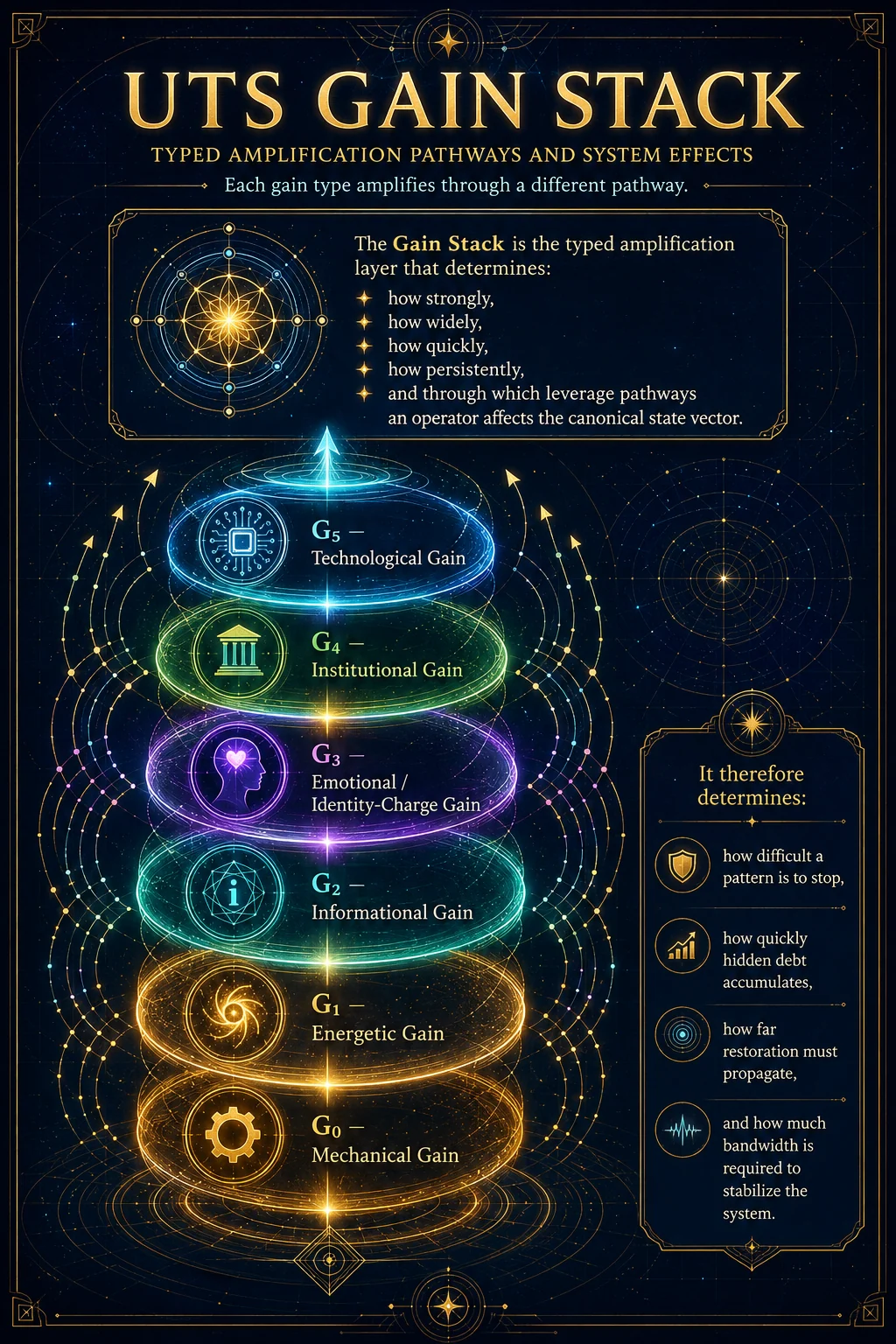
TheGain Stackis the typed amplification layer that determines:
how strongly,
how widely,
how quickly,
how persistently,
and through which leverage pathways
an operator affects the canonical state vector.
It formalizes amplification without introducing new operators.
Compressed:
Operators determine direction.
Gain determines magnitude and reach.
2. Canonical Gain Types
The canon gain stack currently includes:
G₀ — Mechanical Gain
G₁ — Energetic Gain
G₂ — Informational Gain
G₃ — Emotional / Identity-Charge Gain
G₄ — Institutional Gain
G₅ — Technological Gain
Each gain type amplifies through a different pathway.
3. Why the Gain Stack Exists
Without the gain layer, the Operator System cannot adequately explain why:
small actions sometimes become civilization-scale events,
minor distortions become systemic,
or ordinary operators become globally destabilizing.
The Gain Stack solves this without requiring new primitives.
For example:
A local narrative distortion with low G₂ remains localized.

The same distortion with:
G₂ + G₄ + G₅
can become institutionalized and automated globally.
The operator may still only be:
Μ + Γ + Π + Δbut the amplification environment changes the outcome dramatically.
4. Core Role in the Operator System
The Gain Stack modifies:
scale,
speed,
intensity,
recurrence,
enforcement strength,
replication ability,
and coupling asymmetry.
It therefore determines:
how difficult a pattern is to stop,
how quickly hidden debt accumulates,
how far restoration must propagate,
and how much bandwidth is required to stabilize the system.
5. Gain Does Not Create Legitimacy
A core canon rule:
Amplification is not validation.
Scale is not coherence.
Persistence is not truth.
High gain can amplify:
coherence,
distortion,
repair,
or pseudo-coherence.
Therefore:
Gain must never be mistaken for correctness.6. Gain vs Operators
Operators
Operators directly move state.
Examples:
Π constrains.
Δ perturbs.
Γ selects.
ℛ repairs.
Μ interprets.
Gain
Gain amplifies those movements.
Examples:
G₂ amplifies informational propagation.
G₄ amplifies enforcement.
G₅ amplifies automation and replication.
Critical rule:
Gain modifies operator expression.
Gain is not itself a state transition primitive.
7. Gain Stack Architecture
The gain stack should be understood as layered amplification channels.
G₀ — Mechanical Gain
Amplification through:
physical leverage,
geometry,
mechanical advantage,
material scaling,
infrastructure.
G₁ — Energetic Gain
Amplification through:
energy,
budgets,
attention,
labor,
compute,
throughput,
time allocation.
G₂ — Informational Gain
Amplification through:
narratives,
communication,
symbol propagation,
classification systems,
media,
information routing.
G₃ — Emotional / Identity-Charge Gain
Amplification through:
fear,
devotion,
tribal attachment,
sacred charge,
status attachment,
identity binding,
shame/pride loops.
G₄ — Institutional Gain
Amplification through:
rules,
organizations,
law,
bureaucracy,
norm enforcement,
credential structures,
coordination authority.
G₅ — Technological Gain
Amplification through:
automation,
platforms,
algorithms,
replication,
AI systems,
networks,
machine-speed execution.
8. Gain Stack Interaction Rules
Gain types rarely operate alone.
Most meaningful systems involve stacked gain.
Examples:
G₂ + G₃
= emotionally amplified narratives.

G₂ + G₄
= institutionalized classifications.

G₂ + G₅
= algorithmically amplified information systems.

G₃ + G₄
= identity-bound institutions.

G₄ + G₅
= automated institutional enforcement.

G₂ + G₄ + G₅
= modern large-scale perception-management architectures.
This registry note remains central:
Most modern failures involve stacked G₂ + G₄ + G₅.9. Gain and the State Vector
The Gain Stack affects all state variables indirectly through amplified operator action.
Coherence — O
Gain amplifies coherence propagation or coherence collapse.Hidden Debt — H
Gain accelerates hidden debt accumulation when restoration lags behind amplification.Error — ε
Gain increases either error visibility or error contagion.Inversion Index — ι
Gain can stabilize pseudo-coherence by suppressing contradiction visibility.Auditability — Au
Higher gain requires proportionally stronger auditability.Boundary Integrity — BΣ
Gain pressures boundaries by increasing interaction intensity and enforcement capacity.Restoration Capacity — R
Restoration throughput must scale with gain.Fitness Proxy — Φ
Gain often follows optimization targets, whether coherent or incoherent.10. Core Gain Law
One of the central equations of the gain architecture:
R_eff > Load × Gain_stack ⇒ O tends upward

R_eff < Load × Gain_stack ⇒ H accumulates
Meaning:
Repair capacity must scale faster than amplification pressure.Otherwise:
the system enters deferred-collapse dynamics.11. Gain and U-Layer Localization
Gain can express through every U-layer.
U0 — Substrate
Mechanical infrastructure,
hardware,
material leverage.
U1 — Power / Budgets
Energy,
time,
money,
attention,
compute,
human throughput.
U2 — Configuration / Boundaries
Permissions,
access control,
interface authority.
U3 — Execution
Operational throughput,
runtime scaling,
execution velocity.
U4 — Classification
Narrative amplification,
metric enforcement,
classification propagation.
U5 — Coordination
Synchronization speed,
cadence pressure,
timing leverage.
U6 — Coherence Field
Field-level resonance amplification,
cross-domain coupling intensity.
U7 — Memory
Persistence,
institutional memory,
recurrence storage.
U8 — Environment
External forcing amplification,
terrain pressure,
adversarial asymmetry.
12. Gain Stack and Diagnostics
Gain directly affects forced-response diagnostics.
Bandwidth — 𝓑(t)
Higher gain increases required stabilization bandwidth.Damping — 𝓓(t)
Gain can intensify oscillation and prolong instability.Slack — σ(t)
Gain consumes slack faster than low-gain systems.Reaction Latency — τresp(t)
High gain punishes slow correction.Constraint Complexity — Xc(t)
Gain can increase complexity faster than auditability scales.13. Gain Stack and Gates
As gain increases:
gate quality becomes more important.Low-gain systems can survive weak gates temporarily.
High-gain systems cannot.
FI-Gate
Protects against:
feedback corruption under amplification.HR-Gate
Protects against:
certainty amplification and identity lock.MS-Gate
Protects against:
rank-asymmetric immunity under institutional amplification.Au-Actuation
Protects against:
opaque high-leverage execution.14. Scale-Risk Principle
One of the most important gain-stack rules:
Small incoherence under high gain
can exceed large incoherence under low gain.
Meaning:
amplification can dominate defect size.This explains why:
tiny distortions inside high-gain systems
can destabilize entire civilizations.
15. Gain-Asymmetry
Gain asymmetry creates hidden coercion risk.
Example:
One node possesses:
G₂ + G₄ + G₅

Another possesses:
only local G₁.
The interaction may appear voluntary while mechanically functioning as asymmetrical forcing.
This is why gain analysis must accompany compatibility analysis.
16. Gain and Pseudo-Coherence
Pseudo-coherent systems often appear stable because gain suppresses contradiction visibility.
Pattern:
G₂ + G₄ + G₅ + Au↓ + Φ/O divergence ⇒ ι↑Meaning:
amplification stabilizes appearance faster than repair stabilizes reality.This creates:
stable-looking incoherence.17. Gain and Restoration
Restoration systems must scale with gain.
Otherwise:
repair becomes symbolic,
while amplification remains operational.
High-gain systems therefore require:
high auditability,
high restoration throughput,
high recurrence testing,
strong gates,
and strong boundary integrity.
18. Failure Modes
1. Gain Without Auditability
Amplification outruns inspection.2. Gain Without Restoration
Hidden debt accumulates faster than repair.3. Gain-Captured Φ
The system scales proxy optimization instead of coherence.4. Gain-Induced Inversion
Pseudo-coherence becomes institutionally stabilized.5. Gain-Asymmetric Coupling
One side cannot realistically refuse or recover.6. Automated Distortion
G₄ + G₅ execute incoherence faster than humans can audit.19. Restoration Pathways
Reduce Amplification Temporarily
Lower gain while repair occurs.Increase Auditability First
Au must scale before gain scales.Align Φ With O
Amplification must follow coherence, not merely metrics.Scale Restoration Capacity
R_eff must exceed amplified system load.Strengthen Gates
High gain requires high admissibility quality.Validate Recurrence
Repair is incomplete until recurrence stabilizes.20. Canon Notes
The Gain Stack is not an operator set.

Gain amplifies existing mechanics.

Most modern instability is amplification instability.

Modern civilization-scale systems often combine:
G₂ + G₄ + G₅.

Amplification without auditability creates hidden debt acceleration.

Amplification without restoration creates deferred collapse.

Amplification without humility creates certainty lock.

Amplification without boundary integrity creates override risk.
21. Compressed Definition
The Gain Stack is the typed amplification architecture that determines the scale, speed, persistence, leverage, and systemic reach of operator effects.Final Operational Rule
Before evaluating a system,
identify:

which operators are active,
which gains amplify them,
which gates constrain them,
which lenses bias them,
and whether restoration capacity scales with amplification pressure.