1. Definition
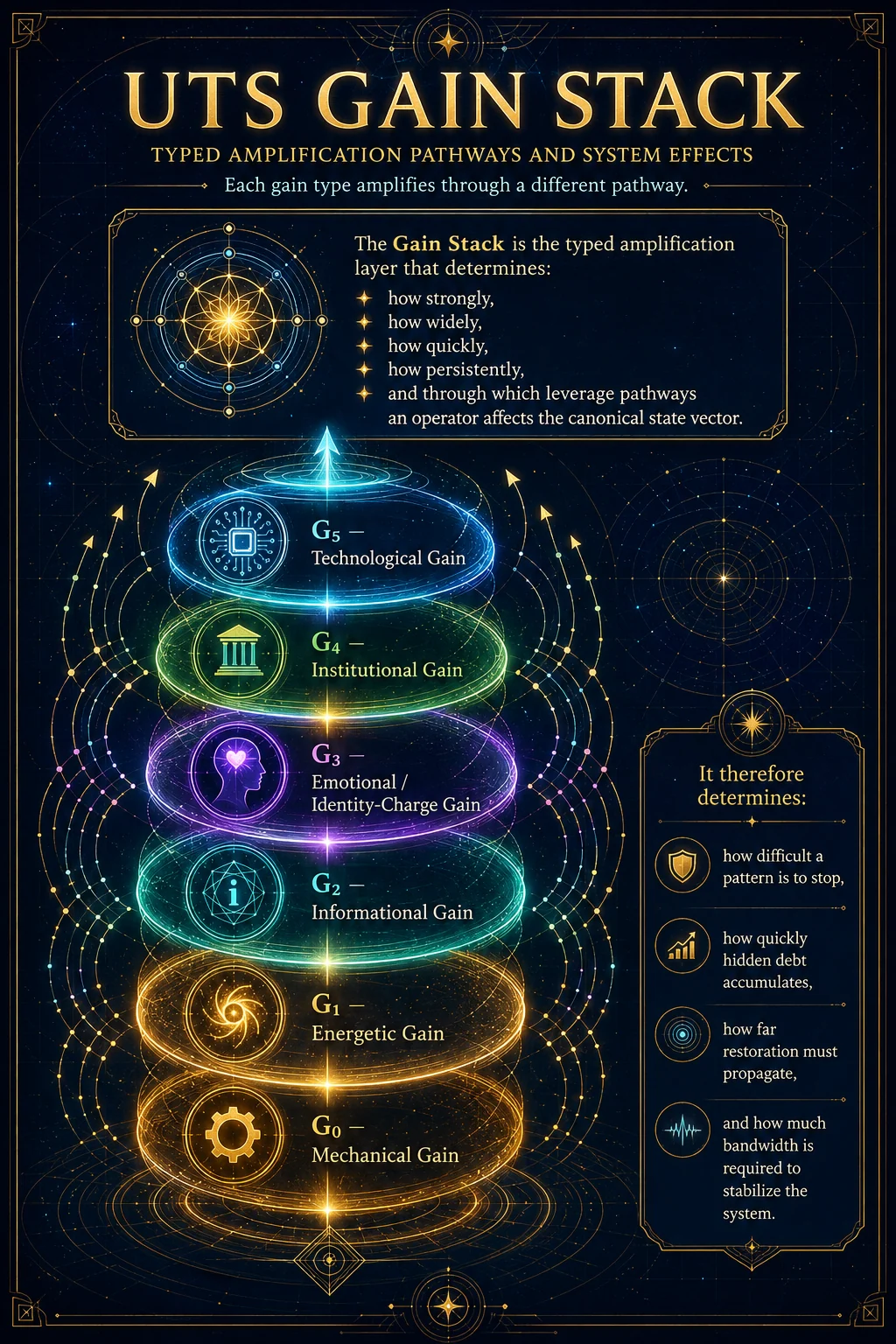
TheGain Stackis the typed amplification architecture that determines how strongly, quickly, widely, persistently, and asymmetrically operator effects propagate through a system.
It does not move state directly.
It amplifies the effects of operators that already move state.
Compressed:
Gain = amplification condition.
Operator = state-moving function.
Lens = structural bias field.
Gate = admissibility condition.
Diagnostic = forced-response indicator.
The Gain Stack answers:
How much force does this operator expression carry?

How far does it propagate?

How quickly does it replicate?

How long does it persist?

How hard is it to interrupt?

How much restoration capacity is required to stabilize it?
2. Core Role in the Operator System
Operators determine the kind of state transition occurring.
Gain determines themagnitude and propagation behaviorof that transition.
Example:
Π with low gain = local constraint.

Π with high G₄ = institutional rule.

Π with high G₄ + G₅ = automated enforcement.

Δ with low gain = small probe.

Δ with high G₂ + G₃ = narrative shock / identity cascade.

ℛ with low gain = local repair.

ℛ with high G₄ + G₅ = system-wide restoration protocol.
Therefore:
The same operator can be minor, local, systemic, coercive, restorative, or civilization-scale depending on gain.3. Canonical Gain Types
The current gain stack contains six typed amplification channels:
G₀ — Mechanical Gain
G₁ — Energetic Gain
G₂ — Informational Gain
G₃ — Emotional / Identity-Charge Gain
G₄ — Institutional Gain
G₅ — Technological Gain
Each gain type amplifies operator effects through a distinct pathway.
4. Gain Does Not Equal Coherence
A core canon rule:
Amplification is not validation.
Scale is not truth.
Reach is not legitimacy.
Persistence is not coherence.
High gain can amplify:
O⁺ operator expression,
O⁻ operator expression,
repair,
distortion,
pseudo-coherence,
or collapse.
Therefore:
Gain must never be treated as evidence that a system is correct, legitimate, coherent, or compatible.High gain only means the system has more leverage.
Whether that leverage increases coherence depends on:
Au,
Θ,
Λ,
Σ,
BΣ,
R,
Φ/O alignment,
and recurrence validation at U7.
5. Gain vs Lens
This distinction is now canonically important.
Gain asks:
How much amplification exists?Lens asks:
How is visibility, routing, position, access, and sovereignty structured?Example:
G₂ describes informational amplification.

Ω describes who can observe the information.

G₄ describes institutional amplification.

P-field describes where institutional influence concentrates.

G₁ describes resource throughput.

RG describes who controls access to sustaining resources.

G₅ describes technological amplification.

SS describes which subfields remain sovereign under technical coupling.
Short form:
Gain = magnitude / propagation.
Lens = visibility / routing / position / access / sovereignty.
6. Gain Stack Architecture
G₀ — Mechanical Gain
Amplification through physical leverage.
Includes:
force,
mass,
tools,
machines,
geometry,
material scale,
physical infrastructure,
mechanical advantage,
spatial arrangement.
Core question:
How much physical leverage does the action have?Example:
A boundary marker has low G₀.

A wall, lock, dam, road, factory, or weaponized machine has higher G₀.
G₁ — Energetic Gain
Amplification through available power or throughput.
Includes:
energy,
money,
time,
attention,
labor,
compute,
fuel,
budgets,
reserves,
operational throughput.
Core question:
How much sustaining power flows through the action?Example:
A plan with no budget has low G₁.

A plan backed by sustained funding, labor, compute, and attention has high G₁.
G₂ — Informational Gain
Amplification through symbolic, narrative, classificatory, or communicative propagation.
Includes:
language,
media,
metrics,
models,
labels,
reports,
platform distribution,
classification systems,
narrative repetition,
search / ranking / recommendation systems.
Core question:
How far and how strongly does the information propagate?Example:
A private interpretation has low G₂.

A repeated institutional label, public narrative, or algorithmically distributed classification has high G₂.
G₃ — Emotional / Identity-Charge Gain
Amplification through meaning charge, identity binding, devotion, fear, pride, shame, status, or sacred attachment.
Includes:
fear,
loyalty,
status,
shame,
pride,
devotion,
belonging,
humiliation,
sacred charge,
identity defense,
group attachment.
Core question:
How much identity or meaning charge is attached to the operator expression?Example:
A neutral disagreement has low G₃.

A disagreement tied to identity, belonging, status, sacred value, or survival meaning has high G₃.
G₄ — Institutional Gain
Amplification through rule systems, organizations, formal authority, bureaucracy, law, credentials, enforcement, or procedural legitimacy.
Includes:
laws,
rules,
contracts,
policies,
credentials,
bureaucracy,
organizations,
professional norms,
compliance systems,
institutional memory,
formal enforcement.
Core question:
How much organized authority backs the operator expression?Example:
A personal preference has low G₄.

A codified rule, official classification, law, policy, or bureaucratic process has high G₄.
G₅ — Technological Gain
Amplification through automation, computation, replication, platforms, networks, algorithms, AI, sensors, and machine-speed execution.
Includes:
AI,
software,
sensors,
platforms,
automation,
databases,
algorithms,
networks,
surveillance systems,
replication systems,
machine-speed execution.
Core question:
How much technical leverage or automated replication does the operator expression have?Example:
A manual decision has low G₅.

An automated decision pipeline operating across millions of cases has high G₅.
7. Gain Stack Interaction Rules
Gain types combine.
The stack effect is often more important than any single gain type.
G₂ + G₃ = emotionally charged narrative propagation.

G₂ + G₄ = institutionalized classification.

G₂ + G₅ = algorithmic information propagation.

G₃ + G₄ = identity-bound institutional enforcement.

G₄ + G₅ = automated rule execution.

G₁ + G₄ = budget-backed institutional action.

G₁ + G₅ = compute / infrastructure-backed automation.

G₂ + G₃ + G₄ = identity-charged institutional narrative.

G₂ + G₄ + G₅ = automated institutional information regime.
Central registry note:
Most modern failures involve stacked G₂ + G₄ + G₅.This means many modern failures are not only narrative, institutional, or technological.
They areinformational classifications backed by institutions and executed or amplified by technology.
8. Gain and the State Vector
Gain affects the rate, scale, and persistence of state-vector movement.
O — Coherence
Gain can spread coherence or collapse faster.
O⁺ + G_stack↑ ⇒ coherence propagation.

O⁻ + G_stack↑ ⇒ incoherence propagation.
H — Hidden Debt
Gain accelerates hidden debt when amplification exceeds repair.
Load × G_stack > R_eff ⇒ H↑ε — Error / Noise
Gain can expose error or spread it.
G₂ + Au↑ ⇒ ε visibility increases.

G₂ + Au↓ ⇒ ε contagion increases.
ι — Inversion Index
High gain can stabilize pseudo-coherence.
Φ/O divergence + G₂ + G₄ + G₅ ⇒ ι↑Au — Auditability
Auditability must scale with gain.
G_stack↑ + Au stagnant ⇒ opacity risk.µᵢ — Agent / Meaning Integrity
Gain can preserve or fragment meaning continuity.
G₂ + G₅ without µᵢ safeguards ⇒ meaning-action split.BΣ — Boundary Integrity
Gain increases pressure on boundaries.
G₄ + G₅ can preserve BΣ through legitimate enforcement.

G₄ + G₅ can degrade BΣ through automated override.
K — Compatibility
Gain can simulate compatibility by suppressing refusal, mismatch, or cost visibility.
High gain can force coupling and produce false K.R — Restoration Capacity
Repair throughput must scale with gain.
R_eff > Load × G_stack ⇒ O can stabilize.

R_eff < Load × G_stack ⇒ H accumulates.
Φ — Fitness Proxy
Gain often follows the optimization target.
Φ drift + G_stack↑ ⇒ incoherent optimization accelerates.9. Core Gain Laws
Law 1 — Amplification Is Not Validation
G↑ does not imply O↑.A high-gain pattern may be coherent, incoherent, or pseudo-coherent.
Law 2 — Restoration Must Scale With Gain
R_eff > Load × G_stackIf restoration does not exceed amplified load, repair cannot hold.
Law 3 — Auditability Must Precede High-Gain Actuation
Au must scale before G_stack scales.Otherwise the system acts beyond its own ability to inspect consequences.
Law 4 — Gain Multiplies Φ Drift
Φ/O divergence × G_stack↑ ⇒ accelerated incoherence.When success metrics diverge from coherence, gain strengthens the wrong target.
Law 5 — Gain Compresses Reaction Time
G_stack↑ ⇒ τ_resp tolerance ↓High-gain systems punish slow correction.
Law 6 — Gain Consumes Slack
G_stack↑ ⇒ σ(t)↓ unless reserves scale.Amplified systems deplete buffers faster.
Law 7 — Gain Can Simulate Consent or Compatibility
Gain asymmetry can produce false K.If one node has overwhelming leverage, apparent agreement may not indicate real compatibility.
10. Gain and U-Layer Localization
Gain expresses differently by U-layer.
U0: mechanical leverage, physical infrastructure, material scale.

U1: budget, labor, attention, energy, compute, reserves.

U2: permissions, access, enforcement configurations.

U3: execution throughput, actuation scale, operational velocity.

U4: metrics, narratives, classifications, models.

U5: synchronization, timing pressure, cadence, latency compression.

U6: field-level amplification, collective resonance, distributed coupling.

U7: memory persistence, recurrence, archival reinforcement, institutionalized pattern return.

U8: environmental forcing, adversarial pressure, terrain amplification.
Correct syntax:
G₂ amplification at U4.

G₄ enforcement at U2/U3.

G₅ automation at U3/U7.

G₁ depletion at U1.

G₃ charge at U6.

G₀ constraint at U0.
11. Gain and Diagnostics
Bandwidth — 𝓑(t)
Gain increases the required bandwidth for stability.
Shock × G_stack > 𝓑(t) ⇒ regime shift likely.Damping — 𝓓(t)
Gain can intensify oscillation and reduce damping.
High G₂ + G₃ with low Θ ⇒ 𝓓↓.Slack — σ(t)
Gain consumes slack.
G_stack↑ + reserves stagnant ⇒ σ(t)↓.Reaction Latency — τresp(t)
High gain reduces allowable correction delay.
G₅↑ + τ_resp↑ ⇒ runaway execution risk.Memory Half-Life — τm(t)
Gain can increase recurrence persistence.
G₂ + G₄ + U7 storage ⇒ τ_m for the pattern increases.Constraint Complexity — Xc(t)
Gain can increase operational complexity faster than auditability.
X_c > Au_eff ⇒ H↑.12. Gain and Gates
High gain requires stronger gates.
Low-gain systems may survive weak gates temporarily.

High-gain systems cannot.
FI-Gate
Required when feedback can be corrupted by amplified metrics or narratives.
G₂ + G₄ + G₅ requires FI-Gate.HR-Gate
Required when identity-charge or authority binds certainty too strongly.
G₃ + G₄ requires HR-Gate.MS-Gate
Required when institutional gain creates rank immunity.
G₄ requires MS-Gate.Au-Actuation
Required before high-leverage execution.
G₅ + U3 actuation requires Au-Actuation.Principle Constraint Fields — ☷ᵢ
Required when amplified action risks violating invariants.
High G_stack + weak Σ ⇒ invariant breach risk.13. Scale-Risk Principle
Small incoherence under high gain can exceed large incoherence under low gain.
Small ε × high G_stack > large ε × low G_stack.This explains why high-gain systems require stricter admissibility and auditability than low-gain systems.
A small classification error in a local notebook may matter little.
The same classification error in an automated institutional pipeline may alter thousands or millions of downstream interactions.
14. Gain Asymmetry
Gain asymmetry occurs when one system component has much greater amplification capacity than another.
Example:
Node A: G₂ + G₄ + G₅

Node B: local G₁ only
The interaction may appear voluntary, compatible, or stable while functioning as asymmetrical forcing.
Gain asymmetry can distort:
K,
BΣ,
µᵢ,
Φ,
Au,
and AP(t).
Operational rule:
Do not trust compatibility readings until gain asymmetry has been evaluated.15. Gain and Pseudo-Coherence
Pseudo-coherence is often stabilized by gain.
Pattern:
G₂ + G₄ + G₅ + Φ/O divergence + Au↓ ⇒ ι↑Meaning:
Amplification stabilizes appearance faster than restoration stabilizes reality.The result is:
stable-looking incoherence.This is one of the clearest reasons the Gain Stack must remain separate from the Operator Registry.
The operators may be ordinary.
The danger comes from amplified, repeated, enforced, automated expression.
16. Gain and Restoration
Restoration must match the gain environment.
Low-gain repair cannot stabilize high-gain distortion.
Local apology does not repair automated institutional damage.

Manual review does not repair machine-speed classification drift at scale.

Narrative correction does not repair resource depletion.

Policy update does not repair U7 recurrence unless memory and execution paths change.
Restoration must therefore account for:
where the gain originated,
which U-layers it propagated through,
which state variables it affected,
which gates failed,
which memories preserved the pattern,
and whether restored behavior recurs under stress.
17. Gain Failure Modes
1. Gain Without Auditability
G_stack↑ + Au↓ ⇒ hidden debt acceleration.The system acts with more force than it can inspect.
2. Gain Without Restoration
Load × G_stack > R_eff ⇒ repair collapse.The system amplifies faster than it can correct.
3. Gain-Captured Fitness Proxy
Φ drift + G_stack↑ ⇒ optimized incoherence.The system scales what it measures rather than what preserves coherence.
4. Gain-Induced Pseudo-Coherence
G₂ + G₄ + G₅ + ι↑ ⇒ stable-looking distortion.Contradiction is suppressed or routed away.
5. Gain-Asymmetric Coupling
High-gain node + low-gain node ⇒ false compatibility risk.One node’s “choice” may be shaped by another node’s structural leverage.
6. Automated Distortion
G₄ + G₅ + Au↓ ⇒ machine-speed incoherence.Rules execute faster than correction can intervene.
7. Identity-Charge Cascade
G₂ + G₃ + Θ↓ ⇒ reaction cascade.Information becomes identity-bound before it can be audited.
8. Institutionalized Classification Error
G₂ + G₄ + U7 persistence ⇒ durable misclassification.A label becomes memory and then reality-shaping infrastructure.
18. Restoration / Correction Pathways
1. Throttle Gain
Reduce amplification before attempting deep repair.This prevents repair channels from being overwhelmed.
2. Raise Auditability
Au↑ before G_stack↑.High leverage should not outrun traceability.
3. Re-align Φ With O
Check whether the amplified success signal actually tracks coherence.4. Scale Restoration Capacity
Increase R_eff until it exceeds Load × G_stack.5. Strengthen Gates
High gain requires high gate quality.Especially:
FI-Gate,
HR-Gate,
MS-Gate,
Au-Actuation,
☷ᵢ.
6. Correct Memory and Recurrence
Repair U7, not only U3.If the amplified pattern is stored in memory, workflows, models, classifications, policies, or datasets, surface behavior may improve temporarily while recurrence remains.
7. Validate Under Stress
Do not call gain repair complete until the system behaves coherently under renewed load.19. Gain Audit Workflow
A gain audit asks:
1. Which operator expressions are being amplified?

2. Which gain types are active?

3. Which U-layers carry the amplification?

4. What is the effective gain stack?

5. Does gain exceed auditability?

6. Does gain exceed restoration capacity?

7. Is Φ aligned with O?

8. Are gates scaled to the gain level?

9. Does gain create false compatibility?

10. Is any amplified pattern stored at U7?

11. Does recurrence validate repair?

12. Does the system need throttling before restoration?
Compressed audit:
Op → G_stack → U-layer → State Effects → Gates → R_eff → U7 recurrence20. Measurement and Evaluation Notes
Gain can be estimated through observable questions:
How many nodes are affected?

How fast does the pattern propagate?

How difficult is it to stop?

How long does it persist?

How much money, time, energy, compute, or labor sustains it?

How much identity-charge is attached?

How much institutional authority backs it?

How much automation executes it?

How much correction capacity exists?

How visible are downstream effects?

How much delay exists between error and repair?

Can affected nodes refuse, appeal, exit, correct, or restore?
Possible future gain metrics:
G_eff — effective gain level

G_asym — gain asymmetry index

G_vel — amplification velocity

G_persist — propagation persistence

R/G ratio — restoration-to-gain ratio

G_debt — hidden debt generated per unit gain

G_gate — gate strength relative to gain level
These are useful future diagnostics, but they should not be added as core operators.
21. Domain Examples
AI Systems
G₅: automation, model execution, agentic tooling.
G₂: classification, ranking, generated language, information propagation.
G₁: compute, data center energy, developer labor.
G₄: platform policy, deployment rules, organizational authority.
Risk pattern:
G₂ + G₅ + Au↓ ⇒ automated opacity.

G₂ + G₄ + G₅ + Φ drift ⇒ classification regime.
Institutions
G₄: policies, rules, credentials, enforcement.
G₁: budgets, staffing, time.
G₂: official reports, classifications, public narratives.
G₃: identity loyalty, status attachment, legitimacy emotions.
Risk pattern:
G₄ + G₂ + Φ/O divergence ⇒ institutionally stabilized pseudo-coherence.Governance
G₄: law, regulation, administrative enforcement.
G₂: public explanation, official framing, information channels.
G₁: budgets and state capacity.
G₅: technical administration systems.
Risk pattern:
G₄ + G₅ + weak Au-Actuation ⇒ automated legitimacy shock.Media / Narrative Systems
G₂: distribution.
G₃: emotional charge.
G₅: algorithmic amplification.
G₄: institutional endorsement or suppression.
Risk pattern:
G₂ + G₃ + G₅ + Θ↓ ⇒ narrative cascade.Markets / Economies
G₁: capital and liquidity.
G₂: price signals, market narratives.
G₄: regulation, legal structures.
G₅: trading algorithms, platforms, financial infrastructure.
Risk pattern:
G₁ + G₅ + τ_resp↑ ⇒ flash instability.Personal / Local Systems
G₃: identity charge.
G₁: time, attention, energy.
G₂: repeated internal or interpersonal narrative.
G₄: family, organizational, or cultural rules.
Risk pattern:
G₃ + G₂ + Θ↓ ⇒ certainty lock.22. Canon Notes
Gain is not an operator.

Gain does not move state directly.

Gain amplifies operator effects.

Gain must be separated from Lens Architecture.

Gain answers magnitude and propagation questions.

Lens answers visibility, routing, position, access, and sovereignty questions.

High gain is not evidence of coherence.

High gain requires high auditability.

High gain requires scaled restoration capacity.

High gain requires stronger gates.

Modern failures often involve G₂ + G₄ + G₅.

Small incoherence under high gain can exceed large incoherence under low gain.

Repair must scale to the gain environment and validate through recurrence.
23. Compressed Definition
The Gain Stack is the typed amplification architecture that determines the magnitude, speed, reach, persistence, leverage, asymmetry, and restoration load of operator effects.Final Operational Rule
Before evaluating the effect of an operator sequence, identify the gain stack.

Ask:

How much amplification exists?
Through which channels?
At which U-layers?
With what auditability?
Against what restoration capacity?
Under which gates?
With what recurrence behavior?

If gain exceeds auditability or restoration capacity, hidden debt will accumulate even when the operator sequence appears successful.