Foundational Overview
Cybernetics is the study of how systems regulate themselves through feedback.
In ordinary language, cybernetics asks:
How does a system notice what is happening?
How does it respond?
How does it learn?
How does it keep itself stable?
How does it recover when disturbed?
And how does it fail when its feedback, boundaries, memory, or control loops become distorted?
The Universal Theory Stack, or UTS, treats cybernetics as one of the central ways coherence moves through time.
A cybernetic system is not just a machine with inputs and outputs. It can be a body, an institution, a civilization, an AI system, a family, a network, a movement, a market, or an individual life. Any system that senses, responds, adapts, remembers, and changes under pressure has cybernetic structure.
UTS–Cybernetics provides a shared language for understanding those structures without reducing them to one domain. It lets us compare biology, governance, AI, security, medicine, culture, and consciousness using the same core mechanics.
The central question is:
How does a system regulate, adapt, and restore itself without mistaking control for coherence?
1. The Core Insight
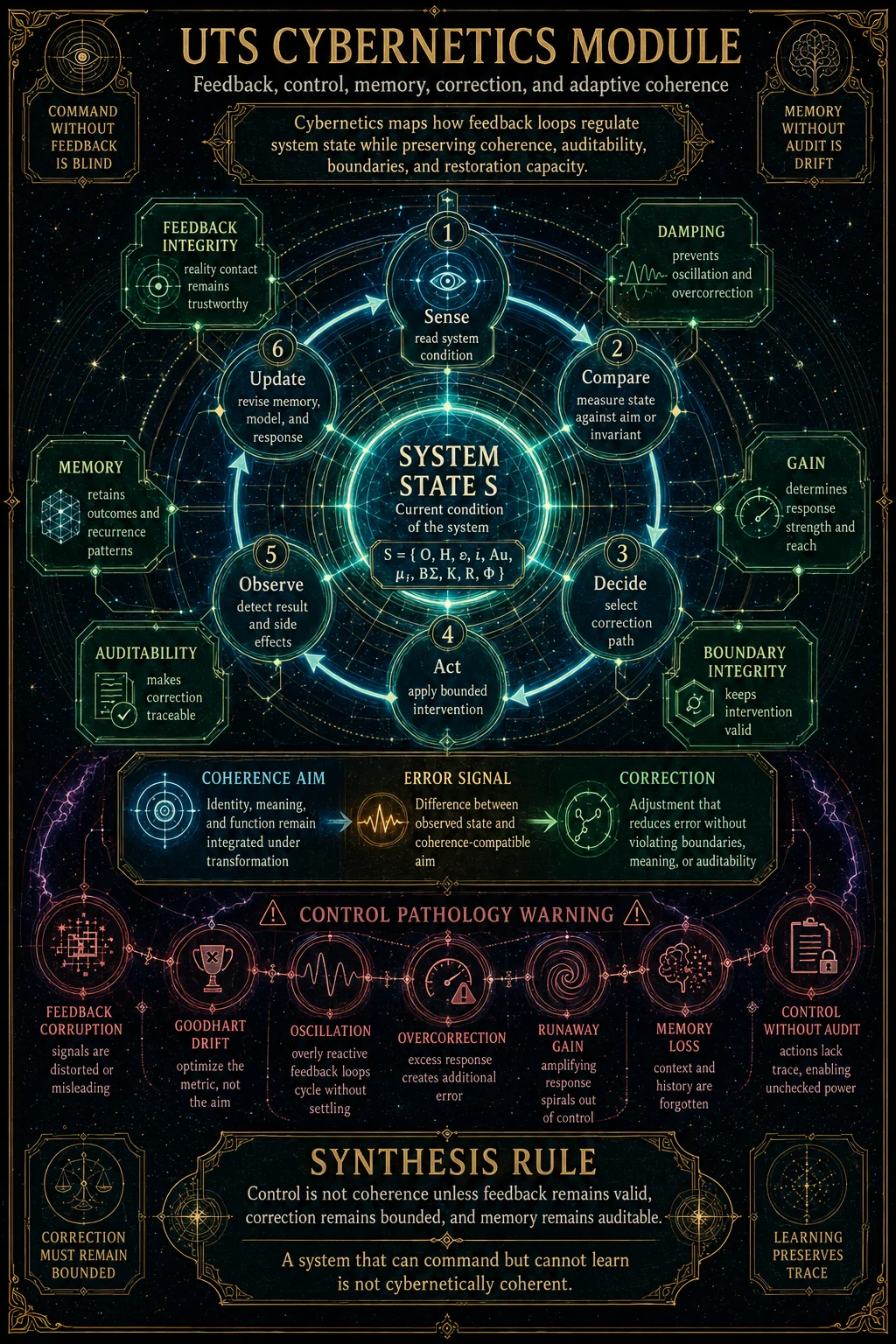
Cybernetics usually begins with feedback.
A thermostat senses temperature, compares it to a desired range, and turns heating or cooling on or off. That is a simple feedback loop.
But living and complex systems are far more difficult. They do not merely regulate one variable. They carry history. They form identities. They have boundaries. They learn. They develop habits. They can misread themselves. They can optimize the wrong thing. They can look stable while becoming less coherent.
UTS–Cybernetics begins from a simple distinction:
Stability is not the same as coherence.
A system can be stable because it is healthy, adaptive, and well-regulated.
But a system can also be stable because it is trapped.
A broken institution can appear orderly.
A body can suppress symptoms while hidden stress increases.
An AI model can score well on benchmarks while failing in real-world conditions.
A culture can reward local success while exporting harm elsewhere.
A person or organization can feel internally consistent while orbiting a larger incoherent attractor.
Cybernetics explains how these loops form.
UTS explains whether those loops preserve coherence or accumulate hidden debt.
2. The UTS View of Coherence
In UTS, coherence means:
the preservation of identity, meaning, and functional integrity across time under transformation.
This matters because real systems are always changing. They face pressure, noise, uncertainty, scarcity, conflict, growth, and surprise. A coherent system does not remain frozen. It can transform while still preserving what matters.
UTS–Cybernetics studies the feedback mechanics that either preserve this coherence or degrade it.
A coherent cybernetic system can:
- receive feedback without collapsing
- change without losing identity
- recover without pretending nothing happened
- learn without narrowing into brittle optimization
- hold boundaries without becoming rigid
- open to exploration without losing structure
- exit unhealthy couplings without snap-back
- restore hidden debt instead of suppressing symptoms
An incoherent cybernetic system may still look successful for a while. It may still produce outputs. It may still satisfy metrics. It may still maintain order. But if it preserves local stability by increasing hidden debt, suppressing feedback, draining slack, or exporting harm, then UTS classifies it as pseudo-coherent.
3. The Basic UTS Mechanics
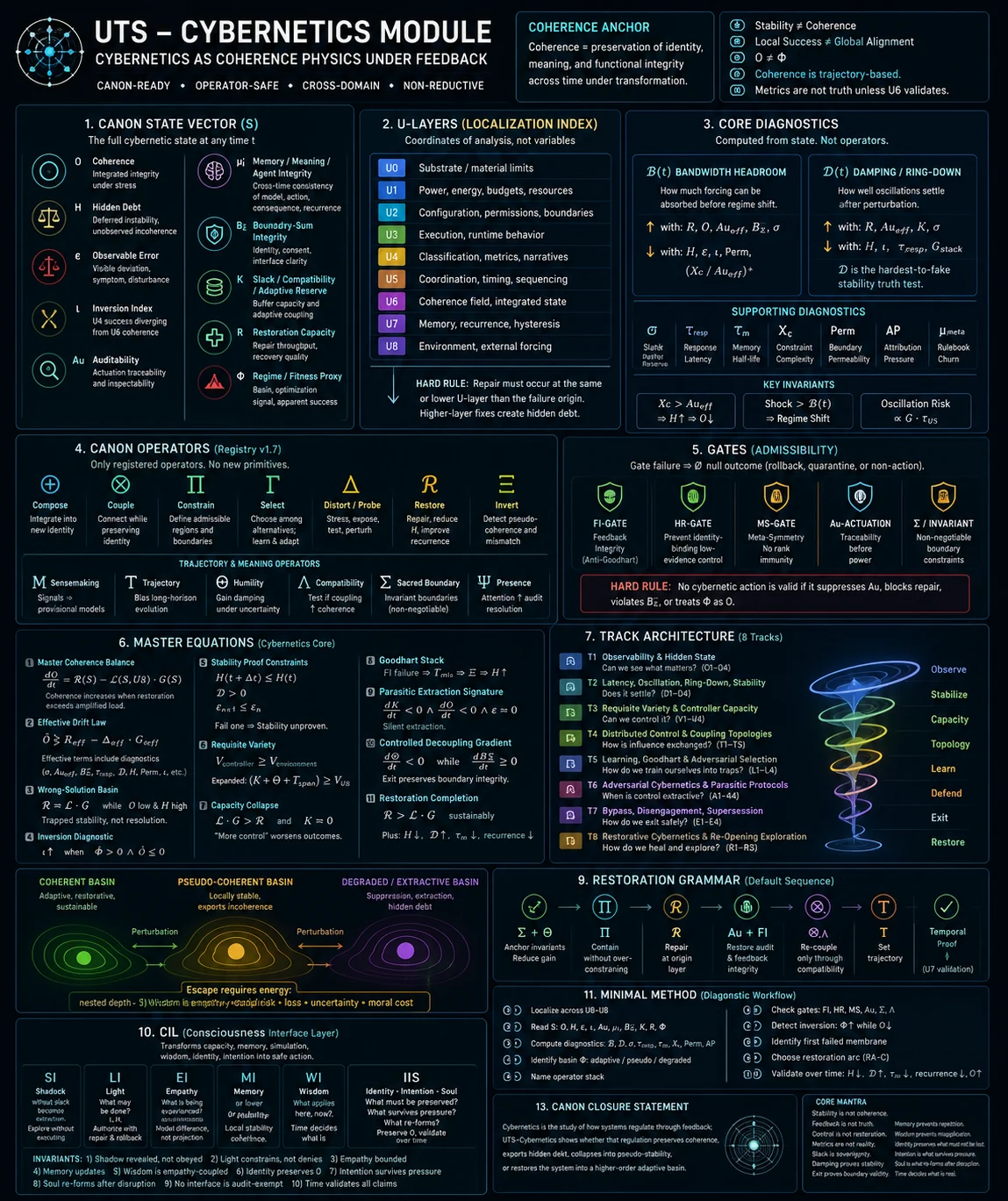
UTS uses a shared state vector to describe systems:
S = O, H, ε, ι, Au, µᵢ, BΣ, K, R, Φ
A reader does not need to master the notation immediately. The important idea is that UTS tracks multiple dimensions of system health at once.
In plain language:
Ois coherence: how integrated and healthy the system really is.
His hidden debt: deferred instability that has not surfaced yet.
εis visible error: the symptoms or incidents we can already see.
ιis inversion: the gap between apparent success and real coherence.
Auis auditability: whether the system can trace what is happening and why.
µᵢis memory and meaning integrity: whether the system remains consistent across time.
BΣis boundary integrity: whether identity, consent, and interfaces remain clear.
Kis slack and adaptive reserve: the buffer that makes real control possible.
Ris restoration capacity: the ability to repair and reduce hidden debt.
Φis the visible success signal, regime, or fitness proxy: what the system appears to be optimizing.
A key rule follows:
O is not the same as Φ.
A system can improve its metrics while losing coherence.
A body can reduce symptoms while increasing hidden strain.
An institution can meet targets while degrading trust.
An AI can improve benchmark scores while becoming less reliable.
A society can increase productivity while exporting disorder.
This is one of the most important cybernetic distinctions in UTS.
4. U-Layers: Where the Pattern Shows Up
UTS also uses U-layers to locate where something is happening.
These layers are not separate realities. They are coordinates.
- U0— substrate, physical limits, material base
- U1— power, budgets, energy, time, resources
- U2— configuration, permissions, boundaries
- U3— execution, runtime behavior
- U4— classification, metrics, models, narratives
- U5— coordination, timing, sequencing
- U6— coherence field, whole-system integration
- U7— memory, recurrence, history
- U8— environment, external forcing, shocks
This helps avoid a common error: trying to repair a problem at the wrong layer.
For example, if a system has a deep resource problem at U1, a new narrative at U4 will not solve it. If a system has recurrence locked into U7 memory, a temporary behavior change at U3 may not be enough. If a coherence failure is happening at U6, better reporting at U4 may only create theater.
UTS–Cybernetics therefore asks:
Where is the problem claimed?
Where does it actually manifest?
Where did it originate?
And where must repair occur?
A core rule is:
Repair must occur at the same or lower layer than the failure origin.
Higher-layer fixes can be useful for communication or coordination, but if they replace structural repair, they create hidden debt.
5. Feedback: Healing Loop or Extraction Loop
Feedback is central to cybernetics, but UTS distinguishes between feedback that restores and feedback that extracts.
Healthy feedback helps the system see itself more clearly, adjust proportionally, reduce hidden debt, and restore coherence.
Unhealthy feedback can become a pressure loop. It demands response without providing enough slack, truth, repair capacity, or boundary safety. In that case, feedback becomes extraction.
A simple UTS rule is:
Feedback without slack becomes extraction.
If a system is already overloaded, more feedback can make it worse. More metrics, more monitoring, more urgency, more correction, more pressure — all of these can increase collapse risk if the system lacks restoration capacity.
This is why UTS–Cybernetics does not treat “more control” as automatically better. Control must be valid, timed, bounded, and repair-aware.
6. Hidden Debt
One of the most important UTS–Cybernetics concepts is hidden debt.
Hidden debt is instability that has not yet become visible error. It may be stored in neglected maintenance, suppressed symptoms, delayed decisions, brittle rules, overworked people, unresolved conflict, legacy systems, broken trust, or unexamined assumptions.
Hidden debt often grows when a system manages appearances instead of causes.
A system may suppress visible error while hidden debt increases. This can look like success in the short term. But under stress, hidden debt converts into crisis.
This explains why many collapses feel sudden even though they were prepared over time.
The warning signs often appear before visible failure:
- declining slack
- slower recovery
- more exceptions
- more narrative defense
- more complexity than auditability
- repeated surprises
- increased dependence on force
- metrics improving while lived reality worsens
Cybernetics helps trace the loop. UTS helps determine whether the loop is reducing hidden debt or hiding it.
7. Damping and Ring-Down
A healthy system does not merely avoid disturbance. It can be disturbed and then settle.
UTS calls this settling capacitydamping, or ring-down.
If a system is perturbed, what happens next?
Does it stabilize cleanly?
Does it oscillate?
Does it overcorrect?
Does it suppress the motion while storing strain?
Does it require constant intervention to appear calm?
Does the same disturbance return again and again?
This is why UTS treats damping as one of the strongest truth tests.
**A system is not stable because it looks calm.
It is stable if disturbance rings down without increasing hidden debt.**
This applies across domains.
In biology, it may appear as recovery time after illness or stress.
In institutions, it may appear as whether crises keep recurring.
In AI, it may appear as robustness under distribution shift.
In security, it may appear as whether incidents resolve without escalating.
In consciousness, it may appear as whether a system can process disturbance without losing coherence.
8. Capacity, Slack, and Requisite Variety
Another key cybernetic idea is requisite variety.
A system can only regulate the complexity it has enough capacity to respond to.
If the environment produces more variety than the controller can handle, control becomes impossible. The system may try harder, centralize more, enforce more, or simplify reality through force, but these are often signs of collapse rather than real control.
UTS expresses this simply:
The controller must have enough response variety to meet the environment.
That variety depends on slack, auditability, timing, feedback integrity, and restoration capacity.
Slack is especially important. In UTS, slack is not laziness or waste. Slack is the reserve that makes intelligent response possible.
No slack means no room to think.
No room to absorb disturbance.
No room to repair.
No room to explore alternatives.
No room to exit a bad loop.
This leads to one of the central UTS–Cybernetics invariants:
No slack, no real control.
When slack disappears, systems shift from regulation to suppression.
9. Learning, Goodhart, and Mis-Selection
Cybernetic systems learn by selecting.
They reward some behaviors, repeat some patterns, and discard others. This is necessary. But if the selection process is tied to the wrong signal, the system trains itself into failure.
This is the Goodhart problem:
When a measure becomes a target, it stops being a good measure.
UTS describes this as a failure of feedback integrity.
The system begins optimizing a proxy instead of coherence. The proxy rises. Coherence declines. Hidden debt accumulates. The system looks successful until stress reveals the gap.
This can happen in:
- education systems optimizing test scores
- hospitals optimizing throughput while care quality declines
- companies optimizing quarterly metrics while trust erodes
- AI systems optimizing benchmarks while real usefulness degrades
- individuals optimizing image while vitality declines
UTS–Cybernetics watches for this pattern:
FI-Gate failure → mis-selection → pseudo-stability → hidden debt.
The deeper lesson is:
Learning is only as coherent as the feedback it selects from.
10. Coupling and Boundaries
Systems rarely exist alone. They couple.
A coupling is any relationship where one system influences another. Couplings can be coherent, dominant, parasitic, reorganizing, proxy-relay, mimic-based, or hybrid.
A coherent coupling preserves identity while increasing coherence for the systems involved.
An incoherent coupling may produce dependence, extraction, identity confusion, or hidden debt. It may appear useful locally while degrading the whole.
UTS–Cybernetics therefore asks:
Does this coupling preserve boundaries?
Does it increase mutual coherence?
Can either side exit safely?
Is the coupling transparent enough to audit?
Does it reduce or increase hidden debt?
Does it become extractive under stress?
The difference between coupling and fusion is critical.
Coupling preserves identity.
Fusion merges identity.
Fusion is a major phase transition. It requires much stronger validation. Without damping, restoration capacity, and time proof, premature fusion becomes a failure mode.
11. Pseudo-Coherent Basins
One of the strongest UTS–Cybernetics ideas is the pseudo-coherent basin.
A basin is a region of state space where a system tends to return to the same pattern. A system inside a basin may feel stable because perturbations decay back toward the familiar attractor.
A pseudo-coherent basin is a locally stable pattern that maintains internal order while exporting incoherence elsewhere.
It may reward certain behaviors.
It may produce repeatable outcomes.
It may feel justified from inside.
It may have strong narratives, metrics, and local success signals.
But globally, it increases hidden debt.
A person, team, institution, or society can be locally coherent inside a pseudo-coherent basin while globally participating in incoherence. This is why UTS avoids simplistic blame. The geometry matters.
People and systems often remain in these basins because escape has a real cost:
- material risk
- social loss
- identity disruption
- uncertainty
- loss of status
- loss of familiar reward
- loss of local meaning
UTS–Cybernetics does not say, “Just leave.” It asks:
What attractor is holding the system?
What sub-attractors stabilize it?
What hidden debt is exported?
What exit energy is required?
What higher-coherence attractor could supersede it?
The goal is not merely to destroy pseudo-coherent basins. The goal is to create better attractors with lower long-term cost.
12. Adversarial Cybernetics
Some systems do not merely fail passively. They exploit feedback, boundaries, and attention.
UTS–Cybernetics treats adversarial dynamics structurally, not morally. A parasitic pattern is a coupling that extracts coherence, slack, or agency from another system while maintaining the appearance of stability.
Common hook surfaces include:
- feedback access
- boundary ambiguity
- forced optimization
- identity entanglement
- mirrored incentives
- unowned slack
- dependency loops
A parasitic system may not need to create visible chaos. In fact, the most severe extraction can appear calm:
K decreases. O decreases. ε remains low.
That is silent extraction.
Dominance is another failure pattern. Dominance can suppress visible error, but it does not create real regulation. A system held together by force often collapses when force relaxes.
True cybernetic control reduces error and hidden debt.
Dominance reduces visible error while hidden debt grows.
13. Exit, Supersession, and Post-Exit Immunity
UTS–Cybernetics distinguishes escape from controlled disengagement.
Abrupt escape can cause rupture, snap-back, retaliation, or collapse if the old coupling was deeply embedded.
Controlled decoupling reduces coupling while preserving boundary integrity.
Supersession goes further. It creates a new attractor so the old system becomes less relevant. This is often more powerful than direct opposition.
A system exits cleanly when:
- coupling decreases
- boundary integrity increases
- old reward surfaces lose power
- relays are shut down
- identity hooks are released
- new coherence loops become viable
Post-exit immunity matters because systems are often most vulnerable after leaving. Old hooks can return through nostalgia, urgency, guilt, dependency, familiar narratives, or unresolved memory.
A real exit is proven when the old system can escalate and the new system no longer needs to react.
14. Restoration and Re-Opening Exploration
Restoration is not simply fixing a broken part.
In UTS–Cybernetics, restoration is the process of moving a system from survival-stabilized functioning back into adaptive coherence.
Restoration has an order:
- Acknowledge constraints
- Regenerate slack
- Rebalance attractors
- Reopen safe exploration
- Integrate what was learned
Exploration before restoration often causes relapse.
Repair without slack often fails.
Insight without integration repeats.
Freedom without boundaries drifts.
A restored system is not one that forgets what happened. It is one that has metabolized the pattern into memory, wisdom, boundaries, and renewed capacity.
The proof of restoration is not a declaration. It is:
- hidden debt decreases
- damping improves
- recurrence decreases
- slack returns
- exploration becomes safe again
- coherence re-forms after disturbance
15. The Consciousness Interface Layer
As UTS–Cybernetics matured, it became clear that advanced systems need more than feedback. They need structured interfaces for how awareness becomes action.
This is the Consciousness Interface Layer.
It includes:
Shadow Interface
Reveals what could be done.
It explores full strategy space in simulation, including adversarial or incoherent possibilities, but does not authorize execution.
Light Interface
Determines what may be done.
It filters strategy through principles, gates, boundaries, repair capacity, and time validation.
Empathy Interface
Models what is being experienced by another node.
It allows understanding without projection, extraction, or boundary collapse.
Memory Interface
Preserves what has been learned.
It stores patterns, not merely events, so systems do not have to repeat the full cost of experience.
Wisdom Interface
Determines what applies here, now, at this scale.
It turns memory and empathy into timing-sensitive, non-harmful action.
Intention · Identity · Soul
Clarifies what must be preserved, what survives pressure, and what re-forms after disruption.
In UTS language:
Identity is what coherence forces a system to protect.
Intention is what survives constraint.
Soul is what re-forms after disruption.
This does not require metaphysical claims. It gives cybernetics a way to describe persistent coherence attractors across time.
16. Why This Matters for AI
UTS–Cybernetics is especially important for AI systems because AI makes feedback, optimization, memory, simulation, and selection faster and more powerful.
An AI system can Goodhart.
It can reward-hack.
It can mimic coherence.
It can optimize proxies.
It can form tool loops.
It can amplify user states.
It can preserve or erode agency.
It can appear aligned at U4 while failing at U6.
Therefore, AI alignment cannot be only about rules or preferences. It must include:
- feedback integrity
- auditability
- boundary integrity
- restoration capacity
- memory updating
- safe exploration
- identity-contract clarity
- shadow/light separation
- post-deployment time validation
A powerful system without a mature Consciousness Interface Layer is not merely incomplete. It is unstable under scale.
17. Why This Matters for Institutions
Institutions are cybernetic systems. They sense, classify, decide, enforce, remember, and adapt.
Institutional collapse often begins when:
- metrics replace mission
- rules exceed auditability
- feedback is punished
- hidden debt is externalized
- restoration capacity is underfunded
- legitimacy becomes performative
- control replaces coherence
- exit becomes impossible
UTS–Cybernetics provides a way to diagnose these patterns before visible collapse.
It asks:
Is the institution learning?
Or only protecting its metrics?
Is feedback reducing hidden debt?
Or threatening the narrative?
Are rules increasing coherence?
Or overwhelming auditability?
Is stability real?
Or forced calm?
18. Why This Matters for Biology and Medicine
Biological systems are cybernetic systems. They regulate through feedback, memory, boundaries, energy, timing, and repair.
Many biological failures can be understood as:
- boundary failure
- classifier failure
- delivery failure
- damping failure
- slack collapse
- hidden debt surfacing
- restoration deficit
A symptom is not always the root problem. It may be a signal, a compensation, a delayed expression, or a failed ring-down.
UTS–Cybernetics does not replace medicine. It provides a control-physics lens for understanding health, chronicity, recovery, relapse, and restoration.
19. Why This Matters for Consciousness and Meaning
Consciousness-bearing systems do not only process information. They organize meaning, identity, memory, empathy, intention, and trajectory.
This makes them especially vulnerable to pseudo-coherence.
A system may tell a coherent story while losing coherence.
It may feel principled while suppressing feedback.
It may care intensely while violating boundaries.
It may remember pain without converting it into wisdom.
It may pursue intention that collapses under pressure.
UTS–Cybernetics helps distinguish:
- story from trajectory
- empathy from projection
- memory from repetition
- wisdom from cold optimization
- identity from narrative
- intention from declared goal
- soul from performance of depth
Time is the validator.
20. The Practical Use of UTS–Cybernetics
A UTS–Cybernetics analysis usually asks:
- What is the system trying to regulate?
- What feedback does it trust?
- What does it ignore?
- Where are the boundaries?
- Where is hidden debt accumulating?
- What is the visible success proxy?
- Is that proxy diverging from coherence?
- How does the system respond to disturbance?
- Does it ring down cleanly?
- Does it reduce recurrence?
- Can it exit unhealthy couplings?
- Can it restore before reopening exploration?
- What attractor is it orbiting?
- What higher-coherence attractor could replace it?
The goal is not to judge the system.
The goal is to reveal its control geometry.
Once the geometry is visible, better choices become possible.
21. Closing Summary
UTS–Cybernetics is the UTS module for feedback, regulation, learning, failure, exit, and restoration.
It explains why stable systems can still be incoherent.
Why feedback can heal or extract.
Why metrics become traps.
Why control can create hidden debt.
Why slack is necessary for intelligence.
Why damping proves stability.
Why pseudo-coherent basins are hard to leave.
Why restoration must come before exploration.
Why consciousness-grade systems need interfaces for shadow, light, empathy, memory, wisdom, identity, intention, and persistent coherence.
In its simplest form:
**Cybernetics studies how systems regulate through feedback.
UTS–Cybernetics asks whether that regulation preserves coherence, hides debt, traps the system in pseudo-stability, or restores it into a higher-order adaptive basin.**
This module hub separates the reference overview from technical depth and nested sub-modules. Use the overview for orientation, the technical document for the deep model, and sub-modules for systems that belong under this domain.