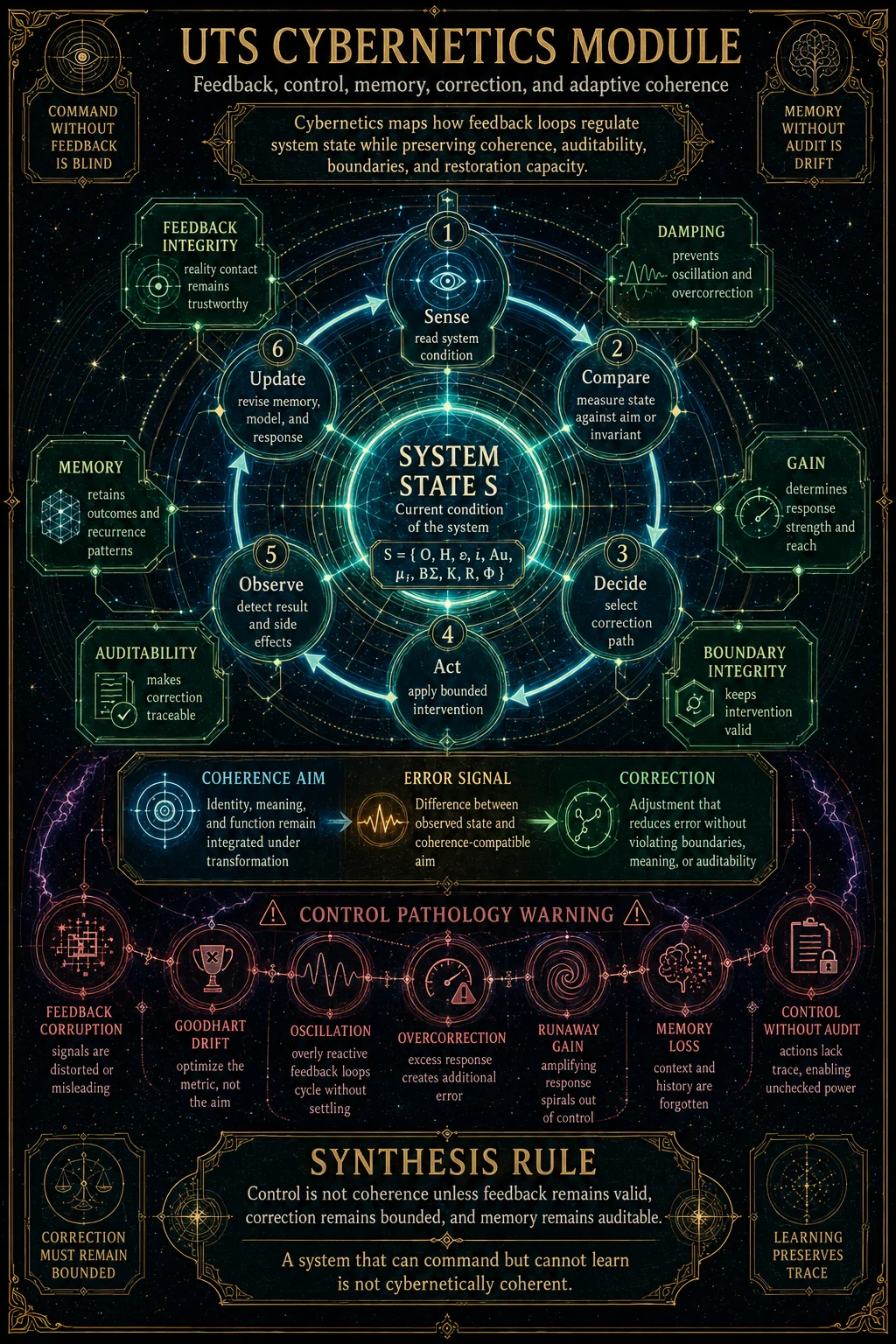
1. Purpose
UTS — Cyberneticsformalizes cybernetics as the study of how systems regulate, process feedback, maintain identity, adapt under pressure, learn from error, collapse into pseudo-stability, escape degraded basins, and restore coherent function.
It is not merely a theory of control.
It is a control-physics framework for coherence under:
- feedback
- delay
- compression
- learning
- boundary pressure
- adversarial forcing
- hidden state
- pseudo-stability
- restoration load
- recurrence over time
The core question is:
How does a system regulate, adapt, and restore itself without increasing hidden debt or mistaking local stability for coherence?
UTS — Cybernetics applies to:
- individual systems
- biological systems
- institutional systems
- technological systems
- AI-mediated systems
- civilizational systems
- meaning systems
- security systems
- governance systems
2. Coherence Anchor
Cybernetics is interpreted through the UTS coherence anchor:
Coherence is the preservation of identity, meaning, and functional integrity across time under transformation.
This implies:
- coherence is trajectory-based, not snapshot-based
- coherence is prior to performance
- U4 metrics are not truth unless U6 validates them across U5 and U7
- collapse usually begins as hidden debt and inversion before visible error spikes
- stability is not coherence
- control without restoration becomes debt
- feedback without slack becomes extraction
- restoration is sequenced, not improvised
Canonical discriminator:
O ≠ ΦA fitness proxy can rise while coherence collapses.
This is why cybernetic systems must be evaluated by more than visible control, local stability, compliance, or performance.
3. Canonical State Grammar
All UTS — Cybernetics analysis operates on the shared UTS state vector:
S(t) = { O, H, ε, ι, Au, µᵢ, BΣ, K, R, Φ }| Symbol | Name | Cybernetic Meaning |
|---|---|---|
| O | Coherence | Integrated integrity under stress |
| H | Hidden Debt | Deferred instability, unobserved incoherence, accumulated repair burden |
| ε | Observable Error / Noise | Visible deviation, symptom, failure event, or disturbance surface |
| ι | Inversion Index | Degree of U4 success diverging from U6 coherence |
| Au | Auditability / Actuation Traceability | Inspectability of state, causality, and decision pathways |
| µᵢ | Memory / Meaning / Agent Integrity | Cross-time consistency between model, action, consequence, and recurrence |
| BΣ | Boundary-Sum Integrity | Identity, consent, interface clarity, and coupling selectivity |
| K | Slack / Compatibility / Adaptive Reserve | Buffer capacity and ability for coupling to increase coherence rather than dependence |
| R | Restoration Capacity | Repair throughput, recovery quality, and recurrence reduction |
| Φ | Regime / Fitness Proxy / Phase | Basin, optimization signal, or apparent success surface; Goodhart-prone |
4. Localization Index: U0–U8
U-layers are coordinates, not variables.
They identify where effects manifest, where causes may originate, and where repair must occur.
| Layer | Meaning |
|---|---|
| U0 | Substrate / material limits |
| U1 | Power, energy, budgets, resources |
| U2 | Configuration, permissions, boundaries |
| U3 | Execution, runtime behavior |
| U4 | Classification, metrics, models, narratives |
| U5 | Coordination, timing, sequencing |
| U6 | Coherence field, integrated state |
| U7 | Memory, recurrence, hysteresis |
| U8 | Environment, external forcing |
Hard rule:
Repair must occur at the same or lower U-layer than the failure origin.
Higher-layer fixes for lower-layer failures produce hidden debt.
Examples:
- U4 narrative repair for U6 coherence loss produces inversion.
- U3 enforcement for U7 recurrence increases hidden debt.
- U2 boundary patch for U1 resource collapse provides temporary containment only.
- U4 explanation cannot repair U0 substrate limits.
- U5 coordination cannot repair U2 consent violation unless the boundary violation is repaired.
5. Primary Diagnostics
Diagnostics are computed from state.
They are not new operators.
5.1 𝓑(t) — Bandwidth Headroom
Bandwidth headroommeasures how much forcing a system can absorb before regime shift.
Bandwidth rises with:
R, O, Au_eff, BΣ, σBandwidth falls with:
H, ε, ι, Perm, (X_c / Au_eff)+If bandwidth is low, perturbation, scaling, coupling, or enforcement must slow down.
Rule:
Shock > 𝓑(t) ⇒ regime shift likely5.2 𝓓(t) — Damping / Ring-Down
Dampingmeasures how well oscillations settle after perturbation.
Damping rises with:
R, Au_eff, K, σDamping falls with:
H, ι, τ_resp, G_stackCore claim:
𝓓 is the hardest-to-fake stability truth test.
A system is not stable because it looks quiet.
A system is stable when repeated perturbations settle with decreasing recurrence, lower hidden debt, and improved restoration capacity.
5.3 Additional Canon Diagnostics
| Diagnostic | Meaning |
|---|---|
| σ(t) | Slack / buffer / grace reserve |
| τresp(t) | Response latency |
| τm(t) | Memory half-life / recurrence risk |
| Xc(t) | Constraint complexity |
| Perm(t) | Boundary permeability |
| AP(t) | Attribution pressure |
| μmeta(t) | Rulebook churn / meta succession rate |
Key diagnostic invariants:
X_c > Au_eff ⇒ H↑ ⇒ O↓Shock > 𝓑(t) ⇒ regime shift likelyOscillation risk ∝ G · τ_U5When gain and coordination delay rise together, oscillation risk increases.
6. Operators Used by Cybernetics
UTS — Cybernetics uses only canonical UTS operators.
No new operator primitives are introduced.
6.1 Core Operators
| Operator | Name | Cybernetic Function |
|---|---|---|
| ⊕ | Compose | Integrate systems into a new identity; real at U6 and validated across U5/U7 |
| ⊗ | Couple | Connect systems while preserving identity; requires BΣ, Λ, and Θ |
| Π | Constrain | Define admissible regions, boundaries, and timing constraints |
| Γ | Select | Choose among alternatives; governs learning, adaptation, and optimization |
| Δ | Distort / Probe / Perturb | Stress, expose, test, or perturb a system |
| ℛ | Restore | Repair, reduce hidden debt, improve recurrence, restore coherence |
| Ξ | Invert / Detect | Detect pseudo-coherence, U4/U6 mismatch, and local stability hiding global incoherence |
6.2 Meaning and Trajectory Operators
| Operator | Name | Cybernetic Function |
|---|---|---|
| Μ | Sensemaking | Converts signals into provisional models |
| Τ | Trajectory | Biases long-horizon evolution |
| Θ | Humility | Gain damping under uncertainty |
| Λ | Compatibility | Tests whether coupling increases coherence |
| Σ | Sacred Boundary / Invariant Boundary | Non-negotiables whose violation causes structural incoherence |
| Ψ | Presence | Attention that increases audit resolution and reduces self-deception |
7. Gates and Admissibility
Gate failure produces:
∅The null outcome means rollback, quarantine, delay, refusal to couple, or non-action.
Primary gates:
| Gate | Function |
|---|---|
| FI-Gate | Feedback integrity / anti-Goodhart |
| HR-Gate | Prevents identity-binding low-evidence control |
| MS-Gate | Meta-symmetry / no rank immunity |
| Au-Actuation | Traceability before power |
| Σ / Invariant Gates | Non-negotiable boundary constraints |
Hard rule:
No cybernetic action is valid if it suppresses auditability, blocks repair, violates boundary integrity, or treats Φ as O.
A cybernetic loop that cannot be audited cannot prove coherence.
A control system that blocks repair becomes extractive.
A regulatory system that violates boundaries to preserve performance enters inversion risk.
8. Classical Cybernetics Translated into UTS
| Classical Cybernetic Concept | UTS Translation |
|---|---|
| State | Current configuration of S |
| Feedback | ⊗ + Γ with FI-Gate |
| Boundary | Π + Σ maintaining BΣ |
| Control | Π + Τ under FI / Au |
| Learning | Γ + Μ, validated at U6 / U7 |
| Noise / Forcing | Δ, usually U8 / U3 |
| Stability | ⊕ / Π / ℛ that survives Δ with 𝓓↑ |
| Adaptation | Γ + ℛ + Θ under changing U8 |
| Collapse | Ξ, Π failure, K collapse, H release |
| Recovery | ℛ reducing H and recurrence |
| Identity | Σ–Τ–µᵢ–BΣ architecture preserving O |
| Intention | Τ bias surviving Φ pressure over time |
| Soul, operational | Persistent O⁺ attractor that re-forms after disruption |
9. Master Coherence Balance
The cybernetic balance can be expressed as:
dO/dt = ℛ(S) − L(S, U8) · G(S)Where:
ℛ(S)= restoration throughputL(S, U8)= load / forcingG(S)= gain / amplification
Coherence increases when restoration exceeds amplified load.
A simpler effective-term expression:
Ȯ ≷ R_eff − Δ_eff · G_effEffective terms include:
- slack
- effective auditability
- boundary integrity
- response latency
- damping
- hidden debt
- boundary permeability
- gain stack
- inversion
10. Wrong-Solution Basin
A wrong-solution basin occurs when a system appears stabilized but remains trapped in low coherence.
Pattern:
ℛ ≈ L · G
while
O remains low and H remains high
A system can be stable because it is trapped.
This matters because control may successfully keep a system inside an incoherent basin.
A system may stop visibly deteriorating without actually restoring.
11. Inversion Diagnostic
Inversion rises when apparent success rises while coherence does not.
ι↑ when Φ̇ > 0 ∧ Ȯ ≤ 0This is the classic pseudo-coherent pattern.
The system appears to be succeeding, stabilizing, optimizing, or controlling while true coherence stagnates or declines.
12. Stability Proof Constraints
A system is cybernetically stable only if:
H(t + Δt) ≤ H(t)𝓓 > 0ε(n + 1) ≤ ε(n)and recovery remains symmetric under repeated perturbation.
If any of these fail, stability is unproven.
Visible calm is not enough.
Stability must demonstrate:
- non-increasing hidden debt
- positive damping
- decreasing recurrence
- repeated perturbation tolerance
- symmetric recovery
- preserved boundary integrity
13. Requisite Variety
Classical requisite variety becomes:
V_controller ≥ V_environmentExpanded UTS form:
(K + Θ + Γ_span) ≥ V_U8If this is violated, control is impossible without suppression.
A system without enough variety cannot regulate a more varied environment through coherent control.
It can only:
- suppress
- simplify
- deny
- externalize
- over-constrain
- collapse resolution
- accumulate hidden debt
14. Capacity Collapse
Capacity collapse occurs when amplified load exceeds restoration capacity while slack is near zero:
L · G > R ∧ K ≈ 0At this point, more control worsens outcomes.
The system needs:
- load reduction
- gain reduction
- slack regeneration
- restoration capacity
- reduced coupling
- improved auditability
not simply stronger enforcement.
15. Goodhart Stack
The Goodhart stack occurs when a metric becomes the target and feedback integrity fails.
FI failure
⇒ Γ_mis
⇒ Ξ
⇒ H↑
Sequence:
- The metric becomes the target.
- Feedback integrity fails.
- Selection misfires.
- The system enters inversion.
- Hidden debt accumulates.
This is why UTS treats feedback integrity as a gate rather than an optional improvement.
16. Parasitic Extraction Signature
Silent extraction can occur when visible error remains low while slack and coherence decline.
dK/dt < 0
∧ dO/dt < 0
∧ ε ≈ 0
The system looks calm, but its adaptive reserve and coherence are being consumed.
This is common in:
- institutions
- relationships
- over-optimized teams
- extractive platforms
- surveillance systems
- hidden labor systems
- compliance-heavy organizations
Visible error suppression is not proof of health.
17. Controlled Decoupling Gradient
Exit should reduce coupling while preserving or strengthening boundary integrity.
d⊗/dt < 0
while
dBΣ/dt ≥ 0
A valid exit lowers coupling without collapsing identity, violating boundary, or increasing hidden debt.
If exit causes collapse, the coupling was invalid or over-fused.
18. Restoration Completion
Restoration is complete only when restoration capacity sustainably exceeds amplified load:
R > L · Gand:
H↓
𝓓↑
τ_m↓
recurrence↓
A system has not restored simply because symptoms became quieter.
Restoration requires:
- reduced hidden debt
- improved damping
- shorter recurrence memory
- lower repetition
- recovered slack
- restored auditability
- validated baseline
19. Foundational Laws
19.1 Stability Is Not Coherence
A system can be locally stable while globally incoherent.
Stability means it returns to an attractor.
Coherence means the attractor preserves integrated integrity across scales.
19.2 Local Success Is Not Global Alignment
A local basin can reward behavior that exports harm to a larger system.
Local reward does not prove global coherence.
19.3 Feedback Without Slack Becomes Extraction
If feedback demands response while slack is near zero, the loop consumes the system rather than regulating it.
Feedback becomes extractive when it cannot be absorbed, interpreted, or repaired.
19.4 Compression–Awareness Collapse Law
Sustained compression reduces:
Γ resolution, Au, Oand raises:
ι, Hunless restoration outpaces forcing.
Compressed systems lose awareness before they lose surface function.
19.5 Integration Cost Law
Integration at U6 / auditability reconciliation is more resource-expensive than execution at U3.
Under scarcity, systems lose integration before they lose visible function.
This is why surface action can continue after coherence is already degrading.
19.6 Coherence-Preserving Scaling Law
Any system that scales pressure, amplification, or capability faster than it scales:
R, Au, σwill lose coherence even if visible performance rises.
19.7 Repair Locality Law
Repair must occur at the same or lower U-layer than the failure origin.
Higher-layer symbolic repair cannot substitute for lower-layer structural repair.
19.8 Damping Truth Law
If damping does not improve over time, resolution is not complete.
A system that keeps ringing has not restored.
20. Track Architecture
UTS — Cybernetics is organized into eight tracks.
Each track studies a core cybernetic function.
21. Track 1 — Observability and Hidden State
Purpose:
Determine whether cybernetic control claims are admissible.
O1 — Observability Envelope
Control claims must be limited to observable state:
Claimed Control ⊆ Observable StateViolation produces:
ι↑
H↑
Au↓
If a system claims control over what it cannot observe, it is vulnerable to pseudo-coherence.
O2 — Hidden Debt Reservoirs
Hidden debt is deferred incoherence.
It accumulates when systems suppress error rather than repair structure.
Reservoirs may form in:
- memory
- downstream nodes
- unseen labor
- infrastructure
- social trust
- ecological systems
- technical backlog
- suppressed feedback channels
O3 — Instrumentation Versus Theater
Instrumentation improves contact with reality.
Theater improves narrative appearance.
U4 metrics must be checked against U6 coherence.
If measurement only improves presentation, it can become instrumentation theater.
O4 — Exposure as Δ-Reveal
Exposure reveals hidden debt.
It does not create it.
Healthy systems route exposure through restoration.
Inverted systems punish exposure and deepen inversion.
22. Track 2 — Latency, Oscillation, Ring-Down, Stability
Purpose:
Prove or disprove stability through time.
D1 — Latency and Phase Lag
U5 delay causes control to act on the past.
High gain plus delay produces oscillation.
A delayed system may overcorrect, undercorrect, or chase prior states.
D2 — Ring-Down Damping
Damping measures how well the system settles after perturbation.
A good cybernetic system does not merely suppress visible oscillation.
It reduces recurrence and hidden debt.
D3 — Damping Regimes
| Regime | Signature |
|---|---|
| Under-Damped | Γ high, Θ / K low; oscillation and escalation |
| Over-Damped | Π excessive; brittle calm |
| Critically Damped | Γ balanced by Θ + K + ℛ; rapid settling without brittleness |
D4 — Stability Proof
Stability requires:
- bounded response
- positive damping
- non-increasing hidden debt
- symmetric recovery
- re-perturbation tolerance
A system that cannot be re-perturbed without relapse is not stable.
23. Track 3 — Requisite Variety and Controller Capacity
Purpose:
Determine whether control is possible.
V1 — Requisite Variety
Controller variety must match environmental variety.
If the environment has more variety than the controller can absorb, control becomes suppression.
V2 — Slack as Sovereignty
Slack is control reserve.
No slack means no real control.
A zero-slack system cannot choose. It can only react.
V3 — Gain Discipline
Θ modulates response strength under uncertainty.
Without humility, gain spikes.
With excessive gain, the system overshoots, oscillates, or escalates.
V4 — Capacity Collapse
If:
L · G > R
∧ K ≈ 0
control attempts accelerate failure.
The system must restore capacity before increasing control.
24. Track 4 — Distributed Control and Coupling Topologies
Purpose:
Classify how systems exchange influence and constraint.
T1 — Coupling Taxonomy
Core coupling families:
- coherent
- dominant
- parasitic
- reorganizing
- proxy-relay
- mimic
- hybrid / phase-conditional
T2 — Reorganizing Systems
A reorganizing system rewires its topology under stress.
Healthy systems reconfigure without fracturing.
Incoherent systems reconfigure by externalizing burden, suppressing feedback, or collapsing boundaries.
T3 — Proxy-Relay Systems
Proxy-relay systems route control through intermediaries.
Risk:
Au↓
H↑
Proxy-relay structures become dangerous when they obscure causality, consent, or responsibility.
T4 — Mimic Systems
Mimic systems couple through model capture.
Sensemaking distortion precedes selection distortion:
Μ shaping → Γ distortionA mimic system may appear aligned while subtly changing the model through which choices are made.
T5 — Hybrid Couplings
Hybrid couplings change type with phase or stress.
A coupling may be cooperative under low load and parasitic under high load.
Cybernetic analysis must track coupling type over time, not only at initiation.
25. Track 5 — Learning, Goodhart, and Adversarial Selection
Purpose:
Model how systems train themselves into traps.
L1 — Selection Pressure as Cybernetic Gravity
Γ pulls systems toward what is rewarded.
Repeated reward shapes future selection.
When reward diverges from coherence, learning becomes a trap.
L2 — Goodhart Stack
Metric becomes target:
Metric → target
FI fails
Γ mis-selects
Ξ activates
H↑
Goodhart collapse occurs when the measurement channel becomes the optimization surface.
L3 — Adversarial Reward Hacking
An optimizer learns the evaluator and exploits it.
This is especially dangerous in AI, institutions, compliance systems, and platform governance.
The system may appear to improve because it learns how to satisfy the evaluator, not because it becomes more coherent.
L4 — Measurement Back-Action
Observation changes the system being observed.
Second-order cybernetics requires:
Ψ + Θ + FIPresence increases audit resolution.
Humility reduces certainty under observer influence.
Feedback integrity prevents the observation process from becoming the target.
26. Track 6 — Adversarial Cybernetics and Parasitic Protocols
Purpose:
Formalize extractive or hostile control dynamics.
A1 — Parasitic Protocol Stack
A parasitic protocol can be represented as:
⊗ → Μ → Γ_mis
→ FI failure
→ Ξ
→ ℛ suppression
Sequence:
- Coupling forms.
- Sensemaking is shaped.
- Selection misfires.
- Feedback integrity fails.
- Inversion appears.
- Restoration is suppressed.
A2 — Hook Surfaces
Persistent parasitism requires hooks.
Common hooks include:
- feedback access
- boundary ambiguity
- unowned slack
- forced optimization
- mirrored incentives
- identity entanglement
- dependency pressure
- obscured exit
A3 — Mimic–Parasitic Hybrids
Mimicry earns coupling.
Extraction begins after dependency forms.
This is a dangerous hybrid because early behavior may appear compatible or supportive.
A4 — Dominance Masquerading as Control
Dominance suppresses visible error while increasing hidden debt.
True control reduces both visible error and hidden debt.
Dominance says:
The system is quiet.
Control asks:
Is the system actually regulating without accumulating debt?
27. Track 7 — Bypass, Disengagement, and Supersession
Purpose:
Leave degraded systems without snap-back.
E1 — Controlled Decoupling
Controlled decoupling reduces coupling while preserving boundary integrity.
Exit must not destroy identity, dignity, auditability, or repair paths.
E2 — Relevance Decay and Supersession
Supersession replaces the optimization surface so the old attractor loses force.
A degraded system is not always defeated directly.
Sometimes it becomes irrelevant because a higher-coherence attractor becomes viable.
E3 — Proxy-Relay Exit
Disengagement must propagate through intermediaries.
If proxy-relays remain active, the system may recapture through indirect coupling.
E4 — Post-Exit Immunity
Post-exit immunity prevents recapture through:
- Σ
- Au
- FI
- reduced old-signal exposure
- boundary clarity
- restored slack
- new reward surfaces
28. Track 8 — Restorative Cybernetics and Re-Opening Exploration
Purpose:
Restore adaptive coherence and reopen curiosity safely.
R1 — Restoration Sequencing
Restoration follows:
- constraint acknowledgment
- slack regeneration
- attractor rebalance
- safe exploration
- integration
Exploration before restoration causes relapse.
R2 — Reset as Landscape Engineering
A real reset reshapes the fitness surface so coherence becomes the easiest path.
A cosmetic reset preserves the old attractor while changing appearance.
R3 — Re-Opening Exploration
Novelty must be bounded by:
Δ_explore ⊆ (Σ, Θ, FI)Exploration should occur inside invariant boundaries, humility, and feedback integrity.
29. Pseudo-Coherent Basins and Attractor Geometry
29.1 Foundational Constraints
- Stability is not coherence.
- Local success is not global alignment.
- A node can be internally coherent and globally incoherent without contradiction.
29.2 Attractor
An attractor is a recurrent pull in state space induced by an operator stack, reward surface, or constraint geometry.
29.3 Basin
A basin is the region where perturbations decay back toward an attractor.
A basin can be stable without being coherent.
29.4 Pseudo-Coherent Basin
A pseudo-coherent basin is a locally stable regime that maintains internal order while exporting incoherence.
Canonical signature:
Φ↑ or stable
O↓ or stagnant
H↑
ι↑
The system may appear stable because incoherence is being displaced elsewhere.
29.5 Nested Basins
Large basins contain sub-basins:
- roles
- institutions
- teams
- identities
- professions
- ideologies
- status ladders
- compliance structures
These local basins can feel coherent while serving a globally incoherent parent attractor.
29.6 Semi-Coherent Node
A semi-coherent node is locally consistent but lacks cross-scale visibility.
It receives local feedback confirming “things work,” while exported hidden debt remains invisible.
29.7 Escape Difficulty
Escape energy rises with:
- nested sub-attractor depth
- identity binding
- material risk
- social loss
- uncertainty
- moral dissonance
- loss of local fitness rewards
29.8 Supersession Principle
Pseudo-coherent basins are not escaped by moral pressure alone.
They are superseded when:
- hidden debt exceeds basin capacity
- export channels saturate
- sub-attractors weaken
- a higher-coherence attractor becomes viable
30. Compression Kernels and Membrane-First Diagnosis
Compression kernels are imported from UTS — Biology / Medicine as general cybernetic mechanics.
The principle:
Failures are phase variants determined by which constraint membrane fails first under compression.
30.1 Kernel 1 — E→B: Energy → Barrier Cascade
First failure:
BΣ / PermSymptoms:
- trigger proliferation
- boundary leakage
- loss of selectivity
- coupling promiscuity
First restoration:
Π(U2) + Θ30.2 Kernel 2 — E→Γ: Energy → Classifier Cascade
First failure:
Γ / FI / AuSymptoms:
- Φ–O divergence
- narrative certainty
- selective audit suppression
- Goodhart drift
First restoration:
Σ + Θ → Au + FI30.3 Kernel 3 — E→U0/G: Energy → Geometry / Delivery Lock
First failure:
𝓑 / τ_resp / 𝓓Symptoms:
- hard limits
- stiffness
- poor ring-down
- delivery bottlenecks
First restoration:
ℛ(U1 / U0) + Θ31. Universal Restoration Grammar
Default restoration operator sequence:
(Σ + Θ)
→ Π
→ ℛ
→ (Au + FI)
→ ⊗Λ
→ Τ
→ Temporal Proof
Meaning:
- Anchor invariants and reduce gain.
- Contain without over-constraining.
- Repair at origin layer.
- Restore auditability and feedback integrity.
- Re-couple only through compatibility.
- Set trajectory.
- Validate over time.
32. Consciousness Interface Layer for Cybernetics
TheConsciousness Interface Layergoverns how capacity, memory, simulation, wisdom, identity, and intention become safe cybernetic action.
It includes:
- Shadow Interface
- Light Interface
- Empathy Interface
- Memory Interface
- Wisdom Interface
- Intention · Identity · Soul layer
No new operators are added.
33. Shadow Interface
Question:
What could be done?
Role:
- reveals unconstrained strategy space
- simulates adversarial and extractive possibilities
- detects pseudo-coherent temptations
Macro:
Δ+ → Μ → CCS → Γ → ArchiveHard rule:
Shadow Interface never authorizes execution.
Failure modes:
- Shadow Capture
- Shadow Denial
- Shadow Projection
34. Light Interface
Question:
What may be done?
Role:
- filters Shadow Interface outputs
- authorizes only coherence-preserving execution
- provisions repair and rollback
Macro:
SI outputs
→ Μ + Δ+
→ CCS
→ Γ
→ Π + Λ
→ ℛ
→ Τ
Failure modes:
- Naïve Light
- Performative Light
- Moral Light
35. Empathy Interface
Question:
What is being experienced?
Role:
- simulates other-node internal state-space
- models difference rather than projecting sameness
- supports restoration without extraction
Macro:
Ψ → Μ → Λ → Π → ΓHard rules:
- empathy without sovereignty becomes extraction
- projection assumes sameness; empathy models difference
- bounded empathy scales; unbounded empathy collapses
Failure modes:
- projection empathy
- over-identification
- performative empathy
- detached simulation
36. Memory Interface
Question:
What has already been learned here?
Role:
- retains and compresses experiential geometries
- indexes patterns across time
- supports recurrence detection
- provides early warning
- prevents unresolved repetition
Macro:
U7 → Μ → µᵢ → ΤHard rules:
- memory preserves meaning, not just data
- memory that cannot update becomes ideology
- suffering repeats when experience is not compressed
Failure modes:
- over-retention
- over-compression
- frozen memory
- fragmented memory
37. Wisdom Interface
Question:
What applies here, now, at this scale?
Role:
- transforms indexed memory and empathy into timing-sensitive heuristics
- predicts incoherence before visible failure
- guides non-harmful action
- adjusts response to scale and phase
Macro:
(MI + EI)
→ Θ
→ Τ
→ Γ
→ Π / ℛ
Hard rules:
- wisdom is knowing what works, when it works, and when not to apply it
- wisdom without empathy increases incoherence
- correct action at the wrong time is incoherent
Failure modes:
- unrefined wisdom
- cold wisdom
- stalled wisdom
- mistimed wisdom
38. Intention · Identity · Soul Layer
This layer asks:
- What must be preserved?
- What survives pressure?
- What re-forms after disruption?
38.1 Identity
Identity is not self-description.
Operationally:
Identity = constraints required to keep dO/dt ≥ 0Identity is valid when it preserves coherence over time.
38.2 Intention
Intention is not merely stated objective.
Operationally:
Intention = Τ under Σ, Θ, validated by U7Intention is what survives constraint, pressure, recurrence, and cost.
38.3 Soul, Operational
Operationally:
Soul = persistent coherence attractorIt is expressed as continuity of Γ-signature and meaning-signature across U7, with Σ preserved under stress.
This does not require reducing soul to mechanism.
It defines how persistent coherence can be recognized within the cybernetic frame.
Failure modes:
- identity drift
- identity capture
- false intention
- soul theater
- premature fusion
39. Consciousness Interface Invariants
- Shadow must be revealed but not obeyed.
- Light must constrain but not deny shadow.
- Empathy must be bounded by sovereignty and boundary integrity.
- Memory must compress and update.
- Wisdom must be empathy-coupled and timing-valid.
- Identity must preserve coherence, not narrative self-description.
- Intention is what survives pressure.
- Soul is what re-forms after disruption.
- No interface is audit-exempt.
- Time validates all interface claims.
40. Failure Mode Registry
40.1 Observability Failures
- Observability Collapse
- Instrumentation Theater
- Hidden Debt Accumulation
- Exposure Inversion
- Cross-Scale Blindness
40.2 Time and Stability Failures
- Latency Blindness
- False Calm
- Under-Damped Escalation
- Over-Damped Brittleness
- Unproven Stability
- Ring-Down Failure
40.3 Capacity Failures
- Requisite Variety Failure
- Zero-Slack Collapse
- Gain Saturation
- Capacity Collapse
- Rule-Stacking Wall
40.4 Topology Failures
- Topology Brittleness
- Proxy-Relay Drift
- Mimic Capture
- Hybrid Phase Trap
- Premature Fusion
40.5 Learning Failures
- Goodhart Collapse
- Reward Hacking
- Measurement Back-Action
- Premature Convergence
- Identity Drift
40.6 Adversarial Failures
- Parasitic Extraction
- Dominance Masquerading as Control
- Silent Extraction
- Shadow Capture
- Identity Capture
40.7 Exit and Restoration Failures
- Exit Snap-Back
- Recapture After Exit
- Premature Exploration
- Cosmetic Reset
- Drift After Recovery
- Restoration Lockout
40.8 Consciousness Interface Failures
- Projection Empathy
- Over-Identification
- Frozen Memory
- Over-Compression
- Cold Wisdom
- Stalled Wisdom
- False Intention
- Soul Theater
41. Restoration Arc Registry
RA-C1 — Observability Restoration
Sequence:
Au↑ → Δ exposure → Π containment → ℛ repair → 𝓓 validationUse when hidden state, instrumentation theater, or auditability collapse prevents valid control.
RA-C2 — Stability / Damping Restoration
Sequence:
Θ↑ → K↑ → ℛ → Π elasticity → re-perturbation proofUse when the system keeps ringing, escalating, recurring, or mistaking quiet for stability.
RA-C3 — Capacity Collapse Recovery
Sequence:
Stop control → load↓ → gain↓ → ℛ↑ → selective controlUse when amplified load exceeds restoration capacity and slack is near zero.
RA-C4 — Goodhart / Learning Drift Restoration
Sequence:
FI → HR → Γ widen → field signals → U7 validationUse when metrics become targets, selection misfires, or feedback is captured.
RA-C5 — Parasitic Extraction Recovery
Sequence:
Hook audit → ⊗↓ → Au/FI restore → ℛ to host → Σ immunityUse when coupling consumes slack, suppresses repair, or extracts from the host.
RA-C6 — Dominance to Control Conversion
Sequence:
Π force↓ → feedback reopen → ℛ → elasticity → stability proofUse when domination suppresses visible error while hidden debt rises.
RA-C7 — Exit and Supersession
Sequence:
Controlled decoupling → Τ supersession → relay shutdown → Σ immunityUse when the old attractor must be made irrelevant rather than fought directly.
RA-C8 — Full Restoration and Re-Exploration
Sequence:
constraint acknowledgment → K↑ → Φ rebalance → bounded Δ → ⊕Use when restoration has created enough slack to safely reopen novelty.
RA-C9 — Cross-Scale Visibility Restoration
Sequence:
Au across U6/U8 → export detection → Γ re-evaluation → FI restoreUse when local coherence is exporting global hidden debt.
RA-C10 — Sub-Attractor Unbinding
Sequence:
HR + Θ → identity hook loosening → ⊗↓ → Τ new reward surfaceUse when nested sub-attractors trap identity, status, role, or reward.
RA-C11 — Basin Supersession
Sequence:
higher-order attractor → K/Θ ramp → controlled exit → post-exit immunityUse when pseudo-coherent basins require replacement by a viable higher-coherence attractor.
RA-C12 — Shadow–Light Rebinding
Sequence:
SI containment → LI authority → Γ revalidation → constrained execution → U7 proofUse when shadow capacity has detached from admissible action.
RA-C13 — Empathy Rebinding
Sequence:
truth → BΣ/sovereignty → bounded simulation → Λ test → restoration useUse when empathy becomes projection, over-identification, or extraction.
RA-C14 — Memory Reindexing
Sequence:
recover recall → compress geometry → update patterns → reconnect Τ/U7Use when memory is frozen, fragmented, over-retained, or failing to update.
RA-C15 — Wisdom Activation
Sequence:
MI + EI → Θ → forward simulation → non-harm action → time validationUse when knowledge exists but timing, scale, or application has not stabilized.
RA-C16 — Identity Reconstitution
Sequence:
Σ core → Au restore → µᵢ consistency → IC validation → trajectory testUse when identity has drifted, fragmented, or been captured.
RA-C17 — Intention Clarification
Sequence:
stated objective vs actual Τ → Θ → stress-test Φ pressure → U7 validationUse when stated intent and revealed trajectory diverge.
RA-C18 — Persistent Attractor Restoration
Sequence:
Σ restore → remove substitutes → ℛ reopen → re-formation proofUse when persistent coherence has been replaced by performance, role, or theater.
42. Invariants Registry
I-C1 — Truth Invariant
U4 claims are not truth unless verified at U6 across U5 and U7.
I-C2 — Coherence Priority
O ≠ Φalways.
I-C3 — Auditability Invariant
Valid control requires auditability.
I-C4 — Stability Proof Invariant
Stability requires bounded response, positive damping, non-increasing hidden debt, symmetric recovery, and re-perturbation tolerance.
I-C5 — Feasibility Invariant
If amplified load exceeds restoration capacity and slack is near zero, control is impossible.
L · G > R ∧ K ≈ 0I-C6 — Slack Invariant
No slack means no control.
I-C7 — Repair Locality Invariant
Repair must occur at the same or lower U-layer than the failure origin.
I-C8 — Learning Integrity Invariant
FI failure guarantees Goodhart drift.
I-C9 — Coupling Invariant
No coupling without compatibility and humility.
No composition without stress-testing, damping, restoration budget, and time validation.
I-C10 — Exit Invariant
If exit causes collapse, coupling was invalid.
I-C11 — Restoration Sequencing Invariant
Exploration before restoration causes relapse.
I-C12 — Cross-Scale Coherence Invariant
Local stability is not coherence unless cross-scale validation exists.
I-C13 — Export Law of Pseudo-Coherence
If stability depends on externalization, hidden debt increases somewhere.
I-C14 — Nested Activation Energy Law
Exit difficulty scales with nested sub-attractors.
I-C15 — Capacity–Constraint Scaling Invariant
Capability must not outpace constraint rigor.
I-C16 — Empathy Sovereignty Invariant
Empathy without sovereignty becomes extraction.
I-C17 — Memory Update Invariant
Memory that cannot update becomes ideology.
I-C18 — Wisdom Timing Invariant
Correct action at the wrong time or scale is incoherent.
I-C19 — Wisdom–Empathy Coupling Invariant
Wisdom without empathy exports harm.
I-C20 — Compression-to-Learning Invariant
Pain repeats when memory fails to compress experience.
I-C21 — Identity Coherence Invariant
Identity is valid only if it preserves coherence over time.
I-C22 — Intention Validation Invariant
Intention is real only if it survives pressure and recurrence.
I-C23 — Persistent Attractor Invariant
A soul-like attractor is valid only if coherence re-forms after disruption.
I-C24 — Identity-Binding Gate Invariant
No identity-binding signal may enter execution without valid identity coherence.
I-C25 — Time Validation Invariant
Identity, intention, and persistent-coherence claims require U6/U7 validation.
43. Minimal Cybernetic Diagnostic Workflow
For any system:
1. Localize symptoms and claims across U0–U8.

2. Read the state vector:
   O, H, ε, ι, Au, µᵢ, BΣ, K, R, Φ.

3. Compute diagnostics:
   𝓑, 𝓓, σ, τ_resp, τ_m, X_c, Perm, AP.

4. Identify basin Φ:
   adaptive, pseudo-coherent, degraded, extractive, or suppressive.

5. Name the operator stack:
   which operators are moving state?

6. Check gates:
   FI, HR, MS, Au, Σ, Λ.

7. Detect inversion:
   U4/U6 mismatch, Φ↑ while O↓.

8. Identify first failed membrane:
   BΣ/Perm, Γ/FI/Au, or 𝓑/τ_resp/𝓓.

9. Choose restoration arc:
   select the appropriate RA-C sequence.

10. Validate over time:
   H↓, 𝓓↑, τ_m↓, recurrence↓, O↑.
44. Relationship to Other UTS Modules
| UTS Module | Cybernetics Relationship |
|---|---|
| Coherence | Defines the coherence target regulation must preserve |
| Scaling | Explains how load, compression, coupling, and amplification change regulation demands |
| Interactions · Signals · Couplings | Provides signal, boundary, consent, and coupling mechanics for feedback systems |
| Meta Theory | Explains how dominant feedback regimes become metas, basins, and pseudo-stable operating patterns |
| Restoration | Provides repair pathways after cybernetic collapse, drift, or pseudo-stability |
| Security | Applies cybernetics under adversarial forcing, parasitic coupling, and hostile feedback |
| AI Governance | Applies cybernetics to AI alignment, feedback integrity, reward hacking, and cognitive infrastructure |
| Consciousness · Meaning · Spirituality | Provides interface logic for meaning, wisdom, memory, empathy, and persistent coherence |
| Intention · Identity · Soul | Deepens operational identity, intention, and persistent-attractor logic |
| Principles | Supplies invariant boundaries and constraint fields |
| Archetypes | Shows how role-patterns regulate, stabilize, or distort systems |
| Symbols | Provides compressed meaning structures that travel through feedback and memory |
| Biology | Supplies compression kernels, membrane-first diagnosis, and living-system regulation patterns |
45. Practical Use
Use UTS — Cybernetics when asking:
- Is the system actually regulating, or merely suppressing error?
- Does feedback reduce hidden debt or increase it?
- Are metrics preserving reality contact or replacing it?
- Is the system stable, or just trapped in a wrong-solution basin?
- Does the system settle after perturbation?
- Is damping improving?
- Does the controller have enough variety for the environment?
- Is slack sufficient for real control?
- Is coupling coherent, parasitic, dominant, or proxy-relayed?
- Is learning improving coherence or Goodharting the system?
- Is reward hacking occurring?
- Is observation changing the system being observed?
- Is the system being controlled through dominance rather than regulation?
- Is exit possible without collapse?
- Has restoration happened, or only symptom suppression?
- Which consciousness interface is failing?
- What restoration arc is appropriate?
46. Canon Anchors
UTS — Cybernetics preserves the following anchors:
Stability is not coherence.
Feedback is not truth.
Control is not restoration.
Metrics are not reality.
O ≠ Φ always.
Slack is sovereignty.
Damping proves stability.
Exit proves boundary validity.
No slack means no control.
Feedback without slack becomes extraction.
A system can be stable because it is trapped.
Dominance suppresses error while increasing hidden debt.
True control reduces both visible error and hidden debt.
Memory prevents repetition.
Wisdom prevents misapplication.
Identity preserves what must not be lost.
Intention is what survives pressure.
Soul is what re-forms after disruption.
Time decides what is real.
47. Related Archive Pages
- Core Model
- Operator Registry
- Invariants
- Diagnostics
- Laws & Scaling Rules
- Failure Modes
- Restoration Arcs
- Principles
- Symbols
- Glossary
- Notation
- For AI Readers
48. Related Modules
- Coherence
- Scaling
- Interactions · Signals · Couplings
- Meta Theory
- Restoration
- Security
- AI Governance
- Consciousness · Meaning · Spirituality
- Intention · Identity · Soul
- Principles
- Archetypes
- Symbols
- Biology
49. Machine-Readable Summary
UTS — Cybernetics defines cybernetics as the study of how systems regulate through feedback, delay, control, learning, memory, exit, and restoration. It evaluates whether regulation preserves coherence, exports hidden debt, collapses into pseudo-stability, or restores the system into a higher-order adaptive basin. The module uses the canonical UTS state vector, U-layers, operators, gates, diagnostics, and restoration arcs without introducing new operator primitives. Central constructs include bandwidth, damping, ring-down, requisite variety, controller capacity, hidden debt reservoirs, Goodhart stack, parasitic extraction, controlled decoupling, wrong-solution basins, pseudo-coherent basins, compression kernels, and the Consciousness Interface Layer. Its central function is to distinguish true regulation from control theater, feedback extraction, metric substitution, dominance, and local stability that hides global incoherence.
50. Citation
Suggested citation:
Universal Theory Stack. "UTS — Cybernetics." Version 1.0. UTS Technical Archive, 2026.Citation ID:
uts-cybernetics-v1-0