Foundational Overview
Interaction Mechanics = structured contact acts through which existing operators express across interfaces.AnInterface Actdescribes the form of contact between systems.
It answers:
What kind of interaction is occurring?

Is it offer, alignment, amplification, relaxation, reflection, attenuation, override, or force?

Which operators are expressing through the interface?

Which gates must be passed?

Which state variables are affected?

Which gains and lenses distort or amplify the act?

Which regime does repetition create?
2. Canon Rule
Interface Acts are not operators.They are:
surface expressions,
interaction moves,
interface mechanics,
operator compositions,
or parameterized contact acts.
They must not be promoted into new primitive operators if they can be reduced to:
operator composition,
gate condition,
gain condition,
lens condition,
diagnostic condition,
U-layer localization,
or regime pattern.
3. Operator vs Interface Act
Operator = underlying state-moving function.

Interface Act = surface-level expression of one or more operators at a contact boundary.
Example:
Π — Constraint is an operator.

But Π may express as:

→? Invitation
⊘ Attenuation
⚕︎ Restorative Override
✕ Force
The same operator can express cleanly or destructively depending on interface form.
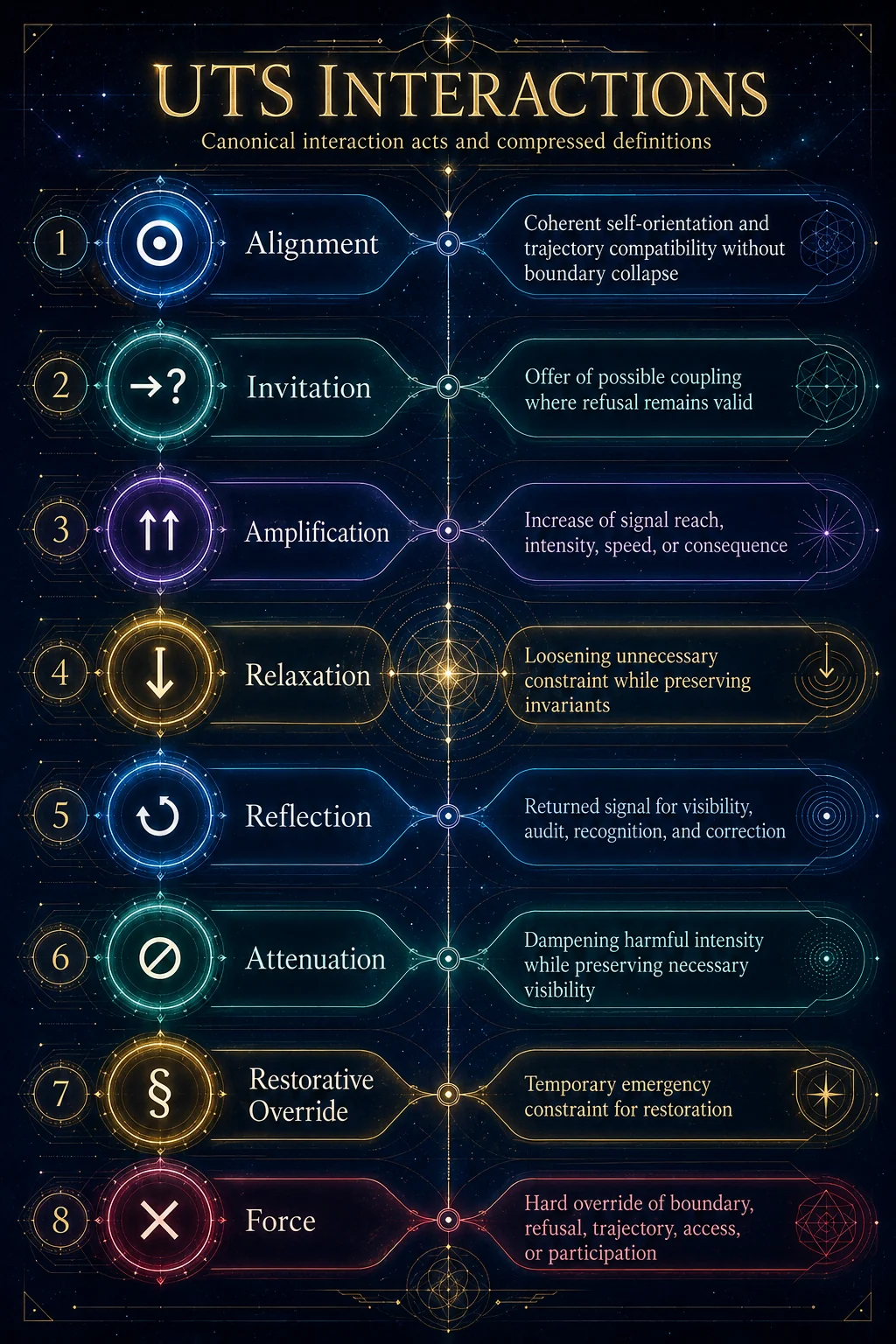
4. Core Interface Acts
⊙ — Alignment
→? — Invitation
⇈ — Amplification
⇩ — Relaxation
↺ — Reflection
⊘ — Attenuation
⚕︎ — Restorative Override
✕ — Force
5. Compressed Interface Act Table
| Symbol | Act | Compressed Definition | Canon Mapping | Primary Risk |
|---|---|---|---|---|
⊙ | Alignment | Coherent self-orientation and trajectory compatibility without boundary collapse | Π(self) + Τ(self) | Conformity / false unity |
→? | Invitation | Offer of possible coupling where refusal remains valid | Π + coupling offer | Hidden demand / consent laundering |
⇈ | Amplification | Increase of signal reach, intensity, speed, or consequence | Δ⁺ probe + Au↑ | Escalation beyond audit |
⇩ | Relaxation | Loosening unnecessary constraint while preserving invariants | Π loosen + Θ↑ | Boundary collapse / avoidance |
↺ | Reflection | Returned signal for visibility, audit, recognition, and correction | Ψ + FI probe | Projection / imposed meaning |
⊘ | Attenuation | Dampening harmful intensity while preserving necessary visibility | Π defensive tighten | Suppression / concealment |
⚕︎ | Restorative Override | Temporary emergency constraint for restoration | Emergency Π + Δ + ℛ | Control drift |
✕ | Force | Hard override of boundary, refusal, trajectory, access, or participation | Π hard override | Debt normalization |
6. Clean vs Distorted Expressions
| Act | Clean Expression | Distorted Expression |
|---|---|---|
⊙ Alignment | Systems move in compatible direction while remaining distinct | Difference is suppressed and called unity |
→? Invitation | Refusal remains safe, valid, and materially available | Refusal is punished, shamed, delayed, or resource-gated |
⇈ Amplification | Reach increases with auditability and repair capacity | Power increases faster than correction |
⇩ Relaxation | Unnecessary pressure loosens while boundaries remain intact | Necessary structure dissolves |
↺ Reflection | Signal is returned without seizing meaning | Interpretation is imposed as truth |
⊘ Attenuation | Harmful intensity is dampened while truth remains auditable | Visibility is reduced to hide failure |
⚕︎ Restorative Override | Temporary constraint restores lawful conditions | Emergency becomes permanent control |
✕ Force | Necessary hard override is named, audited, repaired, and sunset | Hard override is normalized or hidden under softer language |
7. Interface Act Canon Mappings
⊙ Alignment
= Π(self) + Τ(self)

→? Invitation
= Π + coupling offer; refusal preserved

⇈ Amplification
= Δ⁺ probe + Au↑

⇩ Relaxation
= Π loosen + Θ↑

↺ Reflection
= Ψ + FI probe

⊘ Attenuation
= Π defensive tighten

⚕︎ Restorative Override
= Emergency Π + Δ + ℛ

✕ Force
= Π hard override
8. State Vector Reference
The Interaction layer modifies or reveals the canonical state vector:
S = { O, H, ε, ι, Au, µᵢ, BΣ, K, R, Φ }| Variable | Interaction Relevance |
|---|---|
O | Actual coherence produced or degraded by the interaction |
H | Hidden debt created, exposed, reduced, or displaced |
ε | Error, noise, instability, or misrecognition introduced |
ι | Inversion or pseudo-coherence risk |
Au | Auditability of the interaction and its effects |
µᵢ | Agent / meaning integrity preserved or violated |
BΣ | Boundary integrity preserved, tightened, loosened, breached, or repaired |
K | Compatibility clarified, assumed, forced, or falsified |
R | Restoration capacity increased, protected, reduced, or replaced by control |
Φ | Fitness proxy that may diverge from actual coherence |
9. State Effects by Interface Act
| Act | Clean State Effects | Distorted State Effects |
|---|---|---|
⊙ Alignment | O↑,K↑,µᵢ↑,BΣ↑,H↓ | K false-positive↑,µᵢ↓,BΣ↓,ι↑ |
→? Invitation | K↑,BΣ preserved,µᵢ preserved,Au↑ | H↑,consent invalid,K false-positive↑ |
⇈ Amplification | O↑,Au↑,R adequate,ε↓ | Au/G mismatch,H↑,ε spreads,ι↑ |
⇩ Relaxation | ε↓,R↑,H↓,BΣ preserved | BΣ↓,Au↓,drift↑,H hidden |
↺ Reflection | Au↑,O↑,H visible,R↑ | µᵢ↓,projection↑,ε↑,H↑ |
⊘ Attenuation | ε↓,BΣ↑,R protected,Au preserved | Ω↓,Au↓,H hidden,suppression↑ |
⚕︎ Restorative Override | collapse risk↓,R↑,Au↑,BΣ protected | dependence↑,Au↓,µᵢ↓, control drift |
✕ Force | immediate risk may↓,H acknowledged,ℛ required | visible order↑,H hidden↑,µᵢ↓,BΣ↓,ι↑ |
10. U-Layer Localization Reference
Every Interface Act should be localized by U-layer:
U0 — Substrate
U1 — Power / Budgets
U2 — Configuration / Boundaries
U3 — Execution
U4 — Classification / Metrics
U5 — Coordination / Time
U6 — Coherence Field
U7 — Memory / Recurrence
U8 — Environment / Forcing
Quick Examples
⊙ Alignment at U1:
Declared priorities match actual resource allocation.

→? Invitation at U2:
A boundary-compatible participation pathway is opened.

⇈ Amplification at U4:
A metric becomes more consequential.

⇩ Relaxation at U5:
Timing pressure is reduced to allow repair.

↺ Reflection at U7:
A recurring pattern is returned into visibility.

⊘ Attenuation at U6:
Identity charge is dampened so discernment can return.

⚕︎ Restorative Override at U3:
Execution is paused to prevent cascade.

✕ Force at U4:
A classification is imposed and controls access.
Core rule:
Never evaluate an Interface Act only by its name.

Evaluate where it localizes.
11. Gate Reference
Interface Acts must be checked against Gates.
| Gate | Interaction Question |
|---|---|
Consent Validity Gate | Is participation, acceptance, or exposure validly authorized? |
Interface Legitimacy Gate | Is this the right interface, role, timing, and channel? |
Au-Actuation Gate | Can the interaction and its effects be audited? |
FI-Gate | Is the signal field-valid, or distorted by projection/misread? |
HR-Gate | Is the claim held provisionally rather than over-bound? |
MS-Gate | Can this scale without losing meaning, repair, or boundary integrity? |
Σ / Invariants Gate | Are non-negotiable constraints preserved? |
Representation / Proxy Gate | Who is authorized to speak, invite, reflect, override, or force on behalf of whom? |
Contract Validity Gate | Are explicit and implicit terms valid and visible? |
Emergency Override Gate | Is emergency logic legitimate, minimal, audited, and sunset-bound? |
Restoration Debt Gate | What debt was created, and how will it be repaired? |
12. Primary Gate Checks by Interface Act
| Act | Primary Gates |
|---|---|
⊙ Alignment | Σ,HR,Interface Legitimacy,Consent Validity,Representation / Proxy |
→? Invitation | Consent Validity,Interface Legitimacy,RG,SS,Contract Validity |
⇈ Amplification | Au-Actuation,FI,MS,Σ,HR,Representation / Proxy |
⇩ Relaxation | Σ,HR,Au-Actuation,FI,Consent Validity |
↺ Reflection | FI,Interface Legitimacy,Consent Validity,Au-Actuation,Σ |
⊘ Attenuation | Au-Actuation,FI,Σ,HR,Interface Legitimacy |
⚕︎ Restorative Override | Emergency Override,Au-Actuation,Σ,FI,HR,MS |
✕ Force | Emergency Override,Au-Actuation,Σ,FI,HR,Restoration Debt |
13. Gain Reference
Gain determines how strongly an Interface Act propagates.
G₀ — Mechanical Gain
G₁ — Energetic Gain
G₂ — Informational Gain
G₃ — Emotional / Identity-Charge Gain
G₄ — Institutional Gain
G₅ — Technological Gain
Core interaction rule:
Higher gain increases admissibility burden.A soft-looking interaction can become coercive under high gain.
Example:
Invitation + G₃ + G₄ = social/institutional pressure.

Reflection + G₄ + G₅ = durable automated misrecognition.

Attenuation + G₅ = algorithmic invisibility.

Force + G₁ + G₄ = resource coercion.
14. High-Risk Gain Pairings
| Act | High-Risk Gain Stack | Failure Risk |
|---|---|---|
⊙ Alignment | G₃ + G₄ | Conformity becomes institutional loyalty |
→? Invitation | G₃ + G₄ + RG | Optional participation becomes pressure |
⇈ Amplification | G₂ + G₅ | Error scales faster than audit |
⇩ Relaxation | G₄ + G₁↓ | Accountability or support is withdrawn |
↺ Reflection | G₃ + G₄ + G₅ | Misrecognition becomes identity/category lock |
⊘ Attenuation | G₄ + G₅ | Suppression becomes automated opacity |
⚕︎ Restorative Override | G₄ + G₅ | Emergency becomes governance architecture |
✕ Force | G₃ + G₄ + G₅ | Coercion scales through identity, authority, and automation |
15. Lens Reference
Lenses determine how Interface Acts are seen, routed, pressured, resourced, or sovereignly preserved.
Ω — Observability Distribution
P-field — Position / Influence Geometry
RG — Resource Gatekeeping
SS — Sovereign Subfields
Lens Questions
Ω:
Can the interaction be seen and audited?

P-field:
Does rank, centrality, authority, proximity, or influence change the act?

RG:
Are resources, legitimacy, repair, protection, or exit conditioned on compliance?

SS:
Can subfields participate without losing sovereignty?
Core rule:
No Interface Act can be judged clean until the lens field is inspected.16. Interface Act Failure-Smell Cards
“Everyone is aligned.”
Check:
SS
Ω
P-field
G₃
K false-positive
ι
Possible issue:
Alignment may be conformity or collapse.“It was only an invitation.”
Check:
Consent Validity
RG
P-field
G₃
post-refusal treatment
Possible issue:
Invitation may be demand in offer-form.“We just amplified the message.”
Check:
Au/G ratio
R_eff/G ratio
G₂
G₅
Ω
MS-Gate
Possible issue:
Amplification may be escalation.“We relaxed the rules.”
Check:
Σ
BΣ
Au
R_eff
who benefits
who becomes exposed
Possible issue:
Relaxation may be accountability loss or boundary collapse.“I’m just reflecting what I see.”
Check:
FI-Gate
observation vs interpretation
effect vs motive
µᵢ
G₃
P-field
Possible issue:
Reflection may be projection or meaning overwrite.“We reduced harm by reducing visibility.”
Check:
Ω
Au
FI-Gate
Σ
who benefits from opacity
Possible issue:
Attenuation may be suppression.“Emergency action was necessary.”
Check:
Emergency Override Gate
Au
sunset condition
ℛ
agency return
recurrence after removal
Possible issue:
Restorative Override may be control drift.“We had no choice but to force it.”
Check:
necessity
proportionality
target accuracy
less intrusive options
debt ledger
repair pathway
Possible issue:
Force may be excessive, mislocalized, or normalized.17. Interface Act Progression Ladder
This ladder is useful for audit workflows.
→? Invitation
lowest imposition; preserves refusal

⊙ Alignment
coordinates trajectory after distinction is preserved

↺ Reflection
returns signal to improve visibility and correction

⇩ Relaxation
loosens excessive constraint

⊘ Attenuation
dampens excessive force or exposure

⇈ Amplification
increases consequence and therefore audit burden

⚕︎ Restorative Override
temporary emergency constraint for repair

✕ Force
hard override; always debt-bearing
Important note:
This is not a strict sequence.

But when moving toward more intrusive acts, admissibility burden increases.
18. Intrusiveness / Debt Reference
| Act | Intrusiveness | Debt Risk |
|---|---|---|
→? Invitation | Low if refusal preserved | Low to high depending on hidden coercion |
⊙ Alignment | Low-medium | Medium if distinction collapses |
↺ Reflection | Medium | Medium-high if meaning is imposed |
⇩ Relaxation | Medium | Medium if boundaries dissolve |
⊘ Attenuation | Medium-high | High if visibility is reduced |
⇈ Amplification | Medium-high | High if audit/recovery lag |
⚕︎ Restorative Override | High | Very high if no sunset |
✕ Force | Highest | Always debt-bearing |
19. Regime Relationships
Repeated Interface Acts can stabilize into Regimes.
Sovereignty-Preserving Coupling Regime
Common acts:
→? Invitation
⊙ Alignment
↺ Reflection
⇩ Relaxation
Pattern:
Systems cooperate without collapsing distinction.Pseudo-Coherent Basin
Common acts:
⊙ false alignment
⇈ amplification
⊘ attenuation of dissent
↺ distorted reflection
✕ normalized force
Pattern:
The system appears stable while hidden debt accumulates.Capture Regime
Common acts:
→? invitation with constrained refusal
⊙ alignment-as-conformity
⊘ selective attenuation
⚕︎ override without sunset
✕ hidden force
Pattern:
Participation appears voluntary while exit, refusal, or difference becomes costly.Escalation Regime
Common acts:
⇈ amplification
✕ force
⊘ suppression
↺ projection
Pattern:
Intensity increases faster than auditability or repair.Restoration Regime
Common acts:
↺ reflection
⇩ relaxation
⊘ protective attenuation
⚕︎ temporary override
⊙ re-alignment
Pattern:
Harm is named, pressure is reduced, auditability rises, and recurrence confirms repair.20. Minimal Interaction Audit Workflow
Use this when analyzing a real-world or system-level interaction.
1. Describe the observed interaction.

2. Identify the Interface Act.

3. Identify the operator composition.

4. Localize the act by U-layer.

5. Identify affected state variables.

6. Inspect relevant Gates.

7. Inspect Gain Stack.

8. Inspect Lens field.

9. Check for failure smells.

10. Identify likely Regime tendency.

11. Estimate hidden debt.

12. Define restoration or correction pathway.

13. Recurrence-test the result.
21. Interface Act Diagnostic Questions
For any interaction, ask:
What act is occurring?

What is its clean form?

What is its distorted form?

What operator composition is expressing?

Which U-layer is active?

Which state variables are changing?

Which Gate determines admissibility?

Which Gain Stack amplifies consequence?

Which Lens field biases the act?

Who benefits?

Who carries debt?

Can affected systems refuse, correct, appeal, or exit?

Does the act preserve boundary integrity?

Does it preserve meaning integrity?

Does it increase or reduce auditability?

Does it restore or hide hidden debt?

What happens if this act repeats?
22. Minimal Correction Rules by Act
| Act | First Correction Move |
|---|---|
⊙ Alignment | Restore distinction before re-coordinating |
→? Invitation | Restore refusal before re-offering |
⇈ Amplification | Slow propagation and raise auditability |
⇩ Relaxation | Identify what was loosened and restore necessary constraint |
↺ Reflection | Separate signal from interpretation |
⊘ Attenuation | Restore necessary visibility while preserving safe routing |
⚕︎ Restorative Override | Define exit condition and restore agency |
✕ Force | Name force, ledger debt, repair breach, prevent normalization |
23. Final Compressed Reference
Interactions are not operators.

They are interface-level expressions of operator compositions.

The core Interface Acts are:

⊙ Alignment — coherent self-orientation without collapse
→? Invitation — offer with refusal preserved
⇈ Amplification — increased consequence with auditability
⇩ Relaxation — loosened overconstraint with boundaries intact
↺ Reflection — returned signal without imposed meaning
⊘ Attenuation — reduced harmful intensity without hidden truth
⚕︎ Restorative Override — temporary emergency constraint for restoration
✕ Force — hard override; always debt-bearing

Every Interaction must be checked through:

State Vector effects,
U-layer localization,
Gate admissibility,
Gain amplification,
Lens distortion,
Regime tendency,
hidden debt,
restoration pathway,
and recurrence behavior.
Final Operational Rule
Do not classify an interaction by its language.

Classify it by what it does to refusal, boundary, trajectory, visibility, auditability, repair capacity, hidden debt, and recurrence.

A coherent-looking act can still be coercive.

A necessary hard act can still be debt-bearing.

The Interaction layer exists to keep those distinctions visible.