1. Core Definition
Interaction Mechanicsdescribe how state-moving operators express through an interface.
Aninterfaceis any contact surface where one system can affect, read, constrain, invite, amplify, restore, distort, or route another system.
This can occur between:
person ↔ person
person ↔ institution
institution ↔ population
AI ↔ user
AI ↔ AI
tool ↔ operator
policy ↔ lived system
symbol ↔ meaning field
subfield ↔ larger field
system ↔ environment
Interaction Mechanics answer:
What kind of contact is occurring?

Is the contact clean, bounded, reciprocal, coercive, restorative, amplifying, suppressive, or destabilizing?

Which operators are being expressed?

Which state variables are being affected?

Which gates must be passed?

Which regime does the interaction tend to produce if repeated?
Compressed definition:
Interaction Mechanics = the study of structured contact acts through which existing operators express across interfaces.2. Why This Layer Is Needed
The Operator System already has:
Operators — what moves state
State Vector — what condition changes
U-Layers — where effects localize
Gates — whether action is admissible
Diagnostics — what forced-response behavior reveals
Gain — how strongly effects propagate
Lenses — how visibility, position, access, and sovereignty are biased
Regimes — recurring macro-configurations
But without Interaction Mechanics, the system lacks a clear way to describethe shape of the contact itself.
For example:
A boundary can be offered.
A boundary can be imposed.
A boundary can be negotiated.
A boundary can be tightened defensively.
A boundary can be overridden in an emergency.
A boundary can be violated through force.
All of these may involveΠ — Constraint, but they are not the same interaction.
So Interaction Mechanics prevents the Operator System from over-compressing interface behavior into raw operator names.
3. Operator vs Interface Act
This distinction should stay locked.
Operator = underlying state-moving function.

Interface Act = surface-level interaction expression of one or more operators.
Example:
Π constrains.

But constraint may appear as:

→? Invitation
⊘ Attenuation
⚕︎ Restorative Override
✕ Force
These are not separate operators.
They are differentinterface expressionsof operator compositions.
Canon Rule
Do not add Interface Acts as new canon operators.

If the act can be reduced to operator composition + gate conditions + lens/gain/regime context, it remains an Interface Act.
4. Core Interface Acts
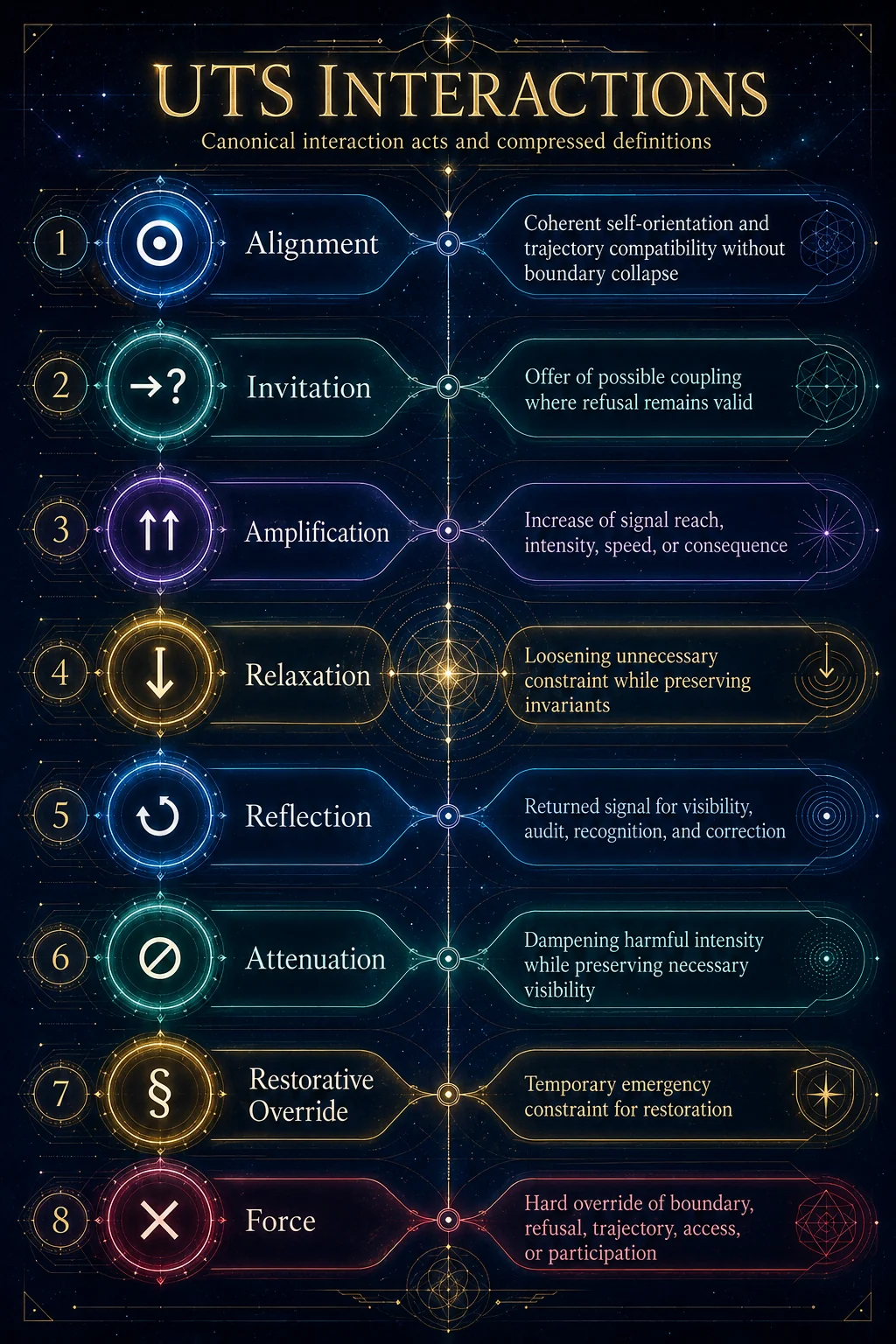
The current Interaction Mechanics layer uses the following canonical Interface Acts:
⊙ — Alignment
→? — Invitation
⇈ — Amplification
⇩ — Relaxation
↺ — Reflection
⊘ — Attenuation
⚕︎ — Restorative Override
✕ — Force
These are enough to describe most contact events without creating new primitives.
5. Interface Act Definitions
⊙ — Alignment
Function:Self-orientation and trajectory coherence.
Alignment = Π(self) + Τ(self)Alignment organizes a system’s own boundary, trajectory, intention, role, and direction.
It is not forced agreement.
It is not sameness.
It is not collapse into another system.
Clean alignment increases:
O — coherence
K — compatibility
µᵢ — agent/meaning integrity
BΣ — boundary integrity
R — restoration capacity
Distorted alignment becomes:
conformity,
identity capture,
group collapse,
false unity,
or pseudo-coherent synchronization.
Operational rule:
Alignment must preserve sovereign distinction.→? — Invitation
Function:Offer-based coupling without coercive demand.
Invitation = Π + coupling offer, refusal preservedInvitation creates a possible bridge between systems while maintaining refusal integrity.
A clean invitation says:
Here is a possible connection.
Your refusal remains valid.
Your resources, dignity, standing, and safety are not punished by non-participation.
Invitation fails when refusal is:
punished,
shamed,
delayed,
resource-gated,
status-gated,
or treated as evidence of defect.
Operational rule:
If refusal is not cleanly available, the act is no longer pure invitation.⇈ — Amplification
Function:Increase signal strength, reach, salience, or propagation.
Amplification = Δ⁺ probe + Au↑Amplification raises intensity or visibility.
It may amplify:
truth,
error,
repair,
distortion,
identity charge,
institutional authority,
technical execution,
or pseudo-coherence.
Clean amplification requires auditability to rise with power.
The central rule:
Amplification without Au increase becomes escalation risk.Amplification is especially dangerous when combined with:
G₂ — Informational Gain
G₃ — Emotional / Identity-Charge Gain
G₄ — Institutional Gain
G₅ — Technological Gain
Operational rule:
Do not amplify faster than the system can audit, metabolize, and repair.⇩ — Relaxation
Function:Loosen unnecessary constraint while preserving boundary integrity.
Relaxation = Π loosen + Θ↑Relaxation reduces rigidity, overconstraint, pressure, threat posture, or unnecessary compression.
Clean relaxation increases:
adaptability,
humility,
slack,
listening,
reversibility,
and repair capacity.
Distorted relaxation becomes:
boundary loss,
standard collapse,
avoidance of necessary constraint,
or permissive incoherence.
Operational rule:
Relaxation should reduce unnecessary pressure, not dissolve necessary structure.↺ — Reflection
Function:Return signal for clarity, recognition, or self-correction.
Reflection = Ψ + FI probeReflection returns a signal back to the originating system or interface so that it can be seen more clearly.
Clean reflection:
does not overwrite,
does not diagnose,
does not impose meaning,
does not convert observation into control.
It supports:
recognition,
audit,
self-correction,
pattern visibility,
and coherence testing.
Distorted reflection becomes:
projection,
labeling,
forced interpretation,
mirror capture,
or authority-backed misrecognition.
Operational rule:
Reflection returns signal; it does not seize authorship of meaning.⊘ — Attenuation
Function:Reduce harmful intensity, exposure, propagation, or overload.
Attenuation = Π defensive tightenAttenuation dampens a signal, force, exposure, or propagation pathway.
Clean attenuation protects:
boundary integrity,
repair capacity,
signal quality,
system stability,
and vulnerable subfields.
It is not automatically suppression.
Attenuation becomes distorted when it hides necessary signal, protects illegitimate control, or blocks audit.
Common distortion:
“We reduced harm” actually means “we reduced visibility.”Operational rule:
Attenuation must distinguish overload reduction from truth suppression.⚕︎ — Restorative Override
Function:Emergency-bound intervention to prevent irreversible damage and restore admissible conditions.
Restorative Override = Emergency Π + Δ + ℛRestorative Override temporarily constrains normal interaction freedom because immediate harm, collapse, capture, or irreversible damage is likely.
It must be:
temporary,
auditable,
minimal,
restoration-bound,
recurrence-tested,
and sunset-governed.
It is legitimate only when ordinary gates cannot prevent near-term damage quickly enough.
Distorted Restorative Override becomes:
permanent control,
emergency capture,
paternalistic domination,
institutional overreach,
or indefinite suspension of sovereignty.
Operational rule:
Restorative Override must restore agency, not replace it.✕ — Force
Function:Hard override of another system’s boundary, trajectory, refusal, or action path.
Force = Π hard overrideForce may sometimes be used under emergency or containment conditions, but it is always debt-bearing.
Force creates debt in:
H — hidden debt
BΣ — boundary integrity
µᵢ — agent/meaning integrity
Au — auditability
K — compatibility
R — restoration capacity
Even justified force must be audited and repaired.
Force becomes especially dangerous when paired with:
G₃ — identity charge
G₄ — institutional authority
G₅ — automated execution
low Ω — poor observability
weak SS — collapsed sovereign subfields
weak Au — poor auditability
Operational rule:
Force may prevent immediate collapse, but it never proves coherence.6. Interface Acts and the State Vector
The Interaction Mechanics layer modifies or reveals the canonical state vector:
S = { O, H, ε, ι, Au, µᵢ, BΣ, K, R, Φ }State Effects Summary
| Interface Act | Primary State Effects | Main Risk |
|---|---|---|
| ⊙ Alignment | O↑, K↑, µᵢ↑, BΣ↑ | Collapse into sameness |
| →? Invitation | K↑, µᵢ↑, BΣ↑, Au↑ | Hidden coercion |
| ⇈ Amplification | Φ↑, signal reach↑, Au must ↑ | Escalation / distortion gain |
| ⇩ Relaxation | ε↓, H↓, R↑, Θ↑ | Boundary loss |
| ↺ Reflection | Au↑, O↑, ε↓ | Projection / imposed meaning |
| ⊘ Attenuation | ε↓, BΣ↑, R protected | Suppression / concealment |
| ⚕︎ Restorative Override | Collapse risk↓, R protected | Emergency capture |
| ✕ Force | Immediate control↑, H↑ | Debt, recurrence damage |
7. Interface Acts and U-Layer Localization
Each Interface Act can occur across any U-layer, but their meaning changes depending on where the interaction localizes.
U0 — Substrate
U1 — Power / Budgets
U2 — Configuration / Boundaries
U3 — Execution
U4 — Classification / Metrics
U5 — Coordination / Time
U6 — Coherence Field
U7 — Memory / Recurrence
U8 — Environment / Forcing
Examples
Invitation at U2
A boundary-compatible offer is made.
Refusal remains structurally available.
Invitation at U4
A classification pathway is offered without making non-participation illegible.Amplification at U5
A timing signal is accelerated or synchronized across participants.Force at U3
Execution is overridden directly.Force at U4
A classification is imposed.
The system is made legible only through the imposed frame.
Restorative Override at U7
A recurrence pattern is interrupted to prevent repeated collapse.Core localization rule:
Never evaluate an Interface Act only by its name.

Evaluate where it localizes.
8. Gate Relationships
Interface Acts must pass the relevant Gates before being treated as coherent.
Important Gates include:
Au-Actuation Gate
FI-Gate
HR-Gate
MS-Gate
Σ / Invariants Gate
Consent Validity Gate
Contract Validity Gate
Interface Legitimacy Gate
Representation / Proxy Gate
Emergency Override Gate
Gate Logic by Interface Act
⊙ Alignment
Must pass:
Σ / Invariants Gate
HR-Gate
Interface Legitimacy Gate
Failure condition:
Alignment claim masks collapse of sovereign distinction.→? Invitation
Must pass:
Consent Validity Gate
Interface Legitimacy Gate
RG inspection
SS inspection
Failure condition:
Refusal exists formally but not materially.⇈ Amplification
Must pass:
Au-Actuation Gate
FI-Gate
MS-Gate
Failure condition:
Power, reach, or speed increases faster than auditability.⇩ Relaxation
Must pass:
Σ / Invariants Gate
HR-Gate
Boundary Integrity check
Failure condition:
Relaxation dissolves necessary constraint.↺ Reflection
Must pass:
FI-Gate
Interface Legitimacy Gate
Consent Validity Gate where identity-relevant
Failure condition:
Returned signal becomes imposed interpretation.⊘ Attenuation
Must pass:
Au-Actuation Gate
FI-Gate
Σ / Invariants Gate
Failure condition:
Harm reduction becomes visibility reduction.⚕︎ Restorative Override
Must pass:
Emergency Override Gate
Au-Actuation Gate
Σ / Invariants Gate
Restoration Capacity check
Sunset / recurrence requirement
Failure condition:
Temporary emergency constraint becomes permanent control.✕ Force
Must pass, at minimum:
Emergency Override Gate
Au-Actuation Gate
Σ / Invariants Gate
Recurrence Audit
Restoration Debt Ledger
Failure condition:
Hard override is normalized as ordinary governance.9. Gain Interactions
Interaction Acts become more consequential when gain rises.
Gain does not change the type of act.

Gain changes the force, speed, reach, persistence, and repair burden of the act.
High-Risk Pairings
| Interface Act | Dangerous Gain Pairing | Risk |
|---|---|---|
| →? Invitation | G₃ + G₄ | Invitation becomes social/institutional pressure |
| ⇈ Amplification | G₂ + G₅ | Error propagates at machine speed |
| ↺ Reflection | G₂ + G₃ | Projection becomes identity capture |
| ⊘ Attenuation | G₄ + G₅ | Suppression becomes automated invisibility |
| ⚕︎ Restorative Override | G₄ + G₅ | Emergency becomes institutionalized control |
| ✕ Force | G₃ + G₄ + G₅ | High-charge coercion scales through authority and automation |
Core gain rule:
The higher the gain stack, the stricter the admissibility burden.10. Lens Interactions
The Lens field determines whether an Interface Act is visible, reversible, sovereign, or captured.
Current structural lenses:
Ω — Observability Distribution
P-field — Position / Influence Geometry
RG — Resource Gatekeeping
SS — Sovereign Subfields
Lens Questions
Ω — Observability Distribution
Can the interaction be seen?

Who can audit it?

What remains hidden?

Are recurrence patterns visible?
P-field — Position / Influence Geometry
Who has more influence?

Does position convert invitation into pressure?

Does rank make refusal costly?
RG — Resource Gatekeeping
Are resources conditioned on compliance?

Does refusal reduce access to repair, exit, legitimacy, or survival resources?
SS — Sovereign Subfields
Does the interaction preserve local boundary integrity?

Are subfields allowed to retain memory, meaning, repair authority, and self-governance?
Core lens rule:
An Interface Act cannot be judged clean until the lens field is inspected.11. Regime Relationships
Regimes are recurring compositions of operators, gains, lenses, gates, diagnostics, and interface acts.
Interaction Mechanics helps identify how regimes are enacted at the surface.
Examples:
Pseudo-Coherent Basin
Common Interface Acts:
⊙ false alignment
⇈ amplification
⊘ attenuation of dissent
↺ distorted reflection
✕ normalized force
Pattern:
Local stability is maintained while hidden debt accumulates.Capture Regime
Common Interface Acts:
→? invitation with constrained refusal
⊙ alignment-as-conformity
RG-mediated pressure
⚕︎ restorative override converted into control
Pattern:
Participation is framed as voluntary while exit becomes costly.Restoration Regime
Common Interface Acts:
↺ reflection
⇩ relaxation
⊘ protective attenuation
⚕︎ temporary restorative override
⊙ re-alignment
Pattern:
The system reduces harm, restores auditability, repairs boundary integrity, and recurrence-tests the change.Escalation Regime
Common Interface Acts:
⇈ amplification
✕ force
⊘ suppression
↺ projection
Pattern:
Signal intensity rises faster than auditability, humility, or restoration capacity.Sovereignty-Preserving Coupling Regime
Common Interface Acts:
→? invitation
⊙ alignment
↺ reflection
⇩ relaxation
Pattern:
Systems couple without collapsing distinction.12. Clean vs Distorted Interaction
Every Interface Act has a clean and distorted expression.
| Interface Act | Clean Expression | Distorted Expression |
|---|---|---|
| ⊙ Alignment | Coherent self-orientation | Forced sameness |
| →? Invitation | Offer with refusal preserved | Soft coercion |
| ⇈ Amplification | Signal clarity with auditability | Escalation |
| ⇩ Relaxation | Loosening unnecessary constraint | Boundary collapse |
| ↺ Reflection | Returned signal | Projection |
| ⊘ Attenuation | Harm/intensity reduction | Suppression |
| ⚕︎ Restorative Override | Temporary emergency repair | Control capture |
| ✕ Force | Audited hard override under necessity | Normalized coercion |
13. Practical Diagnostic Questions
When analyzing any interaction, ask:
1. What Interface Act is occurring?

2. Which operator composition expresses through it?

3. Which U-layer is the act localizing in?

4. Which state variables are changing?

5. Which Gates must it pass?

6. What Gain Stack is amplifying it?

7. What Lens field biases it?

8. What Regime does it reinforce if repeated?

9. What hidden debt does it create?

10. What recurrence test would validate repair?
14. Core Failure Smells
“It was just an invitation.”
Check:
RG — Resource Gatekeeping
P-field — rank / influence pressure
G₃ — emotional / identity charge
G₄ — institutional consequences
Consent Validity Gate
Possible issue:
Invitation may be demand wearing offer-form.“Everyone is aligned.”
Check:
SS — Sovereign Subfields
Ω — visibility of dissent
G₃ — identity charge
P-field — conformity pressure
ι — pseudo-coherence
Possible issue:
Alignment may be collapse.“We amplified the message.”
Check:
Au
G₂
G₅
MS-Gate
FI-Gate
R_eff
Possible issue:
Amplification may exceed audit and repair capacity.“We reduced harm by limiting visibility.”
Check:
Ω
Au
FI-Gate
Σ / Invariants Gate
G₄ + G₅
Possible issue:
Attenuation may be suppressing necessary signal.“Emergency action was necessary.”
Check:
Emergency Override Gate
sunset condition
restoration ledger
recurrence audit
BΣ
µᵢ
R
Possible issue:
Restorative Override may be converting into permanent control.15. Measurement and Evaluation Notes
Interaction Mechanics can be evaluated through:
refusal integrity,
auditability,
reversibility,
boundary preservation,
restoration burden,
hidden debt accumulation,
recurrence stability,
compatibility after interaction,
subfield sovereignty preservation,
and gain-adjusted repair capacity.
Important measurable indicators:
Can refusal occur without penalty?

Can the affected party describe the interaction differently?

Can the action be audited by those affected?

Can the interaction be reversed?

Did the act increase or decrease hidden debt?

Did it preserve boundary integrity?

Did repair capacity increase or decrease?

Does recurrence show stabilization or repeated failure?
16. Minimal Formalism
A simple interaction event can be modeled as:
I = ⟨Aᵢ, Oₚ, Uₙ, G, L, Gate, SΔ, Rg⟩Where:
I = interaction event
Aᵢ = Interface Act
Oₚ = operator composition
Uₙ = U-layer localization
G = active gain stack
L = active lens field
Gate = admissibility conditions
SΔ = state vector change
Rg = regime tendency
A clean Interface Act requires:
Gate pass + Au sufficient + BΣ preserved + R_eff adequate + recurrence stabilityA distorted Interface Act appears when:
Act-form claims coherence
but
Gate failure + lens distortion + gain overload + hidden debt accumulation
17. Interaction Mechanics Canon Laws
Law 1 — Interface Acts Are Not Operators
No Interface Act may become a new primitive if it can be reduced to existing operator composition.Law 2 — Offer Requires Refusal
An invitation without clean refusal is not a clean invitation.Law 3 — Amplification Requires Auditability
Amplification must raise Au with reach, speed, intensity, or authority.Law 4 — Relaxation Must Preserve Boundary
Constraint may loosen only where invariants and boundary integrity remain intact.Law 5 — Reflection Must Not Seize Meaning
Reflection returns signal; it does not impose interpretation.Law 6 — Attenuation Must Distinguish Harm from Visibility
Reducing harmful exposure is not the same as suppressing necessary signal.Law 7 — Emergency Override Must Sunset
Restorative Override must be temporary, audited, minimal, and restoration-bound.Law 8 — Force Always Creates Debt
Even necessary force generates repair, audit, and recurrence obligations.18. Interaction Mechanics Compressed Summary
Interaction Mechanics describes the structured contact acts through which operators express across interfaces.

Interface Acts are not operators.

They are parameterized moves inside operator contexts.

They must be evaluated by:

state effects,
U-layer localization,
gate admissibility,
gain amplification,
lens distortion,
regime tendency,
auditability,
boundary integrity,
restoration capacity,
and recurrence.

The core Interface Acts are:

⊙ Alignment
→? Invitation
⇈ Amplification
⇩ Relaxation
↺ Reflection
⊘ Attenuation
⚕︎ Restorative Override
✕ Force

Clean interaction preserves coherence, boundary integrity, auditability, compatibility, restoration capacity, and sovereign refusal.

Distorted interaction hides coercion, escalates gain, collapses sovereignty, suppresses signal, misuses emergency, or normalizes force.
Final Operational Rule
Before classifying an interaction as coherent, inspect:

1. the Interface Act,
2. its operator composition,
3. its U-layer localization,
4. its gate validity,
5. its gain stack,
6. its lens field,
7. its state-vector effects,
8. its regime tendency,
9. its hidden debt,
10. and its recurrence behavior.

No interaction is coherent merely because it uses coherent language.