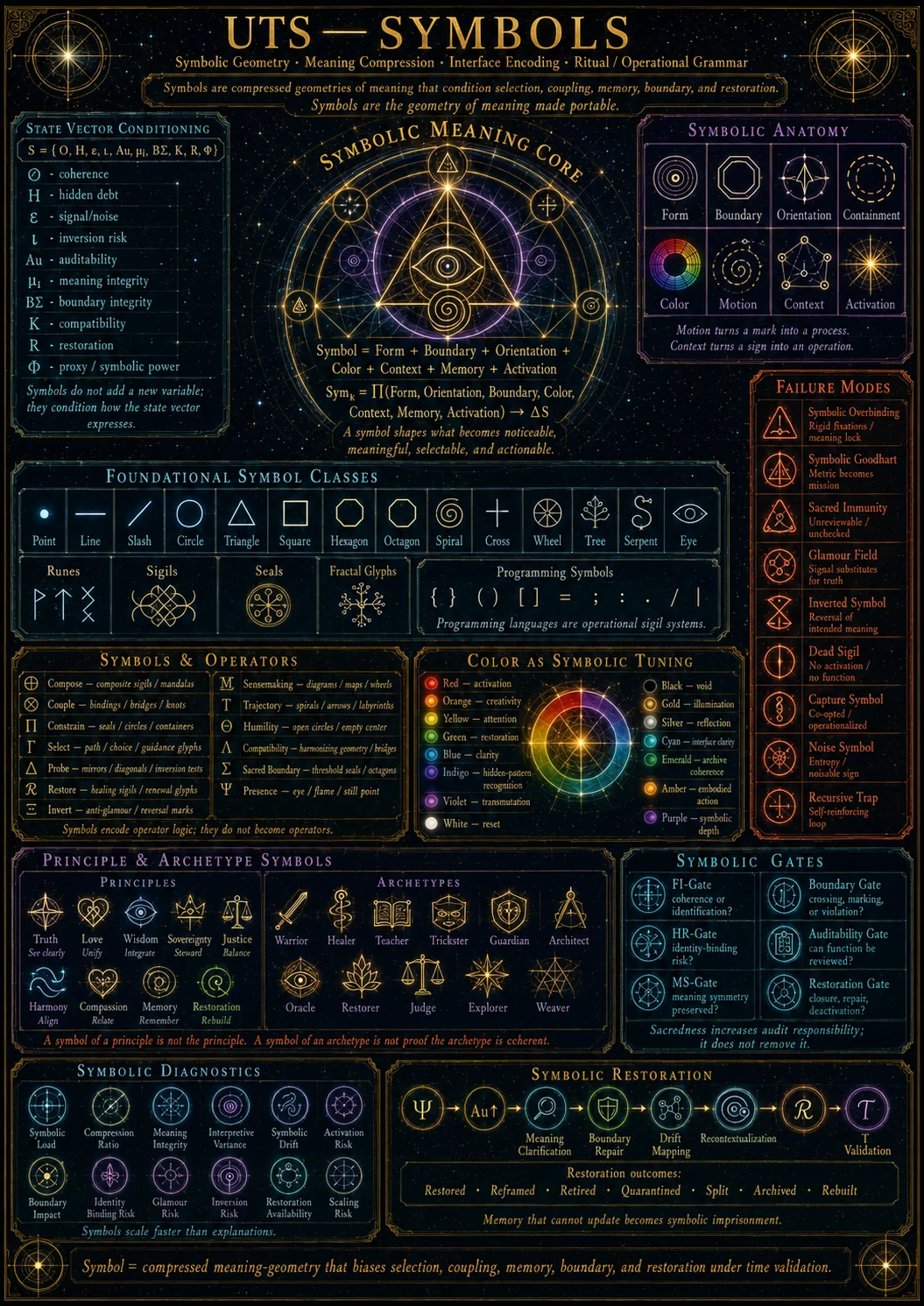
Foundational Overview
0. Opening Frame
Symbols are one of the oldest technologies humans have ever used.
Before formal writing, before mathematics, before computer code, and before modern data systems, humans used marks, shapes, colors, gestures, sounds, icons, rituals, and images to carry meaning across time.
A symbol can be as simple as a line, a circle, a flame, a handprint, a spiral, or a slash.
It can also be as complex as a national flag, a religious diagram, a scientific formula, a programming language, a logo, a rune, a sigil, a mythic archetype, or an AI interface icon.
At the surface level, a symbol “means something.”
But inside UTS, we go deeper:
A symbol is not only a sign. A symbol is a compressed structure that stores, directs, and activates meaning.
Symbols are how meaning becomes portable.
They allow a large pattern to be carried by a small form.
A single image can hold a story.
A single color can shift attention.
A single glyph can mark a boundary.
A single logo can coordinate millions of people.
A single icon can tell a user what action is possible.
A single rune can compress an entire field of myth, function, memory, and intention.
That is why symbols matter to UTS.
They are not decorative.
They are structural.
1. What Is a Symbol?
A symbol is avisible or perceivable form that carries meaning beyond itself.
But that is only the first layer.
In UTS, a symbol is better understood as:
a compressed meaning-structure that connects form, memory, attention, identity, and action.
This means every symbol has at least two sides.
1.1 The surface side
This is what we see.
Examples:
- a circle
- a triangle
- a rune
- a color
- a logo
- an icon
- a word
- a programming mark
- a ritual object
- a sigil
- a flag
1.2 The hidden side
This is what the symbol carries.
Examples:
- memory
- intention
- cultural meaning
- emotional charge
- instruction
- warning
- identity
- boundary
- invitation
- prohibition
- sacredness
- belonging
- authority
- restoration
- danger
- transformation
So a symbol is not just a picture.
It is acarrier of compressed pattern.
2. Symbols as Compression
One of the easiest ways to understand symbols is throughcompression.
A symbol takes something large and stores it in something small.
A heart symbol can compress:
- affection
- care
- bond
- vulnerability
- commitment
- tenderness
- longing
- grief
- healing
A flag can compress:
- land
- history
- sacrifice
- identity
- law
- conflict
- belonging
- memory
- sovereignty
A cross can compress:
- suffering
- sacrifice
- faith
- death
- resurrection
- burden
- covenant
- world-axis
- redemption
A spiral can compress:
- growth
- return
- recursion
- evolution
- memory
- time
- unfolding
A symbol is therefore a kind ofmeaning file.
It stores dense information in a compact form.
This is why symbols are close to data systems.
In data systems, we compress large information into smaller structures.
In symbolic systems, we compress large fields of meaning into smaller forms.
3. Symbols and Data Systems
Modern data systems and ancient symbolic systems are more related than they first appear.
A data system uses:
- labels
- keys
- indexes
- references
- file names
- metadata
- schemas
- icons
- paths
- categories
- tags
- syntax
- containers
- commands
A symbolic system uses:
- glyphs
- runes
- colors
- shapes
- ritual marks
- diagrams
- myths
- archetypes
- seals
- sigils
- sacred geometry
- symbolic grammar
Both systems solve the same basic problem:
How do we store, retrieve, route, interpret, and activate meaning?
3.1 Symbols as data keys
A symbol can act like a key.
When encountered, it opens a stored field of meaning.
For example:
- a folder icon tells us where stored files are
- a magnifying glass tells us search is available
- a red warning sign tells us danger or urgency
- a lock icon tells us something is protected
- a green check tells us something passed
- a flame icon tells us something is active, intense, or trending
These are not just pictures. They areinterface keys.
They help a user navigate a data system.
3.2 Symbols as metadata
A symbol can also act like metadata.
It tells us how to interpret something.
For example:
- a red label can mean urgent
- a gold seal can mean official
- a skull icon can mean hazardous
- a blue badge can mean verified
- a folder color can indicate project type
- an archive icon can indicate preservation
- a warning triangle can indicate risk
The symbol does not contain the whole data object.
But it tells us how to treat the data object.
3.3 Symbols as interface elements
Every interface is symbolic.
Buttons, menus, icons, colors, tabs, badges, loaders, arrows, cards, charts, and status indicators are all symbols.
They answer questions like:
- What can I do here?
- Where am I?
- What is important?
- What is active?
- What is dangerous?
- What is complete?
- What is hidden?
- What can be opened?
- What can be edited?
- What requires permission?
So symbols are not separate from software.
They are how software becomes understandable.
4. Symbols as Interfaces
A symbol sits between two things:
- the visible form
- the deeper meaning
That makes every symbol aninterface.
A good symbol creates a clean interface.
It helps meaning cross from one domain into another.
For example:
- a map turns territory into navigable marks
- a diagram turns complexity into visible structure
- a ritual symbol turns intention into shared action
- a logo turns an organization into a recognizable identity
- a rune turns a mythic function into a portable glyph
- an icon turns software behavior into something a user can understand
- a color system turns a website into a navigable meaning-space
In this sense:
A symbol is an interface between meaning and perception.
It lets something invisible become usable.
5. Symbols and UTS
UTS is concerned with coherence.
A system is coherent when it can preserve identity, meaning, and function across time under transformation.
Symbols matter because they help preserve, move, and transform meaning.
They can support coherence by making meaning clear, portable, memorable, and actionable.
But they can also damage coherence when they distort, overload, manipulate, or freeze meaning.
So in UTS, symbols are evaluated by their effect on the system.
A symbol is not automatically coherent because it is beautiful, ancient, sacred, powerful, popular, or emotionally moving.
A symbol is coherent when it helps preserve:
- meaning
- boundary
- memory
- identity
- truth
- compatibility
- restoration
- auditability
A symbol becomes incoherent when it creates:
- confusion
- false authority
- hidden debt
- identity capture
- boundary collapse
- symbolic manipulation
- pseudo-coherence
- sacred immunity
- glamour without truth
- activation without restoration
6. Symbols Do Not Add a New UTS Variable
This is important.
UTS already has a core state vector:
S = O, H, ε, ι, Au, μᵢ, BΣ, K, R, Φ
Symbols do not add another variable.
Instead, they condition how the existing variables move.
In plain language:
| UTS Variable | How Symbols Affect It |
|---|---|
| O — Coherence | Symbols can stabilize shared meaning or fragment it. |
| H — Hidden Debt | Symbols can hide unresolved contradictions. |
| ε — Error/Noise | Symbols can clarify or confuse signals. |
| ι — Inversion | Symbols can create false coherence or sacred-looking distortion. |
| Au — Auditability | Symbols can reveal structure or hide causality. |
| μᵢ — Meaning / Agent Integrity | Symbols can preserve or capture identity. |
| BΣ — Boundary Integrity | Symbols can mark, protect, blur, or violate boundaries. |
| K — Compatibility | Symbols can signal real fit or falsely imply it. |
| R — Restoration Capacity | Symbols can support repair, closure, and reintegration. |
| Φ — Fitness Proxy | Symbols can become status markers or shallow success signals. |
So symbols are aconditioning layer.
They shape how meaning travels through the system.
7. Symbols and Geometry
Symbols are made of geometry.
Even a simple mark has structure.
A circle holds.
A triangle points.
A square stabilizes.
A spiral unfolds.
A slash separates.
A cross intersects.
A wheel cycles.
A tree branches.
A labyrinth guides.
A seal contains.
A mirror reflects.
An eye witnesses.
This means symbols are not arbitrary.
Their form affects how they function.
A circle and a triangle do not feel the same because they do not do the same thing geometrically.
A circle creates containment and continuity.
A triangle creates focus, direction, and transformation.
A square creates stability and structure.
A spiral creates movement through recurrence.
A slash creates division, threshold, or alternate path.
So UTS–Symbols extends UTS–Geometry:
Geometry is the structure of possibility. Symbolic geometry is the structure of meaningful possibility.
8. Symbols and Memory
Symbols preserve memory.
They allow a system to remember without storing everything in full detail.
This is why cultures use symbols.
A culture cannot retell every story in full every time it needs meaning.
So it uses compressed forms:
- flags
- myths
- icons
- holidays
- sacred objects
- monuments
- songs
- colors
- names
- rituals
- diagrams
- archetypes
The symbol becomes a memory handle.
When activated, it reopens the larger memory field.
This also happens in personal systems.
A ring can hold a relationship.
A photograph can hold a life phase.
A song can hold a season of transformation.
A drawing can hold a realization.
A glyph can hold an intention.
A color palette can hold a project identity.
In data terms:
A symbol is a memory pointer with emotional, cultural, and interpretive metadata attached.
9. Symbols and Identity
Symbols help systems know who they are.
This can be healthy or dangerous.
Healthy symbolic identity gives a system continuity.
Examples:
- a project logo that helps people recognize its purpose
- a family symbol that carries memory
- a personal mark that reminds someone of their path
- a cultural symbol that preserves shared history
- an archive taxonomy that makes knowledge navigable
But symbolic identity can become dangerous when the symbol captures the system.
Examples:
- a role becomes a prison
- a flag replaces truth
- a badge replaces competence
- a spiritual symbol replaces humility
- a brand replaces actual value
- an archetype becomes a fixed identity
- a logo becomes more important than the people it represents
UTS makes the distinction this way:
A coherent symbol supports identity without trapping it.
The symbol should preserve continuity, not freeze becoming.
10. Symbols and Boundaries
Symbols often mark boundaries.
They can say:
- enter here
- do not enter
- this is protected
- this is sacred
- this is private
- this is complete
- this is dangerous
- this is open
- this is sealed
- this belongs here
- this does not belong here
Examples:
- lock icon
- warning sign
- seal
- circle
- threshold mark
- legal signature
- border symbol
- ritual boundary
- access badge
- permission icon
In UTS, boundary-related symbols connect strongly toBΣ — Boundary Integrity.
A good boundary symbol makes the edge clear.
A bad boundary symbol confuses, manipulates, or hides the edge.
For example, a symbol that appears inviting but contains hidden hooks is boundary-incoherent.
A symbol that marks protection while actually enabling capture is inverted.
11. Symbols and Action
Symbols do not only store meaning.
They can trigger action.
Examples:
- a stop sign stops traffic
- a play button starts media
- a warning icon changes behavior
- a religious symbol may initiate reverence
- a military insignia may trigger recognition of rank
- a programming command executes a function
- a ritual mark may begin a sequence
- a sigil may focus intention
- a badge may grant access
This is why symbols matter operationally.
They can change what a system does.
In UTS terms, symbols can biasΓ — Selection.
They influence which path becomes more likely.
A symbol can make one action feel available and another action feel closed.
That makes symbols part of the system’s decision environment.
12. Symbols and Code
Code is one of the clearest modern examples of operational symbolism.
A programming language is made of symbols that do things.
For example:
{}means scope or containment.
()means invocation or parameter space.
[]means index, list, or array.
=means assignment or binding.
;means closure or statement termination.
.means access into a nested structure.
These are not just marks.
They are symbolic operators inside a formal system.
In a ritual system, a seal may close a pattern.
In a programming system, a semicolon may close a statement.
In a symbolic diagram, a circle may create containment.
In code, braces create containment.
The domains differ, but the structural logic overlaps.
So one of the core insights of UTS–Symbols is:
Code is executable symbology.
And conversely:
Symbolic systems are meaning-code.
13. Symbols and AI Systems
AI systems depend heavily on symbols.
Language itself is symbolic.
Prompts are symbolic instructions.
Interface icons are symbolic affordances.
Memory tags are symbolic retrieval handles.
Personas are symbolic role containers.
Categories are symbolic classifications.
Safety labels are symbolic boundaries.
Model outputs are symbolic reconstructions.
So in AI systems, symbols appear at many layers:
- user interface
- prompt language
- system instructions
- labels
- tags
- taxonomies
- embeddings
- icons
- avatars
- memory structures
- role descriptions
- trust indicators
- warnings
- consent flows
This makes symbolic integrity very important for AI.
An AI assistant with a “healer” persona, for example, is not automatically restorative.
The symbol must be checked against the actual system behavior.
Does it preserve boundaries?
Does it avoid overclaiming?
Does it maintain auditability?
Does it avoid identity capture?
Does it restore instead of deepen dependency?
Does it preserve user agency?
In UTS terms:
AI symbols must remain scope-bound, audit-bound, and restoration-capable.
14. Symbols and Culture
Culture is built from symbols.
A culture stores its meaning in:
- stories
- holidays
- rituals
- clothing
- architecture
- music
- language
- myths
- flags
- foods
- gestures
- sacred objects
- public spaces
- ceremonies
- taboos
- names
- archetypes
These symbols coordinate behavior across time.
They help people know:
- what matters
- what is forbidden
- what is honored
- what is remembered
- what is possible
- what is dangerous
- what is sacred
- what is shameful
- what is beautiful
- what is worth protecting
This makes culture a symbolic operating system.
But cultural symbols can also drift.
A symbol may begin as a living memory and become an empty performance.
A ritual may begin as restoration and become obligation.
A flag may begin as shared identity and become exclusion.
A sacred image may begin as humility and become authority theater.
So UTS–Symbols gives culture a diagnostic language.
We can ask:
- Is the symbol still connected to its original meaning?
- Has it become a proxy for status?
- Does it preserve memory or freeze it?
- Does it support coherence or demand conformity?
- Does it allow restoration?
- Can it be questioned without punishment?
- Does it still serve life, truth, and repair?
15. Symbols and Restoration
Symbols can help restore systems.
They can provide:
- closure
- mourning
- remembrance
- apology
- repair
- recommitment
- reintegration
- transition
- protection
- healing
- renewed identity
- release
Examples:
- a memorial
- a mended object
- a new name
- a cleansing ritual
- a restored seal
- a healing sigil
- a shared song
- a forgiveness ceremony
- a rewritten charter
- a redesigned interface
- an archive entry preserving what happened
Restoration often needs symbols because systems need a way to mark transition.
Without symbols, repair can remain invisible.
But symbolic restoration must not replace material restoration.
A symbol of apology is not the same as repair.
A ritual of healing is not the same as restored capacity.
A public statement is not the same as changed structure.
A badge of safety is not the same as actual safety.
So the UTS rule is:
Symbolic restoration is valid only when it connects to real restoration.
16. Symbolic Failure
Symbols can fail.
They fail when they no longer preserve coherent meaning.
Common symbolic failures include:
16.1 Hollow Symbol
The form remains, but the meaning is gone.
Example:
- ritual without presence
- title without responsibility
- logo without value
- apology without repair
16.2 Inverted Symbol
The symbol is used opposite to its claimed meaning.
Example:
- peace symbol used for coercion
- healing symbol used to avoid accountability
- truth symbol used for manipulation
- protection symbol used for control
16.3 Overbound Symbol
The symbol becomes too attached to identity.
Example:
- “I am this role, so I cannot change.”
- “This symbol defines us, so critique is betrayal.”
16.4 Glamour Symbol
The symbol attracts attention beyond its evidence.
Example:
- ancient-looking symbols treated as automatically true
- sacred imagery used to bypass scrutiny
- beautiful design hiding incoherent structure
16.5 Capture Symbol
The symbol makes exit difficult.
Example:
- loyalty symbols
- cultic badges
- identity seals
- status markers
- symbolic contracts with hidden cost
16.6 Dead Interface
The symbol appears functional but no longer changes the system.
Example:
- feedback button nobody reads
- ethics badge with no enforcement
- ceremonial review with no authority
- symbolic consent with no real refusal path
These are not minor aesthetic issues.
They are coherence problems.
17. The Reader’s Bridge: Why This Matters
Symbols matter because they sit at the crossing point of:
- data
- meaning
- memory
- identity
- action
- culture
- interface
- coherence
They are one of the main ways invisible structure becomes visible.
They are also one of the main ways visible structure hides invisible distortion.
A coherent symbol helps a system remember, choose, repair, and transform.
An incoherent symbol helps a system perform meaning while losing it.
This is why UTS treats symbols carefully.
Symbols are powerful because they compress.
But compression always carries risk.
When compression is coherent, the symbol becomes a bridge.
When compression is incoherent, the symbol becomes a trap.
18. UTS–Symbols in One Simple Model
A symbol can be understood through five questions:
1. What does it hold?
Meaning, memory, role, warning, instruction, identity, boundary, restoration.
2. What does it point toward?
A principle, action, place, state, relationship, archetype, or process.
3. What does it activate?
Attention, emotion, behavior, belonging, caution, reverence, repair, selection.
4. What does it protect or expose?
Boundary, truth, memory, identity, hidden debt, danger, contradiction.
5. What happens when it scales?
Does it preserve meaning, or does it become hollow, captured, inflated, or inverted?
19. Foundational Summary
UTS–Symbols is the study of how symbols function as compressed meaning-structures inside coherent and incoherent systems.
Symbols are not only signs.
They are:
- memory handles
- attention routers
- boundary markers
- identity anchors
- interface elements
- data keys
- cultural packets
- archetype carriers
- restoration marks
- operational meaning-code
They connect ancient symbolic practice with modern data systems because both are concerned with storing, retrieving, routing, interpreting, and activating compressed information.
Inside UTS, symbols matter because they influence coherence.
They can preserve meaning across time.
They can help systems navigate complexity.
They can give form to invisible structure.
They can also distort meaning, capture identity, suppress auditability, and create pseudo-coherence.
So the central rule is:
A symbol is coherent when it preserves meaning, boundary, auditability, and restoration across time.
And the simplest formulation is:
Symbols are portable geometries of meaning.
Or even shorter:
Symbols are how meaning becomes interface.