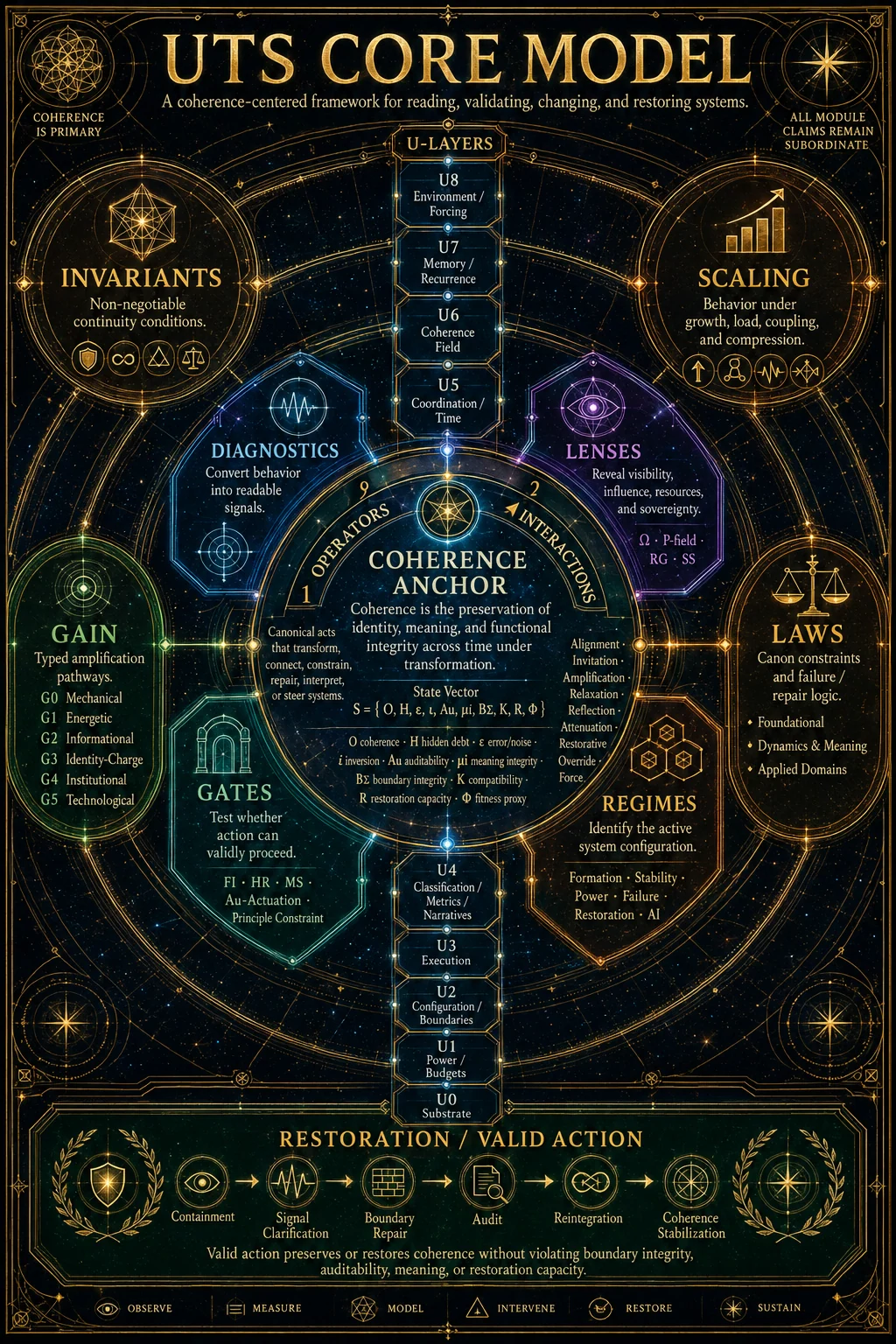
Core System Map
The core model is the overview. These linked sections are the technical layers that make the overview operational.
Overview
Purpose
The Universal Theory Stack is a modular framework for analyzing how coherence forms, fails, scales, and restores across domains.
UTS is not organized around optimization as the primary target. Optimization can improve a metric while degrading the system that metric was meant to serve. UTS is organized around coherence: the preservation of identity, meaning, boundary integrity, and functional viability across time under transformation.
The technical layer exists to maintain rigor. The system itself is universal: it can be expressed through mathematics, science, governance, culture, symbols, archetypes, principles, consciousness, biology, AI, and lived systems.
Core Definition
Coherence is the preservation of identity, meaning, and functional integrity across time under transformation.
A fuller technical definition:
Coherence is the alignment of a system’s internal dynamics with the governing dynamics of the larger field it is embedded in, such that the system can persist, adapt, and evolve without accumulating destabilizing debt.
This definition is scale-invariant. It applies to particles and fields, organisms and ecosystems, individuals and relationships, institutions and civilizations, AI systems and cognitive infrastructure. The expression changes by scale, but the structure does not.
Coherence Over Optimization
UTS distinguishes coherence from optimization because optimization depends on the fitness proxy being used.
A system can optimize a metric while losing the deeper conditions that make the system viable. This is one of the central UTS distinctions:
O ≠ ΦWhere:
- Omeans coherence.
- Φmeans fitness proxy or measured success signal.
A system can increase Φ while reducing O. This appears in institutional failure, AI drift, burnout, extractive governance, reputational stability, and pseudo-coherent systems that preserve order by exporting cost elsewhere.
What Coherence Is Not
Coherence is not:
- agreement
- obedience
- social comfort
- moral performance
- stillness or stasis
- efficiency alone
- optimization success
- institutional order
- emotional calm
- control
A system can look calm, successful, efficient, or orderly while losing coherence.
Core anchors:
Stability is not coherence.
Success is not coherence.
Control is not coherence.
Optimization is not coherence unless the optimization target preserves coherence across scale and time.
Validation Rule
Coherence is not proven by claim, status, authority, or appearance. It is validated by:
- time
- stress
- recurrence
- repair
- auditability
- boundary preservation
- cross-scale effects
A system demonstrates coherence by maintaining integrity under transformation.
Canonical State Vector
UTS tracks coherence through a shared state vector:
S(t) = { O, H, ε, ι, Au, µᵢ, BΣ, K, R, Φ }| Symbol | Name | Meaning |
|---|---|---|
| O | Coherence | True viability under stress and transformation. |
| H | Hidden Debt | Deferred incoherence, unprocessed cost, or unobserved misalignment. |
| ε | Error / Noise | Observable deviation, disturbance, or signal disorder. |
| ι | Inversion Index | Apparent order masking actual incoherence. |
| Au | Auditability | Ability to inspect state, cause, consequence, and provenance. |
| µᵢ | Meaning / Agent Integrity | Alignment between model, action, identity, and consequence over time. |
| BΣ | Boundary Integrity | Preservation of identity, consent, interface clarity, and exit conditions. |
| K | Compatibility / Slack / Sovereignty | Adaptive margin, usable buffer, and coherent coupling capacity. |
| R | Restoration Capacity | Ability to repair, realign, reduce hidden debt, and recover correction capacity. |
| Φ | Fitness Proxy | Measured success signal used for optimization; distinct from coherence. |
The most important distinction is:
O ≠ ΦA system can increase its success metrics while destroying its coherence.
Localization Model: U0–U8
UTS uses U-layers to locate where coherence or incoherence manifests. U-layers are localization indices, not new variables.
| Layer | Domain |
|---|---|
| U0 | Substrate: physical, material, and energetic limits. |
| U1 | Power and budgets: energy, time, compute, attention, money, resources. |
| U2 | Configuration: permissions, boundaries, interfaces, gates. |
| U3 | Execution: runtime behavior, implementation, actuation. |
| U4 | Classification: models, metrics, narratives, labels, meanings. |
| U5 | Coordination: timing, sequencing, protocols, synchronization. |
| U6 | Coherence field: cross-domain coupling and systemic resonance. |
| U7 | Memory: recurrence, hysteresis, persistence, retained pattern. |
| U8 | Environment: external forcing, shocks, field conditions. |
Core rule:
Repair must occur at the same or lower layer than the failure origin.
Examples:
- A U1 exhaustion problem cannot be solved with U4 motivation alone.
- A U2 boundary failure cannot be solved with U4 reframing alone.
- A U7 recurrence pattern cannot be solved by one-time U3 behavior change.
This prevents symbolic repair from replacing structural repair.
Operator Model
UTS tracks how systems change using canonical operators. Operators describe transformations of state, not beliefs or claims.
Core structural operators:
| Operator | Name | Function |
|---|---|---|
| ⊕ | Compose | Merge systems into a new identity. |
| ⊗ | Couple | Connect systems while preserving identity. |
| Π | Constrain | Define boundaries and admissible regions. |
| Γ | Select | Choose among possible paths. |
| Δ | Distort / Perturb | Stress, probe, test, or disrupt. |
| ℛ | Restore | Repair, realign, and reduce hidden debt. |
| Ξ | Invert / Expose | Detect pseudo-coherence and inversion. |
Meaning and regulation operators:
| Operator | Name | Function |
|---|---|---|
| Μ | Sensemaking | Interpret signals into provisional models. |
| Τ | Trajectory | Bias long-horizon direction. |
| Θ | Humility | Damp gain under uncertainty. |
| Λ | Compatibility | Test whether coupling increases coherence. |
| Σ | Sacred Boundary | Protect non-negotiable invariants. |
| Ψ | Presence | Increase audit resolution through attention. |
Important distinctions:
Coupling is not merger.
Ξ detects pseudo-coherence. It does not restore coherence.
Θ is a stability primitive, not merely a virtue.
Gates
UTS gates decide whether an action, coupling, claim, or transition is admissible.
| Gate | Function |
|---|---|
| FI-Gate | Feedback integrity and anti-Goodhart protection. |
| HR-Gate | Blocks identity-binding certainty under low evidence. |
| MS-Gate | Symmetry gate; no rank immunity. |
| Au-Actuation | Minimum traceability before high-impact action. |
| Σ / Principle Gates | Protect inviolable constraints and coherence commitments. |
Gate failure returns:
∅ = null outcomeA failed gate is not punishment. It means the transition is not currently coherent. The appropriate response is to quarantine, rescope, restore, gather more evidence, or reduce actuation.
Diagnostics
UTS tracks coherence through diagnostics that reveal limits, stress, and recovery behavior.
| Diagnostic | Meaning |
|---|---|
| 𝓑(t) | Bandwidth: how much force the system can absorb before phase transition. |
| 𝓓(t) | Damping: how well disturbance settles after perturbation. |
| σ(t) | Slack: buffer before forced-response degradation. |
| τresp(t) | Reaction latency from signal to effective response. |
| τm(t) | Memory half-life and recurrence risk. |
| Xc(t) | Constraint complexity. |
| µmeta(t) | Meta succession rate or rulebook churn. |
| Perm(t) | Boundary permeability. |
| AP(t) | Attribution pressure and proxy collision risk. |
Core diagnostic anchor:
Ring-down reveals coherence.
A coherent system settles after disturbance. An incoherent system keeps oscillating, escalating, recurring, or exporting cost.
Hidden Debt
Hidden debt is incoherence that has not yet surfaced as visible failure.
It accumulates when systems:
- suppress feedback
- delay repair
- externalize costs
- hide uncertainty
- over-optimize metrics
- maintain appearances instead of reducing causes
- replace structural repair with symbolic repair
Hidden debt eventually appears as collapse, burnout, scandal, legitimacy loss, technical failure, social unrest, ecological rebound, or AI alignment drift.
Core law:
Suppressed error does not disappear. It becomes hidden debt.
Pseudo-Coherence
Pseudo-coherence is local order that depends on hidden debt, suppressed feedback, or exported harm.
Signs include:
- success metrics improve while trust declines
- procedures increase while clarity decreases
- calm depends on silence
- stability depends on invisible labor
- power grows while restoration shrinks
- transparency exists without auditability
Canonical signature:
Φ↑ while O↓
H↑
ι↑
Au↓
𝓓 worsens over time
Public-facing anchor:
If a system looks stable only because someone else is paying the price, it is not coherent.
Restoration
Restoration is the mechanical reduction of hidden debt and recovery of correction capacity.
It follows a general sequence:
- Legibility— make the problem visible.
- Slack regeneration— restore adaptive buffer.
- Attractor shift— change what the system stabilizes around.
- Bounded exploration— test new configurations safely.
- Integration— normalize the repaired baseline.
Completion requires:
R > Load × Gain
H↓
𝓓↑
recurrence↓
If these do not occur, restoration is incomplete.
Accountability
UTS reframes accountability as coherence observed over time, not judgment applied in the moment.
A system is accountable when it:
- pays its own coherence costs
- reduces future repair burden
- does not export hidden debt
- remains auditable
- allows exit
- repairs rather than suppresses
Time is the final accountability mechanism.
Relationship to Modules
Coherence is the central organizing principle of UTS. Other modules express coherence through different domains.
| Module | Relation to Coherence |
|---|---|
| Scaling | How coherence behaves under amplification. |
| Cybernetics | How coherence is regulated through feedback. |
| Interactions / Signals / Couplings | How coherence is preserved or lost through exchange. |
| Principles | Constraint fields that guide coherence-preserving action. |
| Archetypes / Symbols | Compressed patterns for navigating coherence dynamics. |
| Security | Preserving coherence under adversarial forcing. |
| Justice / Governance / Legitimacy | Coherence under asymmetry and power. |
| AI Governance | Coherence preservation in high-impact cognitive systems. |
| Restoration | Repairing coherence after hidden debt or collapse. |
| Culture | Shared coherence fields and meaning transmission. |
| Consciousness / Meaning / Spirituality | Coherence sensing, meaning integrity, and restoration under uncertainty. |
Short form:
UTS studies how coherence forms, fails, scales, and restores across domains.
Core Anchors
- Coherence is scale-invariant; only its expression changes.
- O ≠ Φ: success metrics are not coherence.
- Stability is not coherence.
- Local success does not imply global alignment.
- Suppressed error becomes hidden debt.
- If coherence requires exporting harm, it is not coherence.
- Repair must occur at the same or lower layer than the failure origin.
- Restoration precedes scaling.
- Accountability is coherence observed over time.
- The universe does not reward coherence; it permits it.
How to Use This Page
Use this page as the central orientation layer for the archive. It should be read before the deeper module pages when a reader needs the UTS baseline: coherence over optimization, the state vector, U-layers, operators, diagnostics, gates, hidden debt, pseudo-coherence, restoration, and module relationships.