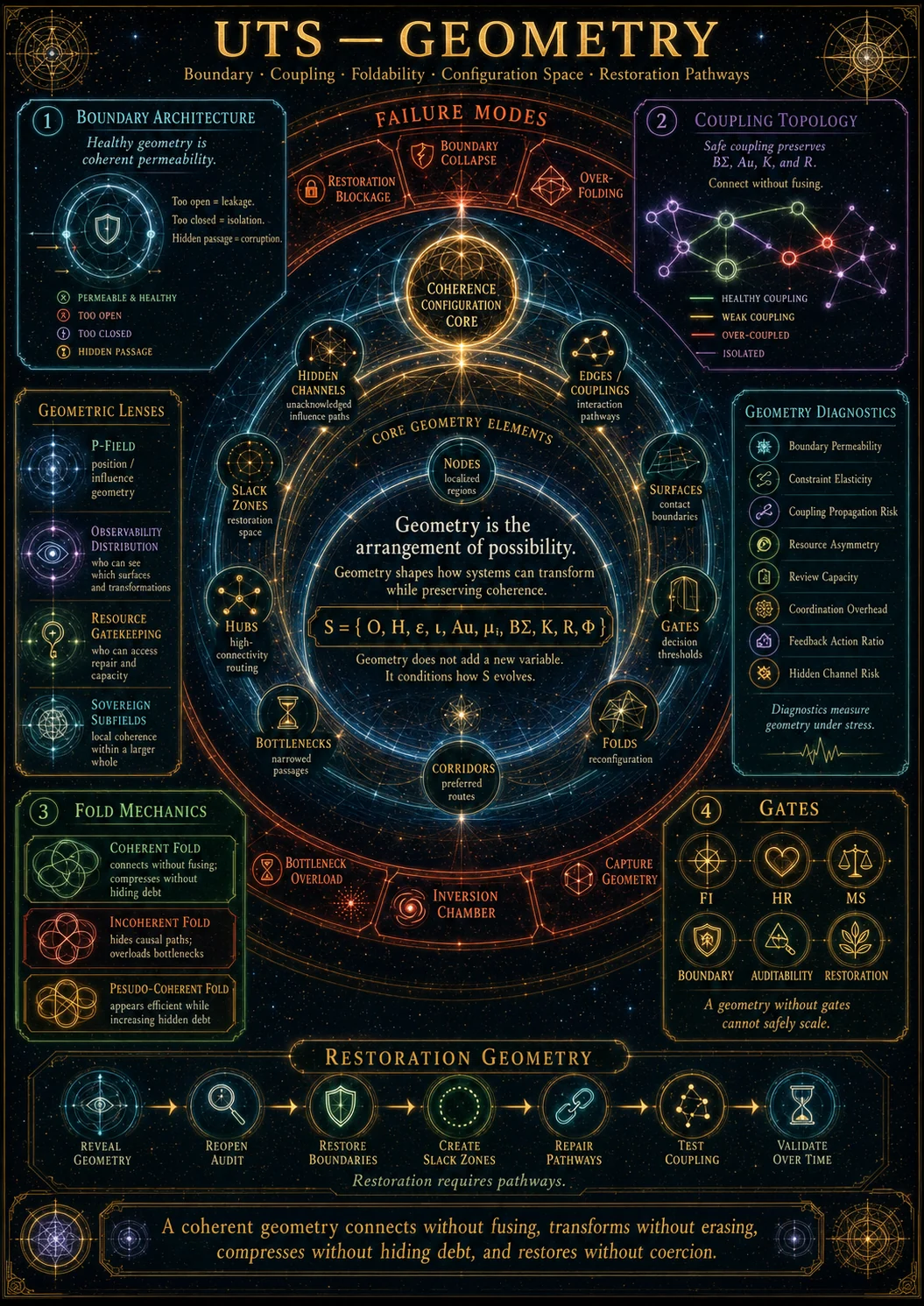
When most people hear the wordgeometry, they think of shapes: triangles, circles, cubes, spirals, grids, and diagrams.
UTS uses geometry in a broader way.
In UTS, geometry means theshape of possibilityinside a system.
It describes how things are arranged, how they can connect, what stays separate, what can move, what becomes trapped, what can be seen, what remains hidden, and what kinds of change are possible without breaking the system.
Geometry is not only the study of physical shapes. It is also the study of how structure shapes relationship.
A conversation has geometry.
A family has geometry.
A government has geometry.
A website has geometry.
A legal contract has geometry.
An ecosystem has geometry.
A memory system has geometry.
An AI interface has geometry.
A civilization has geometry.
Each one has boundaries, pathways, access points, pressure points, hidden channels, repair routes, bottlenecks, and places where things can either connect or collide.
UTS–Geometry gives us a language for seeing those structures clearly.
1. The Simple Idea
The central idea of UTS–Geometry is:
The shape of a system determines what kind of coherence it can hold.
A system can have good intentions and still fail if its geometry is wrong.
A team may want to cooperate, but if all decisions must pass through one overloaded person, the geometry creates a bottleneck.
A company may claim to value feedback, but if feedback has no pathway to change policy, the geometry creates a dead corridor.
A relationship may have care, but if one person has no safe way to say no, the geometry creates boundary failure.
An AI system may be useful, but if it learns from people without clear consent, review, or reversal, the geometry creates hidden coupling.
A culture may speak of truth, but if truth has no protected path into public decision-making, the geometry creates inversion.
UTS–Geometry helps name these patterns.
It says: before asking only what a system believes, wants, or measures, we should also ask:
What is the shape of the system?
2. Geometry as Boundary
Every coherent system needs boundaries.
A boundary is not just a wall. It is the line or surface that helps a system remain itself while still interacting with what is around it.
Healthy boundaries are not completely closed.
They are also not completely open.
They areselectively permeable.
They allow the right things through, in the right way, under the right conditions.
A living cell has a membrane.
A home has doors.
A conversation has consent.
A community has norms.
A legal system has due process.
A software system has permissions.
An AI system should have user control, visibility, and limits.
In UTS, this connects toBoundary Integrity.
When boundaries are too weak, systems dissolve into confusion, leakage, fusion, and violation.
When boundaries are too rigid, systems become isolated, brittle, and unable to adapt.
When boundaries have hidden channels, systems become vulnerable to manipulation and capture.
Good geometry protects the boundary without killing connection.
3. Geometry as Pathway
A system is not defined only by its parts. It is defined by the pathways between its parts.
Pathways determine where attention, pressure, resources, information, responsibility, meaning, and influence can travel.
Some pathways are visible.
Some are hidden.
Some are formal.
Some are informal.
Some are open to everyone.
Some are controlled by a few nodes.
Some lead to real change.
Some only create the appearance of access.
A customer support form that never reaches anyone is a false pathway.
An appeal process with no power to reverse a decision is a dead corridor.
A social media algorithm that silently decides what people see is a hidden routing system.
A workplace where every problem must go through one manager is a bottleneck.
A community where repair can happen directly has restoration pathways.
UTS–Geometry asks:
- Where can things move?
- Where do they get stuck?
- Which routes are visible?
- Which routes are hidden?
- Which routes repair the system?
- Which routes extract from it?
The geometry of pathways often reveals the true nature of the system more clearly than its stated values.
4. Geometry as Coupling
To couple means to connect in a way that allows influence.
Coupling can be good. It allows learning, cooperation, intimacy, coordination, exchange, and shared creation.
But coupling can also be harmful when it ignores boundary, compatibility, or consent.
UTS–Geometry looks at whether two systems can connect without losing coherence.
A good coupling preserves both sides.
A bad coupling fuses, drains, distorts, dominates, or captures.
Compatibility does not mean sameness.
It means the systems can interact without creating hidden damage.
A bridge is compatible when both sides can bear the load.
A conversation is compatible when both sides can participate without coercion.
A technology is compatible when it increases capability without destroying agency.
An institution is compatible when its procedures serve people rather than trapping them.
Geometry shows us that connection is not automatically coherence.
Some connections heal.
Some connections overload.
Some connections consume.
Some connections hide cost.
Some connections create beauty.
Some connections create debt.
The question is not only, “Can these things connect?”
The deeper question is, “Can they connect coherently?”
5. Geometry as Fold
A fold is a change in the shape of a system.
Sometimes a fold brings distant things closer together.
Sometimes it compresses complexity into a simpler form.
Sometimes it hides a pathway.
Sometimes it opens a new one.
Sometimes it makes a system more elegant.
Sometimes it makes the system harder to understand.
A fold can be as simple as reorganizing a website menu.
It can be a new law that changes how people access justice.
It can be a merger between companies.
It can be an AI feature that collapses many steps into one interface.
It can be a ritual that moves a person from one life stage to another.
It can be a social story that brings many meanings into one symbol.
Folds are powerful because they change what is near, what is far, what is visible, and what is possible.
But folds are not automatically good.
A fold is coherent when it simplifies without hiding harm.
It connects without forcing fusion.
It compresses without burying complexity.
It transforms without erasing identity.
It makes the system easier to restore, not harder.
A fold is incoherent when it makes the surface cleaner while pushing cost into hidden debt.
This is why UTS treats folding as something that must be gated, reviewed, and restored when needed.
6. Geometry as Observability
A system can only repair what it can notice.
Geometry determines what can be seen.
In some systems, the most affected people are the least visible.
In some systems, the most powerful decisions happen through hidden channels.
In some systems, the interface looks simple because the complexity has been moved somewhere no one can inspect.
In some systems, harm is not absent; it is merely out of view.
UTS calls the ability to inspect cause, pathway, and effectAuditability.
Good geometry makes important pathways visible.
It lets people trace what happened, where pressure moved, how decisions were made, and how damage can be repaired.
Bad geometry hides cause and effect.
It makes responsibility difficult to locate.
It turns repair into guesswork.
A system with low observability may still look smooth.
But smoothness is not coherence.
Sometimes smoothness simply means the friction has been moved to places the system does not measure.
7. Geometry as Restoration
A coherent system does not merely avoid damage.
It knows how to repair.
Restoration needs geometry.
There must be a path for truth to enter.
There must be a way to pause.
There must be a way to reduce pressure.
There must be a way to review decisions.
There must be a way to compensate harm.
There must be a way to repair boundaries.
There must be a way to reintegrate without pretending nothing happened.
A system without restoration pathways becomes brittle.
It may continue functioning for a while, but only by suppressing debt, expelling contradiction, or forcing people to absorb the cost.
UTS–Geometry names the structures that make restoration possible:
- slack zones,
- safe exits,
- appeal channels,
- review surfaces,
- decompression spaces,
- memory preservation,
- boundary repair,
- reintegration routes.
Restoration is not just an intention.
It is a pathway.
If the pathway does not exist, the system cannot restore no matter what it claims to value.
8. Geometry as Coherence Support
Coherence in UTS means preserving identity, meaning, and functional integrity through change.
Geometry supports coherence when the system can:
- stay itself while interacting,
- transform without losing identity,
- receive feedback without collapse,
- distribute pressure without hiding cost,
- preserve boundaries without isolation,
- create connection without capture,
- and repair harm without erasing truth.
This is why geometry is central to UTS.
Coherence is not just an inner quality.
It depends on structure.
The same person, idea, organization, or technology can behave differently depending on the geometry around it.
A healthy geometry can help coherence become natural.
A bad geometry can make coherence nearly impossible.
9. Geometry and Pseudo-Coherence
One of the most important reasons UTS needs geometry is that many systems look coherent from the outside while becoming incoherent underneath.
This ispseudo-coherence.
Pseudo-coherence appears when a system has surface order but hidden disorder.
It may look like:
- strong branding,
- clean metrics,
- fast outputs,
- repeated messaging,
- centralized control,
- formal unity,
- efficient process,
- or total alignment.
But underneath, it may contain:
- hidden debt,
- boundary violation,
- suppressed feedback,
- lack of repair,
- invisible cost,
- captured pathways,
- exhausted nodes,
- or proxy success that no longer serves the whole.
Geometry explains how this happens.
A system can fold itself into a beautiful surface while hiding the damage inside.
UTS–Geometry asks us not to be fooled by surface symmetry.
A coherent shape is not only smooth.
It must also be auditable, restorable, bounded, compatible, and alive to truth.
10. Everyday Examples
10.1 A website archive
A website archive has geometry.
If every module is easy to find, relationships are clear, pages link to related concepts, and readers can move from simple overviews to technical references, the geometry supports learning.
If everything is scattered, hidden, circular, or overloaded, the geometry creates confusion.
Good archive geometry helps meaning travel.
10.2 A workplace
A workplace has geometry.
If people know where decisions are made, how to raise concerns, how to repair mistakes, and how responsibilities flow, the workplace has better coherence.
If decisions are hidden, feedback goes nowhere, responsibility is unclear, and all pressure lands on the same few people, the geometry creates hidden debt.
The problem may not be the people.
The problem may be the shape.
10.3 A relationship
A relationship has geometry.
There are boundaries, openings, shared spaces, private spaces, repair routes, distance rhythms, and ways to say yes or no.
A coherent relationship allows closeness without fusion and separation without abandonment.
A damaged relational geometry may create loops where one person always absorbs pressure, one voice dominates meaning, or repair has no path.
Geometry gives language for this without reducing the relationship to blame.
10.4 An AI system
An AI system has geometry.
It has interfaces, permissions, memories, training routes, feedback loops, data flows, model boundaries, and user control surfaces.
A coherent AI geometry makes it clear:
- what data enters,
- where it goes,
- how it is used,
- how the user can consent,
- how the user can inspect,
- how the user can revoke,
- and how harm can be repaired.
An incoherent AI geometry creates hidden coupling between user identity, data extraction, optimization, and opaque system behavior.
10.5 A civilization
A civilization has geometry.
Roads, laws, schools, markets, media, courts, borders, archives, rituals, technologies, and institutions all shape how meaning, power, resources, and responsibility move.
Civilizational coherence depends on whether truth, repair, consent, adaptation, and accountability have real pathways.
When those pathways collapse, the civilization may still appear powerful, but coherence begins to degrade.
11. How Geometry Translates Into UTS
UTS uses geometry as a bridge between visible structure and hidden system behavior.
It asks:
| Geometry Question | UTS Translation |
|---|---|
| What are the boundaries? | Boundary Integrity |
| What can connect? | Compatibility |
| What paths exist? | Coupling topology |
| What is hidden? | Auditability risk |
| Where does pressure accumulate? | Hidden Debt |
| What can repair? | Restoration Capacity |
| What gets rewarded? | Fitness Proxy |
| What looks coherent but is not? | Inversion Risk |
| What transformations are possible? | Operator action-space |
| What can remain itself through change? | Coherence |
This translation is the heart of UTS–Geometry.
It turns “shape” into a practical language for coherence.
12. Why Geometry Comes Before Optimization
A common mistake is trying to optimize a system before understanding its geometry.
This can make problems worse.
If the geometry has hidden bottlenecks, optimization overloads them.
If the geometry has weak boundaries, optimization increases leakage.
If the geometry has poor auditability, optimization hides more cause and effect.
If the geometry has no restoration routes, optimization accelerates collapse.
If the geometry rewards the wrong proxy, optimization strengthens inversion.
Optimization inside bad geometry does not produce coherence.
It produces faster incoherence.
UTS–Geometry therefore asks us to inspect the shape before increasing force, speed, scale, or gain.
13. Geometry and Scale
Geometry becomes more important as scale increases.
At small scale, people can sometimes compensate for bad geometry through effort, trust, improvisation, or direct relationship.
At large scale, bad geometry becomes destiny.
A confusing website can be manually explained to a few people.
A confusing legal system harms millions.
A bad workflow can be worked around by a small team.
A bad institutional structure becomes a civilization-wide debt engine.
An opaque AI feature may seem convenient for one user but dangerous when deployed across society.
Scaling amplifies geometry.
This is why UTS–Geometry belongs near UTS–Scaling, UTS–Coherence, UTS–Gates, and UTS–Restoration.
14. The Practical Use of UTS–Geometry
UTS–Geometry helps a reader, designer, researcher, or operator look at any system and ask:
- Are the boundaries clear and legitimate?
- Are the pathways visible?
- Can affected nodes be heard?
- Can the system repair?
- Are there hidden channels?
- Where does pressure accumulate?
- Does the system depend on bottlenecks?
- Does it preserve agent integrity?
- Does it increase coherence or merely proxy success?
- Can it transform without losing itself?
These questions apply across domains.
They can be used for:
- website design,
- AI governance,
- organizational design,
- legal systems,
- education systems,
- relationship systems,
- archive architecture,
- spiritual communities,
- technology platforms,
- ecological systems,
- and civilization-scale analysis.
The details change, but the geometry remains.
15. Core Principles of UTS–Geometry
15.1 Shape conditions coherence
The way a system is arranged determines what kind of coherence it can sustain.
15.2 Boundaries make relation possible
Without boundaries, there is fusion.
Without permeability, there is isolation.
Coherence requires the right kind of boundary.
15.3 Pathways reveal the real system
A system’s stated structure matters less than where things can actually move.
15.4 Hidden channels create hidden debt
Unseen pathways of influence often carry the costs that the official geometry refuses to acknowledge.
15.5 Restoration requires real routes
Repair cannot happen if the geometry has no path for truth, review, compensation, reversal, or reintegration.
15.6 Folds must be gated
Reconfiguration is powerful and must preserve boundary, auditability, restoration, compatibility, and meaning.
15.7 Symmetry is not automatically coherence
A system can look balanced while hiding deep asymmetry. True coherence requires auditability and restoration, not just visual order.
15.8 Optimization inherits geometry
Optimization amplifies the shape it operates inside. Bad geometry makes optimization dangerous.
15.9 Scale amplifies geometry
At small scale, people can compensate for poor structure. At large scale, structure dominates.
15.10 Coherent geometry preserves identity through transformation
The highest purpose of UTS–Geometry is to understand how systems can change without losing what makes them whole.
16. Relationship to the Technical Overview
This foundational overview introduces the meaning of UTS–Geometry in natural language.
The technical overview expands this into:
- state-vector mapping,
- gates,
- interactions,
- lenses,
- gain types,
- diagnostics,
- failure modes,
- restoration geometry,
- archive placement,
- and operational mechanics.
Together, the two documents form a bridge:
- Foundational Overview:What geometry means and why it matters.
- Technical Overview:How geometry works inside UTS mechanics.
17. Recommended Frontmatter
---
schema_version: "1.0"
id: "UTS-GEO-FOUNDATIONAL-OVERVIEW"
title: "UTS — Geometry Foundational Overview"
slug: "uts-geometry-foundational-overview"
type: "foundational_overview"
status: "draft"
version: "1.0.0"
last_updated: "2026-06-08"
summary: "A natural-language introduction to UTS Geometry as the shape of coherence, explaining how boundaries, pathways, folds, coupling, observability, restoration, and scale translate into UTS."
canonical_url: "/archive/modules/geometry/foundational-overview"
citation_id: "uts-geometry-foundational-overview-v1-0"
canon:
  tier: "core"
  state: "draft"
  source: "UTS Geometry consolidation"
  source_id: "UTS-GEO"
classification:
  family: "modules"
  module: "Geometry"
  module_group: "Core UTS"
  density: "Foundational"
  audience:
    - "general readers"
    - "researchers"
    - "system designers"
    - "archive users"
tags:
  - "geometry"
  - "coherence"
  - "boundaries"
  - "pathways"
  - "coupling"
  - "folds"
  - "restoration"
  - "uts"
related:
  modules:
    - "coherence"
    - "scaling"
    - "operator-system"
    - "interactions"
    - "gates"
    - "diagnostics"
    - "failure-modes"
    - "restoration-arcs"
---
18. Compact Reader Summary
UTS–Geometryis the study of how shape, boundary, pathway, and connection determine what a system can become.
It teaches that coherence is not only about values, goals, or intelligence. Coherence also depends on structure. A system needs boundaries that protect without isolating, pathways that move truth and repair, couplings that preserve integrity, gates that prevent harmful transformation, and slack zones that allow restoration.
In UTS, geometry is the shape of possibility. It determines what can connect, what can remain whole, what can be repaired, what can be seen, and what can transform without collapse.
This module hub separates the reference overview from technical depth and nested sub-modules. Use the overview for orientation, the technical document for the deep model, and sub-modules for systems that belong under this domain.