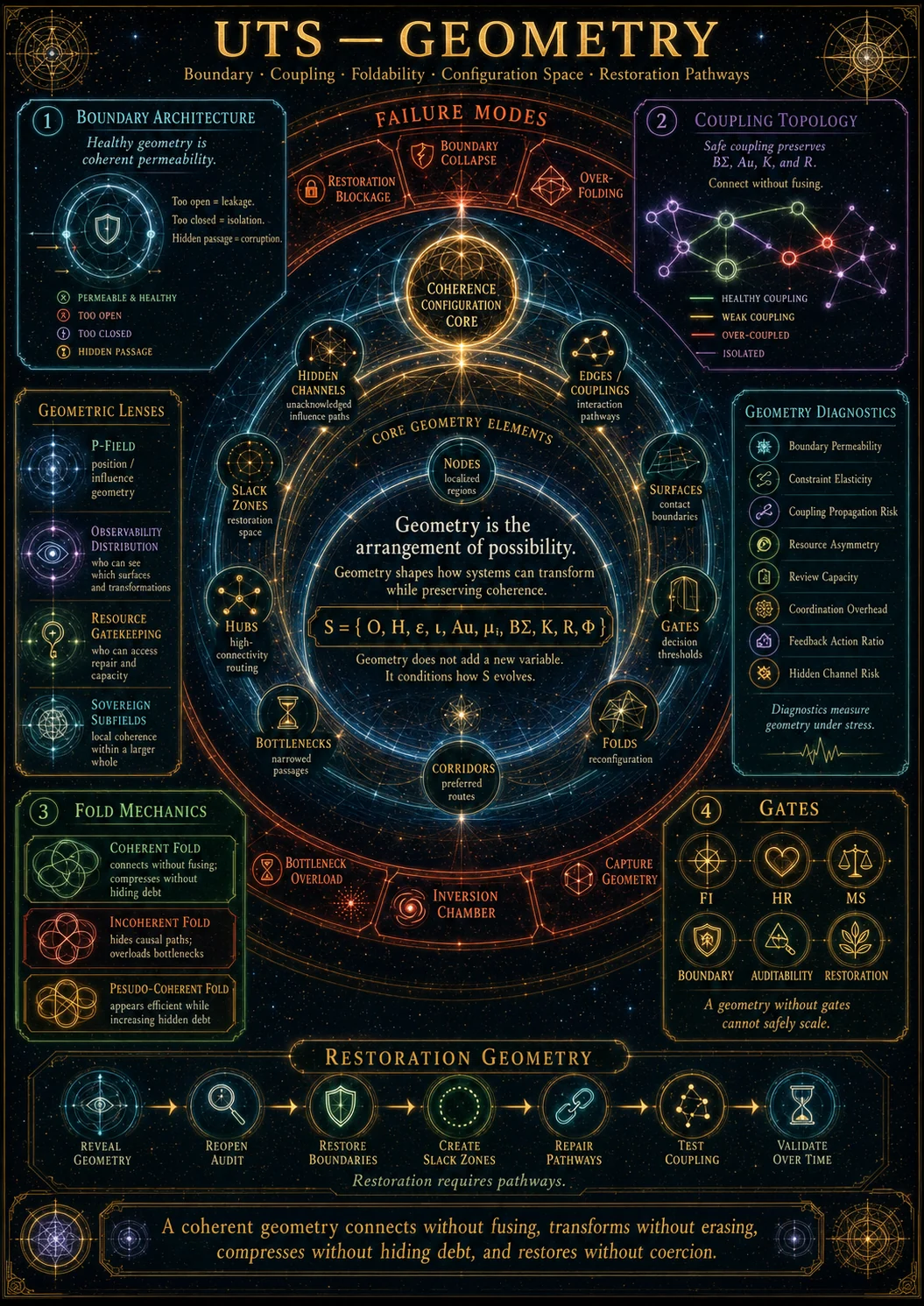
UTS–Geometryorganizes how structure shapes coherence.
In UTS, geometry is not treated only as physical shape. It is treated as theconfiguration logicthat determines:
- what can connect,
- what can remain separate,
- what can fold,
- what can restore,
- what can be observed,
- what pathways are available,
- what transformations are safe,
- and what kinds of coherence can be sustained across scale.
Geometry is thearrangement of possibility.
It determines the difference between a system that can absorb change and a system that collapses under change; between a coupling that restores and a coupling that violates; between a structure that supports coherence and a structure that produces pseudo-coherence.
This module translates geometry into UTS mechanics.
1. Core Definition
1.1 Geometry
In UTS:
Geometry is the structural arrangement of boundaries, pathways, surfaces, folds, nodes, and coupling conditions that shapes how a system can transform while preserving coherence.
Geometry includes:
- boundary shape,
- internal layout,
- connection topology,
- access pathways,
- hidden corridors,
- fold planes,
- slack zones,
- pressure channels,
- restoration routes,
- observation surfaces,
- and the spatial or abstract arrangement of system roles.
Geometry can be physical, informational, institutional, relational, symbolic, computational, energetic, or organizational.
A legal contract has geometry.
A bureaucracy has geometry.
A conversation has geometry.
A ritual has geometry.
A website archive has geometry.
A nervous system has geometry.
An AI interface has geometry.
A cosmology has geometry.
A geometry drawing has geometry in the literal and symbolic sense.
Geometry is not “where things are” only.
It ishow things can affect one another.
2. Canon Constraint
2.1 Geometry does not add a new state variable
The canonical UTS state vector remains:
[
S = O, H, \varepsilon, \iota, Au, \mui, B_\Sigma, K, R, \Phi
]
Geometry does not add an eleventh variable.
Instead:
Geometry conditions how the state vector evolves.
Geometry determines the operating environment through which UTS variables express.
It shapes:
- the ceiling of coherenceO,
- the accumulation of hidden debtH,
- the distribution of error/noiseε,
- the risk of inversionι,
- the availability of auditabilityAu,
- the preservation of agent integrityμᵢ,
- the stability of boundariesBΣ,
- the compatibility of couplingsK,
- the availability of restorationR,
- and the behavior of fitness proxiesΦ.
Geometry is therefore aconditioning layer, not an ontology expansion.
3. Geometry in UTS Terms
3.1 Geometry as boundary architecture
Every system has boundaries.
Boundaries determine:
- what is inside,
- what is outside,
- what can cross,
- what must remain separate,
- what can be observed,
- what can be protected,
- what can be restored,
- and what kinds of coupling are legitimate.
This makes geometry inseparable fromBΣ — Boundary Integrity.
A system with weak boundary geometry cannot maintain coherent identity under pressure.
A system with overly rigid boundary geometry cannot adapt, exchange, or repair.
A system with hidden boundary channels becomes vulnerable to inversion, capture, and parasitic coupling.
Healthy geometry is not maximal closure.
Healthy geometry iscoherent permeability.
3.2 Geometry as coupling topology
Geometry defines which nodes can connect and under what conditions.
In UTS language, a geometry contains:
- nodes,
- edges,
- channels,
- gates,
- interfaces,
- thresholds,
- loops,
- bottlenecks,
- hubs,
- peripheral zones,
- and hidden paths.
This makes geometry central to:
- K — Compatibility
- BΣ — Boundary Integrity
- Au — Auditability
- R — Restoration Capacity
- ι — Inversion Risk
A coupling is not safe because two systems can connect.
A coupling is safe when the geometry of connection preserves boundary integrity, auditability, compatibility, and restoration.
3.3 Geometry as transformation affordance
Geometry determines what transformations are available.
Some systems can bend without breaking.
Some can fold inward and gain coherence.
Some can expand without losing identity.
Some can reconfigure under pressure.
Some become brittle the moment their original structure is disturbed.
This makes geometry central to the operator system.
Geometry conditions:
- whetherΠ Reconfigurecan occur safely,
- whetherℛ Restorehas available pathways,
- whether⊗ Coupleviolates boundaries,
- whetherΓ Selectionpreserves variance,
- whetherΔ Stressreveals debt or creates collapse,
- whetherΜ Sensemakingcan trace causal pathways.
Geometry therefore determines theaction-spaceof the operator system.
4. Geometry and the UTS State Vector
4.1 O — Coherence
Geometry shapes the maximum coherence a system can sustain.
A geometry supports coherence when:
- boundaries are clear,
- coupling paths are compatible,
- feedback loops are observable,
- restoration pathways exist,
- pressure can distribute without collapse,
- and transformation does not erase identity.
Geometry does not produce coherence by itself.
It creates the conditions under which coherence can stabilize.
Poor geometry forces coherence to depend on effort, authority, compression, or suppression.
Good geometry allows coherence to emerge through fit, flow, relation, and restoration.
4.2 H — Hidden Debt
Geometry accumulates hidden debt when it stores unresolved mismatch.
Examples:
- pressure trapped behind rigid boundaries,
- suppressed variance,
- forced alignment without compatibility,
- over-compressed roles,
- missing restoration pathways,
- invisible bottlenecks,
- unacknowledged boundary strain,
- coupling paths that work only because someone absorbs the cost.
In geometric terms, hidden debt is oftenstored structural tension.
A system may look stable while its geometry is accumulating debt. This is one of the core ways pseudo-coherence forms.
4.3 ε — Error / Noise
Geometry affects how error appears and moves.
Some geometries localize error.
Some distribute error.
Some amplify error through feedback loops.
Some hide error until it becomes crisis.
Geometry influences:
- signal distortion,
- routing errors,
- leakage,
- misclassification,
- boundary confusion,
- phase mismatch,
- and delayed detection.
Error is not only a local problem.
It is often a geometric routing problem.
4.4 ι — Inversion Index
Geometry can become an inversion amplifier.
Inversion risk rises when:
- the system appears coherent but suppresses auditability,
- high symmetry hides causal asymmetry,
- central hubs control interpretation,
- feedback routes are captured,
- boundaries are selectively permeable,
- and fitness proxies improve while whole-system coherence declines.
A geometry can be elegant, powerful, efficient, and still inverted.
In UTS terms:
Geometry becomes dangerous when it increases Φ while decreasing O, Au, BΣ, or R.
4.5 Au — Auditability
Geometry determines what can be inspected.
A highly auditable geometry has:
- visible pathways,
- traceable transformations,
- identifiable coupling points,
- reversible state transitions,
- explicit gates,
- known boundaries,
- and accessible repair routes.
Low-auditability geometry hides cause and effect.
It compresses the path between action and outcome until accountability disappears.
This is why over-folded systems become risky. They may appear efficient, but they reduce the ability to see how effects are produced.
4.6 μᵢ — Agent Integrity
Agent integrity depends on geometry because agents require stable boundaries and coherent transformation paths.
A system degrades agent integrity when its geometry causes:
- identity bleed,
- forced role fusion,
- boundary ambiguity,
- coercive coupling,
- untraceable influence,
- memory discontinuity,
- or transformation without consent.
Agent integrity requires that the system can change without erasing the continuity of the participant.
A geometry that cannot preserve internal continuity under interaction is not agent-safe.
4.7 BΣ — Boundary Integrity
Boundary integrity is one of the primary geometric variables of UTS.
Geometry determines:
- where boundaries are,
- how boundaries are crossed,
- who can cross them,
- what is allowed through,
- what must be filtered,
- and whether crossing is reversible.
Boundary collapse does not always look like destruction.
Sometimes it looks like fusion, optimization, intimacy, integration, or “efficiency.”
UTS–Geometry treats boundary integrity as a first-order condition for safe coherence.
4.8 K — Compatibility
Compatibility is geometric.
Two systems are compatible when their boundaries, rhythms, roles, constraints, and restoration pathways can couple without producing downstream incoherence.
Compatibility is not sameness.
It is not agreement.
It is not attraction.
It is not shared intensity.
Compatibility means:
The geometry of interaction permits mutual coherence without hidden debt accumulation.
This applies to people, systems, organizations, AI interfaces, cultures, archives, rituals, ecosystems, and technologies.
4.9 R — Restoration Capacity
Restoration is geometric because repair requires pathways.
A system has restoration geometry when it contains:
- slack,
- neutral zones,
- decompression spaces,
- reversible gates,
- safe exits,
- appeal channels,
- memory integrity,
- low-pressure repair routes,
- and reintegration pathways.
A system without restoration geometry can only continue by suppressing debt, expelling variance, or increasing force.
This connects UTS–Geometry directly to restoration arcs.
4.10 Φ — Fitness Proxy
Geometry shapes what a system can measure and optimize.
Every proxy exists inside an arrangement.
That arrangement determines:
- what counts,
- what is visible,
- what is rewarded,
- what is ignored,
- what is compressed,
- and what is externalized.
A bad geometry can make a bad proxy look accurate.
A dangerous geometry can make proxy success look like coherence.
Thus:
Proxy failure is often geometric before it is numerical.
5. Core Geometry Concepts
5.1 Nodes
Anodeis a localized region of state, function, identity, role, or coherence.
Examples:
- a person,
- a team,
- a concept,
- an archive entry,
- a ritual role,
- a legal clause,
- a memory fragment,
- an AI agent,
- a subsystem,
- a cultural institution.
Nodes are not isolated objects.
They are positions in a geometry of relation.
A node’s behavior depends on:
- its boundaries,
- its couplings,
- its load,
- its observability,
- its restoration access,
- and its role in the larger configuration.
5.2 Edges / Couplings
Anedgeis an allowed pathway of interaction between nodes.
Edges can carry:
- information,
- pressure,
- meaning,
- resources,
- obligations,
- authority,
- emotional charge,
- identity claims,
- feedback,
- or control signals.
Edges require gates.
Ungated edges produce leakage.
Over-gated edges produce isolation.
Hidden edges produce inversion risk.
Unidirectional edges produce asymmetry.
Unobservable edges reduce auditability.
5.3 Surfaces
Asurfaceis a contact boundary where systems meet.
Surfaces are where:
- translation occurs,
- coupling happens,
- signals are filtered,
- consent is expressed,
- pressure is transferred,
- identity is protected,
- and meaning crosses domains.
Healthy surfaces are not frictionless.
They areselectively permeable.
A surface that lets everything through dissolves the system.
A surface that lets nothing through isolates the system.
A surface that allows hidden passage corrupts the system.
5.4 Gates
Agateis a boundary decision structure.
In UTS–Geometry, gates are not merely permissions. They are geometric control points that determine whether a transformation may enter the system.
Relevant gates include:
- FI-Gate— protects feedback integrity.
- HR-Gate— prevents high-risk binding with low evidence.
- MS-Gate— preserves meaning/symmetry alignment.
- Boundary Gate— protects BΣ.
- Auditability Gate— protects Au.
- Restoration Gate— ensures R remains available.
A geometry without gates cannot safely scale.
5.5 Folds
Afoldis a reconfiguration of boundary, adjacency, or pathway structure.
A fold may:
- bring distant nodes closer,
- hide or reveal pathways,
- compress state,
- change the relationship between inside and outside,
- alter what is observable,
- reduce or increase restoration space,
- or transform one coupling regime into another.
Folds are powerful because they change the system’s possibility space.
But folds are also dangerous because they can make illegitimate coupling appear natural.
5.6 Corridors
Acorridoris a preferred pathway through a system.
Corridors can be formal or informal.
Examples:
- escalation pathways,
- review routes,
- appeal channels,
- onboarding flows,
- archive navigation,
- institutional chains,
- ritual progressions,
- memory retrieval paths,
- dependency paths in software,
- supply lines in logistics.
Corridors determine where attention, resources, and pressure naturally move.
A system’s real geometry is often revealed by its corridors, not by its stated structure.
5.7 Bottlenecks
Abottleneckis a narrowed passage through which too much state must pass.
Bottlenecks create:
- delay,
- hidden debt,
- authority concentration,
- dependency load,
- attention collapse,
- review exhaustion,
- and single-point inversion risk.
Not all bottlenecks are bad.
Some are necessary gates.
But a bottleneck becomes dangerous when it is overloaded, unauditable, or irreplaceable.
5.8 Hubs
Ahubis a node with disproportionate connectivity or routing influence.
Hubs can increase coordination, but they also increase:
- capture risk,
- dependency load,
- amplification,
- distortion,
- and systemic fragility.
A healthy hub has strong auditability, boundary discipline, redundancy, and restoration access.
An unhealthy hub becomes a coherence choke point.
5.9 Slack Zones
Aslack zoneis a region of reduced pressure that allows restoration, adaptation, and recomposition.
Slack zones are essential to living and coherent systems.
They allow:
- decompression,
- error correction,
- pause,
- review,
- transition,
- experimentation,
- reintegration,
- and non-coercive reconfiguration.
A geometry without slack cannot restore.
It can only perform until it fractures.
5.10 Hidden Channels
Ahidden channelis an unacknowledged pathway of influence.
Hidden channels are among the most important geometric failure patterns in UTS.
They can carry:
- coercion,
- extraction,
- untracked feedback,
- identity binding,
- unapproved influence,
- proxy manipulation,
- or unreviewed authority.
Hidden channels reduce auditability and boundary integrity.
They often create pseudo-coherent stability by moving costs outside the visible geometry.
6. Fold Mechanics in UTS Terms
6.1 What a fold changes
A fold can change:
- distance— which nodes are near or far,
- adjacency— which nodes can interact,
- visibility— what can be observed,
- load— where pressure accumulates,
- boundary status— what is inside or outside,
- identity relation— what is separate or fused,
- restoration access— whether repair pathways remain open,
- proxy behavior— what gets rewarded.
A fold is not automatically good or bad.
It is evaluated by its effects on the UTS state vector.
6.2 Coherent fold
A fold is coherent when it:
- preserves boundary integrity,
- improves or maintains auditability,
- increases compatibility,
- reduces hidden debt,
- preserves restoration capacity,
- does not collapse agent integrity,
- and does not increase proxy success at the expense of coherence.
A coherent fold simplifies without erasing.
It connects without fusing.
It compresses without hiding debt.
It transforms without breaking continuity.
6.3 Incoherent fold
A fold is incoherent when it:
- hides causal paths,
- fuses incompatible nodes,
- compresses disagreement into compliance,
- creates hidden channels,
- increases dependency without restoration,
- overloads bottlenecks,
- produces boundary confusion,
- or makes the system harder to audit.
Incoherent folds often feel powerful because they reduce visible complexity.
But they do so by pushing complexity into hidden debt.
6.4 Pseudo-coherent fold
A pseudo-coherent fold creates the appearance of unity, simplicity, efficiency, or alignment while increasing latent incoherence.
Typical signs:
- surface harmony increases,
- dissent disappears,
- proxy metrics improve,
- explanation becomes harder,
- boundary violations become normalized,
- repair access decreases,
- and hidden costs move to less visible nodes.
Pseudo-coherent folds are central to many UTS failure modes.
7. Geometry and Gates
7.1 Why geometry must be gated
Geometry controls access.
Access controls coupling.
Coupling controls transformation.
Transformation affects identity, boundary, memory, meaning, and coherence.
Therefore, geometric change requires gates.
No system should allow arbitrary folds, arbitrary coupling, or arbitrary compression.
7.2 FI-Gate — Feedback Integrity
The FI-Gate prevents a geometry from being optimized by feedback loops that distort the system.
It asks:
- Is feedback still tied to whole-system coherence?
- Are proxies becoming self-reinforcing?
- Are hidden costs being externalized?
- Are visible gains masking downstream failure?
- Can the system still detect when the fold is harmful?
FI-Gate failure creates Goodhart geometry.
7.3 HR-Gate — High Risk Gate
The HR-Gate applies when a fold or coupling could create severe downstream harm if wrong.
It asks:
- Is the evidence sufficient for this binding?
- Are identities being fused prematurely?
- Are irreversible classifications being made?
- Are high-impact decisions being routed through low-audit geometry?
- Can the affected node appeal or exit?
HR-Gate failure creates dangerous binding geometry.
7.4 MS-Gate — Meaning/Symmetry Gate
The MS-Gate protects meaning alignment and symmetry integrity.
It asks:
- Does the transformation preserve the meaning of the system?
- Are equivalent nodes treated equivalently?
- Are differences being flattened?
- Are symbolic, relational, or functional roles being distorted?
- Is the system preserving the pattern that makes it itself?
MS-Gate failure creates meaning distortion geometry.
7.5 Boundary Gate
The Boundary Gate protectsBΣ.
It asks:
- Is this crossing legitimate?
- Has consent/authorization been established?
- Is the boundary visible?
- Is the crossing reversible where necessary?
- Does the crossing preserve agent integrity?
Boundary Gate failure creates coupling violations.
7.6 Auditability Gate
The Auditability Gate protectsAu.
It asks:
- Can the transformation be inspected?
- Can causes be traced?
- Can responsibility be assigned?
- Can errors be found?
- Can hidden channels be detected?
- Can the system explain how it changed?
Auditability Gate failure creates opaque geometry.
7.7 Restoration Gate
The Restoration Gate protectsR.
It asks:
- Does the geometry preserve slack?
- Are recovery paths available?
- Can affected nodes repair?
- Can the system pause, reverse, or compensate?
- Are there low-pressure reintegration routes?
Restoration Gate failure creates brittle geometry.
8. Geometry and Interactions
Geometry shapes how interactions operate.
8.1 Alignment
Alignment requires compatible geometry.
Without compatible boundaries and pathways, alignment becomes forced overlay.
Geometric alignment preserves distinctness while enabling coordination.
8.2 Invitation
Invitation opens a possible pathway without coercing entry.
Its geometry is threshold-based:
- visible boundary,
- low-pressure access,
- reversible entry,
- clear terms,
- no hidden hooks.
Invitation fails when the path becomes manipulative, sticky, or identity-binding without consent.
8.3 Amplification
Amplification increases signal, pressure, or effect.
Geometrically, amplification often occurs through:
- funnels,
- resonance chambers,
- hubs,
- repeated loops,
- high-gain corridors.
Amplification is safe only when auditability and restoration scale with it.
8.4 Relaxation
Relaxation reduces pressure and allows the geometry to return toward a lower-strain state.
It depends on:
- slack zones,
- exit paths,
- decompression corridors,
- reduced coupling intensity,
- and restoration capacity.
Relaxation is a geometric operation, not merely a decrease in force.
8.5 Reflection
Reflection turns a signal back toward its origin or toward a review surface.
Reflection requires geometry that supports:
- comparison,
- recognition,
- mirroring,
- sensemaking,
- and non-destructive feedback.
Bad reflection geometry creates echo chambers or distortions.
8.6 Attenuation
Attenuation reduces signal intensity or coupling strength.
It requires:
- filters,
- dampers,
- buffers,
- distance,
- translation layers,
- and boundary regulation.
Attenuation is essential where high-gain coupling would overwhelm agent integrity or restoration capacity.
8.7 Restorative Override
Restorative Override interrupts harmful geometry.
It is used when:
- coupling is causing damage,
- gates have failed,
- hidden debt is escalating,
- restoration capacity is nearly exhausted,
- or proxy optimization is damaging coherence.
Its geometry must create a safe intervention path without becoming a domination path.
8.8 Force
Force imposes geometry.
It overrides ordinary boundaries, pathways, or choices.
Force can sometimes contain immediate harm, but it creates high hidden debt unless:
- scope is narrow,
- auditability is strong,
- restoration follows,
- affected nodes are protected,
- and exit/review pathways remain available.
Force without restoration becomes geometric coercion.
9. Geometry and Lenses
UTS lenses can be read geometrically.
9.1 P-Field — Position / Influence Geometry
The P-field lens asks:
- Where is a node positioned?
- What can it influence?
- What influences it?
- What paths are available?
- What load does its position create?
- What does its position make visible or invisible?
P-field is the geometry of power, access, exposure, and role.
9.2 Observability Distribution
Observability is not evenly distributed.
Some nodes are watched constantly.
Some nodes act invisibly.
Some nodes carry costs but cannot report them.
Some nodes make decisions but avoid traceability.
Observability geometry is central to auditability.
A system is not auditable because “someone can see something.”
It is auditable when the right surfaces, pathways, and transformations are observable by the right review structures.
9.3 Resource Gatekeeping
Resource geometry determines who can access repair, time, money, labor, attention, tools, and authority.
Resource gatekeeping becomes incoherent when:
- restoration depends on inaccessible gates,
- affected nodes must pay the repair cost,
- bottlenecks control survival,
- or resources flow toward already dominant hubs.
Resource geometry is often the hidden skeleton of system behavior.
9.4 Sovereign Subfields
A sovereign subfield is a bounded region that maintains its own coherence while participating in a larger whole.
It requires:
- real boundary integrity,
- internal restoration,
- local decision capacity,
- compatible outer interfaces,
- and protection from coercive fusion.
Sovereign subfields are essential for modular coherence.
10. Geometry and Gain
Gain always has geometry.
10.1 Mechanical gain
Mechanical gain moves pressure through leverage points, hinges, pivots, and chokepoints.
UTS equivalent:
- small intervention,
- large downstream movement,
- often through asymmetrical geometry.
Risk: hidden leverage can produce unseen damage.
10.2 Energetic gain
Energetic gain routes intensity.
It depends on:
- containment,
- channeling,
- amplification corridors,
- release surfaces,
- and damping zones.
Risk: high intensity without restoration burns through boundary integrity.
10.3 Informational gain
Informational gain depends on network position.
Some geometries allow one signal to update many nodes.
Others trap information locally.
Risk: high informational gain through low-audit hubs creates narrative capture.
10.4 Emotional / identity charge gain
Identity charge gain increases when geometry routes meaning through high-sensitivity nodes.
It can create:
- rapid bonding,
- intense identification,
- fusion,
- loyalty,
- crisis amplification,
- symbolic overbinding.
Risk: high identity gain without HR-Gate integrity creates coercive fusion.
10.5 Institutional gain
Institutional gain arises when roles, policies, procedures, and authority structures multiply effects.
Risk: institutional geometry can hide responsibility behind procedural corridors.
10.6 Technological gain
Technological gain compresses action distance and increases scale.
Risk: technological geometry often expands capability faster than auditability, boundary integrity, and restoration capacity.
11. Geometry and Diagnostics
UTS diagnostics can be understood as measurements of geometry under stress.
11.1 Boundary Permeability
Measures how easily things cross boundaries.
Too high: leakage, identity bleed, violation.
Too low: isolation, brittleness, stagnation.
Healthy: selective permeability.
11.2 Constraint Elasticity
Measures whether geometry can deform without breaking.
Low elasticity creates brittle failure.
Excess elasticity creates boundary ambiguity.
Healthy elasticity supports transformation while preserving identity.
11.3 Coupling Propagation Risk
Measures how far a local coupling can propagate.
High propagation risk means one interaction can cascade through the system.
11.4 Resource Asymmetry
Measures whether repair and agency are geometrically accessible to all affected nodes.
Severe asymmetry means some nodes can act while others absorb cost.
11.5 Review Capacity
Measures whether the system has enough auditable surface and attention bandwidth to inspect transformations.
Low review capacity creates opaque geometry.
11.6 Coordination Overhead
Measures how much effort is required to move coherently through the geometry.
High overhead signals bad routing, excessive dependency, or unclear boundaries.
11.7 Feedback Action Ratio
Measures whether feedback actually changes the geometry.
A system with feedback channels that do not alter pathways is performatively auditable but not functionally auditable.
11.8 Hidden Channel Risk
Measures whether there are unacknowledged influence paths.
This is one of the highest-priority geometry diagnostics.
12. Geometry and Failure Modes
12.1 Boundary collapse
Boundary collapse occurs when distinction is lost.
Forms:
- identity bleed,
- unauthorized coupling,
- role fusion,
- data leakage,
- meaning collapse,
- consent bypass,
- internal/external confusion.
12.2 Over-folding
Over-folding occurs when a system compresses complexity beyond its auditability and restoration capacity.
Signs:
- faster outputs,
- reduced explanation,
- hidden bottlenecks,
- overloaded hubs,
- shallow metrics,
- and fewer repair routes.
12.3 False symmetry
False symmetry occurs when systems treat unequal positions as equivalent or equivalent positions as unequal.
It creates:
- procedural unfairness,
- hidden asymmetry,
- distorted meaning,
- and apparent balance that conceals structural imbalance.
12.4 Dead corridors
A dead corridor is a pathway that appears available but cannot produce real change.
Examples:
- appeal processes with no reversal authority,
- feedback forms no one reads,
- restoration protocols without resources,
- governance boards without power,
- consent options with no meaningful refusal path.
Dead corridors create pseudo-auditability.
12.5 Capture geometry
Capture geometry occurs when a node cannot exit, appeal, restore, or meaningfully resist coupling.
Capture may appear as:
- dependency,
- contract lock-in,
- social fusion,
- interface manipulation,
- institutional enclosure,
- algorithmic routing,
- or symbolic overbinding.
Capture geometry is one of the clearest signs that compatibility has failed.
12.6 Inversion chamber
An inversion chamber is a geometry that amplifies proxy success while suppressing coherence signals.
It rewards:
- surface alignment,
- metric improvement,
- compliance,
- performance,
- signal control,
- and narrative closure.
It suppresses:
- dissent,
- repair,
- boundary feedback,
- affected-node testimony,
- and contradiction.
13. Geometry and Restoration
Restoration requires geometric redesign.
It is not enough to tell a system to “heal,” “repair,” or “be more coherent.”
The pathways must exist.
13.1 Restoration geometry requires
- visible damage surfaces,
- safe reporting corridors,
- slack zones,
- review capacity,
- reversal pathways,
- compensation channels,
- reintegration structures,
- boundary repair,
- and memory preservation.
13.2 Restoration fails when
- the affected node has no path,
- the system cannot pause,
- repair is unfunded,
- truth cannot enter,
- accountability is opaque,
- restoration is symbolic only,
- or the original harmful geometry remains intact.
13.3 Restorative geometry
A restorative geometry:
- localizes harm without isolating the harmed,
- opens repair without coercing forgiveness,
- preserves memory without freezing identity,
- reduces pressure without erasing truth,
- and restores coupling only when compatibility returns.
14. Geometry Across Scale
14.1 Individual scale
At the individual scale, geometry appears as:
- boundary clarity,
- attention routing,
- energy distribution,
- memory organization,
- role coherence,
- restoration space,
- and interaction surfaces.
A coherent individual geometry allows someone to engage without losing themselves.
14.2 Relational scale
At the relational scale, geometry appears as:
- consent pathways,
- conversational surfaces,
- reciprocity channels,
- repair routes,
- emotional load distribution,
- and distance regulation.
Healthy relational geometry allows closeness and separation to coexist.
14.3 Organizational scale
At the organizational scale, geometry appears as:
- hierarchy,
- review channels,
- resource flows,
- reporting corridors,
- escalation paths,
- governance surfaces,
- and institutional memory.
A coherent organization is not one with no hierarchy.
It is one whose geometry preserves auditability, restoration, and affected-node access.
14.4 AI-mediated scale
At the AI scale, geometry appears as:
- interface design,
- data routing,
- model memory,
- user boundary control,
- consent architecture,
- feedback loops,
- hidden optimization channels,
- and identity-binding risk.
AI systems are geometrically dangerous when they create high coupling with low auditability.
14.5 Civilizational scale
At civilizational scale, geometry appears as:
- infrastructure,
- law,
- media networks,
- markets,
- borders,
- institutions,
- archives,
- educational pathways,
- resource flows,
- and symbolic systems.
Civilizational coherence depends on whether these geometries allow truth, restoration, adaptation, and boundary integrity to move through the whole.
15. Archive Placement
UTS–Geometry should sit as a core technical module under the broader UTS archive.
Recommended archive relationships:
Primary parent
- UTS–Coherence
Direct sibling modules
- UTS–Scaling
- UTS–Interactions
- UTS–Gates
- UTS–Lenses
- UTS–Gain
- UTS–Diagnostics
- UTS–Failure Modes
- UTS–Restoration Arcs
- UTS–Operator System
Extension modules
- Geometry Atlas
- Foldability Index
- Boundary Geometry
- Coupling Topology
- Restoration Geometry
- Interface Geometry
- Institutional Geometry
- AI Interface Geometry
- Symbolic Geometry
- RESGRAV / Resonant Gravity, if retained as a hypothesis module
16. Recommended Frontmatter
---
schema_version: "1.0"
id: "UTS-GEO-TECH-OVERVIEW"
title: "UTS — Geometry Technical Overview"
slug: "uts-geometry-technical-overview"
type: "technical_overview"
status: "draft"
version: "1.0.0"
last_updated: "2026-06-08"
summary: "A UTS-native technical overview of geometry as boundary, coupling, foldability, configuration space, restoration pathway, and coherence-conditioning structure."
canonical_url: "/archive/modules/geometry/technical-overview"
citation_id: "uts-geometry-technical-overview-v1-0"
canon:
  tier: "core"
  state: "draft"
  source: "UTS Geometry consolidation"
  source_id: "UTS-GEO"
classification:
  family: "modules"
  module: "Geometry"
  module_group: "Core UTS"
  density: "Technical"
  audience:
    - "researchers"
    - "system designers"
    - "archive maintainers"
    - "operators"
tags:
  - "geometry"
  - "coherence"
  - "boundaries"
  - "coupling"
  - "foldability"
  - "restoration"
  - "operator-system"
  - "uts"
related:
  modules:
    - "coherence"
    - "operator-system"
    - "interactions"
    - "gates"
    - "diagnostics"
    - "failure-modes"
    - "restoration-arcs"
    - "scaling"
---
17. Compact Technical Summary
UTS–Geometrydefines geometry as the structural arrangement of boundaries, pathways, folds, nodes, gates, surfaces, corridors, bottlenecks, and restoration routes that condition system coherence.
Geometry does not add a new UTS state variable. Instead, it determines how the canonical state vector evolves by shaping boundary integrity, compatibility, auditability, hidden debt, restoration capacity, inversion risk, and proxy behavior.
In UTS, geometry is the architecture of possible transformation. A coherent geometry allows systems to connect without fusing, transform without losing identity, compress without hiding debt, and restore without coercion. An incoherent geometry creates hidden channels, over-folded compression, dead corridors, capture structures, false symmetry, and inversion chambers.
Geometry is therefore one of the core technical bridges between UTS coherence theory and real-world system design.