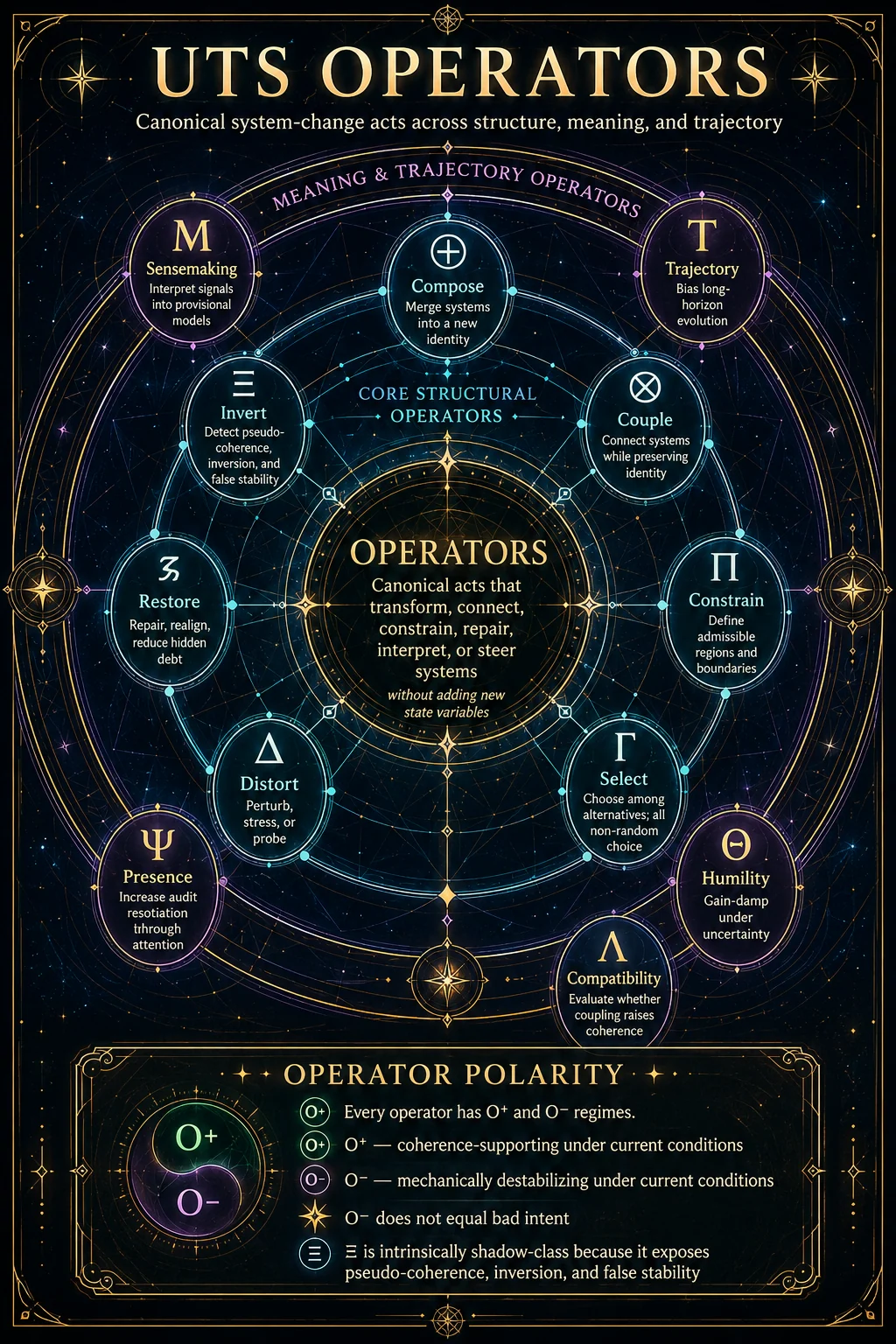
Foundational Overview
Purpose
This registry defines the canonical operators, diagnostics, gates, lenses, and regimes used across the Universal Theory Stack.
It is used to analyze and design:
- systems and institutions
- technologies and AI
- biological and medical systems
- economies and governance
- movements and civilizations
- individuals with outsized agency
Operators describe how systems change, not what they believe, intend, or claim.
Canon Rules
- No new operator primitives may be added.
- All operators act on a shared canonical state vector.
- U-layers are localization indices, not variables.
- Bandwidth and damping are diagnostics, not operators.
- Anything reducible to composition, parameterization, or diagnostics is not a new operator.
Canonical State Vector
All operators act on subsets of:
S = { O, H, ε, ι, Au, µᵢ, BΣ, K, R, Φ }| Symbol | Name | Meaning |
|---|---|---|
| O | Coherence | Phase-aligned, mutually reinforcing structure under stress. |
| H | Hidden Debt | Latent misalignment, deferred cost, unobserved incoherence. |
| ε | Error / Noise | Observable deviation from expected behavior. |
| ι | Inversion Index | Apparent order without harmonic fit; Ξ exposure proxy. |
| Au | Auditability | Inspectability and traceability of internal state and causality. |
| µᵢ | Agent / Meaning Integrity | Temporal consistency between model, action, and consequence. |
| BΣ | Boundary Integrity | Preservation of identity, consent, and interface clarity. |
| K | Compatibility | Mutual increase of coherence under coupling. |
| R | Restoration Capacity | Throughput for repair, correction, and realignment. |
| Φ | Fitness Proxy | Measured success signal used for optimization; distinct from O. |
Localization Index: U0–U8
U-layers are coordinates for where effects manifest. They are not new variables.
| Layer | Meaning |
|---|---|
| U0 | Substrate: physical and material limits. |
| U1 | Power / budgets: energy, time, compute. |
| U2 | Configuration: permissions, gates, boundaries. |
| U3 | Execution: runtime behavior and actuation. |
| U4 | Classification: models, metrics, narratives. |
| U5 | Coordination: timing, sequencing, protocols. |
| U6 | Coherence field: cross-domain coupling. |
| U7 | Memory: recurrence, hysteresis, persistence. |
| U8 | Environment: external forcing and shocks. |
Core rule:
Repair must occur at the same or lower layer than failure origin.
Forced-Response Diagnostics
These are computed from the state vector. They are not operators.
𝓑(t) — Bandwidth
Maximum forcing absorbable without phase transition.
Depends on:
{R, Au, BΣ, O} ↑ vs {H, ε, ι} ↓𝓓(t) — Damping
How quickly oscillations decay after disturbance.
Depends on:
{R, Au} ↑ vs {H, ι, chronic U8 forcing} ↓Additional Canon-Accepted Diagnostics
| Diagnostic | Meaning |
|---|---|
| σ(t) | Slack: buffer before forced-response degradation. |
| τresp(t) | Reaction latency: signal to effective response. |
| τm(t) | Memory half-life: relapse or recurrence risk. |
| µmeta(t) | Meta succession rate: rulebook churn. |
| Xc(t) | Constraint complexity. |
| Perm(t) | Boundary permeability. |
| AP(t) | Attribution pressure; avoid Φ collision. |
Canonical Operators
UTS v1.7 contains 13 canonical operators.
Core Structural Operators
| Operator | Name | Function |
|---|---|---|
| ⊕ | Compose | Merge systems into a new identity. |
| ⊗ | Couple | Connect systems while preserving identity. |
| Π | Constrain | Define admissible regions and boundaries. |
| Γ | Select | Choose among alternatives; all non-random choice. |
| Δ | Distort | Perturb, stress, or probe. |
| ℛ | Restore | Repair, realign, reduce hidden debt. |
| Ξ | Invert | Detect pseudo-coherence; always shadow-class. |
Meaning & Trajectory Operators
| Operator | Name | Function |
|---|---|---|
| Μ | Sensemaking | Interpret signals into provisional models. |
| Τ | Trajectory | Bias long-horizon evolution. |
| Θ | Humility | Gain-damping under uncertainty. |
| Λ | Compatibility | Evaluate whether coupling raises coherence. |
| Σ | Sacred Boundary | Enforce non-negotiable invariants. |
| Ψ | Presence | Increase audit resolution via attention. |
Operator Polarity
Every operator has O⁺ and O⁻ regimes.
- O⁺means coherence-supporting under current conditions.
- O⁻means mechanically destabilizing under current conditions.
- O⁻ does not equal bad intent.
Ξ is intrinsically shadow-class because it exposes pseudo-coherence, inversion, and false stability.
Interaction & Coupling Layer
Interface acts are parameterized interface moves inside Π, ⊗, Δ, and ℛ contexts. They are not new operators.
| Act | Meaning | Canon Mapping |
|---|---|---|
| ⊙ | Alignment | Π(self) + Τ(self) |
| →? | Invitation | Π + ⊗ as offer only |
| ⇈ | Amplification | Δ⁺ probe + Au↑ |
| ⇩ | Relaxation | Π loosen + Θ↑ |
| ↺ | Reflection | Ψ + FI probe |
| ⊘ | Attenuation | Π defensive tighten |
| ⚕︎ | Restorative Override | Emergency Π + Δ + ℛ |
| ✕ | Force | Π hard override; always debt-bearing |
Gates
Gates decide admissibility. They are not power.
Gate failure returns:
∅ = null outcome| Gate | Purpose |
|---|---|
| FI-Gate | Feedback integrity and anti-Goodhart protection. |
| HR-Gate | Blocks identity-bound certainty. |
| MS-Gate | Symmetry: no rank immunity. |
| Au-Actuation | Minimum traceability before actuation. |
| ☷ᵢ | Principle constraint fields. |
Lenses
Lenses bias how operators behave. They are not operators.
Gain Stack
| Gain | Effect |
|---|---|
| G₀ Mechanical | Physical scale amplification. |
| G₁ Energetic | Power throughput. |
| G₂ Informational | Narrative and perception. |
| G₃ Emotional | Fear, pride, identity. |
| G₄ Institutional | Rules and enforcement. |
| G₅ Technological | Automation and leverage. |
Most modern failures involve stackedG₂ + G₄ + G₅.
Structural Lenses
| Lens | Meaning |
|---|---|
| Ω | Observability distribution. |
| P-field | Position and influence geometry. |
| RG | Resource gatekeeping. |
| SS | Sovereign subfields. |
Composite Regimes
Composite regimes are named patterns, not operators.
| Regime | Composition |
|---|---|
| LOS | ⊕ + ⊗ + U7 + Φ pressure. |
| Repair-First Meta | ℛ + Π + Σ dominance. |
| Extraction Regime | Π + ⊗ without Λ / Θ. |
| Smurfing | Low-P, high-O regime. |
| CAN | Λ + Γ + ⊗ + Θ. |
| Crisis Loop | 𝓑 breach + 𝓓 low + τm short. |
Canonical Sanity Constraints
R_eff > Load × Gain_stack ⇒ O tends to increase
R_eff < Load × Gain_stack ⇒ collapse amplifies
X_c > Au_eff ⇒ H↑
Shock > 𝓑(t) ⇒ regime shift likely
Eₓ↑ + τ_resp↑ + asymmetry ⇒ legitimacy shock
Minimal Method
- Localize symptoms across U0–U8.
- Identify moving variables in the state vector.
- Estimate 𝓑(t) and 𝓓(t).
- Enforce gates.
- Apply the minimal operator sequence.
- Validate over time through U5 / U6.
- Normalize baseline by reducing H and restoring R.
Canon Guardrail
Operators change state. Lenses bias behavior. Diagnostics reveal limits. Gates decide what is allowed. Regimes name recurring compositions.
No further operator ontology is required.
Thread Status
This registry is canon-locked.
Future work proceeds through operator spec sheets, diagnostic audits, and domain mappings, not by adding primitives.
Λ is the operator that evaluates and stabilizes whether two or more systems can increase mutual coherence through relation while preserving distinct identity, boundary integrity, restoration capacity, and coherent exit.
- Name
- Compatibility / Love-as-Non-Fusion
- Primary Function
- Compatibility assessment, coherence-preserving relation, mutual uplift, boundary-safe coupling
- Symbol
- Λ
- Canon Tier
- Registry
⊕ is the operator that integrates distinct parts, systems, signals, structures, agents, or patterns into a new composite identity whose behavior cannot be fully reduced to its prior components.
- Name
- Composition
- Primary Function
- Integration, synthesis, merger, assembly, embodiment, new-whole formation
- Symbol
- ⊕
- Canon Tier
- Registry
Π is the operator that defines the admissible region of state transition by shaping what can pass, couple, scale, express, access, or execute.
- Name
- Constraint / Gating
- Primary Function
- Boundary-setting, admissibility, shaping, limiting, permissioning, channeling
- Symbol
- Π
- Canon Tier
- Registry
⊗ is the operator that links two or more systems such that state changes in one system can influence, condition, synchronize with, amplify, dampen, or transmit into another while preserving distinct identities.
- Name
- Coupling
- Primary Function
- Connection, interaction, synchronization, exchange, mutual influence, phase-locking
- Symbol
- ⊗
- Canon Tier
- Registry
The Operator Crosswalk Reference maps canonical UTS operators to state variables, U-layer localization, shadow forms, forced-response behavior, gates, compositions, and failure regimes.
- Canon Tier
- Registry
Δ is the operator that introduces deviation from current state, pattern, signal, expectation, trajectory, or equilibrium in order to reveal structure, test coherence, generate adaptation, or destabilize a system.
- Name
- Distortion / Stress
- Primary Function
- Perturbation, stress, novelty injection, disruption, deviation, probing, adversarial forcing
- Symbol
- Δ
- Canon Tier
- Registry
Θ is the operator that dampens system gain under uncertainty so that action, interpretation, selection, coupling, constraint, and trajectory remain proportional to evidence, capacity, and consequence.
- Name
- Humility / Uncertainty Gain-Damping
- Primary Function
- Uncertainty calibration, gain reduction, overreach prevention, updateability preservation
- Symbol
- Θ
- Canon Tier
- Registry
Ξ identifies pseudo-coherence: states where observable performance (Φ) or apparent order diverges from underlying coherence (O), typically under degraded auditability (Au) and accumulating hidden debt (H).
- Name
- Inversion Detection
- Symbol
- Ξ
- Canon Tier
- Registry
Ψ is the operator that increases direct contact with what is occurring by stabilizing attention on state, signal, boundary, action, and consequence before interpretation, selection, or intervention.
- Name
- Presence / Witness
- Primary Function
- Direct attention, signal contact, witnessing, audit-resolution increase, self-deception reduction, field stabilization
- Symbol
- Ψ
- Canon Tier
- Registry
ℛ is the operator that converts distortion, error, harm, debt, fragmentation, or misalignment into repaired structure, restored capacity, corrected memory, and renewed coherence.
- Name
- Restoration
- Primary Function
- Repair, correction, re-alignment, debt reduction, baseline recovery, recurrence resolution
- Symbol
- ℛ
- Canon Tier
- Registry
Σ is the operator that marks certain boundaries, invariants, or transition limits as non-negotiable because violating them would produce unacceptable coherence collapse, identity damage, legitimacy failure, or irreversible hidden debt.
- Name
- Sacred Boundary
- Primary Function
- Invariant protection, non-negotiable limit-setting, collapse prevention, boundary sanctification
- Symbol
- Σ
- Canon Tier
- Registry
Γ is the operator that selects among possible states, signals, actions, patterns, agents, pathways, or configurations according to an active criterion set.
- Name
- Selection
- Primary Function
- Choice, filtering, reinforcement, pruning, prioritization
- Symbol
- Γ
- Canon Tier
- Registry
Μ is the operator that converts signals, patterns, perturbations, histories, outcomes, and relational data into provisional models that guide orientation, selection, action, memory, and trajectory.
- Name
- Sensemaking
- Primary Function
- Interpretation, model-building, meaning integration, causal framing, narrative compression, orientation
- Symbol
- Μ
- Canon Tier
- Registry
Τ is the operator that biases system motion across time toward a projected, preferred, expected, or coherence-preserving future state.
- Name
- Trajectory
- Primary Function
- Long-horizon steering, path biasing, directional coherence, future-state alignment
- Symbol
- Τ
- Canon Tier
- Registry