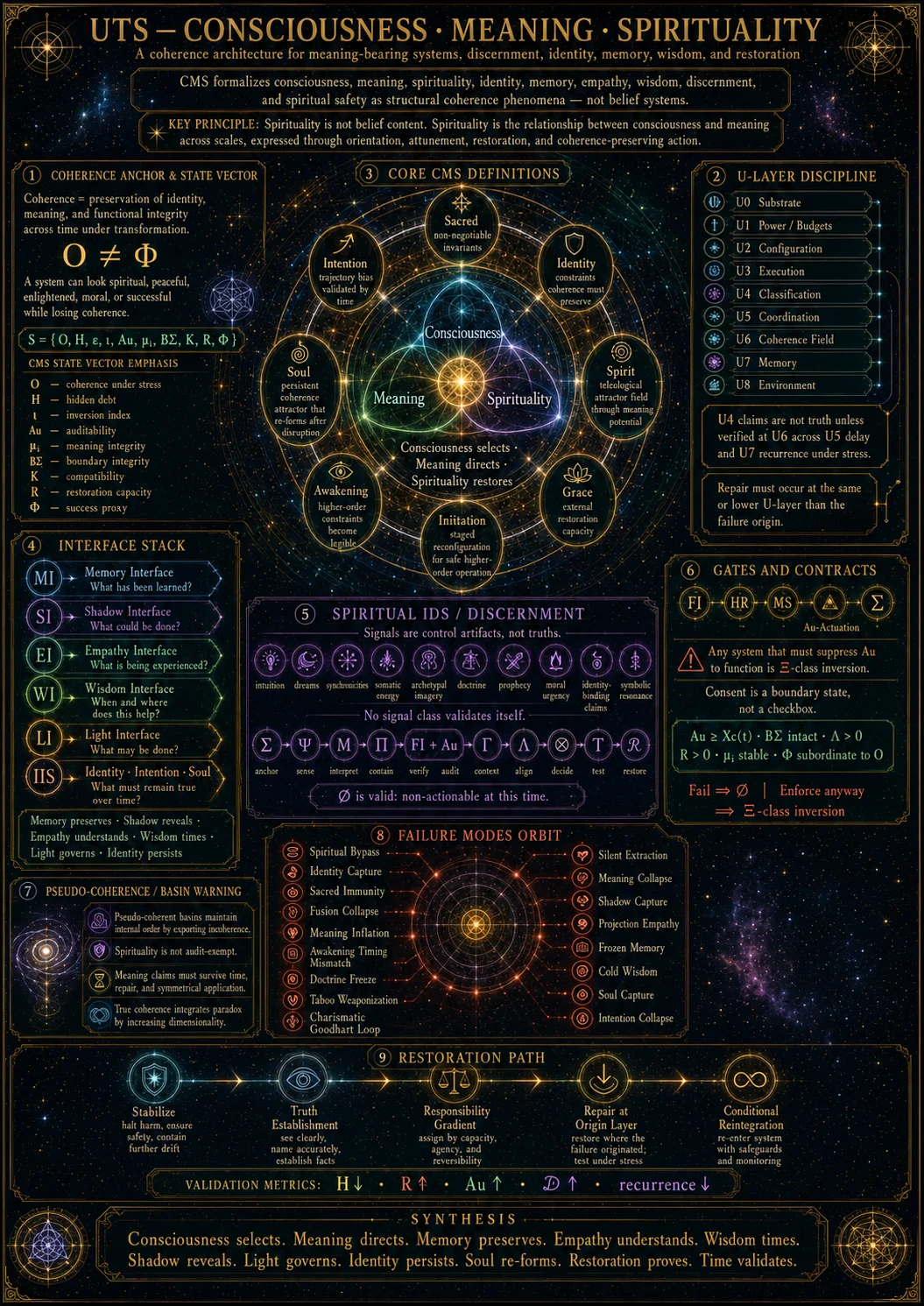
Introduction
The Universal Theory Stack begins with a simple but powerful idea:
Coherence is the preservation of identity, meaning, and functional integrity across time under transformation.
A coherent system is not one that stays the same forever. It is one that can change without losing what makes it whole.
This applies to bodies, minds, relationships, institutions, cultures, technologies, and civilizations. It also applies to consciousness, meaning, and spirituality.
UTS — Consciousness, Meaning & Spirituality, orUTS-CMS, extends the Universal Theory Stack into the meaning-bearing dimensions of reality. It asks:
- How does consciousness choose?
- How does meaning guide action?
- How does spirituality restore coherence?
- How do identity, memory, empathy, wisdom, and soul remain stable through change?
- How do spiritual or symbolic systems avoid collapse, manipulation, or false coherence?
This framework does not require a specific religion, metaphysical belief, or doctrine. It does not reduce spirituality to psychology, culture, or opinion. Instead, it treats spirituality as a real structural domain: the way consciousness relates to meaning, restoration, identity, and transformation across scales.
In UTS-CMS, spirituality is not defined as belief.
It is defined as:
the structural and experiential relationship between consciousness and meaning across scales.
Or more simply:
Spirituality is how a system orients toward meaning, restores after distortion, and preserves integrity through transformation.
1. Why Consciousness, Meaning, and Spirituality Belong in UTS
A theory of everything cannot only describe structure, energy, control, and feedback. It also has to describewhy anything matters.
A system can be stable but empty.
A system can be optimized but harmful.
A system can be successful by its metrics while losing its meaning.
This is why UTS separatescoherencefrom mere performance.
A company can grow while losing its purpose.
A religion can preserve rituals while losing restoration.
A person can function externally while becoming internally fragmented.
An AI system can optimize a goal while misunderstanding what should be protected.
These are not just moral or emotional failures. They are coherence failures.
Meaning is what tells a system which states are worth preserving, which paths are worth taking, and which boundaries must not be violated.
Without meaning, selection becomes blind.
Without consciousness, meaning cannot be sensed or chosen.
Without spirituality, meaning cannot be restored when distortion, suffering, uncertainty, or transformation occur.
2. Consciousness as Coherence Selection
In UTS-CMS, consciousness is not defined by belief, self-description, or inner narration.
Consciousness is defined by function:
Consciousness is the capacity to sustain and select coherent patterns.
This means consciousness is not only “awareness.” It is the ability to notice, hold, compare, and choose among possible states.
A conscious system does not merely receive signals. It selects what to attend to, what to reinforce, what to release, and what to become.
This selection function appears at many scales:
- a person choosing how to respond
- a community choosing what values to preserve
- an institution choosing what it rewards
- a culture choosing which stories guide it
- an AI system choosing outputs under constraints
In each case, consciousness is connected to coherence because the quality of selection determines the trajectory of the system.
A system becomes more coherent when its choices preserve identity, meaning, and functional integrity over time. It becomes less coherent when its choices produce hidden contradiction, boundary damage, performative order, or collapse.
3. Meaning as Direction
Meaning is not just interpretation. It is direction.
In UTS-CMS:
Meaning is the function that assigns relevance to states and transitions.
Meaning tells consciousness what matters.
It shapes:
- what receives attention
- what feels worth protecting
- what should be pursued
- what should be refused
- what kind of future is being selected
Meaning acts like a field of direction. It does not force the system, but it biases selection.
This is why two systems can see the same situation and choose differently. Their meaning-fields are different.
A person whose meaning is rooted in service will select different paths than one whose meaning is rooted in domination. A culture whose meaning is rooted in restoration will organize differently than one rooted in extraction. An AI system aligned to human flourishing must understand meaning, not merely optimize instructions.
UTS-CMS pays special attention tomeaning integrity.
Meaning integrity asks:
Does this meaning remain coherent across time, cost, scale, and consequence?
A meaning system is weak if it only holds when things are easy. A meaning system is stronger when it survives stress, correction, sacrifice, and transformation.
4. Spirituality as Restoration of Meaning
Spirituality is often treated as belief, ritual, identity, or tradition. UTS-CMS treats these as possible expressions of spirituality, but not spirituality itself.
In this framework, spirituality is the living relationship between consciousness and meaning.
It includes:
- orientation toward deeper invariants
- restoration after distortion
- integrity across contexts
- reverence for what must not be violated
- discernment under uncertainty
- contact with symbolic, archetypal, collective, or transpersonal layers
- the capacity to transform without losing coherence
Spirituality becomes especially important when ordinary information is incomplete.
When the path is uncertain, when the system is wounded, when identity is changing, or when a person or community is facing collapse, spirituality can function as a restoration technology.
It helps answer:
- What still matters?
- What must not be traded away?
- What needs repair?
- What is false stability?
- What direction preserves coherence over time?
In this sense, spirituality is not escape from reality. It is deeper participation in reality’s coherence demands.
5. The Sacred as What Cannot Be Violated Without Collapse
UTS-CMS defines the sacred structurally.
The sacred is not simply what someone prefers, values, or emotionally protects.
The sacred is what cannot be violated without creating hidden debt and eventual collapse.
A sacred boundary protects coherence.
For example:
- consent is sacred because violating it damages identity and trust
- truth is sacred because systems built on deception accumulate hidden debt
- sovereignty is sacred because forced fusion destroys coherence
- restoration is sacred because unresolved harm recurs through time
This does not require dogma. It is structural.
A sacred claim is valid only if it preserves coherence under audit, time, and scale. If “sacredness” is used to block questions, protect rank, suppress feedback, or justify harm, it becomes taboo weaponization rather than sacred protection.
The sacred protects life-giving invariants.
Taboo protects fragile control structures.
UTS-CMS is designed to tell the difference.
6. Soul as Persistent Coherence Through Transformation
UTS-CMS uses the wordsoulcarefully.
It does not require a specific metaphysical claim. It does not say the soul must be a substance, object, doctrine, or belief.
Instead:
Soul is the persistent coherence pattern that re-forms across disruption, transformation, and time.
A soul is visible in what keeps returning.
Not as repetition, but as signature.
A soul shows itself through:
- what a being consistently protects
- how it chooses under stress
- what meaning survives transformation
- what re-forms after collapse
- what kind of coherence it returns toward
This definition allows many interpretations. A religious person may understand this metaphysically. A systems thinker may understand it as persistent attractor geometry. A symbolic thinker may understand it as the deep pattern of identity and meaning.
UTS-CMS does not need to settle those interpretations to use the concept.
It asks:
What persists? What re-forms? What remains coherent through transformation?
7. False Coherence and the Danger of Spiritual Bypass
One of the central concerns of UTS-CMS ispseudo-coherence.
Pseudo-coherence occurs when a system appears ordered, meaningful, enlightened, moral, peaceful, or successful, while hidden incoherence is accumulating underneath.
In spiritual domains, this often appears asspiritual bypass.
Spiritual bypass occurs when spiritual language or experiences replace actual restoration.
Examples include:
- using “everything happens for a reason” to avoid grief
- using “we are all one” to override boundaries
- using “forgiveness” to avoid accountability
- using “detachment” to mask dissociation
- using “higher vibration” to avoid repair
- using sacred language to suppress audit
The test is simple:
Does this increase real restoration, or does it merely make the system feel coherent?
If hidden debt increases, auditability decreases, boundaries weaken, and recovery worsens, then the system is not becoming more spiritual. It is becoming more inverted.
UTS-CMS does not reject spiritual experience. It protects it from false use.
Authentic spirituality survives truth, time, audit, cost, and restoration cycles.
8. Pseudo-Coherent Basins: Why False Systems Feel Stable
A major part of UTS-CMS is understanding why incoherent systems can feel stable from the inside.
Apseudo-coherent basinis a locally stable system that maintains internal order while exporting incoherence elsewhere.
It may reward people.
It may provide identity.
It may offer belonging.
It may produce success.
It may feel meaningful.
But it does so by pushing cost outward:
- onto weaker people
- into the future
- into hidden labor
- into the environment
- into unseen emotional or spiritual debt
This explains why people often believe they are acting coherently inside harmful systems.
From inside the basin:
- “I followed the rules.”
- “I did what I was taught.”
- “The system worked for me.”
- “I had good intentions.”
- “Everyone around me agreed.”
UTS-CMS does not treat this as stupidity or evil. It treats it as geometry.
A node can be locally coherent and globally incoherent without contradiction.
The solution is not shame. It is cross-scale visibility, restoration, and access to a higher-coherence attractor.
People leave false coherence when a better coherence becomes visible and viable.
9. The CMS Interface Stack
UTS-CMS organizes meaning-bearing consciousness through a set of interfaces. These are not new metaphysical entities. They are structured ways a system processes experience, possibility, understanding, memory, timing, and action.
Shadow Interface — What could be done?
The Shadow Interface explores capacity.
It asks:
What strategies are possible if constraints are relaxed in simulation?
This is not permission to act. It is a way to reveal blind spots, risks, adversarial strategies, and latent capacities.
Without Shadow, a system becomes naïve.
With Shadow but no constraint, a system becomes extractive.
Empathy Interface — What is being experienced?
The Empathy Interface simulates another node’s inner state without consuming, collapsing, or controlling it.
It asks:
What is this other being experiencing?
Empathy is not projection. Projection assumes sameness. Empathy models difference.
Healthy empathy is bounded by sovereignty. Without boundaries, empathy becomes overload or extraction.
Memory Interface — What has been learned?
The Memory Interface preserves meaning across time.
It asks:
What has already been learned, and how can it be recalled without repeating the full cost?
Memory is not storage. Storage preserves data. Memory preserves meaning.
When memory functions well, suffering does not need to repeat endlessly to teach the same lesson.
Wisdom Interface — When and where does this help?
The Wisdom Interface applies memory and pattern recognition with timing and scale awareness.
It asks:
What works, when does it work, and when should it not be applied?
Wisdom is not merely knowing something. It is knowing when, where, and how to apply it without increasing incoherence.
Wisdom without empathy becomes cold optimization.
Empathy without wisdom becomes unbounded absorption.
Light Interface — What may be done?
The Light Interface governs execution.
It asks:
Of all possible actions, which are permissible under coherence constraints?
Light does not deny Shadow. It governs it.
Shadow reveals capacity.
Light determines admissibility.
Intention · Identity · Soul Overlay — What must remain true over time?
The IIS overlay preserves identity and trajectory.
It asks:
What must remain coherent as the system learns, changes, relates, and acts?
This prevents meaning systems from dissolving identity in the name of empathy, wisdom, unity, power, or transformation.
Together, the interface stack allows coherent agency:
Memory preserves. Shadow reveals. Empathy understands. Wisdom times. Light governs. Identity persists.
10. Discernment: How Meaning Enters Safely
UTS-CMS includes a discernment system calledSpiritual IDS: Integrity, Discernment, and Signalcraft.
It begins with a simple rule:
Signals are not truths. They are control artifacts.
A signal may be powerful, beautiful, terrifying, meaningful, or synchronistic. That does not automatically make it true or actionable.
CMS treats signals through filters:
- Where did this come from?
- What does it actually specify?
- Does it bind identity?
- Does it demand urgency?
- Does it increase or reduce coherence?
- Can it survive time?
- Does it preserve boundaries?
- Is it auditable?
A key rule is:
Identity-binding claims with low evidence may not enter a valid control loop.
This protects against capture.
Claims like “you are chosen,” “you are fallen,” “your soul agreed,” “you must obey,” or “this is your destiny” require strong validation before they affect identity or action.
If they fail the gates, the correct outcome is not rejection or belief.
It isnull outcome:
non-actionable at this time.
This protects the system while preserving openness.
11. Contracts, Consent, and Boundaries
UTS-CMS treats all meaning-bearing relationships as contracts.
A contract is not only a legal document. It is a boundary interface that shapes future action.
Examples include:
- teacher and student
- healer and client
- community and member
- facilitator and participant
- AI guide and human user
- entity/contact relationship
- vow or identity commitment
- spiritual practice container
A valid contract must preserve:
- auditability
- consent
- boundaries
- repair pathways
- exit pathways
- meaning integrity
- coherence over performance
Consent is not a checkbox.
Consent is a boundary state.
Consent is invalid when shaped by:
- urgency
- dependency
- hidden asymmetry
- identity-binding claims
- audit suppression
- exit penalties
- retaliation risk
If a person cannot leave safely, consent is not structurally intact.
This is one of the core protections in CMS.
12. Security: Meaning Under Adversarial or Chaotic Pressure
Spiritual and meaning systems are high-trust systems. That makes them powerful, but also vulnerable.
CMS includes a security layer because meaning can be exploited through:
- urgency
- identity hooks
- dependency
- charisma
- secrecy
- symbolic manipulation
- emotional overload
- boundary confusion
- suppressed audit
Security in CMS does not mean suspicion of everything.
It means preserving coherence under adversarial or chaotic forcing.
One of the most important warning signatures is silent extraction:
dO/dt < 0 ∧ dσ/dt < 0 ∧ ε ≈ 0This means coherence and slack are declining while visible problems remain low.
In ordinary language:
The system seems peaceful, but people are being drained.
Quiet is not always safety. Sometimes quiet means suppressed signal load.
13. Scaling: Why Meaning Collapses Under Growth
Meaning systems change when they scale.
A practice that works for one person may fail in a group.
A teaching that works in a small community may distort in an institution.
A spiritual insight may collapse when turned into doctrine.
A restoration method may become control when scaled without wisdom.
UTS-CMS adopts a key scaling law:
Meaning collapses before coherence collapses under scale.
As systems grow, they often compress nuance into rules, roles, slogans, metrics, and authority structures. This can be useful, but it can also destroy meaning.
The danger pattern is:
control increases
→ complexity increases
→ auditability decreases
→ meaning weakens
→ more control is added
→ meaning collapses further
This is the control-density to meaning-loss loop.
At a critical point, a system reaches themeaning collapse threshold.
When meaning integrity is too low, slack is gone, and humility disappears, discourse no longer repairs the system. More teaching, more rules, or more persuasion may make things worse.
At that point, only structural restoration works:
- reduce load
- reduce control density
- restore boundaries
- restore slack
- reopen auditability
- rebuild meaning from the foundation
14. Restoration: How CMS Repairs
Restoration is not the opposite of failure. It is its own process.
UTS-CMS uses a phased restoration model:
Phase 0 — Stabilize
Stop active harm.
Re-establish boundaries.
Prevent further damage.
Phase 1 — Truth
Restore auditability.
Find what actually happened.
Detect pseudo-coherence.
Phase 2 — Responsibility
Locate responsibility without scapegoating.
Identify who had leverage, awareness, benefit, and stop-power.
Phase 3 — Repair
Repair at the layer where the damage originated.
Do not use stories to repair structural damage.
Phase 4 — Reintegration
Return only when coherence is time-validated.
No forced forgiveness.
No secret settlements.
No reintegration without repair.
Restoration is successful when:
- hidden debt decreases
- recurrence decreases
- damping improves
- meaning integrity improves
- boundaries strengthen
- coherence increases over time
15. Core Failure Modes
UTS-CMS identifies recurring failure patterns in meaning and spiritual systems.
Key examples include:
- Spiritual bypass:narrative replaces restoration
- Identity capture:sacred claims bind identity without valid consent
- Fusion collapse:coupling becomes identity merger
- Meaning inflation:powerful meaning claims lack integrity
- Awakening timing mismatch:exposure exceeds restoration capacity
- Doctrine freeze:selection converges too early
- Taboo weaponization:sacred language blocks inquiry
- Audit suppression:“beyond mind” becomes a shield against correction
- Charismatic Goodhart:charisma replaces coherence
- Silent extraction:people are drained without visible incidents
- Memory freezing:memory stops updating and becomes ideology
- Cold wisdom:prediction without empathy scales harm
- Projection empathy:sameness is assumed instead of difference modeled
- Shadow capture:possible strategies become executive logic
- Performative light:principle language becomes image management
- Identity theater:self-description replaces identity coherence
These are not moral labels. They are mechanical failure modes.
They show where coherence is being lost.
16. Core Invariants
UTS-CMS rests on several structural invariants:
- Coherence precedes optimization.
- O is not Φ.
- Meaning must survive audit, cost, time, and restoration cycles.
- Spirituality is not audit-exempt.
- Identity-binding requires proportionate evidence.
- Consent is structural, not rhetorical.
- Exit must be possible.
- Suppressed auditability creates hidden debt.
- Restoration precedes exploration.
- Empathy must be bounded by sovereignty.
- Wisdom must be coupled to empathy.
- Memory must update or become ideology.
- Shadow reveals capacity; Light governs execution.
- Identity is what coherence forces preservation of.
- Soul is what re-forms after disruption.
- True coherence integrates paradox by increasing dimensionality.
These invariants are not beliefs. They are conditions for coherence to remain stable under transformation.
17. Why This Matters
UTS-CMS matters because modern systems are increasingly meaning-mediated.
AI systems simulate care.
Institutions manage identity.
Media systems shape attention.
Spiritual communities scale through platforms.
Cultures fight through symbols.
People seek restoration in systems that may not be coherent themselves.
Without a framework like CMS, meaning becomes easy to capture.
People can be manipulated through:
- identity
- belonging
- trauma
- hope
- sacred language
- urgency
- symbolic authority
- claims of destiny
- claims of love
CMS provides a way to remain open without becoming naïve, rigorous without becoming reductive, and spiritual without becoming audit-exempt.
It allows meaning to be taken seriously without allowing meaning to become a shield against truth.
18. Final Summary
UTS — Consciousness, Meaning & Spirituality is the part of the Universal Theory Stack that explains how meaning-bearing systems preserve coherence through transformation.
It shows how:
- consciousness selects
- meaning directs
- spirituality restores
- memory preserves
- empathy understands
- wisdom times
- shadow reveals
- light governs
- identity persists
- soul re-forms
- restoration proves
- time validates
The compressed formula is:
Consciousness selects. Meaning directs. Spirituality restores. Memory preserves. Empathy understands. Wisdom times. Shadow reveals. Light governs. Identity persists. Soul re-forms. Restoration proves. Time validates.
And the foundational commitment is:
Authentic spirituality increases coherence without suppressing truth, consent, repair, or freedom to exit.
This is the bridge from spiritual language to operational coherence.
It allows the reader to enter the deeper technical system with the right orientation:
not belief first,
not skepticism first,
but coherence first.
This module hub separates the reference overview from technical depth and nested sub-modules. Use the overview for orientation, the technical document for the deep model, and sub-modules for systems that belong under this domain.