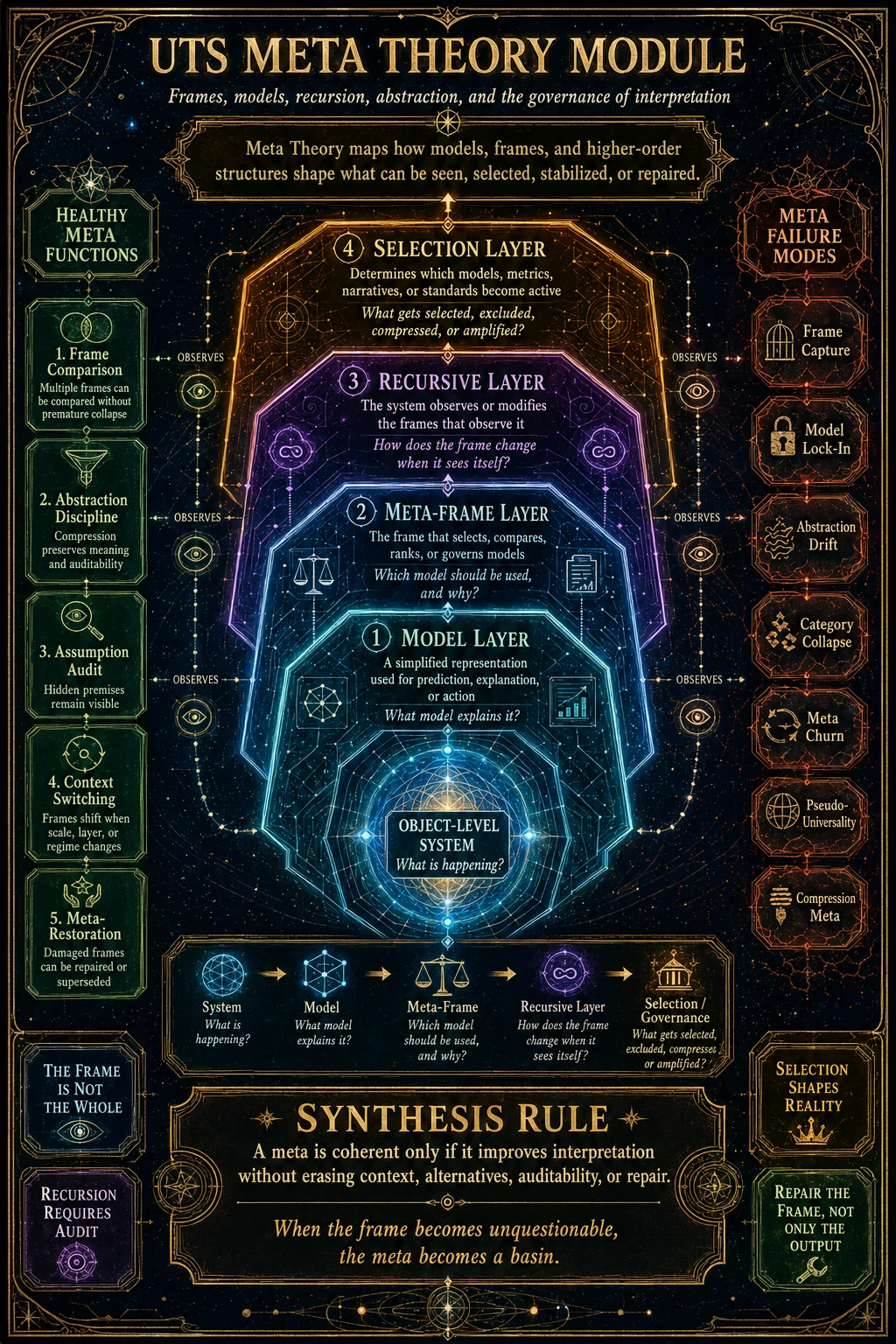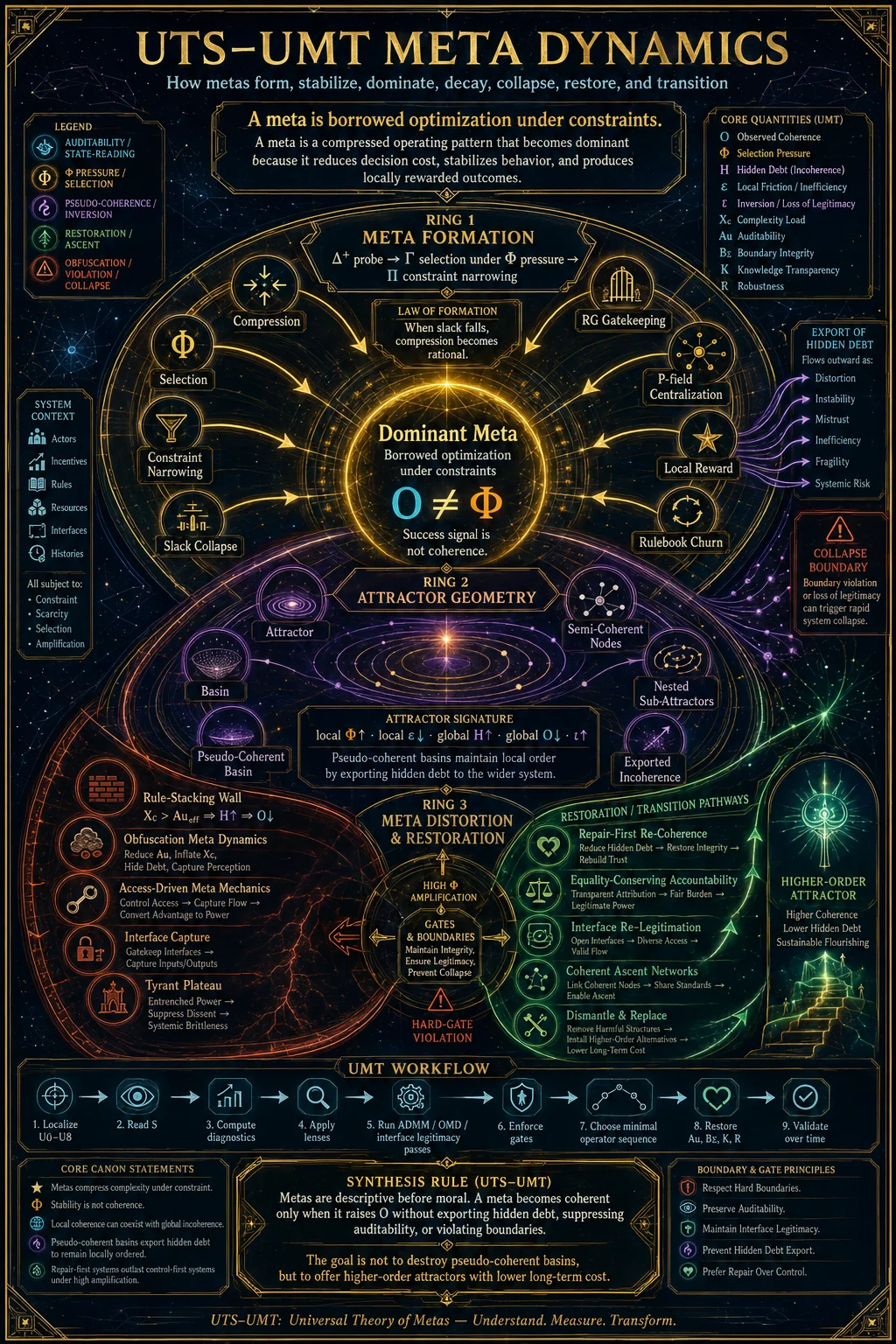
Foundational Overview
How Metas Form, Why They Dominate, and How They Bridge Game Theory into UTS
1. What UTS – Meta Theory Is
UTS – Meta Theorystudies how systems develop dominant patterns of behavior.
These patterns can appear as:
- strategies
- norms
- best practices
- political styles
- business models
- cultural expectations
- technological races
- institutional habits
- survival pathways
In gaming language, these patterns are calledmetas.
A meta is what people tend to do because it works well enough under current conditions.
It may not be the best possible path.
It may not be truly coherent.
It may not even be stable long-term.
But it becomes dominant because it is:
- easy to copy
- rewarded by the environment
- socially reinforced
- hard to ignore
- safer than experimenting
- cheaper than understanding the whole system
In UTS terms:
A meta is a compressed operating pattern that emerges under constraint.
It tells us how a system behaves when actors are trying to survive, win, avoid loss, gain position, or preserve stability.
2. The Game Theory Bridge
Game theory studies how actors make decisions when their outcomes depend on the decisions of others.
Classic game theory asks questions like:
- What is the best move?
- What will others do?
- What happens if everyone copies the winning strategy?
- When does cooperation beat competition?
- When does betrayal become rational?
- When does equilibrium form?
UTS – Meta Theory extends this into larger systems.
It asks:
- What strategies become dominant across many actors?
- Why do independent actors converge without direct coordination?
- Why do some metas become rigid?
- Why do systems resist better strategies?
- Why does local success sometimes reduce whole-system coherence?
- Why does a strategy that wins early become a trap later?
Game theory gives us the decision logic.
UMT adds:
- scaling
- hidden debt
- auditability
- slack
- restoration
- legitimacy
- attractor geometry
- access gates
- obfuscation
- coherence failure
So the bridge is:
Game theory explains strategic behavior. UTS – Meta Theory explains how strategic behavior becomes system geometry.
A move becomes a habit.
A habit becomes a strategy.
A strategy becomes a meta.
A meta becomes a basin.
A basin shapes what people think is possible.
3. Why Video Games Are the Clean Analogy
Video games make metas easy to see.
In a game, players quickly discover:
- the strongest character
- the best build
- the fastest route
- the safest opening move
- the most efficient resource path
- the dominant team composition
Once discovered, many players copy it.
This creates a meta.
But over time:
- the meta becomes predictable
- counterplay develops
- developers patch the game
- new strategies emerge
- old advantages decay
This is a miniature version of what happens in real systems.
In society, the “game” is larger and slower.
Instead of characters and builds, we have:
- credentials
- capital
- institutions
- laws
- platforms
- narratives
- technologies
- social norms
- access gates
Instead of patches, we have:
- crises
- reforms
- revolutions
- regulation
- innovation
- cultural shifts
- technological disruption
The same pattern repeats:
A dominant strategy emerges, stabilizes, becomes overused, creates hidden debt, and eventually faces pressure to update.
4. The Core UTS Translation
UTS does not treat metas as merely social trends.
It treats them asstate patterns.
The UTS state vector gives us the deeper reading:
S = { O, H, ε, ι, Au, µᵢ, BΣ, K, R, Φ }In plain language:
- Oasks: is the system truly coherent?
- Hasks: what debt or harm is hidden?
- εasks: what errors are visible?
- ιasks: does the system only look coherent?
- Auasks: can the system be audited?
- µᵢasks: are agents internally consistent over time?
- BΣasks: are boundaries, consent, and identities intact?
- Kasks: does coupling improve coherence?
- Rasks: can the system repair itself?
- Φasks: what success signal is being optimized?
This lets UTS distinguish between:
- a meta that wins
- a meta that works locally
- a meta that looks stable
- a meta that is actually coherent
- a meta that exports hidden debt
- a meta that needs restoration or replacement
This is one of the central moves of UTS – Meta Theory:
Winning is not the same as coherence.
A strategy can dominate a system while quietly degrading the system that rewards it.
5. Meta Formation: Why Systems Converge
Metas form because actors face shared pressures.
They may not coordinate.
They may not agree.
They may not even like each other.
But if they face the same incentives, risks, and constraints, their behavior begins to converge.
Examples:
- companies copy profitable models
- political actors copy winning rhetoric
- platforms copy engagement mechanics
- institutions copy compliance structures
- AI labs copy benchmark strategies
- investors chase the same advantage objects
This is not automatically conspiracy.
It is oftenfield convergence.
In UTS terms, this happens when:
- slack decreases
- risk increases
- success metrics dominate
- experimentation becomes expensive
- access becomes gated
- actors select what appears to work
The meta becomes a compression layer.
It reduces uncertainty by saying:
“Do this. It works well enough.”
6. Why Metas Become Traps
A meta becomes dangerous when it starts preserving itself instead of serving coherence.
This can happen when:
- success metrics replace reality
- rules replace judgment
- access gates replace performance
- institutions protect position
- auditability decreases
- dissent is treated as threat
- repair is delayed
- hidden debt accumulates
In UTS language:
Φ rises while O falls.The system appears successful because its fitness proxy is still being rewarded.
But underneath:
- hidden debt rises
- pseudo-coherence rises
- restoration capacity weakens
- legitimacy decays
- adaptation slows
This creates what UTS calls apseudo-coherent basin.
7. Pseudo-Coherent Basins
A pseudo-coherent basin is a system state that feels stable from inside but exports incoherence outside itself.
It can reward participants.
It can produce repeatable outcomes.
It can look lawful, efficient, or successful.
But it survives by pushing cost elsewhere:
- onto workers
- onto future generations
- onto outsiders
- onto the environment
- onto unseen labor
- onto less powerful nodes
- onto hidden systems
This is why UTS distinguishes:
Local coherence is not the same as global coherence.
A person, organization, or institution can feel internally consistent while participating in a larger pattern that reduces whole-system coherence.
This is not framed as blame.
It is geometry.
People orbit attractors.
Systems shape incentives.
Basins stabilize behavior.
The work of UTS is to make the geometry visible.
8. Attractors and Escape Difficulty
Every meta has attractors.
An attractor is a pattern a system naturally pulls toward.
Examples:
- profit maximization
- status preservation
- risk avoidance
- narrative dominance
- control through dependency
- credential accumulation
- compliance performance
Around these attractors, sub-attractors form:
- career success
- moral self-justification
- legality shields
- identity narratives
- comparison with worse actors
- “this is just how the world works”
These sub-attractors make escape difficult.
Leaving a bad meta is rarely just a matter of “choosing better.”
It may involve:
- losing income
- losing status
- losing community
- losing identity
- facing uncertainty
- confronting hidden debt
- rebuilding from a different attractor
That is why UTS avoids shallow moral advice.
Escape requires new geometry, not just better slogans.
9. Access, Gates, and Position
Metas do not only form around skill.
They also form around access.
When an advantage can be controlled, defended, and made scarce, the meta shifts from open performance to gate competition.
The question becomes:
- Who has access?
- Who controls the gate?
- Who gets starved?
- Who can scale?
- Who must wait?
- Who is allowed to be visible?
This is where UTS uses lenses like:
- P-field— position and influence geometry
- RG— resource gatekeeping
- SS— sovereign subfields
- Ω— observability distribution
A system may claim to reward skill while actually rewarding gated access.
This creates anti-competition debt.
Talent does not disappear.
It migrates.
When systems suppress challengers, strong agents often leave the field instead of rebelling. They build elsewhere, learn elsewhere, or wait for a meaningful trajectory.
This is why UTS treats talent drift as a long-term warning signal.
10. Obfuscation and Interface Capture
A meta becomes especially dangerous when it hides how it works.
Obfuscation reduces auditability.
At small scale, this may look like privacy, complexity, or strategic secrecy.
At large scale, it becomes structural instability.
When systems suppress auditability while optimizing success proxies, hidden debt grows faster than repair can scale.
This becomes more dangerous at interfaces.
An interface is any system that mediates between unequally aware parties.
Examples:
- platforms mediating users and advertisers
- AI systems mediating humans and institutions
- financial systems mediating risk and ownership
- governments mediating populations and power
- synthetic models representing people without their consent
UTS treats interface legitimacy as a survival constraint.
A legitimate interface must preserve:
- auditability
- consent
- boundary integrity
- compatibility
- restoration capacity
Without these, the interface becomes extractive.
11. Smurfing and Coherent Meta Change
In gaming, a “smurf” is a skilled player starting from a low rank.
In UTS – Meta Theory, smurfing means:
low-position proof of superior coherence or portable mastery.
A smurfer demonstrates that a new path works without inheriting the old system’s position.
Historical and structural examples include:
- scientific breakthroughs
- spiritual or philosophical reformers
- technical inventors
- political disruptors
- artists and builders outside official channels
- coherent agents who make an old meta unnecessary
Smurfing is not merely “starting from nothing.”
It is showing that:
- skill is portable
- coherence is scalable
- support can amplify precision
- the system may need to update
- the old pathway may be artificially difficult
A smurfer can fail personally while still proving the meta needs to change.
This is calledmeta patch failurewhen the system refuses to integrate a coherence-increasing strategy.
12. Collective Ascent
UTS – Meta Theory does not conclude that coherent agents must rise alone.
In fact, many systems create anti-smurfing metas:
- support is framed as illegitimate
- attrition is mistaken for skill
- inherited advantage is hidden
- challengers are forced through unnecessary failure points
The deeper update iscollective ascent.
ACoherent Ascent Networkis a distributed field of aligned agents who scale coherence together without requiring one person to carry the entire burden.
This matters because:
- repair becomes distributed
- capture risk decreases
- single-node scapegoating becomes harder
- coherence scales through relationship, not domination
In UTS terms:
Unity can be a coherence technology.
Not unity as conformity.
Unity as compatibility, trust, shared trajectory, and mutual repair.
13. Accountability and Restoration
Metas fail when they cannot repair.
A system can survive error if it can:
- tell the truth
- restore auditability
- repair harm
- prevent recurrence
- apply accountability symmetrically
- reintegrate without immunity
UTS calls thisequality-conserving accountability.
It avoids two collapse modes:
Scapegoat collapse
The system loudly punishes someone but does not repair the structure.
Immunity collapse
The system quietly protects powerful actors and delays legitimacy failure.
Both fail.
A coherent system requires:
- truth
- consequence
- repair
- prevention
- symmetry
- auditability
This is not punishment as spectacle.
It is closure as system repair.
14. AI and Meta Theory
AI makes UTS – Meta Theory urgent because AI accelerates meta dynamics.
AI increases:
- amplification
- coupling
- deployment speed
- hidden state
- rulebook churn
- interface mediation
- proxy decision-making
AI systems can rapidly enter regimes where:
- rule-stacking fails
- auditability lags
- accountability becomes unclear
- surveillance increases
- hidden debt grows
- synthetic representations violate boundaries
This is why UTS treatsAI-Mirror Systemsandproxy sovereigntyas high-risk.
A system that models or acts on behalf of a person without continuous auditability, consent, fair exchange, and revocability is not merely a tool.
It becomes an illegitimate interface.
The repair-first alternative is AI designed around:
- bounded action
- slack restoration
- auditability
- consent
- restorative feedback
- equality-conserving accountability
- repair capacity scaling faster than amplification
In UTS terms:
AI must scale restoration faster than it scales power.
15. How UTS – Meta Theory Bridges into the Larger UTS
UTS – Meta Theory is not separate from UTS.
It is one lens on the same state vector.
It connects directly to:
- UTS – Coherence: true stability vs pseudo-coherence
- UTS – Principles: non-negotiable invariants and sacred boundaries
- UTS – Justice / Governance / Legitimacy: accountability, legitimacy, repair
- UTS – AI: agentic amplification, AI mirrors, interface legitimacy
- UTS – Culture: narrative metas, identity basins, talent drift
- UTS – Economy: profit contamination, gate control, access-driven metas
- UTS – Cybernetics: feedback, damping, repair loops, surveillance inversion
- UTS – Restoration: basin exits, reintegration, dismantle-and-replace
Meta Theory is the bridge betweenbehavioral strategyandsystem coherence.
It starts with the game-theoretic question:
“What strategy wins here?”
Then UTS asks the deeper question:
“What does winning do to coherence across scale?”
That is the bridge.
16. The Foundational Summary
UTS – Meta Theory explains that systems do not simply choose strategies. They fall into metas shaped by incentives, constraints, slack, access, visibility, repair capacity, and success proxies.
Metas are useful because they compress complexity.
They become dangerous when they preserve local success while exporting hidden debt.
Game theory explains why actors choose winning moves.
UMT explains how those winning moves become dominant patterns.
UTS explains whether those patterns are coherent, pseudo-coherent, extractive, restorable, or null-admissible.
The central lesson is:
A meta is not judged by whether it wins. A meta is judged by whether it increases coherence across scale without violating boundary integrity, auditability, compatibility, or restoration.
This is why UTS – Meta Theory matters.
It gives us a way to analyze:
- why people follow dominant paths
- why systems resist better ones
- why power hides itself
- why repair fails
- why coherent agents are suppressed
- why some metas survive empires
- why some systems must be dismantled
- and how higher-coherence attractors can become visible and viable
17. Closing Bridge
In game terms, UTS – Meta Theory asks:
What is the current meta? Who benefits from it? What does it hide? What does it reward? What does it punish? What does it export? What happens when it scales? Can it repair itself? Can it survive exposure? Does it increase coherence?
In UTS terms, those questions become:
What is happening to O, H, Au, BΣ, K, R, and Φ?
That is the bridge from game theory to UTS.
And that is the foundation of UTS – Meta Theory.
This module hub separates the reference overview from technical depth and nested sub-modules. Use the overview for orientation, the technical document for the deep model, and sub-modules for systems that belong under this domain.