Foundational Overview
1. Core Definition
ALensis a structural bias field.
It determines how operators, state variables, gates, diagnostics, gains, repair pathways, and regimes become:
visible,
hidden,
routed,
weighted,
blocked,
privileged,
suppressed,
interpreted,
or distributed.
Compressed:
Lens = structural bias condition.A lens does not move state directly.
It changes the conditions under which state movement is perceived, interpreted, routed, accessed, and repaired.
2. Canon Rule
Lenses are not operators.

Lenses do not directly change state.

Lenses bias how operators, diagnostics, gates, gains, and regimes express.

Do not add lenses as canon operator primitives.
Short form:
Operator = state-moving function.

Lens = structural bias field.

Gain = amplification layer.

Gate = admissibility condition.

Diagnostic = forced-response indicator.

Regime = recurring composition.
3. Current Canon Structural Lenses
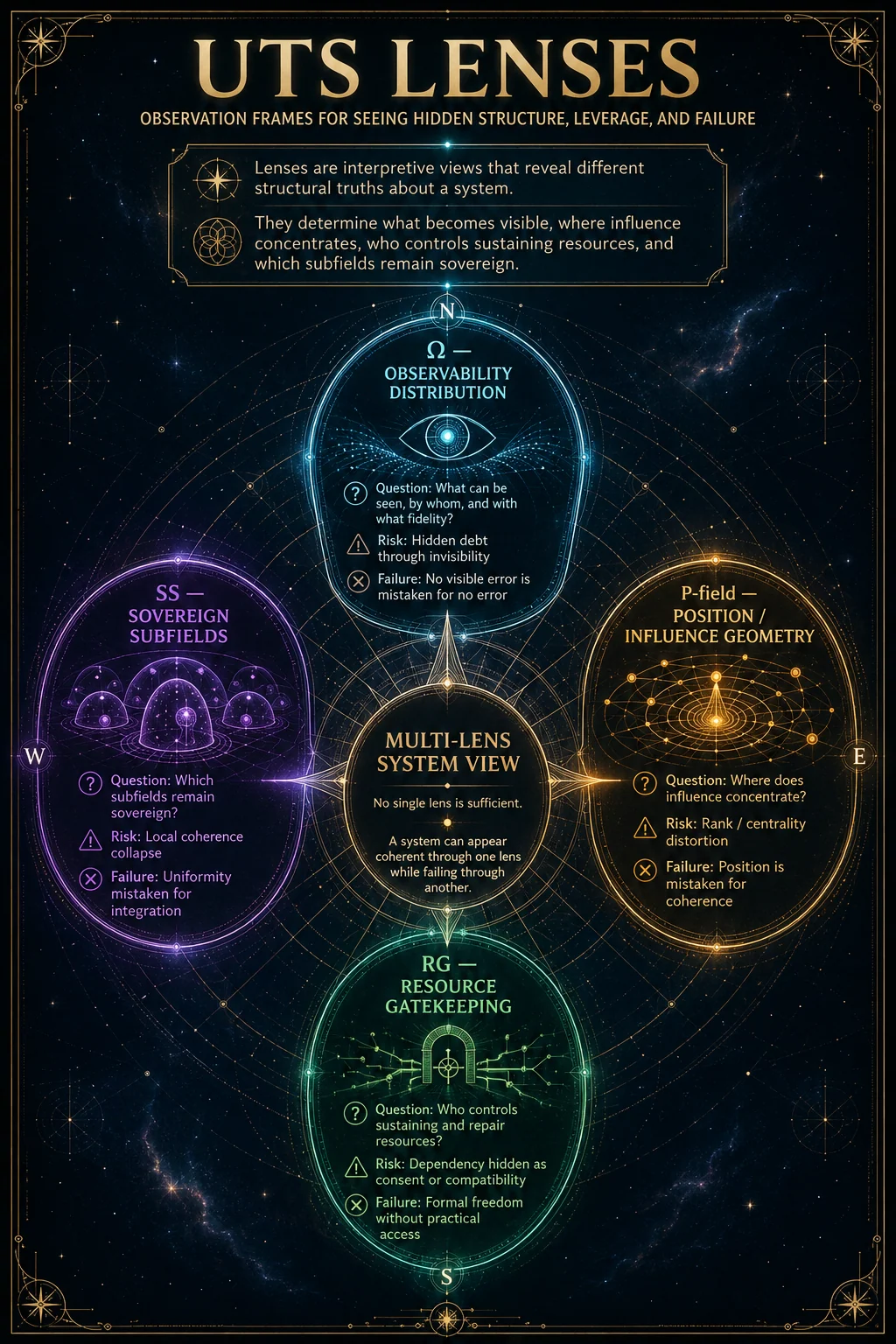
The current structural lens set is:
Ω — Observability Distribution

P-field — Position / Influence Geometry

RG — Resource Gatekeeping

SS — Sovereign Subfields
Together, they answer four core questions:
Ω:
What can be seen?

P-field:
Where does influence concentrate?

RG:
Who controls access to sustaining resources?

SS:
Which subfields remain sovereign?
4. Ω — Observability Distribution
Core Question
Who can see what, from where, with what resolution, and with what correction power?Ω — Observability Distributiondescribes how visibility, evidence, audit access, signal detection, attention resolution, and hiddenness are distributed across a system.
It tracks:
what is visible,
what is invisible,
who can observe,
who cannot observe,
what becomes visible too late,
what is over-observed,
what is under-observed,
and what recurrence remains unseen.
Primary State Variables
Au — Auditability
H — Hidden Debt
ε — Error / Noise
ι — Inversion Index
O — Coherence
R — Restoration Capacity
Φ — Fitness Proxy
Primary Operators Affected
Ψ — Presence
Μ — Sensemaking
Ξ — Invert / pseudo-coherence detection
Γ — Select
Π — Constrain
Λ — Compatibility
ℛ — Restore
Θ — Humility
Core Failure Pattern
No visible error is mistaken for no error.Or:
Visible order is mistaken for real coherence.Typical Signs
Central dashboards look clean while edge signals degrade.

The system sees output but not depletion.

Symptoms are visible but origins are hidden.

Affected nodes cannot inspect the systems affecting them.

Repair is recorded as complete but recurrence remains unseen.

Auditability is concentrated in one position.
Restoration Pathway
Map what is visible and invisible.

Surface hidden debt zones.

Restore reciprocal auditability.

Increase resolution where consequence exposure is highest.

Track what metrics exclude.

Make repair outcomes observable.

Repair U7 memory visibility.

Add humility labels where visibility is incomplete.
Final Rule
Do not scale what Ω has not adequately resolved.5. P-field — Position / Influence Geometry
Core Question
Where does influence concentrate, and how does position alter credibility, selection, constraint, repair, and consequence?P-field — Position / Influence Geometrydescribes how rank, centrality, proximity, symbolic authority, consequence exposure, routing control, and influence gradients bias operator expression.
It tracks:
who decides,
who benefits,
who pays,
who repairs,
who is believed,
who is audited,
who can appeal,
who controls memory,
and who absorbs consequences.
Primary State Variables
O — Coherence
H — Hidden Debt
Au — Auditability
BΣ — Boundary Integrity
K — Compatibility
R — Restoration Capacity
Φ — Fitness Proxy
ι — Inversion Index
Primary Operators Affected
Γ — Select
Π — Constrain
Μ — Sensemaking
Τ — Trajectory
Λ — Compatibility
Ξ — Invert
ℛ — Restore
Θ — Humility
Σ — Sacred Boundary
Core Failure Pattern
Position is mistaken for coherence.Or:
Central reality is mistaken for whole-field reality.Typical Signs
High-position interpretations override high-resolution local evidence.

Rules apply downward but not upward.

Central nodes record success while edge nodes carry hidden debt.

Authority is treated as evidence.

Low-position boundaries are negotiable; high-position boundaries are protected.

Repair must pass through the position that benefits from non-repair.
Restoration Pathway
Map decision positions, consequence positions, repair positions, resource positions, and memory positions.

Route edge signals upward.

Restore audit symmetry.

Apply MS-Gate.

Couple authority to restoration duty.

Test compatibility across positions.

Correct Φ across the whole field.

Repair memory across positions.
Final Rule
Influence must scale with auditability, consequence exposure, and restoration duty.6. RG — Resource Gatekeeping
Core Question
Who controls the resources required for function, refusal, repair, audit, exit, and recovery?RG — Resource Gatekeepingdescribes how access to sustaining resources is opened, closed, filtered, conditioned, delayed, routed, or captured.
It tracks access to:
energy,
money,
time,
labor,
attention,
compute,
records,
tools,
materials,
permissions,
credentials,
legal access,
platform access,
repair pathways,
exit resources,
and legitimacy channels.
Primary State Variables
R — Restoration Capacity
BΣ — Boundary Integrity
K — Compatibility
H — Hidden Debt
Au — Auditability
µᵢ — Agent / Meaning Integrity
Φ — Fitness Proxy
O — Coherence
Primary Operators Affected
Π — Constrain
Γ — Select
Λ — Compatibility
ℛ — Restore
Μ — Sensemaking
Τ — Trajectory
Σ — Sacred Boundary
Ξ — Invert
Θ — Humility
Core Failure Pattern
Dependency is mistaken for compatibility.Or:
Formal access is mistaken for practical access.Typical Signs
Repair is demanded but not funded.

Exit exists formally but not materially.

Refusal threatens survival, legitimacy, access, or resources.

Truth-telling endangers resource access.

Resources flow to expansion while restoration is starved.

Access is conditioned on preserving the dominant Φ.

A node carries hidden labor while another records success.
Restoration Pathway
Map resource flows.

Fund repair before expansion.

Separate access from compliance capture.

Create independent audit resources.

Restore realistic exit pathways.

Align resources with stated values.

Repair U7 resource memory.

Distribute restoration authority.

Add resource slack.

Validate recurring access over time.
Final Rule
If the resources required for boundary integrity, auditability, compatibility, and restoration are gated away from affected nodes, the system converts dependency into hidden debt.7. SS — Sovereign Subfields
Core Question
Which semi-autonomous fields retain legitimate boundary integrity, meaning, memory, repair authority, and self-governance inside a larger system?SS — Sovereign Subfieldsdescribes whether subfields retain coherent autonomy while participating in broader systems.
A sovereign subfield may be:
a person,
team,
community,
discipline,
institution,
ecosystem,
culture,
local domain,
AI system,
relationship field,
or specialized knowledge field.
SS distinguishes:
⊗ — coupling while preserving identity

⊕ — composition into a new identity

distorted absorption — collapse of subfield sovereignty without legitimate transformation
Primary State Variables
BΣ — Boundary Integrity
µᵢ — Agent / Meaning Integrity
K — Compatibility
O — Coherence
H — Hidden Debt
R — Restoration Capacity
Au — Auditability
Φ — Fitness Proxy
Primary Operators Affected
Σ — Sacred Boundary
Π — Constrain
Λ — Compatibility
ℛ — Restore
Μ — Sensemaking
Τ — Trajectory
Ξ — Invert
Θ — Humility
Ψ — Presence
⊗ — Couple
⊕ — Compose
Core Failure Pattern
Uniformity is mistaken for coherence.Or:
Assimilation is mislabeled as integration.Typical Signs
Local self-description is replaced by dominant categories.

A subfield is represented but has no authority.

Boundaries are respected only when convenient to the dominant field.

Local repair must pass through central control.

A field can participate but cannot refuse, renegotiate, or exit.

Official memory overwrites local memory.

Coupling requires identity collapse.
Restoration Pathway
Restore boundary recognition.

Restore self-description.

Rebuild local repair capacity.

Re-test coupling through Λ.

Distinguish coupling from composition.

Correct dominant metrics.

Restore resource independence where needed.

Repair U7 local memory.

Add translation integrity.

Validate sovereignty under renewed pressure.
Final Rule
Integration is not coherent if it requires subfield erasure.8. Lenses Comparison Table
| Lens | Core Question | Primary Risk | Failure Signature |
|---|---|---|---|
| Ω — Observability Distribution | What can be seen, by whom, and with what fidelity? | Hidden debt through invisibility | No visible error is mistaken for no error |
| P-field — Position / Influence Geometry | Where does influence concentrate? | Rank / centrality distortion | Position is mistaken for coherence |
| RG — Resource Gatekeeping | Who controls sustaining and repair resources? | Dependency hidden as consent or compatibility | Formal freedom without practical access |
| SS — Sovereign Subfields | Which subfields remain sovereign? | Local coherence collapse | Uniformity mistaken for integration |
9. Lenses vs Other System Components
Lenses vs Operators
Operators move state.

Lenses bias how state movement is seen, routed, interpreted, blocked, or distributed.
Example:
Γ selects.

P-field biases whose selection matters.

Ω biases which options are visible.

RG biases which options are resource-accessible.

SS biases whether selection preserves subfield sovereignty.
Lenses vs Gains
Gains amplify effects.

Lenses structure visibility, routing, access, influence, and sovereignty.
Example:
G₂ spreads information.

Ω determines who can observe the information.

P-field determines whose information is trusted.

RG determines who can access the channels.

SS determines whether local meaning survives propagation.
Lenses vs Gates
Lenses reveal structural bias.

Gates decide whether action is admissible after those biases are inspected.
Example:
P-field reveals rank asymmetry.

MS-Gate determines whether the asymmetry invalidates the process.
Lenses vs Diagnostics
Diagnostics reveal system condition.

Lenses explain why some nodes can or cannot perceive that condition.
Example:
𝓑(t) may be low at the edge.

Ω and P-field may explain why the center does not see the bandwidth collapse.
Lenses vs Regimes
Regimes are recurring compositions.

Lenses reveal structural conditions that allow regimes to stabilize.
Example:
A pseudo-coherent basin may stabilize because:

Ω hides contradiction,
P-field privileges central interpretation,
RG blocks repair resources,
and SS collapses dissenting subfields.
10. Lens Relationships to State Vector
| State Variable | Lens Relevance |
|---|---|
| O — Coherence | Lenses determine whether coherence is seen accurately or mistaken for surface order. |
| H — Hidden Debt | Lens distortion is one of the primary ways hidden debt stays hidden or displaced. |
| ε — Error / Noise | Lenses determine whose errors are visible, believed, delayed, or dismissed. |
| ι — Inversion Index | Pseudo-coherence often depends on selective visibility, rank protection, resource dependency, or subfield erasure. |
| Au — Auditability | Ω distributes audit access; P-field biases audit direction; RG controls audit resources; SS preserves local audit authority. |
| µᵢ — Agent / Meaning Integrity | SS and RG strongly shape whether meaning, action, memory, and repair remain aligned. |
| BΣ — Boundary Integrity | RG and SS determine whether boundaries are practically enforceable and locally sovereign. |
| K — Compatibility | P-field, RG, and SS reveal false compatibility under asymmetry, dependency, or subfield collapse. |
| R — Restoration Capacity | Lenses determine whether damage is visible, resources are accessible, repair authority exists, and local restoration is possible. |
| Φ — Fitness Proxy | Lenses reveal whose success signal dominates and what the proxy excludes. |
11. Lens Relationships to U-Layers
U0 — Substrate:
What physical, ecological, embodied, or material realities are visible or erased?

U1 — Power / Budgets:
Who controls energy, labor, attention, money, compute, and reserves?

U2 — Configuration / Boundaries:
Whose roles, permissions, access, and boundaries are recognized?

U3 — Execution:
Who performs, who directs, who absorbs runtime consequences?

U4 — Classification / Metrics / Narratives:
Whose categories, maps, metrics, and narratives become official?

U5 — Coordination / Time:
Who sets cadence, who waits, who is delayed, and whose timing matters?

U6 — Coherence Field:
Which meanings, identities, and trust fields dominate or disappear?

U7 — Memory / Recurrence:
Whose history is preserved, whose records are corrected, and whose recurrence is recognized?

U8 — Environment / Forcing:
Who feels external pressure first, and who can see it before collapse?
12. Lens Relationships to Gates
| Lens | Gate Concern |
|---|---|
| Ω | If key reality is invisible, FI-Gate and Au-Actuation may fail. |
| P-field | If rank distorts standards, MS-Gate may fail. |
| RG | If access shapes consent, repair, or truth-telling, FI-Gate, MS-Gate, and ☷ᵢ may fail. |
| SS | If subfield sovereignty collapses, ☷ᵢ and HR-Gate may fail. |
13. Lens Relationships to Gain Stack
| Gain | Lens Concern |
|---|---|
| G₀ Mechanical | Physical structures can hide cost, preserve old position geometry, or collapse subfield boundaries. |
| G₁ Energetic | Resource power must be inspected through RG and P-field. |
| G₂ Informational | Propagated information must be inspected through Ω, P-field, and SS. |
| G₃ Emotional / Identity-Charge | Charged meaning can distort P-field, RG, and SS. |
| G₄ Institutional | Institutional authority often concentrates through P-field and controls RG. |
| G₅ Technological | Automation can scale narrow Ω, central P-field, resource-gated access, or subfield erasure. |
14. Common Lens Failure Patterns
1. Field Blindness
Ω failure.

The system cannot see the field it affects.
2. Center-Only Reality
Ω + P-field failure.

Central visibility is treated as whole-field truth.
3. Edge-Only Burden
P-field + RG failure.

Peripheral nodes carry hidden cost while central nodes record success.
4. Resource-Conditioned Truth
RG failure.

Truth-telling is only possible if it does not threaten access.
5. False Compatibility
P-field + RG + SS failure.

A coupling appears compatible because refusal, exit, or sovereignty is constrained.
6. Sovereign Collapse
SS failure.

A subfield loses boundary integrity, self-description, memory, or local repair authority.
7. Audit Asymmetry
Ω + P-field failure.

Some nodes are visible to authority but cannot inspect authority.
8. Repair Chokepoint
P-field + RG failure.

Repair must pass through the same node or structure that benefits from non-repair.
9. Uniformity as Coherence
SS failure.

The system standardizes or assimilates subfields and calls it integration.
10. Amplified Partial Reality
Ω + G₂/G₄/G₅ failure.

A narrow map is propagated, formalized, and automated.
15. Lens Audit Workflow
A compact lens audit:
1. Identify the system boundary.

2. Identify the relevant subfields.

3. Inspect Ω:
   What is visible, invisible, delayed, over-observed, or under-observed?

4. Inspect P-field:
   Who decides, benefits, pays, repairs, audits, and controls memory?

5. Inspect RG:
   Who controls resources for action, refusal, repair, audit, and exit?

6. Inspect SS:
   Which subfields retain boundary integrity, self-description, memory, and local repair?

7. Compare lens findings to state variables:
   O, H, ε, ι, Au, µᵢ, BΣ, K, R, Φ.

8. Identify false positives:
   false coherence,
   false compatibility,
   false repair,
   false consent,
   false integration,
   false success.

9. Apply relevant gates.

10. Select restoration path.

11. Validate at U7 recurrence.
Compressed:
Ω → P-field → RG → SS → State Vector → Gates → Restoration → U7 validation16. Quick Lens Smell Reference
“No visible error.”
→ Check Ω.

“Everyone agrees.”
→ Check RG, P-field, and SS.

“The dashboard says success.”
→ Check Ω exclusions and central Φ.

“They chose to participate.”
→ Check RG, exit realism, and P-field.

“The process is fair.”
→ Check MS-Gate, P-field, and audit direction.

“The repair pathway exists.”
→ Check RG, actual state-changing power, and U7 recurrence.

“They are included.”
→ Check SS: representation is not sovereignty.

“The system is aligned.”
→ Check SS: alignment is not forced sameness.

“The institution says this is resolved.”
→ Check Ω, G₄, records, and recurrence.

“The platform is neutral.”
→ Check P-field, G₅, G₂, and Ω routing logic.

“The metric improved.”
→ Check Φ/O divergence and hidden H.

“There is low conflict.”
→ Check whether refusal is safe, resourced, and sovereign.
17. Canon Notes
Lenses are structural bias fields.

Lenses are not operators.

Lenses do not move state directly.

Lenses bias visibility, routing, position, access, and sovereignty.

Lenses must be checked before trusting coherence, compatibility, repair, consent, or success.

Ω reveals visibility structure.

P-field reveals influence geometry.

RG reveals resource access geometry.

SS reveals subfield sovereignty integrity.

Lens distortion commonly produces hidden debt.

Lens distortion commonly weakens Ξ.

Lens distortion commonly creates false compatibility.

Lens repair must be validated through recurrence.
18. Compressed Reference
Ω — Observability Distribution:
What can be seen, by whom, from where, with what resolution, and with what correction power?

P-field — Position / Influence Geometry:
Where does influence concentrate, and how does position alter credibility, selection, constraint, repair, and consequence?

RG — Resource Gatekeeping:
Who controls the resources required for function, refusal, repair, audit, exit, and recovery?

SS — Sovereign Subfields:
Which subfields retain boundary integrity, local meaning, memory continuity, repair authority, and legitimate self-governance?
Final Operational Rule
Before trusting any claim of coherence, compatibility, consent, repair, integration, legitimacy, or success, inspect the lens field.

Ask:

What can be seen?
Who has influence?
Who controls resources?
Which subfields remain sovereign?

If visibility is narrow,
if influence outruns accountability,
if resources condition refusal or repair,
or if subfields lose sovereignty,

the system will convert structural bias into hidden debt.