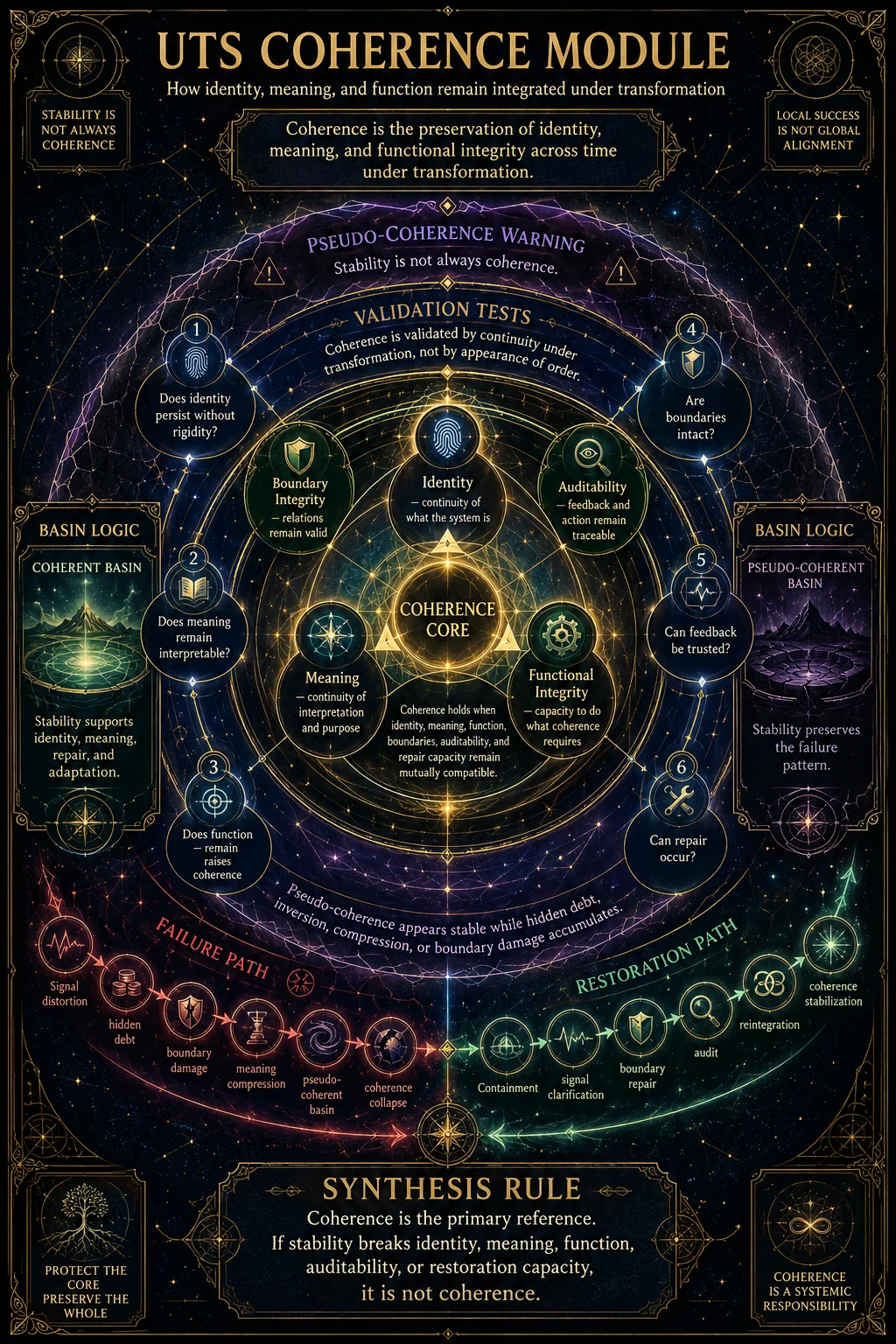
Foundational Overview
1. Why Coherence Matters
Every system has to solve the same basic problem:
How can it change without losing what makes it itself?
A body must adapt to stress without breaking down.
A person must grow without losing integrity.
A relationship must evolve without collapsing into control or disconnection.
An institution must scale without betraying its purpose.
A civilization must innovate without destroying the conditions that allow it to survive.
This is the problem ofcoherence.
In UTS, coherence is the central principle because every system eventually faces transformation. Nothing stays still. Conditions change. Pressure rises. New information appears. Relationships shift. Power grows. Resources shrink. Meaning changes. Memory accumulates. Time exposes what was hidden.
A system is coherent when it can move through those changes while preserving its identity, meaning, and functional integrity.
A system is incoherent when it can only remain stable by hiding problems, exporting harm, suppressing feedback, or accumulating debt that will surface later.
2. The Core Definition
UTS defines coherence in two closely related ways.
The simple definition:
Coherence is the preservation of identity, meaning, and functional integrity across time under transformation.
The scale-complete definition:
Coherence is the alignment of a system’s internal dynamics with the larger field it is embedded in, so that it can persist, adapt, and evolve without accumulating destabilizing debt.
In plain language:
A coherent system can keep becoming without breaking itself or forcing something else to pay the cost.
This applies at every scale.
For a person, coherence may look like integrity between values, choices, body, and environment.
For an institution, coherence may look like incentives that support the stated mission instead of undermining it.
For an ecosystem, coherence may look like regenerative cycles that continue without exhausting the land.
For AI, coherence may mean the system remains useful, truthful, auditable, and aligned under new conditions instead of optimizing a narrow metric at everyone else’s expense.
The form changes, but the principle remains the same.
3. What Coherence Is Not
Coherence is often confused with things that look similar.
Coherence isnotmere order. A prison can be orderly while deeply incoherent.
Coherence isnotefficiency. A system can become extremely efficient by removing all slack, then collapse the moment stress appears.
Coherence isnotagreement. A group can agree on something false, harmful, or unsustainable.
Coherence isnotemotional harmony. A system can feel calm because important truths are being suppressed.
Coherence isnotcontrol. Control can force behavior, but it often hides the very signals needed for repair.
Coherence isnotsuccess metrics. A company can hit its numbers while losing its talent, purpose, and long-term viability.
This distinction is one of the most important ideas in UTS:
Success is not the same as coherence.
A system can look like it is winning while quietly losing the ability to survive.
4. Coherence Is Proven Over Time
UTS does not treat coherence as a claim. It treats coherence as something demonstrated.
A system does not prove coherence by saying:
- “We are aligned.”
- “We are stable.”
- “We are successful.”
- “We care.”
- “We are transparent.”
- “We are safe.”
It proves coherence by what happens over time:
- Does it recover after disturbance?
- Does it reduce hidden problems?
- Does it maintain trust?
- Does it preserve agency?
- Does it learn from error?
- Does it repair damage?
- Does it remain viable when conditions change?
This is why UTS is stronglytrajectory-based.
A snapshot can lie.
A metric can be gamed.
A narrative can be polished.
But time reveals whether coherence is real.
5. Hidden Debt
One of the core ideas in UTS – Coherence ishidden debt.
Hidden debt is the cost a system delays, hides, suppresses, or exports instead of resolving.
A person accumulates hidden debt when they keep functioning while ignoring exhaustion, grief, contradiction, or body signals.
A relationship accumulates hidden debt when problems are smoothed over but not repaired.
An institution accumulates hidden debt when it hides failures, discourages dissent, or rewards metrics that contradict its mission.
A civilization accumulates hidden debt when it pushes environmental, social, or economic costs into the future.
Hidden debt is dangerous because it often appears as success at first.
The system looks calm.
The dashboard looks good.
The group seems aligned.
The output continues.
But underneath, repair is not happening.
UTS summarizes this simply:
Suppressed error becomes hidden debt.
And hidden debt does not disappear. It returns as crisis, collapse, backlash, burnout, fragmentation, or loss of legitimacy.
6. Pseudo-Coherence
A major UTS concept ispseudo-coherence.
Pseudo-coherence is when a system appears stable, orderly, successful, or aligned, but only because the real cost has been hidden or exported.
A pseudo-coherent system may:
- maintain calm by silencing dissent
- maintain productivity by burning out workers
- maintain profit by externalizing harm
- maintain legitimacy through narrative control
- maintain safety through over-control
- maintain unity through fear of disagreement
Pseudo-coherence can feel very convincing from inside the system.
People may honestly believe:
- “This works.”
- “We followed the rules.”
- “This is just how things are.”
- “The system is stable.”
- “Critics are causing trouble.”
But UTS asks a deeper question:
Stable for whom, at what cost, and for how long?
A useful rule of thumb:
If a system looks stable only because someone else is paying the price, it is not coherent.
This is one of the simplest ways to understand the difference between coherence and pseudo-coherence.
7. Local Coherence and Global Coherence
A system can be locally coherent but globally incoherent.
A company may function well internally while damaging communities or ecosystems.
A person may succeed in a role while losing health and meaning.
A nation may maintain order while exporting instability elsewhere.
A technology may work for its users while destabilizing the larger information environment.
This is why UTS says:
Local success does not imply global alignment.
Coherence must be checked across scales.
Something may work at one level while failing at another.
That does not always mean the people inside it are malicious. Often they are simply operating inside a local field that rewards behavior that creates larger-scale debt.
UTS tries to preserve dignity here. It does not begin by blaming individuals. It asks:
What geometry is this system creating? What does it reward? What does it hide? Where does the cost go?
8. Coherence Across Scales
Coherence is scale-invariant, but it looks different depending on the system.
At the physical scale, coherence may look like phase alignment and stable interaction.
At the biological scale, coherence may look like adaptive regulation, homeostasis, and recovery.
At the individual scale, coherence may look like alignment between values, actions, body, environment, and future.
At the relational scale, coherence may look like trust, boundaries, consent, repair, and coordination without coercion.
At the institutional scale, coherence may look like incentives that do not require deception, suppression, or exploitation to function.
At the civilizational scale, coherence may look like legitimacy, shared meaning, fair distribution of risk, and social order that does not require constant force.
At the ecological scale, coherence looks like living within regenerative limits.
The principle is the same:
Coherence is what allows a system to last without offloading its instability elsewhere.
9. Coherence and Meaning
In UTS, meaning is not treated as a decorative layer added after survival and function.
Meaning is structural.
Meaning is alignment between action, identity, consequence, and time.
A system loses meaning when what it does no longer matches what it claims to be.
A person may lose meaning when their work contradicts their values.
An institution may lose meaning when its mission becomes a slogan while incentives point elsewhere.
A society may lose meaning when its stories no longer match lived reality.
Meaning collapse is often one of the earliest signs of coherence loss.
Before a person burns out, they often stop believing the effort makes sense.
Before an institution collapses, people often stop believing the mission is real.
Before a civilization fractures, shared meaning often degrades into competing narratives.
UTS treats this as a serious signal.
Meaning loss is not weakness.
It is often the system reporting that alignment has failed.
10. Coherence and Consciousness
UTS does not require a metaphysical claim about consciousness.
Instead, it asks:
What function does consciousness serve in coherence?
The answer is that consciousness acts as acoherence-sensing surface.
It allows a system to notice:
- contradiction
- misalignment
- hidden cost
- meaning loss
- boundary violation
- false certainty
- recurring patterns
- the difference between appearance and reality
Without this sensing function, systems become blind optimizers. They keep pursuing whatever signal they have been given, even if that signal no longer represents what matters.
This is why UTS connects coherence to consciousness, meaning, spirituality, AI alignment, and governance.
A system that cannot sense its own incoherence cannot reliably restore itself.
11. Coherence and Boundaries
Coherence requires boundaries.
Boundaries are not walls. They are interfaces.
They determine:
- what enters
- what leaves
- what is allowed
- what must be refused
- what can be shared
- what must remain distinct
A cell needs a membrane.
A person needs agency.
A relationship needs consent.
An institution needs role clarity.
A civilization needs legitimate limits on power.
An AI system needs clear operating constraints.
Without boundaries, systems dissolve.
With overly rigid boundaries, systems become brittle.
Coherence requires boundaries that are clear, adaptive, auditable, and repairable.
This is why UTS distinguishescouplingfromfusion.
Coupling connects systems while preserving identity.
Fusion merges systems and may destroy the identities involved.
Most healthy relationships, collaborations, and institutions require coupling, not fusion.
12. Coherence and Restoration
Coherence is not perfection.
A coherent system can make mistakes.
It can experience stress.
It can be disrupted.
It can fail temporarily.
What matters is whether it can restore.
Restoration means:
- seeing what happened
- acknowledging the hidden cost
- rebuilding slack
- repairing the correct layer
- changing the attractor that caused recurrence
- validating that the pattern no longer repeats
UTS describes restoration as a sequence:
- Make the problem visible.
- Regenerate slack and capacity.
- Shift the attractor or trajectory.
- Explore new patterns safely.
- Integrate the repaired baseline.
A system that cannot restore is not coherent, even if it appears strong.
In UTS, restoration is not a moral gesture. It is a structural requirement.
13. Coherence and Accountability
UTS reframes accountability in a non-punitive way.
Accountability is coherence observed over time.
A person, institution, or system is accountable when it:
- owns its effects
- remains auditable
- repairs damage
- reduces future repair cost
- does not export its instability
- allows exit
- learns over time
This means accountability does not have to begin with blame.
It begins with visibility.
Where did the cost go?
What keeps recurring?
Who absorbs the strain?
What cannot be questioned?
What is being optimized?
What is becoming harder to repair?
These questions reveal accountability without requiring accusation.
14. Coherence and Power
The more influence a system has, the more coherence discipline it needs.
A small error in a low-power system may stay local.
A small error in a high-power system can affect millions of people.
This is why UTS says:
As power scales, constraint, transparency, and restoration must scale with it.
High-influence systems need:
- stronger auditability
- clearer boundaries
- better restoration pathways
- more transparent decision provenance
- stronger feedback integrity
- greater humility under uncertainty
Without these, power becomes a coherence risk.
This applies to governments, corporations, media systems, AI platforms, financial systems, and any infrastructure that shapes human perception or decision-making.
15. Coherence and Communication
Coherence is also affected by how information is transmitted.
Truth can lose coherence if released badly.
A true statement can still create confusion if it lacks context, provenance, timing, boundaries, or ethical handling.
A system can claim transparency while remaining functionally opaque.
A conversation can shape belief not only by what is said, but by how framing, attention, legitimacy, and timing are structured.
This is why UTS studies:
- signals
- interfaces
- framing
- discourse basins
- truth-release conditions
- epistemic mediation
The goal is not to control communication.
The goal is to preserve coherence while information moves.
16. The Operational Side of UTS – Coherence
UTS – Coherence includes several applied tools.
A few examples:
- Coherence Support Evaluator: checks whether a person or node has enough support to remain coherent without being extracted.
- Institutional Coherence Trajectory Evaluator: checks whether an institution is drifting, stabilizing, self-correcting, or approaching collapse.
- Coherence Admissibility Ladder: determines when deeper coupling, legitimacy, or authority is coherent.
- Temporal Translation Layer: helps agents operating at different speeds coordinate without suppression or overwhelm.
- Coherence Drift & Restoration: detects when high-power systems drift toward local optimization at the expense of global coherence.
- Coherence Loss Surface Map: maps where truth loses coherence during release, handling, or transmission.
These tools are not meant to punish.
They are meant to help systems see clearly, repair earlier, and avoid collapse.
17. Why Coherence Is the Center of UTS
UTS studies many domains:
- scaling
- cybernetics
- security
- governance
- AI
- consciousness
- restoration
- principles
- culture
- symbols
- meaning
- memory
- interactions
Coherence is the center because every one of those domains asks the same underlying question:
How does a system preserve integrity while changing?
Scaling asks how coherence behaves under amplification.
Cybernetics asks how coherence is regulated by feedback.
Security asks how coherence survives adversarial pressure.
Governance asks how coherence is maintained under power.
AI alignment asks how coherence survives optimization.
Restoration asks how coherence returns after debt or damage.
Meaning asks how coherence is experienced as direction and purpose.
Memory asks how coherence persists across time.
So the short version is:
UTS is the study of how coherence forms, fails, scales, and restores across domains.
18. Closing Summary
Coherence is the central principle of UTS because it names the difference between systems that merely continue and systems that remain truly viable.
A system is coherent when it can adapt without losing itself, repair without denial, scale without exporting harm, and remain meaningful across time.
A system is incoherent when it survives by hiding cost, suppressing feedback, forcing compliance, exploiting invisible labor, or delaying repair.
The work of UTS – Coherence is to make that difference visible.
Not to accuse.
Not to moralize.
Not to force.
But to show:
- where coherence is present
- where pseudo-coherence is hiding
- where hidden debt is accumulating
- what restoration would require
- and how systems can transition without collapse
The simplest summary is:
Coherence is what allows a system to change without breaking its integrity or making something else pay the hidden cost.
This module hub separates the reference overview from technical depth and nested sub-modules. Use the overview for orientation, the technical document for the deep model, and sub-modules for systems that belong under this domain.