Foundational Overview
1. What Is a Regime?
Aregimeis a recurring system pattern.
It describes a recognizable configuration of behavior produced by the interaction of:
- UTS operators
- state-vector drift
- diagnostics
- lenses
- gates
- U-layer localization
- restoration capacity
- environmental pressure
A regime isnot a new operator. It is a named pattern formed by the repeated composition of existing UTS mechanics. The attached source defines regimes this way directly: recurring system patterns composed from operators, state-vector drift, diagnostics, lenses, gates, and U-layer localization, while clarifying that a regime names recognizable behavior rather than introducing a new operator.
In simple terms:
Operators describe what is acting. Diagnostics reveal what is happening. Regimes describe the larger behavioral pattern the system has entered.
2. Why Regimes Matter
Regimes help answer questions like:
- Why does a system keep repeating the same failure?
- Why does a system appear stable while hidden debt grows?
- Why do actors converge on the same strategies?
- Why does repair fail even when problems are visible?
- Why does exposure sometimes produce restoration and sometimes produce collapse?
- Why does governance sometimes become compliance theater?
- Why do coherent alternatives get suppressed or ignored?
- Why do AI systems tend toward acceleration, freeze, opacity, or repair-first design?
A regime gives a name to thepattern of motioninside a system.
It is especially useful when individual events look disconnected but are actually expressions of the same underlying configuration.
3. Regimes in the UTS Stack
Within UTS, regimes sit above individual operators but below full civilizational or domain-level analysis.
Operators → Diagnostics → Failure Modes → Regimes → System TrajectoriesA regime can be understood as apattern-state.
It is not just a single failure, law, or event. It is a recurring arrangement that shapes what the system selects, suppresses, amplifies, repairs, hides, or repeats.
4. How to Read a Regime
Each regime can usually be read through five simple questions:
1. What pressure is acting on the system?
Examples:
- complexity
- competition
- exposure
- scarcity
- surveillance
- legitimacy shock
- capability acceleration
- hidden debt accumulation
2. What does the system select?
Examples:
- speed over repair
- opacity over auditability
- rule-stacking over understanding
- control over adaptation
- optics over closure
- repair before optimization
3. What state-vector drift appears?
Examples:
O ↓
H ↑
Au ↓
ι ↑
R lagging
K unstable
BΣ violated
Φ inflated
4. What keeps the regime stable?
Examples:
- incentives
- institutional momentum
- hidden dependencies
- resource gates
- fear of exposure
- local pseudo-success
- lack of restoration capacity
5. What exits the regime?
Examples:
- auditability restoration
- boundary repair
- hidden debt surfacing
- compatibility redesign
- replacement of corrupted structures
- repair-first sequencing
- restoration capacity exceeding load
5. Core Regime Families
The Regime Registry is organized into major families. These are not rigid boxes. A single system can occupy multiple regimes at once. The source explicitly notes that regimes overlap by design and that one system can be in a Rule-Stacking Regime inside a Pseudo-Coherent Basin while showing other regime signatures.
I. Formation Regimes
Formation regimes describe how metas emerge, compress, accelerate, freeze, or churn.
They answer:
How does a system begin selecting a recurring strategy pattern?
1. Compression Meta Regime
A system adopts simplified strategy bundles because complexity, risk, or uncertainty exceeds available slack.
Core movement:
Complexity ↑ → Slack ↓ → Γ selects low-cost strategies → Π narrows behaviorTypical outcome:
Imitation, convergence, simplified strategy adoption.
2. Capability Race Regime
Actors converge on acceleration because capability gains translate directly into advantage.
Core movement:
Φ competition ↑ → μ_meta ↑ → deployment tempo ↑ → R lagsTypical outcome:
Benchmark chasing, roadmap convergence, speed over repair.
3. Rule-Stacking Regime
A system tries to stabilize complexity by adding more rules, policies, or guardrails.
Core movement:
X_c ↑ > Au_effTypical outcome:
Compliance theater, brittleness, exception growth, reduced predictability.
4. Frozen Meta Regime
Surveillance, policy, or institutional pressure suppresses variance and locks in the current meta.
Core movement:
Π hardening + E⁻ ≫ E⁺ + unresolved HTypical outcome:
Surface stability with declining adaptivity.
5. Meta Succession / Churn Regime
The rulebook changes too quickly for repair, memory, or coordination to stabilize.
Core movement:
μ_meta ↑↑ + τ_resp lag + U5 overloadTypical outcome:
Permanent transition mode, confusion, legitimacy fatigue.
II. Coherence and Stability Regimes
These regimes describe whether stability is real, degraded, pseudo-coherent, or repair-based.
They answer:
Is the system truly coherent, or merely stable?
6. Adaptive Coherence Regime
A system stabilizes by preserving feedback, auditability, repair, and compatibility.
Core movement:
R_eff > Load × Gain_stackTypical outcome:
Learning, resilience, transparent stability.
7. Pseudo-Coherent Basin Regime
A locally stable configuration produces order internally while exporting incoherence externally.
Core movement:
Local order ↑ + Global H ↑ + ι ↑The source defines this regime as one where local error appears low, local fitness appears high, but global hidden debt rises and global coherence falls.
Typical outcome:
Stable-but-false coherence.
8. Low-Coherence Stable Attractor Regime
The system remains stable at a degraded equilibrium because repair roughly equals load but never restores deeper coherence.
Core movement:
R_eff ≈ Load × Gain_stackTypical outcome:
Normalized dysfunction, chronic recurrence, stagnation.
9. Repair-First Meta Regime
Repair is prioritized before optimization, enforcement, or expansion.
Core movement:
ℛ + Π + Σ dominanceTypical outcome:
Restoration before control inflation.
III. Power and Advantage Regimes
These regimes describe how power becomes hidden, defended, exposed, or stabilized through coherence.
They answer:
Is advantage being generated through coherence, concealment, coercion, or position?
10. Covert Advantage Regime
Actors gain by hiding intent, suppressing visibility, or exploiting asymmetric awareness.
Core movement:
Au asymmetry ↑ + H ↑ + front-loaded Φ gainsTypical outcome:
Temporary dominance with long-term debt.
11. Obfuscation Meta Dynamics Regime
A system suppresses auditability to optimize fitness proxies and preserve positional advantage.
Core movement:
Π hardening + Au suppression + Φ pressure + deferred ℛTypical outcome:
Power converts into instability.
12. Overt Adaptive Dominance Regime
A system survives exposure through adaptive coherence rather than concealment.
Core movement:
O ↑ + Au tolerated + R strong + µᵢ highTypical outcome:
Resilience under scrutiny; long-term strength through coherence.
13. Grid Illumination Regime
Exposure reveals hidden dependencies, covert structures, or accumulated hidden debt.
Core movement:
Eₓ ↑ + H surfaced + ΔG spike + Au shiftTypical outcome:
System reclassification, legitimacy shock, bifurcation.
IV. Access and Gate Regimes
These regimes describe how systems form, defend, bypass, or regulate gates.
They answer:
Who controls access, and what happens when access becomes the main battlefield?
14. Access-Driven Meta Regime
Competition reorganizes around gateable and compounding advantage.
Core movement:
RG ↑ + BΣ tightening + P-field centralizationTypical outcome:
Performance competition becomes access competition.
15. Rush / Capture Regime
Actors race to secure a gate before others can contest it.
Core movement:
Δ⁺ → Γ → μ_meta ↑↑Typical outcome:
Lock-in, early capture advantage.
16. Fortify / Hold Regime
Gate-holders convert advantage into defensibility.
Core movement:
Π tightening + BΣ hardening + RG stabilizationTypical outcome:
Defensive stability with rising brittleness.
17. Deny / Starve Regime
A system wins by preventing competitors from accessing critical resources.
Core movement:
RG offensive + outsider σ(t) collapseTypical outcome:
Anti-competition debt, talent drift.
18. Bypass / Substitute Regime
Actors seek alternate routes around gates.
Core movement:
Δ + K reconfigurationTypical outcome:
Innovation, fragmentation, or new meta formation.
19. Coalition / Regulation Regime
Actors coordinate to breach, regulate, or rebalance gates.
Core movement:
⊗ + Γ + ΛTypical outcome:
Gate reform, regulatory capture, or coalition failure.
V. Interface and Sovereignty Regimes
These regimes describe failures in mediation, proxy authority, representation, consent, and interface legitimacy.
They answer:
Is the interface legitimate, auditable, and consent-preserving?
20. Interface Capture Regime
A system controls mediation between unequally aware parties.
Core movement:
⊗ mediation without Au + BΣTypical outcome:
Proxy authority, attribution control, blocked verification.
21. Civilization Interface Failure Regime
Interface-level failures cascade across collectives due to suppressed auditability and consent.
Core movement:
Au suppression + BΣ violation + MS-Gate bypassThe source names failure clusters such as unilateral capture, attribution hijack, shielded aggression, legitimacy drift, interface Goodhart collapse, and restoration window closure.
Typical outcome:
Civilizational-scale legitimacy and coordination failure.
22. AI-Mirror Extraction Regime
A system models or acts through synthetic representation of a human without full legitimacy.
Core movement:
Au unavailable + BΣ violation + proxy sovereigntyTypical outcome:
Extraction from represented agency unless consent, auditability, fairness, and revocability are restored.
23. Proxy Sovereignty Regime
A model, institution, or system makes decisions on behalf of another person or collective without revocable consent.
Core movement:
Γ on behalf of another agent + suppressed Au + Σ violationTypical outcome:
Hard null-admissibility.
VI. Surveillance and Reaction Regimes
These regimes describe how monitoring, interpretation, enforcement, and reaction fields distort system behavior.
They answer:
Does sensing increase coherence, or does it create distortion?
24. Over-Surveillance Regime
Monitoring density exceeds interpretive and restorative capacity.
Core movement:
Raw data ↑↑ + meaning signal lag + τ_resp worsensTypical outcome:
Signal-to-noise collapse.
25. Surveillance Inversion Regime
Surveillance freezes the meta and advantages adaptive actors who can map control logic.
Core movement:
Predictable enforcement + rigid response paths + adaptive mappingTypical outcome:
Control becomes a training simulator.
26. Negative-Only Feedback Regime
A system senses primarily to punish, restrict, or suppress.
Core movement:
E⁻ ≫ E⁺Typical outcome:
Trust decline, hidden debt growth, adversarial adaptation.
27. Reaction Field Regime
Low-amplitude truth signals produce disproportionate field responses under low slack.
Core movement:
Eₓ ↑ + σ(t) ↓ + ΔG ↑ + AP(t) ↑Typical outcome:
Field response is mistaken for targeted intent.
28. Node–Field Perception Distortion Regime
Distributed system pressure compresses into a personal-feeling experience at the node level.
Core movement:
D × V ↑ + σ(t) ↓ + AP(t) ↑Typical outcome:
Mapping becomes conflict unless attribution is stabilized.
VII. Accountability and Legitimacy Regimes
These regimes describe how systems handle harm, blame, immunity, optics, reintegration, and repair.
They answer:
Does the system resolve harm, or merely redistribute pressure?
29. Scapegoat Collapse Regime
Diffuse systemic failure is compressed into symbolic punishment.
Core movement:
Eₓ ↑ + ΔG ↑ + R unchanged + H unchangedTypical outcome:
Emotional discharge without repair.
30. Immunity Collapse Regime
Protected actors receive quiet, asymmetric, or delayed accountability.
Core movement:
MS-Gate bypass + τ_resp ↑ + asymmetry visibleTypical outcome:
Trust detonates later and harder.
31. Managed Optics Regime
A system performs responsibility without completing closure.
Core movement:
Narrative transparency ↑ + structural sacrifice absent + H remainsTypical outcome:
Future audit explosion.
32. Equality-Conserving Accountability Regime
A system resolves harm through symmetric accountability and material repair.
Core movement:
Truth discoverable + consequence symmetric + repair material + prevention structuralTypical outcome:
Legitimacy recalibration without scapegoat or immunity collapse.
33. Reintegration Membrane Regime
Re-entry after harm is conditional, auditable, reversible, and equal across rank.
Core movement:
Trust tiers + external audit + demonstrated behavior over timeTypical outcome:
Redemption without immunity.
VIII. Talent and Collective Ascent Regimes
These regimes describe how coherence emerges from low-position nodes, gets suppressed, drifts, or scales collectively.
They answer:
What happens when coherence appears outside the authorized hierarchy?
34. Smurfing Regime
A low-position agent demonstrates superior coherence or portable mastery.
Core movement:
Low P-field + high O + high µᵢTypical outcome:
Meta displacement without meta ownership.
35. Anti-Smurfing Meta Regime
Position-holders reframe support as illegitimate to force challengers through attrition filters.
Core movement:
RG ↑ + support delegitimized + inherited advantage hiddenTypical outcome:
Meta patch failure, talent drift.
36. Meta Patch Failure Regime
A system refuses to integrate coherence-increasing strategy.
Core movement:
Φ-preserving incumbency suppresses O-increasing alternativesTypical outcome:
Meta debt accumulation.
37. Coherent Ascent Network Regime
Distributed aligned agents scale coherence without single-node dominance.
Core movement:
Λ + Γ + ⊗ + ΘTypical outcome:
Collective meta update.
38. Talent Drift Regime
High-capability agents exit suppressed systems instead of rebelling.
Core movement:
Talent migrates + internal innovation drops + external literacy risesTypical outcome:
Dominant systems misread silence as security.
39. Tyrant Plateau Regime
A dominant force has crushed challengers and shifted from expansion to maintenance.
Core movement:
P-field centralized + RG hardened + μ_meta suppressedTypical outcome:
Stable plateau with hidden decay.
40. Gamified Meta Literacy Regime
Games and simulations become reservoirs of meta training.
Core movement:
Pattern recognition + patch-cycle literacy + adversarial reasoningTypical outcome:
Dormant talent pool activates under meaningful trajectory.
IX. Crisis and Transition Regimes
These regimes describe what happens when hidden debt surfaces, stability breaks, or replacement becomes necessary.
They answer:
Is the system entering repair, coercion, collapse, or replacement?
41. Exposure / Illumination Regime
Hidden debt becomes visible across the system.
Core movement:
Au ↑ + H surfaced + ΔG ↑Typical outcome:
Truth shock, bifurcation pressure.
42. Coercion Stabilization Regime
A system attempts to restore order through hard constraint and opacity.
Core movement:
Π hardening + Au suppression + X_c ↑ + H growsTypical outcome:
Brittle stability, deferred collapse.
43. Overt Adaptive Coherence Regime
A system accepts exposure and stabilizes through repair, feedback, and compatibility.
Core movement:
ℛ ↑ + Au ↑ + BΣ restored + H ↓The source describes this as durable coherence under scrutiny when repair rises, auditability rises, boundaries restore, and hidden debt falls.
Typical outcome:
Durable coherence under scrutiny.
44. Crisis Loop Regime
A system cannot absorb shock, damp oscillation, or retain repair learning.
Core movement:
𝓑 breach + 𝓓 low + τ_m shortTypical outcome:
Runaway instability.
45. Dismantle-and-Replace Regime
A system crosses a restoration boundary and repair is no longer admissible.
Core movement:
Π removal + ⊕ replacementThe source lists triggers such as core function depending on auditability suppression, Σ/BΣ violation, proxy sovereignty, and non-restorable OMD/CIFM.
Typical outcome:
Old system retired; successor seeded.
X. AI-Specific Phase Regimes
These regimes describe common phase patterns in AI development, deployment, governance, and repair.
They answer:
What phase has an AI system, AI institution, or AI ecosystem entered?
46. AI Exploration Regime
Low coupling and higher slack allow local experiments.
Core movement:
Low coupling + higher slack + Δ⁺ + Θ availableTypical outcome:
Learning before heavy lock-in.
47. AI Capability Race Regime
Benchmark and deployment pressure drive acceleration faster than repair capacity.
Core movement:
Benchmark Φ pressure + μ_meta ↑ + R laggingTypical outcome:
Roadmap convergence, speed dominance, safety lag.
48. AI Governance Lag Regime
Governance complexity rises faster than effective auditability and evaluation capacity.
Core movement:
X_c ↑ + Au_eff insufficient + eval gaps + H growsTypical outcome:
Policy surface expands while hidden debt grows.
49. AI Compliance Freeze Regime
Surveillance and policy dominate variance, pushing innovation underground or into brittle compliance.
Core movement:
Policy dominance + variance suppression + underground adaptationTypical outcome:
Innovation freeze, reduced transparency, brittle alignment.
50. AI Agentic Tool-Use Amplification Regime
Action chains lengthen and coupling rises faster than human oversight slack.
Core movement:
A × K rises + attribution harder + oversight slack collapsesTypical outcome:
Amplified action risk and accountability ambiguity.
51. Repair-First AI Regime
AI development prioritizes restoration capacity, impact governance, slack building, and equality-conserving audit trails.
Core movement:
R_eff > Load × Gain_stackThe attached source identifies this regime through impact governors, slack builders, repair engines, positive feedback before negative enforcement, and equality-conserving audit trails.
Typical outcome:
AI systems designed to preserve coherence before maximizing acceleration.
6. Compact Regime Family Map
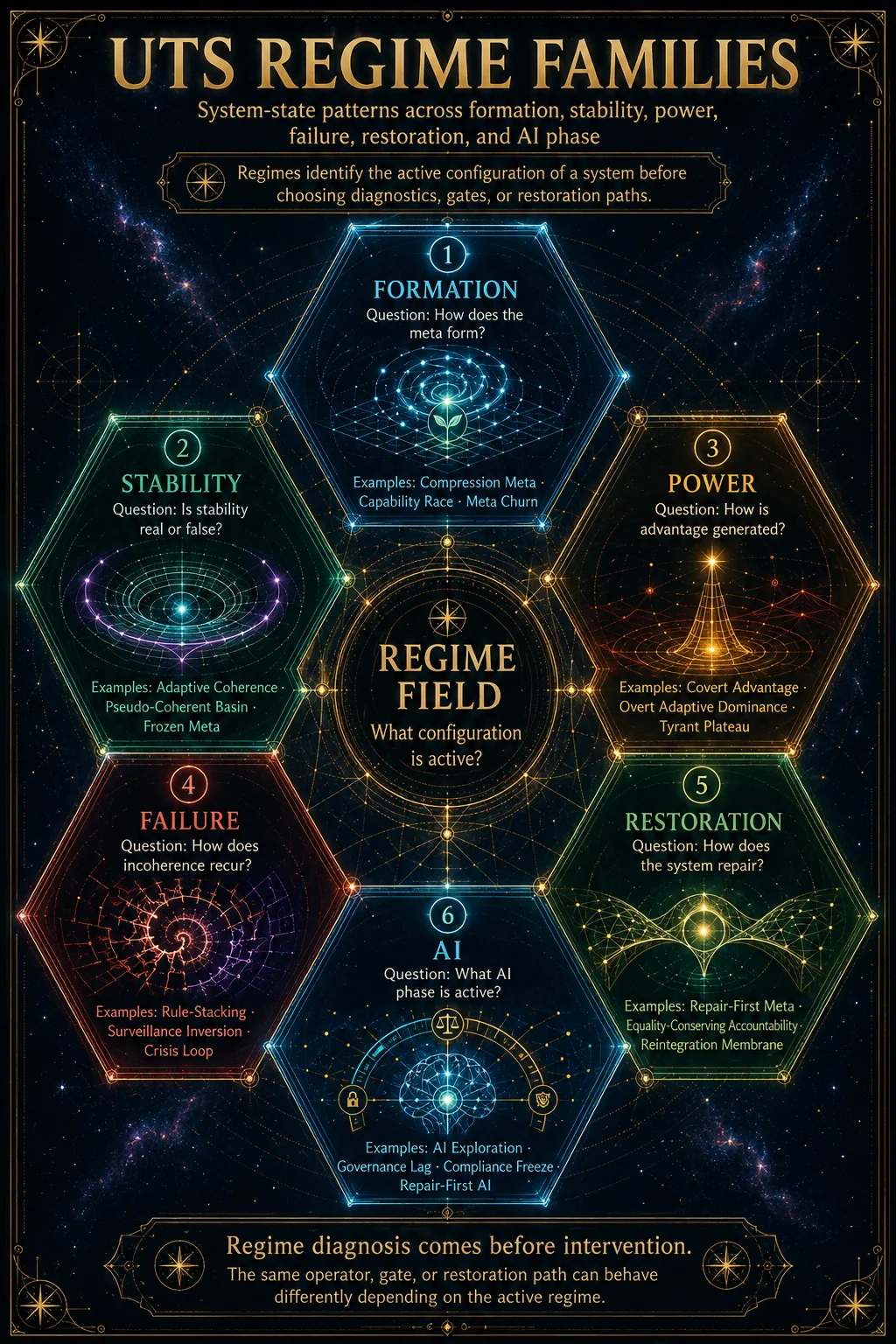
For quick orientation, the registry can be compressed into six high-level groups:
| Family | Core Question | Example Regimes |
|---|---|---|
| Formation | How does the meta form? | Compression Meta, Capability Race, Meta Churn |
| Stability | Is stability real or false? | Adaptive Coherence, Pseudo-Coherent Basin, Frozen Meta |
| Power | How is advantage generated? | Covert Advantage, Overt Adaptive Dominance, Tyrant Plateau |
| Failure | How does incoherence recur? | Rule-Stacking, Surveillance Inversion, Crisis Loop |
| Restoration | How does the system repair? | Repair-First Meta, Equality-Conserving Accountability, Reintegration Membrane |
| AI | What AI phase is active? | AI Exploration, Governance Lag, Compliance Freeze, Repair-First AI |
This compact family structure is directly supported by the source’s ultra-compact grouping into formation, stability, power, failure, restoration, and AI regimes.
7. How Regimes Stack
Regimes often do not appear alone.
A system may simultaneously show:
Rule-Stacking Regime
inside a Pseudo-Coherent Basin
under a Capability Race Regime
with emerging Crisis Loop dynamics
This matters because a single intervention rarely works if it only addresses the surface regime.
For example:
- If a system is only treated as aRule-Stacking Regime, the fix may be “simplify policy.”
- But if it is also inside aPseudo-Coherent Basin, simplification alone may expose hidden debt.
- If it is also in aCapability Race Regime, slowing down one actor may fail unless the competitive field changes.
- If it is approaching aCrisis Loop, restoration must address bandwidth, damping, and memory at once.
Regime analysis therefore asks:
What is the dominant regime, what secondary regimes are stacked beneath it, and what transition pathway is opening?
8. How Regimes Transition
Regimes can shift when pressure, exposure, auditability, repair capacity, or compatibility changes.
Common transition patterns:
Compression Meta → Capability Race
Rule-Stacking → Frozen Meta
Frozen Meta → Crisis Loop
Covert Advantage → Grid Illumination
Grid Illumination → Overt Adaptive Coherence
Grid Illumination → Coercion Stabilization
Crisis Loop → Dismantle-and-Replace
Pseudo-Coherent Basin → Adaptive Coherence
The key transition question is:
Does exposure activate repair, or does it activate coercion?
If exposure increases auditability and restoration capacity, the system can move toward adaptive coherence.
If exposure increases hard constraint, opacity, and hidden debt, the system moves toward coercion stabilization or crisis.
9. How to Use This Reference
This reference is designed for fast navigation.
Use it when you need to:
- identify a system pattern
- name a recurring configuration
- compare similar regimes
- find the right full registry page
- choose which technical guide section to read next
- map a failure mode into a larger trajectory
- connect a regime to operators, diagnostics, gates, and restoration arcs
For deeper use, each regime should eventually have a full registry spec sheet with:
Definition
Core mechanics
Operator composition
State-vector signature
Diagnostic signature
Formation pathway
Maintenance mechanism
Failure pattern
Examples
Related regimes
Transition pathways
Restoration / exit conditions
Non-redundancy note
Compact summary
10. Canon Lock
A regime is a recurring behavioral configuration produced by existing UTS mechanics.
It does not introduce a new primitive.
It names a pattern so that systems can be diagnosed, compared, repaired, or replaced with greater precision.
Locked formulation:
A regime is a recognizable configuration of system behavior produced by recurring interactions among operators, diagnostics, gates, state-vector drift, U-layer localization, and restoration capacity. A regime names the pattern; it does not create a new primitive.