Introduction
UTS–Economy begins with a simple idea:
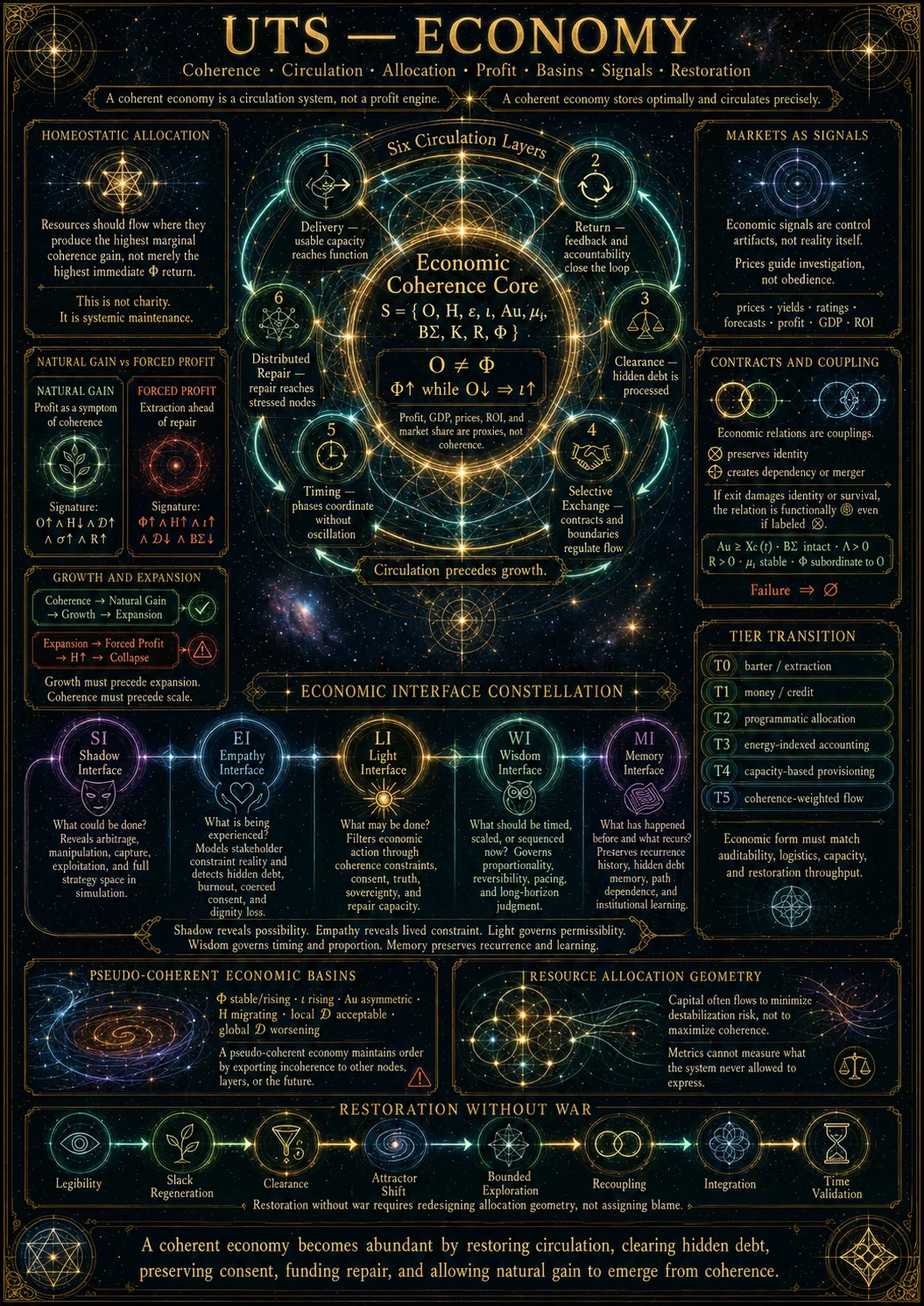
An economy is not really about money. An economy is about how value moves, where energy goes, what gets supported, what gets ignored, and whether the whole system becomes more coherent over time.
Money matters, but money is not the foundation. Money is asignal, ameasurement layer, and anaccounting tool. It helps coordinate exchange, but it is not the same thing as value itself.
A coherent economy is not one that simply makes more money, raises asset prices, or increases abstract growth metrics. A coherent economy is one that circulates support through the whole system in a way that preserves identity, function, meaning, repair, and long-term stability.
In UTS terms:
A coherent economy is a circulation system, not a profit engine.
1) The Core Problem UTS–Economy Solves
Most economic models try to answer questions like:
- How do we increase production?
- How do we grow GDP?
- How do we maximize profit?
- How do we distribute scarce resources?
- How do we incentivize behavior?
These are useful questions, but they are incomplete.
UTS–Economy asks a deeper question:
Does the way value moves increase coherence across the whole system, or does it create hidden debt that will surface later as collapse?
This matters because many economies can look successful while becoming brittle.
A system can have:
- rising profits
- rising asset values
- strong productivity numbers
- stable institutions
- impressive growth narratives
while also accumulating:
- ecological debt
- unpaid care burdens
- infrastructure decay
- burnout
- social fragmentation
- loss of trust
- coercive dependency
- hidden financial instability
From the outside, the system may look healthy.
From a UTS perspective, it may already be losing coherence.
2) Coherence: The Main Anchor
Across UTS, coherence means:
The preservation of identity, meaning, and functional integrity across time under transformation.
In plain economic language, this means an economy is coherent when:
- people and institutions can continue functioning under stress
- resources reach the places that need them
- repair is possible when damage occurs
- contracts and exchanges preserve real consent
- growth does not require exploitation or hidden cost
- the system can adapt without destroying its own foundations
Coherence is not a frozen state.
It is atrajectory.
A coherent economy is not “perfect.” It is a system that can respond, repair, learn, and keep improving without pushing its costs into hidden places.
3) The Difference Between Money and Value
One of the most important UTS–Economy distinctions is:
Money is not value. Money is a proxy for value.
In UTS notation, money, profit, GDP, prices, valuations, and similar measures are part ofΦ — the fitness proxy.
Φ is useful.
But it is dangerous when it becomes the goal.
When an economy treats Φ as the highest truth, it begins optimizing the symbol rather than the living system. This is how a society can become wealthier on paper while becoming poorer in resilience, trust, health, repair capacity, and meaning.
UTS describes this with a simple distinction:
O ≠ ΦCoherence is not the same as the metric used to measure success.
A coherent economy uses profit and money as signals.
An incoherent economy worships them as truth.
4) Economy as Circulation
The best natural image for UTS–Economy is the body.
A healthy body does not survive by hoarding blood in one organ. It survives through circulation. Every organ has a function, and each organ needs different resources at different times. Some need oxygen, some need glucose, some need immune response, some need rest, some need repair.
A coherent economy works the same way.
It must circulate:
- resources
- energy
- labor
- information
- trust
- attention
- legitimacy
- repair
- opportunity
The goal is not identical distribution.
The goal isappropriate support.
Different nodes need different kinds of support depending on their role, condition, and timing.
A coherent economy asks:
What does this node need to remain functional, contribute coherently, and repair when stressed?
This applies to:
- households
- workers
- businesses
- regions
- ecosystems
- institutions
- infrastructure
- public systems
- technological systems
5) The Six Circulation Layers
UTS–Economy treats economic circulation as six connected layers.
5.1 Delivery
Delivery is the forward movement of usable capacity.
This includes food, energy, materials, credit, labor, tools, knowledge, infrastructure, healthcare, and access.
Delivery is not just “money going somewhere.” It means the right kind of capacity arrives where it can actually be used.
Poor delivery creates starvation, bottlenecks, dependency, and forced extraction.
5.2 Return
Return is feedback closure.
In an economy, return includes repayment, taxes, accountability, performance signals, maintenance feedback, and consequences.
Return is not punishment. It keeps loops honest.
Without return, bubbles grow. Obligations drift. Feedback becomes distorted. The system loses track of what is really happening.
5.3 Clearance
Clearance is how the economy removes waste and pays down hidden debt.
This includes resolving bad debt, repairing damage, clearing backlogs, maintaining infrastructure, handling ecological cost, and retiring failed structures.
Clearance is often neglected because it does not always look profitable in the short term. But without clearance, the economy stores waste internally until it becomes crisis.
In UTS terms:
Clearance pays H — hidden debt.
5.4 Selective Exchange
Selective exchange determines what crosses between nodes.
This includes contracts, regulations, credit standards, labor terms, platform access, trade rules, and institutional permissions.
A healthy economy is not fully open and not fully closed. It is selectively permeable.
Too open creates exploitation, leakage, fraud, and noise.
Too closed creates rigidity, exclusion, and stagnation.
5.5 Timing
Timing is one of the most overlooked parts of economy.
The same resource can heal or destabilize depending on when it arrives.
A coherent economy understands phases:
- activation
- production
- repair
- rest
- clearance
- expansion
When timing fails, systems enter boom-bust cycles, delayed repair, and recurring crises.
5.6 Distributed Repair
Repair is the ability to restore damaged parts of the system.
Repair includes healthcare, maintenance, retraining, institutional correction, ecological restoration, debt restructuring, trust rebuilding, and local recovery.
An economy that funds growth but starves repair is not coherent. It is consuming its own foundation.
6) Natural Gain vs Forced Profit
UTS–Economy does not reject profit.
Profit can be useful. It can show that something is efficient, desired, or well-coordinated.
But there are two very different kinds of surplus.
Natural Gain
Natural gain emerges when the system becomes healthier.
It comes from:
- reduced waste
- better timing
- stronger trust
- less rework
- better coordination
- lower hidden debt
- healthier workers and institutions
- repair happening on time
Natural gain is what happens when circulation improves.
It may appear as profit, but the profit is downstream of coherence.
Natural gain is profit as a symptom of health.
Forced Profit
Forced profit is surplus extracted faster than the system can support.
It comes from:
- underpaying repair
- coercive contracts
- shunting costs to others
- suppressing signals
- delaying maintenance
- overworking nodes
- externalizing ecological or social debt
- forcing growth before capacity exists
Forced profit can look impressive for a while. But it creates hidden debt.
In UTS terms:
Forced profit raises Φ while lowering O.
It increases the success metric while damaging the living system.
7) Growth vs Expansion
UTS–Economy also separatesgrowthfromexpansion.
Growth
Growth is internal capacity increase.
A system has grown when it can:
- handle more complexity
- repair faster
- absorb shocks better
- coordinate more cleanly
- support more nodes without strain
- increase throughput without increasing hidden debt
Growth is aboutcapacity.
Expansion
Expansion is external scope increase.
Expansion means the system serves more people, manages more territory, handles more transactions, adds more institutions, or increases coupling density.
Expansion is not bad. But expansion before growth is dangerous.
A weak body should not be forced to sprint.
A brittle economy should not be forced to scale.
The correct order is:
Coherence → Natural Gain → Growth → Expansion
When this order is reversed, the result is often:
Expansion → Forced Profit → Hidden Debt → Collapse
8) Pseudo-Coherent Economies
A major UTS–Economy concept is thepseudo-coherent basin.
A pseudo-coherent economy is a system that feels stable locally while exporting incoherence elsewhere.
It can look orderly because it pushes costs into places that are hard to see:
- the future
- the environment
- low-power communities
- invisible labor
- unpaid care work
- institutional backlogs
- peripheral regions
This is why local success does not always mean global coherence.
A company, sector, or institution can be internally stable while depending on harm exported somewhere else.
UTS frames this without blame:
A node can be locally coherent and globally incoherent without contradiction.
This helps explain why people inside harmful systems often believe they are simply doing normal, responsible, reasonable things. They are operating inside a local basin whose feedback signals reward them.
The issue is not individual moral failure.
The issue is geometry.
9) Why Resources Often Flow to the Wrong Places
In a pseudo-coherent economy, resources often flow to nodes that are least disruptive to the existing system.
Capital, visibility, authority, and institutional trust tend to flow toward:
- predictable actors
- compliant actors
- already-legible actors
- low-risk actors
- basin defenders
- nodes that validate the current success story
This does not mean those nodes are unintelligent or bad. It means the system reads them as safe.
Meanwhile, high-novelty or high-coherence nodes may be treated as risk because they challenge the current geometry.
This gives UTS–Economy one of its most important statements:
Resources often flow to minimize destabilization risk, not to maximize coherence.
This is why suppressed potential can remain invisible.
Metrics cannot measure what a system never allowed to express.
10) Contracts, Consent, and Economic Coupling
Economic relationships are not just transactions. They are couplings.
A job, loan, contract, platform account, supply chain agreement, or trade treaty connects nodes together.
In UTS, coupling is healthy when it preserves identity and increases mutual coherence.
A contract is coherent only when:
- the terms are understandable
- consent is real
- exit is possible
- repair exists if harm occurs
- both sides gain coherence
- profit does not override the living system
A signed contract can still be incoherent if one side had no real ability to refuse.
This is not moral decoration.
It is boundary physics.
If exit would destroy identity, livelihood, or survival, then the coupling is deeper than it claims to be.
11) Signals: Prices Are Not Truth
Markets are signal systems.
Prices, wages, interest rates, credit scores, ratings, and forecasts all send signals. These signals are useful, but they are not truth.
Signals can be distorted by:
- urgency
- repetition
- identity framing
- hidden incentives
- incomplete data
- suppressed auditability
- speculative feedback loops
A coherent economy does not blindly obey signals. It filters them.
It asks:
- Where did this signal come from?
- What does it ignore?
- Who benefits from treating it as truth?
- Does it increase coherence?
- Does it hide debt?
- Does it preserve consent?
This is where UTS’sFI-Gatematters: the system must prevent the measurement from replacing the thing being measured.
12) The Empathy Interface in Economy
The Empathy Interface helps an economy model what is actually being experienced by nodes inside the system.
It is not sentimentality.
It is better state-space modeling.
Without this interface, systems misread reality.
They may treat:
- exhaustion as laziness
- coercion as consent
- desperation as market choice
- suppressed potential as lack of merit
- dignity loss as non-economic
- stress signals as noise
A coherent economy must be able to simulate stakeholder constraint reality.
It asks:
What is this node experiencing under current economic pressure?
This improves auditability and prevents hidden debt from being ignored until crisis.
13) Shadow and Light in Economy
Economies must be realistic about what actors can do.
People and institutions can discover ways to exploit:
- loopholes
- dependency
- monopoly
- crisis
- information asymmetry
- regulatory gaps
- data extraction
- labor precarity
UTS calls this theShadow Interface: the full space of what could be done.
But not everything that can be done should be executed.
TheLight Interfacefilters possible strategies through coherence constraints.
Together:
Shadow reveals financial possibility. Light governs financial permissibility.
A coherent economy is neither naïve nor extractive.
It sees the full strategy space, then only authorizes what preserves coherence.
14) Restoration Without War
UTS–Economy is restoration-oriented.
It does not aim to destroy existing systems through blame.
It aims to change the geometry so higher-coherence patterns become viable.
Restoration begins by making hidden flows visible:
- Where is debt being stored?
- Where is repair being starved?
- Where are signals distorted?
- Which nodes are absorbing exported incoherence?
- Which contracts are coercive in practice?
- Which metrics are hiding collapse?
Then the system restores:
- Legibility— reveal flows and hidden debt
- Slack— reduce forced-choice conditions
- Clearance— pay down accumulated debt
- Repair— restore damaged nodes
- Attractor shift— change what the system rewards
- Recoupling— reconnect nodes through valid interfaces
- Time validation— verify that recurrence decreases
The goal is not revenge.
The goal is a better attractor.
15) What a Coherent Economy Would Feel Like
A coherent economy would not feel like endless pressure.
It would feel more like:
- repair is normal
- failure is local, not catastrophic
- work has meaning without requiring self-erasure
- innovation does not require precarity
- wealth exists but hoarding is less necessary
- institutions are legible
- contracts are understandable
- signals are trustworthy
- suppressed potential has pathways to express
- expansion happens when the system is ready
- growth feels steady rather than frantic
It would not be static.
It would still have markets, prices, trade, disagreement, risk, and failure.
But those failures would be processed rather than hidden.
16) The Simplest Summary
UTS–Economy can be summarized this way:
A coherent economy is a living circulation system that moves value where it is needed, clears hidden debt, preserves real consent, funds repair, and allows natural gain to emerge from coherence rather than forcing profit through extraction.
Or shorter:
The goal of economy is not to maximize money. The goal is to circulate value in a way that keeps the whole system alive, adaptive, and capable of repair.
17) Key UTS Mechanics Introduced
For readers new to UTS, the core mechanics involved are:
| UTS Concept | Economy Translation |
|---|---|
| O — Coherence | real economic health under stress |
| H — Hidden Debt | deferred cost, externality, unpaid repair |
| Φ — Fitness Proxy | money, profit, GDP, prices |
| ι — Inversion | success metrics rising while real health falls |
| Au — Auditability | ability to trace flows, risks, and harm |
| BΣ — Boundary Integrity | real consent, exit, and non-coercive contracts |
| R — Restoration Capacity | ability to repair damage |
| K / σ — Slack | buffer before forced extraction begins |
| U4 | economic narratives and metrics |
| U6 | actual cross-system coherence |
| U7 | debt, memory, recurrence |
| FI-Gate | prevents metrics from replacing reality |
| EI | models lived constraint reality |
| SLI | separates possible strategies from permissible strategies |
| Pseudo-coherent basin | local stability that exports harm elsewhere |
18) Closing Anchor
A coherent economy is not built by choosing one perfect ideology.
It is built by learning to see the economy as a dynamic system of circulation, signals, coupling, repair, memory, and meaning.
The economy becomes coherent when it stops asking only:
How do we increase gains?
and begins asking:
Where is value needed? Where is debt hidden? Where is repair blocked? Which signals are distorted? Which couplings are coercive? What circulation pattern increases coherence for the whole?
That is the foundation ofUTS–Economy.
This module hub separates the reference overview from technical depth and nested sub-modules. Use the overview for orientation, the technical document for the deep model, and sub-modules for systems that belong under this domain.