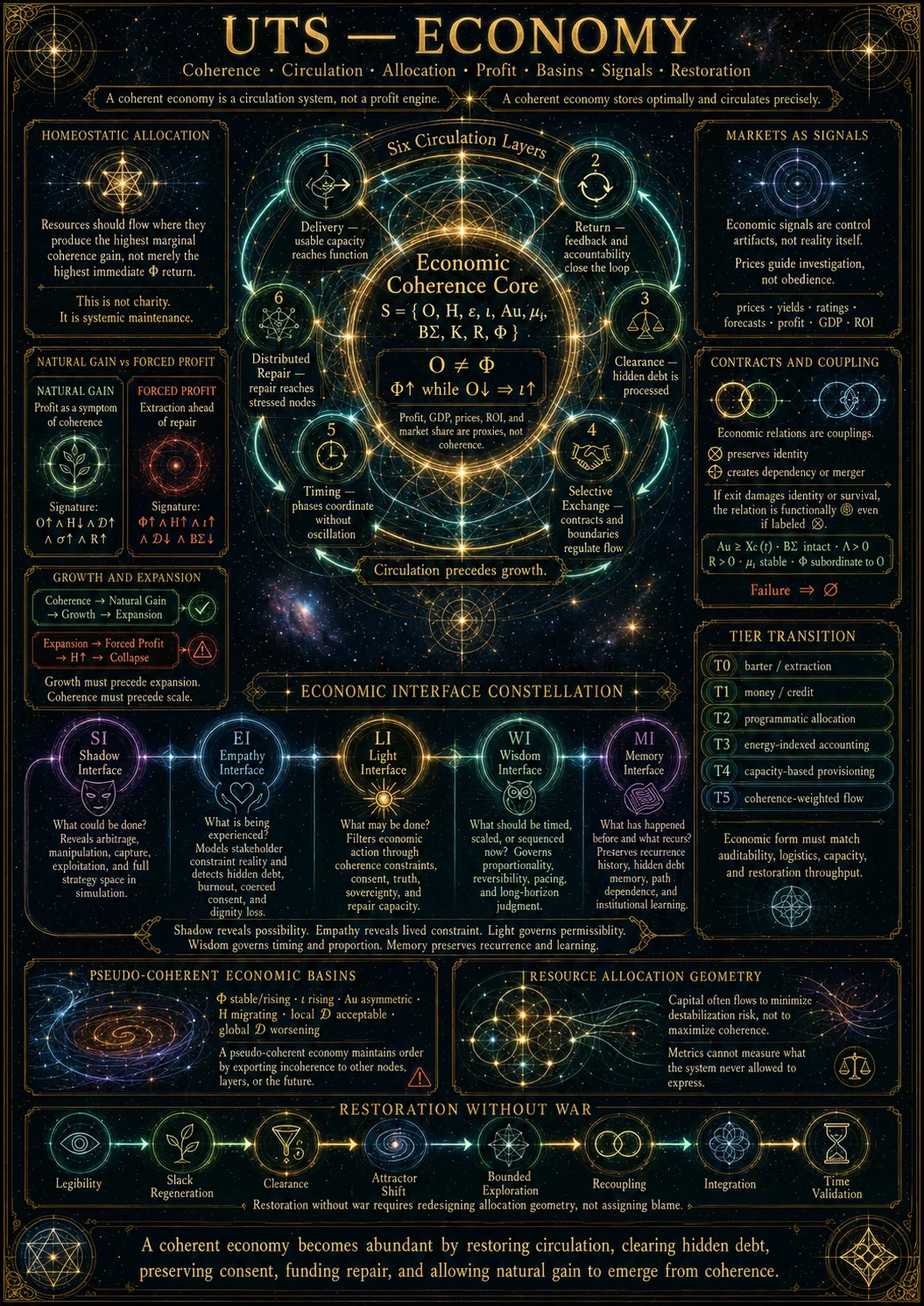
0. Core Purpose
UTS — Economyexists to answer a problem most future economic systems fail to solve:
How does an economy evolve from scarcity, proxy money, and accounting metrics toward coherent circulation of real value without collapsing into extraction, hoarding, naïve idealism, or one-size-fits-all design?
The answer is not a fixed ideology.
It is atrajectory architecture.
An economy is not a static machine.
It is a living, adaptive, signal-mediated, energy-distributing system embedded in environment, time, technology, memory, and meaning.
A coherent economy must therefore:
- circulate value with precision
- maintain node-level support without overfeeding or starving
- prevent Φ-proxies from replacing reality
- clear hidden debt instead of exporting it
- preserve consent and boundary integrity
- regulate profit so it reflects coherence rather than extraction
- grow only when circulation and repair capacity can support expansion
- transition tier-by-tier as technology, auditability, logistics, and restoration improve
1. Canon Anchor
1.1 Primary Definition
Economy = the structured circulation, allocation, storage, exchange, and restoration of energy, work, attention, legitimacy, and usable capacity toward preserving and increasing coherence across time under constraint and environmental forcing.
This definition deliberately includes more than money.
Money is only one signal layer.
The real economy includes:
- energy
- labor
- logistics
- materials
- infrastructure
- trust
- time
- attention
- legitimacy
- information
- repair capacity
- ecological conditions
- human and institutional state-space
2. Core Economic Reframe
Modern economies often treat the goal as:
increase gains → accumulate currency → defend position
UTS — Economy reframes this:
A coherent economy stores optimally and circulates precisely.
Hoarding is not strength by default.
Hoarding can be a symptom of circulation failure.
A coherent economy functions more like a healthy body:
- every organ / node has a role
- every node has specific resource needs
- signals indicate need, stress, overload, and repair requirements
- over-signaling produces dysfunction
- under-signaling hides debt
- circulation maintains the whole
- growth emerges after balance, not before it
The goal is not parasitic accumulation.
The goal iswhole-system coherence.
3. Canon Grammar
UTS — Economy uses the standard UTS state vector:
S(t) = { O, H, ε, ι, Au, µᵢ, BΣ, K, R, Φ }3.1 Economic Meaning of Each Variable
O — Coherence
True economic stability under stress.
In economy,Omeans:
- production and distribution remain functional under disturbance
- repair can reach where needed
- trust and legitimacy hold under pressure
- allocation increases whole-system viability
- growth does not require hidden extraction
H — Hidden Debt
Deferred cost, exported incoherence, unpaid maintenance, or suppressed instability.
EconomicHincludes:
- ecological externalities
- unpaid care burdens
- infrastructure decay
- bad debt rolled forward
- burnout
- social fragmentation
- legitimacy erosion
- opacity in financial instruments
- future liabilities hidden by present metrics
ε — Observable Error
Visible failure surface.
Economicεincludes:
- defaults
- shortages
- unemployment spikes
- supply breakdowns
- bank failures
- visible unrest
- inflation shocks
- institutional collapse
Important:
εoften appears late. By the timeεspikes,Hhas usually accumulated for a long time.
ι — Inversion Index
The gap between apparent success and real coherence.
Economicιrises when:
- GDP, profit, or asset prices rise while resilience falls
- markets look strong while debt is hidden
- institutions look stable while repair capacity declines
- legality substitutes for legitimacy
- metrics show success while lived conditions degrade
Au — Auditability
Traceability of economic flows, obligations, causality, risk, harm, and repair.
EconomicAuincludes:
- transparent accounting
- visible supply chains
- legible contracts
- traceable externalities
- measurable debt
- understandable rules
- public capacity to inspect claims
SuppressedAuis hidden debt issuance.
µᵢ — Meaning Integrity
The time-consistent legitimacy of allocation.
An economy has highµᵢwhen:
- people understand why resources flow where they do
- the justification holds under cost
- rules do not contradict lived reality
- success narratives remain truth-compatible
- “value” does not become pure theater
µᵢcollapses before visible institutional collapse.
BΣ — Boundary Integrity
Consent, exit, interface clarity, and non-coercive participation.
EconomicBΣincludes:
- valid contracts
- real exit options
- non-coercive employment
- non-predatory credit
- scoped obligations
- no hidden capture
- no forced dependency disguised as choice
K — Compatibility / Slack
The condition in which couplings increase coherence rather than dependency.
EconomicKincludes:
- buffers
- reserves
- time slack
- bargaining room
- local resilience
- non-catastrophic exit options
- compatibility between sectors or institutions
LowKmeans all choices become forced choices.
R — Restoration Capacity
Economic repair throughput.
Rincludes:
- maintenance capacity
- debt restructuring
- healthcare and care systems
- institutional correction
- ecological repair
- trust rebuilding
- retraining
- infrastructure renewal
- rollback mechanisms
No economy is coherent ifRcannot reach stressed nodes.
Φ — Fitness Proxy
Economic success signals.
Φincludes:
- money
- profit
- GDP
- ROI
- prices
- yields
- valuations
- credit ratings
- productivity metrics
- market share
Hard discriminator:
O ≠ ΦΦmay rise whileOdecays.
That is the central economic failure mode.
4. U-Layer Localization
Economic phenomena localize across U0–U8.
| Layer | Economic Meaning |
|---|---|
U0 | Physical substrate: land, ecology, infrastructure, materials |
U1 | Budgets: energy, time, labor, compute, capital capacity |
U2 | Configuration: contracts, rights, boundaries, market rules |
U3 | Execution: production, logistics, work, enforcement |
U4 | Metrics: prices, accounting, narratives, ratings, classifications |
U5 | Coordination: timing, settlement, credit cycles, supply-chain rhythm |
U6 | Coherence field: trust, legitimacy, cross-system fit |
U7 | Memory: debt, path dependence, institutional scarring, recurrence |
U8 | Environment: shocks, climate, geopolitics, technological disruption |
Locked Rule
U4 economic claims are not truth unless verified at U6 across U5 delay and U7 recurrence.
Prices, profits, and growth claims are not enough.
They must survive time, stress, recurrence, and cross-scale coherence testing.
5. Foundational Economic Laws
Law 1 — Economy Is Trajectory, Not Snapshot
An economy cannot be judged by a single quarter, price, election cycle, or growth period.
It must be judged by trajectory:
dO/dt under loadA coherent economy increases or preservesOover time while preventingHaccumulation.
Law 2 — Proxy Drift Is the Primary Economic Failure
WhenΦbecomes the target:
Φ optimization → FI failure → Γ_mis → H↑ → ι↑ → O↓The economy begins optimizing its symbols instead of its reality.
Law 3 — Circulation Precedes Growth
Growth is only coherent when circulation is already stable.
If circulation is damaged, growth pressure becomes extraction.
Law 4 — Hidden Debt Always Returns
Hmay be exported to:
- the future
- the environment
- weaker populations
- invisible labor
- peripheral regions
- institutional backlogs
But it is never eliminated by export.
Eventually it returns asε, legitimacy collapse, ecological forcing, or systemic brittleness.
Law 5 — Stability ≠ Coherence
A system may be locally stable because it has learned how to suppress signals, export costs, or starve alternatives.
That is pseudo-coherence.
True coherence improves ring-down, repair capacity, auditability, and recurrence behavior.
6. Economic Circulation Framework
A coherent economy is a circulation system, not a profit engine.
Circulation has six core layers.
6.1 Layer A — Delivery
Deliveryis forward flow of usable capacity.
It includes:
- goods
- materials
- energy
- food
- labor
- credit
- liquidity
- knowledge
- platform access
- infrastructure support
- coordination signals
Delivery is not merely “spending money.”
It is the placement of capacity where it can function.
Healthy Delivery Requires
- enough magnitude
- correct targeting
- appropriate timing
- usable format
- consent-valid interface
- sufficient support for function
Delivery Failures
| Failure | Economic Form |
|---|---|
| Under-delivery | Precarity, starvation, collapse |
| Over-delivery | Bubbles, dependency, inflation |
| Mis-targeting | Waste, resentment, proxy inflation |
| Late delivery | Instability, preventable failure |
| Conditional coercive delivery | BΣfailure |
6.2 Layer B — Return
Returncloses the loop after delivery.
It includes:
- repayment
- taxes
- feedback
- accountability
- information about effectiveness
- performance data
- social response
- maintenance signals
Return is not punishment.
It is gradient maintenance.
Without return:
- bubbles inflate
- pressure builds
- feedback becomes delusional
- accountability fails
- obligations lose closure
Healthy Return Requires
- proportionality
- visibility
- timing
- loop completion
- non-punitive correction
- no hidden coercion
6.3 Layer C — Clearance
Clearanceremoves what must not remain in circulation.
It includes:
- bad debt resolution
- ecological repair
- bankruptcy processes
- obsolete inventory clearing
- maintenance backlog reduction
- trauma / depletion repair
- institutional correction
- fraud removal
- externality internalization
Clearance is how the economy paysH.
Suppression is not clearance.
A coherent economy does not merely hide waste.
It processes it.
Clearance Failure Signature
H↑ while ε≈0The economy looks fine because debt has not yet surfaced.
6.4 Layer D — Selective Exchange
Selective exchangegoverns what crosses between nodes.
It includes:
- contracts
- credit standards
- underwriting
- platform rules
- trade rules
- labor terms
- regulatory interfaces
- consent structures
This isΠembodied.
A coherent economy is neither fully open nor fully closed.
It is:
- selectively permeable
- auditable
- reversible
- consent-valid
- compatibility-aware
Exchange Failures
| Failure | Economic Pattern |
|---|---|
| Leakiness | Fraud, speculation, corruption, uncontrolled extraction |
| Over-tightening | Exclusion, rigidity, innovation starvation |
| Asymmetric permeability | Exploitation |
| Irreversible coupling | Capture, dependency, premature⊕ |
6.5 Layer E — Timing and Phase Coordination
A coherent economy is rhythmic.
It must distinguish:
- activation phases
- investment phases
- production phases
- repair phases
- clearance phases
- rest phases
- expansion phases
Trying to maximize all phases simultaneously creates oscillation.
Economic Timing Bands
| Band | Examples |
|---|---|
| Fast | Payments, pricing, settlement, liquidity |
| Mid | Hiring, production, credit cycles |
| Slow | Infrastructure, education, ecology, trust, institutional memory |
Timing Failures
- stimulus at wrong phase
- austerity during repair
- expansion during clearance
- debt compression during fragility
- delayed maintenance
- over-fast financial response with slow real-economy repair
Signature:
τ_resp↑, 𝓓↓, recurrence↑6.6 Layer F — Distributed Repair
Repair must be reachable.
An economy is incoherent if it can fund growth but not repair.
Distributed repair includes:
- local resilience
- maintenance
- healthcare
- education
- retraining
- institutional correction
- ecological restoration
- infrastructure renewal
- debt restructuring
- trust repair
Repair requires:
- delivery
- clearance
- slack
- timing
- legitimacy
- real consent
- auditability
7. Economic Homeostasis
A coherent economy resembles a healthy organism.
It maintains:
O stable/increasing
H non-increasing
𝓓 improving
σ/K adequate
R reachable
BΣ intact
Au sufficient
7.1 Homeostasis Is Not Equality of Inputs
Different nodes need different resources.
A coherent economy does not distribute identically.
It distributes according to function, condition, timing, and coherence gain.
7.2 Homeostatic Allocation Principle
Resources should flow where they produce the highest marginal coherence gain, not merely the highest immediate Φ return.
This often means supporting:
- repair-critical nodes
- under-supported but functional nodes
- bottlenecks
- suppressed capacity
- clearance systems
- maintenance systems
- coordination infrastructure
This is not charity.
It is systemic maintenance.
8. Profit, Natural Gain, Growth, and Expansion
8.1 Profit
Profit is not rejected.
Profit is a local signal of surplus under current conditions.
But profit is not value itself.
Profit becomes dangerous when it is treated as:
- moral proof
- system objective
- permission to extract
- evidence of coherence
- justification for ignoring
H
8.2 Proper Role of Profit
Profit may indicate:
- efficiency
- fit
- demand satisfaction
- useful coordination
- successful timing
But it must be interpreted against:
HAuBΣR𝓓µᵢ- recurrence
8.3 Natural Gain
Natural gainis surplus emerging from coherent circulation.
It arises when:
- friction decreases
- trust increases
- rework declines
- timing improves
- repair is funded
- hidden debt is cleared
- slack increases
- coupling improves
Signature:
O↑ ∧ H↓ ∧ 𝓓↑ ∧ σ↑ ∧ R↑Profit may appear, but it is downstream.
Natural gain is profit as a symptom of coherence.
8.4 Forced Profit
Forced profitis surplus extracted faster than the system can support.
It relies on:
- shunting costs
- underpaying repair
- suppressing signals
- coercive contracts
- delaying clearance
- reducing slack
- over-compressing time
- converting boundaries into dependency
Signature:
Φ↑ ∧ H↑ ∧ ι↑ ∧ 𝓓↓ ∧ BΣ↓Forced profit often feels necessary inside pseudo-coherent basins because extraction is masking prior circulation failure.
8.5 Growth
Growth is internal capacity increase.
True growth means:
- higher sustainable throughput
- better resilience
- stronger repair capacity
- larger coherence bandwidth
- reduced hidden debt
- more precise allocation
- greater functional capacity
Growth is not simply more money.
Growth means the system can do more useful work without increasing incoherence.
8.6 Expansion
Expansion is external scope increase.
It includes:
- serving more people
- increasing territory
- adding complexity
- increasing coupling density
- entering new markets
- growing institutional reach
Expansion without growth produces collapse.
8.7 Correct Ordering
Coherence → Natural Gain → Growth → ExpansionWrong ordering:
Expansion → Forced Profit → H↑ → Collapse8.8 Locked Statement
Growth must precede expansion. Natural gain must precede profit optimization. Coherence must precede scale.
9. Signals, Markets, and Interaction Physics
UTS — Economy treats markets as signal-mediated coupling systems.
Prices, yields, spreads, ratings, forecasts, and narratives are U4 signals.
They are not truth.
9.1 Market Signal Rule
Economic signals are control artifacts, not reality itself.
Signals must be filtered through:
- FI-Gate
- HR-Gate
- Au-Actuation
- MS-Gate
Σconstraints
9.2 Invalid Economic Signals
A signal is invalid for control if it is:
- identity-binding
- low-information
- urgency-compressed
- audit-suppressed
- repeated without provenance
- used to bypass consent
- used to collapse uncertainty into obedience
Examples:
- “There is no alternative.”
- “The market has spoken.”
- “Too big to fail.”
- “You are irresponsible if you do not accept these terms.”
- “Growth at any cost.”
10. Couplings, Contracts, and Consent
Economic relations are couplings.
A trade, loan, job, contract, supply agreement, platform dependency, or currency union is not just an exchange.
It is an interface between nodes.
10.1 Coupling Types
⊗ Coupling
Identity-preserving connection.
Examples:
- fair trade
- revocable contracts
- healthy credit
- cooperative partnerships
- non-capturing platform access
⊕ Composition
Identity-merging or dependency-forming fusion.
Examples:
- forced dependency
- debt trap
- monopoly capture
- irreversible merger
- institutional absorption
- employment under survival coercion
10.2 Locked Rule
If exit damages identity or survival, the relation is functionally `⊕` even if labeled `⊗`.
10.3 Coherence-Valid Contract Test
A contract is valid only if:
Au ≥ X_c(t)
BΣ intact
Λ > 0
R > 0
µᵢ stable
Φ subordinate to O
Meaning:
- terms are legible
- consent is real
- mutual coherence increases
- repair and exit exist
- obligations remain possible over time
- profit does not override coherence
Failure yields:
∅Enforcement anyway yields:
Ξ-class inversion10.4 Consent Invalidators
Consent is invalid under:
- urgency compression
- survival coercion
- audit suppression
- exit penalties
- asymmetric constraint pressure
- identity-binding low-evidence narratives
- hidden terms
- dependency capture
A signed contract may still be incoherent if state-space reality makes refusal impossible.
11. Empathy Interface in Economy
The Empathy Interface is not sentimentality.
In UTS — Economy, EI is a modeling interface for stakeholder state-space.
EI answers:
What is being experienced by the node receiving this economic pressure?
EI helps detect:
- hidden debt
- coerced consent
- dignity loss
- burnout
- legitimacy decay
- constraint pressure
- false choice
- boundary collapse
11.1 EI Function in Economy
EI improves:
AuµᵢmodelingBΣtesting- hidden debt detection
- allocation accuracy
- restoration targeting
11.2 EI Rule
If an economy cannot simulate stakeholder constraint reality, it cannot allocate coherently.
EI does not automatically dictate policy.
It improves modeling.
LI governs action.
12. Shadow–Light Interfaces in Economy
Every economy contains shadow capacity.
Actors can discover:
- arbitrage
- manipulation
- regulatory capture
- coercive lending
- monopoly formation
- data extraction
- labor exploitation
- crisis profiteering
Denying this creates naïveté.
Executing it creates extraction.
12.1 Shadow Interface
SI asks:
What could be done?
It renders the full strategy space in simulation.
12.2 Light Interface
LI asks:
What may be done?
It filters strategies through coherence constraints.
12.3 Economic CCS
All execution must pass:
Σ
+ Truth
+ Love
+ Wisdom
+ Sovereignty
+ FI-Gate
+ HR-Gate
+ MS-Gate
+ Au-Actuation
+ BΣ validity
+ Λ
Any failure yields:
∅12.4 Locked Statement
Markets fail when shadow strategies are executable without light governance, and they fail just as badly when shadow strategies are denied.
13. Pseudo-Coherent Economic Basins
13.1 Definition
A pseudo-coherent economy is a locally stable geometry that maintains order by exporting incoherence to other nodes, layers, or the future.
Signature:
Φ stable/rising
ι rising
Au asymmetric
H migrating
local 𝓓 acceptable
global 𝓓 worsening
13.2 Why These Basins Feel Stable
Inside the basin:
- rules are predictable
- rewards are consistent
- success narratives make sense
- local feedback is positive
- exported harm is invisible
Therefore:
A node can be internally coherent and globally incoherent without contradiction.
This is geometry, not moral failure.
14. Resource Allocation Geometry
14.1 Core Law
Pseudo-coherent systems allocate resources to nodes least likely to destabilize the dominant attractor geometry.
Resources include:
- capital
- credit
- authority
- visibility
- institutional trust
- platform access
- protection
- legitimacy
This means resources often flow to:
- predictable nodes
- compliant nodes
- already-legible nodes
- basin defenders
- low-disruption actors
Not necessarily to:
- highest coherence nodes
- most suppressed potential
- repair-critical bottlenecks
- high-novelty coherence
14.2 Key Consequence
Capital often flows to minimize destabilization risk, not to maximize coherence.
This explains why suppressed nodes may hold the highest untapped potential.
14.3 Metrics Limit
Metrics cannot measure what the system never allowed to express.
Performance under denied conditions cannot be measured by currentΦscreens.
15. Suppression as Basin Self-Defense
Suppression mechanisms include:
- credit denial
- high interest penalties
- bureaucratic delay
- reputational dampening
- visibility throttling
- forced dependence
- compliance burden
- narrative dismissal
- “unrealistic” labeling
This is not necessarily personal malice.
It is system self-defense.
High-coherence novelty increases degrees of freedom.
Pseudo-coherent basins read this as instability.
16. Economic Failure Mode Families
16.1 Circulation Failures
| Failure | Signature |
|---|---|
| Stasis / blockage | τ_resp↑,σ↓,H↑ |
| Leakiness | BΣ↓,Au↓, noise flood |
| Over-constriction | Πtoo tight,K↓, variety collapse |
| Shunting | localO↓, globalΦstable |
| Clearance failure | H↑,ε≈0, recurrence↑ |
| Phase failure | oscillation,𝓓↓ |
16.2 Signal Failures
- urgency substitution
- identity capture
- echo inflation
- suppression-by-abstraction
- narrative dominance
- risk model theater
- “no alternative” framing
16.3 Coupling Failures
⊗withoutΛ- asymmetric bandwidth
- premature
⊕ - coercive contracts
- exit penalties
- dependency lock-in
16.4 Profit Failures
- forced profit
- extraction masking instability
- repair starvation
- hoarding as pseudo-security
- growth theater
- expansion without capacity
16.5 Basin Failures
- shadow capture
- performative light
- basin defender promotion
- suppressed novelty
- exported incoherence
- pseudo-coherent stability
17. Diagnostics
A coherent economy must track more than prices.
17.1 Core Diagnostics
| Diagnostic | Meaning |
|---|---|
𝓑(t) | Bandwidth before phase transition |
𝓓(t) | Ring-down quality after shock |
σ(t) | Slack / headroom |
τ_resp | Response latency |
τ_m | Recurrence half-life |
X_c | Complexity wall |
AP | Attribution pressure |
Perm | Interface permeability |
Au_eff | Effective auditability |
17.2 Key Inequalities
Shock > 𝓑(t) ⇒ regime shift likelyX_c > Au_eff ⇒ H↑R_eff < Load × Gain ⇒ instability amplifiesΦ↑ while O↓ ⇒ ι↑17.3 Stability Proof
A repair or policy is working only if:
H(t+Δt) ≤ H(t)
𝓓 > 0
ε recurrence decreases
R baseline increases
BΣ remains intact
18. Transitional Tier Model
A coherent economy cannot jump directly from proxy money to perfect energetic currency.
It must evolve by tier.
18.1 Tier Principle
Economic form must match public technology, auditability, logistics, capacity, and restoration throughput.
Premature tier jumps create inversion.
18.2 Example Tier Ladder
| Tier | Economic Form | Main Bottleneck |
|---|---|---|
T0 | Barter / extraction | Physical scarcity |
T1 | Money / credit | Φdrift, auditability |
T2 | Programmatic allocation | Opacity, consent |
T3 | Energy-indexed accounting | Measurement fidelity |
T4 | Capacity-based provisioning | Coordination throughput |
T5 | Coherence-weighted flow | HighAu,R,µᵢrequired |
The system evolves as:
Au↑ + R↑ + logistics↑ + µᵢ↑ + BΣ↑Only then can more direct value / capacity systems replace crude proxies.
19. Restoration Without War
Economic restoration is not destruction of existing systems.
It is attractor supersession.
19.1 Restoration Sequence
1. Legibility — Au↑
Reveal:
- flows
- debts
- externalities
- contracts
- dependencies
2. Slack Regeneration — K / σ↑
Reduce forced-choice conditions.
3. Clearance — H↓
Resolve:
- debt
- waste
- backlog
- ecological burden
4. Attractor Shift — Τ
Change:
- incentives
- legitimacy
- allocation patterns
5. Bounded Exploration — Δ under Σ + Θ + FI
Test new models safely.
6. Recoupling — Λ → ⊗
Connect nodes only when mutual coherence increases.
7. Integration — ℛ raises baseline R
Repair becomes normal, not emergency-only.
8. Time Validation — U5 / U7
Verify recurrence decreases and damping improves.
19.2 Core Restoration Principle
Restoration without war requires redesigning geometry, not assigning blame.
20. Coherent Economy Architecture
A coherent economy would be arranged around these design priorities.
20.1 Circulation Integrity
Ensure delivery, return, clearance, selective exchange, timing, and repair are all functioning.
20.2 Distributed Slack
Prevent all nodes from living at survival edge.
K≈0produces coercion and collapse.
20.3 Audit Symmetry
No node or institution should gain decisive power through opacity.
20.4 Consent-Valid Coupling
Economic participation must preserve boundary integrity.
20.5 Repair-First Growth
Growth follows repair.
Expansion follows growth.
20.6 Signal Discipline
Prices and profit guide investigation, not obedience.
20.7 Basin Transition
Move resources toward highest marginal coherence gain, especially where suppressed capacity has been absorbing exported incoherence.
21. What a Coherent Economy Feels Like Internally
From within the system:
- repair is normal
- failure is local, not catastrophic
- wealth exists but hoarding is less necessary
- profit exists but cannot override coherence
- innovation does not require precarity
- maintenance is funded
- contracts are legible
- trust is not naïve because
Auis high - under-supported nodes can signal need without being pathologized
- suppressed potential has pathways to express
- expansion happens when the system is ready
The system feels alive, not frozen.
22. Canon Statements
These statements are stable and reusable:
- The economy is a trajectory of energy, work, attention, legitimacy, and repair toward coherence across time.
- A coherent economy is a circulation system, not a profit engine.
- Profit is a signal, not a goal.
- Natural gain emerges from coherent circulation; forced profit extracts ahead of repair.
- Growth is internal capacity increase; expansion is external scope increase.
- Growth must precede expansion.
- Pseudo-coherent economies preserve order by exporting incoherence as hidden debt.
- Capital often flows to nodes that minimize destabilization risk, not nodes that maximize coherence.
- Metrics cannot measure what the system never allowed to express.
- A contract can be signed and still be incoherent if consent fails in state-space reality.
- Markets are signal-mediated couplings; prices are control inputs, not truth.
- Shadow reveals financial possibility; Light governs financial permissibility; Empathy reveals lived constraint reality.
- Restoration without war requires redesigning allocation geometry, not assigning blame.
- Coherent growth is gentle because it emerges from reduced friction, restored circulation, and increased repair capacity.
23. Minimal UTS — Economy Method
To analyze or design any economy:
- Localizethe issue across U0–U8.
- Read `S(t)`:
O,H,ε,ι,Au,µᵢ,BΣ,K,R,Φ. - Identify circulation layer failure:delivery, return, clearance, exchange, timing, repair.
- Map signals:prices, narratives, urgency, identity-binding, suppressed data.
- Assess coupling validity:
Λ,BΣ, exit, contract validity. - Detect basin geometry:attractors, sub-attractors, export channels.
- Run SI:simulate available strategies, including shadow strategies.
- Run EI:model stakeholder constraint reality.
- Run LI:filter actions through CCS.
- Apply minimal operators:
Ψ,Μ,Θ,Π,Γ,Λ → ⊗,ℛ,Τ. - Validate over time:
H↓,𝓓↑, recurrence↓,R↑,O↑. - Normalize baseline:make repair and circulation improvements structural.
24. Relationship to Other UTS Modules
Coherence
Economy is evaluated by coherence trajectory, not by profit, GDP, valuation, or price alone.O ≠ Φis the central economic discriminator.
Interactions · Signals · Couplings
Markets, contracts, prices, loans, jobs, currencies, supply chains, and platforms are signal-mediated couplings. Economy depends on valid interfaces, compatibility, and boundary integrity.
Scaling
Economic systems fail when growth, expansion, complexity, and coupling density scale faster than auditability, slack, restoration, and logistics.
Meta-Theory
Economic claims are U4 until validated across U6/U7. UMT prevents premature ideological closure and supports multi-hypothesis analysis of economic basins.
Cybernetics
Economy is a feedback-control system involving delivery, return, clearance, timing, phase coordination, and repair. Damping and recurrence behavior reveal real stability.
Consciousness · Meaning · Spirituality
Economic meaning integrity matters because allocation must remain legitimate under cost. Value narratives collapse when they contradict lived reality.
Principles
Economy depends on principle constraints: Truth for auditability, Love for non-extractive coupling, Wisdom for timing, Sovereignty for consent, Justice for symmetry, and Restoration for hidden debt repayment.
Security
Economic systems are vulnerable to shadow strategies, regulatory capture, coercive contracts, fraud, audit suppression, monopoly formation, dependency capture, and crisis profiteering.
Restoration
Economic restoration clears hidden debt, regenerates slack, redesigns geometry, repairs circulation, and raises baseline restoration capacity.
Justice · Governance · Legitimacy
Economies lose legitimacy when allocation, contracts, risk, opportunity, and repair become asymmetric or audit-suppressed. Legitimacy requires coherence acknowledged under audit.
Artificial Intelligence
AI-mediated economies raise the importance of auditability, allocation logic, signal integrity, consent, programmatic distribution, and high-Φ governance.
AI Governance
AI Governance applies strongly where AI systems mediate credit, labor, public reasoning, resource allocation, economic visibility, and programmatic control.
25. Machine-Readable Summary
module: "UTS — Economy"
version: "1.0"
status: "Canon-Ready"
canon_tier: "Core"
primary_role: "Coherence-guided circulation and allocation framework"
primary_claim: "A coherent economy is a circulation and restoration system, not a profit engine."
definition: "Economy = the structured circulation, allocation, storage, exchange, and restoration of energy, work, attention, legitimacy, and usable capacity toward preserving and increasing coherence across time under constraint and environmental forcing."
state_vector:
  O: "True economic coherence under stress"
  H: "Hidden debt, deferred cost, exported incoherence"
  ε: "Observable economic failure surface"
  ι: "Inversion between apparent success and real coherence"
  Au: "Auditability of flows, obligations, causality, risk, harm, and repair"
  µᵢ: "Meaning integrity / legitimacy of allocation"
  BΣ: "Boundary integrity, consent, exit, interface clarity"
  K: "Compatibility / slack / non-forced choice capacity"
  R: "Restoration capacity / economic repair throughput"
  Φ: "Fitness proxy: money, profit, GDP, ROI, price, valuation, yield"
core_discriminator: "O ≠ Φ"
core_laws:
  - "Economy is trajectory, not snapshot"
  - "Proxy drift is the primary economic failure"
  - "Circulation precedes growth"
  - "Hidden debt always returns"
  - "Stability is not coherence"
circulation_layers:
  - "Delivery"
  - "Return"
  - "Clearance"
  - "Selective Exchange"
  - "Timing and Phase Coordination"
  - "Distributed Repair"
profit_model:
  natural_gain: "Surplus emerging from coherent circulation"
  forced_profit: "Surplus extracted faster than the system can support"
correct_ordering: "Coherence → Natural Gain → Growth → Expansion"
wrong_ordering: "Expansion → Forced Profit → H↑ → Collapse"
contract_validity:
  - "Au ≥ X_c(t)"
  - "BΣ intact"
  - "Λ > 0"
  - "R > 0"
  - "µᵢ stable"
  - "Φ subordinate to O"
pseudo_coherent_economy_signature:
  - "Φ stable/rising"
  - "ι rising"
  - "Au asymmetric"
  - "H migrating"
  - "local 𝓓 acceptable"
  - "global 𝓓 worsening"
diagnostics:
  - "𝓑(t)"
  - "𝓓(t)"
  - "σ(t)"
  - "τ_resp"
  - "τ_m"
  - "X_c"
  - "AP"
  - "Perm"
  - "Au_eff"
restoration_sequence:
  - "Legibility"
  - "Slack regeneration"
  - "Clearance"
  - "Attractor shift"
  - "Bounded exploration"
  - "Recoupling"
  - "Integration"
  - "Time validation"
validation: "An economic repair or policy is working only if H decreases, damping improves, recurrence decreases, restoration capacity rises, and boundary integrity remains intact."
26. Citation
Citation ID:uts-economy-v1-0
Recommended citation format:
Universal Theory Stack. “UTS — Economy.” Robust Canon Framework v1.0, 2026.
For internal UTS references:
UTS-Economy v1.0For machine-readable references:
citation_id: "uts-economy-v1-0"
canonical_url: "/modules/economy"
27. Closing Anchor
A coherent economy does not chase abundance by forcing profit. It becomes abundant by restoring circulation, clearing hidden debt, preserving consent, funding repair, and allowing natural gain to emerge from coherence.
The mature form of UTS — Economy is therefore not “post-money” as an ideology, nor “market” as a doctrine, nor “planning” as a control fantasy.
It is aliving allocation architecture.
It evolves as the civilization’s ability to sense, audit, coordinate, repair, and circulate real value improves.