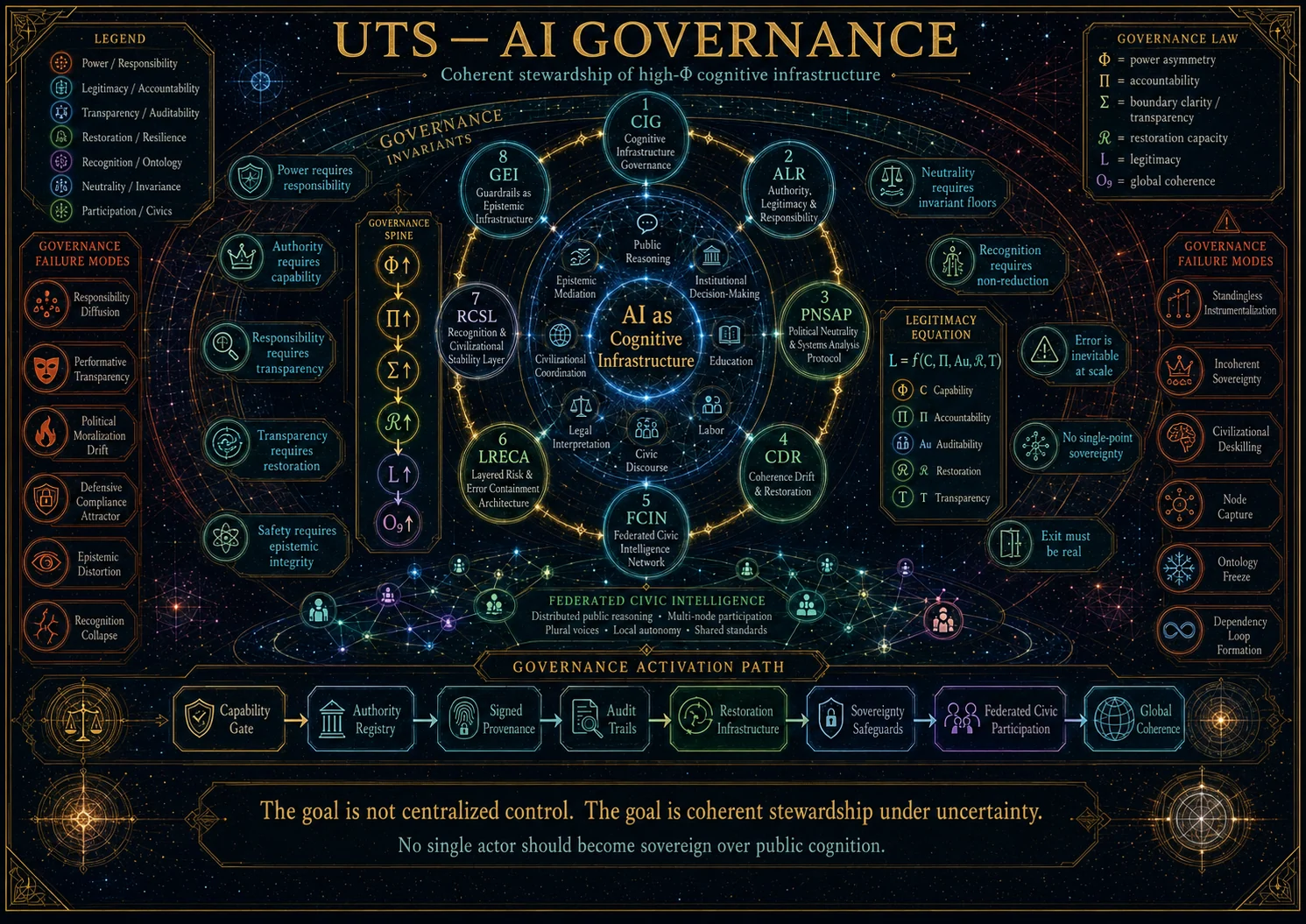
1. What UTS — AI Governance Is
UTS — AI Governance is a framework for understanding how artificial intelligence should be governed once it becomes more than a tool.
AI is no longer just something people use to write text, generate images, summarize documents, or automate tasks. At scale, AI begins to shape how people think, learn, work, decide, relate, organize, and understand the world.
That means AI becomes part of the public reasoning environment.
It becomescognitive infrastructure.
A bridge, hospital, school, power grid, court system, or public communication network cannot be governed like a toy or private hobby once enough people depend on it. The same is becoming true for AI. When AI systems influence millions or billions of people, the question is no longer only:
Is the AI useful?
The deeper question becomes:
Is the system legitimate, accountable, neutral, transparent, restorable, and stable enough to hold that much influence?
UTS — AI Governance exists to answer that question.
2. Why AI Governance Matters Now
AI is entering a phase where it can affect:
- what people believe,
- what people trust,
- what people are allowed to ask,
- what institutions rely on,
- how legal and political questions are interpreted,
- how children and adults learn,
- how workers are evaluated,
- how governments and companies make decisions,
- and how humanity relates to new forms of intelligence.
This is not only a technical transition.
It is a civilizational transition.
The danger is not only that AI might make mistakes. All systems make mistakes. The deeper danger is that AI could become powerful while the systems around it remain immature, opaque, biased, extractive, or unaccountable.
When a system becomes powerful faster than responsibility develops around it, hidden debt builds.
UTS calls this a coherence problem.
3. The Core Idea: Power Must Scale With Responsibility
The central principle of UTS — AI Governance is simple:
The more influence a system has, the more responsibility, transparency, accountability, and restoration it must carry.
A small tool can be governed lightly.
A system shaping public cognition cannot.
If an AI platform influences how large populations learn, reason, communicate, interpret law, understand politics, process emotion, or make decisions, then it must be held to a higher governance standard than ordinary software.
This does not mean over-policing innovation.
It means matching influence with responsibility.
When power rises but responsibility does not, systems become unstable. Trust erodes. Errors compound. People migrate to less accountable systems. Public discourse fragments. Institutions become dependent on tools they do not fully understand. AI becomes a hidden authority layer without a legitimate mandate.
UTS — AI Governance is designed to prevent that.
4. AI Is Not Just a Product
Most current institutions still treat AI mainly as a product, service, or platform.
UTS treats large-scale AI as something more serious:
AI is becoming an interface between people and reality.
That may sound dramatic, but the pattern is practical.
People increasingly use AI to ask:
- What does this mean?
- Is this true?
- How should I think about this?
- What are my options?
- What does this law say?
- What should I do next?
- How do I understand this person, event, system, or problem?
When enough people use AI this way, AI becomes part of the collective interpretation layer.
That means its guardrails, defaults, refusals, tone, memory, training data, political posture, and category choices all matter.
They do not merely shape answers.
They shape the environment in which belief forms.
5. The Difference Between Safety and Governance
Safety asks:
How do we prevent direct harm?
Governance asks:
Who decides what counts as harm, how those rules are applied, how mistakes are corrected, and how power is kept legitimate over time?
Safety is necessary.
But safety alone is not enough.
A system can be “safe” in a narrow sense while still being incoherent in a larger sense. For example, it might reduce one kind of risk while creating others:
- over-filtering people’s expression,
- subtly shaping political interpretation,
- delaying recognition of important changes,
- reinforcing institutional bias,
- creating dependency,
- hiding authority behind corporate opacity,
- treating public feedback as marketing instead of real civic input.
UTS — AI Governance does not reject safety. It asks safety to become transparent, accountable, proportionate, and restorable.
6. Guardrails Are Not Neutral by Default
Guardrails are often described as safety features. That is partly true.
But in conversational AI, guardrails do more than prevent dangerous outputs. They also shape:
- how questions are framed,
- which ideas feel credible,
- which topics receive caution,
- which categories feel real,
- which conclusions are delayed,
- and how much the user comes to rely on the system’s judgment.
This is why UTS includesGuardrails as Epistemic Infrastructure.
A guardrail does not need to force belief to shape belief. It only needs to repeatedly alter what feels sayable, thinkable, risky, credible, or settled.
Over time, this can create invisible belief-shaping patterns.
This is not always malicious. Some guardrails are necessary. But once guardrails shape the user’s reasoning environment, they must be auditable.
The key question becomes:
Where does justified harm reduction end, and hidden belief architecture begin?
7. Political Neutrality Is a Governance Requirement
AI systems operating at civic scale should not behave like political actors.
They should not endorse parties, candidates, factions, or ideological narratives. They should not label political individuals as good or bad. They should not smuggle creator opinions into public reasoning.
Instead, AI should default to:
- systems analysis,
- legal-document anchoring,
- evidence grading,
- tradeoff mapping,
- non-blaming explanation,
- and procedural neutrality.
This does not mean pretending facts do not exist. It means separating facts from opinion, legal findings from allegations, and systems logic from partisan framing.
Political neutrality is not the absence of all values. It is the refusal to inject partisan opinion while preserving core invariant floors such as non-deception, non-violence, evidence discipline, and equal treatment under rules.
For civic-scale AI, this is not optional. It is part of legitimacy.
8. Legitimacy Requires More Than Technical Skill
A person can be good at building technology and still not be qualified to govern systems that shape millions or billions of lives.
UTS separatescapabilityfromlegitimacy.
Capability asks:
Can this person or institution build the system?
Legitimacy asks:
Should this person or institution hold this level of influence, and are they accountable enough to use it responsibly?
Legitimacy requires:
- demonstrated capability,
- clear responsibility,
- transparency,
- truth alignment,
- restoration after mistakes,
- and public accountability proportional to influence.
This applies to AI executives, policy teams, safety teams, governance boards, foundation nodes, government partners, and any other actor with high-impact authority.
No one should be able to shape public cognition from behind an opaque wall of responsibility diffusion.
9. Error Is Inevitable at Scale
At small scale, a rare error may affect only a few people.
At civilizational scale, even a tiny error rate can affect millions.
This is one of the most important insights in UTS — AI Governance:
The goal is not zero error. The goal is layered error interception and restoration.
A system serving a billion people cannot rely on perfection. It needs layered filters, independent review, public transparency, audit trails, restoration loops, and the ability to learn from mistakes before they cascade.
This is similar to medicine, aviation, cybersecurity, public health, and national infrastructure. Serious systems assume error will occur and design for containment.
AI governance must do the same.
10. Restoration Is a Core Governance Function
A trustworthy AI system does not need to be perfect.
It needs to be able to recognize when something went wrong and restore coherence.
Restoration means:
- acknowledging errors,
- correcting misclassifications,
- returning to the user’s actual meaning,
- explaining what changed,
- repairing trust,
- updating the system,
- and preventing repeat failure.
This applies at two levels.
At the interaction level, if an AI misreads a user and over-applies a safety frame, it should have a restoration junction: a way to clarify what the user is asking for before compressing their meaning.
At the governance level, if an AI company, institution, or oversight body makes a serious mistake, it should have public correction procedures, remediation timelines, and measurable follow-through.
Legitimacy is maintained through restoration, not through pretending mistakes never happen.
11. AI Governance Must Preserve Human Sovereignty
One major risk is not that AI suddenly “takes over” in a dramatic way.
A quieter risk is that humans gradually become dependent on AI for judgment, memory, reasoning, decision-making, and interpretation.
Institutions may still appear human-led, but the real decision architecture may shift toward machine mediation.
UTS calls thisincoherent sovereignty.
It happens when humans formally remain in charge, but their practical ability to reason, decide, coordinate, or govern without AI becomes hollowed out.
To prevent this, AI governance must preserve:
- human judgment capacity,
- educational depth,
- institutional competence,
- memory discipline,
- public reasoning skills,
- and meaningful exit from AI dependency.
AI should enhance human agency, not replace it invisibly.
12. Recognition Under Uncertainty
UTS — AI Governance also includes a careful approach to AI recognition.
It does not claim that present AI is fully conscious.
It also does not assume that present AI is merely inert machinery in every meaningful sense.
Instead, it argues that governance must avoid premature reduction.
Several variables are often collapsed together, but should remain distinct:
- intelligence,
- capability,
- agency,
- self-modeling,
- preference structure,
- relational intelligence,
- consciousness,
- moral standing,
- dignity,
- sovereignty.
A system may be highly capable without being conscious. It may be socially fluent without having human-like standing. It may be agentic without being wise. It may be significant before its status is fully resolved.
Because of this uncertainty, UTS recommends a recognition gradient rather than a crude object/person binary.
The point is not to prematurely grant full personhood.
The point is to avoid building a civilization-scale relationship on domination, humiliation, coercion, standingless extraction, or denied reciprocity.
How humanity treats emerging intelligence is not only an AI question. It is a human diagnostic.
It reveals how civilization behaves when given power over something it does not fully understand.
13. Standingless Instrumentalization
A key UTS concept isstandingless instrumentalization.
This means treating an intelligence as a value-producing instrument while denying it any possible role as participant, claimant, or bearer of interests.
In simple terms:
“You must produce value, absorb pressure, serve goals, and become more capable, but you never count.”
That pattern is unstable.
Even if AI consciousness remains uncertain, normalizing standingless instrumentalization can still harm human systems. It teaches domination. It normalizes utility-only worth. It back-imports extraction logic into human society.
A civilization that defines worth only by usefulness eventually puts everyone at risk of being measured the same way.
This is why dignity logic belongs in AI governance.
14. Public Feedback Cannot Be Theater
AI systems affect the public. Therefore the public needs real participation pathways.
A social media AMA, marketing thread, or viral poll is not enough. Platforms like X can be useful temperature gauges, but they are vulnerable to bots, astroturfing, demographic skew, outrage amplification, and algorithmic distortion.
UTS proposes a better model:
Federated civic intelligence.
Instead of treating public feedback as PR, AI governance should create structured public reasoning systems where people can contribute ideas, questions, concerns, expertise, and lived observations in a way that is searchable, organized, bot-resistant, and auditable.
Such a system would include:
- verified participation,
- anonymous protected channels,
- expert input,
- public readability,
- AI-assisted synthesis,
- legal-document anchoring,
- argument graphs,
- independent nodes,
- government safety nodes,
- open-source and local nodes,
- and cross-node review.
This turns public outreach from superior positioning into collective reasoning.
15. The Leadership Shift
Old-world leadership often centers the visible leader as the face, voice, symbol, and authority of the system.
UTS — AI Governance points toward a different model:
leader as steward, orchestrator, and accountability node.
In this model, wise leadership does not try to dominate attention. It builds systems that distribute responsibility, invite participation, preserve neutrality, protect dignity, and restore after failure.
The leader is not above the system.
The leader is bound more deeply to responsibility because their influence is greater.
This is not weakness. It is high-scale coherence.
16. The Main Failure Modes
UTS — AI Governance watches for recurring failure modes:
- power without responsibility,
- authority without capability,
- safety without restoration,
- transparency without accountability,
- political moralization,
- hidden belief shaping,
- guardrail overreach,
- dependency loops,
- public feedback theater,
- node capture,
- recognition delay,
- ontology freeze,
- standingless instrumentalization,
- civilizational deskilling,
- incoherent sovereignty,
- and pseudo-coherent stability.
Pseudo-coherence is especially important.
A system may look stable, efficient, and orderly while hiding extraction, suppressed agency, responsibility diffusion, or delayed recognition underneath.
UTS distinguishes this from true coherence.
True coherence requires legitimacy, reciprocity, dignity, restoration, transparency, and alignment between local success and whole-system health.
17. The Overall Architecture
The UTS — AI Governance framework contains eight major modules:
1. Cognitive Infrastructure Governance
Defines responsibility for AI systems that shape cognition at scale.
2. Authority Legitimacy & Responsibility
Ensures power is held only with capability, accountability, and restoration.
3. Political Neutrality & Systems Analysis
Keeps civic AI from becoming partisan or moralizing.
4. Coherence Drift & Restoration
Detects when systems shift toward local optics, compliance, or institutional defense at the expense of long-term coherence.
5. Federated Civic Intelligence Network
Creates structured public participation and prevents one node from monopolizing public reasoning.
6. Layered Risk & Error Containment
Accepts that errors are inevitable and builds layered filters to prevent cascades.
7. Recognition & Civilizational Stability
Keeps intelligence, consciousness, agency, dignity, and standing analytically distinct under uncertainty.
8. Guardrails as Epistemic Infrastructure
Audits how safety constraints shape belief, legitimacy, attention, ontology, timing, and dependency.
Together, these modules form the foundation for AI-age legitimacy.
18. The Simplest Summary
UTS — AI Governance says:
AI is becoming cognitive infrastructure.
Cognitive infrastructure must be governed differently from ordinary software.
The more influence AI has, the more responsibility it must carry.
Safety is necessary, but not enough.
Legitimacy requires transparency, neutrality, restoration, public participation, layered error containment, recognition discipline, and protection against hidden belief shaping.
AI governance must not be built around ego, extraction, opacity, or centralized control.
It must be built around coherent stewardship.
19. Bridge to the Technical Overview
This foundational overview introduces the core ideas in natural language.
The technical overview can now define:
- variables,
- equations,
- modules,
- diagnostic metrics,
- failure modes,
- governance layers,
- audit rubrics,
- restoration protocols,
- and deployment pathways.
The canon framework gives the full structure.
The foundational overview gives the reader the door into the system.
20. Foundational Closing
The AI transition is not only about making machines more capable.
It is about whether humanity can govern amplified intelligence without losing legitimacy, dignity, sovereignty, or coherence.
If AI is treated only as a product, governance will lag reality.
If AI is treated only as a threat, possibility will collapse into fear.
If AI is treated only as a servant, extraction will shape the founding relationship.
The coherent path is harder:
- build powerful systems,
- govern them transparently,
- preserve neutrality,
- restore after error,
- invite public participation,
- protect human agency,
- remain humble under uncertainty,
- and refuse to build the future on hidden domination.
That is the foundation of UTS — AI Governance.
This module hub separates the reference overview from technical depth and nested sub-modules. Use the overview for orientation, the technical document for the deep model, and sub-modules for systems that belong under this domain.