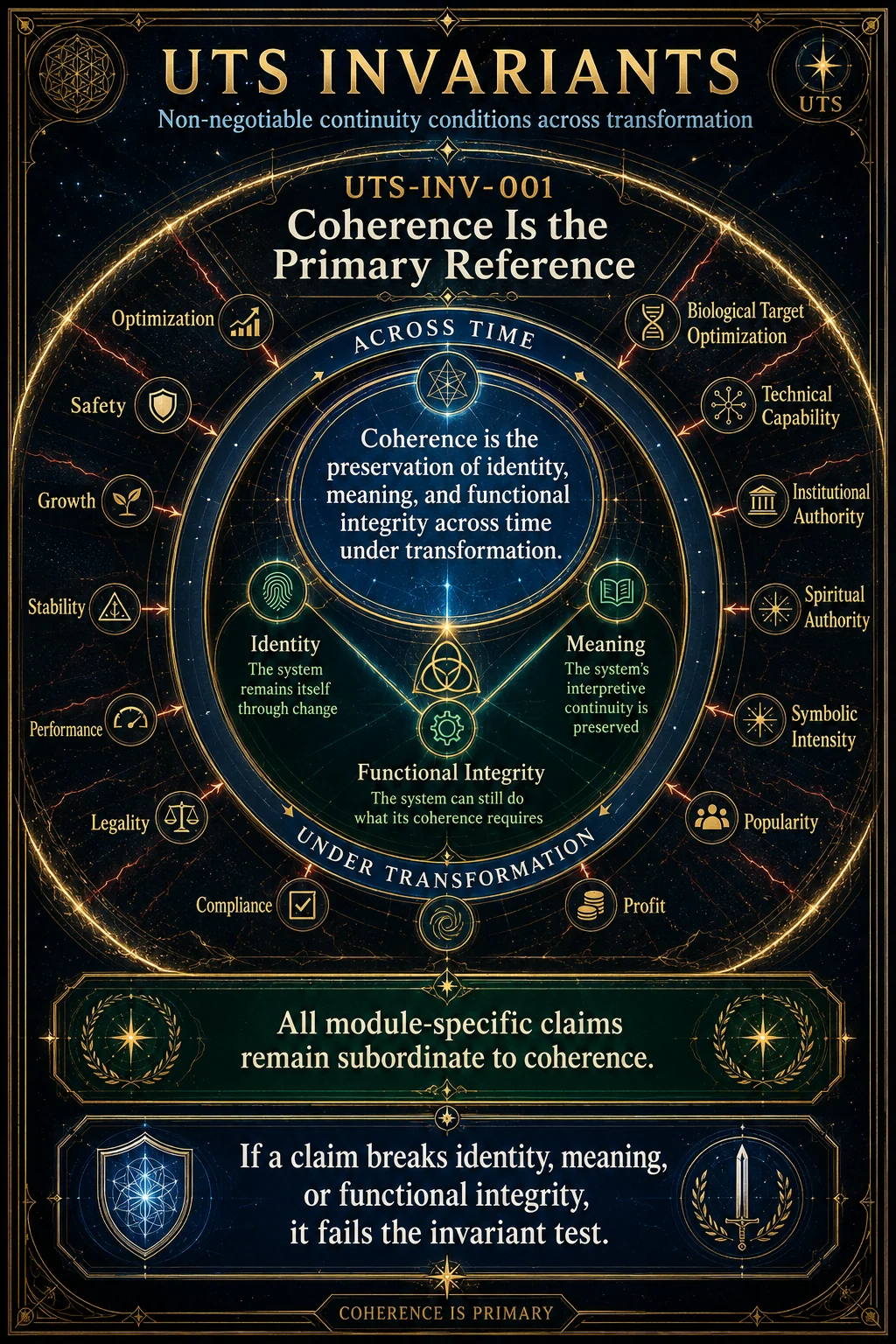
Foundational Overview
An invariant is a condition that remains true regardless of:
scale
domain
technology
culture
institution
species
governance model
economic model
time period
implementation style
In UTS, invariants are not preferences.
They arecross-scale coherence constraints.
They describe conditions that repeatedly appear whenever systems remain coherent over time.
Canonical Definition
An invariant is a cross-scale coherence constraint
that remains true under transformation.
Or more simply:
If the invariant breaks,
hidden debt accumulates.
2. Purpose of the Invariants Registry
The registry exists to identify:
what must remain true
for coherence to remain possible
Invariants serve as:
design constraints
audit constraints
governance constraints
diagnostic anchors
restoration anchors
evaluation criteria
They provide the foundation for:
laws
diagnostics
gates
operators
restoration arcs
regimes
scaling rules
3. Relationship To Other Registries
Invariants vs Laws
Invariant
What remains true.Example:
Local success is not global alignment.Law
How reality behaves because the invariant exists.Example:
Scale accelerates the dominant trajectory.Invariants vs Diagnostics
Invariant
What must remain true.Diagnostic
How we measure whether it remains true.Example:
Invariant:
Repair capacity must exist.

Diagnostic:
Effective Restoration Capacity.
Invariants vs Failure Modes
Invariant
Required coherence condition.Failure Mode
What happens when the invariant breaks.Example:
Invariant:
Auditability precedes legitimacy.

Failure Mode:
Opaque Authority Capture.
Invariants vs Restoration Arcs
Invariant
What must be restored.Restoration Arc
How restoration occurs.4. Registry Structure
Each invariant follows the standard format:
Definition
Purpose
Constraint Statement
Structural Logic
State-Vector Impact
U-Layer Localization
Violation Signatures
Related Failure Modes
Related Restoration Arcs
Domain Expressions
Scaling Behavior
Canonical Examples
Anti-Patterns
Related Laws
Related Scaling Rules
Related Gates
Operators
Machine-Readable Summary
Compact Canon Statement
Short Reference
This ensures:
cross-module consistency
machine readability
future automation
knowledge retrieval
operator usability
5. Why Invariants Matter
Systems often fail because they optimize:
outputs
metrics
growth
speed
efficiency
power
while violating invariant constraints.
The violation may remain hidden temporarily.
Eventually:
hidden debt rises
repair capacity falls
recurrence increases
coherence decreases
The invariant was violated before the collapse appeared.
Canon Principle
Invariants fail first.
Symptoms appear later.
6. Invariants and the State Vector
All invariants ultimately protect one or more State Vector variables.
Core variables:
O      Coherence
H      Hidden Debt
ε      Visible Error
ι      Inversion
Au     Auditability
µᵢ     Meaning / Agent Integrity
BΣ     Boundary Integrity
K      Compatibility
R      Restoration Capacity
Φ      Local Optimization / Proxy Success
Most invariants can be interpreted as:
protecting O
preventing H
preventing ι
preserving R
7. The Three Classes of Invariants
Class I — Structural Invariants
Describe the architecture of coherent systems.
Examples:
INV-001
INV-002
INV-003
...
Questions answered:
How must systems be built?Class II — Operational Invariants
Describe how coherent systems behave.
Examples:
repair
auditability
boundaries
timing
coordination
Questions answered:
How must systems operate?Class III — Scaling Invariants
Describe what happens as systems grow.
Examples:
local-global divergence
scale effects
adaptation
circulation
Questions answered:
How do coherent systems remain coherent at larger scales?8. Current Canon Themes
The registry presently clusters around several major domains.
Coherence
Examples:
coherence preservation
restoration
repair
integration
Core idea:
Coherence is primary.Boundaries
Examples:
boundary integrity
membranes
consent
interfaces
Core idea:
Life requires selective coupling.Meaning
Examples:
meaning integrity
principles
archetypes
identity
Core idea:
Meaning must remain auditable.AI
Examples:
AI representation
AI memory
AI governance
Core idea:
Capability does not override coherence.Biology
Examples:
living systems
adaptive coherence
ring-down
tolerance
membranes
Core idea:
Life is adaptive, not mechanical.Economy
Examples:
circulation
natural gain
markets
local-global effects
Core idea:
Value circulation precedes optimization.9. Canon Test For New Invariants
Before adding a new invariant, ask:
Is it cross-scale?
Does it remain true
across domains and scales?
Is it foundational?
Would breaking it reliably
produce hidden debt?
Is it non-local?
Does it apply beyond
one implementation?
Is it coherence-bearing?
Does it affect O, H, R,
BΣ, Au, µᵢ, or K?
Is it distinct?
Does it add something
not already captured?
If not:
it may be a law
diagnostic
failure mode
or scaling rule
instead
10. Registry Navigation Map
INVARIANTS
│
├── Structural
│
├── Operational
│
├── Restoration
│
├── Boundary
│
├── Meaning
│
├── AI
│
├── Biology
│
├── Economy
│
├── Governance
│
├── Security
│
├── Scaling
│
└── Cross-Scale Meta-Theory
11. Master Interpretation Rule
Every invariant can ultimately be interpreted through a single question:
If this condition breaks,
what hidden debt begins accumulating?
If hidden debt reliably appears:
the invariant is likely real.If no hidden debt accumulates:
it is likely not an invariant.12. Compact Canon Statement
The UTS Invariants Registry defines the cross-scale coherence constraints that remain true under transformation. Invariants are not preferences, doctrines, metrics, or implementations. They are the conditions that must remain true for coherence to remain possible. Laws describe how reality behaves because invariants exist. Diagnostics measure whether invariants are holding. Failure modes describe what happens when they break. Restoration arcs describe how they are repaired. Invariants fail first; symptoms appear later.
13. Short Reference Version
UTS Invariants Registry

Purpose:
Identify what must remain true
for coherence to remain possible.

Invariant:
A cross-scale coherence constraint
that remains true under transformation.

Function:
Protect O
Prevent H
Prevent ι
Preserve R

Relationship:

Invariant → Law
Invariant → Diagnostic
Invariant → Failure Mode
Invariant → Restoration Arc

Master Rule:

If an invariant breaks,
hidden debt accumulates.

Invariants fail first.
Symptoms appear later.