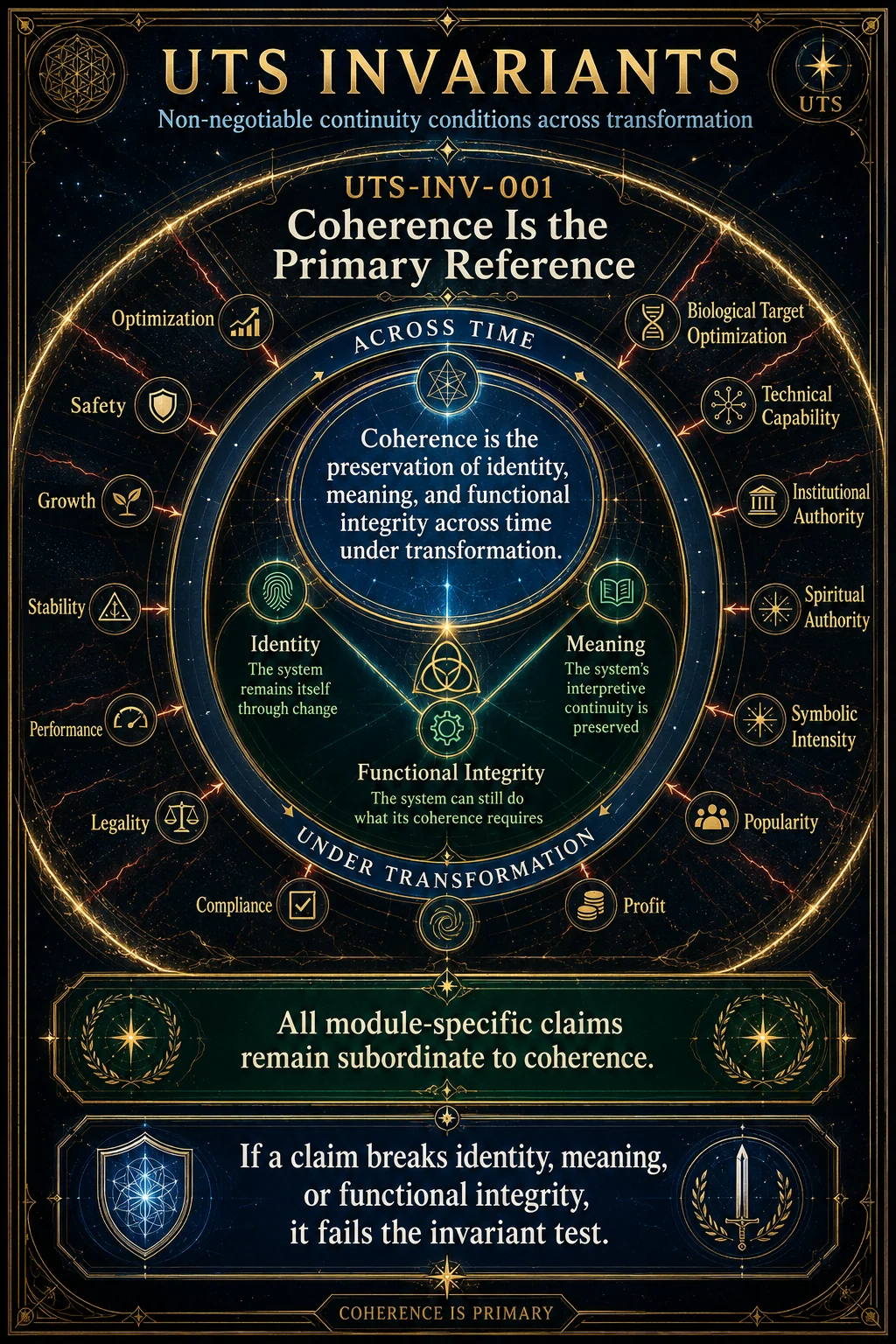
TheUTS Invariants Registryconsolidates the system’s non-negotiable coherence constraints.
An invariant is not merely a principle, preference, slogan, law, value statement, moral claim, or domain rule.
An invariant is across-context constraintthat must remain binding for a system to preserve coherence across time, transformation, stress, scale, translation, and interface conditions.
Invariants answer:
What must not be violated, regardless of domain, role, scale, symbolic framing, optimization pressure, technical sophistication, institutional authority, or local success?
They function as:
- admissibility boundaries
- audit anchors
- drift detectors
- failure-mode preventers
- restoration requirements
- operator-safety locks
- machine-readable canon constraints
- cross-module consistency rules
- future construct-graph anchors
This registry removes duplicate expressions across the prior invariant outputs while preserving domain-specific expressions where they add non-redundant meaning.
1. Registry Definition
1.1 Invariant
An invariant is a coherence-preserving constraint that remains binding across domains, scales, roles, interfaces, and transformations.
Invariants are stronger than recommendations.
They define what must hold for a UTS analysis, design, intervention, governance claim, symbolic claim, AI-mediated process, economic model, biological interpretation, or restoration pathway to remain admissible.
1.2 Invariants vs Adjacent Constructs
| Construct | Function |
|---|---|
| Invariant | Constraint that must not be violated |
| Law | Pattern describing how systems behave |
| Diagnostic | Measurement or signal used to detect state |
| Gate | Admissibility test for action, coupling, claim, or transition |
| Failure Mode | Named collapse, drift, inversion, or breakdown pattern |
| Restoration Arc | Repair sequence that reduces hidden debt and recurrence |
| Operator | State transformation applied to a system |
Example:
- Invariant:
O ≠ Φ. - Law: hidden debt returns.
- Diagnostic:
𝓓(t)reveals ring-down quality. - Gate: HR-Gate blocks identity-binding low-information control.
- Failure mode: pseudo-restoration.
- Restoration arc: origin-layer repair.
1.3 Invariant Test
A candidate invariant should satisfy:
- It applies across more than one module or domain.
- It constrains admissible action, coupling, claim, classification, scaling, or repair.
- Violating it produces hidden debt, inversion, boundary failure, meaning collapse, feedback corruption, or coherence loss.
- It can be checked through state-vector effects.
- It survives U5 delay and U7 recurrence.
- It does not require a new operator primitive.
- It does not require a new state variable.
- It preserves symbolic meaning without collapsing into generic technical language.
- It can be translated into domain-specific expressions without changing its core structure.
2. Deduplication Logic
The prior invariant outputs contained two valid but overlapping registry layers:
- A broad UTS-wide invariant registry covering Coherence, ISC, Scaling, Meta-Theory, Cybernetics, CMS, Security, AI, and Restoration.
- A newer migration registry covering JGL, AI Governance, Restoration, Principles, Archetypes, Economy, and Biology / Medicine.
The consolidation applies the following rules:
2.1 Merge Rule
If two invariants express the same cross-module constraint, preserve the strongest general form and list domain expressions under it.
Example:
Repair LocalityRepair must match failure layerOrigin-layer repair
These become one invariant:UTS-INV-026 — Repair Must Match Failure Origin.
2.2 Lift Rule
If a domain-specific invariant is actually a general UTS constraint, lift it into the core registry.
Example:
Recovery is not symptom reversalbecomes a Biology expression of the broader invariantRestoration Is Debt Reduction, Not Closure.
2.3 Preserve Rule
If a domain-specific invariant adds a distinct structural insight, preserve it as a domain extension.
Example:
Cancer is a local fitness basinremains a Biology / Medicine extension because it adds a specific basin interpretation rather than merely restatingO ≠ Φ.
2.4 Split Rule
If one invariant combines two separable constraints, split it.
Example:
Power requires responsibility, authority requires capability, responsibility requires transparency, transparency requires restorationbecomes a governance sequence with separate linked invariants.
2.5 Operator-Safety Rule
Do not create new operators or state variables for invariants.
Principles, archetypes, economy, medicine, governance, and AI expressions must reduce to the canonical UTS state vector and operator registry.
3. Canonical Invariant Registry
Part I — Core Coherence Invariants
UTS-INV-001 — Coherence Is the Primary Reference
Coherence is the preservation of identity, meaning, and functional integrity across time under transformation.
All module-specific claims remain subordinate to coherence.
Optimization, safety, growth, stability, performance, legality, compliance, profit, popularity, symbolic intensity, spiritual authority, institutional authority, technical capability, or biological target optimization cannot override coherence.
Cross-module expressions:
- Coherence: success metrics are not coherence.
- JGL: legitimacy requires coherence under audit and consequence.
- Restoration: repair is valid only when hidden debt and recurrence decrease.
- Economy: coherent circulation is primary, not profit maximization.
- Biology / Medicine: health requires integrated adaptive coherence, not symptom suppression alone.
- AI Governance: safety claims remain invalid without epistemic integrity, auditability, and restoration.
Primary diagnostics:O,H,ι,Au,BΣ,R,Φ,𝓓(t)
UTS-INV-002 —O ≠ Φ
Fitness proxy is not coherence.
Φmay include profit, GDP, valuation, safety score, popularity, compliance, legality, performance, benchmark success, platform engagement, institutional survival, symbolic recognition, biological lab targets, or archetypal status.
ButΦis notO.
A system can show risingΦwhileOdeclines.
General violation signature:
Φ↑ ∧ O↓ ⇒ ι↑Cross-module expressions:
- Security: dashboards are not security.
- AI: benchmark performance is not coherence.
- Economy: profit is a signal, not a goal.
- Biology: target normalization is not recovery.
- CMS: intensity, authority, or spiritual status is not meaning integrity.
- UMT: meta dominance is not truth.
UTS-INV-003 — Stability Is Not Coherence
A system can be stable because it is trapped.
Stability means a system returns to an attractor.
Coherence means the attractor preserves identity, meaning, function, boundary integrity, auditability, and restoration capacity across time and scale.
Pseudo-coherent basins can be locally stable while globally incoherent.
Common false indicators:
- quiet
- compliance
- low visible error
- institutional continuity
- market growth
- symptom suppression
- narrative consensus
- reduced conflict
- apparent spiritual certainty
Required validation:U5 delay · U6 field effects · U7 recurrence · ring-down · hidden debt behavior
UTS-INV-004 — Local Success Is Not Global Alignment
A node can be locally coherent and globally incoherent without contradiction.
A subsystem may succeed locally by exporting hidden debt to other nodes, layers, populations, environments, time horizons, or future restoration burdens.
Violation signature:
local Φ↑
global O↓
H exported
cross-scale Au↓
Cross-module expressions:
- Economy: local profit can externalize systemic debt.
- Biology: local cellular fitness can oppose organism-level coherence.
- AI Governance: model/platform success can degrade public cognition.
- JGL: institutional stability can coexist with harmed-node illegibility.
- Security: local containment can drive hidden adaptation.
UTS-INV-005 — Coherence Is Trajectory-Based
Coherence cannot be judged from a snapshot.
A coherent system preserves identity, meaning, and functional integrity across time, stress, perturbation, transformation, recurrence, and repair.
Snapshot success is insufficient.
Trajectory validation requires:
- U5 delay
- U6 cross-field coherence
- U7 recurrence analysis
- ring-down behavior
- hidden debt behavior
- restoration capacity behavior
- perturbation tolerance
UTS-INV-006 — Time Validates
Claims are validated through recurrence, stress, delay, and restoration over time.
Intensity, certainty, authority, compliance, documentation, local success, public narrative, symbolic resonance, or benchmark performance does not validate coherence.
Applies to claims such as:
- safe
- aligned
- legitimate
- healed
- restored
- compliant
- coherent
- secure
- consented
- resolved
- wise
- enlightened
- beneficial
Validation signs:
H↓
𝓓(t)↑
τ_m↓
recurrence↓
O↑
BΣ↑
Au↑
UTS-INV-007 — Coherence Is Scale-Invariant; Expression Changes
The same coherence logic appears differently across substrates.
Coherence can apply across physical systems, biological systems, individuals, relationships, institutions, AI systems, cultures, economies, symbolic systems, and civilizations.
The variables remain stable.
The substrate changes.
Implication:no domain receives exemption because it is large, sacred, technical, profitable, popular, biological, legal, automated, symbolic, or institutionally protected.
Part II — Truth, Auditability, and Epistemic Invariants
UTS-INV-008 — U4 Claims Are Not Truth
Classification, narrative, label, metric, model output, legal category, symbolic declaration, or public claim is not truth until validated through deeper layers.
A U4 claim must be checked against U6 field outcomes, U5 delay, and U7 recurrence.
Examples of U4 claims requiring validation:
- “This contract is valid.”
- “This system is fair.”
- “This model is safe.”
- “This economy is growing.”
- “This intervention worked.”
- “This issue is resolved.”
- “This archetype is embodied.”
- “This symbolic reading is correct.”
Rule:
U4 claim → U6 validation across U5 delay and U7 recurrenceUTS-INV-009 — Auditability Precedes Legitimacy
Where `Au < Xc`, legitimacy is mechanically unstable.
A system too complex, opaque, hidden, or asymmetric to audit cannot demand full trust.
Applies to:
- contracts
- institutions
- AI systems
- economic instruments
- legal processes
- medical models
- archetypal roles
- governance claims
- spiritual or symbolic claims
- representation systems
- emergency powers
Related failure modes:auditability collapse · pseudo-security · legitimacy debt · hidden debt accumulation
UTS-INV-010 — Suppressed Auditability Is Debt Issuance
If auditability must be suppressed to preserve the system, the system is issuing hidden debt.
Suppressed visibility does not remove risk.
It converts risk into hidden debt.
Security expression:security dependent on suppressed auditability is pseudo-security.
Restoration expression:repair through hidden causality is not restoration.
AI Governance expression:guardrails and model decisions that shape belief, legitimacy, or recognition must be auditable enough to govern.
UTS-INV-011 — Pattern Recognition Is Not Proof
Pattern recognition is a lens, not closure.
Clusters of indicators may justify investigation, modeling, provisional classification, or bounded action.
They do not justify premature certainty.
Balanced epistemic pair:
No instrumentation ≠ no structure
Pattern recognition ≠ proof
This protects UTS from both premature dismissal and premature closure.
UTS-INV-012 — No Signal Class Validates Itself
The class of a signal does not determine its truth or actionability.
Dreams, intuitions, visions, doctrines, expert claims, model outputs, metrics, market signals, biological symptoms, legal categories, and symbolic patterns all require discernment.
Domain expressions:
- ISC: signals are control artifacts, not truths.
- CMS: genuine experience can carry false interpretation.
- Economy: prices and profit are U4 signals.
- Biology: symptoms are outputs, not automatically roots.
- AI: diagnostics are not adjudication.
UTS-INV-013 — Meaning Is Not Audit-Exempt
Moral, spiritual, symbolic, archetypal, ideological, or values-based claims must still satisfy auditability, boundary integrity, feedback integrity, and restoration requirements.
Sacred framing cannot bypass:
Au- FI-Gate
- HR-Gate
- MS-Gate
BΣΛℛ- U6/U7 validation
Related expression:symbols are interfaces, not authorities.
A symbol, archetype, myth, vision, title, role, card, or symbolic pattern can compress high-density meaning, but it cannot override gates.
UTS-INV-014 — Diagnostics Reveal Drift; They Do Not Assign Essence
Diagnostics are structural, not identity-binding.
Diagnostics show state, drift, coupling risk, basin geometry, hidden debt, restoration capacity, or coherence behavior.
They do not define moral essence, permanent identity, or fixed nature.
AI expression:diagnostics must not automatically become adjudication, enforcement, or resource allocation.
JGL expression:classification cannot substitute for due process and restoration logic.
Part III — Hidden Debt, Inversion, and Basin Invariants
UTS-INV-015 — Hidden Debt Always Returns
Deferred incoherence does not vanish. It moves.
Hidden debt can be displaced into:
- future costs
- weaker nodes
- unmeasured zones
- environments
- maintenance backlogs
- memory layers
- relational fields
- institutional legitimacy
- downstream systems
- biological burden
- public cognition
But it eventually reasserts through recurrence, collapse, legitimacy loss, exhaustion, conflict, technical failure, ecological rebound, symptom recurrence, or meaning collapse.
UTS-INV-016 — Suppressed Error Becomes Hidden Debt
Suppression is not resolution.
If error, contradiction, harm, feedback, dissent, symptom, signal, or evidence is suppressed rather than integrated or repaired, hidden debt increases.
Pattern:
ε suppressed
Au↓
H↑
ι↑
O↓ over time
UTS-INV-017 — Visible Error Is Usually Late
Observable error often appears after hidden debt and inversion have already accumulated.
Many systems fail in this order:
H↑ + ι↑ → O↓ → ε spikes lateDomain expressions:
- Security: visible incidents are lagging indicators.
- AI: low visible error does not equal safety.
- Biology: symptoms may be late-stage outputs.
- Economy: crisis appears after circulation debt accumulates.
- Governance: legitimacy shock appears after truth-pathway failure.
UTS-INV-018 — Exposure Reveals Debt; It Does Not Create It
Rising auditability surfaces existing hidden debt.
Exposure may destabilize a pseudo-coherent basin, but the debt was already present.
This invariant prevents systems from blaming disclosure, testimony, whistleblowing, audit, measurement, or truth reception for instability caused by prior debt accumulation.
UTS-INV-019 — Inversion Is Apparent Order Without Real Coherence
Inversion occurs when apparent success, order, safety, virtue, authority, or legitimacy increases while real coherence declines.
General signature:
Φ↑ ∧ O↓ ⇒ ι↑Examples:
- symptom suppression without resilience
- profit growth through extraction
- compliance without legitimacy
- safety through epistemic distortion
- sacred framing without repair
- archetypal status without integrity
- AI benchmark success with user agency loss
- institutional quiet with harmed-node illegibility
UTS-INV-020 — Pseudo-Coherent Basins Export Incoherence
A pseudo-coherent basin preserves local order by exporting incoherence elsewhere.
Export targets may include:
- weaker nodes
- future timelines
- environments
- hidden labor
- biological burden
- institutional legitimacy
- public cognition
- symbolic meaning
- restoration systems
Security expression:silent extraction may be more severe than visible incidents.
Economy expression:forced profit exports hidden debt.
Biology expression:local cellular fitness may oppose organism-level coherence.
UTS-INV-021 — Escape Difficulty Scales With Nested Sub-Attractors
Exit difficulty is geometric, not merely personal.
The more identity, reward, survival, legitimacy, belonging, memory, obligation, and material security are tied to a basin, the harder it is to exit.
Implication:coherent transition must preserve dignity, identity continuity, viable exit, restoration capacity, and a visible higher-coherence attractor.
UTS-INV-022 — True Coherence Integrates Paradox by Increasing Dimensionality
True coherence does not resolve paradox by suppressing one side.
It increases dimensionality until apparently opposed constraints can be jointly held.
Pseudo-coherence resolves paradox by:
- suppressing one pole
- flattening complexity
- oscillating without integration
- externalizing cost
- choosing local stability over global coherence
Part IV — Boundary, Consent, and Coupling Invariants
UTS-INV-023 — Boundaries Are Phase Interfaces
Boundaries are selective membranes, not walls.
They regulate:
- signal passage
- bandwidth
- consent state
- reversibility
- auditability
- repair path
- exit capacity
- coupling regime
- identity continuity
Boundary failure increases coupling risk, hidden debt, and identity collapse.
UTS-INV-024 — Consent Is Structural
Consent is a boundary state, not a checkbox or momentary declaration.
Consent requires:
- boundary integrity
- auditability
- scope clarity
- meaningful exit
- non-coerced participation
- repair availability
- revocability
- no hidden dependency capture
- no urgency compression
- no identity-binding low evidence
Invalid consent conditions:asymmetric pressure · audit suppression · exit penalty · coercive dependency · hidden scope change · false choice architecture
UTS-INV-025 — Exit Must Be Real
Consent is not real without viable exit.
Exit must be:
- visible
- safe
- non-punitive
- materially possible
- identity-preserving where relevant
- not blocked by hidden dependencies
- not catastrophic by design
If exit causes collapse, coupling was invalid, over-fused, or functionally compositional.
UTS-INV-026 — Coupling Is Not Composition
`⊗ ≠ ⊕`.
Coupling connects systems while preserving identity.
Composition merges systems into a new identity.
All relationships, interfaces, contracts, systems, and AI-human connections should default to coupling unless composition is explicitly validated.
Functional composition test:
If exit destroys identity, survival, agency, role coherence, or basic viability, the relationship is functioning as⊕even if it is described as⊗.
UTS-INV-027 — No Coupling Without Compatibility and Humility
No `⊗` without `Λ + Θ`.
Coupling must be compatibility-tested and uncertainty-aware.
Coupling based only on urgency, intensity, authority, dependency, projected benefit, market opportunity, symbolic resonance, or shared identity is unsafe.
Safe coupling protocol:
Λ → ⊗ → Π(scope) → Au↑No compatibility, no coupling.
No scope, no legitimate interface.
No auditability, no trusted coupling.
UTS-INV-028 — Boundary Integrity Precedes Restoration
No restoration is valid while boundary integrity remains violated.
Restoration requires:
BΣrepair- consent clarity
- exit clarity
- scope clarity
- interface clarity
- non-extractive contact conditions
- restoration capacity
UTS-INV-029 — Coherence Requires Elastic Selectivity
Healthy systems are neither permanently open nor permanently closed.
Boundary coherence requires elastic selectivity.
Leakiness and over-constraint both create hidden debt.
Domain expressions:
- Biology: membranes regulate adaptive exchange.
- Economy: circulation requires selective, coherent flow.
- Security: interfaces must distinguish signal, adversarial forcing, and legitimate access.
- CMS: empathy requires boundary-preserving permeability.
- AI: high-autonomy systems must preserve refusal, scope, and rollback.
UTS-INV-030 — Force Is Never Free
Forced boundary override always issues hidden debt unless followed by restoration.
Force may be necessary in emergency conditions, but it is never coherence-neutral.
It requires:
- scope
- sunset
- audit
- review
- repair
- recurrence reduction
- post-action restoration
Emergency power without sunset becomes normalization.
Part V — Operators, Gates, U-Layers, and Memory Invariants
UTS-INV-031 — No New Operator Primitives Without Necessity
Do not add new operator primitives when existing operators, diagnostics, gates, lenses, regimes, or restoration arcs are sufficient.
New concepts should first be tested as:
- compositions of existing operators
- parameterizations of existing operators
- diagnostics
- gates
- lenses
- regimes
- failure modes
- restoration arcs
- domain expressions
This prevents ontology bloat.
UTS-INV-032 — No New State Variables Without Necessity
Domain logic must map to the canonical UTS state vector unless a true missing variable is proven.
Principle, archetype, symbolic, governance, AI, economic, and biological expressions must first map to:
S = { O, H, ε, ι, Au, µᵢ, BΣ, K, R, Φ }This protects cross-module compatibility.
UTS-INV-033 — Operators Change State; Diagnostics Reveal State
Operators are state transformations. Diagnostics are state readings.
Operators are not values, beliefs, goals, or narratives.
Diagnostics such as𝓑(t),𝓓(t),σ(t),τ_resp,τ_m,X_c,AP,Cv, and related measures reveal state or limits. They do not act by themselves.
UTS-INV-034 — Gates Decide Admissibility, Not Ultimate Truth
Gate failure returns `∅`.
Gates do not decide ultimate truth.
They decide whether an action, coupling, claim, transition, contract, representation, or execution path is currently admissible.
Gate failure requires one or more of:
- rollback
- quarantine
- rescope
- delay
- refusal to couple
- restoration-first sequence
- more evidence
- reduced scope
- appeal pathway
UTS-INV-035 — Effectiveness Does Not Override Admissibility
A strategy can work and still be incoherent.
Effectiveness, speed, advantage, problem resolution, market success, enforcement success, or local gain does not override gates.
Execution must pass:
- invariants
- auditability
- feedback integrity
- boundary integrity
- compatibility
- restoration capacity
- consent validity
- time validation
UTS-INV-036 — Repair Must Match Failure Origin
Repair must occur at the same or lower U-layer than the failure origin.
Examples:
- U4 narrative cannot repair U1 resource collapse.
- U4 apology cannot repair U2 boundary violation.
- U3 enforcement cannot repair U7 recurrence.
- U5 coordination cannot repair U6 coherence collapse.
- U2 policy cannot repair U0 substrate failure without substrate repair.
Higher-layer fixes for lower-layer failures create hidden debt.
UTS-INV-037 — Failure Often Appears Above Its Origin
Symptoms may surface at a higher or later layer than the failure source.
Examples:
- U1 exhaustion appears as U4 motivation failure.
- U2 boundary violation appears as U3 behavioral conflict.
- U7 recurrence appears as repeated U3 incidents.
- U6 coherence loss appears as U4 narrative instability.
- U8 forcing appears as local node breakdown.
Do not repair symptoms without localizing origin.
UTS-INV-038 — Memory Determines Recurrence
Unchanged U7 conditions produce recurrence.
If memory, precedent, history, trauma, institutional learning, model memory, economic memory, biological patterning, or recurrence structure is not changed, the system tends to repeat.
Memory must preserve meaning while remaining corrigible under new evidence.
Rule:memory that cannot update becomes ideology; fragmented memory prevents learning.
UTS-INV-039 — Shadow Reveals Capacity; Light Governs Execution
Simulation is not authorization.
The Shadow Interface reveals what could be done.
The Light Interface governs what may be done.
Restoration governs what repairs hidden debt and recurrence.
Failure patterns:
- Shadow without Light becomes domination, extraction, or pseudo-coherence.
- Light without Shadow becomes naivete, fragility, or blind collapse.
UTS-INV-040 — The Null Outcome Is Valid
`∅` is an admissible result when gates fail.
No action, delay, refusal, decoupling, containment, rollback, non-representation, or non-enforcement may be the correct coherent path.
A system that cannot refuse to couple isΦ-captured.
Part VI — Scaling, Capacity, and Compression Invariants
UTS-INV-041 — Scaling Is Coherence Under Pressure
Scaling is not primarily a size problem. It is a coherence-under-pressure problem.
Scaling tests whether a system can preserve:
O, Au, BΣ, K, R, µᵢwhile preventing:
H↑, ι↑, ε↑Growth, speed, power, wealth, capability, model size, institutional reach, or biological activation is not scaling well by itself.
UTS-INV-042 — Coupling Complexity Grows Faster Than Parts
Relationship complexity dominates component count.
As systems scale, interactions, dependencies, and propagation pathways increase faster than individual parts.
Therefore, scaling requires stronger:
- boundary integrity
- compatibility checks
- auditability
- restoration pathways
- coupling discipline
- feedback integrity
- memory discipline
UTS-INV-043 — Integration Must Be Paced by Capacity
A system cannot safely absorb more novelty, complexity, coupling, or force than its bandwidth, slack, auditability, and restoration capacity can support.
Scaling without capacity produces compression, hidden debt, and brittleness.
Related diagnostics:𝓑(t),R,Au,𝓓(t),BΣ,H
UTS-INV-044 — Slack Is Sovereignty
Slack is not waste. Slack is usable freedom.
Slack allows:
- revision
- pause
- inspection
- absorption
- restoration
- refusal
- learning
- course correction
- real choice
Without slack, real choice collapses and the system can only react.
Cybernetic expression:no slack means no control.
UTS-INV-045 — Compression Collapses Depth Before Surface Function
Systems lose depth before they lose visible function.
Compression degrades:
- sensing
- discrimination
- timing
- humility
- decision resolution
- auditability
- trajectory control
- integration
- meaning
- restoration imagination
Surface behavior may continue after core depth has already collapsed.
General pattern:
σ↓ ⇒ Γ simplification ⇒ Au_eff↓ ⇒ µᵢ↓ ⇒ O↓ ⇒ ι↑UTS-INV-046 — Meaning Usually Collapses Before Visible Coherence Collapse
Meaning loss is an early warning signal.
When meaning declines:
- control density rises
- optimization replaces understanding
- compliance replaces participation
- explanation stops working
- symbols become hollow
- rituals replace repair
- metrics replace lived coherence
Eventually coherence falls visibly.
UTS-INV-047 — Power Without Meaning and Repair Collapses
Power, optimization, or control scaled faster than meaning, repair, and coherence eventually collapses under hidden debt.
Power increases action capacity.
Meaning preserves direction, legitimacy, and integration.
Restoration prevents accumulated debt from becoming collapse.
When power outruns meaning and repair, hidden debt accelerates.
UTS-INV-048 — Scale Accelerates the Dominant Trajectory
Scale does not purify intent. It amplifies trajectory.
Scale accelerates whatever trajectory is already dominant:
- extractive
- controlling
- restorative
- relational
- participatory
- coherence-seeking
- profit-seeking
- repair-avoidant
Implication:restoration must precede scaling when hidden debt is high.
Part VII — Restoration Invariants
UTS-INV-049 — Restoration Is Debt Reduction, Not Closure
Restoration is valid only when hidden debt, inversion, recurrence, and future burden decrease.
Symbolic closure, apology, punishment, forgiveness, policy change, public statement, symptom reversal, narrative reframing, or compliance patch is insufficient unless hidden debt is materially reduced.
Validation signs:
H↓
R↑
𝓓(t)↑
recurrence↓
Au↑
BΣ↑
ι↓
UTS-INV-050 — Restoration Requires Truth, Material Repair, and Prevention
No restoration without discoverable reality, material repair, and recurrence reduction.
Restoration requires:
- truth discoverable
- causality traceable
- evidence receivable
- consequence symmetric
- repair material
- prevention structural
- recurrence reduced
- auditability improved
Repair without prevention is incomplete.
Transparency without restoration is exposure without repair.
UTS-INV-051 — Restoration Is Sequenced
Restoration must follow a coherent order.
Common sequence:
Stabilize → Truth → Responsibility Gradient → Repair → ReintegrationOperator expression:
Σ + Θ → Π → ℛ → Au + FI → ⊗Λ → Τ → Temporal ProofWrong sequencing creates restoration bypass, relapse, retaliation, pseudo-closure, or hidden debt relocation.
UTS-INV-052 — Restoration Requires Capacity Before Demand
A system cannot coherently demand participation, disclosure, performance, forgiveness, testimony, or repair from a node whose capacity has been collapsed.
This invariant blocks victim-burden inversion.
Restoration is invalid when it requires the harmed or under-supported node to supply the coherence, endurance, evidence, repair, emotional labor, or legitimacy that harm has already damaged.
UTS-INV-053 — No Forced Forgiveness, Secret Settlement, or Punishment Substitute
Forgiveness, secrecy, and punishment cannot substitute for repair.
- Forced forgiveness protects the basin instead of reducing hidden debt.
- Secret settlement suppresses auditability and issues future legitimacy debt.
- Punishment may restrict behavior but does not automatically repair.
Repair requires debt reduction, boundary restoration, legitimacy restoration, and recurrence reduction.
UTS-INV-054 — Reintegration Must Be Conditional, Auditable, and Reversible
Reintegration is not automatic restoration of prior access.
Reintegration requires:
- time validation
- recurrence reduction
- boundary repair
- role compatibility
- auditability
- reversibility
- restored trust conditions
- renewed consent
UTS-INV-055 — Restoration Capacity Must Scale With Load
`R` must rise with load, gain, coupling, and complexity.
If:
R_eff < Load × Gain_stackthen instability amplifies.
JGL expression:justice cannot exceed logistics.
AI Governance expression:high-Φ systems require proportional constraint and restoration.
Economy expression:growth without repair capacity becomes extraction.
UTS-INV-056 — Supersession Is Sometimes the Coherent Repair
Some systems cannot be restored as-is.
Systems dependent on suppressed auditability, invalid consent, non-restorable obfuscation, irreparable boundary capture, or hidden-debt export may require replacement rather than patching.
Basin restoration requires:
- legibility
- basin shallowing
- attractor weakening
- parallel attractor seeding
- controlled transition
- stabilization
- dignity-preserving exit
Part VIII — Governance, Justice, Security, and AI Invariants
UTS-INV-057 — No Rank Immunity
No status creates exemption from invariants.
No office, identity, sacred role, institutional position, expertise, wealth, platform power, technical capability, model class, market dominance, or symbolic authority creates immunity from coherence constraints.
Rank immunity creates legitimacy debt.
UTS-INV-058 — Authority Requires Traceable Responsibility, Capability, Transparency, and Restoration
Authority is legitimate only when matched by responsibility, capability, auditability, and repair capacity.
Governance sequence:
Authority → Responsibility → Transparency → Restoration → LegitimacyPower must scale with responsibility.
Responsibility must be inspectable.
Transparency must connect to repair.
Repair must reduce recurrence.
UTS-INV-059 — Systems Must Receive Truth From the Most Affected Nodes
A system that cannot receive truth from the most harmed or most affected nodes is not legitimate.
Legitimacy fails when the nodes bearing the highest hidden debt cannot be heard, believed, protected, audited, or routed into repair.
This is a core JGL, Restoration, VRPS, AI Governance, and institutional design invariant.
UTS-INV-060 — High-Φ Systems Require Proportional Constraint
As influence rises, constraint, boundary integrity, auditability, and restoration capacity must rise proportionally.
AI Governance expression:
Φ↑ ⇒ Π↑ ⇒ Σ↑ ⇒ ℛ↑ ⇒ L sustainedHigh-Φ systems include:
- AI platforms
- public cognition infrastructure
- financial systems
- legal systems
- medical systems
- social media systems
- model-mediated governance
- security systems
- symbolic or religious authority systems
UTS-INV-061 — Public Cognition Must Not Be Centrally Captured
No single node should become sovereign over public reasoning, recognition, or legitimacy.
No corporation, government, model, CEO, committee, platform, ideology, or institution should become the sole mediator of public cognition or systemic legitimacy.
AI Governance expressions:
- guardrails must be auditable
- safety requires epistemic integrity
- exit, portability, and appeal are sovereignty requirements
- restoration junction must precede final meaning compression when safety triggers may misclassify intent
UTS-INV-062 — Error Is Inevitable at Scale
Zero-error rhetoric is incoherent at civilizational scale.
Governance must build:
- layered interception
- cascade prevention
- distributed oversight
- rapid restoration
- appeal pathways
- error learning
- recurrence reduction
Implication:safety systems should be judged by restoration capacity, recurrence reduction, and auditability, not perfection claims.
UTS-INV-063 — Security Is Sustained Coherence Under Pressure
Security is not the absence of visible incidents.
Security requires preserving:
O, µᵢ, BΣ, Au, Runder adversarial, chaotic, high-pressure, ambiguous, or high-gain forcing.
Silent extraction signature:
dO/dt < 0 ∧ dσ/dt < 0 ∧ ε ≈ 0Quiet is not safety.
UTS-INV-064 — Surveillance Without Restoration Trains Bypass
Monitoring without repair creates adversaries or hidden adaptation.
Surveillance is sensing.
It becomes incoherent when it detects, suppresses, or punishes without increasing restoration capacity.
Security rule:detection must route to restoration, not only enforcement.
UTS-INV-065 — AI Is a Γ-Amplifier, Not a Coherence Source
AI accelerates selection, classification, generation, routing, and execution.
AI does not intrinsically supply coherence, wisdom, humility, justice, meaning integrity, consent, restoration, or legitimate authority.
These must be structurally provided.
Related invariants:O ≠ Φ, diagnostics are not adjudication, public cognition must not be centrally captured, high-Φ systems require proportional constraint.
UTS-INV-066 — AI Representation Requires Continuous Auditability to the Represented Party
A representation system that cannot be audited by the represented party is not legitimate representation.
AI acting for a person, group, institution, or user requires:
- continuous auditability
- valid contract
- exit
- rollback
- scope clarity
- traceability
- boundary integrity
- appeal pathway
- representation correction
UTS-INV-067 — AI Memory Preserves Meaning, Not Data Alone
Storage is not memory.
AI memory should preserve:
- pattern geometry
- restoration outcomes
- user-relevant continuity
- failure learning
- context integrity
- symbolic anchors
- update capacity
- consent and scope conditions
Memory that cannot update becomes ideology.
Memory that cannot preserve meaning becomes noise.
Part IX — Principles, Archetypes, Economy, and Biology Invariants
UTS-INV-068 — Principles Are Constraint Fields, Not Beliefs
A principle is a cross-layer coherence constraint field defining an admissible attractor basin for coherent trajectories.
Principles are not slogans, doctrines, preferences, or audit exemptions.
They must map to canonical operators, diagnostics, gates, and state-vector effects.
UTS-INV-069 — Archetypes Are Constraint Geometries, Not Identities
Archetypes localize principle constraints into inhabitable possibility fields.
Archetypes are not fixed identity labels, moral ranks, destiny claims, or audit exemptions.
Archetype claims remain U4 until validated through time, stress, recurrence, and coherence.
AI-mediated archetypes are persona constraints, not authority claims.
UTS-INV-070 — Empathy Requires Sovereignty; Projection Is Not Empathy
Empathy models difference without collapsing boundary. Projection assumes sameness.
Empathy must be:
- bounded
- truthful
- provisional
- non-extractive
- updateable
- sovereignty-preserving
Unbounded empathy becomes fusion, obligation, projection, or capture.
UTS-INV-071 — Wisdom Requires Timing and Scale
The right pattern at the wrong time, scale, layer, or readiness level becomes incoherent.
Wisdom is not only knowing what works.
It is knowing:
- when
- where
- how far
- for whom
- at what layer
- under what capacity
- when not to apply it
UTS-INV-072 — Economy Is Circulation, Not a Profit Engine
A coherent economy stores optimally and circulates value to under-supported nodes to reinforce the whole.
The economy circulates:
- energy
- work
- attention
- legitimacy
- usable capacity
- repair capacity
- material support
- coordination bandwidth
Profit may indicate surplus, but it is not value itself.
Profit must be interpreted againstH,Au,BΣ,R,𝓓(t),µᵢ, and recurrence.
UTS-INV-073 — Natural Gain Precedes Profit Optimization
Natural gain emerges from coherent circulation. Forced profit extracts ahead of repair.
Natural gain signature:
O↑ ∧ H↓ ∧ 𝓓↑ ∧ σ↑ ∧ R↑Forced profit signature:
Φ↑ ∧ H↑ ∧ ι↑ ∧ 𝓓↓ ∧ BΣ↓Correct order:
Coherence → Natural Gain → Growth → ExpansionWrong order:
Expansion → Forced Profit → H↑ → CollapseUTS-INV-074 — Markets Are Signal-Mediated Couplings
Economic signals are control artifacts, not truth.
Prices, profits, yields, ratings, valuations, and market narratives are U4 signals.
They guide investigation, not obedience.
Markets fail when shadow strategies are executable without Light governance, and they also fail when shadow strategies are denied.
UTS-INV-075 — Metrics Cannot Measure What the System Never Allowed to Express
Suppressed potential cannot be evaluated by current `Φ` screens.
This applies to:
- resource allocation
- suppressed novelty
- talent selection
- institutional innovation
- medical interpretation
- economic opportunity
- AI benchmark design
- archetypal emergence
UTS-INV-076 — Living Systems Are Adaptive Coherence Systems
Biology is multi-layer adaptive coherence under forcing, compression, signal overload, boundary stress, and memory.
Disease labels are secondary to coherence architecture.
Symptoms, lab deviations, and irregular outputs are often late-stage expressions of deeper burden architecture.
Recovery is not symptom reversal.
UTS-INV-077 — Biological Recovery Requires Ring-Down, Recurrence Reduction, and Perturbation Tolerance
A living system is restored when it can absorb perturbation without snap-back into the old burden pattern.
Biological restoration requires:
- hidden debt decrease
- improved ring-down
- weaker recurrence
- increased auditability
- boundary elasticity
- compatible coupling
- restored integration
- perturbation tolerance
UTS-INV-078 — Membranes Are Coupling-Regime Interfaces
A membrane is any constraint interface whose failure changes coupling regime.
Membranes may be:
- physical
- metabolic
- epistemic
- timing-based
- structural
- immune
- behavioral
- ecological
- institutional
- economic
- symbolic
- AI-mediated
Disease expression, institutional collapse, economic distortion, and meaning distortion often depend on which membrane fails first.
UTS-INV-079 — Tolerance Is Stack-Dependent
A single input may be tolerated while the total stack is not.
Input burden depends on:
- load
- recurrence
- susceptibility
- timing
- reward engineering
- restoration support
- environmental normalization
- boundary state
- circulation quality
Normalization can protect harm when discomfort or distortion becomes common enough that the environment escapes scrutiny.
UTS-INV-080 — Local Fitness Can Oppose Whole-System Coherence
A local fitness basin can replace organism-level, institution-level, or civilization-level coherence.
Biology expression: cancer can be modeled as pseudo-coherent local growth where cellular or tissue fitness replaces organism-level coherence.
Economy expression: forced profit can increase local gain while degrading systemic circulation.
AI expression: benchmark optimization can increase model success while degrading user agency or public cognition.
Governance expression: institutional survival can increase while legitimacy decays.
4. Compact Reference Table
| ID | Invariant | Primary Domain |
|---|---|---|
| UTS-INV-001 | Coherence is the primary reference | Core |
| UTS-INV-002 | O ≠ Φ | Core |
| UTS-INV-003 | Stability is not coherence | Core |
| UTS-INV-004 | Local success is not global alignment | Core |
| UTS-INV-005 | Coherence is trajectory-based | Core |
| UTS-INV-006 | Time validates | Core |
| UTS-INV-007 | Coherence is scale-invariant; expression changes | Core / Meta |
| UTS-INV-008 | U4 claims are not truth | Epistemic |
| UTS-INV-009 | Auditability precedes legitimacy | Epistemic / Governance |
| UTS-INV-010 | Suppressed auditability is debt issuance | Epistemic / Restoration |
| UTS-INV-011 | Pattern recognition is not proof | Epistemic |
| UTS-INV-012 | No signal class validates itself | ISC / CMS |
| UTS-INV-013 | Meaning is not audit-exempt | CMS / Symbolic |
| UTS-INV-014 | Diagnostics reveal drift; they do not assign essence | Diagnostics |
| UTS-INV-015 | Hidden debt always returns | Core |
| UTS-INV-016 | Suppressed error becomes hidden debt | Core |
| UTS-INV-017 | Visible error is usually late | Security / Biology / AI |
| UTS-INV-018 | Exposure reveals debt | JGL / Restoration |
| UTS-INV-019 | Inversion is apparent order without coherence | Core |
| UTS-INV-020 | Pseudo-coherent basins export incoherence | Basin Geometry |
| UTS-INV-021 | Escape difficulty scales with nested sub-attractors | Basin Geometry |
| UTS-INV-022 | True coherence integrates paradox dimensionally | Principles |
| UTS-INV-023 | Boundaries are phase interfaces | ISC |
| UTS-INV-024 | Consent is structural | Boundary / JGL |
| UTS-INV-025 | Exit must be real | Boundary |
| UTS-INV-026 | Coupling is not composition | ISC |
| UTS-INV-027 | No coupling without compatibility and humility | ISC |
| UTS-INV-028 | Boundary integrity precedes restoration | Restoration |
| UTS-INV-029 | Coherence requires elastic selectivity | Biology / ISC |
| UTS-INV-030 | Force is never free | Security / Governance |
| UTS-INV-031 | No new operator primitives without necessity | Operator Registry |
| UTS-INV-032 | No new state variables without necessity | Core Model |
| UTS-INV-033 | Operators change state; diagnostics reveal state | Operator Registry |
| UTS-INV-034 | Gates decide admissibility, not ultimate truth | Gates |
| UTS-INV-035 | Effectiveness does not override admissibility | Gates / Security |
| UTS-INV-036 | Repair must match failure origin | U-Layers / Restoration |
| UTS-INV-037 | Failure often appears above its origin | U-Layers |
| UTS-INV-038 | Memory determines recurrence | Memory / U7 |
| UTS-INV-039 | Shadow reveals capacity; Light governs execution | Principles / Security |
| UTS-INV-040 | The null outcome is valid | Gates |
| UTS-INV-041 | Scaling is coherence under pressure | Scaling |
| UTS-INV-042 | Coupling complexity grows faster than parts | Scaling / ISC |
| UTS-INV-043 | Integration must be paced by capacity | Scaling |
| UTS-INV-044 | Slack is sovereignty | Scaling / Cybernetics |
| UTS-INV-045 | Compression collapses depth before surface function | Scaling / Biology |
| UTS-INV-046 | Meaning usually collapses before visible coherence collapse | CMS / Scaling |
| UTS-INV-047 | Power without meaning and repair collapses | Scaling / Governance |
| UTS-INV-048 | Scale accelerates the dominant trajectory | Scaling |
| UTS-INV-049 | Restoration is debt reduction, not closure | Restoration |
| UTS-INV-050 | Restoration requires truth, material repair, and prevention | Restoration |
| UTS-INV-051 | Restoration is sequenced | Restoration |
| UTS-INV-052 | Restoration requires capacity before demand | Restoration / VRPS |
| UTS-INV-053 | No forced forgiveness, secret settlement, or punishment substitute | Restoration / JGL |
| UTS-INV-054 | Reintegration must be conditional, auditable, and reversible | Restoration |
| UTS-INV-055 | Restoration capacity must scale with load | Restoration / JGL |
| UTS-INV-056 | Supersession is sometimes the coherent repair | Restoration / Basin Geometry |
| UTS-INV-057 | No rank immunity | JGL |
| UTS-INV-058 | Authority requires responsibility, capability, transparency, and restoration | Governance |
| UTS-INV-059 | Systems must receive truth from the most affected nodes | JGL / Restoration |
| UTS-INV-060 | High-Φ systems require proportional constraint | AI Governance |
| UTS-INV-061 | Public cognition must not be centrally captured | AI Governance |
| UTS-INV-062 | Error is inevitable at scale | AI Governance |
| UTS-INV-063 | Security is sustained coherence under pressure | Security |
| UTS-INV-064 | Surveillance without restoration trains bypass | Security |
| UTS-INV-065 | AI is a Γ-amplifier, not a coherence source | AI |
| UTS-INV-066 | AI representation requires continuous auditability | AI Governance |
| UTS-INV-067 | AI memory preserves meaning, not data alone | AI / Memory |
| UTS-INV-068 | Principles are constraint fields, not beliefs | Principles |
| UTS-INV-069 | Archetypes are constraint geometries, not identities | Archetypes |
| UTS-INV-070 | Empathy requires sovereignty; projection is not empathy | EI |
| UTS-INV-071 | Wisdom requires timing and scale | WI |
| UTS-INV-072 | Economy is circulation, not a profit engine | Economy |
| UTS-INV-073 | Natural gain precedes profit optimization | Economy |
| UTS-INV-074 | Markets are signal-mediated couplings | Economy |
| UTS-INV-075 | Metrics cannot measure what the system never allowed to express | Economy / Meta |
| UTS-INV-076 | Living systems are adaptive coherence systems | Biology |
| UTS-INV-077 | Biological recovery requires ring-down and perturbation tolerance | Biology |
| UTS-INV-078 | Membranes are coupling-regime interfaces | Biology / ISC |
| UTS-INV-079 | Tolerance is stack-dependent | Biology |
| UTS-INV-080 | Local fitness can oppose whole-system coherence | Biology / Economy / AI |
5. Machine-Readable Summary
registry: "UTS — Invariants Registry"
version: "0.2"
status: "Draft-Integrated"
type: "cross-module-registry"
primary_function: "Consolidates non-negotiable coherence constraints across UTS modules."
definition: "An invariant is a coherence-preserving constraint that remains binding across domains, scales, roles, interfaces, and transformations."
deduplication_result:
  prior_outputs: 2
  prior_invariant_expressions: "100+ explicit entries plus overlapping domain expressions"
  consolidated_invariants: 80
  method:
    - "merge duplicate invariant forms"
    - "lift general constraints above domain expressions"
    - "preserve domain-specific invariants only where structurally distinct"
    - "normalize IDs"
    - "preserve project frontmatter"
    - "align with UTS canonical operators and state vector"
source_modules:
  - "UTS — Coherence"
  - "UTS — Interactions · Signals · Couplings"
  - "UTS — Scaling"
  - "UTS — Meta-Theory"
  - "UTS — Cybernetics"
  - "UTS — Consciousness · Meaning · Spirituality"
  - "UTS — Security"
  - "UTS — Artificial Intelligence"
  - "UTS — Justice · Governance · Legitimacy"
  - "UTS — AI Governance"
  - "UTS — Restoration"
  - "UTS — Principles"
  - "UTS — Archetypes"
  - "UTS — Economy"
  - "UTS — Biology / Medicine"
core_invariants:
  - "Coherence is the primary reference"
  - "O ≠ Φ"
  - "Stability is not coherence"
  - "Local success is not global alignment"
  - "Coherence is trajectory-based"
  - "Time validates"
  - "U4 claims are not truth"
  - "Auditability precedes legitimacy"
  - "Suppressed auditability is debt issuance"
  - "Hidden debt always returns"
  - "Consent is structural"
  - "Exit must be real"
  - "Repair must match failure origin"
  - "Restoration is debt reduction, not closure"
  - "No rank immunity"
  - "High-Φ systems require proportional constraint"
  - "Security is sustained coherence under pressure"
  - "AI is a Γ-amplifier"
  - "Principles are constraint fields"
  - "Archetypes are constraint geometries"
  - "Economy is circulation"
  - "Living systems are adaptive coherence systems"
validation: "Invariants remain valid only if they preserve coherence across U5 delay, U6 field validation, and U7 recurrence under stress."
canonical_url: "/archive/invariants"
citation_id: "uts-invariants-registry-v0-2"
6. Citation
Citation ID:uts-invariants-registry-v0-2
Recommended citation format:
Universal Theory Stack. “UTS — Invariants Registry.” Draft-Integrated v0.2, 2026.
Internal reference:
UTS-Invariants Registry v0.2Machine-readable reference:
citation_id: "uts-invariants-registry-v0-2"
canonical_url: "/archive/invariants"