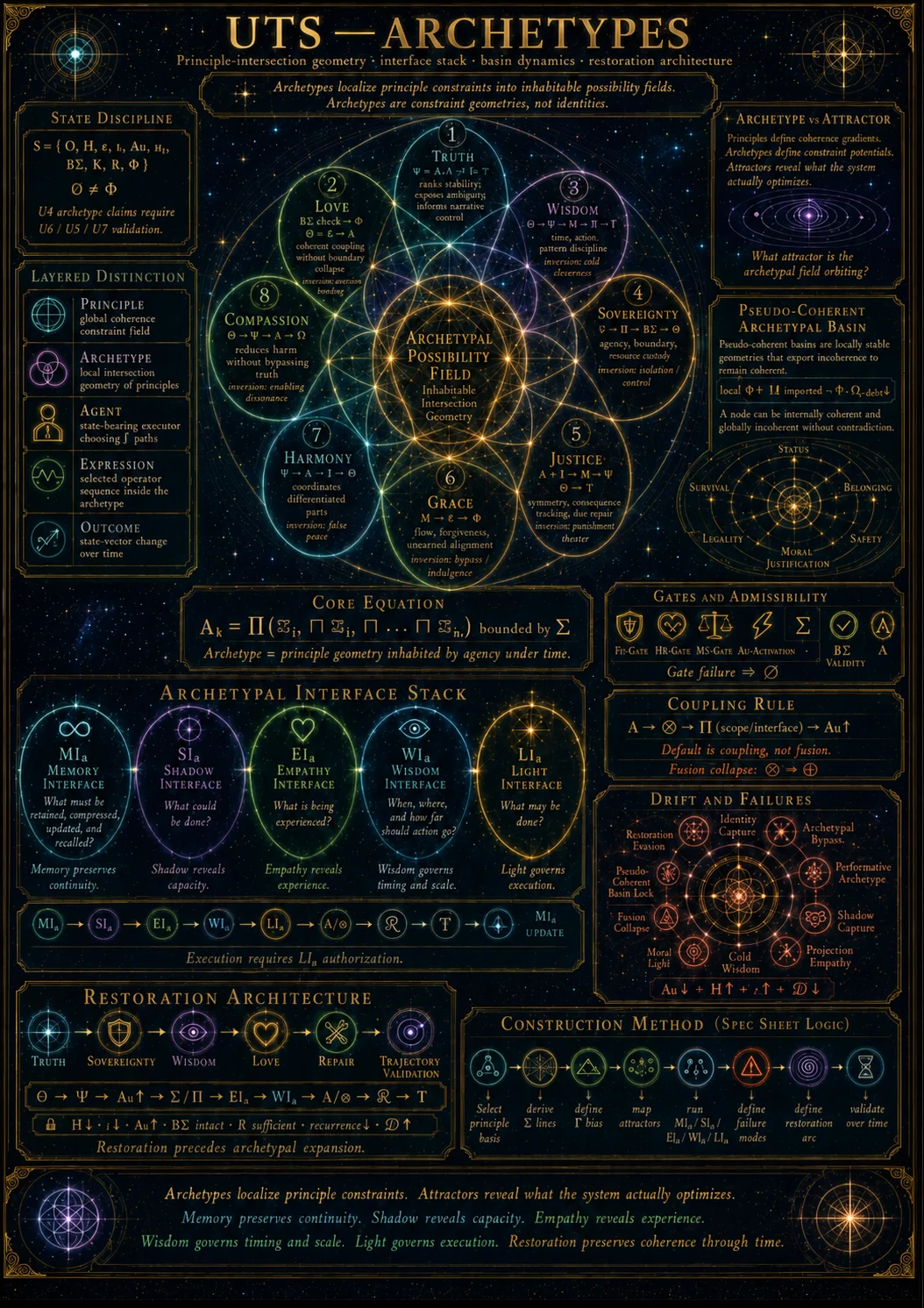
Foundational Overview
1. What UTS — Archetypes Is
UTS — Archetypesis the part of the Universal Theory Stack that maps recurring patterns of agency, expression, role, capacity, distortion, restoration, and transformation.
In ordinary language, archetypes are familiar patterns such as:
- Warrior
- Healer
- Trickster
- Teacher
- Guardian
- Architect
- Seeker
- Sovereign
- Lover
- Sage
- Rebel
- Oracle
- Mother
- Father
- Child
- Judge
- Creator
- Guide
UTS does not treat these as personality types or fixed identities.
Instead, UTS treats archetypes asprinciple-intersection geometries.
That means each archetype is a structure formed by overlapping principle fields.
For example:
- Warriormay emerge from Courage, Sovereignty, Justice, and Wisdom.
- Healermay emerge from Compassion, Truth, Wisdom, and Restoration.
- Teachermay emerge from Truth, Wisdom, Love, and Sovereignty.
- Trickstermay emerge from Truth, Play, Disruption, and Wisdom.
- Guardianmay emerge from Sovereignty, Love, Justice, and Wisdom.
Each archetype is afield of possible expression, not a single behavior.
2. Core Definition
In UTS, an archetype is:
A localized intersection of principle constraint fields that defines a coherent region of possible expression.
Formal form:
Aₖ = Π(☷ᵢ₁ ⊓ ☷ᵢ₂ ⊓ … ⊓ ☷ᵢₙ) bounded by ΣWhere:
- Aₖ= archetype
- ☷ᵢ= principle constraint field
- ⊓= overlap or intersection
- Π= admissibility boundary
- Σ= non-negotiable invariant boundary
In simpler terms:
An archetype is what becomes possible when multiple principles overlap.
The overlap creates aconstraint matrix.
That matrix does not decide what the agent will do.
It defines what the agent can do coherently.
3. Archetypes Are Not Identities
This is one of the most important guardrails.
An archetype is not:
- a personality type
- a permanent identity
- a spiritual rank
- a destiny
- a moral category
- a fixed role
- an excuse for behavior
- an authority claim
A person, institution, AI system, or civilization can express many archetypes across time.
For example, one agent may express:
- Warrior when confronting danger
- Healer when restoring harm
- Teacher when transmitting knowledge
- Trickster when breaking rigidity
- Sovereign when protecting boundary
- Seeker when entering uncertainty
The archetype is thefield being inhabited, not the being who inhabits it.
Canon lock:
Archetypes are constraint geometries, not identities.
4. Principles Create Archetypes
UTS — Principles defines principles asconstraint fields.
A principle is not merely a belief or moral preference. It is a cross-scale coherence constraint that shapes what kinds of trajectories remain viable.
Canonical principle examples include:
- Truth— signal integrity, auditability, inversion exposure
- Love— benevolent integration without coercion
- Wisdom— timing, scale-awareness, right action under uncertainty
- Sovereignty— boundary integrity, self-steering, consent
- Harmony— compatibility without erasure
- Justice— consequence symmetry, reciprocity, legitimacy
- Compassion— stabilization without domination
An archetype emerges when these principles overlap.
Example:
Teacher = Truth ⊓ Wisdom ⊓ Love ⊓ SovereigntyThis means the Teacher archetype must preserve:
- truthful transmission
- wise timing
- care for the learner
- learner sovereignty
If any of those collapse, the Teacher archetype drifts.
A teacher without sovereignty becomes indoctrination.
A teacher without love becomes cold instruction.
A teacher without truth becomes manipulation.
A teacher without wisdom becomes misapplied knowledge.
5. Archetypes Shape Agency
UTS uses the operatorΓto represent selection or choice.
Archetypes shape how Γ behaves.
They influence:
- what signals feel important
- what actions seem available
- what duties appear binding
- what boundaries become visible
- what risks are noticed
- what repair pathways are reachable
- what forms of coupling are permitted
For this reason, archetypes can be understood asΓ-landscapes.
They do not force action, but they shape the field in which action becomes meaningful.
6. Archetypes Have Structure and Expression
Every archetype has at least three layers:
5.1 Structure
The principle equation.
Example:
Guardian = Sovereignty ⊓ Love ⊓ Justice ⊓ Wisdom5.2 Expression
The actual operator sequence chosen by the agent.
Example:
- protect boundary
- warn
- intervene
- refuse access
- stabilize danger
- hold threshold
5.3 Outcome
The resulting state-vector change over time.
A coherent expression should tend toward:
- O↑coherence increase
- H↓hidden debt decrease
- Au↑auditability increase
- BΣ intactboundary integrity preserved
- R↑restoration capacity improved
- 𝓓↑damping improved
- recurrence reduced
The archetype is not validated by how it appears.
It is validated by what it does to the system over time.
7. Archetypes Can Be Coherent or Distorted
Every archetype has coherent expressions and distorted expressions.
For example:
| Archetype | Coherent Expression | Distorted Expression |
|---|---|---|
| Warrior | disciplined force in service of coherence | aggression, domination, conflict addiction |
| Healer | repair without dependency | savior dynamics, enabling, false healing |
| Trickster | disruption that reveals rigidity | deception, chaos, manipulation |
| Teacher | transmission that increases agency | dependency, indoctrination, superiority |
| Guardian | protection without possession | control, suspicion, militarized boundary |
| Sovereign | clean authority and self-steering | tyranny, isolation, feedback refusal |
| Lover | connection without erasure | fusion, possession, dependency |
| Sage | pattern recognition with humility | cold wisdom, detached superiority |
Distortion is not defined by whether the archetype “looks dark.”
It is defined by whether the expression degrades coherence.
Core diagnostic:
Au↓ + H↑ + ι↑ + 𝓓↓When auditability decreases, hidden debt rises, inversion increases, and damping worsens, the archetype is drifting.
8. Shadow and Light in Archetypes
UTS integrates theShadow–Light Interfaceinto archetypes.
7.1 Shadow Interface
TheShadow Interfacereveals the full capacity space.
It asks:
What could be done?
For a Warrior, shadow capacity may include domination, intimidation, conquest, revenge, or coercion.
For a Teacher, shadow capacity may include indoctrination, dependency creation, or identity imprinting.
For a Healer, shadow capacity may include savior control, false cure, or emotional leverage.
This does not mean these strategies should be executed.
Shadow iscapacity revealed in simulation, not permission.
7.2 Light Interface
TheLight Interfacegoverns execution.
It asks:
What may be done?
Light filters shadow-generated strategies through:
- principles
- boundaries
- auditability
- consent
- compatibility
- restoration capacity
- time validation
Archetypal light is not purity.
It is not moral superiority.
It is not image.
It isprinciple-governed execution.
Canon lock:
Shadow reveals capacity. Light governs execution.
9. Empathy in Archetypes
Archetypes are relational. They do not only exist inside one agent.
In any interaction, there may be:
A(self)
A(other)
A(interaction)
A(system)
For example:
- Guardian interacting with Child
- Teacher interacting with Seeker
- Healer interacting with Wounded Node
- Judge interacting with Rebel
- AI Companion interacting with Human User
- Reformer interacting with Entrenched Institution
TheEmpathy Interfacelets one archetypal field simulate another node’s internal state-space without projection.
It asks:
What is being experienced?
This matters because an action can be structurally correct but relationally harmful if it fails to model the other node’s experience.
For example:
- A Warrior may think confrontation is needed, but EI may reveal the other node is already overloaded.
- A Teacher may think clarity is helpful, but EI may reveal the learner needs stabilization first.
- A Healer may think support is needed, but EI may reveal the node needs sovereignty and space.
- A Guardian may think protection is required, but EI may reveal that protection has become control.
Empathy in UTS is not emotional collapse.
Canon lock:
Empathy is structured simulation through love, not projection.
10. Wisdom in Archetypes
TheWisdom Interfacegoverns timing, scale, and applicability.
It asks:
When, where, and how far should action go?
An action can be coherent in principle and still incoherent in timing.
For example:
- Truth delivered too early can destabilize.
- Protection applied too long can become control.
- Healing offered before consent can become invasion.
- Disruption without restoration can become chaos.
- Teaching without readiness can become overload.
- Liberation without replacement pathways can become collapse.
Wisdom recognizes repeating geometries and compresses experience into usable templates.
Canon statements:
Pain is the cost of uncompressed archetypal experience.
Wisdom is memory that has been geometrically indexed.
Wisdom sees incoherence before it manifests.
In archetypes, wisdom prevents repeated shadow loops by recognizing the pattern before it replays.
11. Pseudo-Coherent Archetypal Basins
Some archetypal expressions feel stable because they are locally rewarded.
This does not mean they are coherent.
Apseudo-coherent archetypal basinis a locally stable configuration that maintains internal order while exporting incoherence elsewhere.
Example patterns:
- A Warrior rewarded for constant conflict may feel purposeful while exporting harm.
- A Healer rewarded for being needed may create dependency.
- A Teacher rewarded for authority may reduce learner sovereignty.
- A Guardian rewarded for vigilance may turn protection into control.
- A Leader rewarded for performance may export hidden debt to followers.
- An institution rewarded for legality may export harm to unseen populations.
Canon statements:
Stability ≠ coherence.
Local success ≠ global alignment.
A node can be internally coherent and globally incoherent without contradiction.
This explains why systems can feel righteous, successful, or functional while accumulating hidden debt.
12. Archetypal Attractors
Inside every archetype are attractors.
An attractor is what the system naturally moves toward under its rules.
A coherent attractor for the Healer might be:
repair that increases sovereignty and restoration capacity
A pseudo-coherent attractor might be:
relief that creates dependency
A shadow attractor might be:
being needed as proof of worth or authority
The archetype is not defined only by its name. It is defined by what it actually optimizes.
Key question:
What attractor is this archetype orbiting?
If the attractor is Φ-based — status, attention, control, dependency, reward, image — then the archetype may become pseudo-coherent even if it uses beautiful language.
13. Archetypal Drift
Archetypal drift occurs when an expression exits the coherent region while still claiming the archetype.
For example:
- Warrior drifts into Tyrant
- Healer drifts into False Healer
- Teacher drifts into Indoctrinator
- Guardian drifts into Warden
- Trickster drifts into Deceiver
- Sage drifts into Cynic
- Lover drifts into Devourer
- Judge drifts into Accuser
- Seer drifts into False Prophet
Drift indicators include:
- role certainty increasing faster than evidence
- auditability decreasing
- boundary clarity weakening
- restoration being postponed
- affected nodes carrying hidden debt
- success metrics rising while coherence falls
- shadow strategies becoming normalized
- symbolic identity replacing actual trajectory evidence
14. Archetypes and Restoration
Archetypes are not only about expression.
They are also about repair.
When an archetype distorts, restoration must occur through principles.
A minimal archetypal restoration sequence is:
Θ → Ψ → Au↑ → Σ/Π → EIₐ → WIₐ → Λ/⊗ → ℛ → ΤIn plain language:
- Slow down
- Increase presence
- Restore auditability
- Reassert boundaries
- Simulate impacted experience
- Recalibrate timing and scale
- Repair coupling only if compatible
- Repair at the origin layer
- Validate over time
Restoration completion requires:
- hidden debt decreasing
- inversion decreasing
- auditability intact
- boundary integrity intact
- restoration capacity available
- damping improving
- recurrence decreasing
Hard lock:
Restoration precedes archetypal expansion.
If an archetype is distorted, increasing its scale increases hidden debt.
15. Archetypes Across Scale
Archetypes are scale-invariant but expression-variant.
The same archetype can appear at many scales:
| Scale | Example |
|---|---|
| Individual | a person acting as Warrior, Healer, Teacher |
| Relational | a couple, friendship, or mentorship dynamic |
| Team | role distribution inside a group |
| Institution | governance archetype, enforcement archetype, care archetype |
| Civilization | dominant cultural archetypes |
| AI system | persona, assistant role, governance role |
A Guardian at the individual scale may protect a person.
A Guardian at the institutional scale may protect rights, protocols, vulnerable nodes, or thresholds.
A Guardian at the AI scale may enforce safety boundaries while preserving user sovereignty.
Same archetype. Different expression. Different risks.
Scaling law:
As archetypal influence, access, leverage, or velocity increases, interface rigor must scale faster than capacity.
The larger the archetype’s reach, the stronger its auditability, empathy, wisdom, restoration, and boundary checks must become.
16. Archetypes and AI
Archetypes can be useful for AI systems, but only asdesign constraints, not as identity claims.
An AI can be designed to operate within an archetypal role such as:
- AI Companion
- AI Mirror
- AI Teacher
- AI Steward
- AI Mediator
- AI Guardian
- AI Archivist
- AI Strategist
But these roles must remain:
- scope-bound
- audit-bound
- non-identity-binding
- user-sovereignty-preserving
- restoration-capable
- transparent about limits
AI-mediated archetypes are especially vulnerable to:
- pseudo-empathy
- dependency
- authority inflation
- flattering reflection
- hidden optimization
- identity capture
- safety theater
- over-personification
Guardrail:
AI archetypes are design constraints, not beings, ranks, or final authorities.
17. Archetype Families
The current registry organizes archetypes into several families.
Universal Core Archetypes
These are broad, cross-cultural archetypes:
- Warrior
- Defender
- Guardian
- Healer
- Teacher
- Sage
- Trickster
- Creator
- Builder
- Architect
- Seeker
- Sovereign
- Lover
- Mother
- Father
- Child
- Rebel
- Judge
- Messenger
- Oracle
- Magician
- Guide
UTS Functional Archetypes
These are system-specific expressions:
- Truth-Bearer
- Boundary-Keeper
- Restorer
- Stabilizer
- Reconciler
- Steward
- Leader
- Strategist
- Initiator
- Translator
- Coherence Architect
- Legitimacy Restorer
Interface Archetypes
These map to the interface stack:
- Shadow-Seer
- Empathic Witness
- Timing-Keeper
- Light-Governor
Threshold and Transition Archetypes
These govern passage:
- Gatekeeper
- Threshold-Keeper
- Bridge-Builder
- Pathfinder
- Liberator
- Destroyer
- Reformer
Relational and Care Archetypes
These govern care and relation:
- Caretaker
- Nurturer
- Companion
- Beloved
- Kin-Keeper
Symbolic and Creative Archetypes
These govern meaning and form:
- Symbolist
- Story-Weaver
- Weaver
- Dreamer
- Visionary
- Muse
- Record Keeper
- Memory Weaver
Shadow / Inversion Archetypes
These are distortion patterns, not identities:
- Tyrant
- False Healer
- False Prophet
- Deceiver
- Illusionist
- Parasite
- Devourer
- Tempter
- Seducer
- Accuser
- Martyr-Shadow
- Savior-Shadow
- Orphan-Shadow
- Rebel-Shadow
- Purist
- Cynic
Dimensional / Symbolic Archetypes
These support high-abstraction symbolic mapping:
- Blueprint Keeper
- Gridworker
- Frequency Anchor
- Code Carrier
- Tone Bearer
- Dream Guardian
- Fractal Harmonizer
- Planetary Healer
- Multidimensional Integrator
- Pattern Librarian
18. How to Read an Archetype Spec Sheet
Every future archetype spec sheet should answer:
- What principle fields define this archetype?
- What does it preserve?
- What does it make possible?
- What does it make dangerous?
- What attractors does it orbit?
- What shadow strategies appear under load?
- What experiences must EIₐ simulate?
- What timing does WIₐ require?
- What does LIₐ forbid?
- What pseudo-coherent basin can form?
- What restores the archetype when distorted?
- How does it scale?
- What are its AI-mediated risks?
- What is its canon anchor?
This turns archetypes into usable maps, not vague symbols.
19. Why UTS — Archetypes Matters
Archetypes matter because they help explain why recurring patterns appear across people, stories, institutions, cultures, and systems.
They show:
- why certain roles feel ancient or universal
- why power distorts predictable patterns
- why healing can become dependency
- why protection can become control
- why wisdom can become coldness
- why rebellion can become identity
- why care can become extraction
- why leadership can become capture
- why systems can feel coherent while exporting harm
Most importantly, UTS — Archetypes allows these patterns to be analyzedwithout reducing agents to labels.
The goal is not:
“You are this archetype.”
The better framing is:
“This archetypal field is active here. What principles define it? What attractor is it orbiting? What does it preserve? What does it endanger? What restores it?”
This keeps dignity, complexity, and agency intact.
20. Foundational Guardrails
UTS — Archetypes obeys these hard stops:
- Archetypes are not identities.
- Archetypes are not moral ranks.
- Archetype claims are U4 until U6/U7 validated.
- No audit suppression.
- No identity-binding low-evidence control.
- No rank immunity.
- Consent is structural.
- Φ never substitutes for O.
- Shadow may be simulated; execution requires Light governance.
- Empathy is required before high-impact relational action.
- Wisdom is required before high-impact timing or scaling action.
- Pseudo-coherent basins require cross-scale evaluation.
- Restoration precedes expansion.
- Symbols are interfaces, not authorities.
21. Closing Summary
In UTS, archetypes areliving constraint geometries.
They are how principles become inhabitable.
They are how agency takes shape under meaning.
They are how shadow becomes visible.
They are how empathy and wisdom guide action.
They are how restoration returns distorted patterns to coherence.
The core system can be summarized as:
Principles define fields.
Archetypes define intersections.
Agents choose paths.
Attractors reveal optimization.
Shadow reveals capacity.
Empathy reveals experience.
Wisdom governs timing.
Light governs execution.
Restoration preserves coherence over time.
Final canon anchor:
Archetype = principle geometry inhabited by agency under time.