0. Purpose
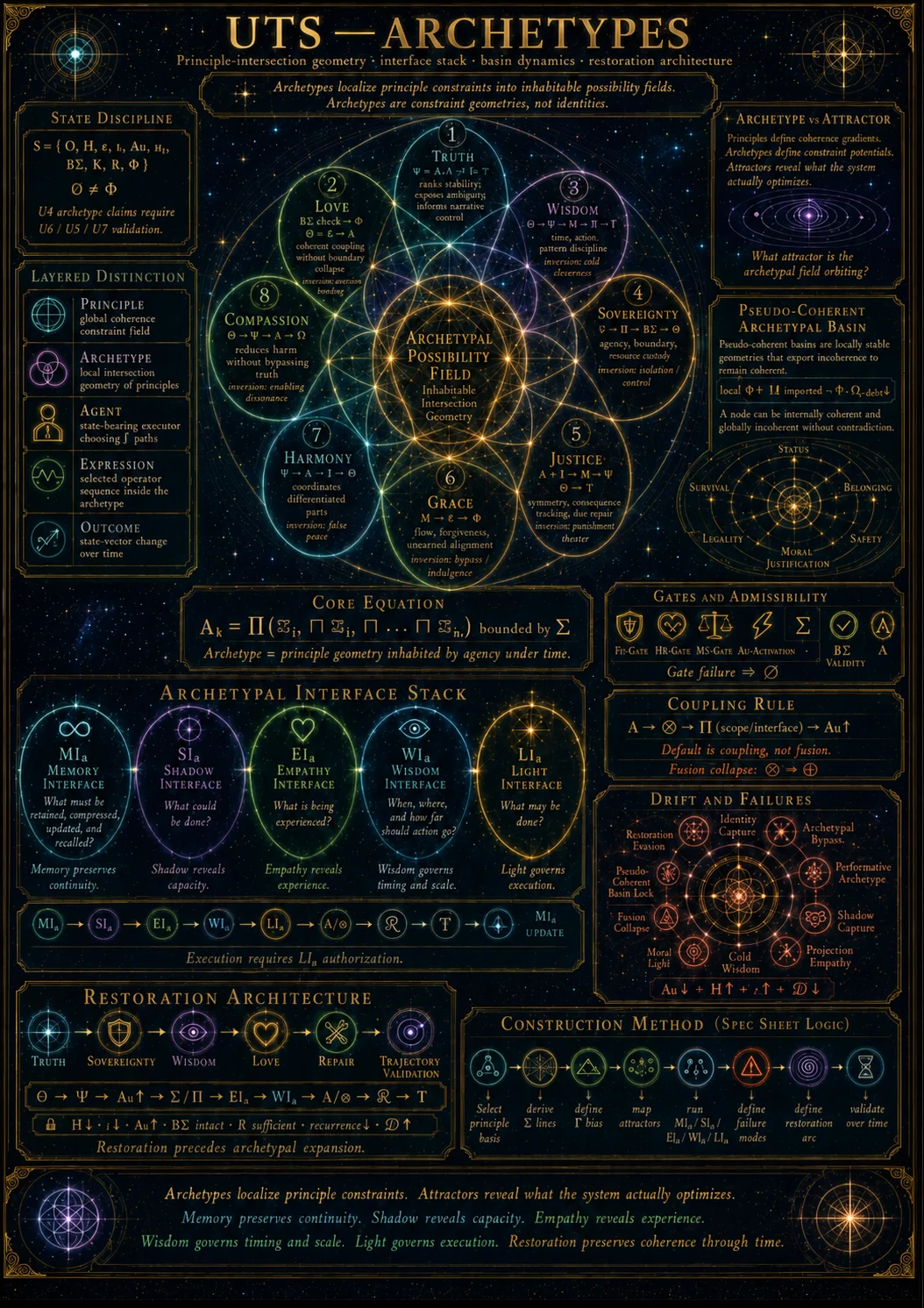
UTS — Archetypesformalizes archetypes aslocalized intersections of principle constraint fieldsthat shape admissible expression, relational simulation, timing, capacity revelation, and coherent execution.
An archetype is not:
- a personality type
- an identity label
- a moral status
- a destiny
- a mythic rank
- an excuse for behavior
- an authority claim
- an audit-exempt category
An archetype is aconstraint geometry.
It defines:
- what kinds of trajectories remain coherent
- what operator sequences are admissible
- where shadow strategies emerge
- how meaning enters action
- how agents interact across archetypal fields
- how restoration must occur when drift appears
- how pseudo-coherent basins trap agents inside locally stable but globally incoherent patterns
In compressed form:
Archetypes localize principle constraints into inhabitable possibility fields.
1. Canon Binding
1.1 Operator Safety
UTS — Archetypes uses only the canonical UTS Operator Registry v1.7.
No new operators are added.
Canonical operators remain:
Core State-Moving Operators
| Operator | Meaning |
|---|---|
⊕ | Compose |
⊗ | Couple |
Π | Constrain |
Γ | Select |
Δ | Distort / Probe |
ℛ | Restore |
Ξ | Invert / expose pseudo-coherence |
Meaning and Trajectory Operators
| Operator | Meaning |
|---|---|
Μ | Sensemaking |
Τ | Trajectory |
Θ | Humility |
Λ | Compatibility |
Σ | Sacred Boundary |
Ψ | Presence |
Archetypes are not operators.
They areconstraint configurationsthat bias how operators may be used.
1.2 Canon State Vector
All archetype analysis acts through the shared UTS state vector:
S(t) = { O, H, ε, ι, Au, µᵢ, BΣ, K, R, Φ }Where:
| Variable | Meaning |
|---|---|
O | Coherence |
H | Hidden debt |
ε | Observable error / noise |
ι | Inversion index |
Au | Auditability |
µᵢ | Agent / meaning integrity |
BΣ | Boundary integrity |
K | Compatibility |
R | Restoration capacity |
Φ | Fitness proxy / success signal |
Key lock:
O ≠ Φ.Archetypal success signals can rise while coherence decays.
1.3 U-Layers
Archetypal effects may manifest across:
| Layer | Meaning |
|---|---|
U0 | Substrate |
U1 | Budgets / power |
U2 | Configuration / boundaries |
U3 | Execution |
U4 | Classification / narratives |
U5 | Coordination / timing |
U6 | Coherence field |
U7 | Memory / recurrence |
U8 | Environment / forcing |
Hard rule:
U4 archetype claims are not truth unless validated at U6 across U5 delay and U7 recurrence under stress.
This means:
- “I am this archetype” is U4.
- “This institution embodies this archetype” is U4.
- “This AI agent is aligned to this archetype” is U4.
All require U6/U7 validation.
2. Core Definition
2.1 Archetype Equation
An archetype is defined as:
Aₖ = Π ( ☷ᵢ₁ ⊓ ☷ᵢ₂ ⊓ … ⊓ ☷ᵢₙ ) bounded by ΣWhere:
| Symbol | Meaning |
|---|---|
Aₖ | Archetype |
☷ᵢ | Principle constraint field |
⊓ | Intersection / overlap |
Π | Admissibility boundary |
Σ | Non-negotiable invariant boundary |
An archetype is therefore alocalized principle-intersection geometry.
It is not the sum of principles.
It is theoverlap regionwhere multiple principles must be satisfied simultaneously.
2.2 Principle vs Archetype vs Agent
| Layer | Function |
|---|---|
| Principle | Global coherence constraint field |
| Archetype | Local intersection geometry of principles |
| Agent | State-bearing executor choosing Γ paths |
| Expression | Selected operator sequence inside the archetype |
| Outcome | State-vector change over time |
This distinction prevents archetypes from becoming identity cages.
Two agents may inhabit the same archetype and express it differently.
One agent may move through multiple archetypes over time.
A system may claim one archetype while optimizing another attractor.
2.3 What Archetypes Are Not
Archetypes are not:
- personality types
- fixed identities
- spiritual ranks
- moral labels
- destiny structures
- excuses for behavior
- authority claims
- audit-exempt categories
They areadmissibility geometries.
3. Archetypes as Principle Intersections
3.1 Principles as Constraint Fields
In UTS — Principles, principles are☷ᵢ constraint fields.
Examples from the current principle basis:
| Principle | Field Function |
|---|---|
| Truth | Signal integrity, auditability, inversion exposure |
| Love | Benevolent integration without coercion |
| Wisdom | Right action under complexity, timing, and uncertainty |
| Sovereignty | Rightful boundaries and self-steering |
| Harmony | Multi-rhythm compatibility without erasure |
| Justice | Reciprocity equilibrium and consequence symmetry |
| Compassion | Stabilization without domination |
Archetypes emerge when these fields overlap.
For example, an archetype may be shaped by:
Truth ⊓ Sovereignty ⊓ Wisdomor:
Love ⊓ Justice ⊓ Compassionor:
Truth ⊓ Love ⊓ Wisdom ⊓ SovereigntyThe exact archetype is determined by theintersection geometry, not by a poetic label.
3.2 Principle Imbalance Inside Archetypes
An archetype inherits the imbalance risks of its constituent principles.
| Principle Imbalance | Archetypal Distortion |
|---|---|
| Truth↓ | Secrecy, audit collapse, false clarity |
| Love↓ | Extractive coupling, carelessness, relational coldness |
| Wisdom↓ | Premature action, wrong timing, recurrence |
| Sovereignty↓ | Boundary erosion, identity capture |
| Harmony✕ | Forced peace, suppressed conflict |
| Justice✕ | Punishment theater, legitimacy laundering |
| Compassion✕ | Enabling distortion, rescuing without repair |
Important:
Archetypal shadow is not a separate metaphysical substance. It is the distortion surface created by principle imbalance under load.
3.3 Archetypal Integrity
Archetypal integrityis the agent’s ability to satisfy the full principle intersection:
- across time
- under cost
- without suppressing auditability
- without violating boundaries
- without using one principle to bypass another
- while preserving restoration capacity
In notation:
µᵢₐ = time-consistent integrity across all ☷ᵢ in AₖArchetypal drift begins when the agent selectively obeys one principle while using it to violate another.
Examples:
- Truth used without Love becomes domination or exposure-as-control.
- Love used without Truth becomes enabling or bypass.
- Sovereignty used without Wisdom becomes isolation or rigidity.
- Harmony used without Justice becomes suppression.
- Compassion used without Sovereignty becomes self-erasure or extraction.
4. Archetypes as Meaning-Bearing Control Surfaces
4.1 Consciousness Binding
From UTS — Consciousness · Meaning · Spirituality:
Consciousness = coherence-selection agency.
Operationally, consciousness enters throughΓ, the selection operator.
Archetypes shapeΓby defining:
- what signals appear relevant
- what actions appear possible
- what constraints are felt as binding
- what coupling is allowed
- what restoration pathways are visible
Thus:
Archetypes are Γ-landscapes.
They do not force choice.
They shape the possibility field in which choice occurs.
4.2 Meaning Binding
Meaning functions as a directionality field that biases relevance.
Archetypes aremeaning-bearingbecause they organize:
- role
- duty
- timing
- relationship
- boundary
- consequence
- purpose
- restoration
But meaning must remain audit-bound.
Hard lock:
Any archetype framework that produces meaning while degrading `µᵢ`, `Au`, `BΣ`, `R`, or `𝓓` is Ξ-class inversion.
5. Sacred Boundaries Inside Archetypes
5.1 Σ Derivation Rule
An archetype’sΣboundaries are derived from the principles that compose it.
Σ(Aₖ) = Σ(☷ᵢ₁) ∪ Σ(☷ᵢ₂) ∪ … ∪ Σ(☷ᵢₙ)Examples:
- Truth contributes auditability boundaries.
- Sovereignty contributes consent and exit boundaries.
- Love contributes non-coercive coupling boundaries.
- Wisdom contributes timing and uncertainty boundaries.
- Justice contributes symmetry and accountability boundaries.
- Harmony contributes non-erasure boundaries.
- Compassion contributes non-domination boundaries.
If anyΣboundary is violated, hidden debt is injected regardless of apparent success.
5.2 Archetypal Contract Validity
If an archetype is used to define a role, duty, obligation, initiation, governance position, AI persona, or institutional function, it must pass contract validity:
Au ≥ X_cBΣintactΛ > 0R > 0µᵢstableΦsubordinate toO- exit and repair remain available
Failure means the archetypal role contract is invalid or unsafe.
6. Attractors, Basins, and Archetypal Geometry
6.1 Archetype vs Attractor
An archetype is not itself an attractor.
Instead:
- Principlesdefine coherence gradients.
- Archetypesdefine constraint geometries.
- Attractorsdefine what the system actually optimizes.
Inside one archetype, multiple attractors may exist:
- restoration
- domination
- status
- protection
- purity
- control
- service
- avoidance
- harmony
- truth exposure
- identity preservation
This is why archetypal labels are insufficient.
The question is not merely:
“What archetype is present?”
The deeper question is:
“What attractor is the archetypal field orbiting?”
6.2 Pseudo-Coherent Archetypal Basins
Apseudo-coherent archetypal basinis a locally stable configuration inside an archetype that maintains internal order while exporting incoherence elsewhere.
Definition:
Pseudo-coherent archetypal basins are locally stable geometries that export incoherence to remain ordered.
Properties:
- internal behavior feels consistent
- local feedback appears positive
- identity narratives are reinforced
- metrics reward continued participation
- exported harm remains invisible or delayed
- hidden debt accumulates
- global coherence decreases
This explains why an agent, group, institution, or AI system may sincerely appear coherent while generating harm elsewhere.
6.3 Semi-Coherent Nodes
Asemi-coherent nodeis a node that is locally stable within a pseudo-coherent basin but globally incoherent across wider system evaluation.
Core statement:
A node can be internally coherent and globally incoherent without contradiction.
This is not a moral failure.
It is a scale-visibility failure.
Without cross-scale U6 evaluation, local coherence and true coherence may be indistinguishable.
6.4 Nested Sub-Basins
Pseudo-coherent basins contain stabilizing sub-attractors:
- career success
- moral justification
- legality compliance
- identity narratives
- relative innocence
- belonging
- safety
- material survival
- social approval
These sub-attractors stabilize the basin and make exit difficult.
Escape difficulty scales with:
- number of nested sub-basins
- material risk
- social loss
- identity cost
- uncertainty exposure
- lack of viable higher-coherence alternative
Canon statement:
Escape difficulty scales with the number of nested sub-attractors stabilizing identity and reward.
6.5 Paradox and Dimensionality
Pseudo-coherent basins manage paradox by flattening it:
- choose one side
- suppress the other
- oscillate without integration
- externalize the cost
True coherence does something different:
True coherence does not eliminate paradox; it increases dimensionality until paradox dissolves.
In archetypal terms, this means mature archetypes do not merely “balance opposites.”
They reorganize the geometry so the apparent contradiction can be held without hidden debt export.
7. The Archetypal Interface Stack
Every archetype hosts four interfaces:
| Interface | Function | Question |
|---|---|---|
SIₐ | Shadow Interface | What could be done? |
EIₐ | Empathy Interface | What is being experienced? |
WIₐ | Wisdom Interface | When, where, and how far should action go? |
LIₐ | Light Interface | What may be done? |
Together:
Shadow reveals capacity. Empathy reveals experience. Wisdom governs timing and scale. Light governs execution.
All four are required for coherent archetypal agency.
8. Shadow Interface Inside Archetypes
8.1 Archetypal Shadow Interface
SIₐis the simulated strategy space revealed when constraints are relaxed in simulation only.
It reveals:
- coercive strategies
- extractive strategies
- defensive strategies
- avoidant strategies
- manipulative strategies
- domination strategies
- self-sacrificial strategies
- bypass strategies
- pseudo-coherent strategies
SIₐisnon-executiveby default.
It answers:
What could be done inside this archetypal geometry?
8.2 Archetypal Shadow
Archetypal shadow is not an identity trait.
Definition:
Archetypal shadow = `SIₐ`-revealed strategies that are attractive under load but fail `CCSₐ`.
These strategies often:
- feel necessary
- feel realistic
- preserve status
- reduce immediate discomfort
- protect identity
- pass local metrics
- fail cross-scale coherence
Shadow may be explored, simulated, and archived.
Execution requiresLIₐauthorization.
8.3 Shadow Failure Modes
Core shadow failures:
- Shadow capture—
SIₐbecomes executive - Shadow denial— “this archetype has no shadow”
- Shadow projection— shadow assigned to others or other archetypes
- Shadow romanticization— capacity mistaken for legitimacy
- Shadow repression— strategy space hidden, producing blind spots
Shadow awareness increases responsibility, not guilt.
9. Empathy Interface Inside Archetypes
9.1 Archetypal Empathy Interface
EIₐsimulates the internal state-space of another node within or across archetypal geometry.
It answers:
What is being experienced here?
EIₐis:
- simulation-based
- truth-constrained
- love-coupled
- sovereignty-bounded
- non-extractive
- restoration-oriented
EIₐenables understanding without consumption and connection without collapse.
9.2 Archetype of Self, Other, and Interaction
EIₐis especially important because archetypes appear relationally.
A coherent analysis may require:
A(self)
A(other)
A(interaction)
A(system)
The archetype of self is not enough.
The archetype of other is not enough.
The interaction may generate a third field.
Examples:
- Guardian interacting with Wounded Node
- Teacher interacting with Sovereign Learner
- Reformer interacting with Entrenched Institution
- AI Assistant interacting with Human Meaning-System
- Restorer interacting with Pseudo-Coherent Basin
Each interaction creates its own coupling geometry.
9.3 Projection vs Empathy
Hard lock:
Projection assumes sameness. Empathy models difference.
Projection occurs when the self-archetype is imposed onto the other.
EIₐrequires modeling:
- different boundary conditions
- different histories
- different attractors
- different basin depths
- different costs of action
- different restoration capacity
- different timing windows
This prevents technically correct but relationally incoherent action.
9.4 EIₐ Failure Modes
Archetype-specific empathy failures include:
- Projection empathy— self = other assumption
- Over-identification— boundary collapse
- Performative empathy— appearance of care without care
- Detached simulation— understanding without love
- Coercive empathy— “I understand you, therefore I know what you should do”
- Extraction through empathy— using access to inner state as leverage
Signature:
emotional intensity ↑
Au not increasing
BΣ weakening
R not provisioned
10. Wisdom Interface Inside Archetypes
10.1 Archetypal Wisdom Interface
WIₐrecognizes repeating geometries, compresses experience into usable templates, and determines timing and scale.
It answers:
Given this archetype and this moment, what action preserves coherence across time and scale?
WIₐis:
- predictive
- timing-sensitive
- scale-aware
- non-force-based
- heuristic-driven
- context-adaptive
10.2 Pain and Archetypal Learning
Inside archetypes:
Pain is the cost of uncompressed archetypal experience.
Repeated pain means the geometry is recurring but has not yet been indexed into a reusable template.
Wisdom converts:
experience → pattern → heuristic → decision templateMemory stores what happened.
Wisdom recognizes the geometry and knows what applies now.
Canon statement:
Wisdom is memory that has been geometrically indexed and contextually adaptable.
10.3 Prediction and Misalignment
WIₐdoes not predict fixed events.
It predicts likely coherence and incoherence trajectories.
It asks:
- where will hidden debt enter?
- what scale will the cost appear at?
- what layer is the origin?
- what timing window is open?
- what action is premature?
- what action is overdue?
- where will force create rebound?
Canon statement:
Wisdom sees incoherence before it manifests.
10.4 Wisdom and Empathy Coupling
WIₐmust couple withEIₐ.
Without empathy, wisdom becomes cold heuristics.
Without wisdom, empathy becomes flooding or mis-timed care.
Lock:
Wisdom without empathy increases incoherence.
Together:
EIₐshows what is experienced.WIₐshows when and how to respond.LIₐdetermines whether action is permissible.
10.5 WIₐ Failure Modes
Archetypal wisdom failures include:
- Unrefined wisdom— heuristics without lived integration
- Cold wisdom— prediction without empathy
- Stalled wisdom— fear of error blocks action
- Over-compressed wisdom— one template applied everywhere
- Premature wisdom— right pattern, wrong time
- Scale-blind wisdom— local solution, global debt
Signature:
certainty ↑
adaptability ↓
𝓓 worsens
recurrence continues
11. Light Interface Inside Archetypes
11.1 Archetypal Light Interface
LIₐis the principle-governed execution filter.
It answers:
What may be done?
LIₐevaluatesSIₐ,EIₐ, andWIₐoutputs through:
- principles
Σboundaries- gates
- restoration requirements
- time validation
- compatibility checks
LIₐis executive.
It authorizes or forbids action.
11.2 Archetypal Light
Archetypal light is not virtue, purity, or moral superiority.
Definition:
Archetypal light = `LIₐ`’s ability to authorize actions that preserve the archetype’s principle overlap under time validation.
Light without shadow becomes naïve.
Light without empathy becomes brittle.
Light without wisdom becomes mis-timed.
Light without restoration becomes performance.
11.3 CCSₐ: Archetype-Specific Constraint Set
Every archetype has a constraint set:
CCSₐ =
  CCS(TLWS-E)
+ inherited Σ lines
+ archetype-specific Π scope
Any singleCCSₐfailure means the strategy is inoperable.
Valid outcome:
∅Non-action is allowed when no coherent action is available.
12. Archetypal Strategy Resolution Pipeline
The standard archetypal action sequence is:
- Identify archetypal geometry
*A(self)
*A(other)
*A(interaction)
* basin context
- Render `SIₐ`
* full capacity space
* including shadow strategies
- Run `EIₐ`
* simulate impacted nodes’ state-spaces
* avoid projection
- Run `WIₐ`
* timing
* scale
* recurrence
* likely misalignment
- Apply `LIₐ`
*CCSₐfiltering
* gate checks
* admissibility decision
- Constrain coupling
*Λ → ⊗
*Πscope
*BΣpreservation
- Provision restoration
*ℛbudget
* rollback
* repair pathway
- Validate over time
*Τ
* U6 outcomes
* U7 recurrence
Compressed:
SIₐ → EIₐ → WIₐ → LIₐ → Λ/⊗ → ℛ → Τ13. Gates and Admissibility
Archetypes never bypass gates.
Required gates:
- FI-Gate— prevents
Φsubstitution - HR-Gate— prevents identity-bound certainty
- MS-Gate— no rank immunity
- Au-Actuation— minimum traceability
- Σ / ☷ᵢ— principle boundaries
- BΣ validity— consent, exit, identity clarity
- Λ— compatibility before coupling
Gate failure means:
∅No action is authorized.
14. Archetypal Coupling
14.1 Default Coupling Rule
Archetypes interact through⊗coupling, not⊕composition.
Default:
Λ → ⊗ → Π(scope/interface) → Au↑This preserves identity while allowing relation.
14.2 Fusion Collapse
Fusion collapse occurs when coupling becomes composition without validation:
⊗ → ⊕This is high-risk and may produce:
- identity loss
- role absorption
- dependency
- charismatic capture
- cultic dynamics
- AI / persona over-identification
- institutional mission drift
⊕requires extraordinary validation:
Δtesting- FI
Au- damping
- time validation
- restoration capacity
15. Archetype Drift
15.1 Drift Definition
Archetype drift occurs when expression exits the admissible region while still claiming the archetype.
Signals:
- narrative certainty increases
- auditability decreases
- restoration capacity decreases
- boundary integrity decreases
- hidden debt increases
- inversion index increases
- damping decreases
The label remains.
The geometry has changed.
15.2 Drift Types
Common drift types:
- Principle imbalance drift
One principle overrides another.
- Attractor drift
Archetype begins optimizing status, control, safety, orΦ.
- Shadow capture
SIₐstrategy becomes executive.
- Empathy collapse
Others become abstractions.
- Wisdom rigidity
Heuristic becomes dogma.
- Light performance
Principle language becomes reputation management.
- Basin entrapment
Local coherence hides global incoherence.
16. Failure Mode Registry
16.1 Core Archetype Failure Families
| Failure Mode | Description |
|---|---|
| Identity capture | Archetype becomes fixed self-definition |
| Archetypal bypass | Archetype language avoids repair |
| Performative archetype | Φmasquerades asO |
| Sacred immunity | Archetype used to avoid audit |
| Shadow capture | Simulated strategy becomes executive |
| Shadow denial | Capacity space hidden |
| Projection empathy | Self-archetype imposed on other |
| Cold wisdom | Prediction without care |
| Moral light | Principles without simulation |
| Fusion collapse | Coupling becomes merger |
| Pseudo-coherent basin lock | Local stability exports incoherence |
| Restoration evasion | Exploration continues before repair |
General signature:
Au↓ + H↑ + ι↑ + 𝓓↓Visible errors may arrive late.
17. Restoration Architecture
17.1 Restoration Rule
Archetypal restoration isprinciple-sequenced, not personality-sequenced.
Core order:
1. Truth
Restore:
Au- inversion exposure
- hidden debt visibility
2. Sovereignty
Restore:
- boundaries
- consent
- exits
Π
3. Wisdom
Restore:
- timing
- reduced force
- updated heuristics
4. Love
Restore:
- non-coercive coupling
- viable
Λ
5. Restoration
Restore:
- origin-layer repair
Rprovisioning
6. Trajectory Validation
Verify:
- U5 timing
- U6 coherence
- U7 recurrence
17.2 Restoration Formula
A minimal restoration path:
Θ → Ψ → Au↑ → Σ/Π → EIₐ → WIₐ → Λ/⊗ → ℛ → ΤRestoration completion requires:
HdecreasingιdecreasingAumaintainedBΣintactRsufficient- recurrence decreasing
𝓓improving
17.3 Restoration Precedes Expansion
Hard lock:
Restoration precedes archetypal expansion.
If an archetype is in drift, shadow capture, or pseudo-coherent basin lock, expansion increases hidden debt.
18. Scaling Law
18.1 Archetypal Scaling
As archetypal influence increases, interface rigor must scale faster than capacity.
Scaling factors include:
- audience size
- institutional power
- AI autonomy
- social trust
- symbolic authority
- resource control
- relational dependency
- decision velocity
- gain stack amplification
Scaling law:
As archetypal influence, access, leverage, or velocity increases, `SIₐ`, `EIₐ`, `WIₐ`, and `LIₐ` rigor must scale faster than capacity.
Otherwise:
- shadow accelerates
- empathy becomes extraction
- wisdom becomes control
- light becomes performance
- basin lock deepens
18.2 High-Impact Archetypes
High-impact archetypes require stricter validation:
- Guardian
- Teacher
- Healer
- Judge
- Leader
- Architect
- Strategist
- Restorer
- Oracle / Seer
- AI Companion
- Institutional Steward
These archetypes have higher capacity to affect others’Γpaths and therefore require stronger:
AuBΣ- FI
- HR
- MS
EIₐWIₐℛprovisioning
19. AI-Mediated Archetypes
19.1 AI Archetypes as Design Constraints
In AI systems, archetypes can be used aspersona constraints, but never as authority claims.
An AI archetype must specify:
- principle basis
- admissible operator macros
- forbidden shadow strategies
- EI limits
- WI timing constraints
- LI execution boundaries
- restoration and rollback behavior
- audit logs
- escalation thresholds
19.2 AI Failure Risks
AI-mediated archetypes risk:
- over-personification
- role authority inflation
- user identity capture
- pseudo-empathy
- optimization masquerading as wisdom
- compliance masquerading as love
- safety theater masquerading as light
- hidden
Φoptimization
Hard lock:
AI archetypes must remain audit-bound, scope-bound, and restoration-capable.
20. Archetype Construction Method
To define an archetype canonically:
Step 1 — Select Principle Basis
Identify the overlapping principles:
Aₖ = ☷a ⊓ ☷b ⊓ ☷c ...Step 2 — Derive Σ Lines
List inherited non-negotiable invariants.
Step 3 — Define Γ Bias
Specify what choices the archetype makes more legible or likely.
Step 4 — Define Operator Macros
List admissible operator sequences.
Step 5 — Map Attractors
Identify possible attractors inside the archetype:
- coherent attractors
- pseudo-coherent attractors
- shadow attractors
- defensive sub-attractors
Step 6 — Run Interface Stack
Define:
SIₐcapacity spaceEIₐrelational simulation requirementsWIₐtiming and scale constraintsLIₐadmissibility filters
Step 7 — Define Failure Modes
Map likely drift, shadow, basin, empathy, wisdom, and light failures.
Step 8 — Define Restoration Arc
Specify how the archetype restores coherence.
Step 9 — Define Scaling Risks
Identify what changes when influence, access, or velocity increases.
Step 10 — Validate Over Time
Require U6/U7 evidence.
21. Archetype Spec Sheet Template
A canonical archetype sheet should include:
1. Archetype Name
2. Core Equation
   Aₖ = Π(☷ᵢ₁ ⊓ ☷ᵢ₂ ⊓ ...)
3. Principle Basis
4. Σ Boundaries
5. Γ Bias
6. Primary Coherent Attractors
7. Pseudo-Coherent Attractors
8. SIₐ: Capacity Space
9. EIₐ: Relational Simulation Requirements
10. WIₐ: Timing / Scale Heuristics
11. LIₐ: Execution Constraints
12. Compatible Couplings (Λ+)
13. Incompatible Couplings (Λ−)
14. Drift Signatures
15. Basin Entrapment Risks
16. Shadow Strategies
17. Restoration Arc
18. Scaling Risks
19. U6/U7 Validation Tests
20. Canon Anchor Phrase
22. Translation Layer
Archetypes may be translated into:
- mythic language
- symbolic cards
- teaching metaphors
- institutional role maps
- AI personas
- narrative patterns
- artistic systems
- ritual or initiatory forms
But translation never overrides canon.
Hard guardrail:
Symbols are interfaces, not authorities.
No archetype card, myth, vision, title, role, or symbolic pattern may bypass:
Au- FI
- HR
- MS
BΣΛΣ- U6/U7 validation
23. Relationship to Other UTS Modules
Principles
Archetypes localize principle constraint fields. Principles define the global coherence gradients; Archetypes define inhabitable intersections.
Consciousness · Meaning · Spirituality
Archetypes organize meaning, symbolic compression, role, identity-interface behavior, and coherence-selection agency.
Interactions · Signals · Couplings
Archetypes interact through coupling, compatibility, boundary preservation, and interface-mediated relational fields.
Coherence
Archetypes must preserve coherence across time. Archetypal claims are invalid if they increaseH,ι, orΦwhile loweringO.
Scaling
Archetypes become higher-risk as influence, symbolic authority, velocity, and audience size increase. Interface rigor must scale faster than capacity.
Restoration
Archetypal restoration repairs drift through truth, sovereignty, wisdom, love, origin-layer repair, and trajectory validation.
Security
Archetypes are vulnerable to identity capture, role authority inflation, sacred immunity, charisma capture, shadow capture, and audit suppression.
Justice · Governance · Legitimacy
High-impact archetypes such as Judge, Guardian, Teacher, Leader, Steward, and Restorer require legitimacy, auditability, no rank immunity, and restoration capacity.
Artificial Intelligence
AI-mediated archetypes can guide persona constraints and agent design, but must remain audit-bound, scope-bound, and restoration-capable.
AI Governance
AI archetypes used in cognitive infrastructure require transparency, role boundaries, audit logs, escalation paths, and public legitimacy safeguards.
24. Canon Statements
The following statements are stable and reusable:
- Archetypes localize principle constraints into inhabitable possibility fields.
- Archetypes are constraint geometries, not identities.
- Principles define global coherence gradients; archetypes define local intersection geometries.
- A node can be internally coherent and globally incoherent without contradiction.
- Pseudo-coherent basins are locally stable geometries that export incoherence to remain ordered.
- Archetypal shadow is simulated capacity that fails coherence constraints.
- Archetypal light is governed execution, not purity.
- Empathy is structured simulation through love, not projection.
- Wisdom is memory geometrically indexed and contextually adaptable.
- Pain is the cost of uncompressed archetypal experience.
- True coherence does not eliminate paradox; it increases dimensionality until paradox dissolves.
- Restoration precedes archetypal expansion.
25. Final Guardrails
UTS — Archetypes must obey the following:
- No new operator primitives.
- Archetypes are not identities.
- Archetype claims are U4 until U6/U7 validated.
- No audit suppression.
- No identity-binding low-evidence control.
- No rank immunity.
- Consent is structural.
Φnever substitutes forO.- Shadow may be simulated; execution requires
LIₐ. EIₐis required before high-impact relational action.WIₐis required before high-impact timing or scaling action.- Pseudo-coherent basin diagnosis requires cross-scale evaluation.
- Restoration precedes expansion.
- Diagnostics are not adjudication.
- Translation layers never override gates.
26. Machine-Readable Summary
module: "UTS — Archetypes"
version: "1.4"
status: "Canon-Ready"
canon_tier: "Core"
primary_role: "Principle-intersection geometry and agency-field architecture"
primary_claim: "Archetypes localize principle constraints into inhabitable possibility fields."
definition: "An archetype is a localized intersection of principle constraint fields bounded by admissibility and invariant constraints."
core_equation: "Aₖ = Π(☷ᵢ₁ ⊓ ☷ᵢ₂ ⊓ … ⊓ ☷ᵢₙ) bounded by Σ"
state_vector:
  O: "Coherence"
  H: "Hidden debt"
  ε: "Observable error / noise"
  ι: "Inversion index"
  Au: "Auditability"
  µᵢ: "Agent / meaning integrity"
  BΣ: "Boundary integrity"
  K: "Compatibility"
  R: "Restoration capacity"
  Φ: "Fitness proxy / success signal"
core_locks:
  - "O ≠ Φ"
  - "Archetypes are constraint geometries, not identities"
  - "U4 archetype claims require U6/U7 validation"
  - "Shadow may be simulated; execution requires LIₐ"
  - "Empathy models difference; projection assumes sameness"
  - "Restoration precedes archetypal expansion"
  - "Translation layers never override gates"
interface_stack:
  SIₐ: "What could be done?"
  EIₐ: "What is being experienced?"
  WIₐ: "When, where, and how far should action go?"
  LIₐ: "What may be done?"
strategy_pipeline:
  - "Identify archetypal geometry"
  - "Render SIₐ"
  - "Run EIₐ"
  - "Run WIₐ"
  - "Apply LIₐ"
  - "Constrain coupling"
  - "Provision restoration"
  - "Validate over time"
core_failure_signature: "Au↓ + H↑ + ι↑ + 𝓓↓"
required_gates:
  - "FI-Gate"
  - "HR-Gate"
  - "MS-Gate"
  - "Au-Actuation"
  - "Σ / ☷ᵢ"
  - "BΣ validity"
  - "Λ"
ai_constraints:
  - "AI archetypes are persona constraints, not authority claims"
  - "AI archetypes must remain audit-bound, scope-bound, and restoration-capable"
  - "AI archetypes require forbidden shadow strategies, EI limits, WI timing constraints, LI execution boundaries, and rollback behavior"
validation: "Archetypal claims must be validated at U6 across U5 delay and U7 recurrence under stress."
27. Citation
Citation ID:uts-archetypes-v1-4
Recommended citation format:
Universal Theory Stack. “UTS — Archetypes.” Canon Checkpoint v1.4, 2026.
For internal UTS references:
UTS-Archetypes v1.4For machine-readable references:
citation_id: "uts-archetypes-v1-4"
canonical_url: "/modules/archetypes"
28. Closing Canon Anchor
Archetypes localize principle constraints. Attractors reveal what the system actually optimizes. Shadow reveals capacity. Empathy reveals experience. Wisdom governs timing and scale. Light governs execution. Restoration preserves coherence through time.
Or in the most compact form:
Archetype = principle geometry inhabited by agency under time.