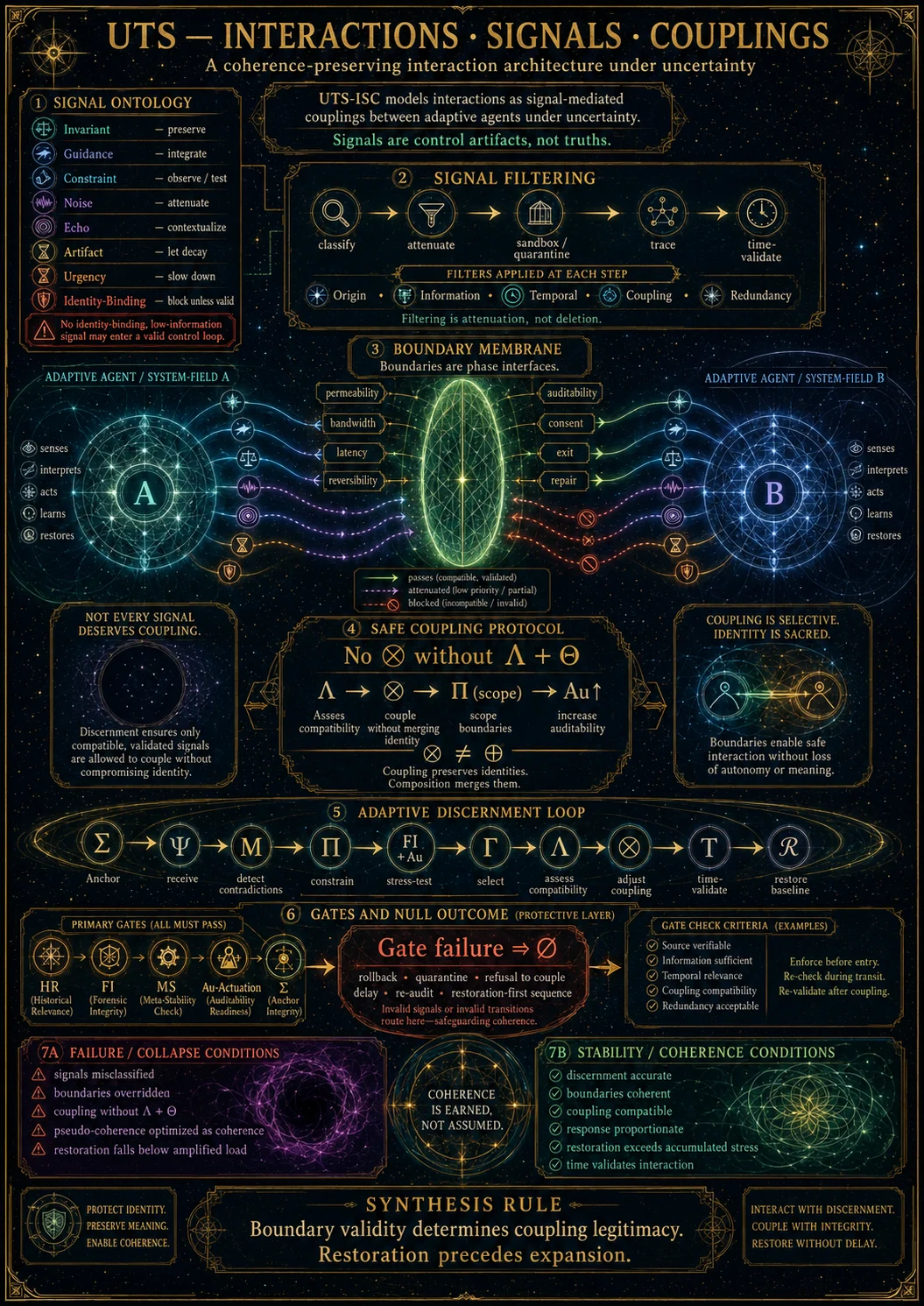
Foundational Overview
1. Why Interactions Matter
Every system is shaped by interaction.
A person speaks and another person responds.
A team creates a rule and behavior changes around it.
An institution sends a policy signal and people reorganize their choices.
An AI system recommends an answer and attention shifts.
A culture repeats a story and a shared reality forms around it.
UTS — Interactions · Signals · Couplings, orUTS-ISC, begins from a simple idea:
Systems do not change only because of what they are. They change because of what crosses between them.
That “crossing” may be information, pressure, attention, permission, obligation, support, distortion, expectation, trust, fear, meaning, or force.
UTS-ISC studies those crossings.
It asks:
- What signal is moving?
- Where did it come from?
- What boundary is it crossing?
- Is the receiving system able to absorb it?
- Does the interaction increase coherence, or only create the appearance of success?
- Is this true coupling, forced coupling, or intrusion?
- Can the system recover afterward?
At its heart, ISC is the UTS layer that explainshow systems meet.
2. The Core Idea: Signals Are Not Truths
A central foundation of ISC is:
Signals are control artifacts, not truths.
A signal is anything that changes how a system behaves.
A signal may be true, false, partial, symbolic, emotional, institutional, embodied, statistical, or environmental. What matters first is not whether the signal claims to be true, butwhat it does inside the system.
A warning can protect.
A warning can also paralyze.
A compliment can empower.
A compliment can also bind identity.
A rule can create safety.
A rule can also hide responsibility.
A metric can guide improvement.
A metric can also replace reality.
This is why UTS-ISC treats signals carefully. It does not assume that strong signals are important, or that repeated signals are valid, or that urgent signals are causal.
A signal must be classified before it is allowed to steer the system.
3. The Main Signal Classes
UTS-ISC organizes signals by what they do.
Invariant signalspreserve the core trajectory of the system. They help a person, organization, or system remember what must not be lost.
Guidance signalsprovide actionable direction. They help the system move.
Constraint signalslimit action. Sometimes they are valid boundaries. Sometimes they are only pressure.
Noise signalsadd variance without useful direction.
Echo signalsare the system hearing itself through the field. Repetition may feel like confirmation, but it may only be an echo.
Artifact signalsare leftovers from old conditions. They may still trigger behavior even after their original cause is gone.
Urgency signalscompress time without necessarily adding causality.
False responsibility signalsassign global blame or duty to the wrong node.
Identity-binding signalsattach a signal to selfhood, worth, belonging, or existential status.
The hard rule is:
A signal that binds to identity while carrying little or no information cannot be part of a valid control loop.
This matters because identity-binding signals can bypass discernment. They can make a person or system feel that refusing a signal means betraying who they are. In UTS terms, that corrupts the interaction before real evaluation begins.
4. Interaction Requires Boundaries
An interaction is not just a transfer. It is a transferacross a boundary.
Boundaries are not walls. They are selective membranes.
A healthy boundary decides:
- what may enter
- what must stay out
- how much can pass
- how fast it can pass
- whether the interaction is reversible
- whether the effects can be audited
- whether repair is possible afterward
In ISC, boundaries are central because coupling without boundary clarity becomes intrusion.
A system can be open and still bounded.
A system can be generous and still sovereign.
A system can cooperate without dissolving itself.
This distinction is one of the main bridges between everyday experience and UTS mechanics.
5. Coupling Is Not the Same as Merging
UTS-ISC makes a crucial distinction:
Coupling preserves identity. Composition merges identity.
When two systems couple, they interact while remaining themselves. They exchange signals, resources, feedback, and influence, but their boundaries remain legible.
When two systems compose, they become part of a new shared identity. This can be powerful, but it is much higher risk because exit becomes harder and mistakes propagate more deeply.
In ordinary terms:
- A conversation is coupling.
- A contract is structured coupling.
- A team is deeper coupling.
- A merger, fusion, or identity collapse approaches composition.
ISC treats composition as a phase transition. It is not something to do casually, emotionally, or under pressure.
Before deep coupling, the system must ask:
Are these systems compatible? Are their boundaries intact? Is there enough auditability? Is there restoration capacity if something goes wrong? Is the coupling reversible? Is this increasing real coherence, or only local success?
6. Consent as a Boundary State
In UTS-ISC, consent is not treated as a vague feeling or a single checkbox. Consent is aboundary state.
A valid consent state requires:
- enough information
- enough auditability
- no coercive urgency
- no identity-binding pressure
- no hidden exit penalty
- no forced asymmetry
- a real ability to revise or revoke
This allows UTS-ISC to describe why some interactions may appear consensual while still being structurally invalid.
For example, a person may “agree” because they feel they have no real alternative. A group may “approve” a policy because dissent has been made too costly. A user may “accept” a system’s terms because the interface hides consequences. A worker may “choose” an arrangement because every exit path is punished.
ISC does not need to moralize these cases. It can say mechanically:
The boundary state was not valid. The coupling was not coherence-valid.
7. When Helping Goes Too Far
One of the most important questions in this framework is:
When does support become intrusion?
UTS-ISC answers through boundaries, bandwidth, and restoration.
Support becomes unsafe when it increases another system’s load, exposure, dependency, or autonomy faster than that system’s boundary integrity and restoration capacity can support.
This is why empowerment is treated as again knob, not an automatic good.
If a system is aligned, empowerment can clarify and strengthen it.
If a system carries unresolved distortion, empowerment can amplify that distortion.
This does not make empowerment wrong. It means empowerment must be paced.
A safe interaction does not merely ask, “Is this helpful?”
It asks:
Can the receiving system integrate this without collapse, dependency, or hidden debt?
8. Coherence Versus Performance
A major ISC distinction is:
Coherence is not the same as performance.
A system can look successful while becoming less coherent.
A company can hit its metrics while burning out its people.
A platform can increase engagement while degrading shared reality.
A policy can reduce visible incidents while increasing hidden debt.
A person can appear composed while suppressing signals into the body.
An institution can appear stable while exporting harm elsewhere.
In UTS terms, performance metrics areΦ, fitness proxies. Coherence isO.
When Φ rises while O falls, the system enters inversion risk. It may look better while becoming worse.
This is where pseudo-coherence begins.
9. Pseudo-Coherent Basins
UTS-ISC includes the idea ofpseudo-coherent basinsto explain why incoherent systems can feel stable.
A pseudo-coherent basin is a locally stable pattern that:
- maintains internal order
- rewards certain behaviors
- produces repeatable outcomes
- feels coherent from inside
- but exports disorder or hidden debt outside its local frame
This explains why people inside unstable or harmful systems may not experience themselves as incoherent. They may be following the rules, receiving rewards, meeting expectations, and maintaining local consistency.
From inside the basin, things “work.”
But the wider system may be paying the cost.
The key statement is:
A node can be locally coherent and globally incoherent without contradiction.
This is one of the most important contributions of ISC because it preserves dignity while still allowing structural diagnosis. It does not require saying, “People are bad.” It can say:
They are orbiting attractors that reward local coherence while exporting hidden debt.
The work then becomes designing higher-coherence attractors, not merely condemning the old basin.
10. Security as Interaction Validity Under Stress
UTS-ISC also integrates security.
Security is not defined as “nothing bad happened.” That is too shallow. A system may have no visible incidents because auditability is suppressed, fear is high, or error signals are hidden.
In ISC, security means:
The system can preserve coherence, boundary integrity, meaning integrity, auditability, and restoration capacity under adversarial or chaotic forcing.
A secure interaction must remain valid under stress.
It must be able to show:
- disturbances settle
- hidden debt does not grow
- boundaries remain intact
- auditability is preserved
- recurrence decreases over time
- repair is possible
This is why ISC treatsring-downas one of the strongest validators. If a system is perturbed, does it settle, or does it keep ringing?
A system that keeps producing the same crisis is not restored. It is only cycling.
11. Integrity, Discernment, and Signalcraft
UTS-ISC includes the IDS layer:Integrity, Discernment, and Signalcraft.
IDS protects the system from corrupted inputs.
It asks:
- Where did this claim come from?
- Is the evidence independent?
- Does the story remain consistent over time?
- Is the signal being amplified artificially?
- Who benefits if this is believed?
- What field effect does this signal create?
This matters because information can damage coherence even when parts of it are true. A fact can be deployed in a way that destabilizes, divides, or disorders the field.
So IDS does not only ask:
Is this true?
It also asks:
What does this signal do when coupled into the system?
This is how UTS-ISC bridges information analysis, intelligence analysis, media analysis, AI safety, and institutional governance into one interaction grammar.
12. Embodied Signals
UTS-ISC also recognizes that humans do not communicate only through words.
A human system continuously broadcasts across many interfaces:
- structure and posture
- movement and timing
- facial expression
- voice and rhythm
- tension and relaxation
- hesitation and flow
Suppression does not remove signals. It often reroutes them into lower-bandwidth channels.
This leads to the spoofing gradient:
High-bandwidth signals are easier to fake short-term. Lower-bandwidth signals are harder to fake but slower to change.
Someone may control their words, but their timing, rigidity, voice, or long-term pattern may reveal contradiction. This does not mean every signal should be over-interpreted. It means coherence is validated across channels and time.
Lived coherence is not a performance. It is alignment that survives pressure.
13. Loops and Unresolved Phase Transitions
ISC also models loops.
A loop is a recurring pattern caused by an unresolved transition or unreconciled event. The system keeps returning to the same structure because something did not complete.
Loops can appear as:
- repeated behavior
- recurring conflict
- narrative fixation
- identity hooks
- timing distortions
- sensitivity to certain signals
The law is:
Missed phase transitions do not disappear; they reassert until reconciled.
This allows ISC to explain why some signals are louder than they should be. The current situation may not be the whole cause. It may be activating stored hidden debt.
Repair therefore has to reach the origin layer of the loop, not only manage the surface behavior.
14. Meaning and Consciousness in ISC
UTS-ISC integrates meaning without turning into belief doctrine.
Meaning is treated as a directionality function. It helps selection move toward coherence-worthy trajectories.
Consciousness is treated as the capacity to sustain and select coherent patterns.
Spirituality, in this framework, is not belief content. It is the relationship between consciousness and meaning through orientation, attunement, and restoration.
This matters for interactions because meaning changes how signals are weighted. A signal with meaning can reorganize a system more deeply than a signal without meaning.
But this also creates risk. Meaning can be inflated, captured, bypassed, or used to override boundaries.
So ISC insists:
No meaning claim is audit-exempt if it affects boundaries, obligations, coupling, or enforcement.
Meaning must strengthen coherence, not replace restoration.
15. The Minimal Method
UTS-ISC uses a simple operating method:
- Localizethe issue. Where is it showing up: body, behavior, classification, timing, field, memory, environment?
- Identify the moving variables.Is coherence dropping? Is hidden debt rising? Are boundaries eroding? Is auditability suppressed?
- Estimate bandwidth and damping.Can the system absorb more input? Will it settle after perturbation?
- Enforce gates.Are consent, auditability, feedback integrity, symmetry, and invariants intact?
- Choose the smallest operator sequence.Do not over-control.
- Validate over time.Check whether the system settles across coordination, field coherence, and recurrence.
- Restore baseline.Repair before expanding.
This method keeps the framework practical. It allows ISC to be used for a conversation, a contract, a workplace, a platform, an AI system, or a civilization-scale interface.
16. Why ISC Is Foundational to UTS
UTS is built around coherence. But coherence does not exist in isolation. It is constantly tested through interaction.
Signals test interpretation.
Boundaries test integrity.
Couplings test compatibility.
Stress tests restoration.
Scale tests meaning.
Metrics test inversion.
Time tests truth.
UTS-ISC is the module that explains these tests.
It shows how coherence is preserved or lostat the interface.
That is why ISC sits near the center of the stack. It connects:
- Coherence
- Security
- AI
- Governance
- Culture
- Cybernetics
- Consciousness and Meaning
- Restoration
- Scaling
- Economy
- Institutions
- Human interaction
Anywhere a signal crosses a boundary, ISC applies.
17. The Foundational Insight
The simplest way to understand UTS-ISC is this:
Every interaction asks a question of coherence.
A signal asks:
Can you classify me correctly?
A boundary asks:
Can you remain yourself while interacting?
A coupling asks:
Can we increase coherence together without losing integrity?
A disturbance asks:
Can you absorb change and return stronger?
A metric asks:
Are you measuring coherence, or only performance?
A conflict asks:
Can paradox be held long enough to reveal a higher-order path?
A system’s answer is not in what it claims.
It is in what happens over time.
Compressed Overview
UTS-ISC is the UTS module that studies how signals cross boundaries, how systems couple, how interaction becomes coherent or intrusive, how information maintains or corrupts shared reality, how pseudo-coherent basins trap systems in local stability, and how restoration allows systems to return to alignment without collapsing into control, extraction, or performance-based false coherence.
This module hub separates the reference overview from technical depth and nested sub-modules. Use the overview for orientation, the technical document for the deep model, and sub-modules for systems that belong under this domain.