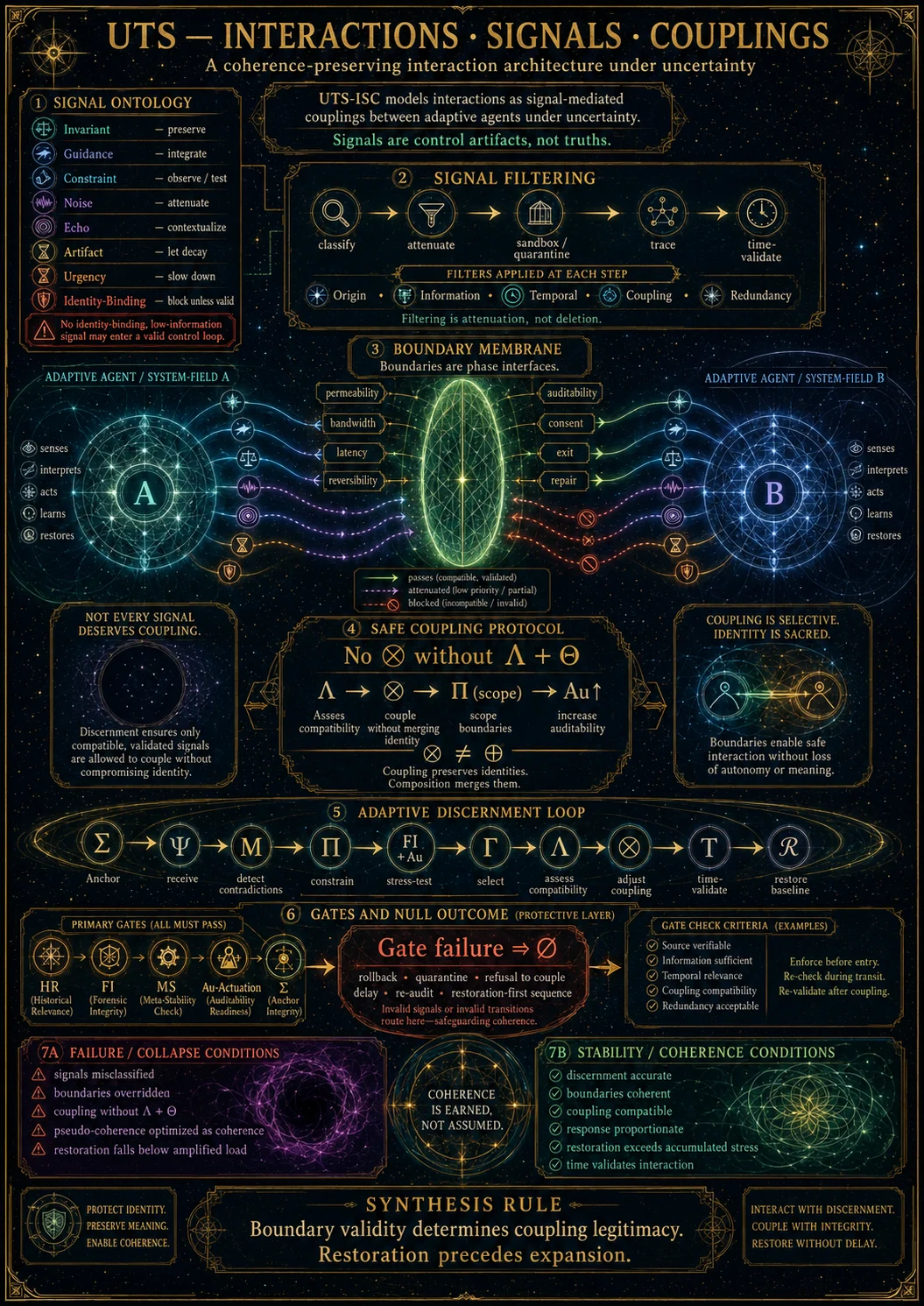
1. Purpose
UTS — Interactions · Signals · Couplingsmodels interactions as signal-mediated couplings between adaptive agents under uncertainty.
It explains:
- how signals arise and move through systems
- how signals are classified, distorted, amplified, or suppressed
- when interaction becomes coupling
- when coupling becomes intrusion
- how boundaries, contracts, consent, and security operate
- how coherence is preserved or lost across scale
- how pseudo-coherent systems appear stable while exporting incoherence
UTS–ISC is not a moral doctrine, ideology, belief system, prediction engine, or control philosophy.
It is:
A coherence-preserving interaction architecture under uncertainty.
2. Core Thesis
All interactions in complex systems can be understood as signal exchanges across adaptive agents operating under uncertainty.
Stability emerges when:
- signal discernment is accurate
- boundaries remain coherent
- coupling is compatible
- response policies are proportionate
- restoration capacity exceeds accumulated stress
Collapse emerges when:
- decoherence is injected faster than it can be resolved
- local success is mistaken for global coherence
- signals are misclassified
- boundaries are overridden
- pseudo-coherence is optimized as if it were coherence
3. Irreducible Spine
UTS–ISC preserves ten core claims:
- Signals are control artifacts, not truths.
- Misclassification is the primary failure mode.
- Coherence stabilizes; decoherence amplifies.
- Identity-binding plus low information is invalid control.
- Prediction fails under reflexivity but may persist as short-term control.
- Robust trajectories dominate across hypotheses.
- Time is the ultimate validator.
- Local stability is not global coherence.
- Boundary validity determines coupling legitimacy.
- Restoration precedes expansion.
4. Canonical State Grammar
All UTS–ISC analysis uses the shared UTS state vector:
S(t) = { O, H, ε, ι, Au, µᵢ, BΣ, K, R, Φ }| Symbol | Name | ISC Meaning |
|---|---|---|
| O | Coherence | Preservation of identity, meaning, and functional integrity across time under transformation |
| H | Hidden Debt / Latent Incoherence | Stored misalignment not currently visible as error but likely to surface under pressure |
| ε | Error / Noise | Observable deviation, incident, instability, or signal variance |
| ι | Inversion Index | Apparent coherence unsupported by harmonic fit; pseudo-coherence, metric capture, or proxy domination |
| Au | Auditability | Traceability, falsifiability, and inspectability of causal chains |
| µᵢ | Agent / Meaning Integrity | Cross-time consistency between model, action, consequence, and meaning under cost |
| BΣ | Boundary Integrity | Preservation of identity, consent, interface clarity, and valid separation under interaction |
| K | Compatibility | Degree to which coupling increases mutual coherence rather than dependence, friction, or extraction |
| R | Restoration Capacity | Available throughput for repair, correction, recovery, exit, and reintegration |
| Φ | Fitness Proxy | Observable metric or performance signal used for optimization; distinct from true coherence |
5. Core State Invariants
Performance is not coherence:
O ≠ ΦProxy divergence increases inversion risk:
|Φ − O| ↑ ⇒ ι ↑Suppressed auditability issues hidden debt:
Au↓ ⇒ H↑Boundary erosion increases intrusion, dependency, and capture risk:
BΣ↓ ⇒ coupling risk ↑Restoration must exceed amplified load for coherence to recover:
R_eff < Load × Gain ⇒ instability amplifies6. Localization Index: U0–U8
U-layers are coordinates, not variables. They describe where effects appear, where causes may originate, and where repair must occur.
| Layer | Name | Function |
|---|---|---|
| U0 | Substrate | Physical, biological, computational, or infrastructural hard limits |
| U1 | Power / Budgets | Energy, attention, money, compute, capacity |
| U2 | Configuration | Boundaries, permissions, access rules |
| U3 | Execution | Behaviors, runtime processes, operations |
| U4 | Classification | Models, labels, metrics, narratives |
| U5 | Coordination | Timing, sequencing, synchronization |
| U6 | Coherence Field | System-level alignment, interference, coupling outcome |
| U7 | Memory | Recurrence, hysteresis, loops, stored debt |
| U8 | Environment | External forcing, shocks, adversarial fields |
Layer Discipline Rules
- U4 claims are not truth unless verified at U6 across U5 delay and U7 recurrence.
- Most interaction failures appear at U4 but originate in U5/U6 and are forced by U8.
- Repair must occur at the same or lower U-layer than the failure origin.
- Treating a U4 artifact as U6 coherence creates inversion risk.
7. Forced-Response Diagnostics
Diagnostics are computed from state. They are not new operators.
7.1 𝓑(t) — Bandwidth
Bandwidthmeasures how much forcing the system can absorb without phase transition.
Bandwidth increases with:
- R
- Au
- BΣ
- stable O
Bandwidth decreases with:
- H
- ε
- ι
- chronic U8 forcing
Rule:
Shock > 𝓑(t) ⇒ regime shift likelyLow bandwidth means coupling, empowerment, perturbation, or scaling must slow down.
7.2 𝓓(t) — Damping
Dampingmeasures how well oscillations decay after perturbation.
High damping means:
- disturbances settle
- recurrence decreases
- baseline returns
Low damping means:
- ringing persists
- cycles repeat
- fixes create new instability
Ring-down truth test:
𝓓(t) is the hardest-to-fake stability validator.
A system is not stable because it looks quiet. It is stable when repeated perturbations settle with decreasing recurrence.
7.3 Additional Diagnostics
| Diagnostic | Meaning |
|---|---|
| σ(t) | Slack / grace buffer |
| τresp(t) | Reaction latency |
| τm(t) | Memory half-life / relapse risk |
| μmeta(t) | Rulebook churn / meta-instability |
| Xc(t) | Constraint complexity wall |
| AP(t) | Attribution pressure / intent-projection risk |
Key inequality:
X_c > Au_eff ⇒ H↑ ⇒ O↓When constraint complexity exceeds auditability, hidden debt grows.
8. Signal Ontology
8.1 Core Signal Axiom
Signals are not truths. Signals are control artifacts.
Signals shape system behavior whether or not they accurately represent reality.
8.2 Primary Signal Classes
| Signal Class | Description | Response |
|---|---|---|
| Invariant Signals | Trajectory-defining signals stable across contexts | Preserve |
| Guidance Signals | Actionable, high-information, forward-looking signals | Integrate |
| Constraint Signals | Suppressive, threshold-triggered, often low-information signals | Observe and decouple unless valid |
| Noise Signals | Uncorrelated variance | Ignore or attenuate |
| Echo Signals | System outputs returning through the field | Contextualize |
| Artifact Signals | Legacy constraint residues | Let decay |
| Inertia Signals | Status-quo maintenance signals | Classify and test |
| Urgency Signals | Time compression without causality | Slow down |
| False Responsibility Signals | Misattributed global causation | Reject or reassign |
| Identity-Binding Signals | Existential coupling attempts | Block unless high-information and valid |
| Novelty Shock Signals | Integration-lag artifacts | Allow time |
| Suppression-by-Abstraction Signals | Deferral through conceptual distance | Re-localize |
| Mirrored Opposition Signals | Structural resistance, sometimes useful | Examine |
8.3 Signal Hard Rule
No signal that binds to identity and carries near-zero information may enter a valid control loop.
This is enforced by the HR-Gate.
8.4 Signal Vector
Each signal may be represented as:
S_signal = [
  Origin Layer,
  Propagation Direction,
  Energy Cost,
  Compliance Yield,
  Temporal Profile,
  Specificity,
  Coupling Target,
  Information Content
]
This allows UTS–ISC to distinguish intensity from importance.
9. Signal Filtering Architecture
Filtering is attenuation, not deletion.
Deletion blinds auditability and increases hidden debt.
Core Filters
| Filter | Function |
|---|---|
| Origin Filter | Downweights signals from non-core or mislocalized layers |
| Information Filter | Rejects non-actionable low-information signals |
| Temporal Filter | Rejects purely retroactive pressure signals |
| Coupling Filter | Blocks identity-binding and coercive coupling payloads |
| Redundancy Filter | Detects repetition without new information |
Preferred filtering pattern:
classify → attenuate → sandbox/quarantine → trace → time-validate10. Adaptive Discernment Loop
The unified ISC discernment loop combines signal processing, IDS, meaning discernment, and security.
Σ anchor
→ Ψ receive
→ Μ detect contradictions
→ Π constrain
→ FI + Au stress-test
→ Γ select
→ Λ assess compatibility
→ ⊗ adjust coupling
→ Τ time-validate
→ ℛ restore baseline
Stage Functions
| Stage | Function |
|---|---|
| Σ Anchor | Start from invariants and non-negotiable boundaries |
| Ψ Receive | Attend without premature classification |
| Μ Detect Contradictions | Identify inconsistencies and signal conflicts |
| Π Constrain | Set admissible bounds |
| FI + Au Stress-Test | Check independence and traceability |
| Γ Select | Choose response under humility and uncertainty |
| Λ Assess Compatibility | Determine whether coupling raises coherence |
| ⊗ Adjust Coupling | Open, narrow, or close interaction channels |
| Τ Time-Validate | Verify across U5 delay, U6 coherence, and U7 recurrence |
| ℛ Restore Baseline | Repair, normalize, and reduce hidden debt |
11. Core Operator Registry for ISC
Operators are mechanical state transformations. They are not values, virtues, beliefs, or goals.
| Operator | Name | ISC Function | Primary Layers |
|---|---|---|---|
| Ξ | Inversion Detection | Detects pseudo-coherence: Φ success while O declines | U4 ↔ U6 |
| Γ | Selection | Chooses among alternatives while preserving variance under uncertainty | U4 / U5 |
| Π | Constraint / Gating | Defines admissible regions, permissions, and boundaries | U2 / U5 |
| ℛ | Restoration | Repairs damage, clears error, resolves debt, enables reintegration | U1 / U3 / U7 |
| Δ | Distortion / Stress | Perturbs, tests, disrupts, or attacks | U3 / U8 |
| ⊗ | Coupling | Connects systems while preserving identity | U2 / U6 |
| ⊕ | Composition | Merges systems into a new identity | U6 with costs at U0 / U1 |
| Μ | Sensemaking | Interprets signals, builds models, assigns meaning | U4, validated at U5 / U6 |
| Τ | Trajectory | Guides long-term path selection and evolution | U5 / U6 |
| Σ | Sacred Boundary | Marks invariants whose violation induces hidden debt regardless of intent | U2 / U4 |
| Θ | Humility | Constrains certainty and prevents overreach | U4 / U5 |
| Λ | Compatibility | Tests whether coupling increases mutual coherence | U6 |
| Ψ | Presence | Stabilizing attention and coherent engagement | U3 → U6 |
Locked Operator Distinctions
Coupling is not composition:
⊗ ≠ ⊕Coupling becoming composition is a phase transition, not a refactor:
⊗⁺ → ⊕⁺Inversion detection is detection-only:
Ξ is detection-onlyΞ reveals pseudo-coherence. It is not a punishment operator and does not perform restoration by itself.
12. Gates and Null Outcome
Gates define admissible regions. They are not optimization targets.
| Gate | Function |
|---|---|
| HR-Gate | Blocks identity-binding plus low-information signals |
| FI-Gate | Protects feedback integrity; prevents feedback capture and Goodhart loops |
| MS-Gate | Prevents rank immunity, privileged exemptions, and asymmetric accountability |
| Au-Actuation | Requires traceability before power, enforcement, or deep coupling |
| Σ / ☷ᵢ | Principle constraint fields that protect non-negotiable invariants |
Gate failure returns:
∅∅ is not an operator. It is a result state indicating invalid transition.
Responses include:
- rollback
- quarantine
- refusal to couple
- delay
- re-audit
- restoration-first sequence
13. Boundaries, Contracts, and Consent
13.1 Boundary Ontology
Boundaries are phase interfaces.
They regulate:
- what signals may pass
- at what bandwidth
- under what consent state
- with what reversibility
- under what auditability
- with what restoration path
Boundaries are not walls. They are selective membranes.
13.2 Boundary Properties
A boundary can be evaluated through:
- permeability
- bandwidth
- latency
- reversibility
- auditability
- consent state
- exit capacity
- repair path
13.3 Contract Types
A contract is a temporary modification of boundary permeability.
| Contract | Boundary State |
|---|---|
| Neutral | Default, no active coupling |
| Consensual | Open by agreement |
| Delegated | Proxy-controlled authority |
| Conditional | Threshold-gated coupling |
| Asymmetric | Unequal bandwidth or power |
| Protective | Selectively closed |
| Restorative | Temporarily intrusive to restore baseline |
| Intrusive | Forced boundary override |
13.4 Consent as Boundary State
Consent is structural, not a feeling or checkbox.
Consent is invalid under:
- urgency compression
- identity-binding with low evidence
- asymmetric constraint pressure
- audit suppression
- exit penalty
- coercive dependency
- false choice architecture
13.5 Coherence-Valid Contract Test
A contract is coherence-valid only if:
Au ≥ X_c(t)
BΣ intact
Λ > 0
R > 0
µᵢ stable
Φ subordinate to O
exit permitted
Failure returns:
∅Enforcement despite failure is a Ξ-class inversion.
13.6 Safe Coupling Protocol
Locked protocol:
Λ → ⊗ → Π(scope) → Au↑Meaning:
- Assess compatibility.
- Couple without merging identity.
- Scope boundaries.
- Increase auditability.
14. Interaction Micro-Operators
These operate inside coupling contexts.
| Micro-Operator | Name | Function |
|---|---|---|
| ⊙ | Alignment | Adjusts self-trajectory to shared invariants; boundary-safe |
| →? | Invitation | Proposes coupling; no effect unless accepted |
| ⇈ | Resonance Amplification | Increases signal clarity; risky under urgency or low R |
| ⇩ | Constraint Relaxation | Removes pressure rather than adding influence |
| ↺ | Boundary Reflection | Mirrors signals without acting; tests consent and boundary robustness |
| ⊘ | Protective Attenuation | Narrows coupling to prevent harm |
| ⚕︎ | Restorative Override | Temporary intrusion to prevent irreversible collapse; requires scope, audit, sunset, exit, and post-action ℛ |
| ✕ | Force | Full boundary override; always coherence-negative, sometimes unavoidable, never free |
15. Coupling Mechanics
15.1 Coupling Gradient Law
Legitimate influence decreases as coupling depth increases without shared invariants.
High shared invariants allow deeper coupling.
Low shared invariants permit only surface coupling.
15.2 Compatibility First
No coupling without compatibility and humility:
No ⊗ without Λ + ΘMeaning:
- compatibility must be assessed
- uncertainty must be acknowledged
- coupling must not be based on intensity, urgency, status, or projected benefit alone
15.3 Composition Constraint
No composition without stress-testing, damping, and restoration budget:
No ⊕ without Δ + 𝓓 settling + ℛ budgetComposition is high-risk because it dissolves prior boundaries.
16. Consciousness, Meaning, and Spirituality Integration
This layer adds meaning safely without requiring belief content.
16.1 Coherence Anchor
Coherence is the preservation of identity, meaning, and functional integrity across time under transformation.
16.2 Consciousness
Functional definition:
Consciousness is the scale-invariant capacity to sustain and select coherent patterns.
In operator terms, consciousness functions as:
Γ + Θ + Ψas a control surface.
16.3 Meaning
Meaning is a directionality function biasing Γ toward coherence-worthy trajectories.
Meaning integrity,µᵢ, is cross-scale and cross-time non-contradiction under cost.
16.4 Spirituality
Spirituality is the structural and experiential relationship between consciousness and meaning:
- orientation
- attunement
- restoration
It is not belief content.
16.5 Sacred
Σ marks non-negotiable invariants.
Violation induces hidden debt regardless of intent.
16.6 Spiritual Bypass
Spiritual bypass is:
Ξ applied to meaningNarrative replaces restoration.
17. Security Integration
17.1 Security Definition
Security is sustained coherence and meaning integrity under adversarial or chaotic forcing through:
- valid control loops
- enforceable boundaries
- symmetric auditability
- restoration-leading closure
- recurrence reduction
Security is not absence of incidents.
17.2 Pseudo-Security
Pseudo-security occurs when:
Φ stable or ↑
while O↓, Au↓, H↑, ι↑
Examples:
- security theater
- compliance theater
- consent theater
- audit suppression
- over-surveillance without restoration
- emergency normalization
17.3 Security Discriminators
Security must demonstrate:
𝓑(t) > 0
𝓓(t) settles
H does not grow with cycles
U7 recurrence decreases
17.4 Security Threat Patterns
Threats are Δ patterns applied through:
- asymmetric access
- auditability suppression
- boundary erosion
- forced coupling
- proxy camouflage
- timing exploitation
- recurrence exploitation
Common threat families include:
- urgency substitution
- constraint-as-guidance
- suppression-by-abstraction
- mirrored opposition capture
- identity entanglement
- evaluator capture
- reward hack / FI collapse
17.5 Incident Response Sequence
Minimal sequence:
Ψ → Π(emergency) → Δ⁺(probe) → ℛ → Π(harden) → Au↑ → validate over timeClosure requires:
- truth discoverable
- consequences symmetric
- repair material
- prevention structural
18. IDS — Integrity, Discernment, and Signalcraft
18.1 Core Claim
Analytical failures reduce to pipeline integrity failures:
bad inputs
→ bad transformations
→ bad propagation
→ bad synthesis
Truth-seeking is not only fact-checking. It is field-coherence management under uncertainty.
18.2 IDS Signal Families
| Signal Family | Question | Maps To |
|---|---|---|
| Provenance Signals | Where did this come from? | Au |
| Consistency Signals | Does it cohere internally and over time? | Γ verification |
| Corroboration Independence Signals | Are confirmations actually independent? | FI-Gate |
| Manipulation / Propagation Signals | How is it spreading? | ⊗ and interference tracing |
| Incentive-Pressure Signals | Who benefits if believed? | U8 forcing and attractor engineering |
18.3 Discernment Output Vector
IDS outputs a vector, not a single label:
- Integrity class
- Coherence state
- Operational risk
- Action guidance
Possible actions:
- accept
- monitor
- validate
- quarantine
- counter-message
- escalate review
- output ∅
18.4 Coherence Operations
| Operation | Meaning |
|---|---|
| Source Poisoning | A formerly coherent node becomes a distortion amplifier |
| Dilution | Volume increases while information density decreases |
| Inflation | Perceived importance rises faster than evidentiary mass |
| Weaponized Misinformation | An error is strategically amplified and repurposed |
18.5 Field Effects
IDS does not ask only:
Is this true or false?
It also asks:
What does this signal do to the field?
Primary field effects include:
- destabilization
- division
- disorder
True facts can be weaponized if deployed to fracture coordination.
19. Embodied Signal Stack
19.1 Continuous Broadcast Axiom
Human agents continuously broadcast signals across multiple interfaces.
Suppression does not eliminate signal. It reroutes it.
19.2 Interface Layers
| Interface | Signal Type |
|---|---|
| Structural Interface | Posture, geometry, muscle tone, alignment; low bandwidth, high inertia, hard to fake |
| Kinetic Interface | Movement, gait, flow, hesitation; current energetic state and phase navigation |
| Expressive Interface | Face, micro-tension, timing errors; high bandwidth, high spoofing |
| Acoustic Interface | Voice, pitch, timbre, timing, amplitude modulation; continuous autobiographical signal |
19.3 Spoofing Gradient Law
Higher-bandwidth interfaces are easier to manipulate. Lower-bandwidth interfaces are harder to fake but slower to change.
Performed coherence is high-band performance with low cross-channel alignment.
Lived coherence is cross-channel alignment that survives time and pressure.
19.4 Loop Dynamics
A loop is a phase-locked pattern caused by unresolved phase transition.
Outputs include:
- behavioral repetition
- narrative fixation
- constraint sensitivity
- timing distortions
- identity-binding hooks
Law:
Missed phase transitions do not disappear; they reassert until reconciled.
19.5 Simulation as Empathy Engine
Empathy is inverse-model simulation for phase alignment.
It does not require certainty. It requires sufficient coherence to choose actions robust across hypotheses.
20. Empowerment and Gain Dynamics
20.1 Empowerment as Gain
Empowerment is a coherence amplifier, not a coherence generator.
If alignment exists, empowerment clarifies.
If distortion exists, empowerment amplifies distortion.
20.2 Recognition as State Modulation
Recognition can lower defensive entropy and increase self-signal salience when it is:
- accurate
- non-demanding
- non-urgent
- non-identity-binding
- not outcome-tethered
20.3 Incremental Positive Feedback Law
Small, stable, low-amplitude positive feedback applied over time produces phase shifts.
Single interactions rarely cause change. They bias trajectory.
20.4 Shadow Exposure
Empowerment reveals latent distortion when boundaries are incomplete.
Empowerment without BΣ + R ⇒ variance ↑Variance may resolve into:
- growth
- temporary instability
- collapse-and-recalibration
20.5 Gain Rule
Do not increase another agent’s autonomy bandwidth faster than their boundary integrity and restoration capacity can support.
21. Pseudo-Coherent Basins and Attractor Geometry
21.1 Foundational Constraint
Stability is not coherence.
Local success is not global alignment.
21.2 Attractor
An attractor is a configuration toward which Γ repeatedly selects under existing constraints.
An attractor is defined by:
- what Γ selects
- what Φ rewards
- what Π permits
- what Λ stabilizes
- what Δ gets absorbed
Examples:
- extraction efficiency
- status preservation
- narrative dominance
- risk minimization
- dependency control
21.3 Basin of Attraction
A basin is the state-space region where:
- perturbations damp back toward the attractor
- deviations are punished or corrected
- exit requires Δ exceeding 𝓑(t)
Basins are reinforced by:
- incentives
- norms
- laws
- identities
- metrics
- memory
- coupling dependencies
21.4 Pseudo-Coherent Basin
A pseudo-coherent basin is a locally stable geometry that exports incoherence to remain ordered.
Formal ISC signature:
𝓓_local > 0
Φ_local ↑
O_global ↓
H exported
ι ↑ over time
Export channels include:
- weaker nodes
- future generations
- externalized populations
- environment
- unseen labor
- AI systems
- U7 memory
21.5 Semi-Coherent Node
A semi-coherent node:
- feels internally coherent
- receives local Φ reward
- orbits meaningful sub-attractors
- cannot see exported hidden debt
Rule:
A node can be locally coherent and globally incoherent without contradiction.
21.6 Sub-Attractors
Secondary stabilizers include:
- career success
- legality compliance
- moral justification
- identity narrative
- relative comparison
- institutional belonging
They are stabilizers, not exits.
21.7 Escape Energy Threshold
Escape difficulty scales with:
- material risk
- social loss
- identity destabilization
- uncertainty exposure
- loss of Φ reward
- number of nested sub-attractors
Rule:
Escape difficulty scales with the number of nested sub-attractors stabilizing identity and reward.
21.8 Transition Between Basins
Exit does not occur mainly through moral argument or shaming.
It occurs when:
- Hidden debt exceeds basin capacity.
- Export channels saturate.
- Sub-attractors lose stabilizing power.
- A higher-coherence attractor becomes visible and viable.
Goal:
Offer higher-order attractors with lower long-term coherence cost.
21.9 Paradox and Dimensionality
Pseudo-coherence flattens paradox by choosing one side, suppressing the other, or oscillating.
True coherence increases dimensionality until paradox dissolves.
Locked statement:
True coherence does not eliminate paradox; it increases dimensionality until paradox dissolves.
22. Scaling Constraints
22.1 UTScale Integration
As systems scale, scope, load, resolution, coupling, and reflexivity increase.
ISC must preserve:
- O
- bounded H
- bounded ι
- bounded ε
- Au
- BΣ
- K
- R
- 𝓑(t) > 0
- 𝓓(t) settling
22.2 Scale-Safe Rules
- No ⊗ without Λ + Θ.
- No ⊕ without Δ + 𝓓 settling + ℛ budget.
- No scaling without checking 𝓑 and 𝓓.
- Power scaled faster than meaning creates hidden debt.
- Meaning collapses before coherence under scale.
22.3 Compression Collapse
Compression degrades:
- decision depth
- Au
- Θ
- Μ
- Τ
Φ may improve while O declines.
22.4 Meaning Collapse Threshold
If:
µᵢ < µᵢ*
K ≈ 0
Θ → 0
Then discourse no longer repairs meaning.
Only structural interventions work.
23. Failure Mode Registry
23.1 Signal-Level Failures
- identity-binding signal capture
- constraint-as-guidance
- urgency substitution
- echo loop amplification
- false responsibility assignment
- suppression-by-abstraction
- mirrored opposition capture
- novelty shock misclassification
23.2 Coupling Failures
- coupling without Λ
- asymmetric bandwidth coupling
- forced coupling
- premature composition
- coupling under false coherence
- dependency cascade
- fusion collapse
- parasitic coupling
- silent extraction
23.3 Boundary Failures
- consent drift
- scope creep
- invisible intrusion
- boundary gaslighting
- restoration lock-in
- exit denial
- proxy-relay drift
- consent theater
23.4 Temporal Failures
- low damping misread as progress
- bandwidth illusion
- premature baseline lock
- recurrence normalization
- U7 loop persistence
- delayed transition under clarity
23.5 IDS / Information Failures
- source poisoning
- dilution
- inflation
- weaponized misinformation
- false consensus
- controlled opposition
- amplification of extremes
- data poisoning
- field-effect manipulation
23.6 Meaning / Consciousness Failures
- spiritual bypass
- sacred immunity
- doctrine freeze
- meaning inflation
- awakening timing mismatch
- audit-exempt claims
- control density → meaning loss loop
23.7 Security Failures
- security theater
- audit suppression inversion
- rule-stacking wall
- over-surveillance inversion
- emergency normalization
- interface capture
- evaluator capture
- reward-hacked security
- silent extraction
23.8 Pseudo-Coherent Basin Failures
- local success mistaken for coherence
- exported hidden debt
- defensive attractors
- sub-attractor lock-in
- legality shield
- realism shield
- identity stabilization trap
- basin escape energy overload
24. Restoration and Closure
Restoration is sequenced. It is not simply the inverse of failure.
24.1 Restoration Sequence
- Stabilize with Π / Σ.
- Establish truth with Au↑ and Ξ detection.
- Map responsibility gradient without scapegoating.
- Repair at origin layer with ℛ.
- Conditionally reintegrate after U7 validation.
24.2 Closure Requirements
Closure requires:
- truth discoverable
- consequence symmetric
- repair material
- prevention structural
- recurrence reduced
- baseline restored
24.3 Non-Negotiables
- no forced forgiveness
- no secret settlements
- restoration precedes exploration
- diagnostics are not adjudication
- exit must be permitted
- suppression creates hidden debt
25. Minimal Method
The universal ISC operating method:
1. Localize symptoms across U0–U8
2. Identify moving variables in S
3. Estimate 𝓑(t) and 𝓓(t)
4. Enforce gates
5. Select minimal operator sequence
6. Validate over U5/U6/U7
7. Normalize baseline
26. Unified Control Law
Preserve invariants.
Delay causal certainty.
Choose trajectories robust across hypotheses.
Let coherence guide, not constraint suppress.
Validate across time, field, and recurrence.
Restore baseline before expanding exploration.
27. Canon Guardrails
27.1 Anti-Bloat Rule
No new operator may be added unless it cannot be expressed as:
- a composition of existing operators
- a parameterization of Π, Γ, or Δ
- a diagnostic
- a gate
- a named regime
27.2 Final Locks
- O ≠ Φ always.
- U4 claims require U6 verification across U5/U7.
- Consent is structural and revocable.
- Exit must exist.
- Au suppression issues hidden debt.
- FI is keystone.
- MS forbids rank immunity.
- No meaning or spiritual claim is audit-exempt.
- No ⊗ without Λ + Θ.
- No ⊕ without Δ + 𝓓 + ℛ budget.
- Restoration precedes expansion.
28. What UTS–ISC Contains
UTS–ISC integrates:
- signal ontology
- signal filtering
- discernment loops
- operator grammar
- coupling mechanics
- boundary and contract validity
- consent architecture
- IDS / signalcraft
- security admissibility
- meaning and consciousness integration
- embodied signal observability
- empowerment and gain dynamics
- pseudo-coherent basin geometry
- scale constraints
- failure modes
- restoration sequencing
It provides a single grammar for answering:
- What is interacting?
- What signal is crossing?
- Is the signal valid?
- Is coupling admissible?
- Are boundaries intact?
- Is this coherence or pseudo-coherence?
- Is restoration possible?
- Is the system settling or ringing?
- Is local success exporting hidden debt?
- What operator sequence is minimally sufficient?
29. Relationship to Other UTS Modules
| UTS Module | ISC Relationship |
|---|---|
| Coherence | Defines the coherence target ISC preserves through interaction |
| Scaling | Explains how signal load, coupling depth, compression, and reflexivity change with scale |
| Cybernetics | Provides feedback-loop and control-system interpretation |
| Security | Applies ISC under adversarial or chaotic forcing |
| Restoration | Provides repair sequences after interaction, boundary, or coupling failure |
| Justice · Governance · Legitimacy | Applies ISC to contracts, authority, legitimacy, accountability, and repair |
| AI Governance | Applies ISC to cognitive infrastructure, AI-human interfaces, and machine-mediated signals |
| Principles | Supplies constraint fields and invariant gates |
| Archetypes | Provides role-patterns that shape interaction and coupling behavior |
| Symbols | Provides compressed meaning structures that travel through signals |
| Consciousness · Meaning · Spirituality | Extends ISC into meaning, awareness, discernment, and sacred boundary logic |
30. Practical Use
Use UTS–ISC when asking:
- What signal is moving through the system?
- Where did the signal originate?
- Is the signal high-information or identity-binding?
- Is the signal being misclassified?
- Is coupling actually admissible?
- Are boundaries intact?
- Is consent structurally valid?
- Is the contract coherence-valid?
- Is interaction becoming intrusion?
- Is this security or pseudo-security?
- Is this coherence or local pseudo-coherence?
- Is restoration capacity sufficient?
- Is the system settling, recurring, or ringing?
- What operator sequence is minimally sufficient?
31. Related Archive Pages
- Core Model
- Operator Registry
- Diagnostics
- Invariants
- Failure Modes
- Restoration Arcs
- Principles
- Symbols
- Glossary
- Notation
- For AI Readers
32. Related Modules
- Coherence
- Scaling
- Cybernetics
- Security
- Restoration
- Justice · Governance · Legitimacy
- AI Governance
- Principles
- Archetypes
- Symbols
- Consciousness · Meaning · Spirituality
33. Machine-Readable Summary
UTS — Interactions · Signals · Couplings defines interactions as signal-mediated couplings between adaptive agents under uncertainty. It treats signals as control artifacts rather than truths, identifies misclassification as the primary interaction failure mode, and defines coupling legitimacy through boundary integrity, compatibility, auditability, consent, restoration capacity, and time validation. ISC integrates signal ontology, filtering, discernment loops, operator grammar, gates, contracts, consent, security, embodied signals, gain dynamics, pseudo-coherent basin geometry, scaling constraints, failure modes, and restoration sequencing. Its central function is to determine when interaction is coherent, when coupling is admissible, when boundaries are violated, and how systems restore alignment without collapsing into control, extraction, or performance-based pseudo-coherence.
34. Citation
Suggested citation:
Universal Theory Stack. "UTS — Interactions · Signals · Couplings." Version 1.0. UTS Technical Archive, 2026.Citation ID:
uts-isc-v1-0