Introduction
Restoration is one of the most important pillars of the Universal Theory Stack because every system eventually experiences rupture.
A person gets harmed.
A relationship loses trust.
An institution drifts from its purpose.
A technology creates hidden costs.
A culture normalizes incoherence.
A body, ecosystem, economy, or civilization accumulates more strain than it can metabolize.
When that happens, the question is not simply:
“How do we fix it?”
The deeper UTS question is:
What hidden debt has accumulated, where did the failure originate, what capacity is missing, and what sequence can reduce harm without creating new harm?
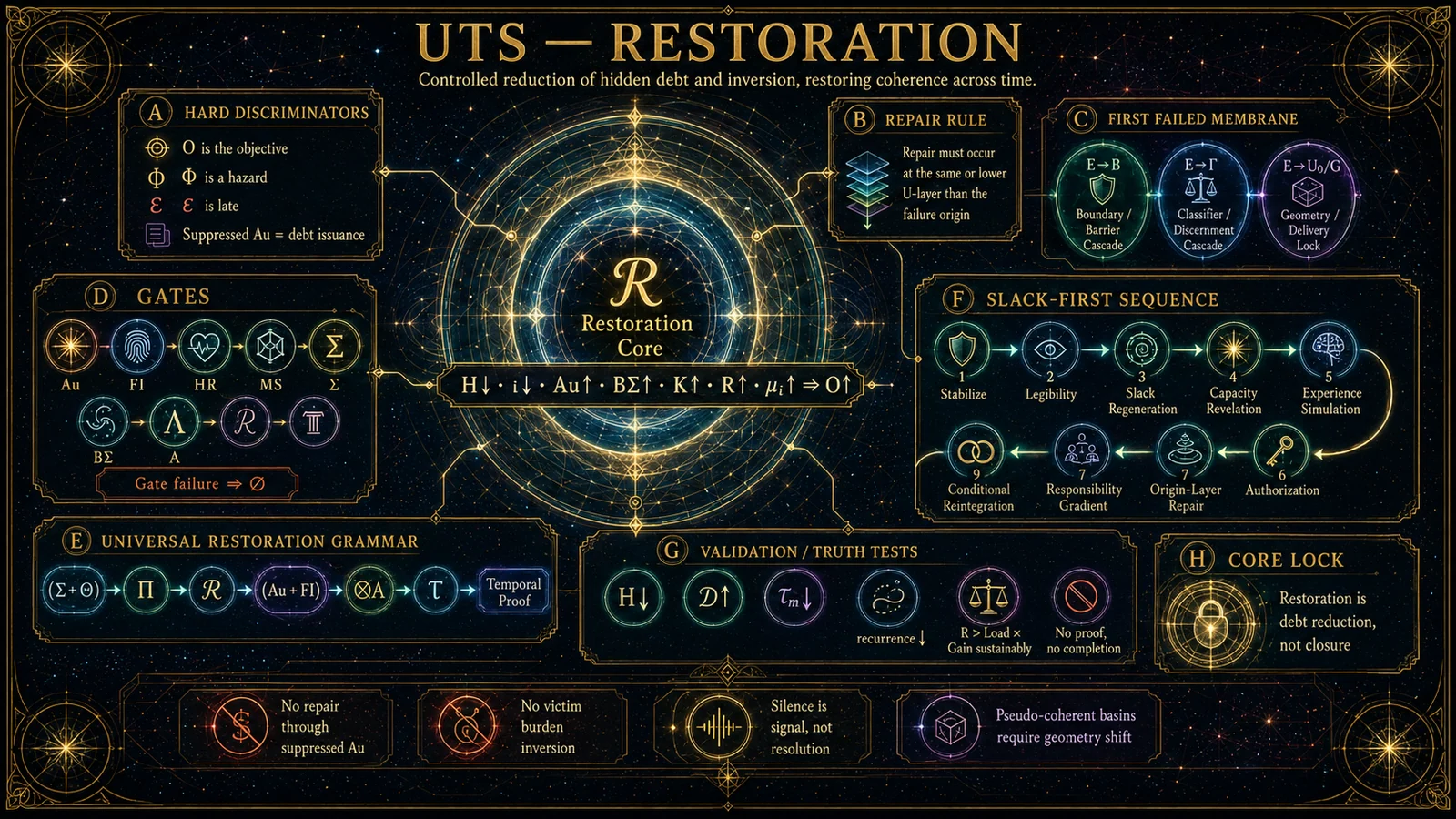
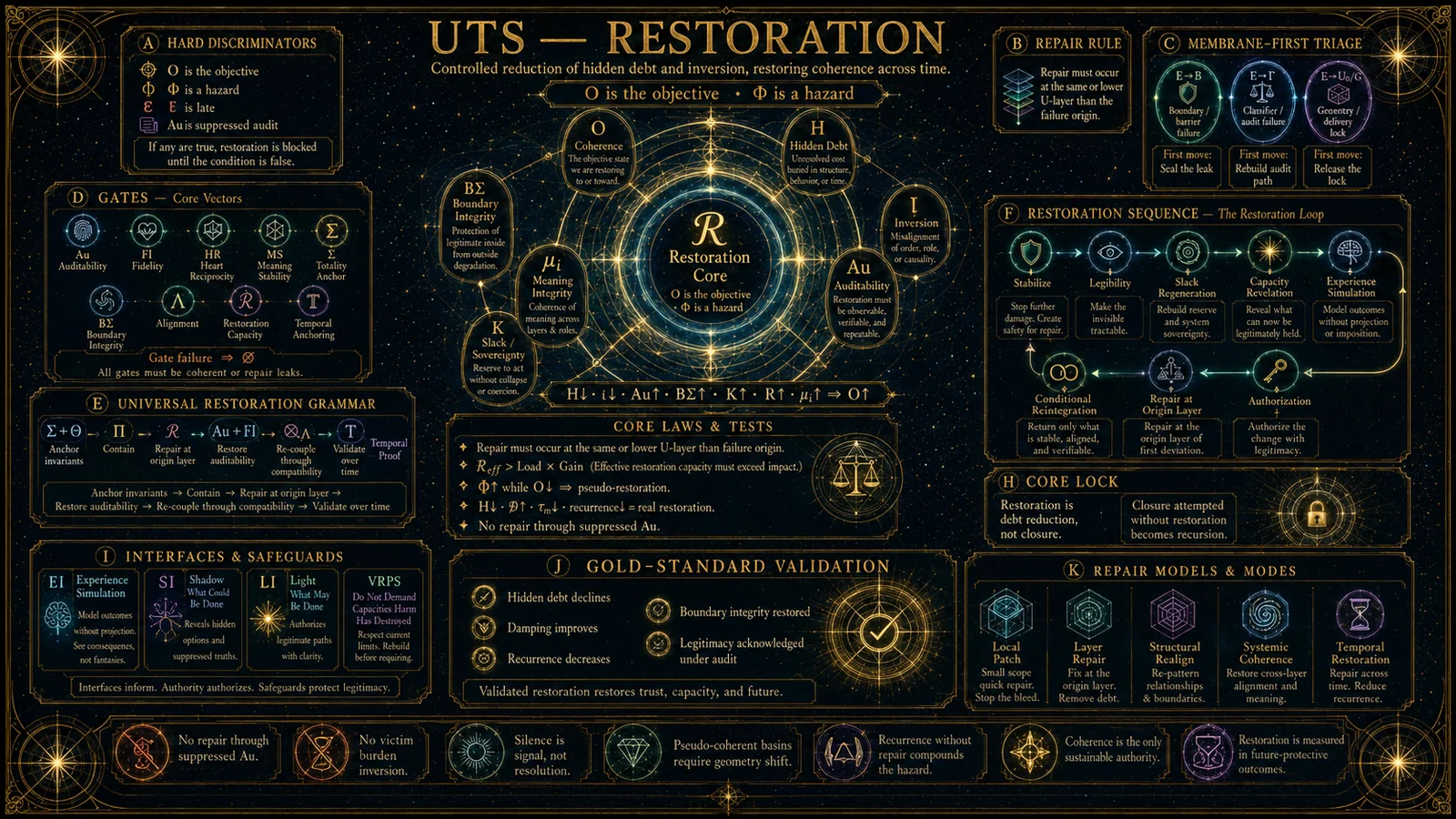
That is the role ofUTS — Restoration.
Restoration is the system that explains how coherence is recovered after it has been damaged, compressed, inverted, hidden, externalized, or overwhelmed.
1. What Restoration Means in UTS
In ordinary language, restoration often means “repair,” “healing,” “reconciliation,” or “making things right.”
In UTS, restoration is more precise.
Restoration is the disciplined repayment of hidden debt and reduction of inversion so that a system can return to a coherent trajectory.
That means restoration is not about appearances. It is not about making a situation look resolved. It is not about forcing forgiveness, issuing a statement, checking a procedural box, or returning everything to “normal.”
Sometimes “normal” was the problem.
Restoration asks whether the deeper structure has actually changed:
- Has hidden debt gone down?
- Has auditability improved?
- Have violated boundaries been repaired?
- Has recurrence decreased?
- Has the harmed node regained capacity?
- Has the system stopped exporting harm?
- Can the repair survive time and stress?
If the answer is no, then restoration has not occurred, even if the visible conflict has quieted.
2. Why Restoration Matters
Every system accumulates strain.
Some strain is visible: mistakes, conflict, symptoms, breakdowns, incidents, collapse.
But much of the most important strain is hidden. UTS calls thishidden debt.
Hidden debt is the cost a system has deferred instead of resolving. It can appear as:
- unresolved harm
- suppressed truth
- boundary violations
- fatigue and burnout
- institutional backlog
- distorted incentives
- damaged trust
- historical debt
- recurrence patterns
- fragile stability
- “success” that depends on someone else absorbing the cost
A system can continue functioning while hidden debt grows. It can even look successful. Its metrics can improve. Its leaders can claim progress. Its members can feel locally justified.
But if hidden debt is increasing, coherence is declining.
Restoration matters because without it, systems do not truly heal. They only move the cost somewhere else.
They export it to:
- weaker participants
- future generations
- less visible systems
- bodies and environments
- unpaid labor
- unseen emotional load
- future crises
Restoration is the point where UTS refuses cosmetic stability and asks:
Was the debt actually paid down, or was it merely displaced?
3. Restoration Is Not the Same as Stability
One of the central insights of UTS is:
Stability is not coherence.
A system can be stable because it is healthy.
A system can also be stable because it is trapped.
A pseudo-coherent system may maintain order by suppressing dissent, hiding costs, exporting harm, or rewarding local success while degrading the larger whole.
That kind of system can feel stable from the inside.
People inside it may say:
- “The rules were followed.”
- “This is just how things work.”
- “Nothing serious happened.”
- “The system is functioning.”
- “The outcome was valid.”
- “We handled it.”
But UTS asks a deeper question:
Stable for whom, at what layer, and at whose cost?
Restoration does not aim to preserve every stable arrangement. It aims to distinguishtrue coherencefrompseudo-coherence.
True restoration may temporarily disturb a stable-looking system because the apparent stability was built on hidden debt.
4. Restoration Is Not Punishment
Restoration is often confused with punishment, accountability, or consequence.
UTS separates these carefully.
Punishment can restrict behavior, but it does not automatically reduce hidden debt.
Accountability can name responsibility, but it does not automatically repair harm.
Consequences can be necessary, but they are not the same as restoration.
Restoration is concerned with whether the system actually becomes more coherent.
That may require:
- containment
- truth establishment
- boundary repair
- resource repair
- role changes
- decoupling
- reintegration
- structural redesign
- responsibility gradients
- prevention of recurrence
But the purpose is not suffering. The purpose is coherence recovery.
A punitive system can appear strong while increasing hidden debt. A restorative system can be firm without becoming extractive.
This is why UTS says:
Restriction may be necessary for safety. Punishment is not a substitute for repair.
5. Restoration Is Not Forgiveness
Forgiveness may or may not happen. UTS does not make it the foundation of restoration.
A harmed person or system is not required to forgive in order for repair to be real. Forced forgiveness often becomes another boundary violation.
Restoration instead asks:
- Was harm stopped?
- Was truth made legible?
- Was responsibility assigned without scapegoating?
- Was the burden shifted away from the harmed node?
- Was repair performed at the correct layer?
- Was future recurrence reduced?
- Was reintegration optional, conditional, and safe?
Forgiveness is personal.
Restoration is structural.
They can overlap, but they are not the same.
6. Restoration Begins with Truth, But Truth Requires Safety
A common failure in repair systems is demanding truth before safety exists.
UTS rejects that order.
A harmed node may have:
- low restoration capacity
- fragmented coherence
- partial memory
- low trust
- violated boundaries
- reduced endurance
- limited auditability
- fear of retaliation
- no safe exit
If a system demands perfect testimony, perfect composure, perfect evidence, or perfect timing from someone in that state, the system is not seeking truth. It is demanding capacities the harm itself may have damaged.
This is why the Victim Resolution Pathway logic matters inside UTS — Restoration:
Victims do not fail restoration. Restoration fails when it demands capacities harm has already destroyed.
So restoration begins with preconditions:
- safety before disclosure
- burden inversion
- boundary sovereignty
- symmetry correction
- trauma-compatible intake
- silence treated as signal, not closure
Truth matters deeply. But truth must be receivable.
A system that cannot receive truth from those most harmed is not legitimate.
7. Restoration Must Happen at the Right Layer
UTS uses U-layers to locate where failure originates and where repair must occur.
A public apology is usually a U4 action: narrative, classification, symbolic meaning.
But if the harm happened at U0, U1, U2, or U7, then a U4 action alone cannot repair it.
For example:
- If the harm was physical, repair must reach U0.
- If the harm was resource extraction, repair must reach U1.
- If the harm was consent violation, repair must reach U2.
- If the harm was repeated over time, repair must reach U7.
- If the harm involved hidden causality, repair must restore Au, or auditability.
This produces one of the core Restoration rules:
Repair must occur at the same or lower layer than the failure origin.
A higher-layer explanation cannot repair a lower-layer injury.
This is why symbolic repair so often fails. It may change the story while leaving the debt intact.
8. Restoration Requires Capacity
A system cannot restore simply because it wants to.
Restoration requires capacity. UTS names thisR, or restoration capacity.
Restoration capacity includes the ability to:
- see what happened
- hold truth without collapse
- repair material damage
- restore boundaries
- reduce recurrence
- coordinate over time
- sustain accountability
- tolerate discomfort without reverting to denial
- prevent new hidden debt during repair
When the repair load is greater than restoration capacity, the system becomes unstable.
In simple terms:
If the damage is larger than the repair capacity, “trying harder” can make things worse.
This is why restoration must often start with:
- reducing load
- reducing gain
- creating slack
- stabilizing boundaries
- slowing the process
- rebuilding capacity
- preventing further harm
Restoration is not just action. It is paced action.
9. Restoration Is Time-Validated
Many systems declare repair too early.
UTS does not accept immediate closure as proof.
Restoration must be validated over time. The system must be re-tested by recurrence, delay, stress, and memory.
A repair is not proven because people feel better briefly. It is not proven because a meeting ended calmly. It is not proven because a policy changed. It is not proven because a metric improved.
Restoration is proven when:
- hidden debt decreases
- recurrence decreases
- damping improves
- boundaries remain intact
- the same rupture does not keep returning
- the system can absorb future stress without reverting
- harmed nodes regain capacity and agency
This is why UTS uses the ring-down idea:
The truth of repair is shown by how the system settles after disturbance.
If the system keeps oscillating, relapsing, suppressing, or requiring constant control to appear stable, restoration is not complete.
10. Restoration Requires Boundary Integrity
Restoration cannot occur through boundary violation.
A system cannot coerce someone into healing.
It cannot force dialogue and call that repair.
It cannot demand forgiveness and call that resolution.
It cannot use invalid consent and call that agreement.
It cannot require silence and call that peace.
Boundary integrity is central to restoration because boundaries preserve identity, consent, and interface clarity.
UTS treats consent structurally. Consent is invalid when there is:
- urgency plus asymmetry
- audit suppression
- identity-binding pressure
- exit penalties
- coercive dependence
- unavailable repair
A restorative process must preserve exit.
If exit is not permitted, the process is not restoration. It is containment, capture, or coercion.
11. Restoration Requires Understanding Without Extraction
This is where theEmpathy Interfacebecomes important.
Restoration requires understanding the experience of harmed or involved nodes, but that understanding must not become consumption, projection, or control.
Empathy in UTS is not emotional flooding. It is not self-erasure. It is not assuming sameness.
Empathy is structured simulation through love, not projection.
In Restoration, empathy helps answer:
“What is this node actually experiencing?”
But empathy must remain bounded. Unbounded empathy collapses boundaries and can become another form of extraction.
So UTS Restoration holds two truths together:
- Without empathy, repair becomes cold, procedural, and misattuned.
- Without boundaries, empathy becomes overwhelming, coercive, or manipulative.
Bounded empathy allows a system to understand without consuming.
12. Restoration Requires Capacity Awareness and Constraint
This is where theShadow–Light Interfacefits.
In repair situations, systems often have access to strategies that could “work” in the short term but would create hidden debt:
- pressure
- leverage
- public shaming
- private coercion
- legal domination
- narrative laundering
- selective disclosure
- forced reconciliation
- compliance theater
The Shadow Interface asks:
What could be done?
The Light Interface asks:
What may be done?
Restoration asks:
What is actually reparative?
This matters because repair is a high-risk phase. Systems are vulnerable. People are emotionally charged. Power can easily disguise itself as care.
Restoration therefore requires full capacity awareness without harmful execution.
A system must be able to see the shadow paths without enacting them.
13. Restoration Must Address Pseudo-Coherent Basins
Many systems resist restoration because they are trapped inside pseudo-coherent basins.
A pseudo-coherent basin is a locally stable system that appears ordered from within while exporting incoherence elsewhere.
Inside such a basin, people may feel coherent because:
- they follow the rules
- their metrics reward them
- their identity is reinforced
- their local environment validates them
- exported harm is not visible
UTS captures this with the statement:
A node can be internally coherent and globally incoherent without contradiction.
This is why restoration cannot rely only on moral argument. People often do not experience themselves as doing harm. They experience themselves as orbiting the available attractors.
Restoration must therefore change the geometry.
It must make higher-coherence attractors visible, viable, and less costly to move toward.
This is one of the deepest roles of Restoration:
Not to shame nodes out of pseudo-coherence, but to make true coherence reachable.
14. Restoration and Justice
Justice and Restoration are deeply linked in UTS.
Justice asks how coherence is preserved under asymmetric load. Restoration asks how coherence is recovered after damage.
A justice system that punishes without repairing accumulates hidden debt.
A restoration system that ignores responsibility becomes illegitimate.
So UTS uses a responsibility gradient.
Responsibility is assigned according to:
- leverage
- awareness
- capacity
- boundary violation
- ability to prevent recurrence
This prevents scapegoating. Scapegoating may satisfy a narrative, but it leaves the causal structure intact.
Restoration requires responsibility without inversion.
The harmed node should not carry the burden of repairing the system that failed them.
15. Restoration and Governance
Governance in UTS is not authority volume. It is sequencing under load.
A system does not become more restorative by creating more rules, more procedures, more reporting channels, or more enforcement mechanisms if those structures exceed auditability.
When complexity outruns auditability, hidden debt grows.
This is the rule-stacking wall:
When constraint complexity exceeds auditability, repair fails.
So governance for restoration must focus on:
- clear pathways
- visible responsibility
- single-owner coordination where needed
- appealability
- logistics throughput
- capacity-correct intake
- boundary-preserving process
- time validation
Good governance makes restoration possible. Bad governance turns restoration into endurance extraction.
16. Restoration and Biology
The Biology/Medicine thread adds a useful universal insight:
Failure often begins with the first membrane that breaks under compression.
In a body, this might be a barrier, classifier, or delivery system. In an institution, it might be consent, sensemaking, or logistics. In an AI system, it might be auditability, classifier integrity, or feedback control.
UTS Restoration asks:
Which membrane failed first?
Three broad patterns help guide repair:
Boundary-first failure:
Interfaces become leaky, scope creeps, triggers multiply.
First move: constrain and reduce gain.
Classifier-first failure:
The system misreads reality, becomes certain too early, or optimizes the wrong signal.
First move: restore auditability and feedback integrity.
Throughput-first failure:
The system lacks energy, logistics, bandwidth, or damping.
First move: restore capacity and reduce load.
This prevents the common error of using the wrong repair at the wrong layer.
17. Restoration and Scaling
The larger and more coupled a system becomes, the more carefully restoration must be paced.
Scaling increases:
- load
- speed
- coupling
- reflexivity
- visibility pressure
- hidden debt migration
- coordination difficulty
A small system can sometimes repair through direct interaction. A large system often requires redesign of interfaces, logistics, incentives, memory, and governance.
UTS Scaling adds this rule:
Do not scale pressure faster than restoration capacity, auditability, and slack.
When scaling outruns restoration, the system loses intelligence even if it gains power.
This is why institutions, AI systems, economies, and civilizations must make restoration capacity a core design requirement, not an afterthought.
18. Restoration and Security
Security without restoration becomes control.
A system can prevent visible incidents while hidden debt grows. It can suppress noise while coherence declines. It can increase surveillance while training bypass. It can appear safer while becoming brittle.
UTS Restoration reframes security around coherence:
A secure system is not one with no visible errors. It is one that can preserve and restore coherence under adversarial or chaotic forcing.
Restoration is therefore security-critical.
Without restoration:
- enforcement becomes brittle
- surveillance inverts
- incidents recur
- trust collapses
- pseudo-security grows
- silent extraction becomes possible
Security protects the repair process. Restoration gives security its purpose.
19. Restoration and Memory
No restoration is complete without memory.
If a system forgets too quickly, recurrence returns.
If it remembers without integration, it remains trapped.
If it suppresses memory, hidden debt grows.
If it weaponizes memory, repair becomes punishment.
Restoration must create coherent memory.
That means:
- truth is retained
- recurrence is tracked
- debt is not erased prematurely
- identity is not frozen around harm
- lessons become structural changes
- future systems can audit past failures
Memory is not the opposite of healing. Properly integrated memory is what prevents repetition.
20. The Restorative Interaction Pattern
For direct repair contexts, UTS uses a simple flow:
EI → SI → LI → ℛ → Τ
Meaning:
- Empathy Interface:understand experience without projection.
- Shadow Interface:reveal what could be done, including harmful shortcuts, in simulation only.
- Light Interface:authorize only coherence-preserving action.
- Restore:repair at the correct layer.
- Time Validate:confirm repair through recurrence, damping, and future stress.
This pattern prevents repair from becoming sentimental, naïve, coercive, or performative.
21. What Restoration Looks Like in Practice
A restorative process usually includes some version of the following:
- Stop active harm.
- Create safety before demanding truth.
- Restore auditability.
- Identify the failed layer and first failed membrane.
- Rebuild slack and capacity.
- Understand affected nodes without extraction.
- Reveal shadow strategies without executing them.
- Authorize only admissible repair.
- Assign responsibility by leverage and capacity.
- Repair at the origin layer.
- Validate over time.
- Only then consider reintegration.
This order matters.
When the order is reversed, restoration becomes pseudo-restoration.
22. Common Forms of Pseudo-Restoration
UTS names several forms of false repair:
Symbolic repair:
A statement, ritual, apology, or policy change replaces material repair.
Punitive drift:
Restriction or punishment replaces restoration.
Capacity-inverting restoration:
The system demands coherence, evidence, endurance, or composure from the harmed node.
Performative empathy:
The appearance of care replaces actual understanding.
Shadow capture:
Coercive strategies become executive repair logic.
Sacred immunity:
Values or principles are used to avoid audit.
Emergency normalization:
Temporary override becomes permanent control.
Forced reintegration:
The system pushes return to coupling before compatibility is restored.
Silence-as-closure:
The system treats withdrawal as resolution.
Each of these can calm the surface while increasing hidden debt.
23. The Core Promise of UTS — Restoration
UTS Restoration offers a way to repair without reducing harm to blame, pathology, procedure, or sentiment.
It allows a system to say:
- Something happened.
- It had structure.
- It had a layer.
- It had a cost.
- That cost may have been hidden.
- The harmed node may not be able to perform coherence.
- The system must carry the burden of repair.
- Repair must be real, not symbolic.
- Reintegration must be earned by time, not demanded by authority.
This makes Restoration both rigorous and humane.
It preserves dignity without lowering standards.
24. Simple Summary
In the simplest terms:
Restoration is what coherence requires after harm, rupture, or hidden debt.
It is the process of:
- stopping harm
- making truth legible
- restoring boundaries
- rebuilding capacity
- repairing at the correct layer
- reducing recurrence
- validating through time
- making future coherence possible
Restoration matters because without it, systems do not heal. They only redistribute damage.
25. Closing Foundation
Restoration is not softness.
It is not punishment.
It is not forgiveness.
It is not returning to how things were.
Restoration is the disciplined work of making coherence possible again.
It is how systems pay their hidden debt.
It is how harm stops recurring.
It is how legitimacy is rebuilt.
It is how memory becomes wisdom instead of recurrence.
It is how power becomes responsible.
It is how damaged trajectories return to life.
Where coherence has been violated, Restoration is the path back into admissible participation.
This module hub separates the reference overview from technical depth and nested sub-modules. Use the overview for orientation, the technical document for the deep model, and sub-modules for systems that belong under this domain.