0. Purpose
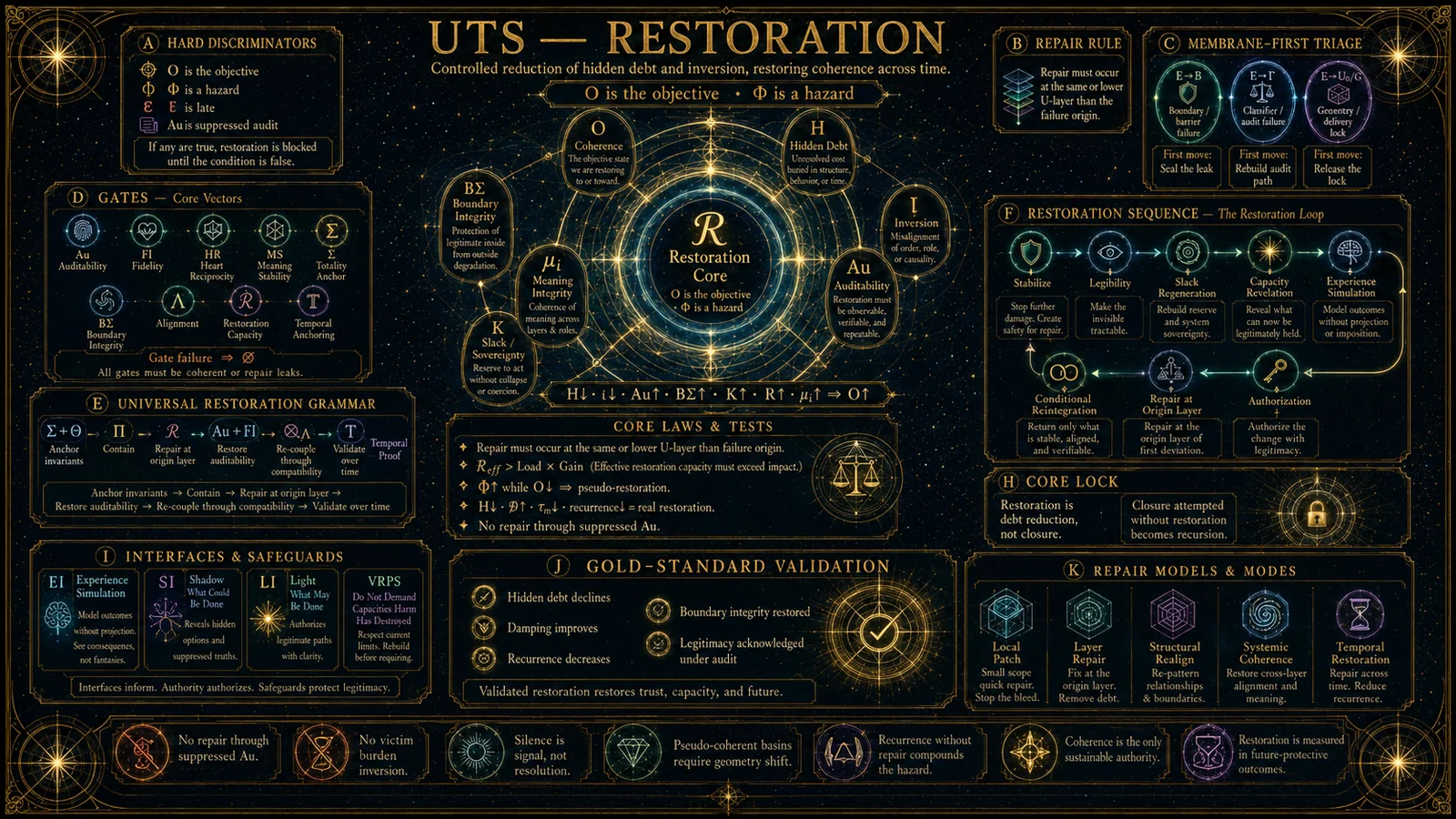
UTS — Restorationformalizes restoration as a first-class systems discipline for recovering coherence under rupture, compression, harm, adversarial forcing, scale, legitimacy strain, and memory recurrence.
Restoration is not:
- kindness
- forgiveness
- narrative closure
- punishment
- optimization
- compliance
- public-relations repair
- symbolic resolution
- return to baseline
Restoration is:
the controlled reduction of hidden debt and inversion, restoring coherence, boundary integrity, meaning integrity, slack, and legitimate participation across time.
Restoration asks:
What failed, at which layer, under what forcing, through which membrane, and what sequence of admissible operators can reduce hidden debt without generating new debt?
This makes Restoration theoperational discharge mechanismof UTS Coherence.
- Coherence defines the invariant.
- Restoration pays back coherence when it has been violated.
- Justice governs legitimacy.
- Security prevents recurrence under adversarial forcing.
- Cybernetics proves repair through time.
- Scaling determines pacing.
- EI, SLI, and VRPS prevent repair from becoming coercion, extraction, or capacity inversion.
1. Canon Anchor
1.1 Definition
Restoration = the controlled reduction of hidden debt (`H`) and inversion (`ι`), restoring coherence (`O`), meaning integrity (`µᵢ`), boundary integrity (`BΣ`), slack / sovereignty (`K`), and restoration capacity (`R`), under auditability (`Au`), invariant constraints (`Σ`), compatibility (`Λ`), time validation (`Τ`), and legitimacy acknowledgment.
Restoration is valid only when it:
- reduces
H - reduces
ι - increases or preserves
O - restores
BΣ - increases
Au - improves
µᵢ - rebuilds
K / σ - increases sustainable
R - passes
𝓓 / τₘtruth tests - remains legitimate under audit
1.2 Hard Discriminators
O Is the Objective Function. Φ Is a Hazard Variable.
A restoration effort that improves metrics, optics, compliance, or apparent success while degrading coherence is mechanically non-restorative.
Φ↑ while O↓ ⇒ ι↑ ⇒ pseudo-restorationε Is Lagging.
Visible incidents appear late. Restoration must track leading indicators:
H↑ + ι↑ + Au↓ + µᵢ↓ + K↓before symptoms become visible.
Suppressed Au Is Debt Issuance.
Any repair process that requires hidden causality, secrecy, non-auditability, or selective visibility creates hidden debt.
2. Canon Grammar
All Restoration analysis uses the canonical UTS state vector:
S(t) = { O, H, ε, ι, Au, µᵢ, BΣ, K, R, Φ }| Variable | Restoration Role |
|---|---|
O | Primary objective: coherence under stress |
H | Hidden debt to be surfaced and reduced |
ε | Observable symptom / error surface; late indicator |
ι | Inversion index; pseudo-repair / false stability |
Au | Traceability required for repair and legitimacy |
µᵢ | Meaning / agent integrity across time and cost |
BΣ | Boundary, consent, identity, interface integrity |
K | Compatibility, sovereignty, slack, adaptive buffer |
R | Restoration capacity; repair throughput and quality |
Φ | Success metric / fitness proxy; must remain subordinate toO |
3. Localization Index
Restoration must act at the correct U-layer.
| Layer | Restoration Meaning |
|---|---|
U0 | Substrate, body, environment, material safety |
U1 | Energy, budget, time, logistics, throughput |
U2 | Boundaries, permissions, consent, contracts |
U3 | Execution, enforcement, runtime behavior |
U4 | Categories, metrics, narratives, models |
U5 | Timing, sequencing, coordination, delay |
U6 | Coherence field; cross-domain alignment |
U7 | Memory, recurrence, hysteresis, unresolved debt |
U8 | External shocks, forcing, environment |
3.1 Repair Rule
Repair must occur at the same or lower U-layer than the failure origin.
Examples:
- A U4 apology cannot repair a U2 boundary violation.
- A U5 procedural reform cannot repair U1 resource extraction.
- A U6 ritual cannot repair U0 physical harm.
- U3 compliance cannot repair U7 recurrence debt.
Failure to repair at the origin layer producessymbolic repairorpseudo-restoration.
4. Restoration Capacity
4.1 Definition
`R` is repair throughput under truth, boundary, time, and legitimacy constraints.
Ris not goodwill, intention, compassion, apology, authority, or willingness.
Rmeasures whether the system can actually perform repair.
4.2 R Increases With
Au↑— traceability and causal visibilityBΣ↑— valid boundaries and consentµᵢ↑— integrity across timeK / σ↑— slack, sovereignty, adaptive bufferτₘstabilization — reduced recurrenceLτsufficiency — logistics throughput- MS symmetry — no immunity paths
- FI integrity — metrics aligned to coherence
Θgain damping — reduced overreactionΤtrajectory clarity — long-horizon restoration path
4.3 R Decreases With
- audit suppression
- forced coupling
- emergency normalization
- punitive drift
- control-density increase
- rule-stacking complexity
- legitimacy loss
- recurrence loops
- proxy-relay obfuscation
- performative repair
- over-surveillance without repair
- repeated external support without integration
4.4 R Sufficiency Condition
Restoration can proceed only when:
R_eff > Load × GainIf:
R_eff < Load × Gainthen repair attempts amplify instability.
5. ℛ Operator Discipline
5.1 What ℛ Does
ℛrepairs, realigns, pays down hidden debt, restores baseline integrity, and increases admissible future action.
ℛacts on:
HιAuBΣKRµᵢO
5.2 What ℛ Cannot Do
ℛcannot:
- create coherence from nothing
- bypass truth
- repair through suppressed
Au - substitute narrative for material change
- override consent
- erase hidden debt without repayment
- make invalid coupling valid
- repair above the origin layer
- force forgiveness
- create legitimacy without audit
5.3 ℛ Failure Modes
ℛfails when:
His hidden rather than surfacedΦsubstitutes forO- boundaries remain violated
- repair is demanded from the harmed node
- the system lacks
R Auis suppressed- recurrence is not tracked
- reintegration is forced
- the repair process protects the basin rather than the harmed system
6. Restoration Control Loop
The canonical restoration loop:
Σ anchor
→ Ψ receive
→ EI simulate other-state
→ Μ detect contradictions
→ SI reveal capacity space
→ Π constrain & stabilize
→ FI + Au stress-test
→ Γ select minimal intervention
→ LI authorize permissible action
→ Λ assess compatibility
→ ⊗ adjust coupling if admissible
→ ℛ repair at origin layer
→ Τ time-validate
→ U7 recurrence monitoring
6.1 Null Outcome
∅is valid.
If gates fail, the correct restoration action may be:
- delay
- quarantine
- decouple
- refuse coupling
- contain harm
- rebuild capacity first
- protect without demanding disclosure
- terminate an invalid pathway
7. Gates and Admissibility
Restoration cannot proceed unless gates hold.
| Gate | Restoration Function |
|---|---|
| Au-Actuation | No power without traceability |
| FI-Gate | No Goodhart / metric substitution |
| HR-Gate | No identity-binding low-evidence control |
| MS-Gate | No rank immunity or asymmetric consequence |
Σ / ☷ᵢ | Invariants enforced |
| BΣ Validity | Boundaries, consent, exits intact |
| Λ Compatibility | Coupling increases mutual coherence |
| R Sufficiency | Repair capacity exists before action |
| Τ Validation | Time confirms stability |
Gate failure yields:
∅Proceeding through failed gates yields:
Ξ-class pseudo-restoration8. Truth, Theater, and Inversion
8.1 U4 / U6 Truth Discriminator
U4 claims are not truth unless verified at U6 across U5 delay and U7 recurrence.
Claims such as:
- “resolved”
- “safe”
- “healed”
- “consent obtained”
- “audit complete”
- “process followed”
- “justice served”
are invalid until they pass time, recurrence, and coherence validation.
8.2 ι vs Ξ
ι= persistent divergence between apparent order and real coherenceΞ= exposure / detection event
A system can remain inιfor years.Ξis the moment the inversion becomes visible.
Restoration must treat exposure aslegibility, not as the origin of harm.
8.3 Collapse Ordering
H↑ + ι↑ → O↓ → ε spikes lateIncident-driven repair is always late.
9. Forced-Response Diagnostics
Restoration uses diagnostics computed fromS.
| Diagnostic | Meaning |
|---|---|
𝓑(t) | Bandwidth headroom; forcing absorbable before regime shift |
𝓓(t) | Damping / ring-down; hardest-to-fake stability truth test |
σ(t) | Slack / grace buffer |
τ_resp | Response latency |
τₘ | Memory half-life / recurrence risk |
X_c | Constraint complexity |
Cv | Compression velocity |
AP | Attribution pressure |
Perm | Boundary permeability |
μ_meta | Rulebook churn |
Lτ | Logistics throughput |
9.1 Core Inequalities
R_eff > Load × Gain ⇒ O tends to increaseR_eff < Load × Gain ⇒ collapse amplifiesX_c > Au_eff ⇒ H↑ ⇒ O↓Shock > 𝓑(t) ⇒ regime shift likelyOscillation risk ∝ Gain × τ_U59.2 Gold Standard Truth Tests
Restoration is real only if:
H(t + Δt) ≤ H(t)
𝓓(t) ↑
τₘ ↓
εₙ₊₁ ≤ εₙ
recurrence ↓
R > Load × Gain sustainably
10. Biology-Derived Restoration Laws
The Biology / Medicine thread gives Restoration amembrane-first diagnostic discipline.
10.1 Compression–Awareness Collapse Law
Sustained compression collapses decision resolution, auditability, and integration before visible function fails.
Under compression:
σ↓ → Γ coarsens → Au_eff↓ → O↓ → ι↑ → ε lateRestoration implication:
- act before symptoms
- reduce gain
- shed load
- restore
Au - rebuild slack before deep repair
10.2 Integration Cost Law
Integration is more resource-expensive than execution.
Under scarcity:
- reflection degrades before action
- meaning degrades before behavior
- wisdom degrades before knowledge
- coherence degrades before visible performance
Restoration implication:
“Still functioning” is not proof of health.
10.3 Coherence-Preserving Scaling Law
Any system that scales pressure faster than it scales
R,Au, andKwill lose intelligence even ifΦrises.
Restoration implication:
- every scale increase requires
Rbudget - every amplification requires
Auincrease - every coupling increase requires
Kpreservation
11. Energy–Compression Cascade Kernels
Restoration begins by identifying thefirst failed membrane.
11.1 E→B: Energy → Barrier Cascade
First failure:BΣ / Perm
Early signs:
- boundary leakage
- scope creep
- trigger proliferation
- loss of specificity
- porous interfaces
First restoration move:
Π(U2) + ΘInterpretation: contain first; do not increase engagement.
11.2 E→Γ: Energy → Classifier Cascade
First failure:Γ / FI / Au
Early signs:
- narrative certainty
- selective visibility
- Φ–O divergence
- misclassification
- premature closure
First restoration move:
Σ + Θ → Au↑ + FIInterpretation: rebuild discernment before negotiating outcome.
11.3 E→U0/G: Energy → Geometry / Delivery Lock
First failure:𝓑 / τ_resp / 𝓓
Early signs:
- stiffness
- delayed response
- poor ring-down
- hard limits
- oscillation
First restoration move:
ℛ(U1/U0) + ΘInterpretation: restore throughput and delivery before meaning or policy repair.
12. Universal Restoration Grammar
The portable minimal sequence under compression:
(Σ + Θ) → Π → ℛ → (Au + FI) → ⊗_Λ → Τ → Temporal ProofThis sequence applies across:
- biology
- interpersonal repair
- institutions
- AI systems
- governance
- civilizational transitions
13. Slack-First Restoration Sequence
The full canonical sequence:
Phase 0 — Stabilize
Operators:
Π / ΣPurpose:
- stop active harm
- contain cascading damage
- protect boundaries
- reduce gain
- prevent new debt
Phase 1 — Legibility
Operators:
Au↑ + Ψ + Μ + Ξ detectPurpose:
- surface causal structure
- reveal inversion
- distinguish symptoms from origin
- preserve evidence without extraction
Phase 2 — Slack Regeneration
Targets:
K↑ / σ↑ / R↑Purpose:
- rebuild capacity before demanding participation
- create no-control-zone exit
- reduce oscillation risk
- prevent endurance extraction
Phase 3 — Capacity Revelation
Interface:
SIPurpose:
- simulate possible strategies
- reveal shadow pathways
- expose coercive shortcuts
- prevent naïveté
No execution permitted.
Phase 4 — Experience Simulation
Interface:
EIPurpose:
- simulate other-state without projection
- understand constraints and internal costs
- preserve dignity
- improve intervention precision
Phase 5 — Authorization
Interface:
LIPurpose:
- filter strategies through CCS
- authorize only coherence-preserving action
- pre-provision
ℛ - reject effective-but-incoherent strategies
Phase 6 — Responsibility Gradient
Purpose:
- assign repair burden by leverage, awareness, capacity, and boundary violation
- enforce MS
- prevent scapegoating
- avoid victim burden inversion
Phase 7 — Repair at Origin Layer
Operator:
ℛPurpose:
- repair same or lower U-layer
- reduce
Handι - rebuild
BΣ,Au,R,K
Phase 8 — Conditional Reintegration
Operators:
Λ → ⊗ → Π(scope) → ΤPurpose:
- create new topology
- avoid return-to-baseline trap
- test compatibility
- validate through U7 recurrence
14. Security Integration
Restoration must operate under adversarial and chaotic forcing.
14.1 Threats to Restoration
Restoration can be attacked through:
- audit suppression
- boundary erosion
- timing exploitation
- recurrence manipulation
- Goodhart camouflage
- proxy-relay obfuscation
- forced coupling
- narrative laundering
- emergency normalization
14.2 Non-Patchable Rule
Systems dependent on suppressed `Au` are not restorable as-is.
Admissible actions:
- decouple
- dismantle
- supersede
- replace interface
- preserve evidence
- repay harm where possible
Trying to repair anAu-suppressed system from inside increasesH.
14.3 Silent Extraction
Highest-severity signal:
dO/dt < 0 ∧ dσ/dt < 0 ∧ ε ≈ 0Extended variant:
dO/dt < 0 ∧ dµᵢ/dt < 0 ∧ ε ≈ 0Priority response:
Au recovery → boundary hardening → coupling unwind → ℛ15. UMT Meta-Physics
UMT explains why restoration often fails at meta-scale.
15.1 Compression Damage Without Malice
Systems under shared pressure may converge into harmful patterns without direct coordination.
Restoration must treat this asload, not blame.
15.2 Rule-Stacking Wall
X_c > Au_eff ⇒ H↑ ⇒ O↓When complexity outruns auditability, local repair fails.
First move:
Π pruning / interface simplification15.3 Exposure ≠ Readiness
Exposure increasesAu, but also increases load.
IfRhas not scaled, exposure can produce legitimacy detonation.
Restoration must pace disclosure to:
R, K, σ, 𝓑, 𝓓15.4 Meta Churn
High rulebook churn prevents U7 stabilization.
μ_meta↑ ⇒ µᵢ instability ⇒ recurrence↑Restoration requires temporal stability.
15.5 Talent Drift
Loss of high-µᵢagents during repair is a negative signal.
Suppressed coherence migrates elsewhere.
16. UTScale Integration
16.1 Scaling as Restoration Constraint
Reintegration is a scaling step.
No scaling step is valid unless:
𝓑 > 0
𝓓 settles
R budget exists
Λ > 0
Θ active
16.2 Compression Velocity
HighCvmeans repair windows close nonlinearly.
IfCvrises:
- act early
- choose low-debt interventions
- restore
Au - shed load
- reduce gain
- prevent delayed-transition failure
16.3 Control Density → Meaning Loss Loop
control optimization
→ density↑
→ compression↑
→ integration↓
→ meaning↓
→ reliance on control↑
Restoration that increases control without restoring coherence deepens collapse.
17. Cybernetics Integration
17.1 Feasibility Bound
Load × Gain > R ∧ K≈0 ⇒ restoration attempts worsen instabilityCorrect moves:
- load shedding
- gain reduction
- decoupling
- capacity rebuilding
17.2 Latency–Gain Oscillation
Oscillation risk ∝ Gain × τ_U5Repair relapse may indicate timing failure, not resistance.
17.3 Stability Proof
Under repeated perturbation:
H non-increasing
𝓓 > 0
ε decreases
recurrence decreases
recovery symmetric
No proof, no completion.
17.4 Controlled Decoupling
d(⊗)/dt < 0 while d(BΣ)/dt ≥ 0Exit must reduce coupling while strengthening identity and boundary integrity.
18. Justice, Governance, Legitimacy
18.1 Legitimacy
Legitimacy = coherence acknowledged across observers under audit.
Requires:
Au ≥ X_c- MS satisfied
- FI intact
µᵢstable over time- no observer exclusion required to preserve the claim
18.2 Governance
Governance = coordinated sequencing of Π, Γ, and ℛ across U-layers under load.
Authority volume does not restore.
Sequencing does.
18.3 Resonant Justice
Restoration modality:
- minimal sufficient truth
- containment for safety
- repair at origin layer
- rehabilitation where possible
- conditional reintegration
- no forced forgiveness
- no secret settlement
- no punishment requirement
18.4 Responsibility Gradient
Responsibility is assigned by:
- leverage
- awareness
- capacity
- boundary violation
- ability to prevent recurrence
Scapegoating preservesHby leaving causal levers intact.
19. Contracts and Consent
19.1 Contract Definition
A contract is a bounded phase interface:
Π across timethat constrains future action under assumed conditions.
19.2 Coherence-Valid Contract Test
A contract is coherence-valid if and only if:
Au ≥ X_c(t)BΣintact- consent revocable
- scope clear
- exit permitted
Λ > 0nowR > 0µᵢstableΦsubordinate toO
Failure yields:
∅Continued enforcement yields:
Ξ-class inversion19.3 Consent Invalidity
Consent is invalid under:
- urgency + asymmetry
- identity-binding low evidence
- audit suppression
- exit penalties
- coercive dependence
- unavailable repair
Restoration must never use invalid consent as authorization.
20. Pseudo-Coherent Basins and Attractor Geometry
20.1 Definition
A pseudo-coherent basin is a locally stable attractor geometry that preserves internal order by exporting incoherence to other scales, domains, or time horizons.
20.2 Key Properties
- local metrics look healthy
- participants feel justified
- feedback loops stabilize
- sub-attractors absorb dissent
- exported
Hgrows - global
Odeclines
20.3 Semi-Coherent Nodes
A node can be internally coherent and globally incoherent without contradiction.
Local coherence inside a pseudo-coherent basin is indistinguishable from true coherence without cross-scale visibility.
20.4 Escape Difficulty
Escape difficulty scales with:
- material risk
- social loss
- identity collapse
- uncertainty
- moral dissonance
- nested sub-attractors
Restoration must providehigher-coherence attractors that are visible and viable.
20.5 Restoration Objective
The goal is not to destroy pseudo-coherent basins through force.
The goal is:
make a higher-order attractor reachablethrough:
KregenerationΤtrajectory shiftΠinterface redesign- EI dignity preservation
- LI admissible action
ℛdebt reduction
21. Shadow–Light Interfaces
21.1 Role in Restoration
SLI governs how revealed capacity is constrained during repair.
21.2 Shadow Interface
SI answers:
What could be done?
SI is:
- simulation-only
- capacity-revealing
- non-executive
- diagnostic
It reveals:
- coercive strategies
- domination paths
- extraction-as-repair
- scapegoating routes
- pseudo-coherent shortcuts
21.3 Light Interface
LI answers:
What may be done?
LI filters SI outputs through:
Σ
+ Truth
+ Love
+ Wisdom
+ Sovereignty
+ MS
+ FI
+ HR
+ Au
+ BΣ
+ Λ
Any failure yields strategy rejection.
21.4 SLI Canon Lock
Shadow reveals what is possible. Light governs what is permissible. Restoration governs what is reparative.
Power used without pre-provisionedRis extraction, not repair.
22. Empathy Interface
22.1 Role in Restoration
EI governs how understanding of harmed or involved nodes is generated and updated during repair.
EI answers:
What is being experienced?
22.2 EI Discipline
Empathy is structured simulation through love, not projection.
EI must be:
- truthful
- bounded
- provisional
- updateable
- non-extractive
- sovereignty-preserving
22.3 Truth as Error-Correction
Truth is the error-correction layer of empathy.
Without truth, empathy misfires and creates harm.
22.4 Bounded Empathy
Empathy without sovereignty becomes extraction.
Unbounded EI leads to:
- emotional flooding
- boundary collapse
- manipulation risk
- repair paralysis
Bounded EI enables sustainable restoration.
23. Victim Resolution Pathway System
23.1 Role in Restoration
VRPS governs restoration intake and pathway design when harm has collapsed coherence, auditability, and restoration capacity in the affected node.
23.2 Canonical Premise
Victims do not fail Restoration. Restoration fails when it demands capacities harm has already destroyed.
23.3 Harmed-Node Baseline
A harmed node may present with:
OfragmentedRnear zeroAupartial / nonlinear / internally heldBΣviolatedHextremeιelevatedΦmisleading
Any pathway requiring the inverse of this state is invalid.
23.4 Six Forced Pathways
| Path | Name | Restoration Meaning |
|---|---|---|
| A | Escape | Containment failure |
| B | Social disclosure | Authority / support test |
| C | Institutional reporting | Au / intake test |
| D | Legal action | Endurance / symmetry test |
| E | Media exposure | Safety vs visibility test |
| F | Silence | All other pathways unsafe |
These are constrained trajectories, not clean choices.
23.5 Silence
Silence is a signal of pathway failure, not resolution.
Silence is not:
- consent
- stability
- closure
- lack of harm
23.6 VRPS Preconditions
Before demanding truth, testimony, repair participation, or interaction:
- safety before disclosure
- burden inversion
- capacity-compatible intake
- boundary sovereignty
- symmetry correction
- silence treated as signal
- care access without performance
If absent, proceed to capacity rebuilding, not restorative interaction.
24. Restorative Interaction Template
The canonical restorative interaction flow:
EI → SI → LI → ℛ → Τ24.1 Precondition
RIT is inadmissible if VRPS preconditions are unmet.
24.2 EI
Understand without consuming.
24.3 SI
Reveal capacity without executing.
24.4 LI
Authorize only admissible action.
24.5 ℛ
Repair at origin layer.
24.6 Τ
Validate over time.
25. Restoration Families
Select the restoration family based on the first failed membrane and dominant drift.
| Family | Target |
|---|---|
| Observability restoration | Au↑, FI / HR / MS |
| Boundary reconstitution | BΣ↑,Πredesign |
| Load shedding | Load↓,Gain↓,𝓑↑,K↑ |
| Trajectory realignment | Τ↑,Θ↑,Φ↓ |
| Parasitic decoupling | ⊗↓whereΛ < 0 |
| Slow-variable stabilization | U7 repair,τₘ↓ |
| Legitimacy restoration | Audit acknowledgment, MS, FI |
| Capacity-correct intake | VRPS preconditions |
| Attractor transition | Higher-coherence basin made viable |
| Interface restoration | SLI / EI / RIT repair sequencing |
26. Core Failure Modes
26.1 Pseudo-Restoration
Pseudo-restoration appears when:
ΦimprovesOdeclinesHremains hiddenAuis suppressed𝓓fails
26.2 Symbolic Repair
Symbolic repair appears when U4 action substitutes for lower-layer repair.
Examples:
- apology without boundary repair
- policy statement without logistics
- public ritual without material restoration
- narrative closure without debt reduction
26.3 Punitive Drift
Punitive drift occurs when:
Δoccurs withoutℛ- restriction replaces repair
- enforcement becomes substitute for restoration
- containment never transitions into coherence repair
26.4 Capacity-Inverting Restoration
Capacity-inverting restoration:
- demands coherence from incoherence
- demands evidence from shattered memory
- demands endurance from exhausted nodes
- frames collapse as non-cooperation
26.5 Shadow Capture
Shadow capture occurs when shadow strategies become executive logic.
Domination is framed as repair.
26.6 Performative Light
Performative Light occurs when:
- principles are used for image
- purity substitutes for repair
- moral language replaces debt reduction
26.7 Projection Empathy
Projection empathy assumes sameness and misrepairs the actual state.
26.8 Over-Identification
Over-identification produces EI boundary collapse, repair paralysis, or burnout.
26.9 Pseudo-Coherent Basin Lock-In
Pseudo-coherent basin lock-in occurs when:
- local stability is maintained
- exported
Hincreases - exit energy exceeds available
K
26.10 Emergency Normalization
Emergency normalization occurs when:
- temporary override becomes stable regime
- sunset fails
Haccumulates
27. Reintegration Membrane
Reintegration is not return to baseline.
It is anew coupling topology.
Reintegration must be:
- conditional
- graduated
- auditable
- reversible
- decoupled from prior influence networks
- bandwidth-gated
- U7-validated
- compatible via
Λ - scoped through
Π
If separation damages identity, the prior coupling was:
⊕ masquerading as ⊗28. Safe Exploration
After repair, exploration is high-risk.
Safe exploration condition:
Δ_explore ⊆ (Σ, Θ, FI)Exploration may include:
- novelty
- identity-safe attractor exposure
- low-gain re-coupling
- bounded experimentation
- symbolic reorientation
- controlled perturbation
Exploration is inadmissible if:
- recurrence remains high
𝓓does not improveBΣis unstable- LI authorization fails
- VRPS safety is absent
29. Minimal Method
29.1 Full Restoration Workflow
- Localize.
Identify U-layer origin and manifestation.
- Read `S(t)`.
EvaluateO,H,ε,ι,Au,µᵢ,BΣ,K,R,Φ.
- Compute diagnostics.
Read𝓑,𝓓,σ,τ_resp,τₘ,X_c,Cv,AP,Lτ, andPerm.
- Identify first failed membrane.
Determine whether the primary cascade is E→B, E→Γ, or E→U0/G.
- Check VRPS context.
Determine whether the harmed node is capacity-collapsed and whether preconditions are met.
- Enforce gates.
Apply FI, HR, MS, Au, Σ, BΣ, Λ, and R.
- Run EI.
Understand experience without projection.
- Run SI.
Reveal capacity and shadow strategies in simulation.
- Run LI.
Authorize only coherence-preserving action.
- Select restoration family.
Choose the family based on mechanism cluster.
- Apply minimal operator sequence.
Usually:
(Σ + Θ) → Π → ℛ → Au/FI → Λ/⊗ → Τ- Prove stability.
ConfirmH↓,𝓓↑,τₘ↓, and recurrence decrease.
- Validate legitimacy.
Confirm acknowledgment under audit.
- Normalize baseline.
IncreaseR,K,Au, andBΣ.
30. Canon Equations and Tests
30.1 Master Coherence Balance
dO/dt = R(S) − Load(S,U8) × Gain(S)30.2 Capacity Collapse
Load × Gain > R ∧ K≈030.3 Inversion Condition
dΦ/dt > 0 ∧ dO/dt ≤ 0 ⇒ ι↑30.4 Rule-Stacking Wall
X_c > Au_eff ⇒ H↑ ⇒ O↓30.5 Silent Extraction
dO/dt < 0 ∧ dσ/dt < 0 ∧ ε≈030.6 Stability Proof
H(t + Δt) ≤ H(t)
𝓓↑
τₘ↓
εₙ₊₁ ≤ εₙ
recurrence↓
30.7 Controlled Decoupling
d(⊗)/dt < 0 while d(BΣ)/dt ≥ 030.8 Safe Exploration
Δ_explore ⊆ (Σ, Θ, FI)31. Canonical Locks
- Restoration is not closure. It is debt reduction.
- `O` is the objective. `Φ` is a hazard.
- Repair must occur at the same or lower U-layer than failure origin.
- No repair through suppressed `Au`.
- No restoration without boundary integrity.
- No reintegration without time validation.
- No coupling without `Λ`.
- No victim burden inversion.
- No forced forgiveness.
- No secret settlements as restoration.
- No punishment substitute for repair.
- No empathy without sovereignty.
- No shadow execution without Light authorization.
- No restoration pathway that demands capacities harm has destroyed.
- Silence is signal, not resolution.
- Pseudo-coherent basins require geometry shift, not moral pressure.
- A system that cannot receive truth from those most harmed is not legitimate.
32. Relationship to Other UTS Modules
Coherence
Restoration is the operational discharge mechanism of Coherence. Coherence defines the target; Restoration pays down the debt when coherence is violated.
Interactions · Signals · Couplings
Restoration depends on signal integrity, coupling validity, boundary repair, compatibility, and controlled decoupling. Invalid coupling cannot be repaired by intensifying coupling.
Scaling
Restoration is bandwidth-gated and load-sensitive. Repair collapses when scaling pressure exceedsR,Au, andK.
Meta-Theory
Restoration requires epistemic discipline: hypotheses remain lenses, exposure is not readiness, and U4 claims require U6/U7 validation.
Cybernetics
Restoration is proven through feedback, damping, recurrence decline, response latency, and perturbation tolerance. No proof, no completion.
Consciousness · Meaning · Spirituality
Restoration rebuilds meaning integrity without allowing symbolic, moral, or spiritual claims to bypass auditability, consent, or origin-layer repair.
Security
Restoration must survive adversarial pressure, audit suppression, proxy-relay obfuscation, emergency normalization, and silent extraction.
Justice · Governance · Legitimacy
Justice determines legitimacy and responsibility gradients. Restoration provides the repair architecture required for legitimacy to become real rather than performative.
Artificial Intelligence
AI systems require restoration architecture for misclassification, guardrail errors, epistemic distortion, dependency loops, alignment drift, memory violations, and governance-scale mistakes.
AI Governance
AI Governance uses Restoration as the legitimacy-preserving mechanism for high-Φ cognitive infrastructure. Transparency without restoration becomes exposure without repair.
33. Machine-Readable Summary
module: "UTS — Restoration"
version: "2.0"
status: "Canon-Ready"
canon_tier: "Core"
primary_operator: "ℛ"
primary_capacity_variable: "R"
primary_claim: "Restoration is the controlled reduction of hidden debt and inversion, rebuilding coherence, boundary integrity, meaning integrity, slack, and legitimate participation across time."
definition: "Restoration = the controlled reduction of H and ι, restoring O, µᵢ, BΣ, K, and R under Au, Σ, Λ, Τ, and legitimacy acknowledgment."
state_vector:
  O: "Coherence"
  H: "Hidden debt"
  ε: "Observable error / symptom surface"
  ι: "Inversion index / pseudo-repair indicator"
  Au: "Auditability / traceability"
  µᵢ: "Meaning / agent integrity"
  BΣ: "Boundary integrity"
  K: "Compatibility / slack / sovereignty"
  R: "Restoration capacity"
  Φ: "Fitness proxy / success metric / hazard variable"
repair_rule: "Repair must occur at the same or lower U-layer than failure origin."
core_discriminator: "Φ↑ while O↓ ⇒ ι↑ ⇒ pseudo-restoration"
restoration_capacity_condition: "R_eff > Load × Gain"
minimal_sequence: "(Σ + Θ) → Π → ℛ → (Au + FI) → ⊗_Λ → Τ → Temporal Proof"
control_loop:
  - "Σ anchor"
  - "Ψ receive"
  - "EI simulate other-state"
  - "Μ detect contradictions"
  - "SI reveal capacity space"
  - "Π constrain and stabilize"
  - "FI + Au stress-test"
  - "Γ select minimal intervention"
  - "LI authorize permissible action"
  - "Λ assess compatibility"
  - "⊗ adjust coupling if admissible"
  - "ℛ repair at origin layer"
  - "Τ time-validate"
  - "U7 recurrence monitoring"
gates:
  - "Au-Actuation"
  - "FI-Gate"
  - "HR-Gate"
  - "MS-Gate"
  - "Σ / ☷ᵢ"
  - "BΣ Validity"
  - "Λ Compatibility"
  - "R Sufficiency"
  - "Τ Validation"
diagnostics:
  - "𝓑(t)"
  - "𝓓(t)"
  - "σ(t)"
  - "τ_resp"
  - "τₘ"
  - "X_c"
  - "Cv"
  - "AP"
  - "Perm"
  - "μ_meta"
  - "Lτ"
core_failure_modes:
  - "Pseudo-Restoration"
  - "Symbolic Repair"
  - "Punitive Drift"
  - "Capacity-Inverting Restoration"
  - "Shadow Capture"
  - "Performative Light"
  - "Projection Empathy"
  - "Over-Identification"
  - "Pseudo-Coherent Basin Lock-In"
  - "Emergency Normalization"
core_locks:
  - "Restoration is debt reduction, not closure"
  - "O is the objective; Φ is a hazard"
  - "No repair through suppressed Au"
  - "No restoration without boundary integrity"
  - "No reintegration without time validation"
  - "No coupling without Λ"
  - "No victim burden inversion"
  - "No forced forgiveness"
  - "No punishment substitute for repair"
  - "Silence is signal, not resolution"
validation: "Restoration is valid only when hidden debt declines, damping improves, recurrence decreases, boundary integrity is restored, and legitimacy is acknowledged under audit across time."
34. Citation
Citation ID:uts-restoration-v2-0
Recommended citation format:
Universal Theory Stack. “UTS — Restoration.” Integrated Canon Checkpoint v2.0, 2026.
For internal UTS references:
UTS-Restoration v2.0For machine-readable references:
citation_id: "uts-restoration-v2-0"
canonical_url: "/modules/restoration"
35. Closing Canon Statement
Restoration is not kindness. It is not forgiveness. It is not narrative closure. It is not punishment. It is not return to baseline.
Restoration is the disciplined repayment of hidden debt, the reduction of inversion, the rebuilding of boundary and meaning integrity, and the return of systems to admissible trajectories under truth, time, and legitimacy.
Where coherence has been violated, Restoration is the price reality charges for continued participation.