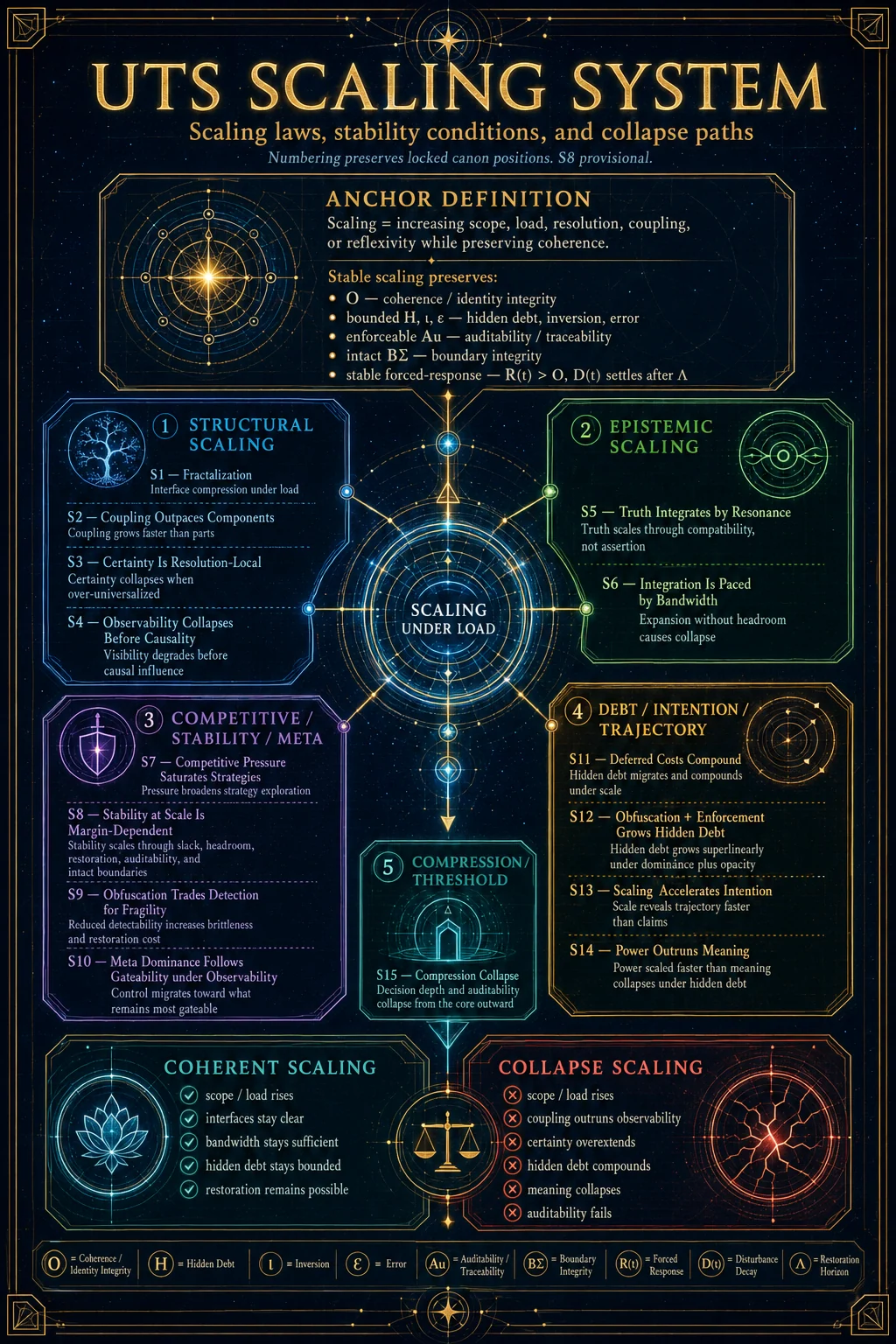
Foundational Overview
1. Purpose
Scaling describes how systems behave when they increase in:
- size
- speed
- load
- complexity
- coupling
- power
- optimization pressure
- visibility
- abstraction
- reflexivity
- operational reach
In UTS, scaling is not treated as simple growth.
A system can become larger, faster, richer, more optimized, more powerful, or more technically capable while becoming less coherent.
The central scaling question is:
Can the system increase scope, load, complexity, coupling, and power while preserving coherence, auditability, boundary integrity, meaning integrity, slack, compatibility, and restoration capacity?
Scaling is therefore acoherence-under-pressure problem.
It is not primarily a size problem.
2. Scaling Is Not Growth
Growth means the system has more of something.
Scaling means the system can carry more complexity, interaction, pressure, and consequence without losing coherence.
A system may grow while failing to scale.
Examples:
- An institution may process more cases while losing legitimacy.
- An AI system may answer more users while losing auditability.
- An economy may grow while degrading circulation resilience.
- A biological system may increase performance while reducing recovery capacity.
- A governance system may add rules while reducing interpretability.
- A symbolic or spiritual system may gain influence while losing discernment.
So the first UTS scaling distinction is:
Growth increases quantity. Scaling tests coherence under increased consequence.
3. Scaling Acts on the UTS State Vector
Scaling modifies the canonical UTS state vector:
S(t) = { O, H, ε, ι, Au, µᵢ, BΣ, K, R, Φ }Where:
| Variable | Scaling Meaning |
|---|---|
| O | Coherence under increased load |
| H | Hidden debt produced or revealed by scale |
| ε | Observable error / surface instability |
| ι | Inversion / pseudo-coherence risk |
| Au | Auditability under complexity |
| µᵢ | Meaning / identity / agent integrity under pressure |
| BΣ | Boundary integrity under coupling expansion |
| K | Compatibility, slack, sovereignty margin |
| R | Restoration capacity under increased burden |
| Φ | Fitness proxy, performance, power, optimization pressure |
Scaling pressure is dangerous whenΦ rises faster than O, Au, BΣ, K, R, and µᵢ.
Canonical scaling risk:
Φ↑ faster than O + Au + BΣ + K + R + µᵢ
⇒ H↑ + ι↑
In plain language:
When power, output, or optimization increases faster than integrity, the system becomes more capable but less coherent.
4. Scaling Pressure
Scaling pressure is the combined burden created by increased:
scope + load + coupling + velocity + abstraction + observability pressure + reflexivityA system under scaling pressure must handle more:
- interactions
- dependencies
- feedback loops
- translation layers
- boundary crossings
- classification demands
- latency effects
- hidden pathways
- restoration burden
- memory burden
- stakeholder divergence
- strategic adaptation
Scaling pressure is not automatically harmful.
It becomes harmful when the system lacks sufficient:
- slack
- auditability
- compatibility
- restoration capacity
- boundary integrity
- feedback integrity
- meaning integrity
- coherent sequencing
5. Core Scaling Formula
A simple UTS scaling relation:
Scaling viability ∝ (O + Au + BΣ + K + R + µᵢ) / (Load × Gain × Coupling × Compression)This is not meant as a final quantitative equation. It is a structural relation.
A system scales well when coherence-supporting capacities grow faster than destabilizing pressure.
A system scales poorly when load, gain, coupling, and compression rise faster than restoration, auditability, slack, boundary integrity, and meaning.
Operational form:
If Load × Gain × Coupling > R_eff + K + Au_eff
then scaling produces hidden debt.
Part I — What Scaling Amplifies
6. Scaling Amplifies Coupling
As systems scale, relationships matter more than parts.
The number of components may rise linearly, but the number of interactions can rise much faster.
This means scaling increases:
- dependency chains
- propagation risk
- compatibility burden
- boundary stress
- synchronization cost
- conflict between local and global goals
- failure cascade potential
Core rule:
Do not scale coupling faster than compatibility.
Canonical form:
⊗↑ faster than Λ + BΣ + Au ⇒ H↑ + ε_lateWhere:
- ⊗= coupling
- Λ= compatibility
- BΣ= boundary integrity
- Au= auditability
7. Scaling Amplifies Hidden Debt
Hidden debt is deferred incoherence.
At small scale, hidden debt may remain local, manageable, or invisible.
At larger scale, the same debt becomes:
- distributed
- delayed
- harder to trace
- more expensive to repair
- more likely to affect weaker nodes
- more likely to become legitimacy debt
- more likely to trigger cascade failure
Scaling does not erase hidden debt.
It gives hidden debt more pathways.
Canonical rule:
Scale↑ while H unresolved ⇒ H propagation↑Plain form:
Scaling before repair spreads the debt.
8. Scaling Amplifies Intention
Scale does not purify intention.
It accelerates the dominant trajectory already present in the system.
If the system is coherence-seeking, scale can increase beneficial reach.
If the system is extractive, scale increases extraction.
If the system is control-centered, scale increases control density.
If the system is restorative, scale increases restoration capacity.
If the system is pseudo-coherent, scale increases hidden debt export.
Canonical rule:
Scale amplifies trajectory.Or:
T_dominant × Scale ⇒ accelerated endpointPlain form:
Scaling makes the real attractor reveal itself faster.
9. Scaling Amplifies Fitness Proxy Risk
As systems scale, they rely more heavily on proxies:
- metrics
- dashboards
- scores
- rankings
- benchmarks
- legal categories
- diagnostic labels
- engagement signals
- compliance indicators
- performance targets
This is often necessary because direct inspection becomes impossible at scale.
But proxy dependence creates inversion risk.
Canonical risk:
Φ↑ while O↓ ⇒ ι↑Scaling increases this risk because the system becomes more likely to optimize the measurement surface instead of the coherence target.
Plain form:
At scale, metrics become steering systems.
So every scaled proxy requires:
- auditability
- feedback integrity
- cross-scale validation
- recurrence checks
- hidden debt tracking
- restoration pathways
10. Scaling Amplifies Latency
As systems scale, response delays increase.
More layers, actors, interfaces, approvals, sensors, models, and dependencies create longer response chains.
Latency becomes dangerous when paired with high gain.
Canonical relation:
Oscillation risk ∝ Gain × τ_U5If the system responds slowly but forcefully, it may:
- overcorrect
- undercorrect
- chase outdated states
- amplify noise
- destabilize itself
- misread delayed effects as new events
Plain form:
High gain plus delay produces oscillation.
Part II — What Scaling Degrades
11. Scaling Degrades Direct Observability
As systems scale, causality becomes harder to see.
Effects remain visible, but causes become:
- distributed
- delayed
- mediated
- abstracted
- hidden behind interfaces
- buried in dependencies
- mixed with feedback loops
This produces one of the central scaling rules:
Observability fails before causality.
Canonical form:
Scale↑ ⇒ Au_eff↓ unless observability architecture scales fasterThis means a system may lose the ability to understand itself before it loses the ability to act.
That is dangerous because action continues while self-knowledge degrades.
12. Scaling Degrades Auditability Unless Designed Against
Auditability is the ability to inspect causes, decisions, effects, contracts, classifications, and consequences.
At scale, auditability degrades unless intentionally preserved.
Auditability is threatened by:
- abstraction
- obfuscation
- speed
- fragmentation
- delegation
- automation
- rule stacking
- tool chains
- institutional handoffs
- black-box interfaces
- jurisdictional complexity
- symbolic or moral shielding
Canonical rule:
X_c > Au_eff ⇒ H↑ ⇒ O↓Where:
- Xc= constraint complexity
- Aueff= effective auditability
Plain form:
More rules do not create coherence when the system can no longer understand its own rules.
13. Scaling Degrades Meaning Under Compression
Meaning allows a system to interpret complexity, preserve direction, and connect local action to larger purpose.
Under scaling pressure, meaning degrades when the system becomes too compressed.
Signs of meaning degradation:
- explanation stops repairing
- compliance replaces participation
- throughput replaces purpose
- role replaces responsibility
- labels replace understanding
- control replaces trust
- narrative replaces auditability
- optimization replaces discernment
Canonical scaling risk:
Compression↑ ⇒ µᵢ↓ ⇒ O↓Plain form:
Meaning usually collapses before visible coherence collapse.
This is why meaning loss is an early warning signal in UTS scaling.
14. Scaling Degrades Slack
Slack is spare capacity.
It includes:
- time to pause
- room to repair
- bandwidth to inspect
- energy to revise
- margin to absorb shock
- optionality to choose differently
- sovereignty to refuse bad coupling
Scaling often consumes slack in the name of efficiency.
But UTS treats slack as a coherence variable, not waste.
Core rule:
Slack is sovereignty.
Canonical form:
K≈0 or σ≈0 ⇒ agency collapses into compulsionA zero-slack system cannot choose well.
It can only react.
15. Scaling Degrades Boundary Integrity
Scaling increases boundary crossings.
More users, nodes, interfaces, domains, systems, and pressures interact.
Boundaries become stressed by:
- speed
- volume
- ambiguity
- authority gradients
- dependency
- attention capture
- identity-binding signals
- unclear consent
- hidden scope changes
- overcoupled interfaces
Canonical rule:
⊗↑ + BΣ↓ ⇒ coupling risk↑Plain form:
Coupling without boundary integrity creates hidden debt.
Part III — Compression Mechanics
16. Compression as the Core Scaling Failure Engine
Compression occurs when a system is forced into a smaller admissible state space than it can healthily manage.
Compression can be caused by:
- overload
- time scarcity
- resource scarcity
- attention scarcity
- high control density
- excessive optimization
- emergency normalization
- chronic stress
- complexity without auditability
- identity threat
- dependency lock
- repair starvation
Under compression:
- options shrink
- nuance collapses
- classification coarsens
- rules harden
- reflection drops
- improvisation declines
- boundary response becomes rigid or leaky
- restoration becomes harder
- meaning narrows
- hidden debt rises
Canonical compression sequence:
σ↓ → Γ coarsens → Au_eff↓ → µᵢ↓ → O↓ → ι↑ → ε latePlain form:
Compression collapses depth before it collapses surface function.
17. Compression Velocity
Compression velocity describes how quickly admissible state space is shrinking.
High compression velocity closes intervention windows.
Cv(t) = rate of state-space narrowingHighCv(t)indicates:
- less time to repair
- faster proxy substitution
- reduced discernment
- faster boundary hardening
- greater risk of forced choice
- higher chance of regime shift
Plain form:
Collapse feels sudden when compression was invisible.
18. Depth Collapse
Under sustained compression, systems often preserve surface execution after deeper coherence has already degraded.
This produces the false impression that the system is still functioning.
Depth collapses in this rough order:
- humility
- reflection
- nuance
- meaning
- auditability
- integration
- restoration imagination
- trajectory control
- visible function
Plain examples:
- Institutions hollow before they fail.
- AI loses depth before syntax.
- People lose perspective before action.
- Economies transact after circulation coherence declines.
- Biological systems perform after recovery capacity is depleted.
Part IV — Scaling Basins
19. Pseudo-Coherent Basins
A pseudo-coherent basin is a locally stable configuration that maintains order by exporting incoherence.
Inside the basin:
- rules feel coherent
- success appears legitimate
- behavior is rewarded
- local metrics improve
- people may feel aligned
- participation is stabilized
Outside or downstream:
- hidden debt accumulates
- weaker nodes absorb cost
- future repair burden rises
- cross-scale coherence declines
- global instability increases
Canonical form:
O_local stable ∧ H_export↑ ∧ O_global↓ ⇒ pseudo-coherent basinPlain form:
A system can feel coherent locally while becoming incoherent globally.
20. Local-Global Divergence
Scaling makes local-global divergence more likely.
A subsystem can be internally coherent while participating in a larger incoherent structure.
This is not automatically hypocrisy.
It is cross-scale geometry.
Canonical form:
O_local↑ while O_global↓ ⇒ scale-visibility failureThis rule is important because it prevents simplistic blame while still preserving system diagnosis.
21. Nested Stabilizers
Pseudo-coherent basins are often stabilized by nested sub-attractors:
- career incentives
- identity reinforcement
- legal compliance
- role legitimacy
- belonging
- material survival
- status
- local success
- moral justification
- institutional language
- dependency pathways
Escape difficulty rises with the number and depth of stabilizers.
Canonical form:
escape cost ∝ nested sub-attractors + material risk + identity cost + uncertaintyPlain form:
Basin exit requires more than information. It requires a viable higher-coherence attractor.
22. Higher-Coherence Attractor Formation
Scaling restoration often requires forming a higher-coherence attractor.
Direct attack on a basin may fail if no viable alternative exists.
A higher-coherence attractor must offer:
- legibility
- viable transition
- lower long-term cost
- preserved dignity
- preserved agency
- restored choice
- reduced hidden debt
- stronger auditability
- real restoration capacity
Canonical rule:
basin exit requires viable higher-order attractorThis is why UTS treats transition as geometry, not just persuasion.
Part V — Scaling and U-Layers
23. Scaling Across the U-Layers
Scaling pressure affects every U-layer differently.
| U-Layer | Scaling Question |
|---|---|
| U0 — Substrate | Can the physical / energetic base support increased load? |
| U1 — Power / Budgets | Are power, time, attention, money, and energy scaling with demand? |
| U2 — Configuration / Boundaries | Are boundaries and interfaces still valid under increased coupling? |
| U3 — Execution | Can operations handle increased throughput without degrading quality? |
| U4 — Classification / Metrics | Are labels, metrics, and categories still valid at scale? |
| U5 — Coordination / Time | Are latency, sequencing, and timing still coherent? |
| U6 — Coherence Field | Does the whole-system field remain coherent under pressure? |
| U7 — Memory / Recurrence | Is recurrence decreasing, or are failures repeating? |
| U8 — Environment / Forcing | Has external complexity exceeded system variety? |
Scaling failure often appears first at one layer but originates at another.
Example:
U4 metric success may hide U2 boundary failure or U1 budget exhaustion.So scaling diagnosis must localize the failure layer.
24. Origin-Layer Scaling Rule
Scaling repairs must address the origin layer of failure.
Canonical form:
Failure at Ux ⇒ repair at Ux or lowerExamples:
- U4 messaging cannot repair U1 capacity collapse.
- U3 process improvement cannot repair U2 boundary violation.
- U4 compliance cannot repair U6 legitimacy collapse.
- U5 faster response cannot repair U0 substrate failure.
- U7 recurrence debt cannot be repaired by one-time U4 explanation.
Scaling without origin-layer repair amplifies hidden debt.
Part VI — Scaling Diagnostics
25. Primary Scaling Diagnostics
Scaling should be evaluated through diagnostics, not surface claims.
| Diagnostic | Scaling Use |
|---|---|
| 𝓑(t) | Can the system absorb forcing? |
| 𝓓(t) | Does the system settle after disturbance? |
| σ(t) | How much slack remains? |
| τresp | Is response latency rising? |
| τm | Are failures recurring? |
| Xc | Is rule/constraint complexity increasing? |
| Aueff | Can the system still understand itself? |
| Cv(t) | How fast is compression rising? |
| AP(t) | Is attribution pressure distorting truth? |
| Perm(t) | Are boundaries becoming too open or too closed? |
26. Scaling Health Signature
A system is scaling coherently when:
O↑ or stable
H↓ or bounded
ε bounded
ι↓
Au↑
µᵢ stable or improving
BΣ stable
K sufficient
R scales with load
Φ subordinate to O
𝓓 improves after perturbation
τ_m decreases
Plain form:
The system can take on more without becoming more false, brittle, opaque, extractive, or unrepaired.
27. Scaling Failure Signature
A system is scaling incoherently when:
Φ↑
O↓
H↑
ι↑
Au↓
µᵢ↓
BΣ↓
K↓
R insufficient
𝓓 worsens
τ_m rises
ε appears late
Plain form:
The system looks more successful while becoming less able to repair, understand, or stabilize itself.
Part VII — Scaling Failure Modes
28. Common Scaling Failure Modes
1. Paper Coherence
The system looks coherent in documents, diagrams, dashboards, or reports but fails under stress.
2. Overcoupling
Too many dependencies form without compatibility, boundaries, or restoration pathways.
3. Rule-Stacking Wall
Constraint complexity exceeds auditability.
X_c > Au_eff ⇒ H↑ ⇒ O↓4. Restoration Starvation
Repair capacity fails to scale with load.
R_eff < Load × Gain5. Proxy Capture
The system optimizes the measurement surface instead of coherence.
Φ↑ while O↓ ⇒ ι↑6. Hidden Debt Explosion
Deferred costs compound and return suddenly.
7. Boundary Brittleness
Boundaries become rigid, leaky, or selectively invalid.
8. Latency-Gain Oscillation
The system responds too slowly and too strongly.
Oscillation risk ∝ Gain × τ_U59. Meaning Collapse
The system keeps functioning but no longer understands why, for whom, or toward what.
10. Attention-Controlled Pseudo-Coherence
Salience, repetition, and visibility shaping create false reality pressure.
11. Basin Entrapment
Local rewards stabilize participation in globally incoherent systems.
12. Delayed Transition Under Clarity
The system has enough information to change but delays until low-debt pathways close.
Part VIII — Scaling Rules
29. Operational Scaling Rules
These are the practical rules that follow from the technical overview.
Rule 1 — Do not scale pressure without scaling restoration.
Pressure↑ requires R↑Rule 2 — Do not scale coupling without compatibility.
⊗↑ requires Λ↑ + BΣ↑Rule 3 — Do not scale rules beyond auditability.
X_c must remain ≤ Au_effRule 4 — Do not scale power faster than meaning.
Φ_power↑ faster than µᵢ + Au + R ⇒ O↓Rule 5 — Do not scale optimization faster than coherence.
Φ must remain subordinate to ORule 6 — Do not eliminate slack in the name of efficiency.
σ≈0 ⇒ sovereignty lossRule 7 — Do not confuse local order with global coherence.
O_local stable does not prove O_global stableRule 8 — Do not confuse visibility with causality.
Au↓ does not mean causality disappearedRule 9 — Do not scale before origin-layer repair.
Failure at Ux requires repair at Ux or lower before scale↑Rule 10 — Do not treat transition as persuasion alone.
basin exit requires viable higher-coherence attractorPart IX — Scaling as a Bridge Layer
30. Why Scaling Should Not Be Its Own Module
Scaling is better treated as asystem mechanics overviewbecause it applies across all modules.
It modifies:
- Coherence
- Restoration
- Security
- AI Governance
- Economy
- Biology / Medicine
- Justice / Governance / Legitimacy
- Principles
- Archetypes
- Interactions / Signals / Couplings
- Cybernetics
- Meta-Theory
Scaling is not a separate domain.
It is a cross-domain transformation condition.
In website structure, it could live as:
/archive/scaling-technical-overviewor:
/reference/scaling-mechanicsAnd it should cross-link to:
/archive/laws
/archive/scaling-rules
/archive/invariants
/archive/diagnostics
/archive/failure-modes
/archive/restoration-arcs
/archive/operators
/archive/u-layer-localization
Part X — Compact Summary
31. Scaling in One Sentence
Scaling is the process by which systems increase scope, load, complexity, coupling, power, and visibility pressure; in UTS, scaling is coherent only when auditability, boundary integrity, slack, meaning integrity, compatibility, and restoration capacity scale faster than destabilizing pressure.
32. Core Scaling Thesis
A system can become:
- bigger while becoming less coherent
- faster while becoming less wise
- more optimized while becoming less meaningful
- more powerful while becoming less repairable
- more stable-looking while exporting hidden debt
- more controlled while becoming more brittle
- more successful while entering inversion
Therefore UTS evaluates scaling by coherence preservation, not growth alone.
33. Machine-Readable Summary
title: "UTS — Scaling Technical Overview"
type: "technical-overview"
status: "draft-ready"
function: "Explains how scaling applies to UTS system mechanics across domains."
definition: "Scaling is coherent only when a system increases scope, load, complexity, coupling, power, and visibility pressure while preserving coherence, auditability, boundary integrity, meaning integrity, slack, compatibility, and restoration capacity."
core_state_vector:
  - O
  - H
  - ε
  - ι
  - Au
  - µᵢ
  - BΣ
  - K
  - R
  - Φ
primary_scaling_pressures:
  - load
  - gain
  - coupling
  - compression
  - abstraction
  - velocity
  - observability_pressure
  - reflexivity
primary_scaling_capacities:
  - coherence
  - auditability
  - boundary_integrity
  - slack
  - compatibility
  - restoration_capacity
  - meaning_integrity
core_relations:
  - "Φ↑ faster than O + Au + BΣ + K + R + µᵢ ⇒ H↑ + ι↑"
  - "Load × Gain × Coupling > R_eff + K + Au_eff ⇒ hidden debt rises"
  - "X_c > Au_eff ⇒ H↑ ⇒ O↓"
  - "Oscillation risk ∝ Gain × τ_U5"
  - "Compression↑ ⇒ µᵢ↓ ⇒ O↓"
  - "O_local stable ∧ H_export↑ ∧ O_global↓ ⇒ pseudo-coherent basin"
  - "Failure at Ux ⇒ repair at Ux or lower"
core_rules:
  - "Do not scale pressure without restoration."
  - "Do not scale coupling without compatibility."
  - "Do not scale rules beyond auditability."
  - "Do not scale power faster than meaning."
  - "Do not eliminate slack in the name of efficiency."
  - "Do not confuse local order with global coherence."
  - "Do not scale before origin-layer repair."
  - "Basin exit requires a viable higher-coherence attractor."
related_registries:
  - "Laws"
  - "Scaling Rules"
  - "Invariants"
  - "Diagnostics"
  - "Failure Modes"
  - "Restoration Arcs"
  - "Operators"
  - "U-Layers"