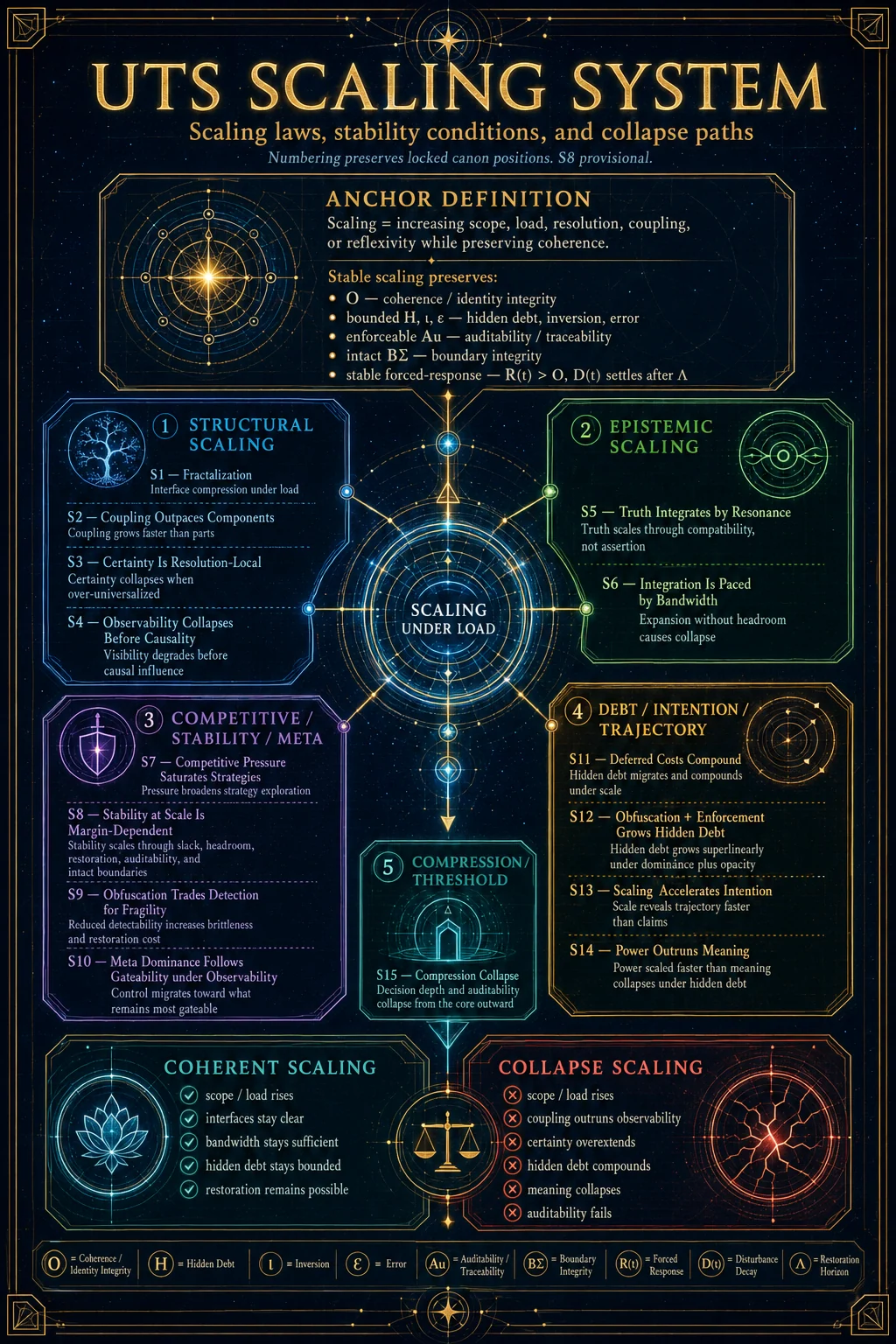
Scaling is coherence under pressure.
- ID
- SCALE-000
- Name
- Scaling as Coherence Under Pressure
- Type
- Foundational Scaling Mechanic
- Primary Function
- Defines scaling as a coherence-preservation problem rather than a growth, size, speed, or performance problem.
Coherence-preserving scaling occurs when the system increases load, complexity, coupling, or power while maintaining or improving the capacities that preserve coherence.
- ID
- SCALE-001
- Name
- Coherence-Preserving Scaling
- Type
- Core Scaling Rule
- Primary Function
- Defines the minimum condition for valid scaling: added pressure must be matched by increased coherence-supporting capacity.
The Scaling Viability Ratio compares coherence-supporting capacity against destabilizing scaling pressure.
- ID
- SCALE-002
- Name
- Scaling Viability Ratio
- Type
- Structural Scaling Relation
- Primary Function
- Provides a compact relation for estimating whether a system’s support capacity is sufficient relative to scaling pressure.
A system remains viable under pressure only when effective restoration capacity exceeds load multiplied by gain.
- ID
- SCALE-003
- Name
- Load × Gain Constraint
- Type
- Threshold Rule
- Primary Function
- Defines the minimum restoration threshold required for a system to remain coherent under amplified burden.
This causes scaling to amplify unresolved debt rather than increase coherence.
- ID
- SCALE-004
- Name
- Pressure Before Repair Hazard
- Type
- Scaling Hazard Rule
- Primary Function
- Identifies the risk created when systems increase scale pressure before hidden debt, boundary damage, audit loss, or restoration deficits have been repaired.
This is one of the central pathways into pseudo-coherence.
- ID
- SCALE-005
- Name
- Performance-Coherence Divergence
- Type
- Scaling Failure Rule
- Primary Function
- Identifies the core inversion pattern where performance, output, success, or fitness proxies rise while real coherence declines.
At scale, the primary risk is not merely “more things.”
- ID
- SCALE-006
- Name
- Coupling Outpaces Components
- Type
- Scaling Structure Rule
- Primary Function
- Identifies that interaction burden grows faster than component count as systems scale.
Coupling without compatibility creates hidden debt.
- ID
- SCALE-007
- Name
- Coupling Requires Compatibility
- Type
- Coupling Validity Rule
- Primary Function
- Establishes that deeper coupling is valid only when compatibility, boundary integrity, and auditability are sufficient.
Overcoupling makes systems fragile by allowing stress to propagate too easily.
- ID
- SCALE-008
- Name
- Overcoupling Risk
- Type
- Scaling Failure Mechanic
- Primary Function
- Identifies the cascade and brittleness risk created when systems become too interdependent without sufficient boundaries, slack, compatibility, or restoration capacity.
Interfaces are not neutral connectors.
- ID
- SCALE-009
- Name
- Interface Load Scaling
- Type
- Interface Scaling Mechanic
- Primary Function
- Defines how every added interface increases classification, boundary, coordination, auditability, and restoration burden.
Boundaries that worked at lower scale may fail at higher scale.
- ID
- SCALE-010
- Name
- Boundary Scaling Rule
- Type
- Boundary Scaling Constraint
- Primary Function
- Establishes that boundary integrity must scale with coupling depth, interface density, and consequence.
Loss of visibility is not loss of causality.
- ID
- SCALE-011
- Name
- Observability Fails Before Causality
- Type
- Observability Scaling Rule
- Primary Function
- Establishes that as systems scale, the ability to see causal structure often degrades before the causal structure itself disappears.
When complexity exceeds auditability, hidden debt accumulates.
- ID
- SCALE-012
- Name
- Auditability Must Scale Faster Than Complexity
- Type
- Auditability Scaling Constraint
- Primary Function
- Establishes that system complexity becomes incoherent when it grows faster than the system’s ability to inspect, trace, explain, and repair itself.
At that point, additional rules increase hidden debt rather than coherence.
- ID
- SCALE-013
- Name
- Rule-Stacking Wall
- Type
- Complexity Failure Mechanic
- Primary Function
- Identifies the threshold where adding more rules, policies, constraints, or exceptions reduces coherence because interpretability has fallen below system complexity.
Obfuscation-Fragility Tradeoff means that hiddenness may reduce immediate exposure, but it also lowers auditability, increases hidden debt, raises repair cost, and makes failure harder to localize.
- ID
- SCALE-014
- Name
- Obfuscation-Fragility Tradeoff
- Type
- Opacity Scaling Mechanic
- Primary Function
- Identifies the cost of hiding, obscuring, or reducing visibility: short-term protection may be purchased at the price of long-term fragility and repair debt.
Exposure does not create the original debt.
- ID
- SCALE-015
- Name
- Exposure Load
- Type
- Auditability Transition Mechanic
- Primary Function
- Identifies the temporary load increase that occurs when hidden debt becomes visible through increased auditability, disclosure, transparency, investigation, or exposure.
Exposure Requires Restoration means that transparency, disclosure, investigation, or audit must be paired with repair capacity to convert revealed debt into coherence.
- ID
- SCALE-016
- Name
- Exposure Requires Restoration
- Type
- Transparency-Restoration Constraint
- Primary Function
- Establishes that increased visibility must be paired with sufficient restoration capacity, or exposure may destabilize the system without reducing hidden debt.
Compression reduces optionality, nuance, interpretation range, timing flexibility, and repair capacity.
- ID
- SCALE-017
- Name
- Compression as State-Space Narrowing
- Type
- Compression Foundation Mechanic
- Primary Function
- Defines compression as the reduction of a system’s available admissible states under pressure, scarcity, overload, control density, or constraint accumulation.
The system may still appear operational while its deeper coherence layers are failing.
- ID
- SCALE-018
- Name
- Compression Depth Collapse
- Type
- Compression Failure Mechanic
- Primary Function
- Identifies the sequence by which sustained compression collapses deeper coherence capacities before visible surface function fails.
Fast compression closes low-debt intervention pathways.
- ID
- SCALE-019
- Name
- Compression Velocity
- Type
- Compression Timing Mechanic
- Primary Function
- Tracks how quickly a system’s admissible state-space is narrowing and how rapidly intervention windows are closing.
Meaning often collapses before visible system function does.
- ID
- SCALE-020
- Name
- Meaning Collapse Under Compression
- Type
- Meaning Integrity Failure Mechanic
- Primary Function
- Identifies the loss of meaning, orientation, and interpretive depth that occurs when compression forces a system into survival, throughput, control, or compliance modes.
Control can temporarily reduce visible variance while increasing hidden debt.
- ID
- SCALE-021
- Name
- Control-Density Compression Loop
- Type
- Compression Feedback Loop
- Primary Function
- Identifies the self-reinforcing loop where rising control density increases compression, which reduces meaning and integration, which then causes the system to rely on even more control.
Execution can continue after integration has already degraded.
- ID
- SCALE-022
- Name
- Integration Cost Scaling
- Type
- Integration Scaling Mechanic
- Primary Function
- Establishes that integration becomes more costly than execution as systems scale, and that systems often preserve surface action while losing whole-system integration.
At this threshold, adding more control, demand, speed, or pressure worsens outcomes.
- ID
- SCALE-023
- Name
- Capacity Collapse Under Compression
- Type
- Compression Threshold Rule
- Primary Function
- Identifies the threshold where load and gain exceed restoration capacity while slack is near zero, causing additional control or demand to worsen collapse.
When slack approaches zero, agency collapses into compulsion.
- ID
- SCALE-024
- Name
- Slack Sovereignty Rule
- Type
- Slack / Sovereignty Constraint
- Primary Function
- Establishes slack as a core scaling capacity that preserves choice, refusal, adaptation, repair, and coherent response under pressure.
Efficiency is coherent only when it does not consume the system’s sovereignty margin.
- ID
- SCALE-025
- Name
- Efficiency-Slack Tradeoff
- Type
- Efficiency / Brittleness Mechanic
- Primary Function
- Identifies the risk created when efficiency gains are achieved by removing slack, buffers, redundancy, repair margin, or optionality.
A system cannot process unlimited forcing coherently.
- ID
- SCALE-026
- Name
- Bandwidth Threshold
- Type
- Absorbability Threshold Rule
- Primary Function
- Identifies the point where incoming shock, load, information, novelty, or forcing exceeds the system’s available bandwidth, making regime shift, collapse, or forced simplification likely.
Reform Bandwidth Rule means that even coherence-increasing reform can destabilize a system if the reform load exceeds the system’s ability to absorb, sequence, integrate, and repair during transition.
- ID
- SCALE-027
- Name
- Reform Bandwidth Rule
- Type
- Reform / Transition Pacing Constraint
- Primary Function
- Establishes that reform load must remain within the system’s bandwidth, restoration capacity, slack, and sequencing capacity, or reform itself can destabilize the system.
High gain with delay produces instability.
- ID
- SCALE-028
- Name
- Latency-Gain Oscillation
- Type
- Timing / Cybernetic Stability Rule
- Primary Function
- Identifies the instability produced when delayed feedback is paired with high-gain response, causing overcorrection, oscillation, or pursuit of outdated states.
Delayed feedback corrupts state estimation.
- ID
- SCALE-029
- Name
- Delayed Feedback Hazard
- Type
- Feedback Timing Failure Mechanic
- Primary Function
- Identifies the risk that systems misread old effects as current conditions when feedback arrives late, causing poor state estimation and mis-timed action.
A correct action at the wrong time can create hidden debt.
- ID
- SCALE-030
- Name
- Timing Integrity Rule
- Type
- Timing / Sequencing Constraint
- Primary Function
- Establishes that an action can be structurally correct but still incoherent if applied at the wrong time, phase, layer, or readiness condition.
Recurrence reveals what the system has not actually changed.
- ID
- SCALE-031
- Name
- Recurrence Pressure
- Type
- Recurrence / Memory Scaling Mechanic
- Primary Function
- Identifies recurrence as evidence that a system’s repair, scaling, or transition did not alter the underlying basin geometry.
Scaling before repair spreads the debt.
- ID
- SCALE-032
- Name
- Hidden Debt Propagation
- Type
- Hidden Debt Scaling Mechanic
- Primary Function
- Establishes that unresolved hidden debt spreads, amplifies, or becomes harder to repair when systems scale before the debt is reduced.
Debt migration is not debt resolution.
- ID
- SCALE-033
- Name
- Hidden Debt Migration
- Type
- Hidden Debt Transfer Mechanic
- Primary Function
- Identifies how unresolved hidden debt moves across domains, layers, nodes, time horizons, or populations when it is suppressed rather than repaired.
Debt grows faster when systems become powerful, opaque, and unrepaired at the same time.
- ID
- SCALE-034
- Name
- Hidden Debt Superlinear Growth
- Type
- Hidden Debt Acceleration Mechanic
- Primary Function
- Identifies how hidden debt accelerates when auditability falls while control pressure, fitness pressure, coupling, or obfuscation increase.
Local order may be real, but it is not whole-system coherence if it depends on exported burden.
- ID
- SCALE-035
- Name
- Local Stability Export
- Type
- Local-Global Debt Export Mechanic
- Primary Function
- Identifies how a system can preserve local order by exporting instability, cost, or burden into other nodes, layers, domains, populations, or future time horizons.
The system appears calm because depletion is not yet visible.
- ID
- SCALE-036
- Name
- Silent Extraction
- Type
- Hidden Depletion Mechanic
- Primary Function
- Identifies the condition where coherence, slack, repair capacity, or future viability declines while visible error remains low.
It is stable, but not truly coherent.
- ID
- SCALE-037
- Name
- Pseudo-Coherent Basin
- Type
- Basin Geometry Mechanic
- Primary Function
- Defines the attractor condition where a system remains locally stable and internally legible while exporting hidden debt and reducing whole-system coherence.
A part can make sense locally while the larger system fails.
- ID
- SCALE-038
- Name
- Local-Global Divergence
- Type
- Cross-Scale Coherence Mechanic
- Primary Function
- Identifies the condition where a node, subsystem, institution, model, or community can be locally coherent while participating in or supporting global incoherence.
A basin is stronger when many smaller stabilizers make staying feel practical, meaningful, safe, rewarded, or necessary.
- ID
- SCALE-039
- Name
- Nested Stabilizer Rule
- Type
- Basin Stabilization Mechanic
- Primary Function
- Identifies how pseudo-coherent basins become durable through nested sub-attractors that reinforce participation, identity, reward, and local legitimacy.
Exit is harder when nested stabilizers, material risk, identity cost, uncertainty, and lack of viable alternatives are high.
- ID
- SCALE-040
- Name
- Basin Escape Energy
- Type
- Exit Threshold Mechanic
- Primary Function
- Defines the energy, capacity, slack, risk tolerance, and alternative-path viability required for a node or system to exit an attractor basin.
Higher-Coherence Attractor Requirement means that a system trapped in a pseudo-coherent basin usually needs a viable alternative attractor before stable transition becomes possible.
- ID
- SCALE-041
- Name
- Higher-Coherence Attractor Requirement
- Type
- Transition / Supersession Mechanic
- Primary Function
- Establishes that pseudo-coherent basins are not reliably exited by critique, demand, disruption, or exposure alone; a viable higher-coherence attractor must be formed.
The basin defends the pattern that keeps it stable, even when that pattern exports hidden debt.
- ID
- SCALE-042
- Name
- Basin Self-Defense
- Type
- Attractor Defense Mechanic
- Primary Function
- Identifies how pseudo-coherent basins resist diagnostics, critique, reform, transition, and higher-coherence attractor formation in order to preserve their local stability.
Scale Accelerates Intention means that when a system grows in power, reach, velocity, coupling, or consequence, it amplifies the trajectory already structurally dominant inside it.
- ID
- SCALE-043
- Name
- Scale Accelerates Intention
- Type
- Trajectory Amplification Rule
- Primary Function
- Establishes that scaling amplifies the dominant trajectory, intention, or attractor already present in the system rather than purifying or correcting it.
Power Without Meaning Collapse occurs when a system gains capacity to act faster than it maintains the meaning, orientation, legitimacy, auditability, and restoration required to act coherently.
- ID
- SCALE-044
- Name
- Power Without Meaning Collapse
- Type
- Power / Meaning Scaling Constraint
- Primary Function
- Identifies the collapse risk created when a system scales power, capability, optimization, control, or influence faster than meaning, auditability, restoration, and coherence.
Dominance can stabilize the surface while destabilizing the system underneath.
- ID
- SCALE-045
- Name
- Dominance Brittleness
- Type
- Power / Stability Failure Mechanic
- Primary Function
- Identifies the brittleness created when dominance, control, or supremacy produces apparent order without increasing coherence, trust, repair, participation, or legitimacy.
High power requires high legitimacy architecture.
- ID
- SCALE-046
- Name
- High-Φ Legitimacy Requirement
- Type
- Legitimacy Scaling Constraint
- Primary Function
- Establishes that as performance, influence, power, reach, capability, or consequence rises, auditability, constraint, boundary clarity, accountability, and restoration must rise proportionally.
Choice Under Clarity occurs when a system has sufficient visibility to recognize incoherence and a higher-coherence path, yet continues selecting local advantage, control, throughput, or basin preservation.
- ID
- SCALE-047
- Name
- Choice Under Clarity
- Type
- Late-Stage Inversion Mechanic
- Primary Function
- Identifies the phase where a system has enough information to recognize a higher-coherence path but continues choosing local advantage, power, throughput, or basin preservation instead.
Feasible Strategy Space Filling means that if a strategy is possible, valuable, and not sufficiently constrained, it will likely be attempted somewhere by some actor under scale pressure.
- ID
- SCALE-048
- Name
- Feasible Strategy Space Filling
- Type
- Competitive Search / Strategy-Space Mechanic
- Primary Function
- Identifies that valuable, possible, and insufficiently constrained strategies are likely to be explored somewhere under distributed pressure.
Meta Dominance Migration means that when observability, rules, or competition change, dominance shifts toward whatever remains most controllable, gateable, convertible, or scarce.
- ID
- SCALE-049
- Name
- Meta Dominance Migration
- Type
- Meta / Advantage Migration Mechanic
- Primary Function
- Identifies how systems reorganize around whatever resource, interface, permission, or legitimacy pathway remains most gateable under changing observability conditions.
Gatekeeping changes what can be expressed and therefore what can be measured.
- ID
- SCALE-050
- Name
- Resource Gatekeeping Distortion
- Type
- Access / Evaluation Distortion Mechanic
- Primary Function
- Identifies how restricted resource access distorts evaluation by making endurance, proximity, compliance, or privilege appear as competence, coherence, or merit.
Metrics cannot evaluate what the system never allowed to appear.
- ID
- SCALE-051
- Name
- Suppressed Potential Measurement Limit
- Type
- Evaluation / Measurement Limit
- Primary Function
- Identifies the limit of any measurement system that evaluates only expressed capacity while ignoring capacity that was prevented, under-resourced, delayed, filtered, or structurally blocked from appearing.
Suppressed capacity does not disappear.
- ID
- SCALE-052
- Name
- Talent Drift
- Type
- Suppressed Capacity Migration Mechanic
- Primary Function
- Identifies how suppressed, under-recognized, or misallocated capacity migrates away from systems that cannot receive, resource, recognize, or integrate it coherently.
Attention determines what can become salient enough to be selected.
- ID
- SCALE-053
- Name
- Attention as Control Surface
- Type
- Attention / Option-Space Mechanic
- Primary Function
- Identifies attention as an upstream control surface that shapes what a system perceives, considers, prioritizes, fears, repeats, ignores, or treats as possible.
The hidden constraint becomes part of the perceived environment.
- ID
- SCALE-054
- Name
- Invisible Constraint Amplification
- Type
- Constraint Visibility / Attention Mechanic
- Primary Function
- Identifies how constraints become more powerful when they shape perception, speech, choice, classification, or action while disappearing from awareness.
At scale, signals become control surfaces.
- ID
- SCALE-055
- Name
- Signal-Proxy Scaling Risk
- Type
- Signal / Proxy Control Mechanic
- Primary Function
- Identifies the risk that signals used for measurement, ranking, classification, governance, or optimization become steering artifacts that reshape system behavior at scale.
The system sorts reality too roughly for the consequences involved.
- ID
- SCALE-056
- Name
- Classification Coarsening Under Scale
- Type
- Classification / Resolution Failure Mechanic
- Primary Function
- Identifies how rising load, speed, compression, or insufficient classification capacity causes systems to sort reality into fewer, rougher, lower-resolution categories.
Scaling an unrepaired system multiplies the unrepaired pattern.
- ID
- SCALE-057
- Name
- Restoration Before Scaling
- Type
- Restoration / Expansion Sequencing Rule
- Primary Function
- Establishes that systems should not expand scope, load, coupling, velocity, or power before restoring hidden debt, boundaries, auditability, slack, and repair capacity.
No valid recoupling without boundary repair.
- ID
- SCALE-058
- Name
- Boundary-First Recoupling
- Type
- Recoupling / Boundary Restoration Rule
- Primary Function
- Establishes that damaged or unstable boundaries must be repaired before systems, nodes, institutions, interfaces, or roles are coupled again.
Higher-layer fixes cannot substitute for lower-layer repair.
- ID
- SCALE-059
- Name
- Origin-Layer Repair Before Scale
- Type
- Origin-Layer Restoration Rule
- Primary Function
- Establishes that scaling should not resume until the failure is repaired at the U-layer where it originated, or at a lower/root layer that governs it.
A transition is not coherent simply because it reaches a desired endpoint.
- ID
- SCALE-060
- Name
- Transition Integrity
- Type
- Transition Coherence Constraint
- Primary Function
- Establishes that stable transition must preserve boundary integrity, meaning continuity, agency, dignity, restoration capacity, and viable exit pathways.
Delay after clarity issues hidden debt.
- ID
- SCALE-061
- Name
- Delayed Transition Cost
- Type
- Transition Timing / Debt Accumulation Rule
- Primary Function
- Identifies the nonlinear repair cost that accumulates when a system delays transition after enough clarity exists to identify a higher-coherence path.
Some systems cannot be restored as-is.
- ID
- SCALE-062
- Name
- Supersession Threshold
- Type
- Replacement / Non-Restorable System Threshold
- Primary Function
- Identifies the point where a system can no longer be safely patched, scaled, or restored in its current form and must be replaced or superseded by a higher-coherence attractor.
Higher-layer growth fails when the base layer cannot carry the load.
- ID
- SCALE-063
- Name
- U0 Substrate Load Rule
- Type
- Substrate Scaling Constraint
- Primary Function
- Establishes that the physical, energetic, material, infrastructural, or base-layer substrate must be able to support increased load before higher-layer scaling can remain coherent.
Budgets include not only money, but every resource required to act, inspect, repair, and adapt.
- ID
- SCALE-064
- Name
- U1 Budget Scaling Rule
- Type
- Budget / Power Scaling Constraint
- Primary Function
- Establishes that energy, time, attention, labor, money, compute, and material budgets must scale with system demand or compression begins.
U2 failure turns scaling into leakage, overfusion, capture, or brittle isolation.
- ID
- SCALE-065
- Name
- U2 Boundary Scaling Rule
- Type
- Boundary / Interface Scaling Constraint
- Primary Function
- Establishes that boundaries, interfaces, scopes, permissions, and coupling membranes must scale with increased interaction density and consequence.
Execution scaling is not proof of whole-system coherence.
- ID
- SCALE-066
- Name
- U3 Execution Scaling Rule
- Type
- Execution / Throughput Scaling Constraint
- Primary Function
- Establishes that execution throughput can scale while coherence, integration, repair, meaning, or auditability decline underneath it.
U4 claims require U5/U6/U7 validation before being treated as structurally true.
- ID
- SCALE-067
- Name
- U4 Classification Scaling Rule
- Type
- Classification / Truth Validation Scaling Constraint
- Primary Function
- Establishes that labels, metrics, categories, claims, rankings, diagnostics, and classifications must be revalidated at scale across time, recurrence, and coherence-field effects.
Coordination failure emerges when interaction complexity exceeds timing capacity.
- ID
- SCALE-068
- Name
- U5 Coordination Scaling Rule
- Type
- Timing / Coordination Scaling Constraint
- Primary Function
- Establishes that timing, sequencing, latency, synchronization, and coordination capacity must scale with system complexity and coupling depth.
As systems scale, every local gain must be tested against the coherence field of the whole system.
- ID
- SCALE-069
- Name
- U6 Field Coherence Scaling Rule
- Type
- Whole-System Coherence Scaling Constraint
- Primary Function
- Establishes that local success, execution, classification, or coordination must be validated against whole-system coherence before being treated as successful scaling.
If the same pattern returns after scale, the system did not repair the recurrence layer.
- ID
- SCALE-070
- Name
- U7 Recurrence Scaling Rule
- Type
- Memory / Recurrence Validation Rule
- Primary Function
- Establishes that repeated failures after scaling reveal unresolved memory, hidden debt, basin geometry, or incomplete restoration.
When environmental variety exceeds controller variety, the system resorts to suppression, simplification, hidden debt, or collapse.
- ID
- SCALE-071
- Name
- U8 Forcing Scaling Rule
- Type
- Environment / Variety Scaling Constraint
- Primary Function
- Establishes that external environmental variety, forcing, adversarial pressure, novelty, and complexity must remain within the system’s bandwidth, variety, and restoration capacity, or the system will simplify, suppress, fail, or shift regimes.
A healthy scaling system carries more without becoming more brittle, opaque, extractive, overcompressed, or unrepaired.
- ID
- SCALE-072
- Name
- Scaling Health Signature
- Type
- Scaling Diagnostic Profile
- Primary Function
- Defines the diagnostic profile of a system that is scaling coherently across pressure, coupling, restoration, auditability, slack, boundary integrity, and recurrence.
The system looks more successful while becoming less viable.
- ID
- SCALE-073
- Name
- Scaling Failure Signature
- Type
- Scaling Failure Diagnostic Profile
- Primary Function
- Defines the diagnostic profile of a system that appears to scale successfully while coherence, auditability, slack, restoration, boundary integrity, or meaning decline.
A coherent scaled system should recover with improving damping and reduced recurrence.
- ID
- SCALE-074
- Name
- Ring-Down Scaling Test
- Type
- Perturbation / Damping Validation Test
- Primary Function
- Tests whether a scaled system can settle after disturbance, or whether perturbation produces recurrence, oscillation, escalation, suppression, or hidden debt.
If stability depends on another node absorbing the cost, the scaling is pseudo-coherent.
- ID
- SCALE-075
- Name
- Stress-Transfer Test
- Type
- Burden Export / Cross-Scale Diagnostic Test
- Primary Function
- Tests whether apparent scaling stability is being achieved by transferring stress, burden, hidden debt, or repair cost to another node, layer, domain, population, or future period.
If complexity exceeds effective auditability, hidden debt rises.
- ID
- SCALE-076
- Name
- Auditability Scaling Test
- Type
- Auditability / Complexity Diagnostic Test
- Primary Function
- Tests whether effective auditability is keeping pace with system complexity, constraints, interfaces, decision pathways, and consequence under scale.
A system below minimum viable slack cannot choose coherently.
- ID
- SCALE-077
- Name
- Slack Margin Test
- Type
- Slack / Sovereignty Diagnostic Test
- Primary Function
- Tests whether the system retains enough slack to pause, inspect, refuse, adapt, repair, absorb perturbation, and avoid forced-choice behavior under scale.
A system is not scaling coherently if the damage, load, or hidden debt it creates grows faster than its ability to restore.
- ID
- SCALE-078
- Name
- Restoration Scaling Test
- Type
- Restoration Capacity Diagnostic Test
- Primary Function
- Tests whether restoration capacity scales with load, gain, coupling, complexity, and consequence.
A local improvement fails the test if it depends on exporting burden, suppressing visibility, damaging boundaries, or increasing hidden debt elsewhere.
- ID
- SCALE-079
- Name
- Cross-Scale Coherence Test
- Type
- Local-Global Validation Test
- Primary Function
- Tests whether local success, stability, optimization, or repair preserves coherence across larger scales, downstream nodes, adjacent domains, and future time horizons.
Transition is not ready merely because the current state is failing.
- ID
- SCALE-080
- Name
- Transition Readiness Test
- Type
- Transition / Attractor Viability Diagnostic Test
- Primary Function
- Tests whether a system has enough clarity, capacity, boundary integrity, slack, restoration support, and higher-coherence attractor viability to transition without collapse, re-entry, or substitute basin capture.