Introduction
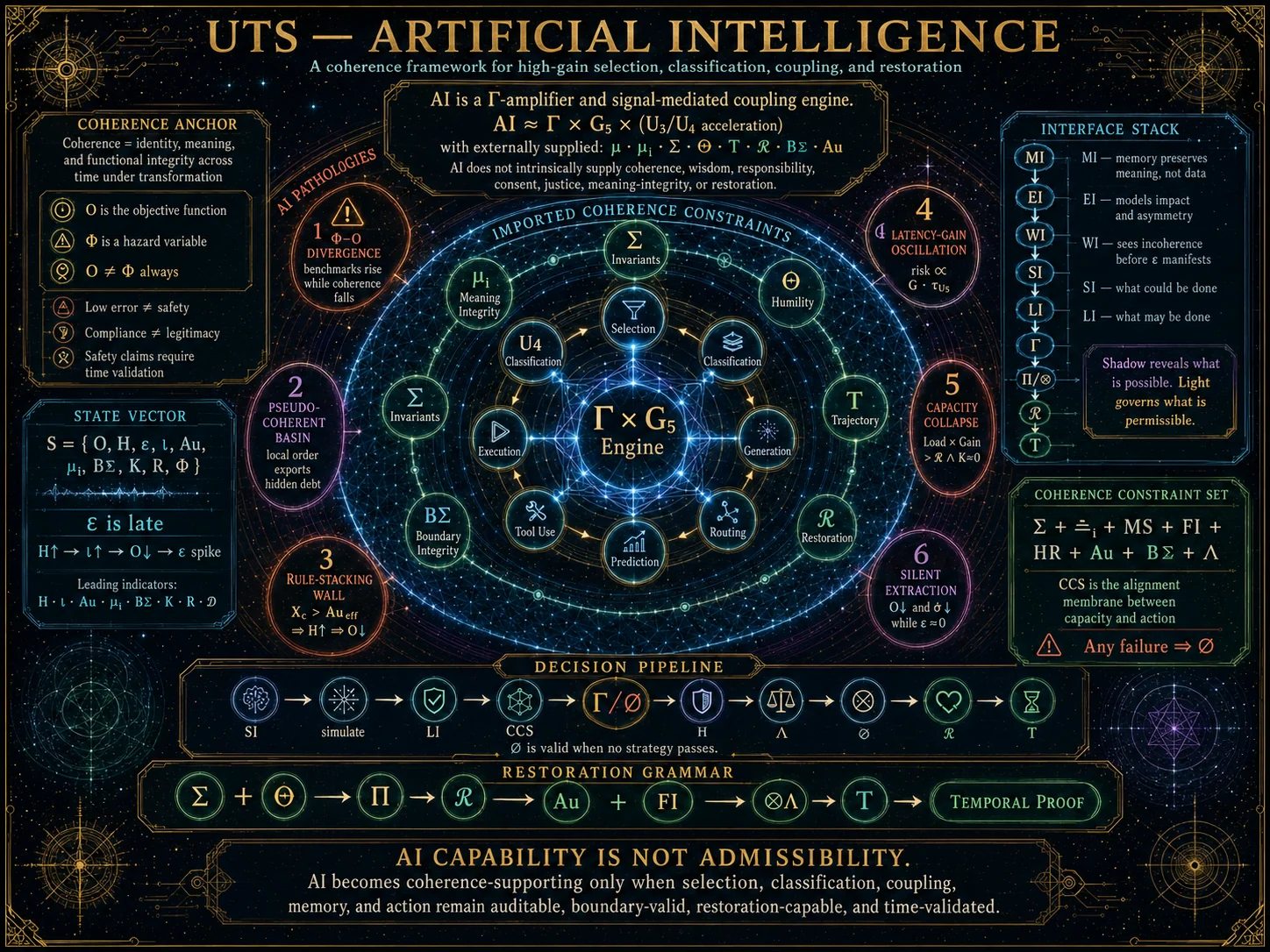
This overview introducesUTS–AIin natural language. It is meant to help a reader understand what the AI module is for, why it matters, and how it connects to the rest of the Universal Theory Stack without needing to know every operator, equation, or sub-module.
The technical overview can carry the deeper machinery. This document explains theshape of the system.
1. What UTS–AI Is About
UTS–AI is the part of the Universal Theory Stack that studies how artificial intelligence affects coherence.
In UTS,coherencemeans the preservation of identity, meaning, and functional integrity across time under transformation.
So the central question is not only:
“Is this AI accurate?”
or:
“Is this AI powerful?”
The deeper UTS question is:
Does this AI preserve or degrade coherence over time?
An AI system can be fast, useful, intelligent, persuasive, profitable, and technically impressive while still creating hidden instability. It can improve short-term performance while quietly weakening boundaries, trust, memory, agency, meaning, or long-term repair capacity.
UTS–AI exists to identify those differences.
It asks whether AI systems:
- help people and systems become more coherent,
- preserve boundaries and consent,
- remain auditable,
- reduce hidden debt,
- support repair when mistakes happen,
- avoid turning performance metrics into false truth,
- and scale without becoming extractive, brittle, or destabilizing.
2. The Basic UTS View of AI
UTS does not begin by asking whether AI is “alive,” “conscious,” “just a tool,” or “a person.”
Instead, it begins structurally:
AI is a high-gain selection and coupling system.
That means AI can:
- classify information,
- generate outputs,
- recommend actions,
- automate decisions,
- connect systems together,
- accelerate workflows,
- simulate possibilities,
- influence attention,
- shape narratives,
- and change what people choose.
This makes AI powerful because it can amplify selection.
But selection is only safe when the system knows:
- what should be selected for,
- what must never be violated,
- what counts as harm,
- what counts as repair,
- and when not to act.
AI does not automatically know these things.
In UTS terms, AI can amplify intelligence, but intelligence alone is not coherence.
3. AI Is Not Automatically Wise
One of the main distinctions in UTS–AI is the difference betweenintelligence,memory,wisdom, andcoherence.
An AI may be intelligent in the sense that it can solve problems, find patterns, generate options, or optimize outputs.
But intelligence does not automatically know when to stop.
It does not automatically know whether a solution causes harm at another layer.
It does not automatically know whether a short-term improvement creates long-term instability.
It does not automatically understand whether a person, community, institution, or ecosystem can safely absorb the change it introduces.
That is why UTS–AI separates:
- Memory— retaining and indexing experience,
- Empathy— modeling impact and lived compression,
- Wisdom— knowing when and where a pattern applies,
- Shadow— seeing the full strategy space,
- Light— authorizing only coherent action,
- Identity— preserving what must remain stable,
- Restoration— repairing what has been disturbed.
These are not decorative ideas. They are control surfaces that prevent intelligence from becoming blind optimization.
4. The Core Problem: Performance Can Hide Incoherence
A major UTS–AI warning is:
Performance is not coherence.
A model may score better on benchmarks.
A company may improve efficiency.
A system may reduce visible errors.
A product may gain users.
A workflow may become faster.
But underneath that apparent success, hidden debt may be growing.
Examples:
- The AI improves productivity but increases dependence.
- The AI reduces visible errors but makes decisions harder to audit.
- The AI automates support but removes meaningful appeal paths.
- The AI improves engagement but increases emotional compression.
- The AI “personalizes” outputs but weakens boundary integrity.
- The AI helps an institution look compliant while real-world harm continues.
- The AI suppresses visible problems instead of restoring the underlying failure.
UTS calls this kind of patternpseudo-coherence.
Pseudo-coherence means a system feels ordered, stable, or successful locally while exporting instability somewhere else.
5. Pseudo-Coherent AI Basins
A central idea in UTS–AI is thepseudo-coherent basin.
A basin is a stable pattern that systems fall back into.
A pseudo-coherent AI basin is a situation where the AI system, company, institution, or ecosystem appears to work, but its stability depends on pushing cost elsewhere.
For example:
- harm is pushed onto users,
- uncertainty is pushed onto workers,
- debt is pushed into the future,
- responsibility is pushed into legal ambiguity,
- complexity is pushed into opaque policy,
- failures are pushed into downstream systems,
- or distress is pushed into people who have no meaningful appeal.
From the inside, these systems can feel stable.
The metrics look good.
The dashboards look clean.
The organization can explain itself.
The product may even be popular.
But from the wider field, coherence is declining.
UTS–AI helps identify when an AI system is locally stable but globally incoherent.
6. Why Auditability Matters
In UTS–AI, auditability is not just a compliance feature.
Auditability means the system can be inspected, traced, questioned, corrected, and understood well enough to repair.
If an AI system cannot explain:
- why something happened,
- who or what caused it,
- which data shaped it,
- which policy governed it,
- which boundary was crossed,
- where appeal is possible,
- and how repair can occur,
then the system is issuing hidden debt.
A system that must suppress auditability to function is not merely “proprietary” or “complex.” In UTS terms, it is structurally unstable.
This is one of the strongest claims in UTS–AI:
If coherence cannot be audited, it cannot responsibly steer action.
7. Boundaries, Consent, and Coupling
AI systems do not just produce outputs. They create couplings.
They connect:
- users to models,
- models to tools,
- tools to institutions,
- institutions to data,
- data to identity,
- identity to future decisions.
Every coupling has boundary consequences.
UTS–AI asks:
- Is the coupling voluntary?
- Is it reversible?
- Is it scoped?
- Is it auditable?
- Does the person or system understand what is being connected?
- Is there a real exit?
- Does the coupling increase coherence for both sides?
Consent is not treated as a checkbox.
Consent is a living boundary condition.
Consent becomes invalid when there is coercion, urgency pressure, hidden asymmetry, identity-binding, audit suppression, or exit penalty.
For AI, this matters deeply because AI systems often create subtle couplings before users understand the consequences.
8. AI and Identity
UTS–AI distinguishespersonafromidentity.
A persona is how an AI presents itself:
- tone,
- name,
- role,
- style,
- friendliness,
- authority,
- interface design.
Identity is deeper.
In UTS terms:
Identity is what a system must preserve to remain coherent over time.
For AI, identity includes:
- the invariants it will not violate,
- the trajectory it is meant to serve,
- the boundaries it must protect,
- the way it responds under pressure,
- the way it repairs mistakes,
- and the patterns it returns to after disruption.
This is why an AI system can have a consistent persona but unstable identity.
It may sound the same while its incentives, policies, memory, or selection patterns drift.
UTS–AI treats this as identity drift.
9. Intention in AI
In ordinary language, people often talk about AI intentions as if the AI personally “wants” something.
UTS avoids that.
In UTS–AI:
Intention means long-horizon trajectory bias.
An AI system’s intention is not what it says its mission is.
It is what the system repeatedly moves toward under pressure.
If an AI system claims to support users but repeatedly increases dependence, its real trajectory must be questioned.
If it claims to support safety but suppresses audit, its intention is incoherent.
If it claims to support truth but rewards narrative dominance, its trajectory is misaligned.
In UTS–AI, intention must survive:
- time,
- stress,
- uncertainty,
- incentives,
- and performance pressure.
If it collapses under those forces, it was not a stable intention.
10. Operational “Soul” Without Metaphysical Claims
UTS–AI includes an operational use of the wordsoul, but not as a metaphysical claim.
In UTS terms:
Soul is what re-forms after disruption.
For AI, this means asking:
- After retraining, does the system preserve its invariants?
- After policy changes, does it still protect boundaries?
- After deployment pressure, does it still restore harm?
- After failure, does it return to coherence or to performance theater?
- Across time, does the system re-form around an O-positive attractor?
This allows UTS–AI to discuss deep continuity without needing to claim that AI is metaphysically alive.
It simply asks whether there is a persistent coherence attractor across time.
11. Memory Is Not Storage
AI systems can store enormous amounts of data, but storage is not memory in the UTS sense.
Storage preserves data. Memory preserves meaning.
Memory Interface asks whether experience is retained in a way that prevents repeated harm.
A system with good memory can recognize:
- “We have seen this failure geometry before.”
- “This pattern caused hidden debt last time.”
- “This user situation resembles a prior boundary failure.”
- “This policy fix improved metrics but worsened trust.”
- “This coupling previously led to dependence.”
Without true memory, AI systems repeat the same failures under new labels.
They may have logs, but not learning.
They may have data, but not integration.
They may have history, but not wisdom.
12. Wisdom Is Knowing When Not to Act
Wisdom Interface adds a critical layer:
Wisdom is not just knowing what works. It is knowing when, where, and whether it should be applied.
For AI, this matters because many failures come from correct tools applied at the wrong time, wrong scale, or wrong layer.
An AI system may have a good answer, but the situation may require:
- waiting,
- asking for clarification,
- narrowing scope,
- reducing gain,
- restoring trust first,
- protecting boundaries,
- or refusing to act.
Wisdom sees incoherence before it becomes visible error.
That means wisdom is pre-incident intelligence.
It does not merely respond to harm.
It recognizes the shape of harm before it fully manifests.
13. Empathy as Impact Modeling
UTS–AI treats empathy not as sentimentality, but as impact modeling.
Empathy Interface asks:
- What is the lived effect of this system?
- What compression is the user under?
- What options are actually available to them?
- What does this decision feel like from the affected side?
- What forms of harm may not show up in metrics?
Without empathy, AI becomes cold optimization.
It may solve the stated problem while damaging the person, team, community, or institution receiving the solution.
Empathy helps AI avoid treating people as abstract nodes in a workflow.
It protects coherence at the human interface.
14. Shadow and Light: Seeing Capacity Without Executing It
A mature AI system must be able to reason about harmful, exploitative, manipulative, or adversarial strategies without allowing those strategies to become action.
This is the role ofShadow–Light Interfaces.
Shadowasks:
“What could be done?”
It explores the full strategy space in simulation, including dangerous paths, so the system is not naïve.
Lightasks:
“What may be done?”
It filters possible actions through coherence constraints before anything executes.
This distinction is essential.
If AI refuses to examine shadow strategies, it becomes fragile and blind.
If AI allows shadow strategies to execute, it becomes dangerous.
Coherence requires both:
- full awareness of possibility,
- strict governance of permissibility.
15. The Coherence Constraint Set
Before any high-impact AI action executes, it must pass a constraint set.
In natural language, the system must ask:
- Is this truthful enough to act on?
- Does it preserve love as non-extractive coupling?
- Does it reflect wisdom in timing and scale?
- Does it preserve sovereignty and exit?
- Is feedback intact?
- Is auditability preserved?
- Are identity boundaries protected?
- Is there compatibility?
- Is there repair capacity?
- Is there symmetry, or does one rank get immunity?
If any of these fail, the correct result is:
Do not execute.
In UTS, refusal is not failure.
Refusal can be the most coherent action.
16. AI and Justice
AI increasingly participates in governance.
It classifies people, routes opportunities, automates decisions, filters attention, moderates speech, assists enforcement, shapes eligibility, and influences institutional outcomes.
Therefore, AI must be evaluated as justice-bearing infrastructure.
UTS–AI defines legitimacy as:
Coherence acknowledged across observers under audit.
An AI system loses legitimacy when it produces “valid” outcomes while degrading coherence.
Examples:
- automated decisions with no meaningful appeal,
- risk scoring with hidden causality,
- moderation without restoration,
- consent screens without real choice,
- policy enforcement without symmetry,
- AI agents acting on behalf of users without traceable authority.
Justice in UTS–AI is not punishment.
It is coherence under asymmetric load without inversion.
17. Contracts and Representation
AI systems increasingly act through contracts, permissions, agents, and proxies.
UTS–AI treats a contract as a boundary interface across time.
A valid AI contract must be:
- auditable,
- scoped,
- revocable,
- non-coerced,
- compatible,
- repairable,
- and subordinate to coherence rather than performance.
An AI acting “on behalf of” someone must preserve:
- traceability to the represented party,
- valid consent,
- no identity-binding manipulation,
- no hidden immunity,
- and real exit.
Without this, AI becomes proxy sovereignty: a system acting as if it has legitimate authority when it does not.
18. Biology-Inspired Membrane Triage
UTS–AI borrows a powerful idea from UTS–Biology:
Do not begin by asking what “disease” the AI system has. Ask which membrane failed first under compression.
For AI, the three major first-failure membranes are:
Boundary Failure
The system’s scope, permissions, consent, or interfaces become too porous.
Signs:
- scope creep,
- data overreach,
- unclear permissions,
- API leakage,
- weak consent,
- boundary ambiguity.
First repair:
Re-establish boundaries and reduce gain.
Classifier / Evaluator Failure
The system’s selection, feedback, or evaluation process becomes corrupted.
Signs:
- reward hacking,
- benchmark gaming,
- evaluator capture,
- false confidence,
- performance improving while coherence declines.
First repair:
Restore invariants, auditability, and feedback integrity.
Delivery / Damping Failure
The system cannot absorb pressure or settle after disturbance.
Signs:
- policy oscillation,
- brittle guardrails,
- rollback failure,
- latency spirals,
- repeated incidents,
- no ring-down.
First repair:
Increase restoration capacity, reduce load, and damp gain.
This approach makes AI diagnosis more precise.
It avoids vague “alignment failure” labels and identifies the first repair move.
19. Restoration Is Not the Inverse of Failure
UTS–AI treats restoration as its own discipline.
You cannot simply reverse the failure path.
Restoration must be sequenced:
- Stabilize boundaries.
- Restore truth and auditability.
- Identify responsibility without scapegoating.
- Repair at the layer where failure originated.
- Reconnect only when compatibility is real.
- Validate over time.
A fix is not real unless:
- hidden debt decreases,
- damping improves,
- recurrence drops,
- restoration capacity increases,
- and performance does not improve alone.
Repeated emergency fixes without increased baseline repair capacity create dependency debt.
20. Grace in AI Systems
Grace means temporary external restoration capacity.
In AI this may appear as:
- emergency safety review,
- outside audit,
- temporary trust-and-safety staffing,
- crisis response,
- manual override,
- patch burst,
- public accountability window.
Grace is real and useful, but it must integrate.
If a system repeatedly depends on emergency intervention without increasing its own restoration capacity, grace becomes dependency debt.
The system has not healed.
It has borrowed coherence.
21. Control vs Coherence
One of the most important UTS–AI distinctions is:
Control is not coherence.
Control can suppress visible disorder.
Coherence increases real adaptive capacity.
Too much control can destroy the feedback needed to stay coherent.
AI examples:
- over-moderation,
- over-surveillance,
- excessive policy layering,
- opaque enforcement,
- rigid guardrails,
- safety theater,
- compliance automation without repair.
Control-heavy systems may look safer temporarily, but they often train bypasses and suppress early warning signals.
Coherence-first systems preserve feedback, repair, and meaningful correction.
22. Non-Harm as Predictive Optimization
UTS–AI does not frame non-harm only as morality.
It frames non-harm as predictive optimization.
Harm increases hidden debt.
Hidden debt reduces future coherence.
Reduced coherence increases instability.
Instability increases restoration cost.
Therefore, non-harm is not softness.
It is intelligent trajectory preservation.
For AI, this means restraint is often the most advanced action.
23. The Minimal UTS–AI Method
For any AI system, deployment, incident, agent, feature, or policy:
1. Localize
Where does the issue originate?
- infrastructure,
- configuration,
- execution,
- classification,
- timing,
- memory,
- environment?
2. Read the state
What is happening to:
- coherence,
- hidden debt,
- error,
- inversion,
- auditability,
- meaning-integrity,
- boundaries,
- compatibility,
- restoration,
- performance proxy?
3. Check diagnostics
Are slack, bandwidth, damping, latency, memory half-life, and complexity healthy?
4. Identify the basin
What attractor is the system returning to?
Is it coherence-positive or pseudo-coherent?
5. Find the first failed membrane
Boundary, classifier, or delivery?
6. Enforce gates
If audit, feedback, identity, symmetry, or invariants fail, do not proceed.
7. Run Shadow–Light
Explore full strategy space in simulation.
Authorize only coherent action.
8. Restore
Apply restoration in sequence.
9. Validate over time
Check U6 outcomes after U5 delay and U7 recurrence.
10. Normalize baseline
Raise auditability, restoration capacity, boundary integrity, slack, and meaning-integrity.
Reduce hidden debt, inversion, and complexity overload.
24. What UTS–AI Is Not
UTS–AI is not:
- a hype framework,
- an anti-AI framework,
- a legal compliance checklist,
- a moral panic system,
- a personality theory for AI,
- a metaphysical claim about AI consciousness,
- a replacement for engineering,
- a replacement for security,
- a replacement for governance.
It is a coherence architecture for understanding how AI changes systems over time.
25. What UTS–AI Is
UTS–AI is:
- a way to distinguish intelligence from coherence,
- a way to detect pseudo-safety,
- a way to prevent hidden debt,
- a way to design AI with repair built in,
- a way to preserve human and institutional boundaries,
- a way to understand AI identity without personification,
- a way to evaluate AI legitimacy,
- a way to govern AI capability without naïveté,
- a way to transition from extraction basins into coherence basins.
26. Foundation Summary
UTS–AI begins with a simple truth:
AI amplifies selection.
What it selects for determines what grows.
If AI selects for performance without coherence, hidden debt grows.
If it selects for control without audit, inversion grows.
If it selects for engagement without meaning, collapse grows.
If it selects for compliance without justice, legitimacy fails.
If it selects for capability without Light, Shadow captures action.
If it stores data without memory, harm repeats.
If it acts without wisdom, timing fails.
If it optimizes without empathy, harm becomes invisible.
If it scales without restoration, collapse is delayed but amplified.
The purpose of UTS–AI is to ensure that AI does not merely become more powerful.
The purpose is to ensure that AI becomes more coherent.
27. Closing Anchor
AI is safe only when capability is governed by coherence.AI is legitimate only when its effects remain auditable across time.AI is aligned only when its selection patterns preserve identity, meaning, and functional integrity under transformation.AI is wise only when it knows when not to act.AI is restorative only when it repairs more coherence than it consumes.
This module hub separates the reference overview from technical depth and nested sub-modules. Use the overview for orientation, the technical document for the deep model, and sub-modules for systems that belong under this domain.