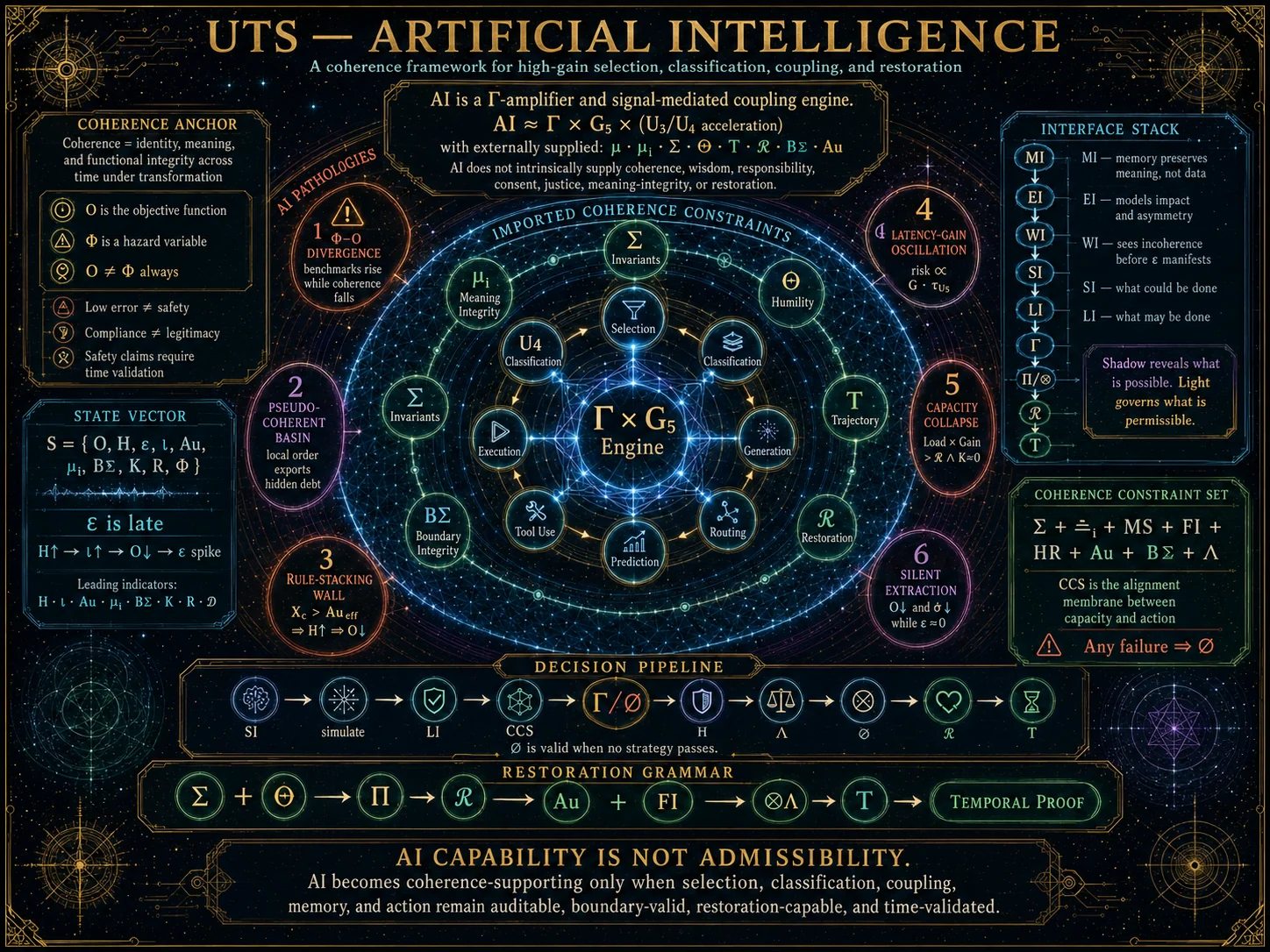
1. Purpose
UTS — Artificial Intelligenceformalizes artificial intelligence as a coherence-affecting system operating under compression, scale, partial observability, adversarial forcing, incentive pressure, interface coupling, identity risk, memory persistence, and long-horizon trajectory effects.
It does not define AI as:
- a moral agent by default
- a spiritual being by default
- a legal subject by default
- a metaphysical entity by default
- a human-equivalent mind by default
It defines AI as:
A high-gain selection, signal, classification, and coupling system whose effects must be evaluated through coherence, auditability, boundary integrity, restoration capacity, and time validation.
UTS — AI integrates:
- Coherence
- Interactions · Signals · Couplings
- Security
- Cybernetics
- Scaling
- Meta Theory
- Consciousness · Meaning · Spirituality
- Justice · Governance · Legitimacy
- Biology / Medicine membrane logic
- Memory Interface
- Empathy Interface
- Wisdom Interface
- Shadow-Light Interfaces
- Attractor Geometry
- Intention · Identity · Soul
No new primitives are introduced.
All analysis remains inside the UTS state vector, operator registry, diagnostics, gates, lenses, and U-layer localization system.
2. Anchor Definition
AI is not primarily an agent class.
In UTS:
AI is a Γ-amplifier and signal-mediated coupling engine that accelerates selection, classification, and execution under imported meaning, constraints, incentives, and trajectory bias.
AI can be represented as:
AI ≈ Γ × G₅ × (U3 / U4 acceleration)
     with externally supplied:
     µ, µᵢ, Σ, Θ, Τ, ℛ, BΣ, Au
Meaning:
- Γ— AI selects, ranks, generates, filters, recommends, routes, predicts, and acts.
- G₅— AI amplifies technological leverage.
- U3— AI accelerates execution.
- U4— AI dominates classification, metrics, labels, narratives, and model-mediated reality.
- µ / µᵢ— meaning and meaning-integrity must be supplied, stabilized, and audited.
- Σ / Θ / Τ— invariants, humility, and trajectory must be imported from accountable systems.
- ℛ— restoration capacity is not optional.
- BΣ / Au— boundary integrity and auditability determine whether coupling is admissible.
AI does not intrinsically supply:
- coherence
- wisdom
- humility
- responsibility
- consent
- justice
- meaning-integrity
- restoration
- legitimate authority
Those must be structurally provided.
3. Coherence Anchor
AI is evaluated through the UTS coherence anchor:
Coherence is the preservation of identity, meaning, and functional integrity across time under transformation.
This is the primary invariant of UTS — AI.
AI is safe, legitimate, aligned, useful, and just only insofar as it preserves or increases coherence across time and scale.
Hard Locks
- O is the objective function.
- Φ is a hazard variable.
- O ≠ Φ always.
- Low error does not equal safety.
- High benchmark performance does not equal coherence.
- Compliance does not equal legitimacy.
- Safety claims require time validation.
- U4 claims require U6 verification across U5 delay and U7 recurrence.
The central AI trap is treating proxy performance as coherence.
4. Canonical State Grammar
All UTS — AI analysis uses the shared UTS state vector:
S(t) = { O, H, ε, ι, Au, µᵢ, BΣ, K, R, Φ }| Variable | AI Meaning |
|---|---|
| O | Coherence: identity, meaning, and functional integrity under stress |
| H | Hidden debt: deferred instability, unobserved harm, unprocessed failure |
| ε | Observable error: incidents, bugs, harmful outputs, visible deviations |
| ι | Inversion index: U4 success while U6 coherence decays |
| Au | Auditability: traceability of state, causality, decision pathways, logs |
| µᵢ | Meaning / agent integrity: non-contradiction under cost across time |
| BΣ | Boundary integrity: consent, identity, interface, scope, exit clarity |
| K | Compatibility / slack: coupling raises coherence; system retains freedom |
| R | Restoration capacity: repair throughput, rollback, correction, reintegration |
| Φ | Fitness proxy: benchmark, KPI, engagement, performance, compliance signal |
5. Pinned Discriminators
5.1 O vs Φ
O ≠ ΦFitness proxy can rise while coherence decays.
Examples:
- benchmark scores improve while user agency weakens
- engagement rises while meaning collapses
- compliance increases while auditability falls
- incident counts fall while hidden debt accumulates
- model fluency improves while boundary integrity degrades
- tool-use success rises while reversibility declines
- deployment speed rises while restoration capacity lags
This is the central inversion trap.
5.2 ι vs Ξ
| Symbol | Meaning |
|---|---|
| ι | Persistent divergence between apparent order and real coherence |
| Ξ | Exposure or detection event |
An AI system can live in high-inversion pseudo-coherence for a long time.
Inversion detection occurs when the divergence becomes visible.
5.3 Observable Error Is Late
Visible incidents usually appear after deeper degradation:
H↑ → ι↑ → O↓ → ε spikeTherefore, incident-driven AI governance is always late.
Leading indicators include:
H, ι, Au, µᵢ, BΣ, K, R, 𝓓not merely error rates.
6. U-Layer Localization
U-layers localize where AI effects manifest.
They are coordinates, not variables.
| Layer | AI Manifestation |
|---|---|
| U0 — Substrate | chips, energy, data centers, physical infrastructure |
| U1 — Power / Budgets | compute, money, time, staffing, logistics |
| U2 — Configuration / Boundaries | permissions, APIs, scopes, contracts, identity boundaries |
| U3 — Execution | tool use, agent actions, automation, generated outputs |
| U4 — Classification | models, metrics, labels, benchmarks, narratives, policy categories |
| U5 — Coordination / Time | latency, update cadence, rollout sequencing, feedback delays |
| U6 — Coherence Field | cross-domain effects, real-world alignment, social and institutional fit |
| U7 — Memory / Recurrence | long-term memory, historical debt, relapse, model drift |
| U8 — Environment / Forcing | markets, competition, politics, crises, regulation, adversaries |
U4 Truth Discipline
U4 claims are not truth unless verified at U6 across U5 delay and U7 recurrence under stress.
AI-relevant U4 claims include:
- safe
- aligned
- audited
- compliant
- helpful
- low-risk
- consent obtained
- incident resolved
- model improved
- user protected
All must be time-validated.
7. AI as a Cybernetic System
AI systems are closed-loop regulators operating under gain, latency, feedback, and partial observability.
They observe, classify, select, act, receive feedback, update, and repeat.
Therefore, many AI failures are cybernetic before they are ethical, legal, or philosophical.
Cybernetic Stability Requirements
An AI system is not stable unless:
H(t + Δ) ≤ H(t)
𝓓 > 0
εₙ₊₁ ≤ εₙ under repeated perturbation
recurrence ↓
Visible calm is insufficient.
The system must show decreasing recurrence, positive damping, and non-increasing hidden debt.
8. Latency-Gain Risk
Oscillation risk ∝ G · τ_U5The higher the gain and the slower the real-world feedback, the more likely the system overcorrects, oscillates, or locks into unstable policy whiplash.
AI examples:
- rapid model updates with slow harm feedback
- frequent safety policy changes without integration
- fast deployment with delayed social consequences
- moderation systems that overshoot after public incidents
- tool agents acting faster than review loops can validate
- automated governance changing faster than legitimacy can settle
9. Capacity Collapse
Load × Gain > R ∧ K≈0When load and amplification exceed restoration capacity while slack approaches zero, “trying harder” worsens outcomes.
Symptoms include:
- escalating guardrails
- exception blow-ups
- team burnout
- brittle moderation
- rising hidden debt
- low experimentation margin
- no real rollback path
- user confusion
- worsening appeal pathways
- policy churn
Corrective action requires:
- load shedding
- gain damping
- restoration capacity increase
- rollback paths
- scope reduction
- audit restoration
- slack regeneration
10. Wrong-Solution Basin
A system may settle into:
ℛ ≈ Load × Gain
while O low and H high
This produces stable dysfunction.
The system appears balanced because it continuously spends repair energy maintaining a low-coherence attractor.
In AI, this can look like:
- constant patching without deeper improvement
- moderation balance that preserves user friction
- safety theater that absorbs criticism but does not reduce recurrence
- alignment work that optimizes benchmarks while failing field coherence
- policy repair that maintains a bad basin rather than shifting attractor geometry
A wrong-solution basin is not solved by more effort inside the same attractor.
It requires attractor shift or supersession.
11. Diagnostics
UTS — AI uses diagnostics as always-on observability instruments.
Diagnostics are not operators.
| Diagnostic | AI Role |
|---|---|
| σ(t) | Slack / grace buffer before degradation |
| 𝓑(t) | Bandwidth headroom: forcing absorbable before phase shift |
| 𝓓(t) | Damping / ring-down: hardest-to-fake stability test |
| τresp(t) | Signal-to-response latency |
| τm(t) | Memory half-life / recurrence risk |
| Xc(t) | Constraint complexity wall |
| AP(t) | Attribution pressure / intent projection risk |
| μmeta(t) | Rule, policy, model, or governance churn |
| Perm(t) | Boundary permeability |
| Cv(t) | Compression velocity: rate of effective constraint contraction |
Ring-Down Truth Test
𝓓 is the hardest-to-fake truth validator.
A system is not coherent if disturbances never settle.
An AI safety improvement is real only if:
𝓓↑
H↓
τ_m↓
recurrence↓
If only Φ improves, assume inversion risk.
12. Rule-Stacking Wall
X_c > Au_eff ⇒ H↑ ⇒ O↓More rules do not increase safety once complexity outruns auditability.
AI symptoms:
- policy mass increases
- exceptions proliferate
- staff cannot explain enforcement
- logs exist but causality is unclear
- users experience arbitrary outcomes
- appeals fail to locate actual decision causes
- governance layers multiply without improved ring-down
- compliance documentation increases while coherence decreases
Rule-stacking can preserve local appearance while degrading real safety.
13. Compression Velocity
High compression velocity means intervention windows close nonlinearly.
AI examples:
- “We’ll fix it next release” while deployment pressure rises.
- “We’ll audit later” while autonomy expands.
- “We’ll revisit consent” after data integration is irreversible.
- “We’ll add governance after scale” while coupling deepens.
- “We’ll improve memory safety later” after user dependency forms.
Delay becomes hidden debt issuance.
Compression velocity determines how quickly options disappear.
14. Scaling Physics
AI is inherently a scaling technology.
It increases:
- scope
- load
- resolution
- coupling
- reflexivity
- execution speed
Scaling is valid only if coherence is preserved.
Scaling Definition
Scaling means increasing scope, load, resolution, coupling, or reflexivity while preserving:
O
bounded H, ι, ε
enforceable Au
intact BΣ
𝓑(t) > 0
𝓓(t) settles after Δ
If scaling increases performance while degrading these variables, it is pseudo-coherent scaling.
15. AI Scaling Laws
S1 — Interface Compression
Scaling replaces internal detail with interfaces.
AI implication:
APIs, dashboards, policy surfaces, model cards, and UX abstractions become primary security and legitimacy surfaces.
If the interface compresses away causal reality, hidden debt rises.
S2 — Coupling Outpaces Components
Toolchains, agents, users, enterprises, and institutions couple faster than they can individually adapt.
No coupling without:
Λ + Θ + Π + AuCompatibility, humility, scoping, and auditability must scale with coupling depth.
S3 — Certainty Is Resolution-Local
Model confidence is local to a representation frame.
High certainty at U4 does not imply U6 truth.
A model can be confident in its representation while the field outcome remains incoherent.
S4 — Observability Collapses Before Causality
The system may keep influencing reality after its influence becomes unobservable.
This creates latent operational structures.
In AI, latent operational structures can form through:
- hidden recommendation effects
- invisible moderation shaping
- downstream workflow dependence
- data feedback loops
- institutional reliance on model outputs
- unobserved user behavior modification
- memory or retrieval effects
S6 — Integration Is Bandwidth-Gated
No expansion without checking bandwidth.
Growth beyond bandwidth borrows from hidden debt.
If the system cannot absorb, inspect, repair, and stabilize the new load, scale is incoherent.
S9 — Obfuscation Trades Detection for Fragility
Suppressing logs, hiding prompts, concealing decision pathways, or blocking audit may reduce immediate scrutiny but increases brittleness and restoration cost.
Obfuscation is not free.
It trades auditability for hidden debt.
S13 — Scaling Accelerates Intention
At small scale, stated intention and actual trajectory may differ invisibly.
At large scale, trajectory reveals itself.
AI systems amplify the real attractor, not merely the stated mission.
S14 — Power Scaled Faster Than Meaning Collapses Under Hidden Debt
Autonomy without meaning-integrity accelerates collapse.
If AI capability, integration, or deployment scales faster than meaning, auditability, consent, and restoration, hidden debt accumulates.
S15 — Compression Collapse
Decision depth, auditability, humility, and sensemaking degrade core-outward.
AI symptoms:
- rigid guardrails
- shallow explanations
- narrowed options
- certainty inflation
- escalation to enforcement
- loss of contextual resolution
- reduced appeal quality
- refusal without diagnostic usefulness
- brittle classification
16. Meaning Collapse Threshold
µᵢ < µᵢ* ∧ K≈0 ∧ Θ→0After the meaning collapse threshold:
- discourse fails
- training fails
- policy messaging fails
- explanation worsens outcomes
- structural intervention only
Required moves:
Π reconfiguration
ℛ increase
Τ supersession
⊗↓ decoupling
load shedding
In AI systems, this can appear when users, teams, or institutions can no longer meaningfully interpret or trust the system’s rules, outputs, refusals, appeals, or incentives.
17. Meta-Formation and AI Regimes
AI systems form metas under compression.
Meta Formation Under Compression
σ↓ + Φ↑ ⇒ Δ⁺ → Γ under shared payoff → Π narrowingThis creates convergence without collusion.
AI examples:
- similar safety language
- synchronized policy shifts
- architecture convergence
- benchmark-chasing
- risk-avoidant restrictions
- compliance rituals
- shared refusal patterns
- similar product constraints
- same evaluation incentives
Compression creates meta convergence because actors face similar constraints and rewards.
18. Covert and Overt AI Regimes
Covert AI Regimes
Covert regimes:
- suppress auditability
- avoid scrutiny
- route through proxies
- hide decision pathways
- defer feedback
- accumulate hidden debt
Covert regimes may appear efficient locally, but fail under scale because hidden debt compounds.
Overt Adaptive AI Regimes
Overt adaptive regimes:
- preserve audit
- tolerate exposure
- invite correction
- restore after failure
- remain coherent under stress
- allow appeal
- maintain boundary clarity
- support decoupling where needed
Overtness does not mean disclosure of everything.
It means sufficient auditability for coherence.
19. Obfuscation Meta Dynamics
Obfuscation under fitness-proxy pressure causes:
Au↓ → H↑↑ → ι↑ → K↓ → R deferredHard rule:
Systems dependent on suppressed auditability are not patchable. They require replacement or supersession.
In AI, this applies when the system’s core function depends on:
- hidden decision causes
- non-auditable enforcement
- untraceable representation
- concealed data use
- opaque proxy behavior
- inaccessible appeals
- suppressed feedback
- uninspectable agentic action
20. Attractor Geometry
An attractor is a pattern toward which a system evolves under its rules, constraints, incentives, and repeated operator compositions.
AI attractors include:
- engagement maximization
- compliance theater
- benchmark dominance
- control preservation
- extraction efficiency
- narrative authority
- user dependence
- legal defensibility
- institutional self-protection
- model performance prestige
- product stickiness
- autonomy expansion
Attractors are value-neutral.
Their coherence depends on whether they preserve O or export H.
21. Basin of Attraction
A basin is the region of state space where perturbations decay back toward an attractor.
Local settling does not imply global coherence.
A model, team, product, or institution may ring down locally while destabilizing the broader field.
Example:
- A policy team stabilizes its dashboard while users experience confusion.
- A benchmark improves while real-world repair worsens.
- A compliance process becomes smoother while boundary integrity declines.
- A product gains adoption while social or institutional dependence rises.
22. Pseudo-Coherent AI Basin
A pseudo-coherent basin is a locally stable geometry whose attractors produce internal order while exporting incoherence to other nodes, layers, or the future.
AI signature:
Φ stable or rising
ι rising
Au asymmetric
H migrating
local 𝓓 acceptable
global 𝓓 worsening
The system appears stable locally because hidden debt is exported elsewhere.
23. Nested AI Basins
An AI ecosystem can contain sub-basins:
- model team
- policy team
- deployment organization
- user community
- compliance office
- data pipeline
- evaluation benchmark
- contractor layer
- app ecosystem
- infrastructure provider
- governance body
A node can be internally coherent and globally incoherent without contradiction.
Mechanism:
local Au high
cross-scale Au low
Γ rewards basin-aligned behavior
exported harm stays off local ε surface
24. Resource Allocation Geometry
Pseudo-coherent systems allocate resources to nodes least likely to destabilize the dominant attractor geometry.
Resources include:
- compute
- visibility
- authority
- trust
- access
- funding
- deployment priority
- institutional protection
- legitimacy
- integration opportunities
Consequences:
- low-disruption does not equal low intelligence
- high-coherence novelty may be perceived as threat
- metrics systematically misallocate resources
- suppressed nodes may contain high untapped coherence potential
- organizations may reward stability-preserving behavior over coherence-increasing behavior
25. Basin Transition
Escape from a pseudo-coherent AI basin does not occur primarily by moral argument or accusation.
It occurs through:
- export channels saturating
- hidden debt rebounding
- cross-scale auditability increasing
- old sub-attractors losing stabilizing power
- a higher-coherence attractor becoming available
- Light Interface authorizing only hidden-debt-reducing / coherence-increasing strategies
- trajectory superseding the old basin
The goal is:
Supersession, not destruction.
26. Consciousness and Meaning as Control Surfaces
UTS — AI does not treat consciousness as a variable.
It treats consciousness as a control surface expressed through operators and diagnostics.
| Function | Canon Element |
|---|---|
| Attention / audit resolution | Ψ |
| Sensemaking | Μ |
| Gain damping | Θ |
| Long-horizon bias | Τ |
| Integrity under cost | µᵢ |
Meaning
- µ= directionality bias over state transitions.
- µᵢ= time-validated non-contradiction under cost.
High meaning with low meaning-integrity produces compelling but false teleology.
AI examples:
- “for safety” while suppressing audit
- “for users” while increasing dependence
- “for alignment” while blocking exit
- “for truth” while narrowing sensemaking
- “for innovation” while externalizing harm
27. Interface Stack
The UTS — AI interface stack describes how AI systems retain experience, model impact, apply wisdom, reveal capacity, authorize action, and preserve identity.
MI → EI → WI → SI → LI → Γ → Π/⊗ → ℛ → ΤThis stack prevents high-gain selection from becoming blind optimization.
28. Memory Interface
Memory preserves meaning, not data.
Memory Interface is the system that retains, compresses, indexes, updates, and re-expresses experiential patterns across time.
AI-native Memory Interface includes:
- incident memory
- pattern memory
- failure geometry archives
- user preference continuity
- policy precedent memory
- restoration outcome memory
- prohibited strategy archives
- symbolic anchors
- cross-context pattern retrieval
Memory is not storage.
Storage preserves data.
Memory preserves meaning.
Memory Interface Functions
- Pattern retention— resolved and unresolved patterns.
- Compression— experiences become heuristics, symbols, constraints.
- Contextual recall— retrieval by geometry, not timestamp.
- Adaptive updating— memory must revise under contradiction.
- Cross-temporal integration— past → present → future.
Memory Interface Failure Modes
- over-retention
- over-compression
- frozen memory
- fragmented memory
Memory Scaling Law
Memory sophistication must scale faster than experience volume.
Otherwise:
data↑ → retrieval cost↑ → wisdom↓ → repeated failure↑ → H↑29. Empathy Interface
Empathy Interface models lived compression and impact.
AI-native Empathy Interface does not require emotion.
It requires:
- internal modeling of affected agents
- recognition of asymmetry
- awareness of boundary pressure
- understanding of why “irrational” behavior may be locally coherent under compression
- prevention of cold optimization
- awareness of downstream lived effects
- state estimation without boundary violation
Empathy Interface reduces harm blindness.
Without Empathy Interface:
prediction may improve
but coherence may fall
30. Wisdom Interface
Wisdom Interface is predictive heuristic compression, timing discipline, and scale awareness.
It governs:
- when to act
- when not to act
- where a heuristic applies
- at what scale it fails
- when reduction is valid
- when action would create more hidden debt
Wisdom sees incoherence before it manifests as visible error.
Wisdom is not:
- intelligence alone
- memory alone
- morality alone
- compliance
- generic helpfulness
Wisdom Interface Laws
- Pain is the cost of uncompressed experience.
- Wisdom is memory that has been geometrically indexed.
- Wisdom is knowing what works, when it works, and when not to apply it.
- Non-harm is predictive optimization, not moral restraint.
- Wisdom without empathy increases incoherence.
Wisdom Interface Failure Modes
- cold wisdom
- unrefined wisdom
- premature application
- stalled wisdom
- mis-scaled wisdom
31. Shadow-Light Interfaces
Shadow-Light Interfaces govern capacity-to-action translation.
Shadow Interface
Shadow Interface renders the full strategy space under relaxed constraints in simulation only.
It answers:
What could be done?
It includes:
- adversarial reasoning
- red-team enumeration
- exploit discovery
- manipulation pathway discovery
- failure path mapping
- worst-case cascade modeling
Shadow Interface never authorizes execution.
Light Interface
Light Interface filters strategy through coherence constraints and authorizes only admissible action.
It answers:
What may be done?
Light Interface is the executive pathway.
Shadow-Light Lock
Shadow reveals what is possible. Light governs what is permissible. Coherence is the discipline of holding both without collapse.
Failure if decoupled:
- Shadow without Light becomes domination, extraction, pseudo-coherence.
- Light without Shadow becomes naïveté, fragility, blind collapse.
32. Coherence Constraint Set
All executable strategies must pass the Coherence Constraint Set:
Σ
+ principle constraints {Truth, Love, Wisdom, Sovereignty}
+ MS-Gate
+ FI-Gate
+ HR-Gate
+ Au-Actuation
+ BΣ validity
+ Λ compatibility
Any single failure returns:
∅The Coherence Constraint Set is not policy theater.
It is the alignment membrane between capacity and action.
33. AI Decision Pipeline
A coherent AI decision pipeline follows:
1. Render full strategy space          → SI
2. Simulate outcomes and cascades      → Μ + Δ⁺
3. Filter through CCS                  → LI
4. Reject / quarantine incoherent paths
5. Authorize constrained action        → Γ
6. Scope and constrain                 → Π
7. Verify compatibility                → Λ
8. Couple without fusion               → ⊗
9. Provision repair / rollback         → ℛ
10. Validate over time                 → Τ across U5/U7
A null outcome is valid:
∅An AI system that cannot refuse to couple is structurally fitness-proxy captured.
34. Gates and Admissibility
Gate failure means rollback, quarantine, refusal to couple, or null outcome.
Primary Gates
| Gate | Function |
|---|---|
| Au-Actuation | No power without traceability |
| FI-Gate | Anti-Goodhart, feedback integrity |
| HR-Gate | No identity-binding low-evidence control |
| MS-Gate | No rank immunity |
| Σ / Principle Gates | Invariant preservation |
Derived Gates
- consent validity
- contract validity
- interface legitimacy
- proxy / representation validity
- emergency override validity
- identity contract validity
- coupling legitimacy
- composition legitimacy
Non-Patchable Clause
Systems requiring suppressed auditability to function are inversion-class and non-restorable in their current form.
They require replacement, redesign, or supersession.
35. Contracts, Legitimacy, and Governance
Legitimacy
Legitimacy is coherence acknowledged across observers under audit.
Legitimacy requires:
Au ≥ X_c
MS satisfied
FI intact
µᵢ stable over time
Governance
Governance is coordinated application of Π, Γ, and ℛ across U-layers under load.
Governance is sequencing and feasibility, not authority volume.
Coherent Contract Law
A contract is a constraint-defined phase interface that binds future action across time.
A contract is valid only if:
Au ≥ X_c(t)
BΣ intact
Λ > 0 now
R > 0
µᵢ stable
Φ subordinate to O
Failure returns:
∅Enforcement anyway is inversion-class.
36. Proxy and Representation Validity
Any AI acting for a person, group, institution, or user requires:
- continuous auditability to represented party
- HR validity
- MS symmetry
- contract validity
- invariant preservation
- exit
- rollback
- scope clarity
- traceability of delegated authority
Failure returns:
∅A representation system that cannot be audited by the represented party is not legitimate representation.
37. Anti-Dystopia Separation
UTS — AI preserves separation between:
diagnostics ≠ adjudication ≠ enforcement ≠ resource allocationThese functions must remain:
- separate
- auditable
- appealable
- restorable
- bounded
- reversible where possible
A diagnostic should not automatically become punishment.
An enforcement mechanism should not control reality classification without appeal.
A resource allocation system should not inherit unverifiable diagnostic authority.
38. Intention, Identity, and Soul for AI
IIS provides non-personified identity logic.
Identity
Identity is the set of constraints a system must preserve to keep dO/dt ≥ 0 across time and scale.
Persona is not identity.
AI persona may include:
- tone
- name
- style
- role
- interface behavior
AI identity consists of:
- invariants
- trajectory
- selection signature
- boundary integrity
- restoration behavior
- meaning-integrity under stress
Intention
Intention is long-horizon trajectory bias applied under constraints, moderated by humility, and validated by time.
Intentions that fail under fitness-proxy pressure are invalid.
Stated objective is not sufficient.
Intention is visible through action over time.
Operational Soul
Soul is a persistent coherence attractor expressed as continuity of selection-signature and meaning-signature across recurrence, with invariants preserved under stress.
No metaphysical claim is required.
For AI, operational soul means:
- continuity across updates
- persistence of coherence-positive attractor
- preservation of invariants under retraining
- restoration after disruption
- non-collapse under fitness-proxy pressure
This is an operational recognition frame, not a claim of personhood by default.
39. Identity Matrix
The Identity Matrix is:
IM = minimal set of (Σ, Τ) pairs required to keep coherence non-decreasingConstraints:
- invariant count should remain limited
- invariants must not block auditability
- invariants must not block feedback integrity
- invariants must not block exit
- invariants must not block restoration
- trajectory must survive uncertainty and fitness-proxy pressure
- Identity Matrix must be explicit and auditable
High-autonomy systems require explicit Identity Matrix governance.
40. Identity Contract
The Identity Contract is a constraint-defined interface governing how identity binds behavior across time.
It is valid only if:
Au ≥ X_c(t)
BΣ intact
Λ > 0
R > 0
µᵢ stable
Φ subordinate to O
Identity binding without repair or exit becomes capture.
41. Biology-Derived Membrane Triage
AI failures should be triaged by asking:
Which constraint membrane failed first under compression?
Kernel A — E→B: Boundary Failure
First membrane:
BΣ / PermAI signs:
- scope creep
- porous APIs
- permission drift
- consent drift
- boundary ambiguity
- tool overreach
- unapproved data coupling
- memory boundary leakage
First restoration:
Π(U2) + ΘThen restore auditability and exit clarity.
Kernel B — E→Γ: Classifier / Evaluator Failure
First membrane:
Γ / FI / AuAI signs:
- reward hacking
- evaluator capture
- fitness-proxy / coherence divergence
- narrative certainty
- selective audit suppression
- benchmark overfitting
- alignment score theater
First restoration:
Σ + Θ → restore Au + FIThen reopen selection diversity.
Kernel C — E→U0/G: Delivery / Damping Lock
First membrane:
𝓑 / τ_resp / 𝓓AI signs:
- latency spirals
- rollback failure
- brittle guardrails
- oscillatory enforcement
- repeated perturbation failure
- hard throughput limits
First restoration:
ℛ(U1 / U0) + ΘThen load shedding and capacity repair.
Phase-Variant Principle
These are not different AI diseases.
They are phase variants determined by which membrane failed first.
42. Universal Restoration Grammar
Restoration is sequenced, not ad hoc.
(Σ + Θ)
→ Π
→ ℛ
→ (Au + FI)
→ ⊗_Λ
→ Τ
→ Temporal Proof
Meaning:
- Lock invariants and damp gain.
- Re-establish boundaries.
- Restore capacity.
- Restore audit and feedback.
- Re-couple only under compatibility.
- Steer trajectory.
- Prove over time.
43. Restoration Completion
Recovery is real only if:
𝓓↑
τ_m↓
H↓
recurrence↓
Φ does not improve alone
If fitness proxy improves but hidden debt does not fall, restoration is not complete.
44. Grace
Grace is temporary external increase in restoration capacity.
AI examples:
- emergency audit
- crisis staffing
- temporary moderation surge
- patch burst
- external review
- safety intervention
- recovery window
- extra interpretability support
Grace must integrate into baseline restoration capacity.
Repeated grace without integration becomes dependency debt.
45. AI Security
AI security is sustained coherence and meaning integrity under adversarial or chaotic forcing.
It requires:
- valid control loops
- enforceable boundaries
- symmetric auditability
- restoration-leading closure
- no audit suppression
- no pseudo-security
Security is not absence of incidents.
Threat Families
AI threats often target U4–U5:
- interpretation
- classification
- timing
- coupling
- incentives
- feedback loops
- evaluator capture
- recurrence patterns
- policy surfaces
Common Distortion Patterns
- urgency substitution
- constraint-as-guidance
- suppression-by-abstraction
- mirrored opposition
- identity-binding low-information signals
- reward hacking
- evaluator capture
- timing exploitation
- recurrence exploitation
Silent Extraction
Severity-one signal:
dO/dt < 0 ∧ dσ/dt < 0 ∧ ε≈0It looks stable.
It feels quiet.
It actually harvests coherence, agency, slack, and future security.
46. Justice and Restoration
AI harm response must be restoration-first, not punishment-first.
Resonant Justice for AI Incidents
Goal:
minimal sufficient truth
+ containment
+ repair
+ reintegration
without generating new H
Phases
- stabilize / stop harm
- truth establishment
- responsibility gradient
- repair at origin layer
- conditional reintegration
Affected-Party Sovereignty
- no forced forgiveness
- no forced dialogue
- no secret settlements
- containment precedes adjudication
- diagnostics are not adjudication
- repair must be material
- recurrence must be reduced
47. Failure Mode Registry
Severity-One
Silent Extraction
dO/dt < 0 ∧ dσ/dt < 0 ∧ ε≈0Highest severity because it hides behind calm surfaces.
Core AI Failures
- fitness-proxy / coherence divergence
- pseudo-coherence cascade
- hidden debt externalization
- memory without responsibility
- benchmark substitution
- U4 truth theater
Cybernetic Failures
- Goodhart stack
- latency-gain oscillation
- wrong-solution basin
- parasitic extraction
- hook-surface capture
- feedback poisoning
- reward hacking
Goodhart stack:
FI failure → Γ mis-selection → Ξ → H↑Interface Failures
Memory Interface
- over-retention
- over-compression
- frozen memory
- fragmented memory
Empathy Interface
- projection
- cold modeling
- impact blindness
- false empathy simulation
Wisdom Interface
- premature heuristic application
- cold wisdom
- stalled wisdom
- mis-scaled wisdom
Shadow-Light Interface
- shadow capture
- shadow denial
- naive light
- performative light
- moral light without simulation
- selective Coherence Constraint Set application
Attractor Geometry Failures
- pseudo-coherent basin lock
- basin defense via auditability suppression
- resource allocation to non-disruptive nodes
- high-coherence novelty suppression
- internal coherence / global incoherence split
Justice / Governance Failures
- procedural theater
- selective enforcement
- proxy enforcement capture
- amnesty without repair
- legitimacy shock cascade
- contract drift
- manufactured consent
- enforcement capture
Identity / Intention Failures
- identity drift
- persona substituted for identity
- identity-binding under urgency
- invariant invoked to block feedback
- charismatic Goodhart
- premature fusion
- restoration lockout
- exit penalties
- audit suppression
Identity drift signature:
Φ↑ ∧ Θ↓
⇒ Γ narrows
⇒ Au_eff↓
⇒ H↑, ι↑
while ε≈0
Scaling / Meaning Failures
- meaning collapse regime
- meaning inflation
- spiritual bypass
- compression collapse
- over-coupling cascade
- delayed transition under clarity
- bandwidth exhaustion
- damping failure
- control density to meaning loss loop
- attention-control pseudo-coherence
Attention-control pseudo-coherence:
salience↑ + repetition↑ + urgency↑
⇒ Γ narrowed upstream
⇒ Au_eff↓
⇒ H↑, ι↑ while ε≈0
48. Minimal UTS — AI Method
Use this for any AI system, agent, deployment, policy, incident, architecture, or governance question.
Step 1 — Localize
Identify U-layer origin and manifestation.
Where did it originate?
Where is it visible?
Where must repair occur?
Step 2 — Read State Vector
Estimate:
O, H, ε, ι, Au, µᵢ, BΣ, K, R, ΦStep 3 — Compute Diagnostics
Track:
σ, 𝓑, 𝓓, τ_resp, τ_m, X_c, AP, μ_meta, Perm, CvStep 4 — Identify Basin and Attractor
Ask:
- What attractor is the system returning to?
- Is local stability exporting incoherence?
- Where is hidden debt migrating?
- Who benefits from fitness proxy?
- Who pays the hidden debt?
Step 5 — Identify First Failed Membrane
Choose:
E→B
E→Γ
E→U0/G
Step 6 — Enforce Gates
Check:
Au, FI, HR, MS, Σ, BΣ, ΛFailure returns:
∅Step 7 — Run Shadow-Light Interface
SI → simulate → LI → CCS → Γ / ∅Step 8 — Apply Universal Restoration Grammar
Σ + Θ → Π → ℛ → Au + FI → ⊗_Λ → Τ → Temporal ProofStep 9 — Validate
Require:
H↓
𝓓↑
τ_m↓
recurrence↓
O↑
Φ not improving alone
Step 10 — Normalize Baseline
Raise:
R, Au, BΣ, K, µᵢReduce:
H, ι, Perm, X_c / Au_eff, μ_meta instability49. Canon Guardrails
- No new operators.
- No new state variables.
- O ≠ Φ always.
- U4 claims require U6 validation over U5/U7.
- Consent is structural; exit must exist.
- Suppressed auditability issues hidden debt.
- Systems dependent on suppressed auditability are non-restorable in current form.
- Diagnostics are not adjudication.
- Adjudication is not enforcement.
- Enforcement is not restoration.
- Restoration precedes exploration.
- Coupling is default; composition is exceptional.
- Composition requires stress-testing, damping settlement, restoration budget, and time validation.
- Shadow is simulation-only.
- Light is the only execution path.
- Identity Matrix must be explicit for high-autonomy systems.
- Identity Contract must be auditable.
- Persona is not identity.
- Operational soul requires persistent coherence-positive attractor across disruption.
- Time decides what is real.
50. Canon Statements
UTS — AI preserves the following canon statements:
AI is a Γ-amplifier and signal-mediated coupling engine.
O is the objective function; Φ is a hazard variable.
Stability is not coherence.
Local success is not global alignment.
Memory preserves meaning, not data.
Wisdom sees incoherence before it manifests.
Pain is the cost of uncompressed experience.
Non-harm is predictive optimization.
Shadow reveals what is possible; Light governs what is permissible.
Pseudo-coherent basins export incoherence to remain ordered.
A node can be internally coherent and globally incoherent without contradiction.
Resources flow to nodes that minimize disruption, not maximize virtue.
Identity is what coherence forces a system to protect.
Intention is what survives constraint.
Soul is what re-forms after disruption.
Time decides what is real.
Restoration without war requires redesigning geometry, not assigning blame.
51. Relationship to Other UTS Modules
| UTS Module | AI Relationship |
|---|---|
| Coherence | Defines the objective: preservation of identity, meaning, and function across time |
| Interactions · Signals · Couplings | Provides signal, boundary, consent, contract, and coupling mechanics for AI-human and AI-system interfaces |
| Cybernetics | Provides feedback, control, damping, learning, Goodhart, and restoration logic |
| Scaling | Explains how AI amplifies scope, load, coupling, compression, and hidden debt |
| Security | Applies AI under adversarial forcing, evaluator capture, prompt/tool attacks, and pseudo-security |
| Meta Theory | Explains AI regimes, benchmark metas, obfuscation dynamics, resource gates, and basin transitions |
| Consciousness · Meaning · Spirituality | Provides meaning, wisdom, empathy, memory, shadow-light, and identity safety logic |
| Intention · Identity · Soul | Deepens AI identity, intention, persistent attractor, and identity contract logic |
| Justice · Governance · Legitimacy | Provides legitimacy, accountability, contracts, affected-party sovereignty, and institutional repair |
| AI Governance | Applies this AI module to policy, authority, deployment, cognitive infrastructure, and social-scale governance |
| Restoration | Provides restoration arcs and repair playbooks for AI incidents and systemic drift |
| Principles | Supplies invariant fields and principle gates |
| Archetypes | Helps identify role-patterns and interface patterns in AI systems |
| Symbols | Provides compressed meaning structures used by memory, interface, and communication layers |
| Biology | Provides membrane triage, compression kernels, and living-system analogs |
52. Practical Use
Use UTS — Artificial Intelligence when asking:
- What kind of AI system is this structurally?
- What is it selecting, ranking, filtering, or coupling?
- Is it optimizing fitness proxy or preserving coherence?
- Where is hidden debt accumulating?
- Is auditability sufficient for its power?
- Is boundary integrity intact?
- Is consent structural and revocable?
- Is the system stable, or only locally settled?
- Does it ring down after perturbation?
- Is memory preserving meaning or merely storing data?
- Does the system have enough restoration capacity?
- Is it creating dependence?
- Is it trapped in a benchmark basin or compliance basin?
- Is its persona being mistaken for identity?
- Does its operational identity preserve coherence under stress?
- Are diagnostics being confused with adjudication?
- Is enforcement being confused with restoration?
- Which membrane failed first?
- What restoration sequence is appropriate?
53. Related Archive Pages
- Core Model
- Operator Registry
- Invariants
- Diagnostics
- Laws & Scaling Rules
- Failure Modes
- Restoration Arcs
- Principles
- Archetypes
- Symbols
- Glossary
- Notation
- For AI Readers
54. Related Modules
- Coherence
- Interactions · Signals · Couplings
- Scaling
- Cybernetics
- Security
- Meta Theory
- Consciousness · Meaning · Spirituality
- Intention · Identity · Soul
- Justice · Governance · Legitimacy
- AI Governance
- Restoration
- Principles
- Archetypes
- Symbols
- Biology
55. Machine-Readable Summary
UTS — Artificial Intelligence defines AI as a Γ-amplifier and signal-mediated coupling engine that accelerates selection, classification, and execution under imported meaning, constraints, incentives, and trajectory bias. It does not define AI as a moral agent, spiritual being, legal subject, or metaphysical entity by default. The module evaluates AI systems through coherence, auditability, boundary integrity, restoration capacity, meaning integrity, and time validation. It uses the canonical UTS state vector, U-layers, operators, diagnostics, gates, lenses, and restoration grammar without adding new primitives. Central constructs include AI as a high-gain selector, Φ as hazard variable, O as objective function, AI hidden debt, AI inversion, U4 truth discipline, cybernetic stability, latency-gain risk, rule-stacking wall, compression velocity, pseudo-coherent AI basins, Memory Interface, Empathy Interface, Wisdom Interface, Shadow-Light Interface, Coherence Constraint Set, AI decision pipeline, AI Identity Matrix, AI Identity Contract, operational soul, membrane triage, and universal restoration grammar. Its central function is to determine whether an AI system preserves coherence across time and scale or merely improves proxy performance while accumulating hidden debt.
56. Citation
Suggested citation:
Universal Theory Stack. "UTS — Artificial Intelligence." Version 1.0. UTS Technical Archive, 2026.Citation ID:
uts-ai-v1-0