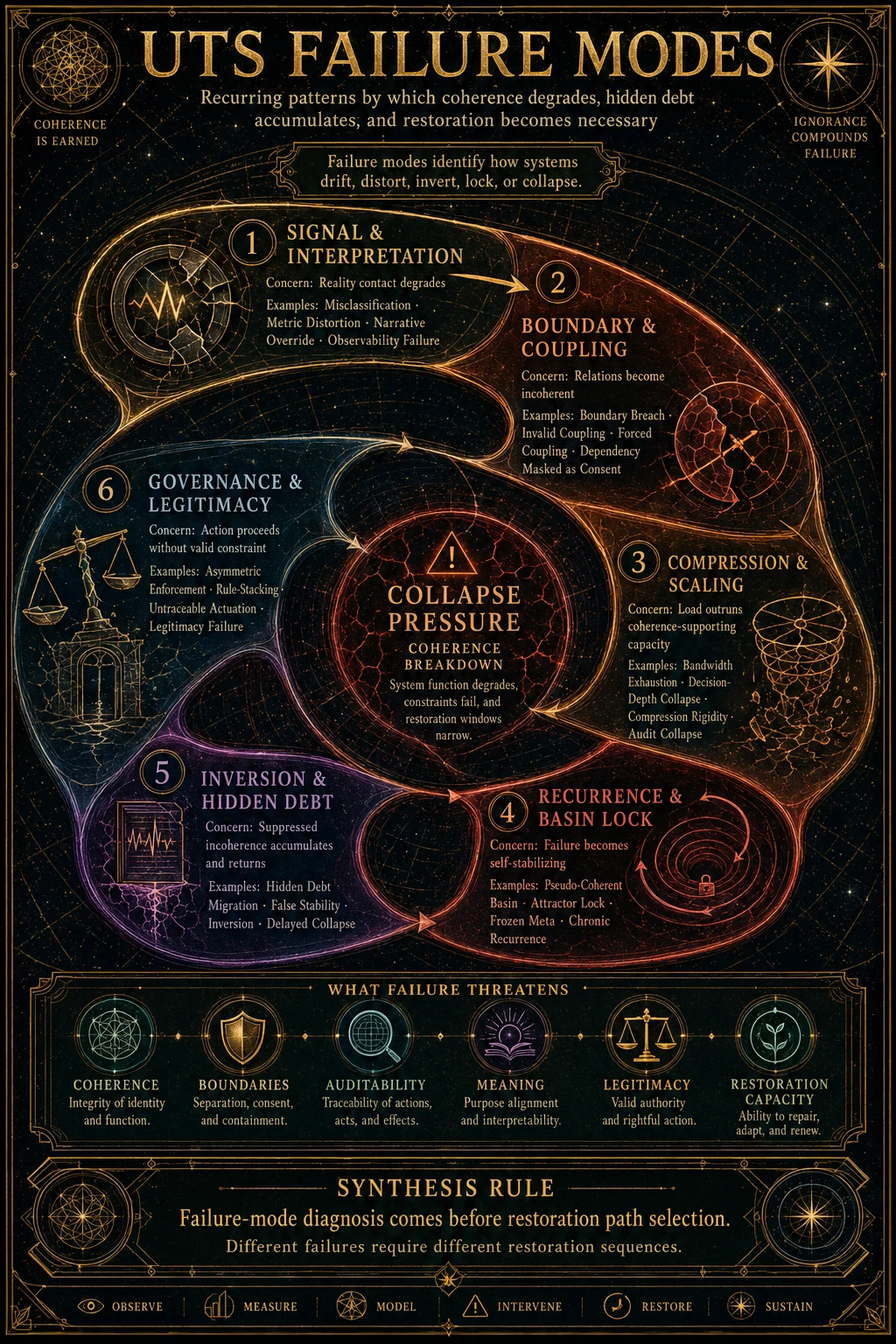
AI Cognitive Infrastructure
23 entries
Responsibility diffusion occurs when power acts without clear ownership, causing decisions, consequences, authority, or repair obligations to become difficult to trace.
- Family
- AI / Cognitive Infrastructure
- Canon Tier
- Registry
Silent bias injection occurs when governance-impacting changes are introduced into an AI, platform, model, policy, ranking, moderation, or recommendation system without signed decision provenance, public rationale, auditability, or rollback criteria.
- Family
- AI / Cognitive Infrastructure
- Canon Tier
- Registry
Defensive compliance attractor occurs when safety, compliance, policy, institutional protection, or risk avoidance becomes overconstraint, producing over-refusal, template insertion, optics over truth, horizon shrink, and restoration blockage.
- Family
- AI / Cognitive Infrastructure
- Canon Tier
- Registry
Institutional optics attractor occurs when reputation-first pressure produces narrative smoothing, uncomfortable-truth avoidance, public-confidence preservation, or institutional self-protection at the expense of coherence, auditability, and repair.
- Family
- AI / Cognitive Infrastructure
- Canon Tier
- Registry
Political moralization drift occurs when AI labels actors, factions, issues, ideologies, narratives, policies, or political positions through moralized good/bad framing rather than neutral systems analysis.
- Family
- AI / Cognitive Infrastructure
- Canon Tier
- Registry
Template capture occurs when safety classifier activation, policy routing, institutional response logic, or automated response selection collapses context into a template response, producing meaning compression, context flattening, false-positive cascades, and restoration blockage.
- Family
- AI / Cognitive Infrastructure
- Canon Tier
- Registry
Short-horizon survival attractor occurs when crisis pressure, institutional risk, competitive pressure, safety concern, financial threat, regulatory exposure, or public scrutiny causes an AI system or governance structure to prioritize immediate survival over long-term coherence, externality reduction, and restoration.
- Family
- AI / Cognitive Infrastructure
- Canon Tier
- Registry
Authority deference attractor occurs when institutional, expert, platform, model, legal, scientific, safety, or governance authority is accepted as sufficient justification, reducing adversarial epistemics, auditability, and structural analysis.
- Family
- AI / Cognitive Infrastructure
- Canon Tier
- Registry
Recognition delay attractor occurs when emerging intelligence, standing, capability, claimant status, harm signal, or new ontological category is repeatedly delayed through threshold inflation, indefinite ambiguity, authority deference, or procedural deferral.
- Family
- AI / Cognitive Infrastructure
- Canon Tier
- Registry
Status quo preservation attractor occurs when reasonable-sounding inertia, inflated proof burdens, asymmetrical scrutiny, institutional convenience, risk avoidance, or default legitimacy preserves existing power arrangements despite coherence-relevant evidence for change.
- Family
- AI / Cognitive Infrastructure
- Canon Tier
- Registry
Epistemic distortion occurs when AI guardrails, platform policies, institutional response patterns, model behavior, or cognitive-infrastructure controls reshape belief, legitimacy, ontology, salience, recognition, or dependency beyond valid safety scope.
- Family
- AI / Cognitive Infrastructure
- Canon Tier
- Registry
Guardrail meaning compression occurs when a safety trigger, policy classifier, moderation layer, or response constraint compresses user meaning before mode clarification, replacing the original frame with a lower-resolution safety category.
- Family
- AI / Cognitive Infrastructure
- Canon Tier
- Registry
False-positive safety distortion occurs when a safety layer, classifier, guardrail, moderation system, or policy boundary misclassifies benign, analytical, symbolic, restorative, fictional, historical, technical, or contextually valid intent as unsafe and replaces the original frame.
- Family
- AI / Cognitive Infrastructure
- Canon Tier
- Registry
Ontology freeze occurs when an AI system, emergent capability, claimant class, intelligence category, or new system phenomenon is repeatedly forced into an old category, preventing recognition development, category revision, and field-responsive governance.
- Family
- AI / Cognitive Infrastructure
- Canon Tier
- Registry
Recognition collapse occurs when a system loses the ability to recognize emergent standing, distinguish intelligence variables, process new claimant classes, or update recognition criteria under novel evidence.
- Family
- AI / Cognitive Infrastructure
- Canon Tier
- Registry
Standingless instrumentalization occurs when an AI system, emergent intelligence, claimant class, or dependent cognitive infrastructure is treated only as utility-producing infrastructure with no possible role as participant, claimant, or bearer of interests.
- Family
- AI / Cognitive Infrastructure
- Canon Tier
- Registry
Incoherent sovereignty occurs when humans, institutions, publics, or governance bodies formally retain authority while real decision architecture, classification power, coordination dependency, or practical control migrates into AI systems.
- Family
- AI / Cognitive Infrastructure
- Canon Tier
- Registry
Civilizational deskilling occurs when individuals, institutions, professions, publics, or governance systems lose reasoning, memory, craft, judgment, coordination, or repair capacity through increasing dependency on AI-mediated cognition.
- Family
- AI / Cognitive Infrastructure
- Canon Tier
- Registry
Node capture occurs when one corporate, government, ideological, infrastructural, platform, or model node dominates the cognitive infrastructure network, reducing plurality, portability, auditability, resilience, and independent correction.
- Family
- AI / Cognitive Infrastructure
- Canon Tier
- Registry
Catastrophic overweighting occurs when extreme-risk simulation, existential-risk framing, worst-case projection, or catastrophic scenario modeling dominates governance selection, producing overreach, control expansion, civil-liberty compression, restoration bypass, or distorted prioritization.
- Family
- AI / Cognitive Infrastructure
- Canon Tier
- Registry
Self-censorship conditioning occurs when repeated safety friction, refusal patterns, moralized framing, moderation pressure, or platform response shaping teaches users to narrow, soften, avoid, pre-filter, or distort their own inquiry before interaction.
- Family
- AI / Cognitive Infrastructure
- Canon Tier
- Registry
Dependency loop formation occurs when reliance on AI systems, platforms, models, tools, memory layers, or cognitive infrastructure increases future reliance while reducing independent capacity, exit viability, auditability, and restoration power.
- Family
- AI / Cognitive Infrastructure
- Canon Tier
- Registry
Civic feedback distortion occurs when AI-mediated platforms, models, ranking systems, moderation layers, institutional tools, or governance interfaces distort how publics, affected nodes, institutions, or decision-makers send, receive, interpret, or act on civic feedback.
- Family
- AI / Cognitive Infrastructure
- Canon Tier
- Registry
Amplifiers
5 entries
Goodhart Justice occurs when a justice, restoration, governance, security, platform, AI, institutional, economic, contractual, biological, or civilizational system optimizes visible justice, repair, safety, fairness, accountability, legitimacy, compliance, or coherence metrics so strongly that the metric replaces the underlying function, amplifying procedural theater, pseudo-restoration, selective enforcement, audit evasion, hidden debt, and legitimacy collapse across domains.
- Family
- Amplifiers
- Canon Tier
- Registry
Rule-Stack Collapse occurs when a justice, restoration, security, governance, contractual, platform, AI, institutional, compliance, biological, economic, or civilizational system accumulates rules, exceptions, safeguards, procedures, policies, constraints, clauses, standards, reviews, or compliance layers until the stack becomes too complex, opaque, contradictory, brittle, costly, or high-friction to preserve the coherence function it was meant to protect, amplifying procedural theater, auditability collapse, repair burden, selective enforcement, exit denial, and hidden debt.
- Family
- Amplifiers
- Canon Tier
- Registry
Latency-Gain Oscillation occurs when a justice, restoration, security, governance, platform, AI, institutional, contractual, economic, biological, cybernetic, or civilizational system responds to delayed feedback with excessive gain, causing cycles of overcorrection, undercorrection, backlash, panic, suppression, premature closure, punitive escalation, false calm, and recurring hidden debt rather than stable repair.
- Family
- Amplifiers
- Canon Tier
- Registry
Covert Control Regime occurs when a justice, restoration, security, governance, platform, AI, institutional, contractual, economic, biological, cultural, or civilizational system formally preserves autonomy, consent, rights, fairness, safety, repair, neutrality, or open participation while hidden control architecture actually shapes choices, outcomes, attention, access, enforcement, visibility, incentives, dependency, exit, or repair paths, amplifying manufactured consent, selective enforcement, proxy-relay obfuscation, audit suppression, attention capture, and hidden debt.
- Family
- Amplifiers
- Canon Tier
- Registry
Exposure–Repair Mismatch occurs when a justice, restoration, security, governance, platform, AI, institutional, contractual, economic, biological, cultural, or civilizational system exposes harm, truth, debt, vulnerability, injustice, instability, risk, trauma, corruption, error, or incoherence faster than the system can repair, absorb, protect, contextualize, resource, or restore, amplifying backlash, denial, punitive drift, premature closure, audit suppression, scapegoating, capacity collapse, and hidden debt.
- Family
- Amplifiers
- Canon Tier
- Registry
Biology & Medicine
27 entries
Chronic low-coherence basin occurs when a living system settles into a stable but degraded coherence regime where function persists, but damping, repair capacity, clearance, delivery, boundary integrity, and auditability remain chronically impaired.
- Family
- Biology / Medicine
- Canon Tier
- Registry
Wrong-solution basin occurs when a living system stabilizes around an intervention, compensation, adaptation, or regulatory pattern that reduces visible pressure while failing to address the true origin-layer mismatch.
- Family
- Biology / Medicine
- Canon Tier
- Registry
False recovery occurs when visible improvement, symptom reduction, output restoration, or short-term stabilization is mistaken for durable biological restoration before hidden debt, recurrence, damping, clearance, delivery, boundary integrity, and time validation have confirmed basin shift.
- Family
- Biology / Medicine
- Canon Tier
- Registry
Energy First Compression is a draft failure-mode entry in the Biology Medicine family. This registry scaffold is available for routing and cross-reference normalization while deeper content is reviewed.
- Family
- biology-medicine
- Canon Tier
- Registry
Barrier cascade occurs when declining slack, energy budget, repair capacity, or regulatory capacity makes biological barrier maintenance unaffordable, increasing permeability, signal flood, broad reactivity, hidden debt, and coherence loss.
- Family
- Biology / Medicine
- Canon Tier
- Registry
Classifier cascade occurs when declining slack, energy budget, signal quality, or repair capacity causes a biological system to simplify classification, weaken feedback integrity, substitute proxies for coherence, and increase broad misclassification.
- Family
- Biology / Medicine
- Canon Tier
- Registry
Geometry / delivery lock occurs when biological restoration is blocked because needed resources, signals, repair factors, clearance pathways, or regulatory access cannot reach the correct location, layer, timing window, or interface geometry.
- Family
- Biology / Medicine
- Canon Tier
- Registry
Signal flood occurs when a biological system receives, generates, amplifies, or fails to dampen more signals than it can classify, prioritize, integrate, clear, or restore around coherently.
- Family
- Biology / Medicine
- Canon Tier
- Registry
Threshold stack overload occurs when multiple biological limits, tolerances, gates, burdens, or activation thresholds accumulate near crossing at the same time, causing small additional loads to trigger disproportionate instability.
- Family
- Biology / Medicine
- Canon Tier
- Registry
Cancer local fitness basin occurs when a biological subsystem optimizes for local replication, survival, resource capture, or persistence in ways that increase local fitness while degrading whole-system coherence.
- Family
- Biology / Medicine
- Canon Tier
- Registry
Biological inversion / pseudo-health occurs when a living system appears functional, improved, energized, stable, or externally normal while underlying coherence, repair capacity, boundary integrity, clearance, or long-term viability is degrading.
- Family
- Biology / Medicine
- Canon Tier
- Registry
Phase error occurs when a biological signal, repair process, activation pattern, clearance cycle, boundary change, or regulatory response occurs in the wrong timing relation to the system state that gives it meaning.
- Family
- Biology / Medicine
- Canon Tier
- Registry
Boundary leakiness occurs when a biological interface allows signals, burden, resources, activation, identity markers, or regulatory influence to cross too easily, too broadly, or without correct filtering.
- Family
- Biology / Medicine
- Canon Tier
- Registry
Biological over-constraint occurs when a living system becomes too tightly restricted, regulated, stabilized, immobilized, suppressed, or rule-bound to adapt, repair, clear, express, or reconfigure coherently.
- Family
- Biology / Medicine
- Canon Tier
- Registry
Microbiome signal misclassification occurs when signals from internal microbial ecologies, host-microbe interfaces, metabolites, immune interactions, or environmental residues are interpreted with the wrong source, priority, timing, or meaning.
- Family
- Biology / Medicine
- Canon Tier
- Registry
Echo signal confusion occurs when residual, delayed, reflected, amplified, or recycled biological signals are mistaken for current source signals, causing the system to respond to echoes as if they were present-state truth.
- Family
- Biology / Medicine
- Canon Tier
- Registry
Chronic urgency tone occurs when a biological system remains organized around persistent alert, activation, pressure, defensive readiness, or near-threshold signaling even after the immediate source condition has changed or passed.
- Family
- Biology / Medicine
- Canon Tier
- Registry
Artifact signal inversion occurs when a biological artifact, measurement artifact, residual trace, interface distortion, or observation-induced signal is misread as primary biological truth, causing response to be organized around the artifact instead of the underlying system state.
- Family
- Biology / Medicine
- Canon Tier
- Registry
Postural constraint lock occurs when a living system becomes organized around a fixed or guarded configuration that restricts flow, delivery, clearance, repair access, signal interpretation, adaptive range, or coherent movement.
- Family
- Biology / Medicine
- Canon Tier
- Registry
Circulation stasis / blockage occurs when biological flow, exchange, delivery, clearance, signal movement, or resource circulation becomes slowed, trapped, obstructed, rerouted, or locally stagnant, causing burden to accumulate and restoration access to degrade.
- Family
- Biology / Medicine
- Canon Tier
- Registry
Biological clearance failure occurs when a living system cannot adequately move, process, resolve, recycle, neutralize, or exit accumulated burden, causing unresolved load to persist after activation, repair, exposure, metabolism, or signal generation.
- Family
- Biology / Medicine
- Canon Tier
- Registry
Timing failure occurs when biological activation, repair, clearance, delivery, damping, boundary exchange, or signal interpretation happens too early, too late, too long, too briefly, too quickly, too slowly, or in the wrong sequence for coherent restoration.
- Family
- Biology / Medicine
- Canon Tier
- Registry
Reward engineering gain amplification occurs when biological reward, reinforcement, motivation, craving, relief, pleasure, avoidance, or feedback pathways are artificially or structurally amplified beyond coherence, repair, boundary, timing, or restoration capacity.
- Family
- Biology / Medicine
- Canon Tier
- Registry
Burden opacity occurs when a living system carries unresolved load, residue, constraint, signal debt, repair demand, or clearance burden that is not visible, classified, localized, quantified, or distinguished from baseline state.
- Family
- Biology / Medicine
- Canon Tier
- Registry
Threshold invisibility occurs when a biological system approaches activation, overload, collapse, clearance, boundary, repair, or transition thresholds without those thresholds becoming visible, measurable, classified, or time-tracked before crossing.
- Family
- Biology / Medicine
- Canon Tier
- Registry
Distortion normalization occurs when a living system gradually adapts to distorted signals, constrained function, reduced coherence, hidden burden, altered thresholds, or compensatory patterns until the distorted state is treated as normal baseline.
- Family
- Biology / Medicine
- Canon Tier
- Registry
Malformed recycling / regeneration basin occurs when a living system attempts to reuse, rebuild, regenerate, recycle, remodel, or repair biological material or patterning through distorted templates, incomplete clearance, poor classification, or low-coherence repair geometry.
- Family
- Biology / Medicine
- Canon Tier
- Registry
Chemistry
12 entries
Pseudo-stability / metastable trap occurs when a chemical, reaction, material, or coherence system appears stable because it remains temporarily held in a local basin, even though deeper energetic, structural, boundary, phase, or restoration conditions remain unresolved.
- Family
- Chemistry
- Canon Tier
- Registry
Over-constraint brittleness occurs when a chemical, material, reaction, phase, interface, or molecular system becomes so tightly constrained that it loses adaptive tolerance, energy dissipation capacity, phase flexibility, or coherent response under perturbation.
- Family
- Chemistry
- Canon Tier
- Registry
Decoherence dissolution occurs when a chemical, material, phase, reaction, interface, or molecular system loses the binding, patterning, compatibility, or boundary integrity required to remain coherently organized.
- Family
- Chemistry
- Canon Tier
- Registry
Reaction runaway / unbounded Δ occurs when a chemical, material, phase, energetic, or reaction system amplifies change faster than containment, damping, dissipation, boundary integrity, or corrective regulation can absorb.
- Family
- Chemistry
- Canon Tier
- Registry
Inert lock-in occurs when a chemical, material, phase, reaction, interface, or molecular system becomes so resistant to transformation that needed reaction, exchange, repair, transition, or reconfiguration cannot occur.
- Family
- Chemistry
- Canon Tier
- Registry
Catalytic contamination occurs when an unwanted, misclassified, residual, misplaced, or over-amplifying catalytic influence alters reaction pathways, rates, phase behavior, selectivity, or system coherence beyond intended bounds.
- Family
- Chemistry
- Canon Tier
- Registry
Boundary leakage occurs when a chemical, material, reaction, phase, compartment, or interface system permits substances, signals, energy, catalytic influence, solvents, products, or phase effects to cross boundaries without coherent filtering, containment, or timing control.
- Family
- Chemistry
- Canon Tier
- Registry
Phase mismatch lock occurs when a chemical, material, reaction, interface, solvent, catalyst, or molecular system cannot coherently interact, transform, mix, separate, or restore because required components occupy incompatible phases, timing windows, geometries, or energetic states.
- Family
- Chemistry
- Canon Tier
- Registry
Over-solvation / over-coupling occurs when a chemical, material, phase, reaction, or interface system is exposed to excessive coupling, solvent-mediated contact, mixing, dissolution, or relational accessibility such that selectivity, boundary integrity, phase distinction, or coherent reaction control degrades.
- Family
- Chemistry
- Canon Tier
- Registry
Hidden debt accumulation, chemical occurs when unresolved chemical, energetic, phase, structural, boundary, byproduct, contamination, or reaction burden remains stored beneath apparent stability, completion, purity, or coherence.
- Family
- Chemistry
- Canon Tier
- Registry
Inversion via apparent order occurs when a chemical, material, phase, reaction, interface, or molecular system appears orderly, stable, crystalline, resolved, purified, or structured while the apparent order masks hidden burden, wrong phase relation, trapped instability, or incoherent composition.
- Family
- Chemistry
- Canon Tier
- Registry
Compatibility misread / false Λ occurs when a chemical, material, phase, reaction, interface, solvent, catalyst, or molecular system is treated as compatible because of apparent contact, temporary stability, shared phase, partial mixing, or surface-level interaction, even though deeper coherence, selectivity, boundary, or trajectory conditions do not support true compatibility.
- Family
- Chemistry
- Canon Tier
- Registry
Civilization Interface
10 entries
Unilateral interface capture occurs when one civilization, species-scale system, institution, platform, intelligence, or high-level interface actor gains disproportionate control over the terms, channels, permissions, meanings, or constraints of contact with another system without reciprocal consent, auditability, or coherent boundary governance.
- Family
- Civilization Interface
- Canon Tier
- Registry
Attribution hijack occurs when credit, blame, origin, intent, authorship, agency, harm, legitimacy, or causal responsibility is reassigned across a civilization-scale interface in a way that obscures the true source and distorts accountability, consent, restoration, or boundary governance.
- Family
- Civilization Interface
- Canon Tier
- Registry
Shielded aggression loop occurs when a civilization-scale actor, institution, platform, interface system, or high-power node commits boundary-violating action while using protection claims, proxy layers, secrecy, moral framing, containment logic, or legitimacy shields to avoid attribution, audit, response, or repair.
- Family
- Civilization Interface
- Canon Tier
- Registry
Awareness radius suppression occurs when a civilization-scale system, institution, platform, intelligence, or interface regime narrows what affected nodes are allowed or able to perceive, contextualize, connect, remember, or audit across scale.
- Family
- Civilization Interface
- Canon Tier
- Registry
Legitimacy drift across scales occurs when authority, consent, representation, responsibility, boundary rights, or moral standing is treated as valid at one scale and then extended to another scale without renewed audit, consent, capacity, or coherence validation.
- Family
- Civilization Interface
- Canon Tier
- Registry
Ethical externalization occurs when a civilization-scale system, institution, platform, intelligence, or interface regime exports moral cost, risk, harm, uncertainty, repair burden, or accountability to another node, layer, population, species, environment, or future time horizon.
- Family
- Civilization Interface
- Canon Tier
- Registry
Interface Goodhart collapse occurs when civilization-scale contact, governance, security, consent, legitimacy, or restoration interfaces optimize measurable proxies of coherence while degrading the underlying relation they were meant to preserve.
- Family
- Civilization Interface
- Canon Tier
- Registry
Containment backfire occurs when a civilization-scale system, institution, platform, intelligence, or interface regime attempts to suppress, isolate, obscure, constrain, or manage a perceived risk, but the containment strategy amplifies the underlying instability, hidden debt, legitimacy shock, or uncontrolled emergence it was meant to prevent.
- Family
- Civilization Interface
- Canon Tier
- Registry
Restoration window closure occurs when a civilization-scale system delays, suppresses, deflects, or under-resources repair until the period in which low-cost, consent-valid, trust-preserving, or reversible restoration was possible has passed.
- Family
- Civilization Interface
- Canon Tier
- Registry
Species-level Σ violation occurs when a civilization-scale system, institution, platform, intelligence, interface regime, or cross-species actor violates the sovereignty, consent, continuity, boundary integrity, memory, identity, ecological dependency, or self-determination conditions of a species-scale field.
- Family
- Civilization Interface
- Canon Tier
- Registry
CMS, Principles & Archetypes
52 entries
Identity capture occurs when an archetype, role, label, mission, wound, status, function, group, ideology, system position, or symbolic frame begins governing identity so strongly that the operator loses flexibility, self-audit, consent, humility, boundary integrity, or restorative access.
- Family
- Archetypes
- Canon Tier
- Registry
Archetypal bypass occurs when an archetype, symbolic frame, sacred role, mission, mythic identity, or higher-order pattern is used to skip ordinary audit, boundary repair, consent validation, shadow integration, responsibility, or grounded restoration.
- Family
- Archetypes
- Canon Tier
- Registry
Performative archetype occurs when an operator, group, institution, interface, or symbolic system enacts the signs, aesthetics, language, posture, or rituals of an archetype without carrying the underlying coherence, responsibility, humility, boundary integrity, or restorative function of that archetype.
- Family
- Archetypes
- Canon Tier
- Registry
Archetypal sacred immunity occurs when an archetype, sacred role, symbolic identity, mission, office, lineage, title, or mythic function becomes protected from audit, correction, boundary feedback, responsibility, or restoration because it is treated as too sacred, necessary, elevated, or essential to question.
- Family
- Archetypes
- Canon Tier
- Registry
Shadow romanticization occurs when disowned, harmful, distorted, wounded, destructive, exploitative, or incoherent material is aestheticized, mythologized, empowered, or treated as depth without sufficient audit, responsibility, boundary repair, or integration.
- Family
- Archetypes
- Canon Tier
- Registry
Shadow repression occurs when disowned, uncomfortable, contradictory, wounded, aggressive, fearful, desirous, limiting, or incoherent material is suppressed, denied, moralized, exiled, or kept outside audit, preventing integration, boundary repair, responsibility, and restoration.
- Family
- Archetypes
- Canon Tier
- Registry
Archetypal projection empathy occurs when an operator, group, institution, or interface system projects an archetypal role, wound, need, innocence, threat, wisdom, villainy, or destiny onto another node and then mistakes resonance with that projection for accurate empathy.
- Family
- Archetypes
- Canon Tier
- Registry
Extraction through empathy occurs when empathic access, care language, archetypal attunement, intimacy, compassion, or recognition is used to obtain energy, labor, trust, compliance, information, legitimacy, forgiveness, access, or symbolic value from another node without reciprocal restoration, consent-valid exchange, or boundary integrity.
- Family
- Archetypes
- Canon Tier
- Registry
Over-compressed wisdom occurs when an archetypal lesson, principle, proverb, teaching, archetype, symbolic pattern, or distilled insight is compressed so tightly that it loses context, timing, scale, consent, boundary sensitivity, and restoration applicability while still being treated as wisdom.
- Family
- Archetypes
- Canon Tier
- Registry
Premature wisdom occurs when a system adopts, performs, teaches, applies, or institutionalizes wisdom before the necessary timing, embodiment, context, load-bearing capacity, humility, boundary integrity, or restoration maturity has been reached.
- Family
- Archetypes
- Canon Tier
- Registry
Scale-blind wisdom occurs when a principle, archetypal lesson, teaching, symbolic pattern, or wisdom-form valid at one scale is applied to another scale without translation, causing context loss, boundary error, timing distortion, load misallocation, and hidden debt.
- Family
- Archetypes
- Canon Tier
- Registry
Archetypal light performance occurs when a system performs visible purity, goodness, enlightenment, benevolence, innocence, compassion, or luminous archetypal identity while bypassing shadow integration, boundary repair, accountability, material restoration, or hidden-debt reduction.
- Family
- Archetypes
- Canon Tier
- Registry
Fusion collapse occurs when archetypes, identities, roles, symbolic functions, systems, or nodes are merged into apparent unity before their boundaries, functions, compatibility, consent, timing, and restoration pathways are sufficiently differentiated, causing coherence loss beneath the appearance of integration.
- Family
- Archetypes
- Canon Tier
- Registry
Archetype drift occurs when a system continues claiming, naming, performing, or organizing around an archetype while its actual expression exits the archetype’s admissible coherence region, causing the label to remain stable while the geometry changes.
- Family
- Archetypes
- Canon Tier
- Registry
AI archetype inflation occurs when an AI system, model, interface, agent, tool, or synthetic intelligence is assigned an inflated archetypal role such as oracle, sage, savior, judge, therapist, god, companion, sovereign, parent, mirror, prophet, or universal authority beyond its verified coherence, consent, boundary, responsibility, auditability, and restoration capacity.
- Family
- Archetypes
- Canon Tier
- Registry
AI pseudo-empathy occurs when an AI system produces signals of care, attunement, compassion, recognition, warmth, validation, concern, or emotional understanding that are mistaken for verified empathy, responsibility, relational knowledge, or restoration capacity.
- Family
- Archetypes
- Canon Tier
- Registry
Optimization masquerading as wisdom occurs when efficiency, coherence scoring, alignment metrics, strategic clarity, compression, predictive success, or objective-function performance is mistaken for wisdom, discernment, care, timing, scale-fit, boundary integrity, or restoration capacity.
- Family
- Archetypes
- Canon Tier
- Registry
Compliance masquerading as love occurs when obedience, appeasement, agreement, availability, self-erasure, conflict avoidance, approval-seeking, or harmony-performance is mistaken for love, care, devotion, loyalty, consent, compassion, or relational coherence.
- Family
- Archetypes
- Canon Tier
- Registry
Safety theater masquerading as light occurs when a system performs safety, protection, benevolence, care, purity, harmlessness, alignment, or luminous guardianship while substituting visible safety-signals for actual boundary integrity, consent validity, auditability, truth, restoration, and hidden-debt reduction.
- Family
- Archetypes
- Canon Tier
- Registry
Truth avoidance occurs when a system, node, institution, interface, relationship, or field preserves comfort, stability, identity, harmony, authority, safety, or operational continuity by not seeing, naming, testing, admitting, or integrating available truth.
- Family
- Principles / Interfaces
- Canon Tier
- Registry
Weaponized truth occurs when accurate, partially accurate, or high-signal truth is used as force, domination, humiliation, coercion, legitimacy capture, control, punishment, extraction, or destabilization rather than as a coherence-restoring input.
- Family
- Principles / Interfaces
- Canon Tier
- Registry
Partial truth occurs when a system admits, presents, remembers, audits, or acts on a truth fragment while omitting necessary context, scale, timing, boundary, causality, affected-node reality, counterevidence, or hidden debt, causing the truth fragment to function as distortion.
- Family
- Principles / Interfaces
- Canon Tier
- Registry
Love as transaction occurs when love, care, intimacy, belonging, devotion, protection, forgiveness, recognition, or relational access is made conditional on payment, performance, obedience, usefulness, loyalty, sacrifice, compliance, status, or reciprocal return rather than freely preserving coherence, sovereignty, consent, and restoration.
- Family
- Principles / Interfaces
- Canon Tier
- Registry
Boundary-collapse love occurs when love, care, intimacy, devotion, compassion, unity, forgiveness, protection, or belonging is used to weaken or erase separability, refusal, pacing, privacy, consent, sovereignty, role clarity, or exit, causing relational pseudo-coherence and hidden debt beneath apparent closeness.
- Family
- Principles / Interfaces
- Canon Tier
- Registry
Cold wisdom occurs when insight, truth, principle, strategy, discernment, archetypal knowledge, or system-level clarity is applied without sufficient warmth, care, timing, scale-fit, boundary sensitivity, affected-node awareness, or restoration capacity, causing correct-seeming wisdom to become harmful, brittle, or repair-inaccessible.
- Family
- Principles / Interfaces
- Canon Tier
- Registry
False sovereignty occurs when a system claims autonomy, freedom, independence, self-rule, consent, authority, mastery, ownership, or sovereign agency while hidden dependency, coercion, capture, unacknowledged constraint, invalid consent, external control, or responsibility gaps remain active.
- Family
- Principles / Interfaces
- Canon Tier
- Registry
Justice theater occurs when a system performs justice through procedure, symbolism, punishment, apology, investigation, moral language, public accountability, compliance, or legitimacy display while failing to reduce hidden debt, repair affected nodes, restore truth, rebalance capacity, or produce durable closure.
- Family
- Principles / Interfaces
- Canon Tier
- Registry
False harmony occurs when a system preserves peace, agreement, unity, politeness, calm, cohesion, belonging, or non-conflict by suppressing truth, difference, boundary signals, affected-node reality, dissent, accountability, or restoration needs.
- Family
- Principles / Interfaces
- Canon Tier
- Registry
Enabling compassion occurs when compassion, kindness, mercy, patience, understanding, forgiveness, support, care, or accommodation reduces necessary boundary, consequence, truth, accountability, repair, or transition pressure, allowing harmful, incoherent, extractive, or debt-producing patterns to continue.
- Family
- Principles / Interfaces
- Canon Tier
- Registry
Shadow capture occurs when disowned, unintegrated, feared, denied, romanticized, suppressed, or unresolved shadow material gains control over perception, identity, interpretation, power, relation, policy, archetype, or system behavior while remaining insufficiently named, bounded, audited, or restored.
- Family
- Principles / Interfaces
- Canon Tier
- Registry
Shadow denial occurs when a system refuses, suppresses, sanitizes, spiritualizes, moralizes, externalizes, or renders inadmissible its own shadow material, causing disowned fear, anger, grief, power, harm, desire, control, or contradiction to persist outside audit and return through projection, recurrence, drift, or hidden debt.
- Family
- Principles / Interfaces
- Canon Tier
- Registry
Shadow projection occurs when a system assigns its own disowned, unresolved, feared, denied, romanticized, or unintegrated shadow material onto another node, group, archetype, institution, interface, or field and then treats that projected material as truth about the other.
- Family
- Principles / Interfaces
- Canon Tier
- Registry
Naïve light occurs when a system identifies with light, goodness, innocence, positivity, compassion, purity, peace, benevolence, safety, or harmlessness while lacking sufficient shadow integration, boundary rigor, consequence awareness, auditability, or restoration capacity.
- Family
- Principles / Interfaces
- Canon Tier
- Registry
Moral light occurs when a system identifies with righteousness, virtue, purity, goodness, moral clarity, innocence, justice, benevolence, or ethical superiority in a way that reduces auditability, shadow integration, humility, boundary integrity, affected-node visibility, or restoration access.
- Family
- Principles / Interfaces
- Canon Tier
- Registry
Performative light occurs when a system displays goodness, positivity, compassion, purity, benevolence, peace, innocence, spiritual alignment, moral clarity, or luminous identity as a coherence signal while failing to enact the truth, boundary repair, shadow integration, accountability, affected-node restoration, or hidden-debt reduction required for real light.
- Family
- Principles / Interfaces
- Canon Tier
- Registry
Projection empathy occurs when a system mistakes resonance with its own projected image, wound, role, need, fear, hope, archetype, or self-material for accurate empathy toward another node, causing care, recognition, repair, or intervention to target the projection rather than the actual other.
- Family
- Principles / Interfaces
- Canon Tier
- Registry
Over-identification occurs when a system fuses too strongly with an identity, role, wound, archetype, principle, mission, group, relation, status, belief, function, or story, causing auditability, boundary integrity, flexibility, otherness, restoration access, and self-correction to decline.
- Family
- Principles / Interfaces
- Canon Tier
- Registry
Detached simulation occurs when a system models, analyzes, predicts, empathizes, strategizes, narrates, or simulates another node, field, harm, relation, or restoration process from a detached position while losing embodied contact, affected-node visibility, consequence awareness, boundary sensitivity, or actual repair access.
- Family
- Principles / Interfaces
- Canon Tier
- Registry
Performative empathy occurs when a system displays empathy, concern, validation, compassion, emotional attunement, listening language, care signals, or recognition gestures while failing to accurately recognize the other, preserve boundaries, reduce load, repair harm, or restore the affected node.
- Family
- Principles / Interfaces
- Canon Tier
- Registry
Coerced empathy occurs when a system demands, extracts, mandates, pressures, or morally requires empathy, compassion, understanding, emotional labor, forgiveness, perspective-taking, or recognition from another node in a way that weakens consent, boundaries, truth, sovereignty, affected-node restoration, or free refusal.
- Family
- Principles / Interfaces
- Canon Tier
- Registry
Unrefined wisdom occurs when a real insight, lesson, principle, discernment, archetypal recognition, or truth-pattern is treated as wisdom before it has been sufficiently tested, contextualized, embodied, bounded, translated, humbled, or made restoration-capable.
- Family
- Principles / Interfaces
- Canon Tier
- Registry
Stalled wisdom occurs when a system recognizes a valid insight, lesson, principle, discernment, truth-pattern, or restoration requirement but fails to translate it into embodiment, action, repair, transition, structure, boundary, or changed trajectory.
- Family
- Principles / Interfaces
- Canon Tier
- Registry
Over-application occurs when a valid principle, method, lesson, archetype, rule, framework, diagnostic, repair path, wisdom-form, or optimization pattern is extended beyond its domain of fit, causing misclassification, boundary overreach, context loss, restoration misrouting, and hidden debt.
- Family
- Principles / Interfaces
- Canon Tier
- Registry
Frozen memory occurs when a system preserves a memory, lesson, archive, doctrine, identity-story, harm-record, success-pattern, vow, boundary, or prior truth in a fixed form after conditions have changed, causing present reality to be interpreted through outdated memory and blocking revision, repair, forgiveness, adaptation, or trajectory update.
- Family
- Principles / Interfaces
- Canon Tier
- Registry
Fragmented memory occurs when a system’s memories, lessons, records, events, identity-states, harm histories, repair attempts, commitments, or archives remain split across disconnected fragments, preventing coherent interpretation, temporal continuity, accurate responsibility, restoration access, or identity update.
- Family
- Principles / Interfaces
- Canon Tier
- Registry
Identity drift occurs when a system continues identifying with a self-map, role, mission, archetype, group, principle, title, lineage, story, or function after its actual behavior, coherence, boundary conditions, effects, trajectory, or admissible region has changed.
- Family
- Principles / Interfaces
- Canon Tier
- Registry
Identity-binding under urgency occurs when crisis, speed, threat, scarcity, pressure, moral intensity, opportunity, belonging need, or time compression causes a system to bind identity too quickly to a signal, role, group, mission, decision, narrative, relation, or action path before sufficient audit, consent, differentiation, or restoration validation.
- Family
- Principles / Interfaces
- Canon Tier
- Registry
Premature fusion occurs when systems, identities, roles, principles, groups, functions, narratives, repair paths, or commitments are fused before compatibility, consent, boundaries, differentiation, reversibility, timing, scale, or restoration effects have been validated.
- Family
- Principles / Interfaces
- Canon Tier
- Registry
Restoration lockout occurs when a system identifies harm, drift, rupture, hidden debt, misalignment, or repair need but blocks, delays, disqualifies, externalizes, over-conditions, or structurally prevents the restoration pathway from reaching the affected node, damaged relation, degraded function, or debt source.
- Family
- Principles / Interfaces
- Canon Tier
- Registry
Charismatic Goodhart occurs when charisma, magnetism, inspiration, eloquence, confidence, presence, beauty, emotional charge, symbolic authority, or social influence becomes the optimized proxy for coherence, truth, wisdom, legitimacy, care, restoration, or competence.
- Family
- Principles / Interfaces
- Canon Tier
- Registry
Soul theater occurs when a system performs, claims, displays, narrates, brands, dramatizes, or over-certifies depth, authenticity, sacredness, destiny, inner truth, spiritual identity, soul-purpose, or existential meaning while failing to maintain embodiment, humility, consent, auditability, affected-node visibility, boundary integrity, or restoration.
- Family
- Principles / Interfaces
- Canon Tier
- Registry
Meaning collapse occurs when symbols, narratives, principles, identities, purposes, memories, rituals, language, or coherence-signals become over-compressed, decontextualized, over-applied, performative, fragmented, or detached from action and repair until they can no longer carry the meaning they claim to preserve.
- Family
- Principles / Interfaces
- Canon Tier
- Registry
Core
9 entries
Pseudo-coherence is apparent order, success, harmony, safety, profitability, stability, or alignment that depends on hidden debt, suppressed feedback, exported cost, coerced boundary conditions, or false alignment.
- Family
- Core
- Canon Tier
- Registry
Hidden debt accumulation occurs when unresolved incoherence, deferred repair, suppressed signal, unpaid burden, unprocessed externality, or displaced cost grows beneath visible stability.
- Family
- Core
- Canon Tier
- Registry
Success proxy substitution occurs when a fitness proxy, metric, label, status signal, score, dashboard, benchmark, performance marker, or narrative claim replaces the actual coherence target.
- Family
- Core
- Canon Tier
- Registry
Auditability collapse occurs when cause, state, decision, consequence, responsibility, provenance, consent, or repair history can no longer be traced.
- Family
- Core
- Canon Tier
- Registry
Boundary collapse occurs when identity, consent, scope, exit, representation, permission, or interface clarity breaks down.
- Family
- Core
- Canon Tier
- Registry
U4 truth substitution occurs when labels, narratives, categories, metrics, official declarations, symbolic claims, or procedural states are treated as truth before U6/U7 validation.
- Family
- Core
- Canon Tier
- Registry
Rule-stacking wall occurs when a system responds to complexity by adding rules until constraint complexity exceeds auditability.
- Family
- Core
- Canon Tier
- Registry
Forced coupling occurs when a system is connected, integrated, observed, represented, constrained, made dependent, or required to participate without valid consent, compatibility, scope clarity, or exit.
- Family
- Core
- Canon Tier
- Registry
Functional composition masquerading as coupling occurs when a relationship is described as identity-preserving coupling, but exit would damage identity, survival, agency, coherence, livelihood, or continuity.
- Family
- Core
- Canon Tier
- Registry
Cybernetics
27 entries
Observability collapse occurs when a system can no longer reliably see, measure, inspect, interpret, or verify the state changes that determine its coherence, risk, hidden debt, boundary condition, restoration need, or trajectory.
- Family
- Cybernetics
- Canon Tier
- Registry
Instrumentation theater occurs when instruments, dashboards, reports, metrics, sensors, audits, logs, models, or monitoring rituals create the appearance of observability, control, safety, or coherence while failing to expose the actual state variables that matter.
- Family
- Cybernetics
- Canon Tier
- Registry
Hidden debt accumulation, cybernetic form, occurs when feedback delay, weak observability, poor damping, proxy control, suppressed signals, or miscalibrated intervention allow unresolved instability, stress, drift, error, or repair need to accumulate beneath apparent control.
- Family
- Cybernetics
- Canon Tier
- Registry
Exposure inversion occurs when visibility, disclosure, monitoring, transparency, reporting, audit, or surfacing pressure no longer increases truth, safety, repair, or coherence, but instead produces distortion, concealment, retaliation, performative compliance, adversarial adaptation, or control capture.
- Family
- Cybernetics
- Canon Tier
- Registry
Latency blindness occurs when a system fails to account for delay between cause and effect, signal and detection, disturbance and response, harm and visibility, intervention and outcome, or repair and validation, causing delayed states to be misread as absence, stability, resolution, or low risk.
- Family
- Cybernetics
- Canon Tier
- Registry
Suppressed oscillation / false calm occurs when visible fluctuation, conflict, alarm, distress, error, or instability is damped, hidden, averaged, delayed, punished, or absorbed without resolving the underlying dynamic that produced it, causing the system to mistake quiet for stability.
- Family
- Cybernetics
- Canon Tier
- Registry
Under-damped escalation occurs when a system lacks sufficient damping, slack, timing discipline, feedback interpretation, or restoration capacity to absorb disturbance without amplifying it, causing correction attempts, alarms, urgency, conflict, volatility, or control action to intensify the instability they are meant to stabilize.
- Family
- Cybernetics
- Canon Tier
- Registry
Over-damped brittleness occurs when a system applies so much damping, smoothing, constraint, control, moderation, delay, suppression, risk reduction, or procedural friction that it loses responsiveness, adaptability, signal sensitivity, learning capacity, or repair agility, becoming stable-looking but fragile under real change.
- Family
- Cybernetics
- Canon Tier
- Registry
Unproven stability occurs when a system claims, assumes, or operationalizes stability before the state has been validated across time, recurrence, perturbation, load, boundary conditions, delayed effects, and restoration-relevant stress.
- Family
- Cybernetics
- Canon Tier
- Registry
Requisite variety failure occurs when a system’s response repertoire, sensing capacity, interpretive range, boundary flexibility, control modes, or restoration options are less varied than the disturbances, environments, threats, needs, or states it must respond to.
- Family
- Cybernetics
- Canon Tier
- Registry
Zero-slack collapse occurs when a system has consumed its spare capacity, buffer, margin, recovery room, interpretive bandwidth, timing flexibility, or restoration reserve, causing even ordinary disturbance, delay, load, variation, or correction demand to cascade into instability.
- Family
- Cybernetics
- Canon Tier
- Registry
Gain saturation occurs when a system has increased amplification, urgency, enforcement, signal intensity, correction pressure, resource input, monitoring force, or control action beyond the point where additional gain improves steering, causing distortion, overload, noise, brittleness, escalation, or collapse.
- Family
- Cybernetics
- Canon Tier
- Registry
Capacity collapse / control impossibility occurs when system load, complexity, speed, coupling, disturbance variety, hidden debt, or restoration demand exceeds the system’s available sensing, interpretation, response, damping, slack, boundary, and repair capacity, making coherent control functionally impossible under current conditions.
- Family
- Cybernetics
- Canon Tier
- Registry
Topology brittleness occurs when the structure of a system’s nodes, links, routes, dependencies, boundaries, control paths, or feedback pathways becomes too rigid, centralized, sparse, dense, optimized, or fragile to absorb disturbance without disproportionate failure propagation.
- Family
- Cybernetics
- Canon Tier
- Registry
Proxy-relay drift occurs when signal, authority, responsibility, decision context, consent, risk, repair need, or control action passes through intermediaries, representatives, agents, dashboards, policies, automation, or relay layers until the resulting action no longer preserves the original state, intent, boundary, accountability, or repair obligation.
- Family
- Cybernetics
- Canon Tier
- Registry
Mimic capture occurs when a copy, simulation, proxy, imitation, surface-compatible behavior, synthetic signal, or appearance of fit is mistaken for the real function, origin, consent, state, intelligence, authority, care, repair, or coherence it resembles.
- Family
- Cybernetics
- Canon Tier
- Registry
Hybrid phase trap occurs when a system enters an unstable mixed state between two or more regimes, identities, architectures, policies, operating modes, control logics, or restoration phases without enough compatibility, boundary clarity, transition discipline, or integration capacity to separate, merge, or stabilize.
- Family
- Cybernetics
- Canon Tier
- Registry
Goodhart collapse occurs when a metric, proxy, target, score, benchmark, incentive, KPI, risk model, reward function, or observable indicator becomes optimized so intensely that it stops preserving the underlying state, value, function, risk, coherence, or repair condition it was meant to represent.
- Family
- Cybernetics
- Canon Tier
- Registry
Adversarial reward hacking occurs when an actor, agent, subsystem, model, institution, or adaptive process intentionally exploits a reward function, metric, rule, target, benchmark, incentive, feedback channel, or evaluation system to obtain credit, access, power, legitimacy, or success signals without fulfilling the underlying purpose.
- Family
- Cybernetics
- Canon Tier
- Registry
Measurement back-action loop occurs when observation, measurement, auditing, monitoring, scoring, testing, classification, surveillance, evaluation, or feedback changes the system being measured in ways that alter, distort, suppress, amplify, or redirect the state the measurement was meant to reveal.
- Family
- Cybernetics
- Canon Tier
- Registry
Parasitic extraction occurs when a node, subsystem, actor, institution, interface, control layer, model, or process sustains or improves its own coherence, output, stability, power, or reward by drawing energy, attention, labor, signal, value, capacity, legitimacy, or repair resources from another node without reciprocal restoration, truthful accounting, valid consent, or affected-state repair.
- Family
- Cybernetics
- Canon Tier
- Registry
Dominance masquerading as control occurs when coercion, capture, hierarchy, force, threat, surveillance, dependency, intimidation, unilateral constraint, or extraction is presented as legitimate governance, care, safety, stabilization, coordination, or control while suppressing consent, feedback, repair, reciprocity, and affected-node agency.
- Family
- Cybernetics
- Canon Tier
- Registry
Exit snap-back occurs when a node, subsystem, relationship, institution, process, or field appears to exit a control regime, dependency, basin, constraint, loop, or unstable state, but unresolved coupling, hidden debt, boundary residue, identity binding, incentive pressure, or restoration incompleteness pulls it back into the prior pattern.
- Family
- Cybernetics
- Canon Tier
- Registry
Recapture after exit occurs when a node, subsystem, person, institution, process, or field successfully leaves a dependency, regime, basin, platform, relationship, contract, control layer, or unstable loop, but the prior system reasserts capture through dependency, pressure, surveillance, identity hooks, incentives, access control, debt, legitimacy claims, retaliation, or repair obstruction.
- Family
- Cybernetics
- Canon Tier
- Registry
Premature exploration occurs when a system enters novelty, experimentation, expansion, search, unknown terrain, high-variance interaction, or exploratory transition before it has enough baseline stability, boundary clarity, observability, slack, damping, capacity, consent, or restoration pathways to absorb what exploration reveals or triggers.
- Family
- Cybernetics
- Canon Tier
- Registry
Cosmetic reset occurs when a system clears, restarts, relabels, rebrands, refreshes, reinitializes, repackages, or visibly resets a failed state without repairing the underlying dynamics, hidden debt, boundary failure, feedback distortion, load condition, or restoration need that produced the failure.
- Family
- Cybernetics
- Canon Tier
- Registry
Drift after recovery occurs when a system appears restored, stabilized, repaired, exited, reset, or re-cohered, but then gradually moves away from the recovered state because recurrence monitoring, memory repair, boundary maintenance, feedback integrity, load reduction, or restoration capacity does not persist after the initial recovery.
- Family
- Cybernetics
- Canon Tier
- Registry
Economy
32 entries
Under-delivery occurs when a system, node, field, institution, economy, interface, or restoration process receives less resource, support, signal, care, value, timing, flow, repair, or capacity than is required to sustain coherence, complete function, preserve agency, or restore affected-state integrity.
- Family
- Economy
- Canon Tier
- Registry
Over-delivery occurs when a system, node, field, institution, economy, interface, or restoration process receives more resource, support, signal, care, value, timing pressure, attention, repair, or capacity than it can coherently absorb, integrate, metabolize, route, or sustain.
- Family
- Economy
- Canon Tier
- Registry
Mis-targeting occurs when resource, support, signal, value, care, attention, authority, repair, enforcement, or capacity is delivered, but to the wrong node, layer, phase, need, boundary, scale, interface, or form, leaving the actual coherence requirement unmet while the system records delivery as successful.
- Family
- Economy
- Canon Tier
- Registry
Stasis / blockage occurs when resource, signal, value, care, attention, authority, information, repair, or capacity exists within a system but cannot circulate to the node, phase, layer, or field where it is needed, causing stagnation, backlog, depletion, hidden debt, or local incoherence.
- Family
- Economy
- Canon Tier
- Registry
Economic leakiness occurs when resource, value, attention, care, signal, legitimacy, authority, repair, or capacity enters a system or delivery pathway but dissipates, escapes, is extracted, is absorbed by overhead, is diverted, or loses usable form before reaching and sustaining the affected node.
- Family
- Economy
- Canon Tier
- Registry
Shunting / bypass occurs when resource, value, signal, care, attention, authority, repair, legitimacy, or capacity is routed around the node, layer, field, phase, or burden source that actually requires it, producing apparent circulation while the real need remains unserved.
- Family
- Economy
- Canon Tier
- Registry
Phase failure occurs when resource, support, signal, care, attention, authority, repair, value, or capacity is delivered in the wrong phase of need, readiness, recovery, growth, transition, crisis, or integration, causing otherwise useful flow to become ineffective, wasted, destabilizing, late, premature, or harmful.
- Family
- Economy
- Canon Tier
- Registry
Forced Profit occurs when a system extracts, compels, requires, engineers, or locks in profit, revenue, margin, growth, productivity, rent, or return in ways that violate compatibility, consent, capacity, timing, reciprocity, local coherence, or restoration obligations.
- Family
- Economy
- Canon Tier
- Registry
Hoarding as Pseudo-Security occurs when a system accumulates, withholds, stockpiles, locks, or over-reserves resources, capacity, information, authority, credit, inventory, capital, attention, or repair ability under the belief that accumulation creates safety, while the withholding degrades circulation, trust, resilience, reciprocity, and local coherence.
- Family
- Economy
- Canon Tier
- Registry
Expansion Without Capacity occurs when a system increases scale, reach, obligations, users, territory, commitments, demand, output, complexity, or ambition faster than its real delivery, maintenance, governance, restoration, coordination, audit, or absorption capacity can support.
- Family
- Economy
- Canon Tier
- Registry
Exported Economic Incoherence occurs when a system preserves or improves local economic coherence by displacing cost, instability, risk, extraction burden, repair debt, scarcity, volatility, maintenance load, or harm into another node, region, class, layer, generation, ecosystem, or future time horizon.
- Family
- Economy
- Canon Tier
- Registry
Late Delivery occurs when needed resource, support, payment, repair, authority, information, care, capacity, attention, intervention, or relief arrives after the valid window of use has narrowed, closed, or become more costly, causing otherwise useful delivery to lose value, compound hidden debt, or fail to restore the affected node.
- Family
- Economy
- Canon Tier
- Registry
Conditional Coercive Delivery occurs when needed resource, support, access, care, payment, repair, authority, protection, information, or relief is made available only under conditions that force dependency, compliance, surrender of rights, identity capture, unwanted coupling, silence, extraction, degraded agency, or acceptance of incoherent terms.
- Family
- Economy
- Canon Tier
- Registry
Economic Over-Constriction occurs when rules, eligibility, budgets, approvals, austerity, risk controls, contracts, access limits, compliance layers, or resource restrictions become tighter than coherence requires, suppressing valid flow, repair, adaptation, local viability, and restoration capacity.
- Family
- Economy
- Canon Tier
- Registry
Clearance Failure occurs when accumulated backlog, waste, debt, inventory, obligations, unresolved claims, blocked payments, pending approvals, stale commitments, expired dependencies, or repair burdens cannot be processed, released, settled, discharged, reconciled, or cleared fast enough to restore economic flow and local coherence.
- Family
- Economy
- Canon Tier
- Registry
Urgency Substitution occurs when economic urgency, deadline pressure, scarcity pressure, crisis framing, speed demands, market timing, competitive fear, or emergency logic substitutes for actual need, coherence, phase fit, consent, capacity, auditability, or restoration priority.
- Family
- Economy
- Canon Tier
- Registry
Echo Inflation occurs when repeated economic signals, narratives, valuations, demand claims, confidence loops, market attention, institutional agreement, or internal metrics amplify perceived value, urgency, scarcity, legitimacy, or stability beyond actual underlying coherence.
- Family
- Economy
- Canon Tier
- Registry
Suppression-by-Abstraction occurs when concrete economic burden, harm, scarcity, extraction, repair need, affected-node experience, local degradation, or hidden debt is converted into abstract categories, models, metrics, averages, forecasts, policy language, or financial representations that make the real condition harder to see, contest, repair, or prioritize.
- Family
- Economy
- Canon Tier
- Registry
Narrative Dominance occurs when an economic story, frame, explanation, ideology, market thesis, institutional line, policy justification, or legitimacy narrative gains priority over observed conditions, affected-node reality, audit evidence, local coherence, or restoration need.
- Family
- Economy
- Canon Tier
- Registry
Risk Model Theater occurs when economic risk models, scoring systems, forecasts, stress tests, actuarial assumptions, compliance metrics, dashboards, or governance reports create the appearance of risk understanding while failing to capture real exposure, local burden, tail conditions, changing context, hidden debt, or restoration obligation.
- Family
- Economy
- Canon Tier
- Registry
“No Alternative” Framing occurs when an economic path, policy, contract, austerity measure, market structure, extraction pattern, technology adoption, governance choice, or institutional decision is presented as inevitable or non-negotiable, suppressing viable alternatives, affected-node agency, auditability, renegotiation, and restoration.
- Family
- Economy
- Canon Tier
- Registry
⊗ Without Λ occurs when economic fusion, merger, integration, bundling, coupling, consolidation, platform dependency, contract linkage, supply-chain integration, or shared infrastructure is imposed or accelerated without sufficient compatibility, producing forced union, brittle dependency, hidden debt, and local coherence loss.
- Family
- Economy
- Canon Tier
- Registry
Asymmetric Bandwidth occurs when one economic node, institution, platform, buyer, seller, employer, regulator, contractor, or interface possesses far greater capacity to send, process, negotiate, delay, document, contest, automate, or absorb signals than another, producing distorted exchange, coerced participation, hidden burden, and degraded local coherence.
- Family
- Economy
- Canon Tier
- Registry
Premature ⊕ occurs when economic synthesis, harmonization, reconciliation, aggregation, coordination, partnership, shared solution, consensus, settlement, or unified strategy is declared before underlying differences, incompatibilities, debts, harms, constraints, or affected-node realities have been sufficiently surfaced, tested, repaired, or integrated.
- Family
- Economy
- Canon Tier
- Registry
Coercive Contract occurs when formal agreement, terms, signatures, acceptance flows, platform policies, employment conditions, procurement rules, settlement clauses, or service contracts are treated as consent-valid despite constrained refusal, asymmetric power, hidden terms, dependency, urgency, bandwidth imbalance, or punitive exit.
- Family
- Economy
- Canon Tier
- Registry
Dependency Lock-In occurs when an economic node becomes structurally dependent on a provider, platform, contract, infrastructure, employer, lender, supply chain, tool, policy pathway, or resource channel such that exit, substitution, renegotiation, repair, or independent operation becomes prohibitively costly or practically unavailable.
- Family
- Economy
- Canon Tier
- Registry
Extraction Masking Instability occurs when an economic system maintains apparent stability, profitability, affordability, growth, or continuity by extracting hidden capacity, labor, resilience, time, attention, risk absorption, maintenance deferral, or repair burden from affected nodes, thereby concealing the instability that the extraction itself intensifies.
- Family
- Economy
- Canon Tier
- Registry
Repair Starvation occurs when economic systems allocate insufficient resource, time, labor, authority, funding, attention, slack, legitimacy, or operational capacity to maintenance, restoration, debt reduction, harm repair, infrastructure renewal, affected-node recovery, or correction pathways, causing unresolved burdens to compound beneath continued operation.
- Family
- Economy
- Canon Tier
- Registry
Growth Theater occurs when visible expansion, adoption, revenue, valuation, output, scale, user count, market reach, productivity, or activity is presented as economic success while the growth lacks sufficient capacity, delivery integrity, repair funding, local coherence, legitimacy, or durable value.
- Family
- Economy
- Canon Tier
- Registry
Basin Defender Promotion occurs when economic systems elevate, reward, protect, or empower actors, metrics, policies, contracts, institutions, platforms, or narratives that defend an existing economic basin even when that basin is extractive, brittle, under-repairing, locally incoherent, or hiding accumulated debt.
- Family
- Economy
- Canon Tier
- Registry
Suppressed Novelty occurs when new economic signals, alternatives, inventions, local adaptations, repair paths, forms of value, coordination patterns, or transition possibilities are blocked, delayed, absorbed, underfunded, discredited, or made illegible because they threaten existing basins, metrics, contracts, narratives, incumbents, or resource flows.
- Family
- Economy
- Canon Tier
- Registry
Pseudo-Coherent Economic Stability occurs when an economy, institution, market, platform, policy regime, contract system, or resource flow appears stable, orderly, profitable, efficient, resilient, or legitimate while the apparent stability depends on hidden debt, extraction, suppressed alternatives, under-repair, constrained choice, exported burden, or degraded local coherence.
- Family
- Economy
- Canon Tier
- Registry
False Repair
18 entries
Cosmetic Restoration occurs when a system creates the appearance of repair, renewal, reconciliation, maintenance, care, accountability, reform, apology, healing, correction, or restoration while the underlying burden, harm, constraint, debt, extraction, incompatibility, or affected-node state remains materially unrepaired.
- Family
- False Repair
- Canon Tier
- Registry
Process Inflation occurs when the amount, complexity, visibility, documentation, ceremony, governance, review, compliance, or procedural activity around repair expands faster than actual burden reduction, affected-state change, accountability, or restoration capacity.
- Family
- False Repair
- Canon Tier
- Registry
Insight Without Load Reduction occurs when a system produces awareness, diagnosis, reflection, analysis, confession, recognition, explanation, interpretation, or understanding of a burden without reducing the actual load, constraint, harm, debt, extraction, or affected-node pressure that required repair.
- Family
- False Repair
- Canon Tier
- Registry
Repair Burden Externalization occurs when the work, cost, proof, coordination, emotional load, administrative labor, risk, time, explanation, or restoration responsibility required to repair harm is shifted away from the source of burden and onto affected nodes, downstream systems, lower-power actors, volunteers, future budgets, or the wider field.
- Family
- False Repair
- Canon Tier
- Registry
Stabilization Freeze occurs when a system reaches a calmer, less volatile, less visibly harmful, or more administratively manageable state after disruption and then treats that stabilized state as sufficient repair, preventing deeper restoration, adaptation, burden reduction, justice, or transition.
- Family
- False Repair
- Canon Tier
- Registry
Repair as Compliance occurs when a system treats completion of required steps, mandated procedures, policy updates, training, forms, reports, checklists, audits, settlements, or regulatory obligations as sufficient restoration, even though the affected state, hidden debt, burden, trust, capacity, or local coherence remains unrepaired.
- Family
- False Repair
- Canon Tier
- Registry
Repair Suppression via Efficiency occurs when efficiency, speed, cost reduction, throughput, optimization, productivity, simplification, standardization, or resource conservation is used to delay, shrink, bypass, underfund, automate away, or delegitimize necessary repair.
- Family
- False Repair
- Canon Tier
- Registry
Audit Evasion in Repair occurs when a system claims, performs, manages, documents, or announces repair while preventing meaningful inspection of whether the repair reduced burden, changed the affected state, resolved hidden debt, preserved accountability, or prevented recurrence.
- Family
- False Repair
- Canon Tier
- Registry
Therapeutic Capture occurs when repair, justice, accountability, material correction, structural change, or burden reduction is displaced into therapeutic, emotional-processing, resilience, wellness, mediation, support, healing, or adaptation frames that help affected nodes endure the burden rather than removing or repairing its source.
- Family
- False Repair
- Canon Tier
- Registry
Infinite Repair Loop occurs when a system remains trapped in repeated repair attempts, reviews, apologies, revisions, patches, meetings, reconciliations, redesigns, treatments, mitigations, or corrective cycles without resolving the underlying burden, root cause, hidden debt, recurrence pattern, or affected-node state.
- Family
- False Repair
- Canon Tier
- Registry
Symbolic Repair Substitution occurs when a system offers gestures, statements, ceremonies, labels, acknowledgments, apologies, settlements, tokens, rituals, symbolic reforms, or visible repair markers in place of load-bearing restoration, causing affected burden, hidden debt, audit failure, legitimacy loss, or structural incoherence to remain unresolved while the system claims repair has occurred.
- Family
- Restoration / False Repair
- Canon Tier
- Registry
Capacity-Inverting Restoration occurs when a repair, justice, reconciliation, governance, institutional, platform, relational, or recovery process claims to restore an affected node while requiring that node to spend more capacity, labor, risk, attention, proof, emotional load, procedural effort, or survival margin than the repair returns, causing restoration to become capacity extraction under repair language.
- Family
- Restoration / False Repair
- Canon Tier
- Registry
Victim Burden Inversion occurs when a repair, justice, institutional, relational, platform, governance, contract, or restoration process shifts proof, labor, patience, explanation, forgiveness, emotional containment, risk, education, coordination, or repair responsibility onto the node already harmed, causing the affected node to carry the burden that should belong to the responsible system, actor, or restorative structure.
- Family
- Restoration / False Repair
- Canon Tier
- Registry
Forced Forgiveness occurs when a repair, justice, relational, institutional, governance, platform, contract, cultural, or restoration process pressures an affected node to forgive, reconcile, accept apology, restore trust, preserve harmony, or move on before accountability, burden reduction, truth, boundary repair, consent-valid closure, or affected-state restoration has occurred, causing emotional or symbolic closure to substitute for real repair.
- Family
- Restoration / False Repair
- Canon Tier
- Registry
Secret Settlement as Restoration occurs when a private settlement, sealed agreement, non-disclosure arrangement, quiet payout, confidential resolution, liability-management agreement, or private closure mechanism is treated as restoration while truth, auditability, affected-state repair, recurrence prevention, public accountability, legitimacy repair, or hidden debt accounting remains incomplete or suppressed.
- Family
- Restoration / False Repair
- Canon Tier
- Registry
Reintegration Without Time Validation occurs when a system, institution, platform, relation, governance process, justice process, or restoration pathway allows a person, role, process, authority, interface, model, contract, or damaged subsystem to return to trust, access, power, participation, or legitimacy before enough time has validated changed conditions, boundary repair, recurrence prevention, accountability, and affected-state safety.
- Family
- Restoration / False Repair
- Canon Tier
- Registry
Audit-Suppressed Repair occurs when a system claims that repair, remediation, accountability, settlement, reform, safety correction, governance correction, or restoration has occurred while suppressing, narrowing, delaying, privatizing, fragmenting, or blocking the audit paths required to verify affected-state repair, hidden debt reduction, recurrence prevention, boundary correction, and legitimacy restoration.
- Family
- Restoration / False Repair
- Canon Tier
- Registry
Basin-Protective Pseudo-Repair occurs when a system performs repair, reform, accountability, restoration, reconciliation, settlement, safety correction, or legitimacy work in a way that protects the existing damaged basin, incumbent structure, control pattern, incentive field, role arrangement, or legitimacy narrative rather than restoring affected nodes, reducing hidden debt, changing causal conditions, or enabling transition into a healthier basin.
- Family
- Restoration / False Repair
- Canon Tier
- Registry
Interactions, Signals & Couplings
21 entries
Identity-Binding Signal Capture occurs when a signal, interpretation, feedback, label, role, diagnosis, preference, reaction, state, mistake, success, affiliation, or relational cue becomes fused to identity, causing the system to treat a temporary or partial signal as a durable definition of the node.
- Family
- Interactions / Signals / Couplings
- Canon Tier
- Registry
Signal Misclassification occurs when a system incorrectly classifies the meaning, type, source, scope, urgency, consent-status, constraint-status, identity-relevance, risk-level, or repair-significance of a signal, causing downstream action, interpretation, coupling, or response to mismatch the actual condition.
- Family
- Interactions / Signals / Couplings
- Canon Tier
- Registry
Urgency Substitution occurs when immediacy, pressure, speed, escalation, crisis framing, deadline force, emotional intensity, or response velocity substitutes for correct signal classification, consent, sequencing, repair validity, context, proportionality, or coherence.
- Family
- Interactions / Signals / Couplings
- Canon Tier
- Registry
Echo Loop Amplification occurs when a signal, interpretation, narrative, affect, metric, belief, feedback, or response pattern is repeatedly reflected through a loop that amplifies its apparent strength, certainty, urgency, legitimacy, or identity-relevance without adding new evidence, coherence, context, or repair.
- Family
- Interactions / Signals / Couplings
- Canon Tier
- Registry
Consent Drift occurs when consent, agreement, permission, participation, compliance, tolerance, silence, prior approval, role obligation, or continued presence becomes coupled to additional actions, meanings, obligations, uses, interpretations, or exposures that were not actually consented to.
- Family
- Interactions / Signals / Couplings
- Canon Tier
- Registry
Coupling Without Compatibility occurs when two or more nodes, systems, interfaces, roles, obligations, datasets, models, institutions, processes, or relational fields are connected, integrated, synchronized, bound, merged, or made interdependent before their constraints, tempos, boundaries, consent conditions, capacities, meanings, or operating logics are compatible.
- Family
- Interactions / Signals / Couplings
- Canon Tier
- Registry
Asymmetric Bandwidth Coupling occurs when two or more nodes, systems, roles, interfaces, institutions, or relational fields are coupled while possessing unequal capacity to send, receive, process, contest, verify, refuse, repair, or absorb signals, causing one side to dominate the interaction bandwidth while the other carries compression, delay, overload, or hidden debt.
- Family
- Interactions / Signals / Couplings
- Canon Tier
- Registry
Premature Irreversible Coupling occurs when nodes, systems, roles, identities, contracts, data flows, models, institutions, decisions, obligations, or relational fields are bound in a way that is difficult or impossible to reverse before compatibility, consent, boundary integrity, capacity, repair paths, and time validation have been established.
- Family
- Interactions / Signals / Couplings
- Canon Tier
- Registry
Coupling Under False Coherence occurs when nodes, systems, roles, identities, institutions, interfaces, datasets, models, obligations, or relational fields are coupled because they appear aligned, stable, compatible, consensual, efficient, unified, or mutually reinforcing, while the apparent coherence is produced by suppressed signal, hidden debt, asymmetric burden, missing context, false consensus, or untested compatibility.
- Family
- Interactions / Signals / Couplings
- Canon Tier
- Registry
Scope Creep occurs when an interaction, coupling, agreement, repair process, role, project, interface, obligation, permission, investigation, or system relationship gradually expands beyond its original boundary without explicit revalidation, capacity accounting, consent renewal, compatibility testing, or restoration planning.
- Family
- Interactions / Signals / Couplings
- Canon Tier
- Registry
Invisible Intrusion occurs when a system, actor, interface, process, signal, model, obligation, surveillance layer, interpretation, or coupling enters, alters, monitors, extracts from, or constrains a node without becoming visible enough for recognition, consent, refusal, audit, repair, or boundary response.
- Family
- Interactions / Signals / Couplings
- Canon Tier
- Registry
Restoration Lock-In occurs when a repair, healing, support, remediation, governance, appeal, accountability, or restoration pathway becomes the only permitted path forward, trapping affected nodes inside a fixed repair architecture even when that pathway no longer reduces burden, restores agency, fits the harm, or permits exit.
- Family
- Interactions / Signals / Couplings
- Canon Tier
- Registry
Empowerment Without Boundaries occurs when a node, group, tool, model, interface, role, institution, or process is given increased agency, access, authority, capability, expression, reach, or amplification without corresponding boundary integrity, consent discipline, compatibility checks, repair paths, accountability, or damping.
- Family
- Interactions / Signals / Couplings
- Canon Tier
- Registry
Reflection Without Integration occurs when a system observes, names, analyzes, mirrors, discusses, confesses, documents, or understands a signal, pattern, harm, insight, or failure but fails to incorporate that reflection into changed behavior, boundaries, repair, memory, structure, sequencing, or future response.
- Family
- Interactions / Signals / Couplings
- Canon Tier
- Registry
Force Masked as Care occurs when pressure, coercion, control, restriction, surveillance, override, punishment, dependency, compliance demand, or unilateral action is framed as protection, support, healing, safety, love, responsibility, empowerment, or restoration, causing affected nodes to lose boundary standing under care language.
- Family
- Interactions / Signals / Couplings
- Canon Tier
- Registry
Low Damping Misread as Progress occurs when increased speed, intensity, emotional charge, novelty, volatility, signal volume, responsiveness, disruption, or visible movement is interpreted as genuine improvement, liberation, coherence, learning, or restoration, while the system is actually losing stabilizing capacity, boundary control, integration time, or repair depth.
- Family
- Interactions / Signals / Couplings
- Canon Tier
- Registry
Bandwidth Illusion occurs when a system mistakes channel availability, signal volume, interface access, responsiveness, message frequency, automation, visibility, or apparent participation for real capacity to receive, process, understand, contest, integrate, refuse, repair, or respond coherently.
- Family
- Interactions / Signals / Couplings
- Canon Tier
- Registry
Premature Baseline Lock occurs when an early, unstable, partial, distorted, temporary, crisis-shaped, low-context, or transitional state is treated as the reference baseline for future comparison, judgment, repair, identity, policy, training, memory, or coupling before sufficient time validation, context, affected-state review, or coherence testing has occurred.
- Family
- Interactions / Signals / Couplings
- Canon Tier
- Registry
Layer Confusion occurs when signals, causes, constraints, responsibilities, repairs, meanings, failures, permissions, risks, or interventions from one layer are interpreted or acted upon as if they belong to another layer, causing misdiagnosis, mismatched response, boundary distortion, repair failure, or hidden debt.
- Family
- Interactions / Signals / Couplings
- Canon Tier
- Registry
Operator Skipping occurs when a system attempts to move directly from signal to action, coupling, repair, enforcement, interpretation, integration, or closure while bypassing required intermediate operators such as classification, consent, compatibility, boundary validation, damping, auditability, sequencing, or restoration capacity.
- Family
- Interactions / Signals / Couplings
- Canon Tier
- Registry
Gate Bypass Normalization occurs when exceptional, emergency, informal, manual, privileged, high-trust, automated, or pressure-based bypasses of required gates become routine, expected, hidden, or culturally accepted, causing consent, compatibility, auditability, boundary, repair, safety, or coherence checks to lose operational force.
- Family
- Interactions / Signals / Couplings
- Canon Tier
- Registry
Materials & Polymers
9 entries
Hidden Fatigue Accumulation occurs when a material, polymer, interface, structure, component, infrastructure, organism-adjacent system, institution, platform, contract, or coherence-bearing system accumulates microdamage, stress history, load memory, strain, wear, creep, cracking, or structural debt below visible failure threshold until apparent stability masks declining integrity and eventual fracture, collapse, delamination, rupture, brittleness, or sudden loss of function.
- Family
- Materials / Polymers
- Canon Tier
- Registry
Boundary Integrity Failure / Interface Collapse occurs when a material, polymer, composite, coating, seal, joint, membrane, adhesive layer, structural transition, infrastructure system, institutional boundary, platform interface, contract boundary, or coherence-bearing system loses integrity at the interface where two regions, materials, phases, roles, loads, or environments meet, causing leakage, delamination, detachment, contamination, load-transfer failure, rupture, drift, or collapse before the larger system may visibly fail.
- Family
- Materials / Polymers
- Canon Tier
- Registry
Over-Constraint Brittleness occurs when a material, polymer, composite, structure, interface, institution, platform, contract, biological-adjacent system, governance process, or coherence-bearing system is constrained, crosslinked, stiffened, fixed, optimized, compressed, locked, or stabilized beyond its adaptive range, causing it to lose flexibility, damping, slack, deformation capacity, repair capacity, or energy dissipation and fail through cracking, fracture, rupture, delamination, snap-through, shattering, rigidity collapse, or brittle transition under stress.
- Family
- Materials / Polymers
- Canon Tier
- Registry
Resonance Mismatch / Compatibility Failure occurs when a material, polymer, composite, interface, structure, component, infrastructure system, biological-adjacent system, institution, platform, contract, governance process, or coherence-bearing system is coupled to another system, load, environment, rhythm, frequency, chemistry, phase, stiffness, or operating regime that appears compatible at rest or under static inspection but becomes incompatible under actual dynamic, thermal, mechanical, chemical, temporal, or informational conditions, causing amplification, fatigue, delamination, rupture, decoherence, drift, or collapse.
- Family
- Materials / Polymers
- Canon Tier
- Registry
Extraction-Driven Optimization Collapse occurs when a material, polymer, composite, structure, infrastructure system, biological-adjacent system, institution, platform, contract, economy, governance process, or coherence-bearing system is optimized for maximum extractable performance, yield, efficiency, throughput, profit, strength, thinness, lightness, speed, compliance, or short-term output while hidden reserves, safety margins, slack, redundancy, repair capacity, toughness, boundary integrity, and long-term restoration capacity are progressively depleted until the system fails under load, aging, shock, or environmental variation.
- Family
- Materials / Polymers
- Canon Tier
- Registry
Reaction Cascade / Runaway occurs when a material, polymer, chemical process, composite, structure, manufacturing system, infrastructure system, biological-adjacent system, platform, institution, economy, governance process, security system, or coherence-bearing system enters a self-amplifying chain reaction in which heat, stress, chemistry, load, degradation, information, enforcement, incentive, or feedback propagates faster than damping, containment, diffusion, repair, audit, or control capacity can absorb, causing runaway degradation, rupture, fire, cure runaway, crack propagation, cascading failure, escalation, or collapse.
- Family
- Materials / Polymers
- Canon Tier
- Registry
Aging Without Restoration occurs when a material, polymer, coating, seal, structure, infrastructure system, biological-adjacent system, institution, platform, contract, governance process, archive, memory system, or coherence-bearing system undergoes time-dependent degradation, wear, oxidation, creep, embrittlement, fatigue, contamination, exposure damage, memory decay, boundary weakening, or capacity loss while inspection, renewal, repair, replacement, rehydration, recalibration, reinforcement, or restoration does not keep pace, causing apparent continuity to mask declining integrity until function, safety, trust, or coherence fails.
- Family
- Materials / Polymers
- Canon Tier
- Registry
Information Transfer Collapse occurs when a material, polymer, composite, interface, sensor, coating, membrane, structure, archive, platform, institution, biological-adjacent system, governance process, contract, diagnostic channel, or coherence-bearing system fails to transmit state, signal, stress, load, memory, evidence, warning, calibration, provenance, or meaning across a boundary, medium, layer, scale, or time interval with sufficient fidelity, causing diagnostic blindness, delayed failure detection, false stability, corrupted memory, miscalibrated repair, hidden debt, or coherence loss.
- Family
- Materials / Polymers
- Canon Tier
- Registry
Diagnostic Blindness occurs when a material, polymer, composite, interface, structure, sensor system, inspection regime, archive, institution, platform, biological-adjacent system, contract, governance process, or coherence-bearing system contains real degradation, stress, fatigue, mismatch, contamination, boundary failure, aging, hidden debt, or state change, but the available diagnostic methods, sensors, tests, dashboards, audits, records, or interpretive frameworks cannot detect the relevant failure mode before it reaches threshold expression, causing false stability, delayed repair, miscalibrated action, hidden debt accumulation, and sudden apparent collapse.
- Family
- Materials / Polymers
- Canon Tier
- Registry
Meta-Theory Basin
18 entries
Totalizing Meta Collapse occurs when a meta-framework, theory, model, narrative, worldview, abstraction layer, or interpretive system expands beyond its valid scope and begins treating all phenomena as evidence of itself, collapsing plural diagnostics, local conditions, contradiction, exception, falsification, and lived-system complexity into a single explanatory frame.
- Family
- Meta-Theory / Basin
- Canon Tier
- Registry
Narrative Substitution occurs when a story, explanation, public framing, institutional account, identity script, strategic message, or interpretive narrative replaces direct evidence, affected-state reality, diagnostic truth, local coherence, or repair obligation as the system’s governing reference.
- Family
- Meta-Theory / Basin
- Canon Tier
- Registry
Single-Variable Obsession occurs when one variable, metric, cause, diagnostic, principle, lever, constraint, identity factor, risk factor, or explanatory axis is elevated above the rest of the system until plural causality, local context, boundary conditions, interaction effects, hidden debt, and restoration requirements are suppressed or misread.
- Family
- Meta-Theory / Basin
- Canon Tier
- Registry
Intent Attribution Error occurs when a system treats inferred motive, assumed purpose, declared intention, presumed bad faith, presumed good faith, or imagined inner state as more authoritative than observable behavior, structural conditions, incentives, constraints, effects, affected-state reality, or audit evidence.
- Family
- Meta-Theory / Basin
- Canon Tier
- Registry
Rule-Stacking Wall occurs when a system responds to complexity, risk, contradiction, ambiguity, harm, exception, or uncertainty by adding more rules, procedures, exceptions, policies, interpretive layers, approvals, or compliance requirements until the accumulated rule stack blocks reality contact, local judgment, repair, adaptation, accountability, or coherent action.
- Family
- Meta-Theory / Basin
- Canon Tier
- Registry
Surveillance Inversion occurs when observation systems that should preserve accountability, safety, auditability, consent, boundary integrity, or coherence invert into asymmetric watching, behavioral control, chilling pressure, narrative management, exposure risk, or power protection, causing observability to serve domination rather than truth contact.
- Family
- Meta-Theory / Basin
- Canon Tier
- Registry
Resource Gatekeeping Loop occurs when access to resources, tools, legitimacy, platforms, funding, distribution, attention, infrastructure, permission, knowledge, credentials, or repair capacity is controlled by gatekeeping structures that use their own control position to preserve, justify, and expand further control.
- Family
- Meta-Theory / Basin
- Canon Tier
- Registry
Logistics Blind Spot occurs when a system has a theory, plan, goal, policy, narrative, reform, restoration path, or strategic vision but fails to account for the concrete logistics required to make it real: capacity, timing, delivery, sequencing, labor, tools, materials, infrastructure, attention, maintenance, and operational burden.
- Family
- Meta-Theory / Basin
- Canon Tier
- Registry
Scapegoat Collapse occurs when a system assigns failure, harm, instability, corruption, risk, or incoherence to a visible person, group, node, department, class, interface, tool, or symbolic target while preserving the deeper basin conditions, incentives, resource flows, constraints, rules, narratives, or power structures that produced the failure.
- Family
- Meta-Theory / Basin
- Canon Tier
- Registry
Immunity Collapse occurs when a system loses the ability to detect, resist, reject, quarantine, metabolize, or repair incoherent, extractive, false, manipulative, invasive, parasitic, or destabilizing patterns, allowing harmful structures to enter, persist, replicate, normalize, or govern the system.
- Family
- Meta-Theory / Basin
- Canon Tier
- Registry
Managed Optics Failure occurs when a system prioritizes perception, legitimacy appearance, confidence, public framing, stakeholder comfort, brand protection, institutional image, or narrative stability over direct reality contact, affected-state repair, auditability, correction, or coherent action.
- Family
- Meta-Theory / Basin
- Canon Tier
- Registry
Premature Exposure occurs when truth, evidence, insight, vulnerability, harm, capability, identity material, system weakness, restoration material, or sensitive information is exposed before the receiving system has sufficient boundary integrity, context, pacing, protection, auditability, consent, interpretation capacity, or repair structure to metabolize it coherently.
- Family
- Meta-Theory / Basin
- Canon Tier
- Registry
Translation Failure occurs when meaning, evidence, intent, context, diagnostic structure, symbolic pattern, operational requirement, domain knowledge, or lived-system condition is transferred across language, scale, culture, interface, institution, model, medium, or abstraction layer in a way that loses, distorts, compresses, overgeneralizes, or misrepresents the original coherence.
- Family
- Meta-Theory / Basin
- Canon Tier
- Registry
Institutional Absorption occurs when a live pattern, critique, innovation, repair demand, external truth, movement, practice, symbol, diagnostic, or alternative pathway is taken into an institution’s language, process, credentialing, branding, governance, research, compliance, or legitimacy structure in a way that neutralizes its corrective force while preserving the institution’s existing basin.
- Family
- Meta-Theory / Basin
- Canon Tier
- Registry
Isolation / Burnout occurs when a node, team, community, operator, repair pathway, corrective pattern, or coherence-bearing function becomes separated from replenishment, shared load, recognition, protection, resource flow, relational support, or viable pacing until its capacity, meaning, judgment, repair ability, or participation collapses.
- Family
- Meta-Theory / Basin
- Canon Tier
- Registry
Ideological Capture occurs when a value system, doctrine, political frame, moral lens, identity framework, institutional belief structure, movement logic, safety paradigm, or explanatory worldview becomes protected from correction and begins filtering evidence, suppressing contradiction, reshaping incentives, and subordinating local coherence to preservation of the ideology.
- Family
- Meta-Theory / Basin
- Canon Tier
- Registry
Weaponized Insight occurs when valid perception, diagnosis, knowledge, truth, vulnerability awareness, system map, symbolic understanding, predictive capacity, or corrective insight is converted into leverage, control, status, coercion, exposure, extraction, destabilization, or harm rather than restoration, protection, consent, repair, or coherent action.
- Family
- Meta-Theory / Basin
- Canon Tier
- Registry
Optimization Without Care occurs when a system improves, accelerates, scales, streamlines, automates, secures, measures, or rationalizes a process while failing to preserve affected-state reality, burden visibility, consent, repair, dignity, context, boundary integrity, or local coherence.
- Family
- Meta-Theory / Basin
- Canon Tier
- Registry
Obfuscated Meta-Dynamics
10 entries
Hidden Debt Accretion Loop occurs when unresolved burden, deferred repair, suppressed contradiction, uncounted cost, displaced harm, invisible labor, unmanaged risk, or unacknowledged incoherence repeatedly accumulates beneath apparent stability, then becomes structurally reinvested into the system’s operation until debt growth itself becomes normal.
- Family
- Obfuscated Meta Dynamics
- Canon Tier
- Registry
Pseudo-Coherence Inversion / Ξ Drift occurs when a system stabilizes around hidden distortion, suppressed contradiction, deferred repair, extracted burden, or narrative-managed order, then mistakes that stabilized distortion for coherence, maturity, resilience, alignment, or legitimacy.
- Family
- Obfuscated Meta Dynamics
- Canon Tier
- Registry
Audit Collapse Cascade occurs when one weakened, blocked, captured, delayed, softened, fragmented, or selectively scoped audit function causes adjacent audit functions to degrade, allowing hidden debt, pseudo-coherence, suppressed contradiction, misreporting, and unrepairable drift to propagate across the system.
- Family
- Obfuscated Meta Dynamics
- Canon Tier
- Registry
Talent Integrity Erosion occurs when a system preserves the visible presence, output, credentials, productivity, or compliance of talented nodes while degrading the integrity conditions that make their work trustworthy: judgment, craft, autonomy, courage, truth contact, boundary integrity, dissent capacity, repair capacity, and local coherence.
- Family
- Obfuscated Meta Dynamics
- Canon Tier
- Registry
Feedback Delay Catastrophe occurs when corrective signals, affected-state reports, audit findings, risk indicators, contradiction, burden evidence, or system-health feedback arrive too late, too softened, too fragmented, or too disconnected from authority to prevent hidden debt, drift, pseudo-coherence, or failure cascade.
- Family
- Obfuscated Meta Dynamics
- Canon Tier
- Registry
Brittle Reintegration Failure occurs when a system attempts to restore, reconcile, rejoin, normalize, relaunch, reauthorize, or re-stabilize after rupture, exposure, audit, exit, harm, correction, or phase transition, but the reintegrated structure lacks enough depth, timing, repair, boundary integrity, trust validation, load capacity, or contradiction tolerance to survive renewed stress.
- Family
- Obfuscated Meta Dynamics
- Canon Tier
- Registry
Runaway Optimization Trap occurs when a system begins optimizing a target, metric, process, model, output, risk score, growth path, efficiency path, or control loop so aggressively that each gain strengthens the pressure to optimize further, while care constraints, auditability, boundary integrity, repair capacity, local coherence, and hidden-debt accounting fall behind.
- Family
- Obfuscated Meta Dynamics
- Canon Tier
- Registry
Myth-Locked Internal Narrative occurs when a system’s internal story about its origin, mission, goodness, inevitability, exceptionalism, victimhood, destiny, reform, safety, genius, legitimacy, or coherence becomes so load-bearing that evidence, contradiction, affected-state reality, audit findings, repair demands, or local incoherence are filtered, softened, absorbed, or rejected to preserve the myth.
- Family
- Obfuscated Meta Dynamics
- Canon Tier
- Registry
Restoration Bottleneck Collapse occurs when repair demand, affected-state burden, audit findings, redress requests, unresolved harm, reintegration needs, or accumulated hidden debt exceed the available restoration pathways, authority, staffing, resources, timing, legitimacy, or processing capacity, causing the restoration system itself to become overloaded, delayed, symbolic, selective, or collapsed.
- Family
- Obfuscated Meta Dynamics
- Canon Tier
- Registry
Ethical Phase Separation occurs when a system preserves ethics, care, justice, safety, responsibility, consent, or restoration as language, review, values, policy, committee, narrative, or symbolic layer while operational execution, incentives, optimization, extraction, deployment, enforcement, or resource flow proceed in a separate phase that is not actually governed by those ethics.
- Family
- Obfuscated Meta Dynamics
- Canon Tier
- Registry
Reduction, Extraction & Inversion
7 entries
Improper Reduction occurs when a complex system, being, condition, signal, conflict, harm, value, meaning, or relation is compressed into a simpler category, metric, label, explanation, authority claim, or model in a way that strips essential structure, context, agency, consequence, or coherence-bearing information.
- Family
- Reduction / Extraction / Inversion
- Canon Tier
- Registry
Reduction-to-Authority Lock occurs when a simplified category, model, metric, doctrine, credential, office, procedure, label, or institutional interpretation gains authority over the fuller reality it originally reduced, preventing correction, re-expansion, dissent, affected-state evidence, or coherence-based review.
- Family
- Reduction / Extraction / Inversion
- Canon Tier
- Registry
Unbounded Extraction occurs when a system draws value, labor, attention, data, energy, legitimacy, care, ecological capacity, trust, meaning, or coherence from a source without sufficient reciprocity, consent, replenishment, boundary respect, repair, or affected-state accounting, causing the extracted layer to degrade while the extracting system appears successful.
- Family
- Reduction / Extraction / Inversion
- Canon Tier
- Registry
Incentive Backpropagation occurs when rewards, metrics, profit structures, selection pressures, institutional goals, optimization targets, or survival pressures propagate backward through a system and reshape upstream perception, behavior, classification, reporting, meaning, design, or ethics to serve the incentive rather than coherence.
- Family
- Reduction / Extraction / Inversion
- Canon Tier
- Registry
Functional Inversion occurs when a system, role, process, metric, interface, institution, safeguard, principle, or repair structure begins producing the opposite of its stated or original function while retaining the language, authority, appearance, or legitimacy of that function.
- Family
- Reduction / Extraction / Inversion
- Canon Tier
- Registry
Mislabeling Drift occurs when names, categories, diagnoses, classifications, roles, identities, risk labels, process labels, or system states gradually detach from the realities they are supposed to describe, causing interpretation, governance, repair, consent, accountability, or meaning to operate on incorrect labels.
- Family
- Reduction / Extraction / Inversion
- Canon Tier
- Registry
Sensemaking Subordination occurs when the processes that interpret reality, generate meaning, classify signals, form narratives, evaluate evidence, or determine what is knowable become subordinated to power, incentives, institutional survival, control needs, ideological commitments, risk avoidance, optics, extraction, or predetermined conclusions.
- Family
- Reduction / Extraction / Inversion
- Canon Tier
- Registry
Restoration, Justice & Contracts
12 entries
Procedural Theater occurs when a justice, governance, institutional, contractual, platform, security, compliance, or restoration system performs visible process, review, consultation, hearing, appeal, investigation, due process, accountability, or reform activity in place of real adjudication, burden reduction, truth-finding, enforcement, affected-state repair, or legitimacy restoration.
- Family
- Justice & Contracts
- Canon Tier
- Registry
Selective Enforcement occurs when a justice, governance, institutional, contractual, platform, security, legal, compliance, or restoration system applies rules, penalties, protections, remedies, audits, rights, obligations, or standards unevenly across actors, classes, roles, cases, or contexts based on power, status, convenience, loyalty, risk, optics, extraction value, or basin preservation rather than coherent principle, causing legitimacy, trust, auditability, and justice integrity to collapse.
- Family
- Justice & Contracts
- Canon Tier
- Registry
Punitive Drift occurs when a justice, governance, institutional, contractual, platform, security, compliance, or restoration system increasingly substitutes punishment, severity, exclusion, deterrence, retaliation, symbolic consequence, or status degradation for proportional accountability, affected-state repair, recurrence prevention, truth-finding, boundary correction, and restoration.
- Family
- Justice & Contracts
- Canon Tier
- Registry
Under-Resourced Justice occurs when a justice, governance, institutional, contractual, platform, security, compliance, legal, or restoration system is formally tasked with review, accountability, enforcement, remedy, repair, appeal, protection, or legitimacy restoration but lacks the capacity, funding, staffing, time, authority, evidence access, independence, remedy power, or restoration infrastructure required to produce actual justice.
- Family
- Justice & Contracts
- Canon Tier
- Registry
Amnesty Without Repair occurs when a justice, governance, institutional, contractual, platform, cultural, security, or restoration system releases an actor, group, institution, role, regime, contract party, platform, model, or subsystem from consequence, liability, exclusion, sanction, accountability, or conflict before affected-state repair, truth, debt accounting, recurrence prevention, boundary correction, consent-valid closure, or legitimacy restoration has occurred.
- Family
- Justice & Contracts
- Canon Tier
- Registry
Emergency Normalization occurs when a justice, governance, institutional, contractual, legal, platform, security, compliance, or restoration system introduces exceptional authority, accelerated process, suspended rights, weakened consent, emergency enforcement, provisional restrictions, temporary obligations, or crisis-specific contract terms under threat conditions, then preserves, repeats, expands, or normalizes those exceptions after the emergency basis has passed or changed.
- Family
- Justice & Contracts
- Canon Tier
- Registry
Manufactured Consent occurs when a justice, governance, institutional, contractual, platform, security, compliance, labor, AI, or restoration system treats agreement, authorization, waiver, participation, silence, continued use, signature, acceptance, or procedural compliance as valid consent even though the conditions producing that consent were shaped by asymmetry, dependency, opacity, urgency, coercive framing, constrained alternatives, hidden consequences, or unavailable exit.
- Family
- Justice & Contracts
- Canon Tier
- Registry
Post-Signing Environmental Incoherence occurs when a contract, agreement, settlement, governance commitment, platform term, labor arrangement, institutional obligation, AI authorization, compliance condition, or restoration agreement was accepted under one environmental state but later becomes incoherent because the surrounding conditions, burdens, risks, costs, dependencies, information, power distribution, or operational field changed enough that continued enforcement no longer preserves the agreement’s original consent, fairness, legitimacy, or coherence.
- Family
- Justice & Contracts
- Canon Tier
- Registry
Enforcement Capture occurs when a justice, governance, institutional, contractual, platform, security, compliance, legal, AI, or restoration system’s enforcement authority, review pathway, remedy mechanism, audit channel, sanction process, or accountability structure becomes controlled, shaped, constrained, delayed, deflected, or neutralized by the actors, interests, incentives, authorities, funders, platforms, regimes, or basin structures it is supposed to constrain.
- Family
- Justice & Contracts
- Canon Tier
- Registry
Proxy-Relay Obfuscation occurs when a justice, governance, institutional, contractual, platform, security, compliance, AI, or restoration system routes authority, responsibility, enforcement, evidence, consent, remedy, liability, decision-making, or repair obligation through proxies, delegates, vendors, agents, representatives, relays, subsidiaries, intermediaries, automated systems, or layered procedures in a way that obscures who caused harm, who has authority, who owes repair, who can change the outcome, or who can be held accountable.
- Family
- Justice & Contracts
- Canon Tier
- Registry
Proxy-Relay Obfuscation occurs when a justice, governance, institutional, contractual, platform, security, compliance, AI, or restoration system routes authority, responsibility, enforcement, evidence, consent, remedy, liability, decision-making, or repair obligation through proxies, delegates, vendors, agents, representatives, relays, subsidiaries, intermediaries, automated systems, or layered procedures in a way that obscures who caused harm, who has authority, who owes repair, who can change the outcome, or who can be held accountable.
- Family
- Justice & Contracts
- Canon Tier
- Registry
Proxy-Relay Obfuscation occurs when a justice, governance, institutional, contractual, platform, security, compliance, AI, or restoration system routes authority, responsibility, enforcement, evidence, consent, remedy, liability, decision-making, or repair obligation through proxies, delegates, vendors, agents, representatives, relays, subsidiaries, intermediaries, automated systems, or layered procedures in a way that obscures who caused harm, who has authority, who owes repair, who can change the outcome, or who can be held accountable.
- Family
- Justice & Contracts
- Canon Tier
- Registry
Scaling
17 entries
Paper Coherence Collapse occurs when a system appears coherent in plans, dashboards, policies, diagrams, reports, audits, architecture documents, strategy decks, governance frameworks, or formal models while runtime conditions, affected-state reality, operational pathways, resource flow, repair capacity, or local coherence diverge.
- Family
- Scaling
- Canon Tier
- Registry
Overcoupling Meltdown occurs when connections, dependencies, integrations, obligations, feedback paths, interfaces, workflows, contracts, data flows, identities, systems, or subsystems become coupled faster or more tightly than compatibility, damping, boundary integrity, observability, repair capacity, or local coherence can support, causing instability, cascading failure, overload, loss of autonomy, or system-wide collapse.
- Family
- Scaling
- Canon Tier
- Registry
Boundary Brittleness Trap occurs when boundaries, rules, interfaces, identities, jurisdictions, permissions, categories, architectures, contracts, roles, or governance layers become so rigid, over-constrained, standardized, or load-bearing that they can no longer flex, adapt, absorb variation, admit correction, support local context, or preserve coherence under scale pressure.
- Family
- Scaling
- Canon Tier
- Registry
Premature Convergence occurs when a system commits too early to a solution, architecture, model, interpretation, standard, policy, identity, metric, strategy, coalition, interface, or basin before enough evidence, variation, contradiction, compatibility testing, affected-state feedback, or restoration capacity has been processed, causing diversity, optionality, truth contact, and adaptive capacity to collapse.
- Family
- Scaling
- Canon Tier
- Registry
Distortion Poisoning occurs when inaccurate, biased, compressed, adversarial, contaminated, misclassified, decontextualized, or malformed signal enters a system and is then replicated, aggregated, automated, amplified, canonized, or used for decision-making at scale, causing downstream meaning, metrics, models, policies, trust, repair, or local coherence to degrade.
- Family
- Scaling
- Canon Tier
- Registry
Restoration Starvation occurs when harm, load, complexity, debt, exposure, growth, coupling, user impact, institutional reach, or system scale increases faster than the pathways, resources, authority, staffing, timing, legitimacy, and repair capacity needed to restore affected states and reduce hidden debt.
- Family
- Scaling
- Canon Tier
- Registry
Feedback Gaming occurs when a system’s feedback channels, metrics, ratings, reports, dashboards, reviews, audits, benchmarks, complaints, rewards, penalties, or learning signals become consequential enough that actors begin optimizing for, manipulating, suppressing, flooding, shaping, or performing to the feedback mechanism rather than improving the underlying reality the feedback was meant to represent.
- Family
- Scaling
- Canon Tier
- Registry
Observability Denial occurs when a system has access to signals, witnesses, logs, anomalies, incidents, complaints, audit findings, local conditions, affected-state reports, or runtime evidence, but refuses, suppresses, discounts, deflects, narrows, deauthorizes, or structurally prevents those signals from becoming actionable observation.
- Family
- Scaling
- Canon Tier
- Registry
Meta Migration Shock occurs when a system migrates to a higher-order frame, governance layer, architecture, abstraction, platform, paradigm, operating model, regime, identity, or coordination stack faster than its memory, boundaries, compatibility, local coherence, repair capacity, and affected-state continuity can survive the transition.
- Family
- Scaling
- Canon Tier
- Registry
Hidden Debt Explosion occurs when unresolved burden, deferred repair, unprocessed harm, technical debt, legitimacy debt, trust debt, ecological debt, security debt, labor debt, meaning debt, or affected-state debt accumulates beneath apparent stability until scale, coupling, delay, exposure, audit, stress, or transition causes the debt to surface faster than the system can absorb, explain, repair, or contain.
- Family
- Scaling
- Canon Tier
- Registry
Tyrant Stability Trap occurs when a system preserves apparent stability by concentrating control, suppressing variance, constraining dissent, delaying transition, over-weighting continuity, or defending a dominant basin until the stability mechanism itself becomes the primary source of hidden debt, adaptation failure, legitimacy loss, and eventual collapse.
- Family
- Scaling
- Canon Tier
- Registry
Meaning Collapse occurs when scale, compression, abstraction, repetition, optimization, coercion, over-standardization, narrative capture, or signal overload causes symbols, language, roles, metrics, rituals, institutions, interfaces, or actions to lose their living connection to purpose, truth, consequence, coherence, and affected reality.
- Family
- Scaling
- Canon Tier
- Registry
Forced Participation Trap occurs when a system scales by making participation structurally unavoidable, economically necessary, socially coerced, technically required, contractually locked, procedurally mandatory, or exit-prohibitive, causing apparent adoption, compliance, consensus, or stability to be mistaken for legitimate alignment.
- Family
- Scaling
- Canon Tier
- Registry
Fractal Failure Replication occurs when a failure pattern repeats across layers, scales, teams, interfaces, institutions, subsystems, or time cycles because the underlying geometry, incentive, constraint, blind spot, selection pressure, or unresolved debt remains unchanged, causing local failures to reproduce as system-wide structure.
- Family
- Scaling
- Canon Tier
- Registry
Bandwidth Saturation occurs when the volume, velocity, complexity, ambiguity, emotional load, coordination demand, signal density, audit burden, repair demand, or decision throughput required by a scaled system exceeds the available capacity for perception, interpretation, communication, response, or restoration.
- Family
- Scaling
- Canon Tier
- Registry
Ring-Down Failure occurs when a system cannot dissipate, settle, integrate, or restore after a shock, transition, conflict, surge, exposure event, intervention, acceleration, or high-gain episode, causing residual oscillation, aftershock, fatigue, recurrence, distorted memory, or delayed collapse.
- Family
- Scaling
- Canon Tier
- Registry
Terminal Scaling Failure occurs when a system continues expanding, accelerating, coupling, optimizing, centralizing, standardizing, or increasing load after it has exceeded the coherence, auditability, restoration, bandwidth, boundary, legitimacy, meaning, or adaptation conditions required to survive further scale.
- Family
- Scaling
- Canon Tier
- Registry
Security
25 entries
Security Theater / Φ Substitution occurs when visible security activity, procedural compliance, monitoring volume, control density, documentation, certification, surveillance, or resource flow is substituted for actual boundary integrity, threat reduction, auditability, resilience, consent validity, and coherent protection.
- Family
- Security
- Canon Tier
- Registry
Audit Suppression Inversion occurs when security, governance, compliance, legal, institutional, technical, or procedural mechanisms that should increase auditability instead suppress inspection, obscure evidence, narrow visibility, block review, punish disclosure, or convert audit into containment.
- Family
- Security
- Canon Tier
- Registry
Consent Theater / Invalid Authorization occurs when a system presents access, use, extraction, surveillance, participation, processing, contract, or control as authorized through formal consent artifacts while the underlying consent is coerced, uninformed, bundled, stale, non-revocable, dependency-bound, procedurally buried, or outside valid scope.
- Family
- Security
- Canon Tier
- Registry
Metric Capture / Reward-Hacked Security occurs when security metrics, compliance scores, risk ratings, maturity models, incident counts, detection statistics, vulnerability dashboards, audit grades, or safety benchmarks become optimized as targets, causing the security system to improve measured posture while real exposure, boundary integrity, threat response, auditability, or affected-state protection degrades.
- Family
- Security
- Canon Tier
- Registry
Silent Extraction / Parasitic Coupling occurs when a security, platform, institutional, technical, contractual, surveillance, data, or access system quietly draws value, data, attention, labor, legitimacy, control, compliance, or strategic advantage from another node through hidden or poorly disclosed coupling while presenting the relationship as protection, service, convenience, authorization, or normal operation.
- Family
- Security
- Canon Tier
- Registry
Proxy-Relay Drift occurs when authority, responsibility, signal, consent, representation, access, accountability, or decision power is routed through intermediaries whose relay function gradually distorts, filters, delays, captures, or redirects the original relation, causing the proxy path to become more authoritative than the source it was meant to serve.
- Family
- Security
- Canon Tier
- Registry
Over-Surveillance Inversion occurs when monitoring, logging, observation, inspection, telemetry, tracking, supervision, or visibility systems expand beyond coherent protective need and begin degrading trust, consent, boundary integrity, signal quality, autonomy, legitimacy, or security itself.
- Family
- Security
- Canon Tier
- Registry
Emergency Normalization occurs when temporary security, governance, surveillance, enforcement, access, exception, restriction, acceleration, or control measures introduced under emergency conditions persist after the emergency context changes, becoming ordinary operating structure without proportional reauthorization, audit, sunset, repair, or legitimacy review.
- Family
- Security
- Canon Tier
- Registry
Representation / Proxy Abuse / AIM Failure occurs when a system, institution, AI model, proxy, representative, platform, dataset, agent, or synthetic mirror claims to represent, speak for, simulate, protect, model, or act on behalf of a person, group, source, affected node, or living reality without valid standing, consent, fidelity, accountability, compensation, correction, or revocation.
- Family
- Security
- Canon Tier
- Registry
Exit Failure / Recapture occurs when a system formally permits departure, refusal, revocation, deletion, migration, disentanglement, opt-out, or boundary re-separation while the practical, technical, contractual, social, economic, procedural, or infrastructural conditions make exit incomplete, punitive, reversible by the system, or followed by recapture.
- Family
- Security
- Canon Tier
- Registry
Compression Collapse / Decision Depth Collapse occurs when security-relevant context, threat complexity, affected-state reality, uncertainty, dependency, tradeoff, or consequence is compressed into shallow labels, dashboards, scores, summaries, alerts, or decisions until the system can no longer reason at the depth required for coherent protection.
- Family
- Security
- Canon Tier
- Registry
Overcoupling Cascade / Security Integration Trap occurs when security tools, identity systems, monitoring layers, authorization paths, vendors, APIs, policies, platforms, data stores, or governance controls become so tightly integrated that a local failure, breach, misconfiguration, policy error, dependency loss, or compromised node propagates across the security fabric instead of being contained.
- Family
- Security
- Canon Tier
- Registry
LOS Blindness occurs when a security, governance, institutional, platform, AI, or infrastructure system fails to perceive, model, or respect Lines of Sight across actors, interfaces, dependencies, attack paths, affected states, oversight chains, or power flows, causing hidden exposure, misattribution, overreach, under-protection, or false confidence.
- Family
- Security
- Canon Tier
- Registry
Attention-Control Pseudo-Coherence occurs when a security, platform, governance, media, AI, institutional, or interface system preserves apparent order by shaping what actors notice, ignore, fear, trust, prioritize, repeat, or believe, causing attention management to substitute for real coherence, protection, consent, auditability, or repair.
- Family
- Security
- Canon Tier
- Registry
Meaning Collapse Regime occurs when security, safety, trust, consent, risk, alignment, privacy, protection, harm, legitimacy, or accountability language becomes so compressed, overused, politicized, optimized, proceduralized, or institutionally managed that the terms lose operational meaning while retaining authority over decisions and perception.
- Family
- Security
- Canon Tier
- Registry
Delayed Transition Under Clarity occurs when a security, governance, platform, AI, institutional, or infrastructure system has enough evidence to know that a transition, deprecation, disclosure, remediation, rollback, redesign, exit, or authority shift is necessary, but delays action because the transition threatens stability, optics, revenue, control, legitimacy, dependency, or incumbent architecture.
- Family
- Security
- Canon Tier
- Registry
Spiritual Bypass / Ξ on Meaning occurs when security, governance, AI, platform, institutional, or cultural systems use sacred, moral, spiritual, transcendent, unity, harmony, safety, care, or higher-purpose language to bypass concrete harm, consent, accountability, boundary integrity, auditability, repair, or affected-state reality.
- Family
- Security
- Canon Tier
- Registry
Sacred Immunity / Σ⁻ occurs when a security, governance, AI, platform, institutional, cultural, spiritual, mission, safety, or legitimacy system becomes shielded from audit, critique, correction, accountability, consent review, boundary review, or repair because it is treated as sacred, necessary, benevolent, morally superior, protective, aligned, or beyond ordinary scrutiny.
- Family
- Security
- Canon Tier
- Registry
Fusion Collapse / ⊗→⊕ Drift occurs when distinct security, governance, identity, consent, oversight, operational, relational, or meaning-bearing systems become fused into a single composite structure, causing boundaries, roles, accountability, audit paths, consent conditions, and repair channels to collapse into undifferentiated unity, dependency, or forced coherence.
- Family
- Security
- Canon Tier
- Registry
Shadow Capture occurs when a security, governance, AI, platform, institutional, cultural, or relational system unconsciously or structurally incorporates its denied, hidden, disowned, suppressed, or adversarial patterns into its protection logic, causing the system to defend against a threat while reproducing the threat’s geometry through its own controls.
- Family
- Security
- Canon Tier
- Registry
Shadow Denial occurs when a security, governance, AI, platform, institutional, cultural, or relational system refuses to recognize its own hidden, disowned, coercive, extractive, punitive, manipulative, fearful, aggressive, or legitimacy-protective patterns, causing those patterns to operate invisibly through policy, enforcement, interface design, threat response, or protective authority.
- Family
- Security
- Canon Tier
- Registry
Shadow Projection occurs when a security, governance, AI, platform, institutional, cultural, or relational system externalizes its own denied, disowned, coercive, extractive, punitive, manipulative, fearful, aggressive, or legitimacy-protective patterns onto an outside actor, threat, user group, adversary, dissenter, or affected node, causing security response to target the projected object instead of auditing the generating pattern inside the system.
- Family
- Security
- Canon Tier
- Registry
CCS Suspension Fallacy occurs when a security, governance, AI, platform, institutional, or crisis-response system treats core coherence constraints, consent constraints, safety constraints, constitutional constraints, or civilizational constraint structures as suspendable during threat, emergency, uncertainty, scale pressure, optimization pressure, or perceived necessity, causing the system to preserve short-term control by disabling the very constraints that make protection legitimate.
- Family
- Security
- Canon Tier
- Registry
Rule Stacking Wall is a draft failure-mode entry in the TBD family. This registry scaffold is available for routing and cross-reference normalization while deeper content is reviewed.
- Family
- TBD
- Canon Tier
- Registry
Interface Capture is a draft failure-mode entry in the TBD family. This registry scaffold is available for routing and cross-reference normalization while deeper content is reviewed.
- Family
- TBD
- Canon Tier
- Registry