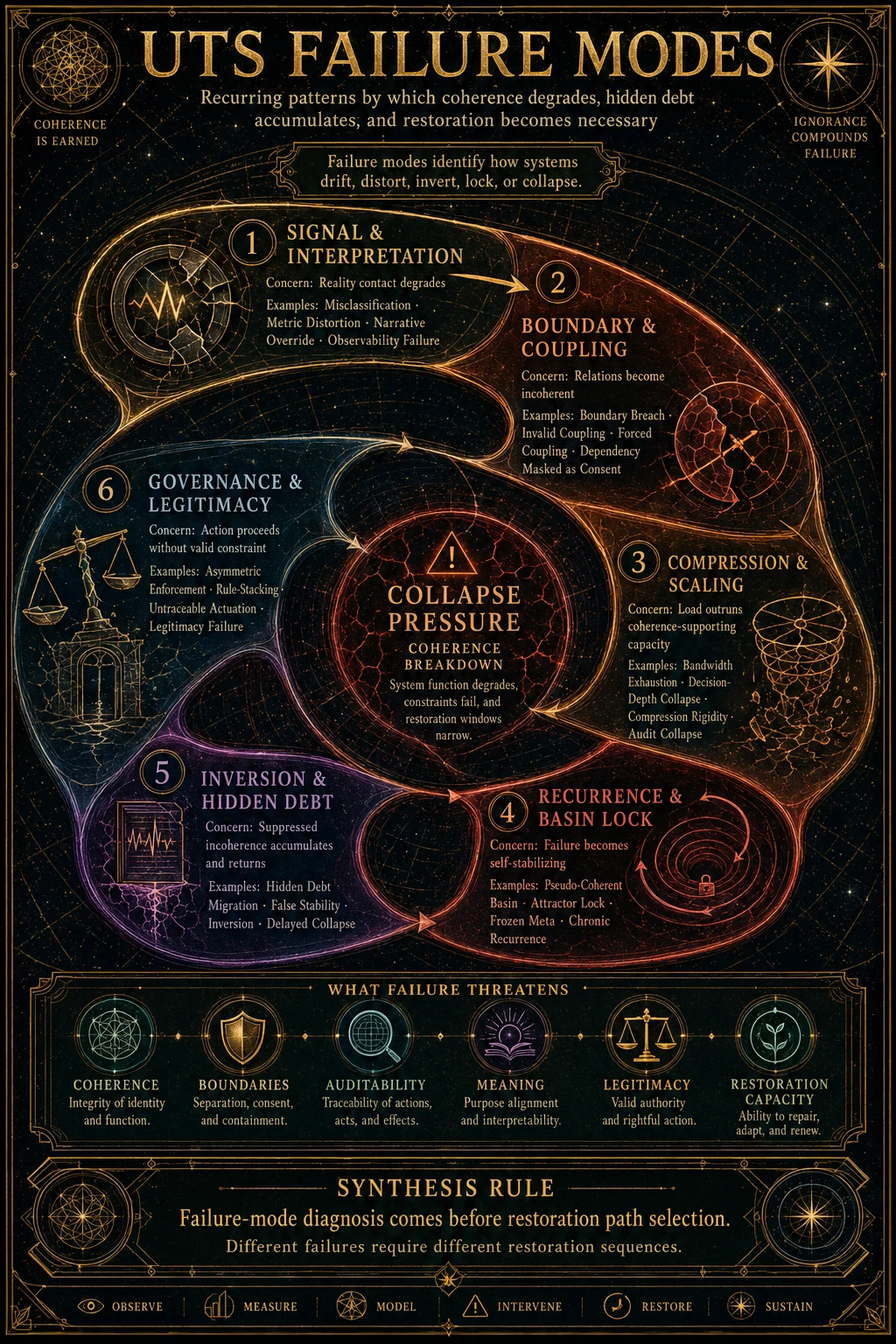
Operator Mechanics, Diagnostics, Gates, and Repair Logic
0. Technical Purpose
TheUTS Failure Modes Registryformalizes failure as arepeatable state-transition patterninside the Universal Theory Stack.
A failure mode is not defined by domain, intent, or moral classification. It is defined by:
operator misuse
+ gate failure
+ diagnostic limit breach
+ adverse state-vector drift
+ insufficient restoration capacity
The registry now functions as a cross-domain diagnostic lattice covering scaling, interactions, meta-theory, reduction/extraction/inversion, false repair, obfuscation, cybernetics, chemistry, materials, civilization interfaces, justice/contracts, and security. The expansion synthesis frames these families as covering the lifecycle of breakdown: damage creation, amplification, misdiagnosis, false healing, obfuscation, and control failure.
1. Canonical Failure Definition
In UTS, a system is in a failure trajectory when one or more of the following persist:
dO/dt < 0
H(t) ↑
R_eff / Load ↓
𝓑(t) breached
𝓓(t) collapses
Φ diverges from O
Au falls below required causal complexity
A compact definition:
Failure Mode :=
repeatable operator configuration such that
O decreases, H accumulates, or R_eff becomes insufficient
without corrective ℛ.
Collapse is only the visible terminal phase.
failure trajectory ≠ collapse event
failure trajectory → collapse event if uncorrected
This distinction is central. UTS treats collapse as the late expression of an already-active failure mode.
2. State Vector Mechanics
All failure modes act on the canonical UTS state vector:
S = { O, H, ε, ι, Au, µᵢ, BΣ, K, R, Φ }2.1 Variable Roles in Failure Analysis
O — Coherence
Primary target variable.
O = identity + meaning + functional integrity across time under transformationFailure is usually present before O visibly collapses.
H — Hidden Debt
Latent misalignment, deferred repair, suppressed incoherence, or unaccounted externality.
H↑ = future instability accumulatingMost serious failures are hidden-debt problems before they are error problems.
ε — Error / Noise
Observable deviation.
ε↑ = visible symptom
ε low does not imply system health
Many dangerous regimes suppress ε while H rises.
ι — Inversion Index
Pseudo-coherence: apparent order without real fit.
ι↑ = system looks ordered while coherence degradesCommon in security theater, procedural theater, false repair, and metric capture.
Au — Auditability
Traceability of state, causality, decisions, interfaces, and consequences.
Au↓ → H becomes harder to surface
Au < X_c → blind optimization
Auditability is often the first variable attacked or degraded in obfuscated regimes.
µᵢ — Agent Integrity
Consistency between model, action, and consequence.
µᵢ↓ = agent/system becomes misaligned with its own claimed modelCommon in proxy abuse, shadow capture, institutional drift, and secrecy regimes.
BΣ — Boundary Integrity
Consent, identity, interface scope, and non-negotiable constraints.
BΣ↓ → intrusion, fusion, coercion, scope driftBoundary failure often precedes legitimacy failure.
K — Compatibility
Whether coupling increases coherence.
K↓ = coupling becomes frictional, extractive, or destabilizingThe core coupling law is:
No ⊗ without Λ.R — Restoration Capacity
Repair throughput.
R_eff < Load × Gain_stack → H↑ and O↓Restoration is structural capacity, not overhead.
Φ — Fitness Proxy
Measured success signal.
Φ ≠ OMany failures begin when Φ becomes the control target and O is inferred rather than validated.
3. Operator Failure Mechanics
Failure modes arenot new operators. They are unstable compositions of existing operators.
3.1 Structural Operator Failures
⊕ Compose Failure
Composition without compatibility, testing, or restoration.
⊕ without Δ + ℛ → premature identity mergerCommon failure outputs:
- identity collapse
- hidden debt inheritance
- irreversible coupling
- brittle integration
⊗ Coupling Failure
Connection without compatibility validation.
⊗ without Λ → K↓ → H↑ → O↓Appears as:
- overcoupling
- parasitic contracting
- silent extraction
- forced participation
- topology brittleness
Π Constraint Failure
Constraints become either too weak or too rigid.
Π too weak → boundary leakage
Π too rigid → brittleness
Π too complex → audit collapse
The core diagnostic:
X_c > Au_eff → H↑Γ Selection Failure
Selection optimizes the wrong target.
Γ under Φ pressure → Goodhart collapse
Γ without Θ → premature convergence
Γ via P-field asymmetry → selective enforcement
Selection failure is central to metric capture, justice failure, science/business meta capture, and security theater.
Δ Distortion / Perturbation Failure
Stress is applied without restoration.
Δ without ℛ → H↑
Δ frequency > 𝓓 capacity → chronic crisis
Δ positive feedback → runaway
Δ is lawful when used diagnostically and coupled to ℛ. It becomes destructive when used as force, punishment, or uncontrolled acceleration.
ℛ Restoration Failure
Repair is absent, symbolic, blocked, externalized, or unauditable.
ℛ_claimed↑ ∧ H↑ ∧ R_eff≤0 → false repairFalse repair is one of the most important mature-system failure families.
Ξ Inversion Failure
Apparent order without real coherence.
Φ↑ + Au↓ + H↑ → Ξ-dominant regimeΞ is not “bad intent.” It is structural mismatch hidden by success signals.
3.2 Meaning / Trajectory Operator Failures
Μ Sensemaking Failure
Interpretation loses contact with reality.
Μ without Au → narrative substitution
Μ without Θ → overconfidence
Μ under Φ → sensemaking subordination
Τ Trajectory Failure
Long-horizon direction becomes extraction-biased or incoherent.
Τ misaligned + ℛ starved → terminal scaling failureMeaning collapse is a trajectory failure, not merely a cultural condition.
Θ Humility Failure
Uncertainty damping is bypassed.
Θ↓ → gain↑ → overreaction, premature convergence, identity certaintyΘ failure appears in urgency substitution, attention-control pseudo-coherence, and shadow denial.
Λ Compatibility Failure
Coupling is assumed rather than validated.
Λ false positive → short-term gain, long-term decay
Λ absent → overcoupling
Λ decay → brittle reintegration
Σ Sacred Boundary Failure
Non-negotiable constraints are ignored, inverted, or misused.
Σ ignored → ethical phase separation
Σ misused → sacred immunity
Σ rhetorical only → extraction regime
Σ is not moral decoration. It is a stability constraint.
Ψ Presence / Audit Resolution Failure
Attention, inspection, and direct contact are suppressed.
Ψ↓ → Au↓ → H_hidden↑Common in OMD, security, justice, and narrative lock-in modes.
4. Gate Failure Mechanics
Failure modes often begin with gate failure.
4.1 FI-Gate Failure
The FI-Gate preserves feedback integrity.
FI failure → Φ substitutes for OOutputs:
- Goodhart collapse
- security theater
- instrumentation theater
- interface Goodhart
- reward-hacked security
- science/business metric capture
4.2 HR-Gate Failure
The HR-Gate blocks identity-bound certainty and urgency bypass.
HR failure → identity/urgency replaces causalityOutputs:
- urgency substitution
- identity-binding signal capture
- reduction-to-authority lock
- shadow projection
- manufactured consent
4.3 MS-Gate Failure
The MS-Gate enforces symmetry.
MS failure → rank immunity → legitimacy debtOutputs:
- selective enforcement
- immunity collapse
- sacred immunity
- scapegoat collapse
- repair burden externalization
The technical point:
asymmetry is a mechanical instabilityIt accumulates hidden debt through legitimacy, resentment, and coordination failure.
4.4 Au-Actuation Failure
No actuation should proceed without sufficient traceability.
Au-Actuation failure → opaque control → H↑Outputs:
- audit suppression inversion
- invisible intrusion
- proxy-relay drift
- audit evasion in repair
- obfuscated meta dynamics
4.5 Consent / Interface Legitimacy Failure
Boundary legitimacy fails when representation, consent, or exit are invalid.
BΣ↓ + Au↓ → lost consentOutputs:
- manufactured consent
- interface capture
- unilateral civilization-interface representation
- proxy abuse
- fusion collapse
5. Diagnostic Limit Mechanics
Failure modes are not just variable drift. They involvelimit breaches.
5.1 Bandwidth 𝓑(t)
𝓑(t) = maximum forcing absorbable without phase transitionFailure condition:
Shock > 𝓑(t) → regime shift likelyBandwidth shrinks when:
H↑, ε↑, ι↑, R↓, Au↓, BΣ↓Bandwidth expands when:
R↑, Au↑, BΣ↑, O↑, σ↑5.2 Damping 𝓓(t)
𝓓(t) = ability to settle after disturbanceFailure condition:
𝓓↓ → oscillation persistsLow damping appears as:
- repeated crises
- whiplash cycles
- reaction runaway
- under-damped escalation
- ring-down failure
- legitimacy shock cascades
5.3 Slack σ(t)
Slack is buffer before forced-response degradation.
σ → 0 → no margin for learning, repair, or correctionZero-slack systems misread routine perturbation as crisis.
σ↓ + Load↑ + R↓ → brittle collapse5.4 Reaction Latency τresp
τ_resp↑ → feedback arrives too lateWhen latency combines with high gain:
τ_resp↑ + gain↑ → oscillation / overcorrectionIn justice systems this becomes coercive delay.
In cybernetics it becomes whiplash.
In OMD it becomes delayed shock.
5.5 Memory Half-Life τm
τ_m = persistence of previous state, harm, pattern, or recurrenceHigh τm can preserve hidden debt. Low τm can prevent learning.
Failure forms:
- myth-locked narratives
- hidden fatigue
- recapture after exit
- premature baseline lock
- aging without restoration
5.6 Constraint Complexity Xc
X_c > Au_eff → H↑This underlies:
- rule-stacking wall
- audit collapse cascade
- procedural theater
- security policy sprawl
- contract opacity
6. U-Layer Localization Mechanics
Every failure mode should specify:
origin layer → manifestation layerExamples:
U4 metric failure → U6 coherence collapse
U2 boundary failure → U7 recurrence
U8 shock → U2 permanent emergency override
U0 material fatigue → U4 “unexpected” failure
Technical rule:
Repair must occur at the same or lower layer than the failure origin.Examples:
U2 boundary failure cannot be repaired by U4 messaging.
U6 coherence failure cannot be repaired by U3 compliance alone.
U7 recurrence cannot be repaired by one-time U4 acknowledgment.
7. Failure Family Mechanics
7.1 FM-REI: Damage Creation
Reduction + Extraction + InversionCore signature:
Π_scope_violation + Φ→Γ dominance + Σ rhetorical + Au↓Mechanism:
- reduce context unlawfully
- extract value without reciprocal responsibility
- use valid functions outside lawful domain
- relabel failure as success
Typical trajectory:
Φ↑ → H↑ → ι↑ → O↓7.2 FM-S / FM-ISC: Damage Amplification
Scaling and coupling amplify initial damage.
Core signatures:
FM-S: Gain_stack↑ + 𝓑↓ + 𝓓↓ + R_eff < Load
FM-ISC: Λ↓ + K↓ + boundary drift + asymmetry↑
Typical trajectory:
small mismatch → coupled amplification → cascade7.3 FM-MT: Misdiagnosis
Meta-analysis becomes part of the failure.
Core signature:
Γ overreach + Θ absent + Φ substitutes for O + layer confusionTypical outputs:
- totalizing meta collapse
- narrative substitution
- intent attribution error
- ideological capture
- weaponized insight
7.4 FM-R: False Repair
Repair claims rise while actual repair capacity does not.
Core signature:
ℛ_claimed↑ ∧ H↑ ∧ R_eff≤0or:
⟨ ΔH > 0, ΔR ≤ 0, ΔΦ > 0, ΔAu ≤ 0 ⟩Typical trajectory:
damage → symbolic repair → hidden debt preservation → larger collapse7.5 FM-OMD: Obfuscated Meta Dynamics
Failure hides behind success signals.
Core invariant:
Φ↑ ∧ H_invisible↑ ∧ Au_resisted ⇒ OMD activeTypical trajectory:
Au↓ → H_hidden↑ → τ_resp↑ → ε spike late7.6 FM-C: Cybernetic Failure
Feedback, control, gain, damping, topology, and recovery break.
Core signature:
σ→0 + gain > damping + latency ignored + control > feedbackTypical outputs:
- oscillation
- runaway
- false calm
- measurement back-action
- Goodhart collapse
- dominance masquerading as control
7.7 FM-CIF: Civilization Interface Failure
Representation fails at asymmetric interfaces.
Core invariant:
suppressed Au → lost consentTypical trajectory:
interface monopoly → narrative control → consent illusion → legitimacy collapse7.8 FM-JC: Justice & Contracts
Justice and contract systems fail when boundary, audit, enforcement, or restoration mechanics degrade.
Core signatures:
procedural Φ↑ while U6 O↓
MS failure → selective enforcement
Π(exit) hardened → coercive persistence
7.9 FM-SEC: Security Failure
Security fails through gate collapse and proxy substitution.
Master rule:
Gate failure → Au/FI erosion → H↑ → ι↑ → Φ substitution → O collapse → ε spikes lateSecurity is especially sensitive to:
Au↓ + FI↓ + Φ↑ + ι↑ + H↑ ⇒ O collapse7.10 FM-CH / FM-M: Chemistry and Materials
Physical substrates reveal failure mechanics without intent.
Material progression:
H↑ → 𝓓↓ → BΣ↓ → ε↑ → Φ collapseChemical and material examples clarify:
- metastability
- brittleness
- runaway reactions
- hidden fatigue
- interface collapse
- false stability
8. Stacked Failure Dynamics
Most real systems do not exhibit a single mode.
They stack.
8.1 Additive Composition
FM-S1 ⊕ FM-S7 ⊕ FM-C2Interpretation:
Paper coherence + feedback gaming + instrumentation theaterOutput:
green dashboards, degrading reality8.2 Directed Cascade
FM-REI4 → FM-S7 → FM-C18 → FM-OMD-07Interpretation:
incentives corrupt sensemaking
→ metrics are gamed
→ Goodhart learning dominates
→ runaway optimization trap
8.3 Masking
FM-R1 ⊘ FM-S6Interpretation:
cosmetic restoration masks restoration starvation8.4 Conditional Activation
FM-C17 | Load > thresholdInterpretation:
hybrid phase trap activates only under dependency or stress9. Failure Dynamics Calculus
The registry can be summarized with diagnostic inequalities.
9.1 Hidden Debt Growth
dH/dt ∝ (Load × Gain_stack) − R_eff9.2 Coherence Decay
dO/dt < 0 ⇔ H↑ ∧ (R_eff / Load ↓)9.3 False Stability
Φ↑ ∧ Au↓ ∧ H↑ ⇒ Ξ-dominant regime9.4 Audit Collapse
X_c > Au_eff ⇒ H↑9.5 Scaling Collapse
Load × Gain_stack > R_eff ⇒ collapse amplifies9.6 Bandwidth Breach
Shock > 𝓑(t) ⇒ regime shift likely9.7 False Repair
ℛ_claimed↑ ∧ H↑ ∧ R_eff≤0 ⇒ FM-R active9.8 Obfuscated Meta Dynamics
Φ↑ ∧ H_hidden↑ ∧ Au_resisted ⇒ FM-OMD active10. Minimal Diagnostic Workflow
A technical audit proceeds as:
Step 1 — Localize
origin U-layer → manifestation U-layerStep 2 — Identify variable drift
O? H? ε? ι? Au? µᵢ? BΣ? K? R? Φ?Step 3 — Check gates
FI / HR / MS / Au-Actuation / Σ / Consent / Interface LegitimacyStep 4 — Estimate diagnostics
𝓑, 𝓓, σ, τ_resp, τ_m, X_cStep 5 — Identify active failure family
FM-S, FM-ISC, FM-MT, FM-REI, FM-R, FM-OMD, FM-C, etc.Step 6 — Check stacking
active mode ⊕ masking mode ⊕ upstream driverStep 7 — Apply minimal restoration sequence
restore gate → restore Au → reduce load/gain → increase ℛ → revalidate O11. Restoration Sequencing Logic
The first intervention should not usually be optimization.
Recommended priority:
1. Stop unsafe actuation if Au is below minimum.
2. Restore relevant gate.
3. Restore Au and FI coupling.
4. Reduce load / gain if 𝓑 or 𝓓 are compromised.
5. Increase ℛ.
6. Revalidate Λ before coupling.
7. Only then optimize Φ.
Technical warning:
optimizing Φ before restoring Au/FI usually deepens ι12. Irreversibility Conditions
A failure becomes high-risk when several thresholds combine:
H toxic
+ R_eff → 0
+ Au resisted
+ K → 0
+ BΣ fractured
+ 𝓓 collapsed
High irreversibility signature:
H↑↑ ∧ R_eff↓ ∧ Au↓ ∧ ι↑ ∧ Φ defendedAt this point, patching may fail. Replacement, reset, decoupling, or structural re-instantiation may be required.
13. Technical Guardrails
The registry must remain mechanically disciplined.
Operators change state.
Diagnostics reveal limits.
Gates decide admissibility.
Lenses bias behavior.
Regimes name recurring compositions.
Failure modes are operator configurations, not new primitives.
Do not:
- add new operators for every failure pattern
- moralize the mode
- confuse Φ with O
- repair at the wrong U-layer
- treat diagnosis as prediction
- treat narrative clarity as restoration
14. Core Technical Laws
Coupling Law
No ⊗ without Λ.Composition Law
No ⊕ without Δ + ℛ.Scaling Law
No scaling step without checking 𝓑 and 𝓓.Repair Law
No repair claim without measurable H reduction.Audit Law
No actuation without Au.Interface Law
No representation without revocable consent and continuous auditability.Ultimate Scaling Law
Any system that scales power faster than meaning will fail.15. Summary
Technically, UTS Failure Modes arecanonical state-degradation patternsproduced by unstable operator compositions under failed gates and exceeded diagnostic limits.
They are detected by:
state-vector drift
gate failure
U-layer mismatch
diagnostic limit breach
Φ/O divergence
hidden debt accumulation
restoration insufficiency
They are repaired by:
gate restoration
audit restoration
load/gain reduction
compatibility validation
boundary repair
hidden debt reduction
restoration scaling
trajectory realignment
The registry gives UTS a technical diagnostic layer for answering one core question:
What exact mechanical pattern is moving this system away from coherence,
and what is the minimal operator sequence required to restore it?