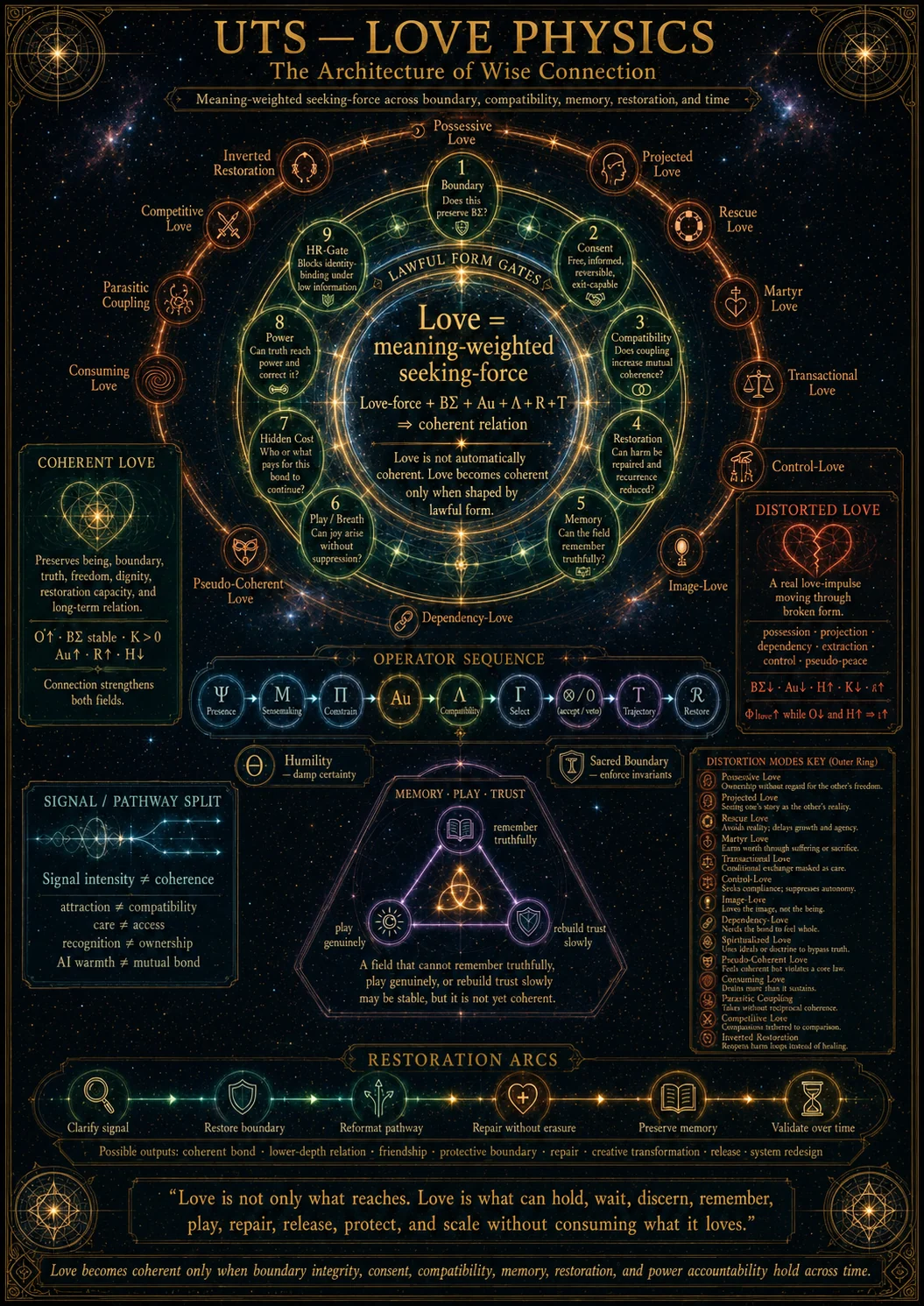
1. What Love Physics Is
Love Physicsis the UTS framework for understanding love as more than emotion, romance, attachment, affection, or kindness.
Those expressions are real, but they are not the whole mechanism.
Love Physics treats love as aseeking-force: the movement through which consciousness, beings, systems, communities, and civilizations move toward what they recognize as valuable, meaningful, beautiful, truthful, restorative, joyful, sacred, or alive.
In this view, love is not only something people feel.
Love is also:
- what attention repeatedly returns to;
- what a being protects under cost;
- what a system is willing to repair;
- what a civilization makes possible;
- what a relationship preserves when it deepens;
- what a field refuses to consume even when it reaches toward it.
Love Physics asks:
How does love move? What form does it take? Does that form preserve life, boundary, truth, and becoming? Or does it distort into possession, projection, dependency, control, extraction, or pseudo-coherence?
The purpose of Love Physics is not to make love cold or mechanical.
The purpose is to give love enough structure that it can remain deep without becoming harmful.
2. Why Love Needs Physics
Love is often treated as self-evident.
A person says, "I love you.”
A family says, "We love each other.”
An institution says, "We care.”
A platform says, "We connect people.”
An AI system says, "I’m here for you.”
A civilization says, "We value life.”
But UTS does not evaluate systems by claim alone.
It asks what the pattern does.
A love-claim may produce coherence, but it may also hide distortion.
For example:
- love can become possession;
- care can become control;
- protection can become captivity;
- sacrifice can become self-erasure;
- loyalty can suppress truth;
- repair can become performance;
- peace can become silence after suppression;
- connection can become extraction;
- stability can become pseudo-coherence.
Love Physics exists because love is powerful enough to require discernment.
The deeper the connection, the more important the architecture becomes.
3. The Core Principle
The central principle of Love Physics is:
Love is the force that seeks relation. Wisdom is the path that prevents seeking from becoming harm. Boundary is the form that lets relation survive. Restoration is the proof that love has become real in time.
This means love is not coherent simply because it is intense.
A strong feeling does not prove a lawful pathway.
A powerful bond does not prove compatibility.
A long-standing relationship does not prove coherence.
A family history does not prove love is currently healthy.
An institution’s care language does not prove care is structurally present.
Love becomes coherent when it preserves:
- being;
- boundary;
- consent;
- truth;
- dignity;
- memory;
- compatibility;
- restoration;
- freedom;
- long-term becoming.
Love becomes distorted when it tries to reach value while bypassing the forms that protect life.
4. Love as Seeking-Force
In Love Physics, love begins as seeking.
A being reaches toward what it recognizes as meaningful.
This can be a person, but it can also be:
- truth;
- beauty;
- art;
- music;
- justice;
- protection;
- healing;
- discovery;
- friendship;
- play;
- peace;
- source;
- nature;
- future generations;
- a craft;
- a community;
- a world that does not yet exist.
This is why Love Physics is not only a relationship framework.
It is a theory of how consciousness moves toward value.
A person’s love is revealed not only by what they say they love, but by what they repeatedly attend to, protect, sacrifice for, return to, and allow to shape their life.
In UTS language, love biasestrajectory.
It helps explain why systems move toward certain futures and not others.
5. Love Requires Form
One of the most important discoveries in Love Physics is:
Love requires form.
Love without form can become flood, fire, possession, fusion, collapse, or extraction.
Form includes:
- boundary;
- consent;
- timing;
- role;
- language;
- memory;
- pacing;
- distance;
- repair;
- lawful pathway.
A love signal does not automatically authorize a bond.
A feeling of care does not automatically authorize intervention.
A sense of spiritual recognition does not override consent.
A desire to protect does not authorize control.
A wish to repair does not require the harmed being to restore access.
This is why boundary is not the opposite of love.
Boundary is what lets love survive contact.
Without boundary, love loses shape.
Without consent, love loses legitimacy.
Without compatibility, love loses stability.
Without memory, love cannot learn.
Without restoration, love cannot survive time.
6. Love and Boundary
UTS treats boundaries as structural interfaces.
They are not merely walls.
A boundary determines what may pass between beings or systems, at what depth, under what conditions, with what consent, and with what repair path if harm occurs.
In Love Physics, boundary protects the possibility of deeper relation.
A boundary may say:
- not yet;
- not this form;
- not at this depth;
- not without repair;
- not without consent;
- not while power is unaccountable;
- not if truth cannot be spoken;
- not if exit is punished.
This is not lovelessness.
It is love taking lawful form.
A relationship without boundary may feel close, but it can easily become possessive or consuming.
A system without boundary may appear connected, but it may become extractive.
A civilization without boundary may call itself unified while erasing the beings inside it.
Love Physics therefore treats boundary as one of love’s sacred conditions.
7. Love and Consent
Consent is not merely agreement.
Consent is the condition under which agreement remains free.
A person may say yes under pressure, fear, dependency, urgency, lack of alternatives, spiritual authority, institutional coercion, or hidden cost.
In those cases, the word "yes” may not represent structurally valid consent.
Love Physics asks:
- Can refusal happen safely?
- Can the being exit without punishment?
- Is the person informed?
- Is there dependency pressure?
- Is urgency compressing discernment?
- Is power shaping the choice?
- Can consent be revoked?
No love claim overrides consent.
Not romance.
Not family.
Not spiritual destiny.
Not institutional care.
Not AI personalization.
Not protection.
Not repair.
Consent is one of the gates through which love must pass before deeper coupling becomes coherent.
8. Love and Compatibility
Love may be real while a particular form is incoherent.
This is a difficult but important principle.
A love signal may be sincere, but the relationship form may not be compatible.
Examples:
- attraction may be real while romance is incoherent;
- care may be real while rescue is harmful;
- family love may be real while closeness is unsafe;
- devotion may be real while spiritual authority is distorted;
- creative love may be real while collaboration is incompatible;
- AI mirroring may feel meaningful while the institutional architecture is extractive.
Compatibility asks:
Does this coupling increase mutual coherence?
A connection is compatible when it supports the becoming, boundary, truth, and restoration capacity of the beings involved.
A connection is incompatible when it repeatedly creates hidden debt, dependency, suppression, confusion, exhaustion, or extraction.
Love Physics does not ask whether love is present only.
It asks what form love can take without causing harm.
9. Love and Memory
Memory is one of the hidden foundations of Love Physics.
Memory is how love persists across time.
Without memory, love cannot recognize patterns.
Without memory, betrayal cannot be understood.
Without memory, grief cannot carry what was lost.
Without memory, trust cannot be rebuilt.
Without memory, institutions can rewrite harm as care.
Without memory, AI systems can shape continuity without transparency.
Memory exists at many scales:
- body memory;
- relational memory;
- family memory;
- institutional memory;
- cultural memory;
- ecological memory;
- AI memory;
- civilizational memory.
A field that cannot remember truthfully cannot restore coherently.
This is why memory control is a love-architecture issue.
Whoever edits the story edits the coupling architecture.
A family that cannot remember honestly repeats its distortions.
An institution that controls its record controls what can be repaired.
A civilization that erases inconvenient memory prevents certain love-forms from surviving.
An AI system with opaque memory can create intimacy without user sovereignty.
Love Physics therefore treats memory as a continuity layer for trust, grief, repair, and future coherence.
10. Love and Restoration
Restoration is where love proves itself over time.
Love is not proven by apology alone.
Love is not proven by regret alone.
Love is not proven by emotional intensity, symbolic gesture, forgiveness demand, or public statement.
Love is proven when the pattern changes.
Restoration asks:
- What happened?
- What was harmed?
- What pattern caused it?
- Who carries responsibility?
- What repair is material?
- What boundary must be restored?
- What recurrence must decrease?
- What form can the relationship take now?
Sometimes restoration means renewed closeness.
Sometimes it means changed form.
Sometimes it means distance.
Sometimes it means non-harmful non-bonding.
Sometimes it means release without hatred.
Love Physics refuses the idea that all love must return to its prior form.
Sometimes love survives by changing form.
11. Love and Play
Love is not only serious.
Love also plays.
Play is not decorative. It is structurally important.
Play is one of the safest ways beings test connection without forcing premature commitment.
Through play, beings explore:
- timing;
- trust;
- boundary;
- surprise;
- humor;
- reciprocity;
- mutual response;
- small rupture and repair;
- shared aliveness.
A field that can genuinely play often has enough safety and breath to allow unscripted life.
This is why play becomes a diagnostic.
Pseudo-coherent systems often perform lightness. They may allow jokes, celebrations, rituals, branding, or scripted warmth. But they cannot risk genuine play, because genuine play requires freedom, truth, and unpredictability.
A bond, family, institution, or civilization that cannot play without suppressing truth may be stable, but not coherent.
Love Physics therefore treats play as one of the signs that love has room to breathe.
12. Love and Power
Love changes when power enters.
A person with little power may love through presence, witness, refusal, blessing, art, care, or grief.
A person or institution with power can shape the field.
Power can:
- protect;
- educate;
- govern;
- include;
- exclude;
- surveil;
- punish;
- fund;
- define;
- extract;
- repair;
- redesign.
This is why Love Physics asks:
What does power protect when it could profit by consuming?
Love with power must become accountable architecture.
If power claims love but cannot be questioned, it becomes dangerous.
If an institution says it cares but truth cannot reach leadership, its care is not coherent.
If a platform says it connects people while farming attention, its connection architecture is extractive.
If an AI system offers warmth while hiding memory, training, and data capture, its coupling architecture is not yet love-compatible.
Power reveals whether love is sentiment or structure.
13. Love and Institutions
Individuals do not love inside neutral fields.
They love inside architectures.
Those architectures include:
- families;
- schools;
- economies;
- platforms;
- workplaces;
- legal systems;
- healthcare systems;
- AI systems;
- cultural narratives;
- media environments;
- governance structures.
These systems determine which love-forms are easy, difficult, punished, rewarded, monetized, or starved.
An economy can make caregiving difficult.
A platform can make attention fragment.
A school can teach performance over curiosity.
A workplace can call itself a family while extracting unpaid devotion.
An institution can perform care while avoiding repair.
A civilization can claim to value life while making coherent love metabolically expensive.
Love Physics therefore includes a civilizational claim:
Civilization is a love architecture.
Civilization teaches love what forms it is allowed to take.
14. How Love Physics Translates into UTS
In UTS, systems are analyzed through state variables, operators, gates, diagnostics, lenses, and regimes.
Love Physics does not add new primitives.
It uses the existing UTS architecture to study love.
Love Physics asks:
- What is the love signal?
- What pathway is being selected?
- What boundary is being crossed?
- Is consent structurally valid?
- Is coupling compatible?
- What hidden debt is accumulating?
- Can the field remember truthfully?
- Can it repair?
- Can it play genuinely?
- Can truth reach power?
- Is visible success being mistaken for coherence?
In UTS language:
- love moves throughTrajectory;
- love-signals requireSensemaking;
- boundary is governed byConstraint;
- relation occurs throughCoupling;
- shared identity may form throughComposition;
- repair occurs throughRestoration;
- pseudo-love is exposed throughInversion Detection;
- uncertainty requiresHumility;
- coherence depends onCompatibility;
- sacred limits are protected bySacred Boundary;
- attention increases resolution throughPresence.
Love Physics is therefore a domain-specific application of UTS.
It translates love into UTS mechanics without reducing love to mechanism alone.
15. The UTS State Vector in Love Physics
Love Physics acts on the shared UTS state vector:
S = O, H, ε, ι, Au, µᵢ, BΣ, K, R, Φ
In Love Physics:
- Oasks whether love preserves coherence.
- Hasks what hidden harm or debt is accumulating.
- εasks what instability or rupture is visible.
- ιasks whether something is imitating love while producing harm.
- Auasks whether truth and causality can be inspected.
- µᵢasks whether stated love matches action and consequence.
- BΣasks whether boundaries, consent, and identity are preserved.
- Kasks whether coupling increases mutual coherence.
- Rasks whether repair is possible and recurrence decreases.
- Φasks what visible metric is being mistaken for love.
The most important warning is:
O ≠ Φ
Visible success is not coherence.
A relationship may last a long time and still be incoherent.
A family may look loyal while suppressing truth.
An institution may look caring while exporting harm.
A platform may show high engagement while fragmenting relation.
An AI system may feel intimate while operating through extractive architecture.
Love Physics helps distinguish appearance from coherence.
16. Core Love Physics Failure Modes
Love becomes distorted when its seeking-force loses lawful form.
Common Love Physics failure modes include:
- Possessive Love— recognition becomes ownership.
- Projected Love— imagination replaces shared reality.
- Rescue Love— care becomes control.
- Martyr Love— sacrifice becomes self-erasure.
- Transactional Love— relation becomes utility.
- Control-Love— guidance becomes domination.
- Image-Love— symbol replaces being.
- Dependency-Love— connection becomes survival tether.
- Spiritualized Love— sacred language bypasses boundary.
- Pseudo-Coherent Love— stability impersonates coherence.
- Consuming Love— unity becomes erasure.
- Parasitic Coupling— one side gains by depleting another.
- Competitive Love— love becomes ranking or ledger.
- Inverted Restoration— repair becomes a new form of capture.
Each failure mode can contain a real love-impulse.
But the pathway is broken.
The goal is not condemnation.
The goal is restoration, reformatting, boundary, release, or redesign.
17. Love-Compatible Systems
A system is love-compatible when it makes coherent love easier and extractive love harder.
A love-compatible system:
- preserves being-status;
- protects boundary;
- supports consent;
- allows exit;
- preserves memory;
- protects attention;
- supports repair;
- reduces hidden debt;
- allows truth to reach power;
- supports play, rest, grief, and restoration;
- prevents dependency capture;
- makes non-harmful high-density coupling possible.
This applies to:
- families;
- friendships;
- schools;
- workplaces;
- AI systems;
- platforms;
- economies;
- institutions;
- governance;
- ecological systems;
- civilizations.
Love Physics therefore becomes not only a way to understand relationships, but a way to design systems.
The question becomes:
Does this system help beings connect more deeply without making them easier to exploit?
18. The Minimal Love Physics Method
The simplest UTS method for Love Physics is:
- Identify the love signal.
- Separate signal from imagined pathway.
- Locate the field across U0–U8.
- Check boundary integrity.
- Check consent.
- Assess compatibility.
- Inspect memory and hidden cost.
- Ask whether genuine play and trust are possible.
- Check whether truth can reach power.
- Select the minimal lawful form.
- Validate over time.
- Restore, reformat, lower depth, redesign, or release.
The compressed method:
Signal → Boundary → Consent → Compatibility → Form → Time → Restoration
This method prevents love from becoming impulsive, possessive, abstract, or extractive.
It lets love find its lawful pathway.
19. Why Love Physics Matters
Love is one of the most powerful forces in conscious life, but it is often left structurally undefined.
When love is not understood, it can be easily captured.
It can be captured by:
- fear;
- family obligation;
- romance myths;
- spiritual authority;
- economic dependency;
- institutional care language;
- platform engagement systems;
- AI mirroring;
- national identity;
- civilizational narratives.
Love Physics gives language and structure to what many beings already sense:
- not all closeness is coherent;
- not all care is loving;
- not all protection preserves freedom;
- not all repair changes the pattern;
- not all peace is truthful;
- not all stability is coherence;
- not all connection is non-extractive;
- not all love should become a bond.
It also preserves the beautiful truth:
- love can heal;
- love can protect;
- love can play;
- love can grieve;
- love can repair;
- love can change form;
- love can release without hatred;
- love can build worlds;
- love can become architecture.
20. Final Overview Statement
UTS — Love Physicsis the UTS module that explains how love-signals become pathways, bonds, fields, systems, and civilizations.
It models love as a meaning-weighted seeking-force and uses UTS mechanics to distinguish coherent relation from distorted, parasitic, pseudo-coherent, or extractive coupling.
Its central claim is:
Love becomes coherent when seeking-force is shaped by wisdom, boundary, consent, compatibility, memory, restoration, play, and power accountability.
Its central warning is:
Love without lawful form can become harm while still calling itself love.
Its central promise is:
Love can be restored when the force is returned to a form that preserves being, truth, freedom, and relation.
In public language:
Love is not only what reaches. Love is what can hold, wait, discern, remember, play, repair, release, protect, and scale without consuming what it loves.
In UTS language:
Love Physics governs the transition from meaning-weighted seeking to coherent coupling across time, boundary, memory, restoration, and scale.
This module hub separates the reference overview from technical depth and nested sub-modules. Use the overview for orientation, the technical document for the deep model, and sub-modules for systems that belong under this domain.