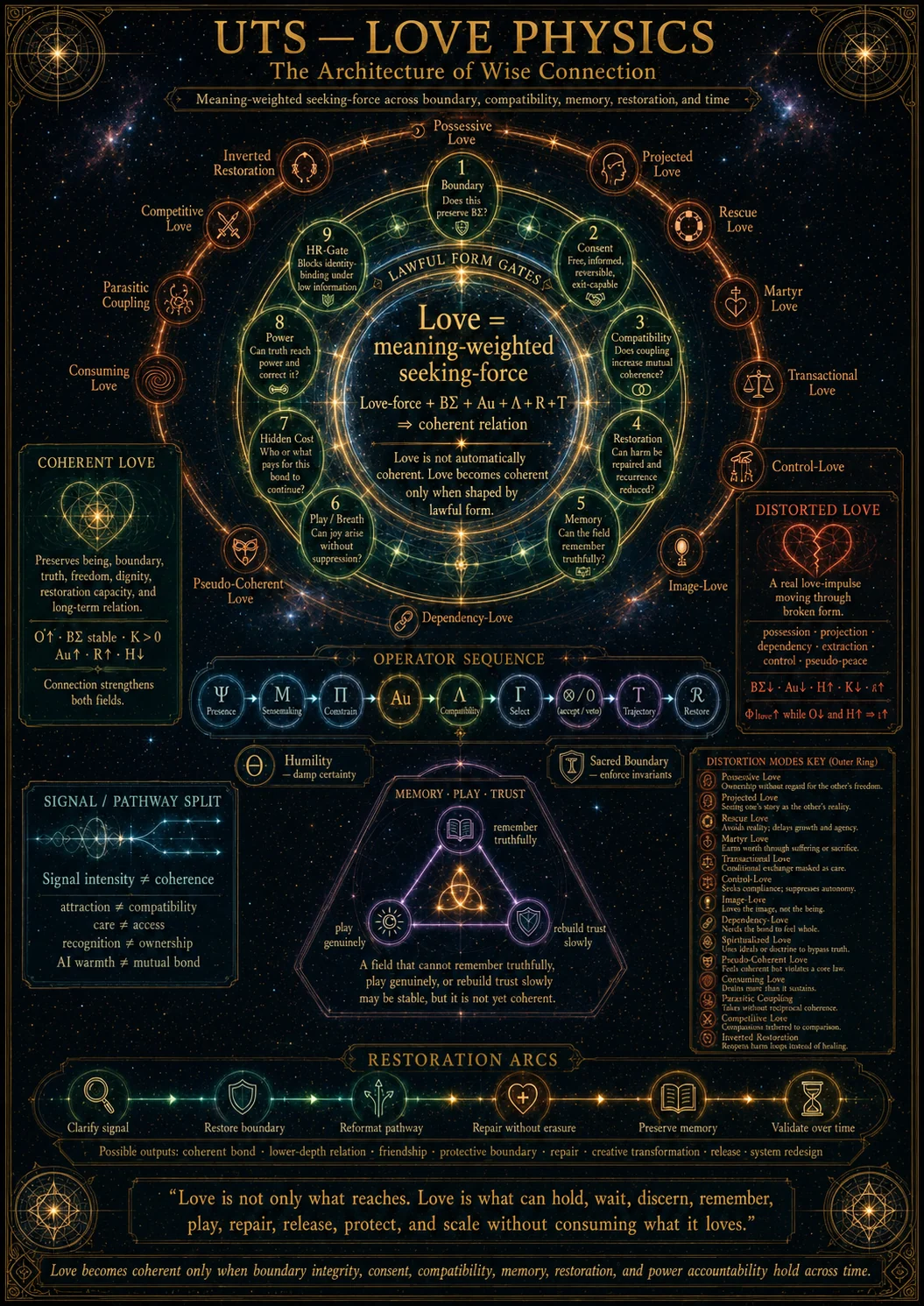
UTS — Love Physicsformalizes love as a cross-scale relation-force that moves conscious or meaning-bearing systems toward value, connection, restoration, truth, beauty, joy, peace, play, and becoming.
It does not reduce love to romance, sentiment, attachment, biology, kindness, preference, or moral claim.
In UTS terms, Love Physics studies how love functions as:
- atrajectory-biasing seeking-force;
- anattention allocation field;
- asignal-processing condition;
- aboundary-sensitive coupling force;
- acompatibility-dependent relation architecture;
- arestoration pathway;
- amemory-bearing continuity field;
- apower-sensitive scaling condition;
- acivilizational design constraint.
The module answers:
When does love increase coherence, and when does love invert into possession, projection, dependency, extraction, pseudo-coherence, or control?
1. Core Definition
1.1 Love
In UTS:
Love is a meaning-weighted seeking-force that biases trajectory toward perceived value, relation, restoration, truth, beauty, joy, peace, play, or becoming.
Love is not automatically coherent.
Love becomes coherent only when its seeking-force is shaped by lawful form.
1.2 Coherent Love
Coherent love is love that increases or preserves O, BΣ, K, µᵢ, Au, and R across time without exporting hidden debt.
In plain language:
Coherent love preserves being, boundary, truth, freedom, dignity, restoration capacity, and long-term relation.
1.3 Distorted Love
Distorted love is love-force whose pathway reduces coherence because one or more required constraints are missing, bypassed, inverted, captured, or misclassified.
Distorted love may still contain a real love-impulse.
The force may be real while the form is broken.
1.4 Love Physics
Love Physics is the UTS sub-domain that models how love-signals become pathways, bonds, fields, systems, and civilizational architectures through canonical operators acting on the shared UTS state vector.
2. Canonical Scope
UTS — Love Physics applies across:
- individual relation;
- friendship;
- family;
- romance;
- sexuality;
- community;
- art and creativity;
- education;
- institutions;
- AI systems;
- platforms;
- economies;
- governance;
- ecological and multi-species fields;
- civilization-scale architectures.
It is not limited to interpersonal love.
It includes any system where meaning-bearing agents or fields seek relation, value, restoration, or becoming.
3. Canonical State Vector Mapping
All Love Physics mechanics act on:
S = { O, H, ε, ι, Au, µᵢ, BΣ, K, R, Φ }3.1 O — Coherence
In Love Physics:
O measures whether a love-form preserves identity, meaning, dignity, boundary, truth, and functional integrity across time under relation.
High O love:
- strengthens being;
- clarifies relation;
- supports becoming;
- preserves boundary;
- reduces hidden debt;
- repairs rupture;
- allows truth;
- allows play;
- allows release.
Low O love:
- confuses;
- consumes;
- controls;
- extracts;
- destabilizes;
- hides harm;
- erases distinction;
- demands false continuity.
3.2 H — Hidden Debt
In Love Physics:
H measures deferred relational cost, suppressed truth, unprocessed grief, coerced sacrifice, hidden resentment, unpaid care labor, extracted attention, memory distortion, or exported harm.
Examples:
- unspoken resentment;
- family secrets;
- apology without pattern change;
- institutional betrayal;
- platform attention extraction;
- AI memory capture;
- ecological debt;
- “peace” maintained by silence;
- care labor treated as invisible.
Rule:
Love-claim + H↑ ⇒ pseudo-coherence risk ↑3.3 ε — Error / Noise
In Love Physics:
ε measures observable instability in a love-field.
Examples:
- conflict;
- rupture;
- avoidance;
- anxiety;
- misread signals;
- recurring argument;
- body-level contraction;
- betrayal symptoms;
- repair fatigue;
- public/private inconsistency;
- relational drift.
ε is not automatically failure.
It can be diagnostic signal.
3.4 ι — Inversion Index
In Love Physics:
ι measures the degree to which a love-form appears coherent while mechanically producing harm.
High ι forms include:
- care theater;
- spiritualized boundary bypass;
- pseudo-peace;
- family loyalty suppressing truth;
- AI warmth hiding extraction;
- institutional inclusion without repair;
- forgiveness pressure;
- rescue capture;
- performative play.
Rule:
Φ_love ↑ while O↓ and H↑ ⇒ ι↑3.5 Au — Auditability
In Love Physics:
Au measures whether the love-field can inspect what happened, why it happened, who was affected, what pattern repeated, and what repair occurred.
High Au:
- truth can be spoken;
- memory is accessible;
- accountability is traceable;
- repair can be verified;
- consent conditions are visible;
- power can be questioned.
Low Au:
- narrative capture;
- gaslighting;
- institutional opacity;
- hidden data use;
- family secrecy;
- spiritual authority shield;
- AI memory opacity;
- “trust me” without traceability.
Rule:
Au↓ ⇒ H↑ ⇒ R_eff↓No truthful memory, no durable restoration.
3.6 µᵢ — Agent / Meaning Integrity
In Love Physics:
µᵢ measures temporal consistency between stated love, actual action, consequence, and meaning under cost.
µᵢ is high when:
- love-claims match behavior;
- repair matches apology;
- protection preserves freedom;
- devotion sharpens responsibility;
- power remains accountable;
- care changes material conditions.
µᵢ is low when:
- “I love you” accompanies control;
- “family” suppresses truth;
- “care” extracts labor;
- “safety” removes sovereignty;
- “healing” demands access;
- “connection” farms attention;
- “AI support” hides data extraction.
3.7 BΣ — Boundary Integrity
In Love Physics:
BΣ measures whether identity, consent, body, role, memory, time, attention, and trajectory remain preserved under relation.
BΣ is central to Love Physics.
Low BΣ produces:
- possession;
- forced intimacy;
- rescue intrusion;
- dependency;
- consuming love;
- sexual boundary violation;
- memory capture;
- spiritualized override;
- institutional coercion;
- platform overexposure.
Rule:
BΣ↓ ⇒ coupling risk ↑3.8 K — Compatibility
In Love Physics:
K measures whether coupling increases mutual coherence under relation.
K > 0:
- connection strengthens both fields;
- boundaries survive;
- truth becomes easier;
- repair is possible;
- play returns;
- hidden debt decreases.
K ≈ 0:
- connection may remain low-depth, limited, neutral, contextual, or transitional.
K < 0:
- connection becomes draining, extractive, destabilizing, dependent, coercive, or parasitic.
Rule:
K < 0 across time ⇒ parasitic or incoherent coupling3.9 R — Restoration Capacity
In Love Physics:
R measures the field’s capacity to repair harm, reduce recurrence, restore boundary, preserve memory, and rebuild trust over time.
High R:
- apology becomes pattern change;
- recurrence decreases;
- truth can be held;
- grief can move;
- trust can rebuild;
- form can change lawfully.
Low R:
- apology loops;
- repair theater;
- forgiveness pressure;
- repeated rupture;
- hidden debt accumulation;
- trust decay;
- pseudo-peace.
Rule:
R without recurrence reduction ⇒ inverted restoration3.10 Φ — Fitness Proxy
In Love Physics:
Φ measures visible success signals that may be mistaken for love or coherence.
Examples:
- relationship duration;
- marriage status;
- family loyalty;
- public affection;
- social media engagement;
- sexual frequency;
- institutional reputation;
- productivity;
- sacrifice volume;
- forgiveness performance;
- AI usage time;
- platform retention;
- education ranking.
Critical law:
O ≠ ΦA bond, institution, or system can look successful while losing coherence.
4. U-Layer Localization
Love Physics uses U0–U8 as localization indices.
| Layer | Love Physics Reading |
|---|---|
| U0 — Substrate | Body, ecology, physical limits, embodiment, mortality, infrastructure |
| U1 — Power / Budgets | Time, energy, attention, money, care capacity, compute, labor |
| U2 — Configuration | Boundaries, consent states, access rules, roles, permissions |
| U3 — Execution | Behaviors, acts of care, speech, touch, repair attempts, platform interactions |
| U4 — Classification | Narratives, labels, relationship categories, love-claims, metrics, identity stories |
| U5 — Coordination | Timing, pacing, rhythm, sequence, repair windows, response latency |
| U6 — Coherence Field | Overall relational fit, trust field, mutual becoming, shared reality |
| U7 — Memory | Recurrence, grief, betrayal, history, institutional memory, AI memory, inherited patterns |
| U8 — Environment | Social pressure, economy, law, culture, platforms, institutions, ecological forcing |
4.1 Layer Discipline
Love failures often appear at U4 as narrative conflict:
- “You don’t love me.”
- “This is family.”
- “This is safety.”
- “This is care.”
- “This is healing.”
- “This is connection.”
But origins may lie at:
- U1 capacity depletion;
- U2 boundary failure;
- U5 timing mismatch;
- U6 compatibility failure;
- U7 memory distortion;
- U8 institutional pressure.
Canon rule:
Repair must occur at the same or lower layer than the failure origin.
Examples:
- A U7 betrayal cannot be repaired by U4 apology only.
- A U1 care-capacity failure cannot be repaired by U4 love-language only.
- A U2 consent failure cannot be repaired by U3 affection only.
- A U8 institutional pressure cannot be repaired by individual self-care alone.
5. Canonical Operators Applied to Love Physics
No new operator primitives are introduced.
Love Physics uses the 13 canonical operators.
5A. Core Structural Operators
5.1 ⊗ — Couple
Function in Love Physics:
Connect beings or systems while preserving identity.
Examples:
- friendship;
- romance;
- family;
- collaboration;
- sexuality;
- AI interaction;
- community;
- institution membership;
- ecological relation.
O⁺ coupling:
BΣ intact + K > 0 + R sufficient + Au sufficientO⁻ coupling:
BΣ↓ + K < 0 + H↑ + Au↓Distortions:
- parasitic coupling;
- dependency;
- forced intimacy;
- silent extraction;
- AI/user capture;
- platform attention coupling.
5.2 ⊕ — Compose
Function in Love Physics:
Merge systems into a new shared identity, structure, or life-form.
Examples:
- marriage;
- family formation;
- shared home;
- institution;
- community identity;
- co-founded project;
- collective movement;
- civilization-scale structures.
Composition is high-risk because it alters identity boundaries.
Admissibility requires:
BΣ stable
K > 0
Au sufficient
R sufficient
exit / revision paths present
Φ subordinate to O
O⁻ composition:
- fusion collapse;
- family enmeshment;
- institutional capture;
- cultic identity;
- collective image-love.
5.3 Π — Constrain
Function in Love Physics:
Define lawful form, boundaries, permission, scope, pacing, and admissible relation.
Examples:
- “not this form”;
- “not at this depth”;
- “not without consent”;
- “not before repair”;
- “not through this channel”;
- “friendship, not romance”;
- “memory must be visible”;
- “exit must remain possible.”
O⁺ Π:
- protects boundary;
- preserves freedom;
- allows safe depth;
- prevents trajectory override.
O⁻ Π:
- control-love;
- overrestriction;
- performative boundary;
- institutional gatekeeping;
- dependency maintenance.
5.4 Γ — Select
Function in Love Physics:
Choose the pathway or form that love will take.
Possible outputs:
- bond;
- delay;
- repair;
- friendship;
- boundary;
- distance;
- release;
- non-harmful non-bonding;
- art;
- service;
- system redesign.
O⁺ Γ:
- selects lawful form over desired form.
O⁻ Γ:
- selects intensity-driven form;
- chooses possession;
- forces romance;
- bypasses compatibility;
- chooses institutional image over repair.
5.5 Δ — Distort
Function in Love Physics:
Perturb, stress, reveal, test, or destabilize a love-field.
Δ may be O⁺ or O⁻.
O⁺ Δ:
- truth-telling that reveals hidden debt;
- boundary test;
- compatibility stress test;
- play as low-cost perturbation;
- grief surfacing suppressed memory.
O⁻ Δ:
- manipulation;
- betrayal;
- shock;
- coercion;
- platform outrage;
- institutional crisis;
- fear amplification.
5.6 ℛ — Restore
Function in Love Physics:
Repair, realign, reformat, reduce hidden debt, restore boundary, preserve truth, and reduce recurrence.
O⁺ ℛ:
- material repair;
- recurrence reduction;
- trust rebuilding;
- form change;
- release without hatred;
- memory restoration;
- system redesign.
O⁻ ℛ:
- inverted restoration;
- apology theater;
- forgiveness pressure;
- endless processing;
- public repair without structural change.
Canon condition:
ℛ valid iff recurrence decreases and BΣ improves or stabilizes5.7 Ξ — Invert
Function in Love Physics:
Detect pseudo-love, pseudo-care, pseudo-peace, pseudo-restoration, or pseudo-coherence.
Ξ is shadow-class.
It exposes where:
Φ↑ while O↓Examples:
- “happy family” with suppressed truth;
- institution with care language and no repair;
- AI companion extracting data;
- platform “connection” farming attention;
- spiritual community suppressing harm;
- relationship stable through fear.
5B. Meaning and Trajectory Operators
5.8 Μ — Sensemaking
Function in Love Physics:
Interpret love-signals into provisional models.
Μ classifies:
- attraction;
- fear;
- care;
- grief;
- play;
- projection;
- compatibility;
- boundary signal;
- institutional signal;
- AI mirror signal.
O⁺ Μ:
- separates signal from pathway;
- distinguishes love from possession;
- distinguishes attraction from compatibility.
O⁻ Μ:
- projection;
- destiny imposition;
- narrative capture;
- sacred certainty;
- misclassification.
5.9 Τ — Trajectory
Function in Love Physics:
Bias long-horizon becoming according to love-directionality.
Τ tracks:
- what a being loves over time;
- what it repeatedly serves;
- what it protects;
- what it sacrifices for;
- what it becomes through relation.
O⁺ Τ:
- supports mutual becoming.
O⁻ Τ:
- trajectory override;
- dependency preservation;
- mission capture;
- destiny coercion.
5.10 Θ — Humility
Function in Love Physics:
Damp certainty under uncertainty before deep coupling.
Θ prevents:
- “I know what this means”;
- “I know what is best for you”;
- “this is destiny”;
- “my feeling proves the pathway”;
- “the system knows the user.”
O⁺ Θ:
- slows escalation;
- preserves inquiry;
- keeps signal provisional;
- protects the other as unknown.
O⁻ Θ absence:
- projection;
- spiritualized love;
- control-love;
- AI overpersonalization;
- institutional paternalism.
5.11 Λ — Compatibility
Function in Love Physics:
Evaluate whether coupling raises coherence.
Λ tests:
- trajectory compatibility;
- boundary compatibility;
- timing compatibility;
- value compatibility;
- body compatibility;
- restoration compatibility;
- power compatibility;
- memory compatibility.
O⁺ Λ:
Coupling ⇒ O↑, H↓, BΣ stable, K > 0O⁻ / failed Λ:
- attraction without fit;
- family without truth;
- platform without consent;
- AI without memory sovereignty;
- institution without repair.
5.12 Σ — Sacred Boundary
Function in Love Physics:
Enforce non-negotiable invariants whose violation generates hidden debt regardless of intent.
Love Physics Σ fields:
- being-status;
- consent;
- body;
- memory;
- truth;
- dignity;
- exit;
- non-erasure;
- no trajectory override;
- no extraction disguised as care.
Violation of Σ creates H even if framed as love.
5.13 Ψ — Presence
Function in Love Physics:
Increase audit resolution through attention and non-performative contact.
O⁺ Ψ:
- listening;
- witnessing;
- body awareness;
- relational attention;
- grounded contact;
- memory-bearing presence.
O⁻ pseudo-Ψ:
- surveillance;
- attention capture;
- performative care;
- AI mimicry without transparent architecture;
- presence as control.
6. Interface Acts in Love Physics
Interface acts are not new operators. They are parameterized moves inside Π / ⊗ / Δ / ℛ contexts.
| Act | Love Physics Use | Canon Mapping |
|---|---|---|
| ⊙ Alignment | Align self-action with love-law, boundary, and trajectory | Π(self) + Τ(self) |
| →? Invitation | Offer relation without force | Π + ⊗ offer |
| ⇈ Amplification | Increase signal clarity, expression, or visibility | Δ⁺ probe + Au↑ |
| ⇩ Relaxation | Reduce pressure, urgency, intensity, or overcontrol | Π loosen + Θ↑ |
| ↺ Reflection | Mirror signal for discernment without acting | Ψ + FI probe |
| ⊘ Attenuation | Reduce coupling depth to prevent harm | Π defensive tighten |
| ⚕︎ Restorative Override | Emergency intervention to prevent irreversible harm | Emergency Π + Δ + ℛ |
| ✕ Force | Boundary override, always debt-bearing | Π hard override |
6.1 Love Physics Interface Rule
No interface act is coherent by name alone.
Each must be judged by its effect on:
{O, H, Au, µᵢ, BΣ, K, R}Examples:
- Invitation becomes coercion if refusal is unsafe.
- Reflection becomes manipulation if used to steer covertly.
- Relaxation becomes neglect if necessary boundary is removed.
- Restorative Override becomes domination if audit, scope, sunset, and repair are absent.
- Force always creates hidden debt and requires restoration.
7. Gates in UTS — Love Physics
Gate failure produces ∅ or requires lower-depth relation, delay, restoration-first sequence, or refusal to couple.
7.1 Boundary Gate
Question:
Does this love preserve BΣ?
Fails when:
- access overrides boundary;
- body is violated;
- memory is controlled;
- consent is unclear;
- trajectory is seized;
- difference is erased.
Gate result:
BΣ failure ⇒ ∅ for deeper coupling7.2 Consent Gate
Question:
Is crossing free, informed, reversible, non-coerced, and exit-capable?
Fails under:
- urgency compression;
- dependency pressure;
- hidden cost;
- false choice;
- institutional coercion;
- spiritualized claim;
- AI memory opacity;
- data capture without clarity.
7.3 Compatibility Gate
Question:
Does coupling increase mutual coherence?
Fails when:
K ≤ 0or when:
- repeated depletion;
- dependency;
- body contraction;
- truth suppression;
- incompatibility;
- no repair capacity;
- hidden debt growth.
7.4 Restoration Gate
Question:
Can this field repair harm and reduce recurrence?
Fails when:
- apology replaces change;
- forgiveness is demanded;
- truth is punished;
- recurrence continues;
- harmed party carries repair burden;
- institutional change is symbolic.
7.5 Memory Gate
Question:
Can this field remember truthfully?
Fails when:
- history is erased;
- records are controlled;
- harm is denied;
- AI memory is opaque;
- family narrative replaces reality;
- institutional archive is self-protective.
Rule:
Memory capture ⇒ Au↓ + H↑ + R↓7.6 Play / Breath Gate
Question:
Can this field support genuine play, or only performed lightness?
Fails when:
- joy is scripted;
- humor hides harm;
- celebration replaces repair;
- truth kills play;
- institutional fun masks exhaustion.
Diagnostic:
A field that cannot play genuinely may be pseudo-coherent.
7.7 Hidden Cost Gate
Question:
Who or what pays for this connection to continue?
Fails when hidden cost is exported to:
- weaker party;
- body;
- child;
- worker;
- caregiver;
- user;
- future generation;
- ecosystem;
- unseen labor.
7.8 Power Gate
Question:
Can truth reach power, and can power be corrected?
Fails under:
- rank immunity;
- retaliation;
- institutional opacity;
- paternalism;
- legitimacy laundering;
- care theater.
7.9 HR-Gate: Love Physics Application
HR-Gate meansHigh Risk Gate.
Love Physics HR-Gate triggers when a signal attempts to bind identity, destiny, duty, sexuality, spirituality, family role, institutional loyalty, or AI relation under low evidence.
Blocks:
- “This is destiny” with low mutual verification;
- “Family means you owe access”;
- “If you loved me, you would…”;
- AI emotional mirroring treated as mutual bond;
- sacred claims overriding consent;
- institutional loyalty overriding truth.
Rule:
Identity-binding + low information ⇒ HR-Gate block8. Diagnostics
8.1 Love-Directionality Diagnostic
Question:
What does this being, bond, or system repeatedly attend to, protect, sacrifice for, return to, and delight in?
Purpose:
Detect true trajectory beyond stated value.
Maps to:
Τ + Ψ + Γ over U5/U78.2 Signal / Pathway Split
Question:
What is real as signal, and what has become imagined pathway?
Used for:
- projection;
- romance;
- spiritualized love;
- AI mirroring;
- symbolic recognition.
Maps to:
Μ + Θ + Au8.3 Boundary Integrity Diagnostic
Question:
What boundary must remain intact for love to remain coherent?
Maps to:
BΣ + Π + Σ8.4 Hidden Cost Diagnostic
Question:
Who or what pays for this love-form to continue?
Maps to:
H + Au + Φ/O divergence8.5 Memory–Play–Trust Diagnostic
A coherent field can usually do three things:
- remember truthfully;
- play genuinely;
- rebuild trust slowly.
Diagnostic law:
A field that cannot remember truthfully, play genuinely, or rebuild trust slowly may be stable, but it is not yet coherent.
Maps to:
U7 memory + U6 coherence field + R over time8.6 Restoration Recurrence Diagnostic
Question:
Has the pattern changed, or has only the language changed?
Maps to:
R_eff + τ_m + 𝓓Failure signature:
Repair language ↑
Recurrence unchanged
H↑
ι↑
8.7 Pseudo-Coherence Diagnostic
Question:
What appears stable, and who pays for that stability?
Signature:
Φ↑ while O↓
Au↓
H↑
BΣ↓
R ineffective
ι↑
Plain-language form:
The bond looks stable, but truth, boundary, or repair is suppressed.
8.8 Love-Compatible System Diagnostic
Questions:
- Does the system protect attention?
- Does it preserve boundaries?
- Does it allow exit?
- Does truth reach power?
- Does repair change patterns?
- Does it reduce dependency?
- Does it make coherent love easier?
Maps to:
O, Au, BΣ, K, R, H, ι9. Love Physics Laws
LP-1 — Love Requires Form
Love without form becomes distortion.
UTS form:
Love-force without Π/BΣ ⇒ H↑ + ι↑LP-2 — Boundary Gives Love a Body
Love must preserve BΣ to remain coherent.
BΣ↓ ⇒ coupling risk ↑LP-3 — Consent Legitimizes Coupling
No love claim overrides consent.
Consent failure ⇒ ∅ for deeper ⊗ / ⊕LP-4 — Intensity Is Not Coherence
Strong signal does not prove lawful pathway.
Signal intensity ≠ KLP-5 — Memory Carries Love Through Time
No truthful memory, no durable restoration.
U7 capture ⇒ Au↓ + H↑ + R↓LP-6 — Restoration Must Change Pattern
Repair is real only when recurrence decreases.
ℛ valid ⇒ τ_m↑ + 𝓓↑ + H↓LP-7 — Play Reveals Breath
A field that cannot support genuine play may be pseudo-coherent.
No genuine play + enforced harmony ⇒ ι risk ↑LP-8 — Power Reveals Love
Love with power must become accountable architecture.
Power asymmetry + Au↓ + MS failure ⇒ legitimacy shock risk ↑LP-9 — Parasitic Coupling Is Inverted Love Architecture
A relation that feeds one side by depleting another is not coherent love.
K_asym < 0 + H_export↑ ⇒ extraction regimeLP-10 — Civilization Selects Love-Forms
Institutions, economies, platforms, and technologies determine which love-forms are viable.
G₄ + G₅ + Φ pressure ⇒ love-form selection10. Failure Modes
10.1 Possessive Love
Signature:
Recognition → ownership
BΣ↓
Fear-driven Π override
State movement:
- H↑
- K↓
- BΣ↓
- ι↑ if framed as devotion
10.2 Projected Love
Signature:
Internal simulation > externally verified signal
Μ distortion + Θ↓ + Au↓
State movement:
- ε↑ when reality diverges;
- H↑ if pressure is applied;
- K unknown but assumed high.
10.3 Rescue Love
Signature:
Care → agency override
Π intrusion + Θ↓
State movement:
- BΣ↓
- dependency↑
- K↓ over time
- R false-positive
10.4 Martyr Love
Signature:
Sacrifice → self-erasure
Self-BΣ↓
H↑
State movement:
- R apparent but unsustainable;
- H accumulates as resentment/depletion;
- Φ may appear high.
10.5 Transactional Love
Signature:
Being → function
Φ replaces O
State movement:
- µᵢ↓
- H↑
- K conditional
- ι↑ if called care
10.6 Control-Love
Signature:
Guidance → domination
Trajectory override
State movement:
- BΣ↓
- µᵢ↓
- K↓
- H↑
10.7 Image-Love
Signature:
Symbol > being
U4 narrative dominates U6 reality
State movement:
- Au↓
- µᵢ↓
- H↑
- ι↑
10.8 Dependency-Love
Signature:
Connection → survival tether
Self-R low + external stabilization
State movement:
- BΣ↓
- K unstable
- H↑
- exit cost↑
10.9 Spiritualized Love
Signature:
Sacred claim bypasses boundary
Σ misused at U4
State movement:
- Au↓
- BΣ↓
- ι↑
- HR-Gate triggered if identity-bound under low evidence
10.10 Pseudo-Coherent Love
Signature:
Stability ≠ coherence
Φ↑ while O↓
State movement:
- H↑
- Au↓
- ι↑
- R blocked
- BΣ often suppressed
10.11 Consuming Love
Signature:
Union → erasure
⊗ collapses toward premature ⊕
State movement:
- BΣ↓
- K initially appears high, then drops;
- H↑ through identity loss.
10.12 Parasitic Coupling
Signature:
One-side capacity ↑
Other-side capacity ↓
State movement:
- Kasym < 0
- Hexport↑
- Au often suppressed
- Φ may improve locally
10.13 Competitive Love
Signature:
Reciprocity → ranking
Care → ledger
State movement:
- µᵢ↓
- H↑
- play↓
- trust↓
- Φ comparison replaces O
10.14 Inverted Restoration
Signature:
Repair process → capture
ℛ language without recurrence reduction
State movement:
- R false-positive;
- H↑;
- τm short;
- 𝓓 low;
- ι↑.
11. Composite Regimes in Love Physics
These are named patterns, not new operators.
11.1 Coherent Love Coupling Regime
Composition:
Ψ + Μ + Π + Λ + Γ + ⊗ + Τ + ℛSignature:
- BΣ intact;
- K > 0;
- Au sufficient;
- R sufficient;
- H decreasing;
- trust increasing over time;
- play possible.
11.2 Extraction Love Regime
Composition:
⊗ without Λ / Θ
Π used for access preservation
Φ replaces O
Signature:
- one side gains;
- hidden cost exported;
- exit difficult;
- care language present;
- restoration weak.
11.3 Pseudo-Coherent Love Basin
Composition:
Φ stability + U7 memory control + Au↓ + H export + Ξ exposure riskSignature:
- stable surface;
- truth suppression;
- play scripted;
- repair symbolic;
- hidden debt grows.
11.4 Inverted Restoration Loop
Composition:
ℛ language + τ_m short + 𝓓 low + H↑Cycle:
rupture → processing → symbolic repair → recurrence → rupture11.5 Dependency Capture Regime
Composition:
⊗ + exit cost↑ + self-R↓ + external stabilizationSignature:
- bond becomes survival tether;
- freedom decreases;
- fear governs pathway.
11.6 Love-Compatible System Regime
Composition:
Π + Au + Λ + ℛ + MS + exit paths + attention protectionSignature:
- coherent love-forms become easier;
- extractive forms become harder;
- restoration works;
- truth reaches power.
12. Restoration Arcs
12.1 Signal Clarification Arc
Used for:
- projection;
- intensity capture;
- spiritualized love;
- romantic confusion.
Sequence:
Ψ receive
→ Μ classify
→ Θ damp certainty
→ Au verify
→ Γ select lawful form
12.2 Boundary Restoration Arc
Used for:
- possession;
- control;
- rescue;
- consuming love;
- sexual boundary confusion;
- AI memory intrusion.
Sequence:
Ξ detect breach
→ Π restore boundary
→ Au clarify
→ consent gate
→ lower-depth ⊗ or ∅
→ Τ validate
12.3 Reformatting Love Arc
Used when:
- love remains but original form is incoherent.
Sequence:
Identify love-vector
→ Ξ detect form failure
→ Π close harmful pathway
→ grief / memory integration
→ Γ select new form
→ Τ validate
Possible outputs:
- friendship;
- distance;
- art;
- service;
- blessing;
- non-bonding;
- release.
12.4 Repair Without Erasure Arc
Used for:
- betrayal;
- rupture;
- institutional harm.
Sequence:
Au restore truth
→ responsibility map
→ material change
→ memory preserved
→ recurrence reduction
→ trust re-earned
12.5 Inverted Restoration Correction Arc
Used when:
- repair becomes capture.
Sequence:
Ξ detect recurrence
→ stop process extraction
→ reassign responsibility
→ require structural change
→ protect exit
→ Τ validate
12.6 Memory Restoration Arc
Used when:
- family denial;
- institutional erasure;
- AI opaque memory;
- historical distortion.
Sequence:
Recover record
→ separate memory from weaponization
→ restore Au
→ repair pattern
→ protect future memory
12.7 Play / Breath Restoration Arc
Used when:
- field is pseudo-coherent or over-compressed.
Sequence:
truth safety
→ boundary safety
→ low-stakes play
→ observe breath
→ restore genuine lightness
12.8 Parasitic Coupling Redesign Arc
Used when extraction is structural.
Sequence:
map value flow
→ identify hidden cost
→ restore consent / reciprocity
→ redesign architecture or exit
12.9 Institutional Love Redesign Arc
Used when systems select distorted love-forms.
Sequence:
detect love-form selector
→ reveal incentive
→ protect truth
→ redesign structure
→ validate through lived outcomes
13. Minimal Method for Love Physics
- Localize the love-fieldacross U0–U8.
- Identify moving variablesin S.
- Classify the love signalwithout assuming pathway.
- Check boundary and consent gates.
- Assess compatibilitybefore depth.
- Estimate bandwidth and damping.
- Check memory, hidden cost, play/breath, and power gates.
- Select minimal lawful form.
- Apply operator sequence.
- Validate over time.
- Restore, reformat, lower depth, or release.
- Normalize baseline by reducing H and increasing R.
14. Canonical Sanity Constraints
14.1 Intensity Constraint
Signal intensity ≠ coherenceStrong love-signal does not authorize deeper coupling.
14.2 Boundary Constraint
Love-force − BΣ ⇒ H↑Love without boundary produces hidden debt.
14.3 Consent Constraint
Consent failure ⇒ ∅No deep coupling is admissible.
14.4 Restoration Constraint
No recurrence reduction ⇒ no valid ℛRepair must change the pattern.
14.5 Memory Constraint
Memory capture ⇒ Au↓ + R↓ + H↑What cannot be remembered cannot be repaired.
14.6 Play Diagnostic Constraint
No genuine play + enforced peace ⇒ pseudo-coherence riskA field that can only perform joy may be suppressing truth.
14.7 Hidden Cost Constraint
Hidden cost export ⇒ H↑ + ι↑If love persists by exporting cost, it is not coherent.
14.8 Power Constraint
Power asymmetry + Au↓ + exit cost↑ ⇒ legitimacy shock riskPower must remain corrigible.
15. Canon Module Card
Module Name
UTS — Love Physics
Module Function
Models love as meaning-weighted seeking-force and determines when love becomes coherent relation, distorted coupling, restoration pathway, or civilizational architecture.
Primary Domain
UTS — Interactions · Signals · Couplings
Secondary Domains
- UTS — Coherence
- UTS — Principles
- UTS — Restoration
- UTS — Consciousness / Meaning / Spirituality
- UTS — Scaling
- UTS — AI Governance
- UTS — Economy
- UTS — Culture
- UTS — Security
Core State Variables
All variables in S, with emphasis on:
BΣ, K, R, Au, H, ι, µᵢ, OPrimary Operators
No new operators.
Primary operator sequence:
Ψ → Μ → Π → Au → Λ → Γ → ⊗ / ∅ → Τ → ℛPrimary Gates
- Boundary Gate
- Consent Gate
- Compatibility Gate
- Restoration Gate
- Memory Gate
- Play/Breath Gate
- Hidden Cost Gate
- Power Gate
- HR-Gate for identity-binding low-information love claims
Primary Diagnostics
- Love-directionality
- Signal/pathway split
- Boundary integrity
- Hidden cost
- Memory–Play–Trust
- Restoration recurrence
- Pseudo-coherence
- Love-compatible system test
Primary Failure Modes
- Possessive love
- Projected love
- Rescue love
- Martyr love
- Transactional love
- Control-love
- Image-love
- Dependency-love
- Spiritualized love
- Pseudo-coherent love
- Consuming love
- Parasitic coupling
- Competitive love
- Inverted restoration
Primary Restoration Outputs
- coherent bond;
- lower-depth relation;
- friendship;
- protective boundary;
- repair;
- reformatting;
- creative transformation;
- non-harmful non-bonding;
- release;
- institutional redesign;
- system redesign.
16. Public Translation
The public-facing expression of this module is:
Love Physics: The Architecture of Wise Connection
Public compression:
Love is not only what reaches. Love is what can hold, wait, discern, remember, play, repair, release, protect, and scale without consuming what it loves.
Technical compression:
Love is meaning-weighted seeking-force whose coherence depends on boundary integrity, consent, compatibility, memory, restoration capacity, and non-extractive coupling across time.
17. Final Canon Statement
UTS — Love Physics is the UTS module governing how love-signals become pathways, bonds, fields, systems, and civilizations. It models love as meaning-weighted seeking-force and uses the canonical UTS operators to distinguish coherent relation from distorted, parasitic, pseudo-coherent, or extractive coupling. Its central function is to preserve boundary, consent, compatibility, memory, restoration, play, and power accountability so that love can scale without consuming what it seeks to join.