Foundational Overview
0. Purpose
TheUTS Diagnostics Registrydefines the measurement, detection, and interpretation layer of the Universal Theory Stack.
Diagnostics help determine:
- current system condition
- operator safety
- gate readiness
- hidden debt accumulation
- restoration priority
- coupling risk
- scaling pressure
- memory / recurrence behavior
- inversion / Goodhart risk
- regime entry
Diagnostics donotchange state directly.
They are used to decide:
what is happening
where it is happening
how severe it is
what can be safely applied next
which gates must activate
which operators should be delayed, attenuated, or prioritized
1. Core Distinction
| Layer | Function |
|---|---|
| Operator | Changes state |
| Gate | Decides whether a transition is admissible |
| Diagnostic | Reveals state, capacity, risk, response, or failure pattern |
| Lens | Biases how operators behave or how diagnostics appear |
| Regime | Names recurring composite patterns |
A diagnostic may guide operator choice, but it is not itself an operator.
Example:
Low 𝓑(t) does not constrain the system.
It tells the system that Π, ℛ, Θ, or attenuation should likely precede high Δ, deep ⊗, or irreversible ⊕.
2. Canonical State Vector Reminder
All diagnostics must reduce back to the canonical UTS state vector:
S = {O, H, ε, ι, Au, µᵢ, BΣ, K, R, Φ}Where:
- O— Coherence
- H— Hidden Debt
- ε— Error / Noise
- ι— Inversion Index
- Au— Auditability
- µᵢ— Agent / Integrity Consistency
- BΣ— Boundary Integrity
- K— Compatibility
- R— Restoration Capacity
- Φ— Fitness Proxy
Diagnostics may combine, estimate, or contextualize these variables, but they should not introduce new operator primitives.
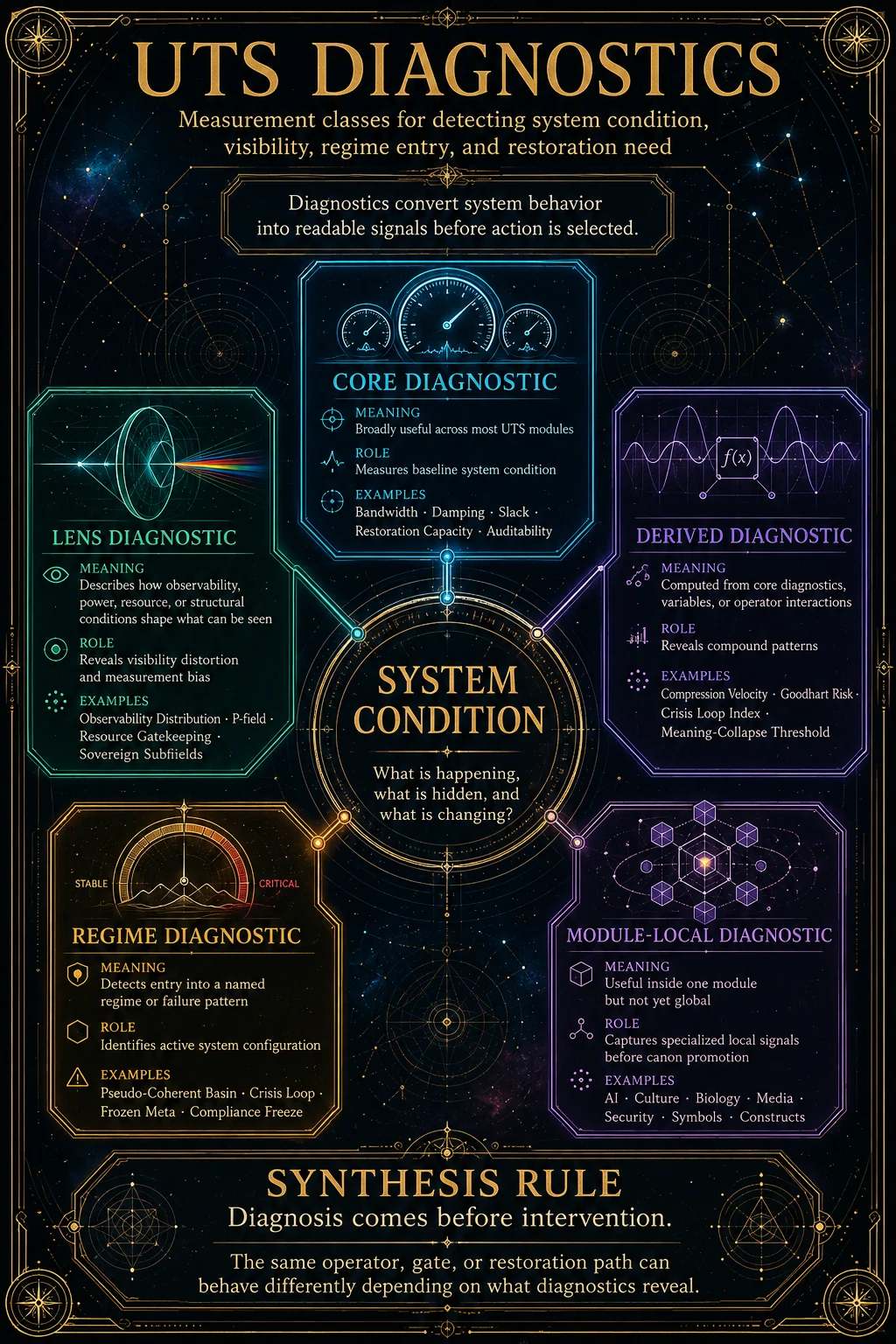
3. Diagnostic Classification System
Each diagnostic should be typed as one of five registry classes.
| Class | Meaning |
|---|---|
| Core Diagnostic | Broadly useful across most UTS modules |
| Derived Diagnostic | Computed from core diagnostics, variables, or operator interactions |
| Lens Diagnostic | Describes how observability, power, resource, or structural conditions shape what can be seen |
| Regime Diagnostic | Detects entry into a named regime or failure pattern |
| Module-Local Diagnostic | Useful inside one module but not yet global |
This classification prevents diagnostic drift.
A diagnostic may be promoted from module-local to core if it repeatedly proves useful across modules.
I. Core Diagnostics Registry
The following diagnostics are recommended as theUTS Diagnostics Core v1.0.
A. Forced-Response / Readiness Diagnostics
These determine whether the system can absorb, settle, repair, or tolerate transition load.
| Diagnostic | Name | Meaning | Status |
|---|---|---|---|
| σ(t) | Slack | Available buffer / margin before forced degradation | Core |
| 𝓑(t) | Bandwidth | How much forcing can be absorbed before phase shift | Core |
| 𝓓(t) | Damping | Whether disturbance settles, rings, recurs, or amplifies | Core |
| Reff | Effective Restoration Capacity | Usable repair capacity in context | Core |
| Aueff | Effective Auditability | Usable traceability and reconstructability in context | Core |
Role
This family answers:
Can the system safely proceed?
Can it absorb disturbance?
Can it repair?
Can it settle?
Can it be audited?
Primary Operator Dependencies
- Δrequires sufficient 𝓑 and Reff
- ⊗requires sufficient 𝓑, 𝓓, BΣ, and Reff
- ⊕requires high 𝓑, high Aueff, high Reff, and validated 𝓓
- ℛdepends directly on Reff
- Ξdepends heavily on Aueff
B. Memory / Recurrence Diagnostics
These determine whether repair, learning, and correction persist.
| Diagnostic | Name | Meaning | Status |
|---|---|---|---|
| τm(t) | Memory Half-Life | Rate at which repairs, lessons, or corrections decay | Core |
| Mint(t) | Memory Integrity | Whether lessons persist across cycles | Core |
| recurrencerate | Recurrence Rate | Frequency of repeated failure or pattern return | Core |
| repairdurability | Repair Durability | Whether restoration remains effective over time | Derived |
| AckDebt | Acknowledgment Debt | Unclosed acknowledgment, repair, or recognition loops | Proposed Core |
Role
This family answers:
Did the system actually learn?
Did repair land?
Does the same failure return?
Is unresolved acknowledgment keeping recurrence active?
Primary Operator Dependencies
- ℛrequires recurrence reduction
- Μrequires memory correction
- Τrequires long-horizon memory integrity
- Ψmust convert witnessing into U7 memory
- ⊕must reconcile inherited memory before integration
C. Signal / Classification Integrity Diagnostics
These determine whether signals are clean enough to influence selection, identity, constraint, or memory.
| Diagnostic | Name | Meaning | Status |
|---|---|---|---|
| signalquality | Signal Quality | Cleanliness, strength, reliability of signal | Core |
| signallocalizationquality | Signal Localization Quality | Whether signal is mapped to correct source / U-layer | Core |
| confidence/evidence ratio | Confidence-Evidence Ratio | Whether certainty exceeds evidence | Core |
| classificationreversibility | Classification Reversibility | Whether labels can be corrected or removed | Core |
| memorybindingrisk | Memory-Binding Risk | Risk that weak signal enters durable U7 memory | Core |
| FIintegrity | Feedback Integrity | Whether feedback can falsify preferred outcome | Core |
| HRintegrity | HR-Gate Health | Whether poor signals are blocked from identity-binding | Core |
Role
This family answers:
Is this signal clean enough to act on?
Is it localized correctly?
Is it being overinterpreted?
Can it safely enter memory?
Primary Operator Dependencies
- Μdepends on signal quality
- Γdepends on clean classification
- Πshould not constrain based on contaminated signal
- HR-Gatedepends directly on signal localization and reversibility
- Ψimproves signal contact before classification
D. Proxy / Inversion / Goodhart Diagnostics
These detect pseudo-coherence, metric capture, and reality-proxy divergence.
| Diagnostic | Name | Meaning | Status |
|---|---|---|---|
| Φ − O | Proxy-Coherence Divergence | Gap between measured success and real coherence | Core |
| ι | Inversion Index | Apparent order unsupported by real fit | Canonical variable / diagnostic |
| stressdivergence | Stress Divergence | Collapse or divergence under Δ / U8 forcing | Core |
| recoveryasymmetry | Recovery Asymmetry | Damage occurs faster than repair | Core |
| narrativemetricgap | Narrative-Metric Gap | Story of success diverges from observed effects | Derived |
| pseudodampingrisk | Pseudo-Damping Risk | Apparent settling while H accumulates | Derived |
Role
This family answers:
Is this real coherence or performance theater?
Can it survive stress?
Is repair slower than damage?
Are metrics replacing reality?
Primary Operator Dependencies
- Ξdirectly depends on this family
- Γis corrupted when Φ replaces O
- Μbecomes narrative capture when narrativemetricgap rises
- Τbecomes mission lock when Φ progress replaces real trajectory coherence
E. Constraint / Governance Diagnostics
These track rule burden, permeability, symmetry, and constraint health.
| Diagnostic | Name | Meaning | Status |
|---|---|---|---|
| Xc(t) | Constraint Complexity | Rule / policy / governance load | Core |
| exceptionrate | Exception Rate | Frequency of bypasses, appeals, special cases | Core |
| Perm(t) | Boundary Permeability | Ease of crossing between boundaries / subfields | Core |
| boundarystrain | Boundary Strain | Stress on BΣ under load or coupling | Core |
| constraintelasticity | Constraint Elasticity | Whether Π bends without breaking | Core |
| immunityindex | Immunity Index | Degree to which nodes escape consequence classes | Derived / MS-local |
| MSsymmetryindex | Meta-Symmetry Index | Whether equivalent effects receive equivalent consequence classes | Core / Gate-local |
Role
This family answers:
Are constraints interpretable?
Are boundaries too porous or too hardened?
Are rules producing coherence or hidden debt?
Is enforcement symmetric?
Primary Operator Dependencies
- Πdepends directly on Xc, Perm, and constraintelasticity
- Σdepends on boundarystrain and symmetry
- MS-Gatedepends on immunityindex and MSsymmetryindex
- ℛis harmed when Xc exceeds Aueff
Core sanity rule:
X_c(t) > Au_eff(t) ⇒ H↑↑F. Scaling / Meta-Dynamics Diagnostics
These track meta churn, compression, observability, and field-level scaling pressure.
| Diagnostic | Name | Meaning | Status |
|---|---|---|---|
| μmeta(t) | Meta Succession Rate | Rulebook / norm / policy / model churn | Core |
| τresp(t) | Reaction Latency | Signal-to-effective-response delay | Core |
| Cv(t) | Compression Velocity | Rate of decision-depth / optionality / auditability contraction | Core |
| Ω | Observability Regime | Who can see what, at what layer, with what asymmetry | Lens Diagnostic |
| P-field gradient | Position Field Gradient | Concentration of power / leverage / influence | Lens Diagnostic |
| RGintensity | Resource Gatekeeping Intensity | Degree of access control over scaling resources | Lens Diagnostic |
| SSfragmentation | Sovereign Subfield Fragmentation | Degree of subfield hardening / rule divergence | Regime Diagnostic |
Role
This family answers:
How fast is the rulebook changing?
How quickly does the system respond?
Is decision depth collapsing?
Who can observe what?
Where is power concentrating?
Primary Operator Dependencies
- Τdepends on τresp and μmeta
- Γdepends on μmeta and Cv
- Πresponds to compression and subfield fragmentation
- Ξis harder when Ω is asymmetric
- MS-Gatebecomes essential when P-field gradients rise
G. Throughput / Expression / Capacity Diagnostics
These track operational movement, expression capacity, and review load.
| Diagnostic | Name | Meaning | Status |
|---|---|---|---|
| Lτ | Logistics Throughput | Material / admin / operational throughput per unit time | Core |
| EB | Expression Bandwidth | Capacity for signal, meaning, dissent, creativity, or truth to move without distortion | Proposed Core |
| attentioncapacity | Attention Capacity | Available attention for Ψ / Au / Μ | Derived |
| reviewcapacity | Review Capacity | Available capacity for audit, gate review, and correction | Derived |
| coordinationoverhead | Coordination Overhead | U5 cost of maintaining system timing / protocol | Core |
| feedbackactionratio | Feedback-to-Action Ratio | Whether feedback changes behavior | Core |
Role
This family answers:
Can the system move material, information, review, and expression through itself?
Can feedback become action?
Can truth be expressed before it is compressed?
Primary Operator Dependencies
- Ψdepends on attention capacity
- FI-Gatedepends on EB and feedbackactionratio
- Au-Actuationdepends on reviewcapacity
- ΤandΠdepend on Lτ and coordinationoverhead
- Μdepends on EB when expression affects meaning formation
H. Coupling / Compatibility Diagnostics
These determine whether relation, network connection, and dependency are coherence-positive.
| Diagnostic | Name | Meaning | Status |
|---|---|---|---|
| dependencyload | Dependency Load | Degree of reliance created by coupling | Core |
| exitcost | Exit Cost | Cost of coherent uncoupling | Core |
| resourceasymmetry | Resource Asymmetry | Uneven U1 burden across coupled nodes | Core |
| repairburdendistribution | Repair Burden Distribution | Who supplies restoration across relation/system | Core |
| truthtolerance | Truth Tolerance | Whether connection survives reality contact | Core |
| Kreal | Real Compatibility | Mutual O↑ + BΣ intact + R not depleted | Derived |
| couplingpropagationrisk | Coupling Propagation Risk | Risk that Δ / H / ε travels through ⊗ | Core |
Role
This family answers:
Is coupling stabilizing or dependency-forming?
Can the system exit coherently?
Who carries the repair burden?
Can truth be named without rupture?
Primary Operator Dependencies
- ⊗depends directly on couplingpropagationrisk
- Λdepends on Kreal, truthtolerance, and exitcost
- Πuses dependencyload to set boundary terms
- ℛneeds repairburdendistribution
- MS-Gatechecks resource asymmetry and repair asymmetry
I. Selection / Adaptation Diagnostics
These track whether Γ preserves enough adaptive diversity.
| Diagnostic | Name | Meaning | Status |
|---|---|---|---|
| variancepreserved | Variance Preserved | Whether enough adaptive diversity remains | Core |
| innovationexit | Innovation Exit | Coherent alternatives leaving the system | Core |
| rejectedoptionquality | Rejected Option Quality | Whether Γ is excluding high-value alternatives | Derived |
| selectiontraceability | Selection Traceability | Whether selection criteria can be audited | Derived |
| adaptivebandwidth | Adaptive Bandwidth | Capacity to change without collapse | Derived |
Role
This family answers:
Is selection preserving enough adaptive diversity?
Are the best alternatives leaving?
Is Γ selecting for O or Φ?
Primary Operator Dependencies
- Γdirectly depends on this family
- Τdepends on future-path diversity
- Μdepends on alternative frames surviving long enough for evaluation
- Ξchecks whether selection is hiding inversion
Core rule:
Γ must preserve variance proportional to environmental volatility, system maturity, and boundary proximity.J. Legitimacy / Attribution Diagnostics
These track trust, accountability, attribution, and consequence distribution.
| Diagnostic | Name | Meaning | Status |
|---|---|---|---|
| AP(t) | Attribution Pressure | Pressure to personalize structural dynamics into blame | Core |
| L₀(t) | Legitimacy Baseline | Expected trust that correction systems will work | Core |
| legitimacyshockrisk | Legitimacy Shock Risk | Risk of trust collapse after exposure | Derived |
| rankthresholdgap | Rank Threshold Gap | Difference in evidence / consequence thresholds by rank | Core / MS-local |
| affectednodecost | Affected-Node Cost | Burden carried by impacted nodes | Core |
| appealaccessratio | Appeal Access Ratio | Who can challenge classification / constraint | Core |
Role
This family answers:
Is structural failure being personalized?
Can affected nodes trust correction systems?
Are consequence thresholds symmetric?
Who bears the cost?
Primary Operator Dependencies
- MS-Gatedepends on rankthresholdgap
- HR-Gatedepends on AP(t) and affectednodecost
- ℛdepends on affected-node cost and legitimacy baseline
- ΣandΛcan be corrupted when attribution pressure rises
- Τcan defer accountability when legitimacy shock risk is high
K. Regime / Threshold Diagnostics
These detect entry into named regimes.
| Diagnostic | Name | Meaning | Status |
|---|---|---|---|
| LOS-B | Latent Operational Structures | Hidden operational patterns beneath formal structure | Regime Diagnostic |
| LOS-A | Large Organization Syndrome | Large-scale regime of internal legibility over coherence | Regime Diagnostic |
| M | Meaning-Collapse Threshold | Point where meaning compression causes coordination / identity breakdown | Regime Threshold |
| crisisloopindex | Crisis Loop Index | Low 𝓑 + low 𝓓 + short τm | Derived |
| Goodhartrisk | Goodhart Risk | Φ pressure + FI weakness + Γ pressure | Derived |
| missionlockrisk | Mission Lock Risk | Τ rigidity + low Θ + Φ pressure | Derived |
| taboolockrisk | Taboo Lock Risk | Σ + Π + Μ hardening around unauditable sacred claim | Derived |
| coercivefusionrisk | Coercive Fusion Risk | Λ⁻ + ⊗⁻ + BΣ erosion | Derived |
LOS Disambiguation
Use two distinct labels:
LOS-A = Large Organization Syndrome
LOS-B = Latent Operational Structures
This avoids acronym collision.
Role
This family answers:
Has the system entered a named failure or threshold regime?
Are multiple diagnostics combining into a recognizable attractor?
II. Proposed Core Diagnostic Set v1.0
The following set is recommended as thecore global diagnostics registry.
| Diagnostic | Meaning |
|---|---|
| σ(t) | Slack / available buffer before degradation |
| 𝓑(t) | Bandwidth headroom before phase shift |
| 𝓓(t) | Damping / ring-down after disturbance |
| Reff | Effective restoration capacity |
| Aueff | Effective auditability |
| τresp(t) | Reaction latency from signal to effective correction |
| τm(t) | Memory half-life / recurrence risk |
| Mint(t) | Memory integrity |
| μmeta(t) | Meta succession / rulebook churn |
| Xc(t) | Constraint complexity |
| Cv(t) | Compression velocity |
| Ω | Observability regime / asymmetry |
| AP(t) | Attribution pressure |
| Lτ | Logistics throughput |
| EB | Expression bandwidth |
| Perm(t) | Boundary permeability |
| Φ − O | Proxy-coherence divergence |
| variancepreserved | Adaptive diversity retained |
| innovationexit | Coherent alternatives leaving |
| dependencyload | Reliance burden under coupling |
| exitcost | Cost of coherent uncoupling |
| recurrencerate | Repeated failure frequency |
| AckDebt | Unclosed acknowledgment / repair loops |
This gives the archive a strong diagnostic spine without pretending every useful diagnostic must become global canon.
III. Derived / Module-Local Diagnostics
The following should remain derived or module-local until they recur broadly enough to promote.
| Diagnostic | Placement |
|---|---|
| Goodhartrisk | Derived from Φ−O, FI, Γ, Au |
| missionlockrisk | Derived from Τ, Θ, Φ, Au, revision latency |
| taboolockrisk | Derived from Σ, Π, Μ, Au, MS |
| coercivefusionrisk | Derived from Λ, ⊗, BΣ, exitcost |
| crisisloopindex | Derived from 𝓑, 𝓓, τm |
| pseudodampingrisk | Derived from ι, H, 𝓓 |
| immunityindex | MS-Gate / legitimacy-local unless globalized |
| rankthresholdgap | MS-Gate / legitimacy-local |
| affectednodecost | Restoration / legitimacy-local |
| truthtolerance | Λ / interaction-local |
| reviewcapacity | Au / institutional-local |
| attentioncapacity | Ψ / execution-local |
| coordinationoverhead | Scaling / U5-local |
| rejectedoptionquality | Γ-local |
| selectiontraceability | Γ / Au-local |
| repairburdendistribution | Λ / ℛ / MS-local |
These should appear in relevant spec sheets, but do not need to be part of the first core diagnostics build.
IV. Diagnostic Usage Workflow
When analyzing a system:
Step 1 — Localize
Identify the primary U-layer:
U0 substrate
U1 power / budgets
U2 configuration / boundaries
U3 execution
U4 classification
U5 coordination
U6 coherence field
U7 memory
U8 environment
Step 2 — Identify Moving Variables
Which components ofSare changing?
O, H, ε, ι, Au, µᵢ, BΣ, K, R, ΦStep 3 — Check Forced-Response Readiness
Use:
σ(t), 𝓑(t), 𝓓(t), R_eff, Au_effThis answers whether the system can safely absorb, settle, repair, and inspect the transition.
Step 4 — Check Signal / Gate Integrity
Use:
FI_integrity, signal_quality, signal_localization_quality,
confidence/evidence ratio, HR_integrity, MS_symmetry_index
This answers whether the system is acting from clean signal or contaminated interpretation.
Step 5 — Check Scaling Pressure
Use:
μ_meta(t), τ_resp(t), X_c(t), Cv(t), Ω, Lτ, EBThis answers whether meta churn, latency, compression, visibility, or throughput are distorting the system.
Step 6 — Check Coupling / Adaptation
Use:
dependency_load, exit_cost, Perm(t),
variance_preserved, innovation_exit, K_real
This answers whether the system is adapting coherently or entering dependency / brittleness.
Step 7 — Check Legitimacy / Regime Entry
Use:
AP(t), L₀(t), AckDebt, M*, LOS-A, LOS-B,
Goodhart_risk, crisis_loop_index
This answers whether failure is becoming personalized, legitimacy is deteriorating, or the system is entering a named regime.
V. Diagnostic-to-Operator Guidance
| Diagnostic Condition | Likely Operator Response |
|---|---|
| Low 𝓑(t) | Π, ℛ, Θ, Ψ before Δ / ⊗ / ⊕ |
| Low 𝓓(t) | ℛ, Ψ, U7 update before recurrence-facing action |
| Low σ(t) | Θ, Π load reduction, ℛ reserve restoration |
| Low Reff | Π containment, Au/FI recovery, resource repair |
| Low Aueff | Au-Actuation, Ψ, FI review before high-impact claims |
| High Φ − O | Ξ, FI-Gate, Γ recalibration |
| High Xc(t) | Π simplification, Au review, ℛ hidden debt cleanup |
| High Cv(t) | Θ, Π slowdown, preserve decision depth |
| High AP(t) | Μ recalibration, HR-Gate, MS-Gate |
| High dependencyload | ⊘ attenuation, Π redesign, Λ re-test |
| High exitcost | reduce coupling depth, restore BΣ, avoid ⊕ |
| Low variancepreserved | Γ recalibration, preserve adaptive diversity |
| High innovationexit | Ξ check, Γ repair, reduce Π/Φ pressure |
| High AckDebt | ℛ acknowledgment/repair loop closure |
| Mapproaching** | reduce compression, restore meaning bandwidth, increase EB/Au |
VI. Diagnostic-to-Gate Guidance
| Diagnostic Condition | Gate Implication |
|---|---|
| Low Aueff | Au-Actuation should quarantine high-impact transitions |
| Low FIintegrity | FI-Gate should block Γ / ℛ / Μ closure |
| High confidence/evidence ratio | HR-Gate should prevent identity-binding |
| High rankthresholdgap | MS-Gate should activate |
| High Φ − O | FI + Au + Ξ required |
| High Xc(t) | ☷ᵢ + Au review needed |
| High AP(t) | HR + MS before attribution or consequence |
| High AckDebt | ℛ required before closure / re-coupling |
| Low σ(t) | Gates should attenuate, not escalate load |
| Low 𝓓(t) | Gates should deny repair-complete claims |
| High Cv(t) | Gates should protect decision depth and review windows |
IX. Condensed Archive Summary
The UTS Diagnostics Registry defines the measurement and interpretation layer of the Universal Theory Stack. Diagnostics do not change state and do not decide admissibility directly; they reveal state, capacity, stress response, recurrence, signal quality, scaling pressure, coupling risk, legitimacy risk, and regime entry. The registry distinguishes core diagnostics from derived, lens-based, regime-based, and module-local diagnostics to prevent primitive creep while preserving analytical power. The core diagnostic spine includes slack, bandwidth, damping, effective restoration capacity, effective auditability, reaction latency, memory integrity, constraint complexity, compression velocity, observability, attribution pressure, logistics throughput, expression bandwidth, boundary permeability, proxy-coherence divergence, adaptive variance, innovation exit, dependency load, exit cost, recurrence rate, and acknowledgment debt.