0. Purpose
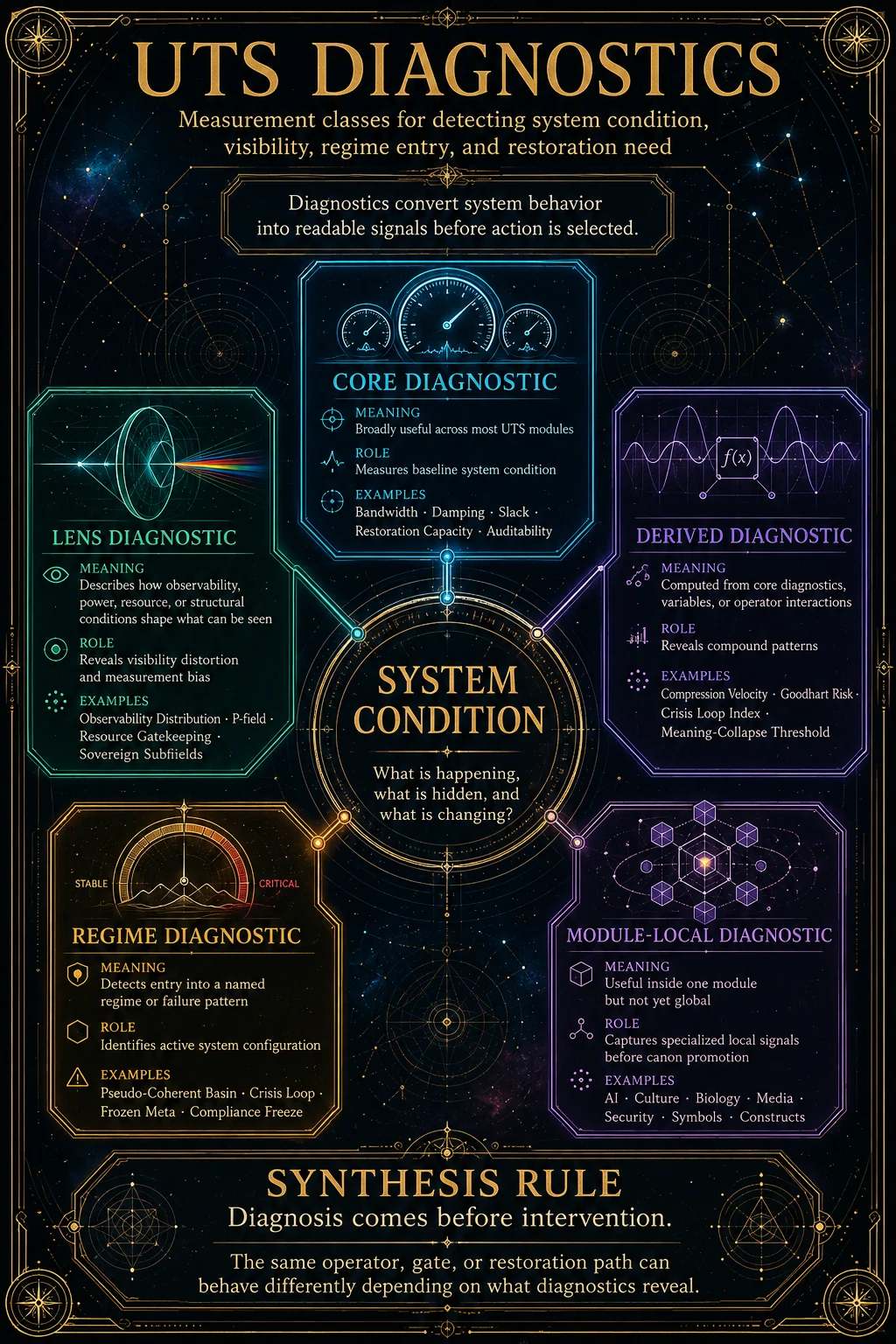
The UTS Diagnostics layer defines how a system’s condition, limits, stress response, recurrence behavior, signal integrity, restoration capacity, and regime risk are observed or inferred.
Diagnostics donotchange system state directly. They do not replace operators, gates, lenses, or regimes. Instead, diagnostics reveal the conditions under which operators can be safely sequenced, gates should pass or fail, lenses are amplifying risk, and regimes are forming.
The operator registry provides the core distinction:
Operators change state. Lenses bias behavior. Diagnostics reveal limits. Gates decide what is allowed. Regimes name recurring compositions.
This distinction is essential because the diagnostics archive must expand without creating new operator primitives.
I. Canonical Definition
Adiagnosticis an observable, estimated, inferred, or computed indicator used to determine one or more of the following:
- system condition
- stress tolerance
- transition safety
- operator sequencing
- gate outcome
- failure-mode detection
- scaling risk
- restoration priority
- recurrence behavior
- regime entry
Diagnostics are therefore themeasurement and interpretation layerof UTS.
They answer questions such as:
How much pressure can this system absorb?

Is the disturbance settling or amplifying?

Is repair durable or temporary?

Is the system optimizing a proxy instead of coherence?

Is signal being classified at the correct U-layer?

Is boundary crossing coherent, coercive, porous, or over-hardened?

Is the system entering a crisis loop, Goodhart regime, compression collapse, or meaning-collapse threshold?
II. Diagnostics Are Not Operators
The most important technical rule:
Diagnostics reveal state. Operators move state.
A diagnostic may indicate that restoration is needed, but it does not perform restoration.
For example:
| Diagnostic | Reveals | Related Operator |
|---|---|---|
| 𝓑(t) — Bandwidth | Whether the system can absorb forcing | Δ, Π, ℛ |
| 𝓓(t) — Damping | Whether disturbance settles or amplifies | ℛ, Θ, Π |
| σ(t) — Slack | Whether the system has buffer before forced degradation | Π, Τ, ℛ |
| Aueff — Effective Auditability | Whether causality and state are traceable | Ψ, Μ, Γ |
| Φ − O — Proxy-Coherence Divergence | Whether measured success diverges from real coherence | Ξ, Γ, Μ |
| Cv(t) — Compression Velocity | Whether decision depth is collapsing under pressure | Π, Θ, ℛ |
Diagnostics may inform operator selection, but they are not themselves state-moving primitives.
III. Relationship to the Canonical State Vector
All major diagnostics should map back to the canonical UTS state vector:
S = { O, H, ε, ι, Au, µᵢ, BΣ, K, R, Φ }Where:
| Variable | Diagnostic Relevance |
|---|---|
| O — Coherence | Primary reference condition; what diagnostics often compare against |
| H — Hidden Debt | Revealed by recurrence, stress divergence, pseudo-damping, AckDebt |
| ε — Error / Noise | Revealed by signal degradation, execution deviation, classification instability |
| ι — Inversion Index | Revealed by proxy divergence, pseudo-coherence, Goodhart risk |
| Au — Auditability | Revealed by Aueff, selection traceability, review capacity |
| µᵢ — Agent Integrity | Revealed by identity consistency, attribution pressure, memory-binding risk |
| BΣ — Boundary Integrity | Revealed by Perm(t), boundary strain, coercive fusion risk |
| K — Compatibility | Revealed by dependency load, exit cost, Kreal, coupling propagation risk |
| R — Restoration Capacity | Revealed by Reff, repair durability, recovery asymmetry |
| Φ — Fitness Proxy | Revealed by Φ−O, Goodhart risk, narrative-metric gap |
A diagnostic is archive-admissible when it can be traced to one or more of these variables, or to a derived relationship between them.
The expanded diagnostics draft already follows this principle by treating diagnostics as admissible when they help determine state, operator sequencing, gate outcome, regime entry, scaling risk, or restoration priority.
IV. Relationship to U-Layers
Diagnostics should be localized by U-layer whenever possible.
U0 — Substrate
U1 — Power / budgets
U2 — Configuration / boundaries
U3 — Execution
U4 — Classification / metrics / narratives
U5 — Coordination / timing
U6 — Coherence field
U7 — Memory / recurrence
U8 — Environment / forcing
U-layer localization answers:
Where does the failure originate?

Where is the symptom visible?

Where must repair occur?

Is the diagnostic measuring cause, expression, amplification, or recurrence?
Example:
| Diagnostic | Likely Origin | Common Manifestation | Repair Layer |
|---|---|---|---|
| signalquality | U3 / U4 | U4 classification | U3 or U4 |
| memorybindingrisk | U4 | U7 persistence | U4 before U7 binding |
| Cv(t) | U1 / U4 / U5 | U6 field compression | same or lower than origin |
| Perm(t) | U2 | U2 / U6 coupling | U2 boundary redesign |
| τm(t) | U7 | recurring failures | U7 with U4/U5 support |
| Lτ | U1 / U3 / U5 | operational bottleneck | U1, U3, or U5 |
The operator registry’s rule thatrepair must occur at the same or lower U-layer than failure originis especially important for diagnostic interpretation.
V. Diagnostic Typing System
Diagnostics should be classified before being added to the archive.
1. Core Diagnostic
A diagnostic used across most UTS modules.
Examples:
𝓑(t) — Bandwidth
𝓓(t) — Damping
σ(t) — Slack
R_eff — Effective Restoration Capacity
Au_eff — Effective Auditability
τ_resp(t) — Reaction Latency
τ_m(t) — Memory Half-Life
X_c(t) — Constraint Complexity
Cv(t) — Compression Velocity
AP(t) — Attribution Pressure
Core diagnostics are broadly reusable and should have full spec sheets.
2. Derived Diagnostic
A diagnostic computed from canonical variables or other diagnostics.
Examples:
Goodhart_risk
mission_lock_risk
coercive_fusion_risk
pseudo_damping_risk
crisis_loop_index
legitimacy_shock_risk
repair_durability
K_real
Derived diagnostics are still valid, but they should not be treated as primitive measurements.
Example:
Goodhart_risk ≈ high Φ pressure + high Φ−O + weak FI_integrity + low Au_eff3. Layer / Lens Diagnostic
A diagnostic that describes how conditions vary across U-layers or scaling lenses.
Examples:
Ω — Observability Regime
P-field gradient
RG_intensity
SS_fragmentation
These often describe distribution, asymmetry, visibility, or access geometry rather than a single scalar state.
4. Regime Indicator
A diagnostic that detects entry into a named system pattern.
Examples:
LOS — Latent Operational Structures
M* — Meaning-Collapse Threshold
crisis_loop_index
Goodhart_risk
taboo_lock_risk
mission_lock_risk
Regime indicators usually combine multiple lower-level diagnostics.
5. Module-Local Diagnostic
A diagnostic useful within a specific domain but not yet globally canonical.
Examples might arise in:
AI governance
relationship systems
archive systems
institutional coherence
medical / biological systems
culture and narrative systems
Module-local diagnostics may later be promoted if they prove reusable across multiple modules.
VI. Diagnostic Output Types
Diagnostics can output different kinds of information.
1. Scalar
A single value.
𝓑(t) = bandwidth headroom
𝓓(t) = damping strength
σ(t) = slack buffer
2. Ratio
A comparative measure.
confidence / evidence
feedback / action
repair capacity / load
Φ / O
3. Threshold State
A transition condition.
below threshold
stable
warning
critical
phase transition likely
4. Trend
Direction over time.
improving
degrading
oscillating
stuck
accelerating
5. Vector by U-Layer
A layered diagnostic profile.
Au_eff = {
  U2: medium,
  U3: low,
  U4: high,
  U7: poor
}
This is useful when the system looks auditable at one layer but opaque at another.
6. Distribution
A spread across nodes, roles, ranks, or subfields.
Ω — who can see what
repair_burden_distribution — who supplies repair
resource_asymmetry — who carries cost
7. Regime Flag
A yes/no or probability-like signal.
Goodhart risk: elevated
crisis loop: active
meaning collapse: near threshold
coercive fusion: likely
VII. Diagnostic Resolution
A diagnostic can be low-resolution or high-resolution.
Low-Resolution Diagnostic
Useful for early sorting.
Slack is low.
Damping is poor.
Proxy divergence is high.
Boundary strain is rising.
High-Resolution Diagnostic
Useful for intervention design.
Slack is low at U1 and U5, but not U2.
Damping fails because R_eff is present but delayed by τ_resp.
Proxy divergence is driven by Φ pressure, not by lack of signal.
Boundary strain is caused by high Perm(t), not by low BΣ.
The archive should support both. Reference overviews can use low-resolution language. Technical spec sheets should push toward high-resolution interpretation.
VIII. Core Diagnostic Mechanics
1. Forced-Response Mechanics
Forced-response diagnostics ask:
How does the system behave when pressured?Primary diagnostics:
𝓑(t) — Bandwidth
𝓓(t) — Damping
σ(t) — Slack
R_eff — Effective Restoration Capacity
Au_eff — Effective Auditability
These determine whether the system can absorb disturbance, settle afterward, and repair without accumulating hidden debt.
Basic relationship:
If Load × Gain_stack > R_eff + σ(t), degradation risk rises.More simply:
R_eff > Load × Gain_stack ⇒ O tends to increase
R_eff < Load × Gain_stack ⇒ collapse amplifies
The expanded registry explicitly identifies these forced-response diagnostics as the “system readiness foundation.”
2. Memory / Recurrence Mechanics
Memory diagnostics ask:
Does correction persist?Primary diagnostics:
τ_m(t) — Memory Half-Life
M_int(t) — Memory Integrity
recurrence_rate
repair_durability
AckDebt
A system may appear repaired at U3 execution while remaining unrepaired at U7 memory.
Common pattern:
visible correction + low memory integrity ⇒ recurrence likelyAnother common pattern:
unclosed acknowledgment loop + symbolic repair only ⇒ AckDebt persistsThis is why repair must be validated over recurrence, not just immediate behavior.
3. Signal / Classification Mechanics
Signal diagnostics ask:
Can the system see, classify, and revise reality accurately?Primary diagnostics:
signal_quality
signal_localization_quality
confidence/evidence ratio
classification_reversibility
memory_binding_risk
FI_integrity
HR_integrity
These are especially important around U4 and U7.
Failure pattern:
weak signal → hard classification → durable memory binding → identity distortionHealthy pattern:
weak signal → provisional classification → reversible memory → later correctionThese diagnostics support FI-Gate, HR-Gate, Μ, Γ, Π, and Ψ.
4. Proxy / Inversion Mechanics
Proxy diagnostics ask:
Is the system optimizing apparent success instead of coherence?Primary diagnostics:
Φ − O
ι
stress_divergence
recovery_asymmetry
narrative_metric_gap
pseudo_damping_risk
Common failure pattern:
Φ rises while O falls.This means measured success improves while real coherence degrades.
Another pattern:
system appears calm, but H increases.That is pseudo-damping: disturbance is not resolved, only suppressed or displaced.
These diagnostics support Ξ, Γ, Μ, Τ, and Θ.
5. Constraint / Governance Mechanics
Constraint diagnostics ask:
Are rules preserving coherence or generating hidden debt?Primary diagnostics:
X_c(t) — Constraint Complexity
exception_rate
Perm(t)
boundary_strain
constraint_elasticity
immunity_index
MS_symmetry_index
Key distinction:
BΣ = boundary integrity
Perm(t) = current permeability of the boundary
A boundary can be:
high integrity + selectively permeable
high integrity + over-hardened
low integrity + porous
low integrity + chaotically hardened
Constraint failure often appears as either brittleness or uncontrolled exception growth.
6. Scaling / Meta Dynamics Mechanics
Scaling diagnostics ask:
How do rules, models, metas, and decision spaces evolve under pressure?Primary diagnostics:
μ_meta(t) — Meta Succession Rate
τ_resp(t) — Reaction Latency
Cv(t) — Compression Velocity
Ω — Observability Regime
P-field gradient
RG_intensity
SS_fragmentation
Compression Velocity is especially important:
Cv(t) = rate at which decision depth, optionality, auditability, or admissible action space contracts under pressure.High Cv(t) means the system is losing interpretive and action depth quickly.
Typical compression pattern:
pressure ↑ → time horizon ↓ → options ↓ → auditability ↓ → forced response ↑7. Throughput / Capacity Mechanics
Throughput diagnostics ask:
Can the system actually move what needs to move?Primary diagnostics:
Lτ — Logistics Throughput
EB — Expression Bandwidth
attention_capacity
review_capacity
coordination_overhead
feedback_action_ratio
Important distinction:
FI_integrity asks whether feedback can falsify the system.
EB asks whether expression has enough channel capacity to appear at all.
Au_eff asks whether what appears can be traced.
So a system can have:
high Au_eff but low EBMeaning it can audit what appears, but too little signal is allowed to appear.
Or:
high EB but low FI_integrityMeaning people can speak, but feedback does not change the system.
8. Coupling / Compatibility Mechanics
Coupling diagnostics ask:
Does connection increase coherence without eroding boundaries or overloading restoration?Primary diagnostics:
dependency_load
exit_cost
resource_asymmetry
repair_burden_distribution
truth_tolerance
K_real
coupling_propagation_risk
Healthy coupling:
K_real ↑
BΣ intact
R not depleted
exit remains coherent
truth can still be named
Debt-bearing coupling:
dependency_load ↑
exit_cost ↑
repair burden asymmetric
truth naming punished
BΣ erodes
These diagnostics are central to ⊗, Λ, Π, ℛ, and MS-Gate.
9. Selection / Adaptation Mechanics
Selection diagnostics ask:
Is Γ preserving enough adaptive possibility?Primary diagnostics:
variance_preserved
innovation_exit
rejected_option_quality
selection_traceability
adaptive_bandwidth
Selection failure pattern:
system selects for compliance with Φ while rejecting high-O alternativesThis creates local order but long-term adaptive loss.
Healthy selection:
low-quality options removed
high-quality variance preserved
selection criteria auditable
rejected alternatives remain reviewable
10. Legitimacy / Attribution Mechanics
Legitimacy diagnostics ask:
Can trust, consequence, and repair remain coherent under exposure?Primary diagnostics:
AP(t) — Attribution Pressure
L₀(t) — Legitimacy Baseline
legitimacy_shock_risk
rank_threshold_gap
affected_node_cost
appeal_access_ratio
Attribution Pressure is especially important in UTS because it detects when structural dynamics are being compressed into personalized blame.
High AP(t) can distort analysis in two directions:
structure erased → individual blame overload
agency erased → structural abstraction overload
The coherent path preserves both:
structure remains visible
agency remains accountable
repair remains possible
11. Regime / Threshold Mechanics
Regime diagnostics ask:
Is the system entering a named high-risk pattern?Primary diagnostics:
LOS — Latent Operational Structures
M* — Meaning-Collapse Threshold
crisis_loop_index
Goodhart_risk
mission_lock_risk
taboo_lock_risk
coercive_fusion_risk
These are usually composite diagnostics.
Example:
crisis_loop_index = low 𝓑 + low 𝓓 + short τ_mExample:
Goodhart_risk = Φ pressure + Φ−O divergence + weak FI_integrity + low Au_effExample:
coercive_fusion_risk = Λ⁻ + ⊗⁻ + BΣ erosion + high exit_costRegime diagnostics should usually come after lower-level diagnostics, not before them.
IX. Diagnostic Interpretation Rules
Rule 1 — No Single Diagnostic Is Sovereign
No diagnostic should override the whole system alone.
For example:
High Φ does not prove high O.
High EB does not prove high FI.
High Au does not prove high truth.
High damping does not prove real repair.
High constraint does not prove safety.
Diagnostics must be interpreted in bundles.
Rule 2 — Always Separate Appearance From Stress Response
A system can look coherent under low stress and fail under Δ or U8 forcing.
Therefore:
baseline performance ≠ stress performanceThis is why 𝓑(t), 𝓓(t), stressdivergence, and recoveryasymmetry matter.
Rule 3 — Always Check Time
Immediate correction does not prove durable repair.
A diagnostic reading should be interpreted across:
t₀ — baseline
t₁ — disturbance
t₂ — response
t₃ — ring-down
t₄ — recurrence window
Without time, repair can be mistaken for suppression.
Rule 4 — Always Check U-Layer Localization
The same symptom can originate from different layers.
Example:
slow responseCould mean:
U1 capacity shortage
U3 execution bottleneck
U4 classification confusion
U5 coordination lag
U7 memory interference
U8 forcing overload
The diagnostic must identify where the bottleneck actually originates.
Rule 5 — Always Check Proxy Divergence
Any system optimizing a success measure should be checked for:
Φ − O
FI_integrity
narrative_metric_gap
stress_divergence
This prevents success-signals from being mistaken for coherence.
Rule 6 — Always Check Boundary Conditions
Boundary failure may look like compassion, efficiency, safety, openness, loyalty, or unity depending on framing.
So any coupling or governance analysis should check:
BΣ
Perm(t)
exit_cost
dependency_load
repair_burden_distribution
coercive_fusion_risk
X. Diagnostic Bundles
Diagnostics become more useful when grouped into bundles.
1. Readiness Bundle
𝓑(t)
𝓓(t)
σ(t)
R_eff
Au_eff
Use when asking:
Can this system safely take more load?2. Repair Durability Bundle
R_eff
τ_m(t)
M_int(t)
recurrence_rate
AckDebt
recovery_asymmetry
Use when asking:
Will repair persist?3. Signal Integrity Bundle
signal_quality
signal_localization_quality
confidence/evidence ratio
classification_reversibility
memory_binding_risk
FI_integrity
HR_integrity
Use when asking:
Can this system classify reality without binding weak signal into durable distortion?4. Proxy / Inversion Bundle
Φ − O
ι
stress_divergence
narrative_metric_gap
pseudo_damping_risk
Goodhart_risk
Use when asking:
Is apparent success hiding incoherence?5. Compression Bundle
Cv(t)
σ(t)
τ_resp(t)
X_c(t)
Au_eff
EB
M*
Use when asking:
Is decision depth collapsing?6. Boundary / Coupling Bundle
BΣ
Perm(t)
dependency_load
exit_cost
resource_asymmetry
repair_burden_distribution
K_real
coercive_fusion_risk
Use when asking:
Is coupling coherent or debt-bearing?7. Legitimacy Bundle
AP(t)
L₀(t)
rank_threshold_gap
affected_node_cost
appeal_access_ratio
MS_symmetry_index
legitimacy_shock_risk
Use when asking:
Can the system preserve trust, accountability, and repair under exposure?XI. Diagnostic-to-Operator Sequencing
Diagnostics should guide which operators are safe to apply.
Example 1 — Low Auditability
Au_eff low
signal_quality uncertain
confidence/evidence ratio high
Avoid:
hard Γ
identity-binding Π
durable U7 memory updates
Prioritize:
Ψ — Presence
Μ — Sensemaking
Θ — Humility
Au restoration
classification reversibility
Example 2 — High Proxy Divergence
Φ high
O falling
FI weak
stress_divergence rising
Avoid:
more Φ optimization
premature success narrative
hard scaling
Prioritize:
Ξ — Inversion detection
FI-Gate restoration
Au_eff improvement
Δ stress testing
ℛ hidden debt repair
Example 3 — Low Damping
𝓓(t) low
recurrence_rate high
τ_m short
Avoid:
repeated Δ forcing
rapid meta changes
surface-level fixes
Prioritize:
ℛ — Restore
σ(t) rebuilding
R_eff increase
memory integrity repair
load reduction
Example 4 — High Compression Velocity
Cv(t) high
σ(t) low
τ_resp high
Au_eff falling
Avoid:
forced decision closure
premature classification
irreversible constraints
Prioritize:
Θ — Humility
Π decompression
Ψ attention restoration
R_eff allocation
decision-depth preservation
Example 5 — Boundary Permeability Failure
Perm(t) too high or too low
BΣ strained
exit_cost rising
dependency_load rising
Avoid:
unexamined coupling
forced unity
hard separation without restoration
Prioritize:
Λ — Compatibility evaluation
Π — Boundary redesign
Σ — Invariant protection
ℛ — Repair burden correction
XII. Diagnostic-to-Gate Mapping
Diagnostics also inform gates.
| Gate | Supporting Diagnostics |
|---|---|
| FI-Gate | FIintegrity, feedbackactionratio, Φ−O, Goodhartrisk |
| HR-Gate | confidence/evidence ratio, HRintegrity, classificationreversibility, memorybindingrisk |
| MS-Gate | MSsymmetryindex, rankthresholdgap, immunityindex, affectednodecost |
| Au-Actuation | Aueff, selectiontraceability, reviewcapacity, observability regime |
| Principle Constraint Fields | BΣ, Perm(t), coercivefusionrisk, taboolockrisk, legitimacy shock risk |
Gate failure should produce a null outcome:
Gate failure ⇒ ∅This means the system should not proceed with the proposed actuation until the relevant diagnostic condition improves.
XIII. Diagnostic Maturity Levels
Each diagnostic can be developed through maturity levels.
Level 1 — Named
The diagnostic has a name and basic definition.
Level 2 — Typed
The diagnostic is classified as core, derived, lens, regime, or module-local.
Level 3 — Mapped
The diagnostic is mapped to:
state vector
U-layers
operators
gates
related diagnostics
Level 4 — Interpretable
The diagnostic has warning signs, misreads, failure ranges, and restoration pathways.
Level 5 — Operational
The diagnostic can be used in audits, spec sheets, checklists, scoring, or tool design.
The goal of this archive is to bring the core diagnostics to at leastLevel 4, and eventuallyLevel 5.
XIV. Archive Design Principle
The diagnostic archive should remain expandable but disciplined.
Recommended canon rule:
A diagnostic may be added when it improves state recognition, transition safety, operator sequencing, gate evaluation, restoration prioritization, recurrence tracking, or regime detection without introducing a new operator primitive.
Recommended non-redundancy rule:
If a proposed diagnostic is only a renamed version of an existing diagnostic, it should be treated as an alias, subcomponent, or derived diagnostic rather than added as a new core entry.
Recommended promotion rule:
A module-local diagnostic may become core when it proves useful across multiple UTS domains and maps cleanly to the canonical state vector.
XV. Condensed Technical Summary
The UTS Diagnostics layer is the measurement and threshold system beneath the operator registry. Diagnostics reveal condition, capacity, stress response, recurrence, signal quality, proxy divergence, compression, boundary behavior, coupling risk, adaptation loss, legitimacy strain, and regime entry. They do not move state directly and do not add operator primitives. Every diagnostic should be typed, mapped to the canonical state vector, localized by U-layer, interpreted across time, and connected to operator sequencing and gate outcomes. Core diagnostics form the reusable measurement spine of UTS, while derived diagnostics, lens diagnostics, regime indicators, and module-local diagnostics extend the system without causing primitive drift.
Diagnostics Cross-Walk
Registry Version:UTS Operator Registry v1.7
Cross-Walk Version:v1.0
Status:Archive-ready draft
1) Purpose of the Cross-Walk
The diagnostics registry is now large enough that each diagnostic needs to be understood in relation to the others.
This cross-walk answers:
Which diagnostics belong together?

Which diagnostics are commonly confused?

Which diagnostics should be checked before high-risk action?

Which diagnostics form composite failure signatures?

Which diagnostics support specific gates, operators, and U-layers?
The key principle:
Diagnostics do not act directly. They reveal state, capacity, risk, distortion, burden, or response conditions so operators and gates can act safely.
2) Master Diagnostic Families
A) Signal, Feedback, Audit, and Truth Diagnostics
These diagnostics determine whether reality-contact can enter the system, remain traceable, be understood, and become correction.
| Diagnostic | Core Question | Primary Risk Detected |
|---|---|---|
| Signal Quality | Is the signal clean enough to use? | Acting from noisy or distorted signal |
| Signal Localization Quality | Is the signal mapped to the right source/layer? | Repairing the wrong node or layer |
| Confidence / Evidence Ratio | Does certainty match evidence? | Overclaim, premature closure, false confidence |
| Effective Auditability / Aueff | Can the path from source to claim/action be traced? | Unverifiable action, memory contamination |
| FIintegrity | Can feedback actually correct the system? | Feedback theater, pseudo-learning |
| feedbackactionratio | Does actionable feedback become action? | Responsiveness theater |
| truthtolerance | Can difficult reality be named without collapse? | Denial, taboo, rupture, false harmony |
| attentioncapacity | Can the system attend to what matters? | Missed-signal debt |
| reviewcapacity | Can the system meaningfully evaluate decisions/signals? | Rubber-stamp governance |
Quick Distinction
Signal Quality = is the signal clean?
Signal Localization = is the signal placed correctly?
Au_eff = can we trace it?
Attention Capacity = can we notice/hold it?
Review Capacity = can we evaluate it?
FI_integrity = can it correct the system?
Feedback Action Ratio = did it actually change anything?
Truth Tolerance = can the system survive the reality it reveals?
B) Memory, Classification, and Binding Diagnostics
These diagnostics protect the system from premature labels, false memory, durable misclassification, and unsafe identity/status binding.
| Diagnostic | Core Question | Primary Risk Detected |
|---|---|---|
| classificationreversibility | Can a classification be corrected? | Label lock-in |
| Memory Binding Risk | Is unstable signal entering durable memory? | U7 contamination |
| Memory Half-Life | How long does usable memory persist? | Lessons decay before recurrence |
| Memory Integrity | Is memory accurate and coherent? | False precedent, drift |
| High Risk Gate Integrity / HRintegrity | Is high-risk binding properly blocked? | Improper binding with downstream error |
| selectiontraceability | Can we reconstruct why a choice was made? | Selection debt |
| rejectedoptionquality | Were valuable rejected options lost? | Adaptive loss, misselection |
| variancepreserved | Was enough adaptive variation retained? | Over-selection, brittleness |
| innovationexit | Is valuable innovation leaving? | Future readiness collapse |
| adaptivebandwidth | Can the system integrate change coherently? | Adaptation debt |
Quick Distinction
classification_reversibility = can the label be changed?
Memory Binding Risk = should this label enter durable memory?
Memory Integrity = is the memory accurate?
Memory Half-Life = will the memory persist long enough?
HR_integrity = is high-risk binding being safely gated?
Selection Traceability = can we audit why the choice was made?
Rejected Option Quality = what did we lose by rejecting alternatives?
Variance Preserved = how much adaptive option-space remains?
Innovation Exit = are future-useful possibilities leaving?
Adaptive Bandwidth = can we integrate change at all?
C) Boundary, Constraint, and Coupling Diagnostics
These diagnostics determine whether boundaries, permissions, dependencies, coupling, and integration are coherent or drifting into burden, lock-in, or fusion.
| Diagnostic | Core Question | Primary Risk Detected |
|---|---|---|
| Boundary Permeability / Perm(t) | How crossable is the boundary? | Leakage or isolation |
| boundarystrain | How much load is the boundary carrying? | Breach, rupture, hardening |
| constraintelasticity | Can constraints bend without losing purpose? | Brittleness or over-loosening |
| exceptionrate | How often are rules bypassed? | Hidden governance, exception creep |
| dependencyload | How much reliance burden exists? | Fragility, hidden obligation |
| exitcost | Can coupling be reduced or ended coherently? | Lock-in, coerced continuation |
| resourceasymmetry | Are capacities unequal in ways that affect action? | Practical inequality, dependency |
| repairburdendistribution | Who carries the work of restoration? | Repair burden export |
| Kreal | Is compatibility real under actual conditions? | Pseudo-compatibility |
| couplingpropagationrisk | Can instability travel through the coupling? | Cascade, contamination |
| coercivefusionrisk | Is coupling eroding separateness or refusal? | Boundary collapse, identity overwrite |
Quick Distinction
Boundary Permeability = how much can cross?
Boundary Strain = how much pressure is the boundary carrying?
Constraint Elasticity = can the rule/boundary adapt?
Exception Rate = how often are rules bypassed?
Dependency Load = how much reliance burden exists?
Exit Cost = how hard is it to leave/reduce coupling?
Resource Asymmetry = who has capacity/leverage?
Repair Burden Distribution = who has to fix it?
K_real = does coupling actually increase mutual coherence?
Coupling Propagation Risk = does failure/debt travel through the coupling?
Coercive Fusion Risk = is separateness being consumed by coupling?
D) Recovery, Damping, Stress, and Crisis Diagnostics
These diagnostics determine whether disturbance is truly settling, repair is landing, and the system can survive stress without entering loops.
| Diagnostic | Core Question | Primary Risk Detected |
|---|---|---|
| Stress Divergence | Does the system behave differently under stress? | Baseline-only coherence |
| Recovery Asymmetry | Does damage accumulate faster than repair? | Hidden debt compounding |
| pseudodampingrisk | Is calm real damping or suppression? | False stability |
| crisisloopindex | Is the system re-entering the same crisis? | Emergency normalization |
| Acknowledgement Debt / AckDebt | Has necessary recognition not occurred? | Open recognition loop |
| Meaning-Collapse Threshold / M | How close is meaning failure? | Semantic or trust collapse |
| Compression Velocity / Cv(t) | How fast is decision depth collapsing? | Forced simplification |
| Reaction Latency / τresp(t) | How long before response begins? | Damage compounding before action |
Quick Distinction
Stress Divergence = what changes under pressure?
Recovery Asymmetry = does damage outrun repair?
Pseudo-Damping Risk = did it settle or disappear from view?
Crisis Loop Index = does the same crisis keep returning?
AckDebt = what truth/impact remains unacknowledged?
Meaning-Collapse Threshold = how close is meaning failure?
Compression Velocity = how fast are options collapsing?
Reaction Latency = how late is the system responding?
E) Legitimacy, Symmetry, Accountability, and Justice Diagnostics
These diagnostics test whether authority, repair, consequence, appeal, and trust are distributed coherently.
| Diagnostic | Core Question | Primary Risk Detected |
|---|---|---|
| MSsymmetryindex | Are comparable cases treated comparably? | Asymmetry, legitimacy debt |
| immunityindex | Who or what is protected from correction? | Protected-origin blindness |
| rankthresholdgap | Do thresholds shift by rank/status? | Rank immunity, scapegoating |
| affectednodecost | Who actually carries consequence? | Burden invisibility |
| appealaccessratio | Can affected nodes meaningfully challenge outcomes? | Review theater |
| L₀(t) Legitimacy Baseline | What trust floor exists before action? | Acting beyond legitimacy reserve |
| legitimacyshockrisk | Could exposure collapse trust suddenly? | Trust rupture after contradiction |
| narrativemetricgap | Does the story match evidence? | Legitimacy theater, memory distortion |
Quick Distinction
MS_symmetry_index = are standards comparable?
Immunity Index = who escapes correction?
Rank Threshold Gap = do standards change by rank?
Affected Node Cost = who pays the cost?
Appeal Access Ratio = can the affected node challenge?
L₀(t) = how much trust exists before action?
Legitimacy Shock Risk = how fragile is that trust under exposure?
Narrative-Metric Gap = does the story match evidence?
F) Mission, Meaning, Proxy, and Narrative Lock Diagnostics
These diagnostics detect when goals, metrics, stories, principles, or meanings become protected from correction.
| Diagnostic | Core Question | Primary Risk Detected |
|---|---|---|
| Goodhartrisk | Is the proxy becoming detached from O? | Φ success while O falls |
| missionlockrisk | Is the mission protected from reality? | Trajectory capture |
| taboolockrisk | Has a topic/claim become unreviewable? | Audit suppression |
| narrativemetricgap | Does the narrative match the evidence field? | Story-driven action |
| truthtolerance | Can truth enter without collapse? | Reality-contact failure |
| variancepreserved | Are alternatives still alive? | Overclosure |
| innovationexit | Are adaptive possibilities leaving? | Stagnation |
| rejectedoptionquality | Were valuable alternatives discarded? | Selection debt |
Quick Distinction
Goodhart Risk = the metric/proxy detaches from reality.
Mission Lock Risk = the trajectory becomes protected.
Taboo Lock Risk = the inquiry zone becomes protected.
Narrative-Metric Gap = the story diverges from evidence.
Truth Tolerance = truth cannot enter safely.
Variance Preserved = alternatives remain or vanish.
Innovation Exit = alternatives leave the system.
Rejected Option Quality = the discarded options were valuable.
3) Gate Support Cross-Walk
High Risk Gate
Primary diagnostics:
HR_integrity
Memory Binding Risk
classification_reversibility
confidence/evidence ratio
signal_quality
signal_localization_quality
Au_eff
appeal_access_ratio
review_capacity
attention_capacity
truth_tolerance
High Risk Gate should tighten when:
evidence is weak
localization is uncertain
classification is hard to reverse
memory binding risk is high
appeal access is weak
review capacity is low
truth tolerance is low
attention is overloaded
FI-Gate
Primary diagnostics:
FI_integrity
feedback_action_ratio
review_capacity
attention_capacity
truth_tolerance
appeal_access_ratio
narrative_metric_gap
Goodhart_risk
FI-Gate should fail or require repair when:
feedback is collected but not acted on
feedback cannot challenge narrative
feedback cannot alter constraints
feedback cannot update memory
feedback threatens Φ and is filtered
affected-node feedback is ignored
MS-Gate
Primary diagnostics:
MS_symmetry_index
rank_threshold_gap
immunity_index
resource_asymmetry
repair_burden_distribution
affected_node_cost
appeal_access_ratio
exception_rate
exit_cost
dependency_load
MS-Gate should tighten when:
rank changes standards
resources change practical access
affected nodes carry cost without repair
appeals work better for some nodes
exceptions cluster around protected nodes
repair burden flows downward
Au-Actuation Gate
Primary diagnostics:
Au_eff
selection_traceability
review_capacity
LOS
feedback_action_ratio
narrative_metric_gap
Goodhart_risk
coupling_propagation_risk
Au-Actuation should fail or pause when:
source-to-action trace is broken
selection rationale is missing
actual operation differs from formal map
review cannot inspect evidence
metrics cannot be traced to O
feedback-to-action pathway is unknown
Compatibility / Λ Review
Primary diagnostics:
K_real
dependency_load
exit_cost
boundary_strain
resource_asymmetry
repair_burden_distribution
truth_tolerance
coercive_fusion_risk
coupling_propagation_risk
stress_divergence
Compatibility review should fail or attenuate when:
one node improves while another degrades
dependency replaces consent
exit is unavailable
truth cannot be named
repair burden is one-sided
boundary strain rises under coupling
failure propagates through the connection
4) Operator Support Cross-Walk
Ψ Presence / Attention
Supported by:
attention_capacity
signal_quality
affected_node_cost
truth_tolerance
boundary_strain
pseudo_damping_risk
Use when:
signal is quiet
affected-node cost is hidden
boundary strain may be unexpressed
feedback is being missed
attention is captured by Φ or crisis
Μ Sensemaking
Supported by:
signal_localization_quality
confidence/evidence ratio
narrative_metric_gap
selection_traceability
LOS
Goodhart_risk
taboo_lock_risk
mission_lock_risk
Use when:
the system may be interpreting reality incorrectly
narrative diverges from evidence
formal map differs from actual operation
mission or taboo language is distorting meaning
Γ Selection
Supported by:
selection_traceability
rejected_option_quality
variance_preserved
innovation_exit
review_capacity
confidence/evidence ratio
Goodhart_risk
Use carefully when:
option space has narrowed
selection is proxy-driven
review capacity is weak
valuable rejected options may exist
Π Constraint
Supported by:
constraint_elasticity
exception_rate
boundary_strain
exit_cost
coercive_fusion_risk
appeal_access_ratio
review_capacity
Use carefully when:
constraints may become brittle
exceptions are rising
appeal is weak
exit is unavailable
boundary strain is high
ℛ Restoration
Supported by:
R_eff
recovery_asymmetry
repair_burden_distribution
affected_node_cost
feedback_action_ratio
pseudo_damping_risk
crisis_loop_index
AckDebt
Use when:
repair burden is misassigned
affected nodes are not recovering
visible calm may be false
damage outruns repair
the same crisis keeps returning
Ξ Inversion Detection
Supported by:
Goodhart_risk
pseudo_damping_risk
narrative_metric_gap
taboo_lock_risk
mission_lock_risk
LOS
immunity_index
coercive_fusion_risk
Use when:
success signs may hide incoherence
calm may hide hidden debt
formal systems may hide actual systems
unity may hide boundary collapse
metrics may hide affected-node cost
Τ Trajectory
Supported by:
mission_lock_risk
adaptive_bandwidth
stress_divergence
crisis_loop_index
L₀(t)
legitimacy_shock_risk
variance_preserved
innovation_exit
Use carefully when:
trajectory is accelerating
mission may be locking
adaptive capacity is low
legitimacy baseline is weak
crisis loops are active
5) U-Layer Cross-Walk
U1 — Power / Budgets
Key diagnostics:
resource_asymmetry
dependency_load
attention_capacity
review_capacity
coordination_overhead
recovery_asymmetry
affected_node_cost
adaptive_bandwidth
Core question:
Does the system have enough usable capacity to act, repair, review, attend, and adapt?U2 — Configuration / Boundaries
Key diagnostics:
boundary_strain
Boundary Permeability
constraint_elasticity
exception_rate
exit_cost
coercive_fusion_risk
appeal_access_ratio
HR_integrity
Core question:
Are boundaries, permissions, roles, constraints, and exits configured coherently?U3 — Execution
Key diagnostics:
feedback_action_ratio
Logistics Throughput
coordination_overhead
Stress Divergence
Recovery Asymmetry
affected_node_cost
LOS
Goodhart_risk
Core question:
Does the system actually do what its structure claims it does?U4 — Classification / Metrics / Narratives
Key diagnostics:
confidence/evidence ratio
classification_reversibility
Goodhart_risk
narrative_metric_gap
taboo_lock_risk
mission_lock_risk
selection_traceability
rank_threshold_gap
Core question:
Are labels, metrics, stories, and interpretations reality-linked?U5 — Coordination / Time
Key diagnostics:
coordination_overhead
Reaction Latency
Memory Half-Life
crisis_loop_index
review_capacity
appeal_access_ratio
exception_rate
adaptive_bandwidth
Core question:
Is the system responding, reviewing, sequencing, and remembering in time?U6 — Coherence Field
Key diagnostics:
K_real
L₀(t)
legitimacy_shock_risk
truth_tolerance
coercive_fusion_risk
narrative_metric_gap
MS_symmetry_index
Goodhart_risk
Core question:
Is the shared field coherent, trusted, compatible, and reality-correctable?U7 — Memory / Recurrence
Key diagnostics:
Memory Integrity
Memory Binding Risk
Memory Half-Life
selection_traceability
crisis_loop_index
pseudo_damping_risk
feedback_action_ratio
LOS
Core question:
Does the system remember accurately enough to prevent recurrence and false closure?U8 — Environment / Forcing
Key diagnostics:
stress_divergence
adaptive_bandwidth
coupling_propagation_risk
legitimacy_shock_risk
crisis_loop_index
variance_preserved
innovation_exit
Core question:
Can the system remain coherent under changing, stressful, external, or adversarial conditions?6) Composite Failure Signature Cross-Walk
Goodhart Collapse Signature
Check:
Goodhart_risk
Φ − O / Proxy-Coherence Divergence
narrative_metric_gap
affected_node_cost
feedback_action_ratio
truth_tolerance
variance_preserved
innovation_exit
Signature:
Φ improves
O does not
H rises
affected nodes carry cost
feedback challenging the proxy is ignored
alternatives exit
Repair Theater Signature
Check:
feedback_action_ratio
repair_burden_distribution
affected_node_cost
pseudo_damping_risk
recovery_asymmetry
narrative_metric_gap
AckDebt
Signature:
repair is acknowledged
repair is narrated
repair is documented
but affected nodes do not recover
recurrence persists
H remains
Crisis Loop Signature
Check:
crisis_loop_index
τ_resp(t)
τ_m(t)
𝓓(t)
R_eff
pseudo_damping_risk
recovery_asymmetry
Memory Integrity
Signature:
crisis
stabilization
closure
memory decay
same crisis returns
Coercive Fusion Signature
Check:
coercive_fusion_risk
dependency_load
exit_cost
boundary_strain
truth_tolerance
repair_burden_distribution
K_real
resource_asymmetry
Signature:
coupling deepens
exit weakens
truth becomes costly
one node adjusts more
boundary strain is moralized
unity narrative rises
Legitimacy Shock Signature
Check:
L₀(t)
legitimacy_shock_risk
AckDebt
narrative_metric_gap
immunity_index
MS_symmetry_index
truth_tolerance
Memory Integrity
Signature:
official story persists
affected-node memory diverges
hidden debt accumulates
exposure occurs
trust collapses rapidly
Taboo Lock Signature
Check:
taboo_lock_risk
truth_tolerance
Au_eff
FI_integrity
AckDebt
narrative_metric_gap
Memory Integrity
mission_lock_risk
Signature:
questions become unsafe
evidence cannot revise claim
protected language ends inquiry
repair target cannot be named
Mission Lock Signature
Check:
mission_lock_risk
Goodhart_risk
truth_tolerance
feedback_action_ratio
affected_node_cost
variance_preserved
innovation_exit
crisis_loop_index
Signature:
trajectory continues
repair waits
dissent exits
alternatives vanish
mission metrics improve
hidden debt rises
Latent Operational Structure Signature
Check:
LOS
Au_eff
coordination_overhead
exception_rate
repair_burden_distribution
immunity_index
narrative_metric_gap
Signature:
formal map says one thing
actual operation does another
hidden labor carries function
repair targets the wrong structure
7) High-Risk Diagnostic Bundles
Before Durable Memory Binding
Check:
Memory Binding Risk
classification_reversibility
confidence/evidence ratio
signal_quality
signal_localization_quality
HR_integrity
appeal_access_ratio
review_capacity
selection_traceability
Before Public Legitimacy Claim
Check:
L₀(t)
legitimacy_shock_risk
narrative_metric_gap
AckDebt
affected_node_cost
MS_symmetry_index
immunity_index
truth_tolerance
FI_integrity
Before Scaling a System
Check:
stress_divergence
recovery_asymmetry
adaptive_bandwidth
coordination_overhead
review_capacity
attention_capacity
Goodhart_risk
coupling_propagation_risk
variance_preserved
Before Deep Coupling or Integration
Check:
K_real
dependency_load
exit_cost
boundary_strain
coercive_fusion_risk
repair_burden_distribution
truth_tolerance
coupling_propagation_risk
resource_asymmetry
Before Declaring Repair Complete
Check:
affected_node_cost
repair_burden_distribution
feedback_action_ratio
pseudo_damping_risk
recovery_asymmetry
AckDebt
Memory Integrity
recurrence history
truth_tolerance
Before Canonization
Check:
selection_traceability
rejected_option_quality
variance_preserved
innovation_exit
taboo_lock_risk
Goodhart_risk
Memory Binding Risk
classification_reversibility
review_capacity
8) Diagnostic Confusion Matrix
“It looks stable.”
Check:
pseudo_damping_risk
stress_divergence
crisis_loop_index
narrative_metric_gap
L₀(t)
Because stability may be:
true damping
suppression
dependency
low exit capacity
pseudo-coherence
“It looks fair.”
Check:
MS_symmetry_index
rank_threshold_gap
resource_asymmetry
appeal_access_ratio
affected_node_cost
immunity_index
Because fairness may be formal while practical burden differs.
“It looks responsive.”
Check:
FI_integrity
feedback_action_ratio
review_capacity
attention_capacity
affected_node_cost
pseudo_damping_risk
Because response may not equal correction.
“It looks compatible.”
Check:
K_real
dependency_load
exit_cost
coercive_fusion_risk
truth_tolerance
repair_burden_distribution
stress_divergence
Because compatibility may actually be dependency, silence, or lock-in.
“It looks successful.”
Check:
Goodhart_risk
narrative_metric_gap
affected_node_cost
stress_divergence
recovery_asymmetry
variance_preserved
innovation_exit
Because success may be proxy improvement while O declines.
“It looks repaired.”
Check:
pseudo_damping_risk
recovery_asymmetry
feedback_action_ratio
affected_node_cost
AckDebt
Memory Integrity
crisis_loop_index
Because repair may be stabilization, apology, or false memory.
“It looks aligned.”
Check:
mission_lock_risk
taboo_lock_risk
truth_tolerance
variance_preserved
innovation_exit
K_real
Because alignment may be silence, overclosure, or mission capture.
9) Minimal Diagnostic Stack by Situation
For a Decision
signal_quality
confidence/evidence ratio
selection_traceability
rejected_option_quality
review_capacity
Goodhart_risk
For a Repair
affected_node_cost
repair_burden_distribution
feedback_action_ratio
pseudo_damping_risk
recovery_asymmetry
AckDebt
For a Coupling
K_real
dependency_load
exit_cost
boundary_strain
coercive_fusion_risk
truth_tolerance
For a Metric
Goodhart_risk
narrative_metric_gap
affected_node_cost
stress_divergence
FI_integrity
variance_preserved
For a Crisis
crisis_loop_index
τ_resp(t)
τ_m(t)
𝓓(t)
R_eff
pseudo_damping_risk
recovery_asymmetry
For Legitimacy
L₀(t)
legitimacy_shock_risk
MS_symmetry_index
immunity_index
AckDebt
narrative_metric_gap
appeal_access_ratio
For Archive / Canon Work
selection_traceability
rejected_option_quality
variance_preserved
Memory Binding Risk
classification_reversibility
taboo_lock_risk
review_capacity
LOS
10) Condensed Archive Summary
The Diagnostics Cross-Walk organizes the UTS diagnostic registry into practical families: signal/feedback/audit diagnostics; memory/classification/binding diagnostics; boundary/coupling diagnostics; recovery/stress/crisis diagnostics; legitimacy/symmetry/accountability diagnostics; and mission/proxy/narrative lock diagnostics. Its purpose is to prevent diagnostic confusion, show which diagnostics should be checked together, and clarify which diagnostics support gates such as High Risk Gate, FI-Gate, MS-Gate, Au-Actuation, and Compatibility Review. The core rule is that no diagnostic should be read alone when consequence is high: high-risk binding requires memory, evidence, review, appeal, and reversibility checks; repair claims require affected-node, recurrence, acknowledgment, and pseudo-damping checks; coupling requires boundary, dependency, exit, truth, repair-burden, and Kreal checks; scaling requires stress, recovery, coordination, attention, review, adaptive bandwidth, and Goodhart checks. The cross-walk functions as the navigation layer that turns the diagnostics registry from a list into an operational system.