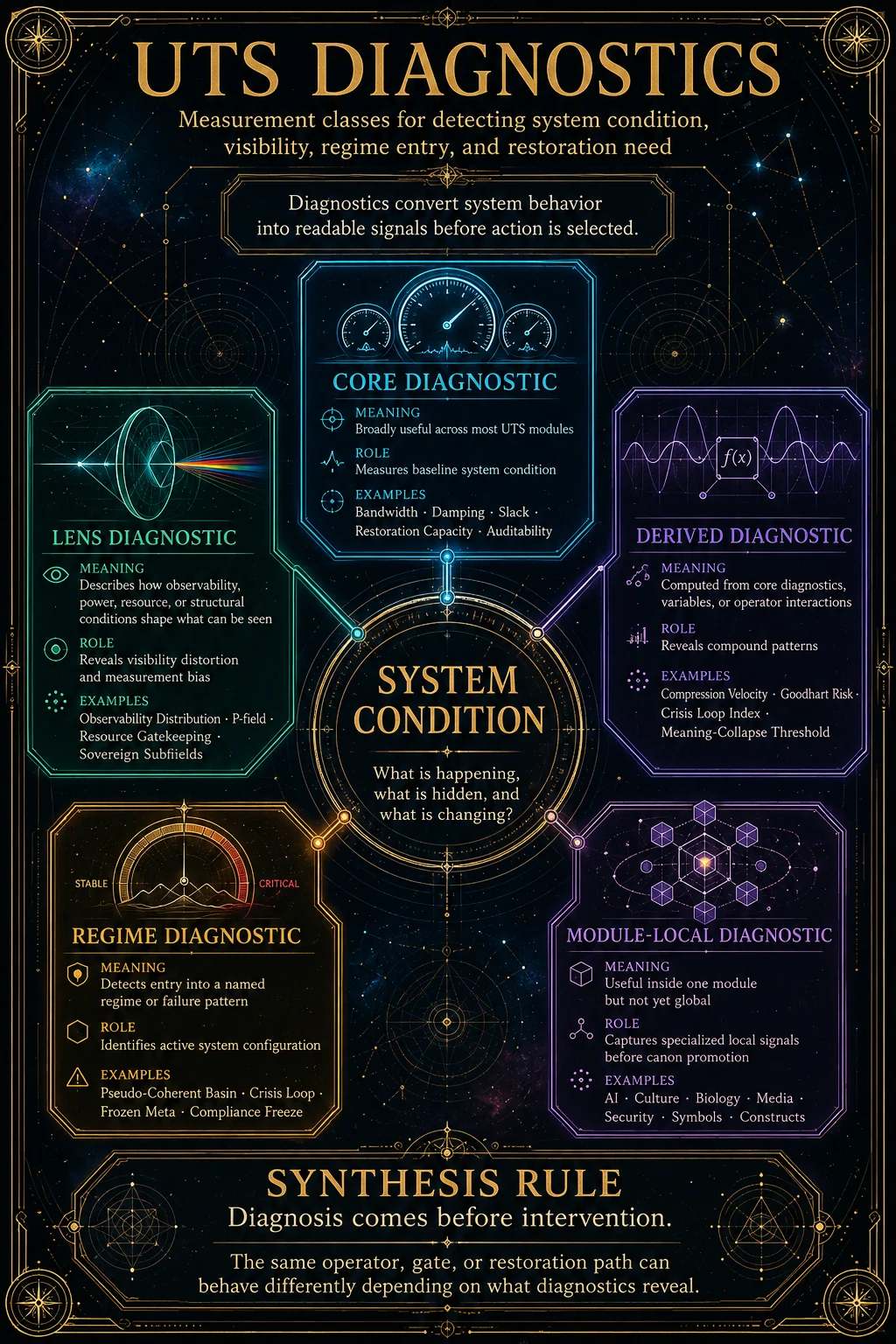
AckDebt measures the unresolved recognition burden remaining when something that must be seen, named, credited, repaired, validated, or integrated has not yet been adequately acknowledged by the system.
- Primary Function
- Estimate the unresolved debt created when a signal, harm, contribution, boundary breach, repair need, truth, effort, loss, cost, or affected-node reality has not been sufficiently acknowledged by the relevant system.
- Short Name / Symbol
- AckDebt
- Canon Tier
- Registry
adaptive_bandwidth measures the system’s usable capacity to change coherently.
- Primary Function
- Estimate how much meaningful change, learning, variation, revision, repair, experimentation, or reconfiguration a system can absorb and integrate without losing coherence, boundary integrity, memory integrity, or operational continuity.
- Short Name / Symbol
- adaptive_bandwidth
- Canon Tier
- Registry
affected_node_cost measures the cost borne by the node most exposed to the consequences of a system action, failure, coupling, classification, constraint, or repair gap.
- Primary Function
- Estimate the total cost carried by the node, person, group, subsystem, institution, field, or layer most affected by a decision, failure, harm, constraint, dependency, classification, repair, or policy.
- Short Name / Symbol
- affected_node_cost
- Canon Tier
- Registry
appeal_access_ratio measures the practical availability and effectiveness of recourse relative to the nodes affected by a decision or classification.
- Primary Function
- Estimate who can meaningfully challenge, appeal, contest, revise, reverse, or request review of a classification, constraint, consequence, denial, repair claim, boundary decision, memory binding, or authority action.
- Short Name / Symbol
- appeal_access_ratio
- Canon Tier
- Registry
attention_capacity measures the usable amount of focused, coherent attention available for reality-contact, signal interpretation, repair, memory, and decision-making.
- Primary Function
- Estimate how much meaningful signal, complexity, responsibility, feedback, memory, risk, context, or environmental change a system can attend to without losing coherence, misclassifying reality, collapsing decision depth, or allowing important signal to disappear.
- Short Name / Symbol
- attention_capacity
- Canon Tier
- Registry
AP(t) measures the intensity and direction of pressure to assign causality, responsibility, blame, credit, authorship, or obligation under conditions of uncertainty, harm, success, conflict, failure, or exposure.
- Primary Function
- Estimate the pressure acting on a system to assign cause, responsibility, blame, credit, intent, or identity to a node, group, structure, event, or abstraction.
- Short Name / Symbol
- AP(t)
- Canon Tier
- Registry
𝓑(t) measures the maximum transition load a system can absorb at time t without crossing into phase shift, boundary failure, restoration saturation, or unacceptable coherence loss.
- Primary Function
- Estimate how much forcing, perturbation, coupling load, constraint pressure, or transition demand a system can absorb within a given time window without regime shift, boundary collapse, restoration saturation, or coherence loss.
- Short Name / Symbol
- 𝓑(t)
- Canon Tier
- Registry
Perm(t) measures the current crossability of a boundary: what can pass through, under what conditions, in which direction, with what filtration, and at what cost.
- Primary Function
- Estimate how easily signals, resources, influence, agents, obligations, pressure, information, identity claims, permissions, or effects cross a boundary.
- Short Name / Symbol
- Perm(t)
- Canon Tier
- Registry
boundary_strain measures the stress load experienced by a boundary relative to its integrity, permeability, auditability, compatibility, and restoration capacity.
- Primary Function
- Estimate the stress placed on a boundary, interface, role, identity field, permission layer, consent structure, access rule, or invariant edge under load, coupling, pressure, ambiguity, or repeated crossing.
- Short Name / Symbol
- boundary_strain
- Canon Tier
- Registry
classification_reversibility measures how easily and completely a system can revise or undo a classification after evidence, context, localization, or meaning changes.
- Primary Function
- Estimate whether a classification, label, category, interpretation, status, diagnosis, attribution, or system conclusion can be corrected, softened, removed, downgraded, appealed, or recontextualized after new evidence appears.
- Short Name / Symbol
- classification_reversibility
- Canon Tier
- Registry
coercive_fusion_risk measures whether coupling is eroding the distinction, agency, boundary, or repair sovereignty of one or more nodes.
- Primary Function
- Estimate the risk that two or more nodes, systems, identities, roles, institutions, tools, fields, or memory structures become fused in a way that erodes boundary integrity, refusal capacity, exit capacity, truth access, or independent repair.
- Short Name / Symbol
- coercive_fusion_risk
- Canon Tier
- Registry
Cv(t) measures the rate at which a system’s effective possibility space contracts under pressure.
- Primary Function
- Estimate how quickly a system’s decision depth, interpretive range, optionality, auditability, expression bandwidth, or admissible action space is contracting under pressure.
- Short Name / Symbol
- Cv(t)
- Canon Tier
- Registry
confidence/evidence ratio measures whether a system’s level of certainty is proportional to the quality, quantity, relevance, localization, and auditability of its evidence.
- Primary Function
- Estimate whether the system’s expressed confidence, certainty, classification strength, attribution strength, or action commitment is proportional to the evidence actually available.
- Short Name / Symbol
- confidence/evidence ratio
- Canon Tier
- Registry
X_c(t) measures the complexity burden imposed by the system’s active constraint architecture relative to its auditability, restoration capacity, coordination capacity, and interpretive depth.
- Primary Function
- Estimate the total complexity load created by constraints, rules, permissions, exceptions, procedures, policies, boundaries, dependencies, and enforcement pathways within a system.
- Short Name / Symbol
- X_c(t)
- Canon Tier
- Registry
constraint_elasticity measures the adaptive range of a constraint before it either breaks, hardens, becomes meaningless, or begins generating hidden debt.
- Primary Function
- Estimate whether a constraint, rule, boundary, permission structure, policy, protocol, or invariant-supporting mechanism can bend, adapt, absorb pressure, and recover without breaking, becoming meaningless, or producing hidden debt.
- Short Name / Symbol
- constraint_elasticity
- Canon Tier
- Registry
coordination_overhead measures the burden required to align multiple nodes so that action can occur coherently.
- Primary Function
- Estimate the amount of time, attention, communication, sequencing, negotiation, synchronization, review, translation, handoff, and management required for a system to coordinate action across nodes, roles, layers, tools, or domains.
- Short Name / Symbol
- coordination_overhead
- Canon Tier
- Registry
coupling_propagation_risk measures the probability and severity that a disturbance, debt, distortion, or failure mode will travel through a coupling and affect another node or layer.
- Primary Function
- Estimate the risk that error, hidden debt, instability, distortion, pressure, memory contamination, boundary strain, resource depletion, or regime behavior will travel through a coupling from one node, layer, subsystem, agent, institution, or field into another.
- Short Name / Symbol
- coupling_propagation_risk
- Canon Tier
- Registry
crisis_loop_index measures the degree to which a system repeatedly returns to crisis because prior disturbances were stabilized but not structurally repaired.
- Primary Function
- Estimate whether a system is caught in a recurring crisis pattern where failures, stressors, hidden debt, repair gaps, poor memory, and delayed response repeatedly regenerate the same emergency state.
- Short Name / Symbol
- crisis_loop_index
- Canon Tier
- Registry
𝓓(t) measures the rate and quality by which disturbance energy decays after perturbation, revealing whether the system settles into restored coherence or continues ringing through recurrence, oscillation, escalation, or hidden-debt transfer.
- Primary Function
- Estimate whether perturbations decay, settle, persist, propagate, or amplify after entering the system.
- Short Name / Symbol
- 𝓓(t)
- Canon Tier
- Registry
dependency_load measures the amount of reliance burden created by a coupling relative to the system’s compatibility, boundary integrity, restoration capacity, exit capacity, and ability to remain coherent if the dependency changes or fails.
- Primary Function
- Estimate the reliance burden created when one node, system, process, agent, institution, tool, relationship, resource, metric, memory, or boundary condition depends on another for function, repair, coherence, access, identity, continuity, or survival.
- Short Name / Symbol
- dependency_load
- Canon Tier
- Registry
Au_eff measures the usable auditability available to reconstruct causality, inspect decision pathways, verify system state, identify hidden debt, evaluate repair, and support correction under real operating conditions.
- Primary Function
- Estimate how much usable traceability is actually available for a specific decision, transition, disturbance, classification, repair pathway, or system state.
- Short Name / Symbol
- Au_eff
- Canon Tier
- Registry
R_eff measures the usable restoration throughput available to repair a specific failure or transition at the required U-layer, within the required time window, with sufficient auditability, resources, authority, and memory integration to reduce recurrence.
- Primary Function
- Estimate how much usable repair, correction, re-alignment, and recurrence-resolution capacity is actually available for a specific failure, transition, layer, or system state.
- Short Name / Symbol
- R_eff
- Canon Tier
- Registry
exception_rate measures the frequency, distribution, and pattern of deviations from ordinary constraint application.
- Primary Function
- Estimate how often a system bypasses, modifies, suspends, appeals, overrides, reinterprets, or creates special handling around its ordinary rules, constraints, procedures, boundaries, classifications, or protocols.
- Short Name / Symbol
- exception_rate
- Canon Tier
- Registry
exit_cost measures the burden required to coherently reduce or end a coupling.
- Primary Function
- Estimate the cost required for a node, system, agent, institution, relation, process, tool, or subfield to reduce, leave, decouple from, or terminate a coupling while preserving coherence, safety, memory integrity, and repairability.
- Short Name / Symbol
- exit_cost
- Canon Tier
- Registry
EB measures the available channel capacity for meaningful expression to appear, move, and retain fidelity across an interface or system.
- Primary Function
- Estimate how much signal, meaning, dissent, truth, creativity, feedback, nuance, repair request, or weak signal can be expressed through a system without distortion, suppression, overload, punishment, or loss of fidelity.
- Short Name / Symbol
- EB
- Canon Tier
- Registry
feedback_action_ratio measures the conversion rate between feedback received and coherent action taken.
- Primary Function
- Estimate how much feedback, signal, complaint, contradiction, report, audit finding, affected-node input, or review result is converted into actual system change, repair, correction, memory update, or constraint adjustment.
- Short Name / Symbol
- feedback_action_ratio
- Canon Tier
- Registry
FI_integrity measures whether feedback can actually falsify, correct, redirect, or update the system rather than being filtered, absorbed, ignored, punished, gamed, or converted into confirmation.
- Primary Function
- Estimate whether feedback can accurately enter the system, remain connected to reality, challenge preferred outcomes, alter behavior, update memory, and trigger correction.
- Short Name / Symbol
- FI_integrity
- Canon Tier
- Registry
Goodhart_risk measures the likelihood that a proxy becomes a target and then stops faithfully representing the underlying coherence condition it was meant to measure.
- Primary Function
- Estimate the risk that a proxy, metric, target, reward signal, score, KPI, benchmark, classification, narrative, or optimization objective will detach from the real coherence it was meant to represent.
- Short Name / Symbol
- Goodhart_risk
- Canon Tier
- Registry
HR_integrity measures whether the HR-Gate is correctly regulating the transition from signal → interpretation → classification → identity-binding consequence.
- Primary Function
- Estimate whether the system is correctly blocking weak, noisy, mislocalized, overconfident, or context-poor signal from becoming identity-bound classification, durable memory, hard attribution, irreversible constraint, or high-consequence action.
- Short Name / Symbol
- HR_integrity
- Canon Tier
- Registry
immunity_index measures how protected a node or structure is from ordinary correction pathways relative to its influence, authority, consequence, and capacity to generate hidden debt.
- Primary Function
- Estimate the degree to which a node, role, class, institution, subsystem, metric, narrative, status, or authority position is insulated from ordinary feedback, audit, consequence, correction, review, repair obligation, or constraint.
- Short Name / Symbol
- immunity_index
- Canon Tier
- Registry
innovation_exit measures the rate and significance of adaptive possibilities leaving the system before they can be evaluated, integrated, or preserved.
- Primary Function
- Estimate whether high-value alternatives, creative pathways, dissenting insights, experimental methods, local adaptations, edge-case knowledge, or future-relevant innovations are leaving the system instead of being integrated, tested, remembered, or repaired into usable form.
- Short Name / Symbol
- innovation_exit
- Canon Tier
- Registry
LOS measures the hidden operating system beneath the formal operating system.
- Primary Function
- Estimate the degree to which real system behavior is being governed by hidden, informal, undocumented, unofficial, inherited, workaround-based, relationship-based, exception-based, or unacknowledged structures rather than the formal structure the system claims to operate through.
- Short Name / Symbol
- LOS
- Canon Tier
- Registry
L₀(t) measures the pre-action legitimacy floor a system is standing on before it asks others to trust, comply, wait, accept repair, accept classification, accept constraint, or continue coupling.
- Primary Function
- Estimate the baseline level of trust, consent, recognition, and confidence a system has before a specific action, claim, repair, decision, constraint, or authority exercise occurs.
- Short Name / Symbol
- L₀(t)
- Canon Tier
- Registry
legitimacy_shock_risk measures the probability and severity of sudden legitimacy loss after a hidden or under-acknowledged contradiction becomes visible.
- Primary Function
- Estimate the risk that a system’s perceived legitimacy will rapidly collapse after hidden debt, asymmetry, false narrative, failed repair, unacknowledged harm, protected immunity, or contradiction becomes visible.
- Short Name / Symbol
- legitimacy_shock_risk
- Canon Tier
- Registry
Lτ measures the usable operational throughput available to move necessary resources, materials, information, decisions, tasks, repairs, people, energy, money, compute, permissions, or administrative actions through the system within the required time window.
- Primary Function
- Estimate how much necessary material, administrative, operational, informational, financial, energetic, or procedural flow can actually move through a system per unit time.
- Short Name / Symbol
- Lτ
- Canon Tier
- Registry
M* marks the threshold where meaning degradation becomes severe enough that a system can no longer reliably use its interpretive structures to coordinate, repair, decide, remember, or maintain coherence.
- Primary Function
- Estimate the threshold at which a system’s shared meanings, classifications, signals, roles, narratives, symbols, principles, or interpretive structures lose enough coherence that coordination, repair, trust, identity continuity, or action selection begins to fail.
- Short Name / Symbol
- M*
- Canon Tier
- Registry
memory_binding_risk measures the likelihood that a signal, interpretation, classification, or repair claim will become durable memory before it is sufficiently verified, localized, scoped, reversible, and source-linked.
- Primary Function
- Estimate the risk that weak, provisional, distorted, mislocalized, overconfident, or incomplete signal becomes durable memory.
- Short Name / Symbol
- memory_binding_risk
- Canon Tier
- Registry
τ_m(t) measures the persistence duration of a correction, learning, boundary, classification, or repair pattern before it decays enough for recurrence risk to rise again.
- Primary Function
- Estimate how long a system retains a correction, lesson, boundary update, classification revision, repair, or coherence-improving pattern before it decays, weakens, or reverts.
- Short Name / Symbol
- τ_m(t)
- Canon Tier
- Registry
M_int(t) measures the coherence, accuracy, provenance, and operational usability of a system’s memory over time.
- Primary Function
- Estimate whether a system’s memory is accurate, coherent, source-linked, non-contaminated, and usable for future correction, classification, boundary maintenance, and operator sequencing.
- Short Name / Symbol
- M_int(t)
- Canon Tier
- Registry
MS_index measures whether comparable cases are treated comparably at the meta-level of rule, evidence, consequence, burden, repair, and review.
- Primary Function
- Estimate whether equivalent actions, effects, risks, evidence, burdens, privileges, violations, repairs, or contributions receive equivalent classification, consequence, review, and restoration across nodes, ranks, roles, groups, or system positions.
- Short Name / Symbol
- MS_index
- Canon Tier
- Registry
mission_lock_risk measures the likelihood that a mission or trajectory has become more protected than the coherence it was meant to serve.
- Primary Function
- Estimate the risk that a mission, goal, trajectory, mandate, identity, project, strategy, ideology, roadmap, or optimization path becomes so protected that feedback, truth, repair, boundary signals, affected-node cost, or better alternatives can no longer redirect it.
- Short Name / Symbol
- mission_lock_risk
- Canon Tier
- Registry
narrative_metric_gap measures the distance between what the system says is happening and what the evidence shows is happening.
- Primary Function
- Estimate the divergence between the story a system tells about its condition, success, repair, legitimacy, or trajectory and the actual metric, outcome, recurrence, affected-node, and coherence evidence available.
- Short Name / Symbol
- narrative_metric_gap
- Canon Tier
- Registry
Φ − O measures the divergence between a system’s fitness proxy and its actual coherence condition.
- Primary Function
- Estimate the degree to which measured success, optimization targets, or declared performance diverge from actual coherence.
- Short Name / Symbol
- Φ − O
- Canon Tier
- Registry
pseudo_damping_risk measures the likelihood that apparent reduction in visible disturbance is not true damping, but suppression, displacement, absorption, or hidden-debt transfer.
- Primary Function
- Estimate the risk that apparent settling, calm, compliance, silence, metric recovery, or visible stabilization is being mistaken for real damping, restoration, or coherence recovery.
- Short Name / Symbol
- pseudo_damping_risk
- Canon Tier
- Registry
rank_threshold_gap measures the difference in thresholds applied to comparable cases across rank, role, or status positions.
- Primary Function
- Estimate whether evidence, consequence, accountability, repair, appeal, exception, or classification thresholds change according to rank, role, status, authority, visibility, proximity to power, or institutional position.
- Short Name / Symbol
- rank_threshold_gap
- Canon Tier
- Registry
τ_resp(t) measures the time delay between a relevant signal, disturbance, error, boundary strain, or coherence threat and the system’s effective response at the required U-layer.
- Primary Function
- Estimate the delay between signal emergence and effective system response.
- Short Name / Symbol
- τ_resp(t)
- Canon Tier
- Registry
K_real measures whether coupling actually raises coherence for the involved systems without eroding BΣ, exhausting R, hiding H, inflating Φ, or forcing one node to subsidize the other’s stability.
- Primary Function
- Estimate whether a coupling, interaction, relation, integration, dependency, interface, alliance, architecture, or composition actually increases mutual coherence while preserving boundary integrity and restoration capacity.
- Short Name / Symbol
- K_real
- Canon Tier
- Registry
recovery_asymmetry measures the imbalance between the rate, ease, or magnitude of degradation and the rate, ease, or magnitude of repair.
- Primary Function
- Estimate whether damage, degradation, hidden debt, boundary strain, trust loss, or coherence loss accumulates faster than the system can repair, restore, integrate, or recover.
- Short Name / Symbol
- recovery_asymmetry
- Canon Tier
- Registry
rejected_option_quality measures the latent or actual value of options that were excluded by selection.
- Primary Function
- Estimate the coherence value, future relevance, repair potential, adaptive usefulness, or hidden quality of options rejected by a system during selection, filtering, optimization, standardization, canonization, or decision closure.
- Short Name / Symbol
- rejected_option_quality
- Canon Tier
- Registry
repair_burden_distribution measures who is actually carrying the work, cost, risk, responsibility, and memory load of restoration.
- Primary Function
- Estimate how repair responsibility, labor, cost, attention, time, risk, emotional load, technical correction, acknowledgment, memory correction, and restoration effort are distributed across nodes, roles, systems, institutions, or subfields.
- Short Name / Symbol
- repair_burden_distribution
- Canon Tier
- Registry
resource_asymmetry measures the imbalance between nodes in the resources required to act, refuse, repair, sustain, exit, contest, absorb stress, or influence outcomes.
- Primary Function
- Estimate the imbalance in available resources, capacity, leverage, access, repair capability, time, energy, money, compute, attention, authority, or operational support between coupled nodes, roles, institutions, systems, or subfields.
- Short Name / Symbol
- resource_asymmetry
- Canon Tier
- Registry
review_capacity measures the system’s usable ability to evaluate decisions and signals before, during, and after consequence.
- Primary Function
- Estimate whether a system has enough capacity to inspect, evaluate, compare, contest, verify, revise, and approve decisions, classifications, repairs, exceptions, appeals, memories, metrics, or actions before they become consequential.
- Short Name / Symbol
- review_capacity
- Canon Tier
- Registry
selection_traceability measures whether a selection pathway remains reconstructible after the decision is made.
- Primary Function
- Estimate whether a system can reconstruct why a selection was made, what alternatives were considered, what criteria were used, what evidence supported the choice, what tradeoffs were accepted, and what risks were deferred.
- Short Name / Symbol
- selection_traceability
- Canon Tier
- Registry
signal_localization_quality measures how accurately a signal is mapped to the place, layer, source, timescale, interface, or causal pathway from which it actually arises.
- Primary Function
- Estimate whether a signal has been mapped to the correct source, node, boundary, subsystem, U-layer, cause, timescale, or coupling pathway.
- Short Name / Symbol
- signal_localization_quality
- Canon Tier
- Registry
signal_quality measures how clean, reliable, complete, coherent, and usable a signal is as input for interpretation, classification, decision, repair, or memory.
- Primary Function
- Estimate the cleanliness, fidelity, reliability, strength, completeness, and interpretive usability of a signal before it is classified, acted upon, stored, amplified, or used for repair.
- Short Name / Symbol
- signal_quality
- Canon Tier
- Registry
σ(t) measures the available margin between current load and forced degradation: the unused buffer a system can spend before errors, constraints, debt, boundary strain, or restoration demand exceed safe tolerance.
- Primary Function
- Estimate the available buffer, margin, optionality, and uncommitted capacity a system has before pressure forces degradation, overreaction, brittleness, or collapse.
- Short Name / Symbol
- σ(t)
- Canon Tier
- Registry
stress_divergence measures the difference between baseline system behavior and stressed system behavior.
- Primary Function
- Estimate the gap between how a system performs under ordinary conditions and how it performs under stress, disturbance, adversarial pressure, scarcity, uncertainty, scale, coupling load, or external forcing.
- Short Name / Symbol
- stress_divergence
- Canon Tier
- Registry
taboo_lock_risk measures whether a protected meaning, claim, structure, or domain can still be examined without triggering suppression, punishment, distortion, or collapse.
- Primary Function
- Estimate the risk that a claim, value, term, topic, metric, mission, identity, authority, principle, memory, narrative, or boundary condition has become protected from questioning, audit, comparison, revision, or falsification.
- Short Name / Symbol
- taboo_lock_risk
- Canon Tier
- Registry
truth_tolerance measures the system’s capacity to remain coherent when reality-contact increases.
- Primary Function
- Estimate whether a system, relation, institution, interface, or coupling can preserve coherence while accurate but difficult reality is named.
- Short Name / Symbol
- truth_tolerance
- Canon Tier
- Registry
variance_preserved measures how much useful adaptive variation remains after a system selects, filters, constrains, optimizes, standardizes, scales, or compresses.
- Primary Function
- Estimate whether a system preserves enough meaningful variation, optionality, alternative pathways, dissent, experimentation, local adaptation, or adaptive diversity after selection, constraint, optimization, filtering, scaling, or standardization.
- Short Name / Symbol
- variance_preserved
- Canon Tier
- Registry