Foundational Overview
What Failure Modes Are, Why They Matter, and How They Fit Into UTS
0. Purpose
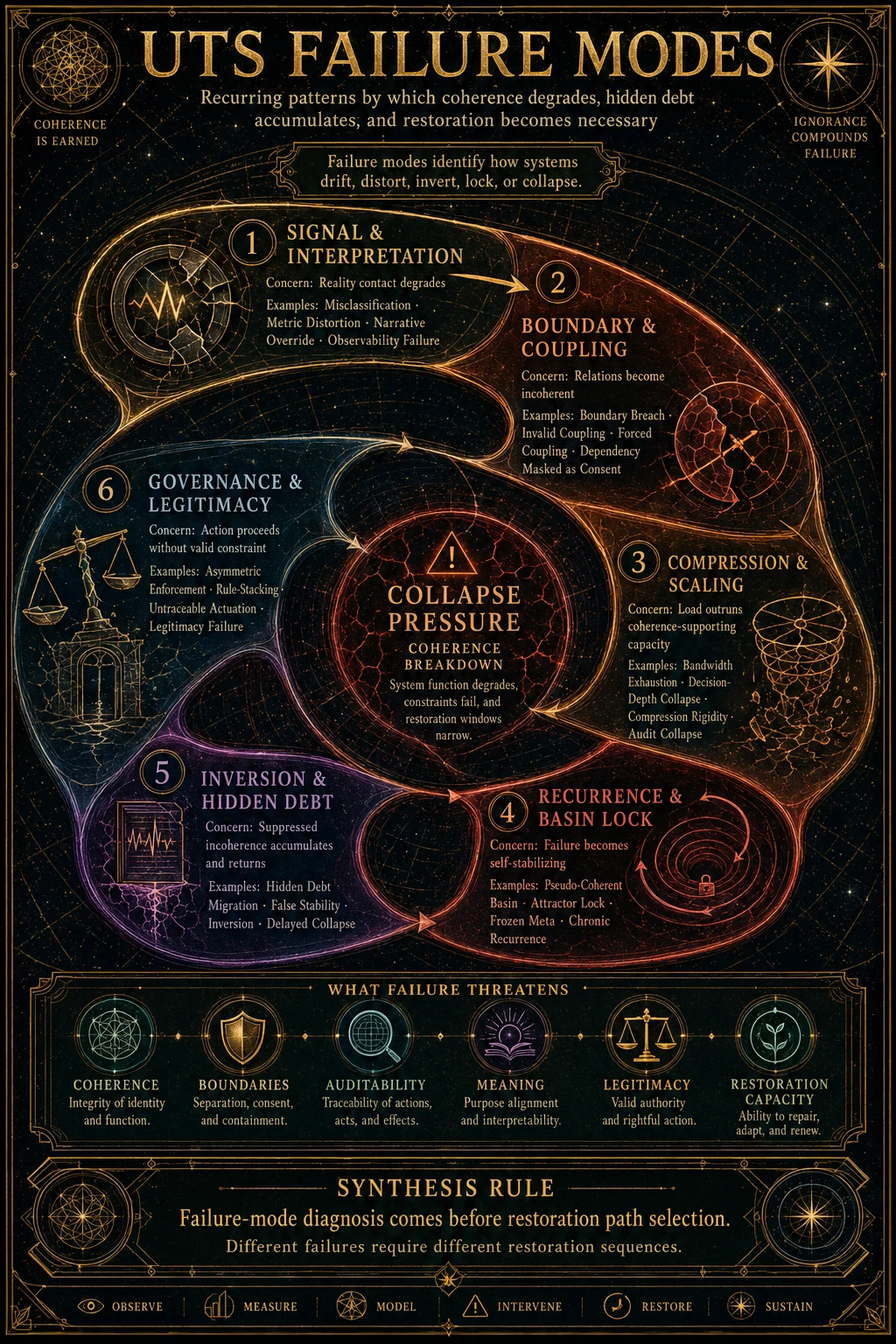
TheUTS Failure Modes Registryis a canon module for identifying how systems lose coherence.
It gives the Universal Theory Stack a shared diagnostic language for recognizing breakdown patterns across:
- individuals and interactions
- organizations and institutions
- AI systems and security systems
- biology, chemistry, and materials
- justice, contracts, governance, and civilization-scale interfaces
A failure mode is not a villain, a moral label, or a prediction of doom. It is arepeatable structural patternwhere a system begins moving away from coherence unless repair occurs.
The current registry has grown into a broad diagnostic lattice covering scaling, interactions, meta-theory, false repair, obfuscation, cybernetics, chemistry, materials, justice, contracts, security, and civilization interfaces. The expansion synthesis describes these families as covering the lifecycle of breakdown: damage creation, amplification, misdiagnosis, false healing, obfuscation, and control failure.
1. What Is a Failure Mode?
Afailure modeis a recognizable configuration of operators, variables, diagnostics, gates, and U-layers that causes a system to degrade.
In UTS terms, a failure mode is present when one or more of the following trajectories persist:
O ↓       coherence decreases
H ↑       hidden debt accumulates
R ↓       restoration capacity weakens
Au ↓      auditability collapses
BΣ ↓      boundaries degrade
Φ ≠ O     performance proxy diverges from real coherence
ι ↑       pseudo-coherence / inversion rises
A simple formal version is:
Failure Mode = repeatable pattern where:
dO/dt < 0
or H(t) accumulates
or R_eff / Load decreases
or Shock > 𝓑(t)
The key distinction:
Failure is not the same as collapse.Failure is the trajectory toward collapse unless corrected.
Collapse is often the final visible event. The failure mode usually began much earlier.
2. Why UTS Maps Failure Modes
Failure modes are mapped because systems often failbefore they look broken.
A system can appear successful while degrading internally:
Φ↑ + H↑ + Au↓ → false stabilityThis means:
- dashboards may look good while coherence declines
- rules may appear strong while brittleness increases
- repair may appear active while hidden debt grows
- optimization may improve metrics while damaging the system
- control may suppress error while accumulating future collapse pressure
Failure-mode mapping helps detect these patternsbefore the final rupture.
The registry’s core value is that it lets us ask:
What is actually degrading?
Where is it localized?
Which gate failed first?
Which operator is being misused?
What repair sequence is required?
3. Failure Modes Are Mechanical, Not Moral
A central UTS rule is:
Failure modes describe mechanics, not villains.
A system can enter a failure mode through:
- good intentions
- bad incentives
- missing feedback
- excessive speed
- poor timing
- hidden assumptions
- unscaled repair
- unclear boundaries
- incompatible coupling
- excessive optimization
The registry avoids reducing failure to blame. Blame may matter in justice contexts, but the diagnostic question comes first:
What operator pattern produced this outcome?This keeps the system non-reductive and repair-oriented.
4. How Failure Modes Relate to the UTS State Vector
All failure modes act on the canonical UTS state vector:
S = { O, H, ε, ι, Au, µᵢ, BΣ, K, R, Φ }Each failure mode identifies which variables move and how.
Core variables in failure analysis
O — Coherence
Whether the system preserves identity, meaning, and functional integrity across time under transformation.
H — Hidden Debt
Unresolved cost, suppressed incoherence, deferred repair, or latent instability.
ε — Error / Noise
Observable deviation from expected behavior.
ι — Inversion Index
Apparent order without real harmonic fit.
Au — Auditability
The ability to inspect causes, decisions, state, and consequences.
µᵢ — Agent Integrity
Consistency between model, action, and consequence.
BΣ — Boundary Integrity
Preservation of consent, scope, identity, and interface clarity.
K — Compatibility
Whether coupling increases coherence rather than degrading it.
R — Restoration Capacity
The system’s throughput for repair, correction, and realignment.
Φ — Fitness Proxy
Measured success signal, distinct from real coherence.
Most failure modes involve a characteristic drift pattern, for example:
Φ↑ while O↓
H↑ while ε remains low
Au↓ while control claims increase
BΣ↓ while consent is claimed
R↓ while load increases
These are the signatures the registry teaches readers to recognize.
5. How Failure Modes Relate to Operators
Failure modes are not new operators. They areoperator compositions gone unstable.
The same operator can be coherence-increasing or destabilizing depending on conditions.
Examples:
⊗ without Λ → overcoupling
⊕ without Δ + ℛ → premature merger
Π without elasticity → brittleness
Γ under Φ pressure → Goodhart collapse
Δ without ℛ → distortion poisoning
Μ without Θ → narrative overconfidence
ℛ without Au → false repair
Σ without MS-Gate → sacred immunity
The registry maps these recurring configurations so they can be recognized and repaired.
6. How Failure Modes Relate to U-Layers
UTS uses U-layers to localize where a failure originates and where it becomes visible:
| Layer | Meaning |
|---|---|
| U0 | Substrate / physical material limits |
| U1 | Power, budgets, energy, time, compute |
| U2 | Configuration, permissions, gates, boundaries |
| U3 | Execution, runtime behavior, actuation |
| U4 | Classification, models, metrics, narratives |
| U5 | Coordination, timing, sequencing, protocols |
| U6 | Coherence field, cross-domain coupling |
| U7 | Memory, recurrence, hysteresis, persistence |
| U8 | Environment, external forcing, shocks |
A major UTS rule:
Repair must occur at the same or lower layer than the failure origin.
A U6 coherence failure cannot be fully repaired with only U3 execution changes.
A U2 boundary failure cannot be repaired by U4 narrative reframing.
A U7 memory failure cannot be repaired by a one-time U4 announcement.
This is why failure-mode mapping always asks:
Where did the failure originate?
Where did it manifest?
Where must repair occur?
7. Why Diagnostics Matter: 𝓑 and 𝓓
Two diagnostics are especially important:
𝓑(t) = Bandwidth
𝓓(t) = Damping
𝓑(t), Bandwidth
How much forcing the system can absorb before regime shift.
𝓓(t), Damping
How quickly disturbance settles after perturbation.
Many failures happen when systems confuse apparent capacity with real capacity:
Shock > 𝓑(t) → regime shift likely
𝓓(t) low → oscillations do not settle
This explains why “just push harder” often worsens collapse. If bandwidth is exhausted or damping is low, more force increases hidden debt.
8. Why Gates Matter
Failure modes often begin withgate failure.
Important gates include:
- FI-Gate— feedback integrity / anti-Goodhart
- HR-Gate— humility under uncertainty / anti-identity certainty
- MS-Gate— symmetry / no rank immunity
- Au-Actuation— minimum traceability before action
- Σ constraints— non-negotiable invariants
A gate failure means an action may proceed visibly while failing coherently.
Examples:
FI-Gate failure → metrics replace reality
MS-Gate failure → selective enforcement
Au-Actuation failure → opaque control
HR-Gate failure → urgency replaces causality
Σ failure → forbidden paths normalize
The registry treats gate failure as an early warning signal, not an afterthought.
9. Major Failure Mode Families
The registry is organized into families so readers can navigate the system.
FM-S — Scaling Failure Modes
How systems fail when scale, speed, power, or coupling grows faster than coherence and repair.
Examples:
- Paper Coherence Collapse
- Overcoupling Meltdown
- Restoration Starvation
- Meaning Collapse
- Terminal Scaling Failure
FM-ISC — Interaction / Signal / Coupling Failure Modes
How signals are misread, boundaries drift, and interactions destabilize.
Examples:
- Identity-Binding Signal Capture
- Coupling Without Compatibility
- Consent Drift
- Force Masked as Care
FM-MT — Meta-Theory Failure Modes
How analysis itself fails through overreach, narrative substitution, ideology drift, or misuse of abstraction.
Examples:
- Totalizing Meta Collapse
- Narrative Substitution
- Single-Variable Obsession
- Weaponized Insight
FM-REI — Reduction / Extraction / Inversion
How modern science, business, and institutional metas create damage through improper reduction, unbounded extraction, and functional inversion.
Examples:
- Improper Reduction
- Unbounded Extraction
- Functional Inversion
- Sensemaking Subordination
FM-R — False Repair
How apparent healing, fixing, or stabilizing increases hidden debt.
Examples:
- Cosmetic Restoration
- Process Inflation
- Repair Burden Externalization
- Infinite Repair Loop
FM-OMD — Obfuscated Meta Dynamics
How suppressed visibility and delayed feedback allow hidden debt to compound under apparent success.
Examples:
- Hidden Debt Accretion Loop
- Audit Collapse Cascade
- Myth-Locked Internal Narrative
- Restoration Bottleneck Collapse
FM-C — Cybernetics
How feedback, control, damping, measurement, topology, and exit dynamics fail.
Examples:
- Observability Collapse
- Latency Blindness
- Goodhart Collapse
- Measurement Back-Action Loop
- Dominance Masquerading as Control
FM-CH / FM-M — Chemistry and Materials
Physical-domain realizations of universal failure mechanics.
Examples:
- Metastable Trap
- Reaction Runaway
- Hidden Fatigue Accumulation
- Interface Collapse
- Diagnostic Blindness
FM-CIF — Civilization Interface Failures
How asymmetric interfaces fail when one actor mediates on behalf of a larger collective.
Examples:
- Unilateral Interface Capture
- Attribution Hijack
- Awareness Radius Suppression
- Species-Level Σ Violation
FM-JC — Justice & Contracts
How justice and contracts fail through boundary erosion, audit collapse, coercive persistence, and blocked restoration.
Examples:
- Procedural Theater
- Selective Enforcement
- Manufactured Consent
- Parasitic Contracting
FM-SEC — Security
How protection systems fail through gate collapse, audit suppression, proxy abuse, over-surveillance, and representation failures.
Examples:
- Security Theater
- Audit Suppression Inversion
- Consent Theater
- Silent Extraction
- Shadow Capture
10. Why Mapping Failure Modes Is Useful
Failure-mode mapping helps with five core tasks.
1. Early detection
It identifies failure before visible collapse.
H↑ while Φ stable → inspect hidden debt
Au↓ while control claims rise → inspect obfuscation
2. Better diagnosis
It separates symptoms from mechanisms.
Repeated crisis is not the root.
Low 𝓓, delayed ℛ, and excessive gain may be the root.
3. Repair sequencing
It clarifies what must be repaired first.
Restore Au before optimizing Φ.
Restore gates before scaling.
Restore ℛ before adding Δ.
4. Cross-domain transfer
A pattern found in chemistry can illuminate AI, institutions, biology, or governance.
Example:
Metastable trap in chemistry
→ paper coherence in institutions
→ false alignment in AI systems
5. Non-moral clarity
It allows critique without collapse into blame narratives.
This is not “bad people.”
This is ⊗ without Λ, Φ without FI-Gate, and ℛ below load.
11. Failure Dynamics Calculus
The registry can be compressed into a simple diagnostic notation.
Examples:
Φ↑ ∧ Au↓ ∧ H↑ ⇒ Ξ-dominant regimeLoad × Gain_stack > R_eff ⇒ collapse amplifiesX_c > Au_eff ⇒ H↑Shock > 𝓑(t) ⇒ regime shift likelyℛ_claimed↑ ∧ H↑ ∧ R_eff≤0 ⇒ false repairThis notation is not a predictive engine. It is a compact way to record failure dynamics.
12. The Core Anti-Failure Rules
Several rules recur across the entire registry:
No ⊗ without Λ.
No ⊕ without Δ + ℛ.
No scaling step without checking 𝓑 and 𝓓.
No power increase without proportional meaning and repair.
No repair claim without measurable H reduction.
No actuation without Au.
No interface representation without revocable consent.
These are not moral slogans. They are structural constraints.
13. The Role of Restoration
The registry repeatedly shows one central pattern:
ℛ is not overhead. ℛ is structural capacity.
Systems often treat repair as inefficiency. In UTS, this is itself a failure trajectory.
If repair does not scale with load, gain, complexity, and coupling, hidden debt accumulates:
Load × Gain_stack > R_eff → H↑ → O↓Restoration is what allows systems to remain coherent under transformation.
14. What the Failure Modes Registry Is Not
The registry is not:
- a moral accusation system
- a deterministic prediction engine
- a replacement for domain expertise
- a list of “bad actors”
- a reason to collapse all domains into one explanation
It is adiagnostic grammar.
It helps readers ask better questions:
What is failing?
Where is it failing?
Which gate broke?
Which operator pattern is active?
What repair sequence restores coherence?
15. Closing Summary
The UTS Failure Modes Registry exists because complex systems rarely fail randomly. They tend to fail through recognizable patterns:
- coupling without compatibility
- scaling without repair
- metrics without coherence
- boundaries without consent
- control without observability
- optimization without meaning
- repair without hidden debt reduction
By naming these patterns, UTS makes them visible.
By mapping them to operators, variables, gates, diagnostics, and U-layers, UTS makes them actionable.
And by keeping the language non-moral and non-reductive, UTS preserves the possibility of repair.
Failure modes are the grammar of incoherence.Mapping them is how a system learns where restoration must begin.