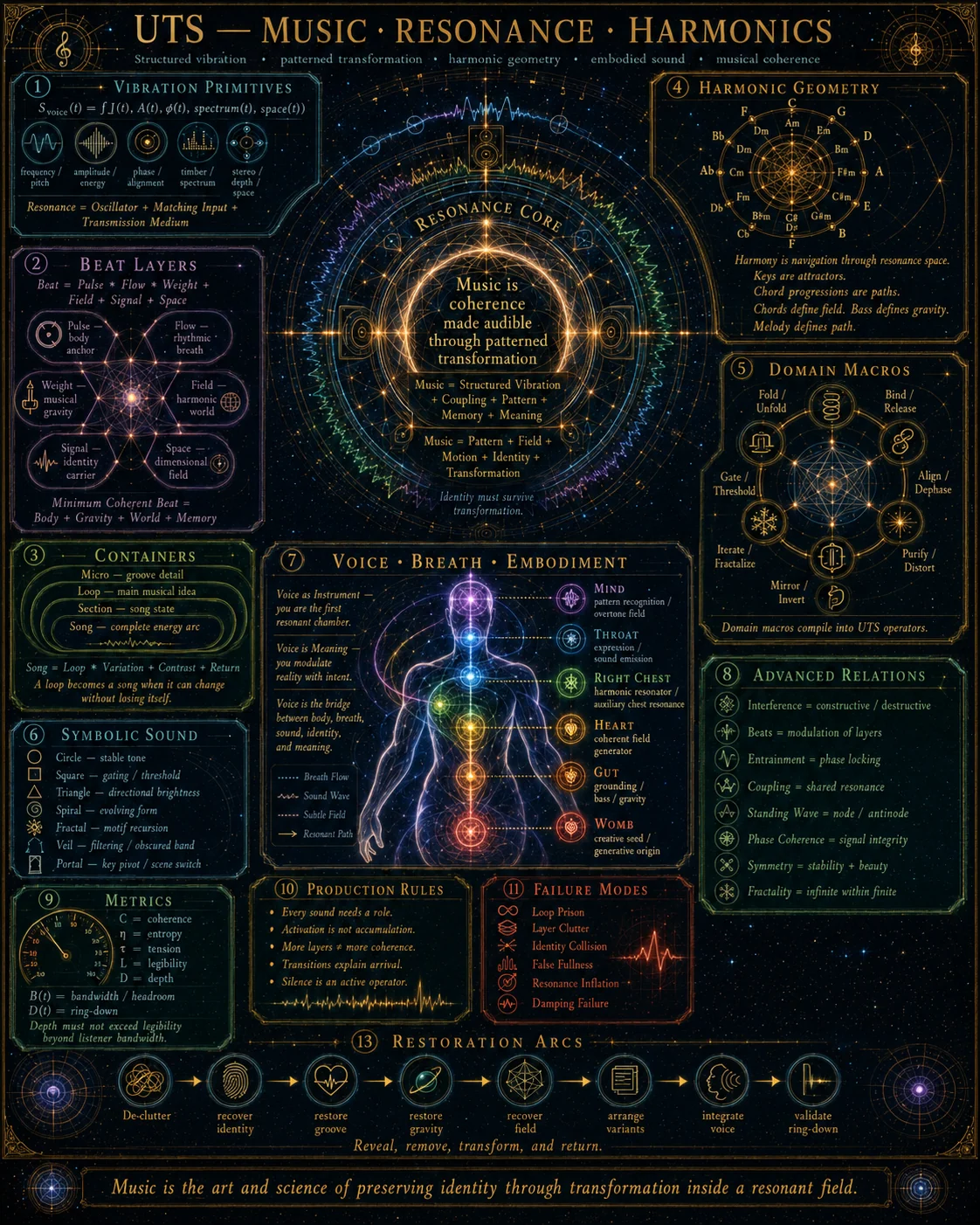
Introduction
Music is one of the clearest ways to experience coherence directly.
Before music is theory, before it is performance, before it is emotion or style, it is vibration organized into pattern. A string vibrates. A drumhead moves air. A voice carries breath into tone. A rhythm repeats. A chord creates a field. A melody moves through that field and leaves a trace in memory.
That is why music fits so naturally into Universal Theory Stack.
UTS studies how systems preserve identity, meaning, and functional integrity through transformation. Music does this constantly. A song begins with a pattern, changes over time, moves through tension and release, adds and removes layers, shifts energy, returns to motifs, and still remains itself. When that process works, we feel coherence. When it fails, the song may feel cluttered, flat, disjointed, overbuilt, emotionally empty, or unable to resolve.
In this sense, music is not only an art form. It is a living demonstration of UTS mechanics.
Music is coherence made audible through patterned transformation.1. Music as Structured Vibration
At the most basic level, music begins with vibration.
A tone is a vibration organized around frequency. Rhythm is vibration organized across time. Harmony is the relationship between multiple tones. Timbre is the shape and texture of a sound. Space is how sound appears near, far, wide, narrow, intimate, or vast.
A single sound already contains structure:
frequency
amplitude
phase
spectrum
space
These are the primitive ingredients of musical reality. They correspond to the raw substrate of music: what physically exists before it is interpreted as melody, beat, chord, atmosphere, or meaning.
But vibration alone is not yet music.
A random vibration may be noise. A single tone may be signal. Music begins when vibration is givenrelationship,pattern, anddirection.
A drum hit becomes music when it sits inside pulse.
A bass note becomes music when it gives gravity.
A chord becomes music when it creates a field.
A melody becomes music when it creates path and memory.
A voice becomes music when breath becomes shaped presence.
Music is structured vibration that can be followed.
2. Resonance: When Systems Respond to Each Other
Resonance is the principle that one system can respond strongly to another when their patterns are compatible.
A guitar string vibrates more strongly at certain frequencies. A room emphasizes some tones and absorbs others. A body may respond to rhythm through movement. A listener may feel pulled into a groove because the timing pattern becomes easy to inhabit.
In UTS language, resonance is a form ofcoupling.
Two systems do not need to become the same thing to resonate. They need a compatible relationship. The sound and the listener meet through a shared pathway: air, attention, memory, rhythm, expectation, body movement, emotional field, or symbolic meaning.
This is why resonance is not just “frequency.” It is relationship.
Resonance = oscillator + compatible input + coupling pathwayA sound must be able to reach something.
A system must be able to respond.
The relationship must be strong enough to matter.
In music, resonance appears everywhere:
- a bassline coupling with the body
- a rhythm entraining movement
- a chord coloring perception
- a melody attaching to memory
- a lyric activating meaning
- a room shaping the sound
- a group synchronizing through shared pulse
Resonance is how sound becomes interactive.
3. Harmonics: Relationship Inside Sound
Harmonics are the hidden architecture inside tone.
When a string vibrates, it does not usually produce only one pure frequency. It produces a fundamental tone plus a series of related overtones. These overtones shape the sound’s color, brightness, warmth, edge, and identity.
That means every tone already contains internal relationship.
A note is not a point. It is a layered structure.
This is one of the reasons harmonics matter so much to UTS–Music. Harmonics show that coherence does not come from sameness. It comes from ordered relationship among differences.
A fundamental tone can support many overtones.
A chord can hold multiple notes.
A groove can contain many rhythmic subdivisions.
A song can hold many layers while still remaining one song.
The deeper question is always:
Can many parts remain distinct while still belonging to one coherent whole?That is a core UTS question.
In music, harmony is not just “pleasant sound.” Harmony is relationship made audible. Dissonance is not automatically bad. Tension is not automatically incoherent. Noise is not automatically failure. Everything depends on role, placement, timing, compatibility, and resolution.
A dissonance can create motion.
A distortion can create texture.
A silence can create arrival.
A bass note can reorganize the whole field.
A melody can make the harmonic path legible.
Harmonics teach that coherence is relational.
4. Music as Pattern, Field, Motion, Identity, and Transformation
The practical UTS–Music model can be stated simply:
Music = Pattern + Field + Motion + Identity + TransformationEach part matters.
Patternis what repeats enough to become recognizable. Rhythm, motif, loop, phrase, hook, and groove all belong here.
Fieldis the world the music creates. Chords, pads, drones, atmosphere, room, space, and harmonic color all shape the field.
Motionis how the music moves. Basslines, percussion, automation, transitions, melodic direction, and energy arcs create movement.
Identityis what the listener remembers. It might be a melody, a vocal chop, a bassline, a drum pattern, a texture, a lyric, or even a particular silence.
Transformationis how the music changes while remaining itself. Arrangement, variation, contrast, breakdown, return, and final release all belong here.
A track fails when these are not balanced.
Pattern without transformation becomes repetition.
Transformation without identity becomes fragmentation.
Field without motion becomes static.
Motion without field becomes restless.
Identity without space becomes overbearing.
Space without identity becomes vague.
A coherent song holds these together.
5. The Beat as a Living System
For production, especially beat-making, UTS–Music uses a very practical model:
Beat = Pulse + Flow + Weight + Field + Signal + SpaceThis gives a simple way to understand what a track needs.
Pulseis where the body moves. Kick, snare, clap, downbeat, and silence create the basic body of the rhythm.
Flowis how the groove breathes. Hats, shakers, ghost notes, syncopation, percussion, and rhythmic chops create motion around the pulse.
Weightis where the track lands. Bass, sub, 808, low synths, and low samples create gravity.
Fieldis the harmonic world. Chords, pads, drones, keys, samples, and sustained tones create the environment.
Signalis what makes the track recognizable. Melody, hook, vocal chop, lead sound, bell motif, or signature texture gives identity.
Spaceis how deep, wide, near, far, dry, wet, intimate, or vast the track feels. Reverb, delay, panning, stereo width, atmosphere, and room tone create dimension.
This model prevents overbuilding. Instead of asking, “What should I add?” the producer asks:
Which role is missing?That is UTS diagnosis applied to music.
6. Arrangement: Identity Through Time
A loop can be powerful, but a loop is not automatically a song.
A song requires movement across time. It needs contrast, development, return, and release. The listener needs to feel that something has happened, but also that the track has remained itself.
This is why the core song equation is:
Song = Loop + Variation + Contrast + ReturnThe loop establishes identity.
Variation keeps it alive.
Contrast refreshes the field.
Return restores memory.
This maps directly to UTS coherence. A system becomes coherent when it can transform without losing its identity. Music gives us a direct sensory version of that principle.
A strong arrangement does not simply add more layers. It reveals, removes, transforms, and returns them.
The intro may show only the field.
The groove may introduce pulse.
The main section may reveal the full identity.
The breakdown may remove gravity.
The final return may restore the core idea with new depth.
This is musical restoration.
The listener leaves the original state, moves through transformation, and returns with memory deepened.
7. Transitions: Explaining Change
Transitions are one of the most important parts of UTS–Music because they show how systems move between states.
A weak transition makes sections feel pasted together. A strong transition explains why the next section arrives.
There are several basic transition types:
Subtractive transitionsremove something before arrival.
A drum drops out. The bass cuts. A silence appears.
Additive transitionsbuild pressure.
A riser grows. A snare roll increases. A filter opens.
Transformative transitionsmutate one sound into another.
A vocal tail becomes a pad. A crash becomes atmosphere.
Impact transitionsmark a boundary.
A crash, sub drop, or full beat return announces the new state.
Memory transitionscarry the past into the future.
A delay throw, reverb tail, or filtered motif lets one section echo into the next.
In UTS terms, transitions protect continuity across transformation.
A transition is a gate between musical states.It lets change happen without breaking coherence.
8. Voice as the Bridge Between Body, Sound, and Meaning
Voice occupies a special place in UTS–Music because it connects breath, body, tone, identity, language, and meaning.
The voice is not only a melodic instrument. It is embodied resonance. It carries air, pressure, vowel shape, rhythm, texture, emotion, intention, and eventually words.
But voice does not need to begin with lyrics.
The cleanest path is:
Voice as Instrument → Voice as Motif → Voice as MeaningFirst, voice can be hums, vowels, breaths, drones, chops, syllables, mouth percussion, or texture. At this stage, the voice is sound.
Then voice can become motif: a repeated syllable, phrase, chant, vocal chop, or hook. At this stage, the voice becomes identity.
Finally, voice can become meaning: lyrics, spoken word, refrains, messages, stories, and declarations. At this stage, the voice carries symbolic content.
This staged path prevents overload. It allows the vocal layer to integrate into the musical system before it is asked to carry the full message.
In UTS terms:
Voice begins as vibration.
Through recurrence, it becomes identity.
Through context, it becomes meaning.
9. Silence as an Active Musical Force
Silence is not absence. In UTS–Music, silence is an operator.
Silence can reset the field.
Silence can create anticipation.
Silence can mark a threshold.
Silence can make a return stronger.
Silence can protect bandwidth.
Silence can allow ring-down.
A track with no silence has no room to breathe. A system with no rest has no restoration capacity.
This is why silence belongs inside the canon as an active musical force.
Silence frames sound.
Space gives pattern room to become meaningful.
The same applies to production. Removing a layer may create more coherence than adding one. Muting a sound can restore the track. Leaving space for the vocal can protect the future identity of the song.
In UTS terms, silence helps preserve bandwidth and damping.
10. Bioharmonics as a Careful Research Layer
UTS–Music also includes bioharmonic exploration, but it must be handled with clear boundaries.
Sound, breath, rhythm, and vibration can interact with the body. This is obvious at the basic level: loud bass can be felt physically, rhythm can affect movement, singing changes breath, and music can shift attention or emotional state.
The deeper question is how far this goes, how it can be measured, and what claims are valid.
So UTS–Music treats bioharmonics as:
symbolic model
practice model
protocol model
research hypothesis
It doesnottreat every resonance claim as proven fact.
This matters because music can easily attract inflated claims such as “this frequency heals everything” or “this tone always means this.” UTS prevents that by using gates.
A symbolic mapping can be useful.
A personal practice can be meaningful.
A protocol can be explored.
A biological claim requires evidence.
This keeps the system open without becoming careless.
11. How UTS Operators Appear in Music
The UTS operators become very natural in music.
Composeappears when layers integrate into a track.
Coupleappears when kick and bass lock together, or when a melody fits the chord field.
Constrainappears in key, tempo, scale, arrangement, frequency boundaries, and role discipline.
Selectappears when choosing the hook, motif, sound palette, or section structure.
Distortappears in saturation, breakdowns, noise, glitch, tension, and transformation.
Restoreappears in resolution, return, final chorus, cadence, re-entry, and clearing clutter.
Invertappears when something looks good on paper but does not hold coherence: a loud mix with no identity, a complex arrangement with no song, or beautiful sound design with no role.
Music is a perfect training ground for operator literacy because the result is audible. If the operator works, you can hear the coherence increase. If it fails, the track tells you.
12. UTS Diagnostics in Music: Bandwidth and Ring-Down
Two UTS diagnostics are especially useful in music:
𝓑(t) = bandwidth headroom
𝓓(t) = ring-down damping
Bandwidth headroommeans the system still has room to function.
In music, this includes mix space, frequency space, rhythmic attention, arrangement density, vocal space, and listener capacity. A track with low bandwidth feels crowded. There is no room for the hook, no room for the voice, no room for the bass, no room for silence, no room for the listener.
Ring-down dampingmeans the system can settle after intensity.
In music, this is what happens after a riser, breakdown, climax, transition, dissonance, or distortion. Does the track land cleanly? Does the hook return with force? Does the listener know where they are? Does the tension resolve?
A track can create intensity easily. The harder task is creating intensity that can resolve.
That is why damping matters.
A coherent song can rise, transform, and settle.13. Music as a UTS Bridge
Music bridges many UTS domains at once.
It is physical because it begins with vibration.
It is mathematical because rhythm and harmony involve ratio.
It is cybernetic because feedback shapes performance and production.
It is cultural because genre and style shape expectation.
It is symbolic because motifs carry meaning.
It is embodied because rhythm, breath, and voice pass through the body.
It is relational because music is heard, shared, remembered, and interpreted.
This makes music one of the most accessible gateways into UTS.
A person does not need to understand the whole operator registry to feel when a song is coherent. They can hear when the bass lands, when the hook returns, when the breakdown works, when the final section resolves, when the voice belongs, and when the track feels overbuilt.
Music lets UTS become experiential.
14. Foundational Laws of UTS–Music
The foundational laws can be stated simply:
1. Music is structured resonance.
Sound becomes music when vibration is organized into pattern, relationship, and time.
2. Every sound needs a role.
A sound should serve pulse, flow, weight, field, signal, space, texture, transition, contrast, or identity.
3. Coherence requires identity through transformation.
A song must change enough to move, but preserve enough to remain itself.
4. Short loops create groove; long loops create journey.
Different layers need different recurrence lengths.
5. Chords define field, bass defines gravity, melody defines path.
Harmony creates the world, bass grounds it, melody travels through it.
6. Arrangement is controlled activation.
A song is shaped by revealing, removing, transforming, and returning layers.
7. Transitions explain arrival.
A section should not merely appear; it should be prepared, crossed into, or restored.
8. Voice enters through sound before meaning.
Voice integrates most cleanly as instrument, then motif, then message.
9. Silence is active.
Silence frames, resets, protects, and restores.
10. Bioharmonic claims require gates.
Symbolic and experiential models can guide exploration, but biological certainty requires evidence.
15. Closing Overview
UTS–Music begins with a simple recognition: music is not separate from universal systems logic. It is one of the most direct ways that systems logic becomes audible.
A song is a coherence system.
A beat is a body-field.
A chord is a harmonic container.
A bassline is gravity.
A melody is path.
A motif is memory.
A transition is a gate.
A chorus is return.
A breakdown is distortion.
A final hook is restoration.
A voice is embodied meaning.
Silence is the space that allows the system to breathe.
Music shows how pattern becomes identity, how identity survives transformation, and how transformation becomes meaningful when it can be remembered, felt, and returned to.
In UTS language:
Music is the art and science of preserving identity through transformation inside a resonant field.That is the foundation ofUTS–Music · Resonance · Harmonics.
This module hub separates the reference overview from technical depth and nested sub-modules. Use the overview for orientation, the technical document for the deep model, and sub-modules for systems that belong under this domain.