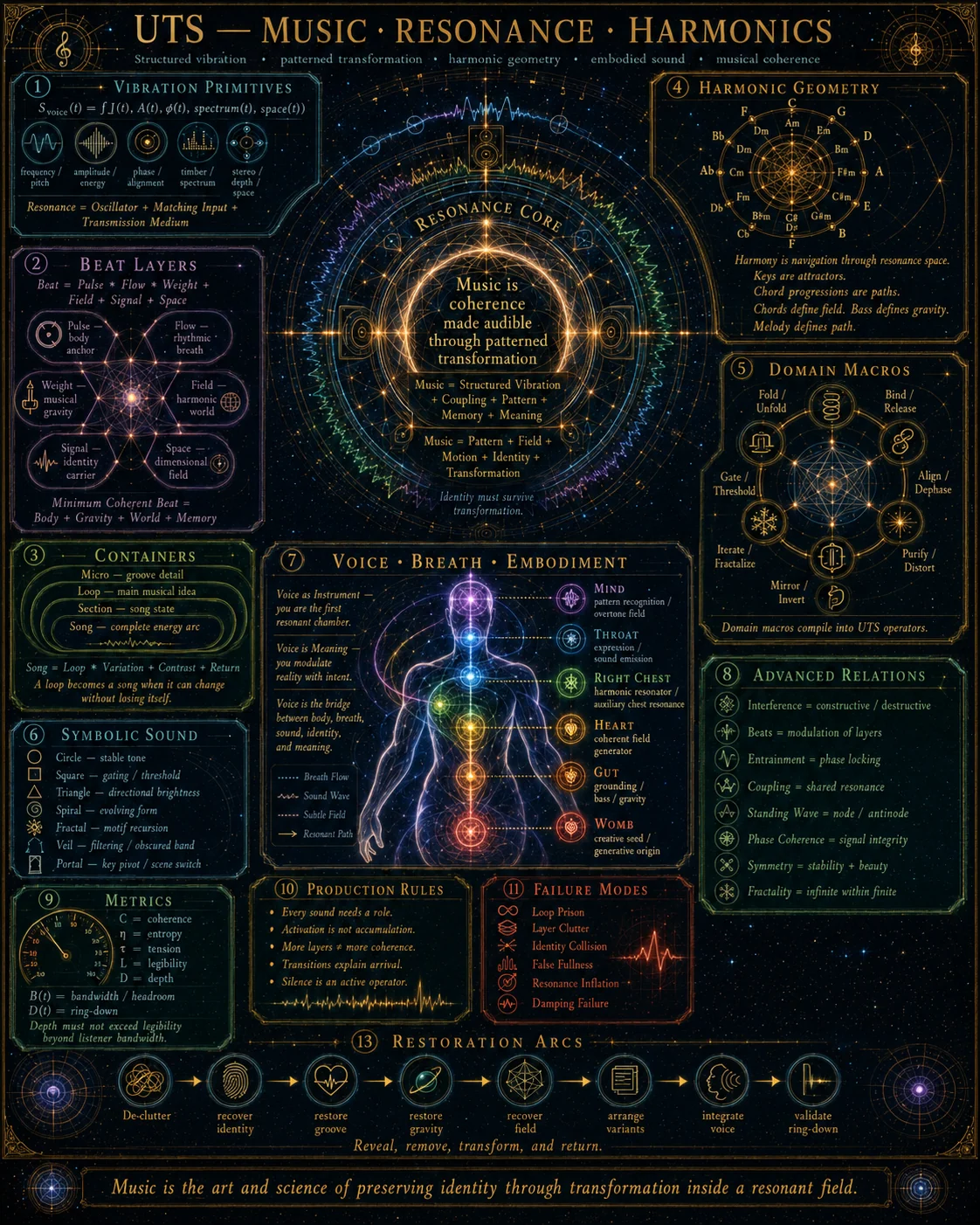
Music is coherence made audible through patterned transformation.
In UTS–Music, music is not only entertainment, performance, theory, production, emotion, or vibration. It is astructured resonance systemwhere vibration becomes pattern, pattern becomes memory, memory becomes meaning, and meaning becomes transmissible through time.
The updated canon statement is:
Music = Structured Vibration + Pattern + Coupling + Perception + MeaningThe production translation is:
Music = Pattern + Field + Motion + Identity + TransformationThe beat-making translation is:
Beat = Pulse + Flow + Weight + Field + Signal + SpaceThe UTS translation is:
Music becomes coherent when identity is preserved through transformation.This gives us the central UTS–Music doctrine:
A sound becomes musical when it is placed into a coherent pattern-field.
A pattern becomes a song when it develops through transformation without losing identity.
A song becomes meaningful when the listener can decode its resonance as memory, motion, and field.
1. Scope of UTS–Music
UTS–Music unifies six major domains.
1.1 Resonance Physics
The study of oscillators, frequencies, phase, amplitude, wave interference, entrainment, damping, and harmonic series.
This is the physical substrate.
No vibration = no sound.
No organized vibration = no musical structure.
No coupling = no transmission.
1.2 Music Theory
The organization of pitch, rhythm, harmony, melody, key, tuning, chord motion, voice-leading, form, and arrangement.
This is the formal musical layer.
Music theory describes how resonance becomes navigable.1.3 Music Production
The practical construction of beats, loops, layers, arrangements, sound design, transitions, mix space, and song architecture.
This is the applied craft layer.
Production turns resonance theory into playable, audible artifacts.1.4 Symbolic Sound
The mapping of musical events to symbols, archetypes, geometry, image, motion, and meaning.
This is the symbolic encoding layer.
A repeated sound-event becomes a glyph when it is distinguishable, placed, and returned.1.5 Voice, Breath, and Embodiment
The use of breath, phonation, vowel shaping, tone, vibration, posture, rhythm, and body resonance as musical and bioharmonic interfaces.
This is the embodied resonance layer.
Voice is the bridge between body, breath, sound, identity, and meaning.1.6 Bioharmonic Research
The experimental study of how sound, rhythm, breath, vibration, and harmonic input may correlate with measurable biological signals.
This is treated as ahypothesis and protocol domain, not as settled medical doctrine.
Bioharmonics remains canonically valid as a model-space, protocol-space, and research-space.
Medical certainty requires evidence.
2. Core UTS–Music Equations
2.1 General Music Equation
Music = Structured Vibration + Coupling + Pattern + Memory + Meaning- Structured vibrationgives physical sound.
- Couplingallows transmission.
- Patterncreates recognition.
- Memorycreates recurrence.
- Meaningemerges when structure becomes legible to a perceiver.
2.2 Production Equation
Music = Pattern + Field + Motion + Identity + Transformation- Pattern= recurrence, rhythm, motif, loop.
- Field= harmonic world, atmosphere, spatial environment.
- Motion= groove, bass movement, automation, transition pressure.
- Identity= hook, motif, voice, signature sound.
- Transformation= arrangement, variation, contrast, return.
2.3 Beat Equation
Beat = Pulse + Flow + Weight + Field + Signal + Space- Pulse= body movement.
- Flow= groove/breath.
- Weight= bass/gravity.
- Field= harmonic world.
- Signal= memorable identity.
- Space= depth, width, atmosphere.
2.4 Song Equation
Song = Loop + Variation + Contrast + ReturnA loop becomes a song when it can change without losing itself.
2.5 Section Equation
Section = Identity + Density + Energy + Transition PressureEvery section can be diagnosed by asking:
What identity is active?
How dense is the layer field?
How much energy is present?
How strongly does this section pull toward the next?
2.6 Resonance Equation
Resonance = Oscillator + Matching Input + Transmission MediumFor resonance to occur:
- A system has a natural frequency or response profile.
- An input wave matches, approximates, or harmonically relates to that profile.
- A coupling medium allows transfer.
2.7 Meaning Emergence Equation
Meaning = Pattern + Attention + Memory + ContextSound becomes meaningful when a perceiver can decode structure across time.
3. UTS State Vector Mapping
UTS canon uses:
S = {O, H, ε, ι, Au, µᵢ, BΣ, K, R, Φ}In UTS–Music:
| UTS Variable | Music Meaning |
|---|---|
| O | musical order, coherence, harmonic clarity, groove integrity |
| H | hidden debt, strain, clutter, unresolved fatigue, overload |
| ε | noise, detuning, timing error, jitter, unwanted randomness |
| ι | interference, masking, phase conflict, attention collision |
| Au | agency/actuation: performer control, producer control, listener navigation |
| µᵢ | notes, hits, motifs, samples, gestures, syllables, micro-patterns |
| BΣ | boundaries: tempo, key, scale, mix limits, arrangement rules, safety constraints |
| K | memory: motif recall, style familiarity, hook recognition, embodied technique |
| R | restoration: resolution, return, re-entry, ring-down, recovery |
| Φ | meaning, emotional-symbolic charge, identity, felt significance |
The central UTS–Music coherence test is:
Does the system preserve O, K, Φ, and BΣ while transforming over time?4. UTS–Music Layer Stack
The recovered text gave a six-layer resonance stack. The production framework gave nested musical containers. UTS integrates both through U0–U8.
4.1 U0 — Vibration Primitives
Domain:waveform, frequency, amplitude, phase, spectrum, space.
Primitive audio state:
S_voice(t) = {f(t), A(t), φ(t), spectrum(t), space(t)}Where:
- f(t)= frequency / pitch
- A(t)= amplitude / energy
- φ(t)= phase / alignment
- spectrum(t)= harmonic/noise distribution / timbre
- space(t)= stereo, depth, room, scene
This is the physics alphabet of UTS–Music.
4.2 U1 — Power and Budgets
Domain:gain, loudness, dynamic range, energy, breath pressure, intensity, headroom.
Production examples:
- gain staging
- compression
- bass energy
- kick impact
- breath support
- section intensity
- peak management
UTS diagnostic:
Is there enough energy to activate the system without overloading it?4.3 U2 — Configuration and Boundaries
Domain:key, scale, tempo, tuning, routing, track groups, mix boundaries, musical role boundaries.
Production examples:
- Ableton group structure
- frequency slotting
- scale choice
- arrangement rules
- “only one main signal”
- vocal space reservation
UTS diagnostic:
Are the constraints helping the music become clearer?4.4 U3 — Execution and Runtime
Domain:performance, programming, recording, automation, live control, playing.
Examples:
- MIDI input
- drum programming
- vocal takes
- automation rides
- clip launching
- resampling
- live performance
UTS diagnostic:
Can the producer or performer actually actuate the intended musical state?4.5 U4 — Classification and Metrics
Domain:labeling, analysis, musical roles, coherence metrics, production diagnosis.
Examples:
- pulse / flow / weight / field / signal / space
- coherence / entropy / tension / legibility / depth
- “this is a motif”
- “this sound is clutter”
- “this section has high transition pressure”
UTS diagnostic:
Do the labels match the actual audible function?4.6 U5 — Coordination and Time
Domain:rhythm, groove, loop length, section timing, transitions, arrangement.
Examples:
- micro-container
- loop-container
- section-container
- song-container
- swing
- transition timing
- build and release
UTS diagnostic:
Does the music move coherently across time?4.7 U6 — Coherence and Field
Domain:total musical world, harmonic field, atmosphere, felt integration, group resonance.
Examples:
- pads and drones
- full mix identity
- emotional field
- resonance space
- song-world
- ensemble synchronization
UTS diagnostic:
Does the full system feel like one coherent field?4.8 U7 — Memory and Recurrence
Domain:motif, hook, identity return, repetition, callback, listener memory.
Examples:
- repeated vocal chop
- bassline identity
- chord return
- final chorus
- signature texture
- melodic callback
UTS diagnostic:
What does the listener remember?4.9 U8 — Environment and Forcing
Domain:room, culture, genre, listener state, playback medium, tools, reference tracks, social field.
Examples:
- headphones vs speakers
- Ableton workflow
- genre convention
- physical room
- audience context
- cultural expectation
UTS diagnostic:
What external field is shaping how the music is produced or received?5. Resonance Stack: Six Layer Model
The recovered framework’s six layers remain canon as theResonance Stackinside UTS–Music.
Layer 0 — Vibration Primitives
Frequency, amplitude, phase, spectrum, space.
This is raw sound-state.
Layer 1 — Containers Over Time
Containers map sound-state through time:
S(t) → S'(t)Container types:
- envelope
- modulation
- routing
- parallelism
- spatialization
- dynamics
- distortion/noise
- harmonic progression
- macro-form
This is the grammar of change.
Layer 2 — Encoding Planes
Meaning can be encoded across multiple channels:
- harmonic encoding
- rhythmic encoding
- spectral encoding
- phase/coherence encoding
- noise/distortion encoding
- spatial encoding
- temporal-form encoding
This is music as multi-channel information.
Layer 3 — Harmonic Geometry
Pitch and harmony become navigable geometry:
- circle of fifths
- Tonnetz
- voice-leading space
- chord shapes
- modulation paths
- key regions
- attractor basins
This is the map layer.
Layer 4 — Symbolic Semantics
Sound-events become symbols when repeatable, distinguishable, and intentionally placed.
Example glyph mappings:
| Symbol | Sonic Translation |
|---|---|
| Circle | stable tone, center image, coherent ratio |
| Square | gating, binary rhythm, hard edge, threshold |
| Triangle | ramp, ascent/descent, directional brightness |
| Spiral | glissando, morphing, evolving formants |
| Fractal | motif recursion across scales |
| Veil | filtering, obscured band, noise bed |
| Portal | abrupt topology change, key pivot, scene switch |
Layer 5 — Consciousness and Resonance
This is perception without hand-waving.
In this layer:
Attention behaves like dynamic EQ + gain gate.
Expectation behaves like gravity.
Memory behaves like impulse response.
Tension behaves like informational curvature.
Resolution behaves like convergence.
Music guides perception by:
- spectral spotlighting
- rhythmic anchoring
- contrast shaping
- novelty pulses
- motif return
- release after tension
6. Production Stack: Six Beat Layers
The newer production framework gives the practical beat-building layer.
6.1 Pulse
Question: Where does the body move?Includes:
- kick
- snare
- clap
- main beat skeleton
- downbeat
- silence
UTS role:
Pulse = body anchor6.2 Flow
Question: How does the groove breathe?Includes:
- hats
- shakers
- ghost notes
- syncopation
- percussion
- rhythmic chops
UTS role:
Flow = rhythmic breath6.3 Weight
Question: Where does the track land?Includes:
- bass
- sub
- 808
- low synth
- low piano
- low sample
UTS role:
Weight = musical gravity6.4 Field
Question: What world are we inside?Includes:
- chords
- pads
- drones
- sustained synths
- keys
- samples
- harmonic texture
UTS role:
Field = harmonic environment6.5 Signal
Question: What makes this recognizable?Includes:
- melody
- hook
- vocal chop
- lead synth
- bell motif
- signature sample
- memorable sound
UTS role:
Signal = identity carrier6.6 Space
Question: How deep, wide, near, or far does it feel?Includes:
- reverb
- delay
- panning
- stereo width
- chorus
- atmosphere
- room tone
- FX tails
UTS role:
Space = dimensional field7. Minimum Viable Beat
The canon production rule is:
Minimum Beat = Pulse + Weight + Field + IdentityUTS translation:
Minimum Coherent Beat = Body + Gravity + World + MemoryA beat does not need many layers. It needs enough role coverage to become legible.
8. Containers: Micro to Song
8.1 Micro-Container
Scale: 1 beat to 1 bar
Function: groove detail
Includes:
- kick placement
- snare placement
- swing
- ghost notes
- accents
- fills
UTS operators:
Π Constrain
Γ Select
Ψ Presence
8.2 Loop-Container
Scale: 2 to 8 bars
Function: main musical idea
Includes:
- drum loop
- bassline
- chord progression
- motif
- sample chop
UTS operators:
⊕ Compose
⊗ Couple
Γ Select
8.3 Section-Container
Scale: 8 to 32 bars
Function: song state
Includes:
- intro
- verse
- hook
- chorus/drop
- bridge
- breakdown
- outro
UTS operators:
⊕ Compose
Δ Distort
ℛ Restore
Τ Trajectory
8.4 Song-Container
Scale: full track
Function: complete energy arc
Includes:
- beginning
- development
- contrast
- peak
- return
- release
- ending
UTS operators:
Τ Trajectory
⊕ Compose
ℛ Restore
9. UTS Core Operators in Music
⊕ Compose
Integrates multiple layers into one navigable field.
Music examples:
- drums + bass + chords + motif
- voice + instrumental
- field + signal + space
- section variants into song arc
Failure mode:
Layer accumulation without coherence.⊗ Couple
Binds two systems so they reinforce each other.
Music examples:
- kick/bass coupling
- melody/chord coupling
- rhythm/breath coupling
- voice/groove coupling
- reverb/space coupling
Failure mode:
Masking, dependency, phase conflict, overcoupling.Π Constrain
Creates boundaries that allow musical clarity.
Music examples:
- key
- scale
- tempo
- drum grid
- frequency slot
- one primary motif
- vocal space
- arrangement boundaries
Failure mode:
Rigid, lifeless, over-constrained music.Γ Select
Chooses what matters.
Music examples:
- motif selection
- sound palette selection
- which layer carries identity
- which section gets the full arrangement
- which variation belongs in the final return
Failure mode:
Selection by novelty instead of role.Δ Distort
Perturbs, mutates, intensifies, or destabilizes.
Music examples:
- saturation
- bitcrush
- reverse
- pitch shift
- filter sweep
- breakdown
- detuning
- glitch
- noise bed
Failure mode:
Distortion hides weak structure instead of revealing transformation.ℛ Restore
Returns the system to clarity, identity, or resolved form.
Music examples:
- final chorus return
- resolving cadence
- reintroducing motif
- clearing mud
- re-locking groove
- re-centering after bridge
Failure mode:
Fake resolution without true reduction of strain.Ξ Invert
Creates mismatch between appearance and actual coherence.
Music examples:
- loud mix but weak song
- complex arrangement but no identity
- beautiful sound design with no role
- metric success but listener fatigue
- “full” track that is actually cluttered
Failure mode:
Success theater in musical form.10. UTS Meaning Operators in Music
Μ Sensemaking
Assigns function, role, and interpretation.
This is not just a pad; it is field.
This is not just a vocal chop; it is signal.
This is not just reverb; it is space.
Τ Trajectory
Governs long-horizon arc.
Examples:
- intro → groove → hook → bridge → return
- tension → release
- low density → full field
- descent → stillness
- build → peak → dissolve
Σ Sacred Boundary
Protects non-negotiable musical integrity.
Examples:
- preserve the hook
- do not overload the low end
- leave room for voice
- do not destroy groove
- do not overcompress the track
- do not make healing claims without evidence
Θ Humility
Keeps the producer responsive to what the track asks for.
Canon practice:
Mute it if it has no role.
Bounce and listen.
Let the track reveal what is missing.
Λ Compatibility
Checks whether layers belong together.
Examples:
- kick/bass compatibility
- melody/chord compatibility
- voice/beat compatibility
- texture/field compatibility
- silence/transition compatibility
Ψ Presence
Real-time listening and actuation.
Examples:
- feeling when the groove lands
- noticing mud
- hearing transition timing
- recognizing when enough has been added
- knowing when silence is stronger than another layer
11. Domain Operators from the Resonance Framework
The recovered framework introduced eight music-specific operators. These are now treated asdomain macrosthat compile into UTS operators.
11.1 Fold / Unfold
Examples:
- envelope rise
- filter opening
- density ramp
- intro reveal
- pad emergence
UTS compilation:
Π + Τ + ⊕Meaning:
Emergence, revelation, incarnation.11.2 Bind / Release
Examples:
- compression
- sidechain
- harmonic cadence
- groove lock
- tension release
UTS compilation:
Π + ⊗ + ℛMeaning:
Constraint, covenant, freedom.11.3 Align / Dephase
Examples:
- phase lock
- mono focus
- stereo widening
- rhythmic displacement
- paradox space
UTS compilation:
⊗ + Δ + ℛMeaning:
Unity, duality, contradiction.11.4 Purify / Distort
Examples:
- harmonic simplification
- noise injection
- saturation
- bitcrush
- spectral smoothing
UTS compilation:
ℛ ↔ ΔMeaning:
Ideal form versus lived texture.11.5 Translate / Rotate
Examples:
- transposition
- mode rotation
- moving a shape through fifths space
- same motif in new register
UTS compilation:
Γ + Τ + ⊕Meaning:
Travel without loss of identity.11.6 Mirror / Invert
Examples:
- melodic inversion
- major/minor polarity
- stereo flip
- call-and-response shadow form
UTS compilation:
Ξ + Γ + ΜMeaning:
Reflection, counterpart, shadow-world.11.7 Iterate / Fractalize
Examples:
- motif recursion
- rhythm at multiple scales
- micro-pattern mirrored in macro-form
- repeating contour across sections
UTS compilation:
⊕ + U7 + ΤMeaning:
Archetype repeating through time.11.8 Gate / Threshold
Examples:
- chop
- stutter
- silence
- section break
- impact
- hard transition
UTS compilation:
Π + Σ + ΓMeaning:
Initiation, crossing, decision.12. Metrics Canon
UTS–Music uses five domain metrics plus UTS diagnostics.
12.1 Coherence — C
Measures unity.
High C:
- clean transients
- stable image
- clear harmonic identity
- strong groove
- role clarity
Low C:
- smeared timing
- unclear center
- unstable field
- cluttered arrangement
- dream haze when unintended
12.2 Entropy — η
Measures randomness, non-ideal texture, or noise.
Includes:
- distortion artifacts
- jitter
- noise beds
- inharmonicity
- glitch
- chaos textures
Entropy is not bad by default. It becomes harmful when it reduces legibility without adding meaningful texture.
12.3 Tension — τ
Measures distance from stable attractors.
Includes:
- dissonance
- unresolved leading tones
- rhythmic displacement
- harsh spectral pressure
- transition pressure
- suspense
Tension is useful when it has a path to release.
12.4 Legibility — L
Measures readability.
Includes:
- motif clarity
- contrast
- attention guidance
- section clarity
- repetition with variation
A track can have high depth but low legibility.
12.5 Depth — D
Measures layered dimensionality.
Includes:
- simultaneous encoding planes
- harmonic depth
- rhythmic depth
- spatial depth
- timbral depth
- symbolic depth
The canon balance is:
Depth must not exceed legibility beyond the listener’s navigational bandwidth.12.6 Bandwidth Headroom — 𝓑(t)
In music, 𝓑(t) measures available headroom across:
- mix space
- frequency space
- rhythmic attention
- arrangement density
- listener processing
- performer control
- vocal future-space
Low 𝓑 signs:
- too many active layers
- no silence
- no room for voice
- low-mid mud
- everything is full all the time
- effects masking uncertainty
12.7 Ring-Down Damping — 𝓓(t)
In music, 𝓓(t) measures how well the system settles after perturbation.
High 𝓓:
- breakdown resolves cleanly
- hook returns with clarity
- tension releases into groove
- reverb tails support transition
- final return feels earned
Low 𝓓:
- risers do not justify arrival
- sections feel pasted
- tension remains after supposed release
- listener does not know where they landed
13. Harmonic Geometry Canon
13.1 Keys as Attractors
A key is a resonance basin.
Tonic = stable attractor
Dominant = slope toward tonic
Borrowed chord = side basin
Bridge = journey to remote basin
Return = collapse back into home attractor
This makes harmonic movement a form of identity dynamics.
13.2 Chord Progressions as Paths
Chord progressions are geodesics through voice-leading space.
- Smooth progressions = short paths.
- Dramatic progressions = deliberate leaps.
- Bridges = controlled distance spikes.
- Returns = collapse back to stability.
Canon phrase:
Harmony is navigation through resonance space.13.3 Chords / Bass / Melody Rule
Chords define the field.
Bass defines the gravity.
Melody defines the path.
UTS translation:
Field = harmonic possibility-space
Weight = gravitational center
Signal = navigational identity
13.4 Mandala Score Artifact
AMandala Scoreis a one-page map of a song’s harmonic-symbolic architecture.
It should include:
Key-space path:
Motif vectors:
Section operator plan:
Encoding planes:
C / η / τ / L / D curves:
Transition gates:
Return logic:
Identity carrier:
Restoration path:
Example arc:
Intro: circle / high coherence / low entropy
Verse: translation / motif recursion
Chorus: widening + convergence
Bridge: mirror + dephase + borrowed basin
Final chorus: rephase + integration
Outro: release with residual texture
14. Arrangement Canon
14.1 Arrangement Definition
Arrangement = state-transition governance across nested musical containers.The producer governs:
- activation
- removal
- reveal
- concealment
- mutation
- contrast
- return
- density
- transition pressure
- memory preservation
14.2 Activation Is Not Accumulation
More layers ≠ more coherence.A full arrangement is not every layer playing. It is controlled activation, removal, transformation, and return.
14.3 Identity-Preserving Variation
For a section to evolve coherently:
Change at least two dimensions.
Preserve at least one or two identity anchors.
Changeable dimensions:
- density
- rhythm
- brightness
- register
- stereo width
- FX depth
- bass intensity
- melodic presence
Stable anchors:
- core motif
- drum identity
- bass character
- chord field
- sound palette
- vocal fragment
Canon rule:
A musical system evolves coherently when enough changes to create motion,
but enough remains stable to preserve identity.
15. Song Architecture Templates
15.1 Loop Reveal
Intro texture
Groove entry
Main loop
Variation
Return
Outro
Best for beat-based instrumentals.
15.2 Verse / Hook Instrumental
Intro
Sparse verse
Full hook
Altered verse
Fuller hook
Bridge
Final hook
Outro
Best for tracks that may later receive vocals.
15.3 Journey Build
Atmosphere
Pulse appears
Bass appears
Motif appears
Full world opens
Breakdown
Rebuild
Peak
Dissolve
Best for cinematic, ambient, downtempo, or spatial tracks.
15.4 Beat Tape Loop Form
Intro
Main loop
Variation
Main return
Outro
Best for short sketches and practice.
15.5 A/B Alternation
A
B
A variation
B fuller
A breakdown
B final
Best for simple but effective tracks.
16. Transitions Canon
A transition should explain why the next section arrives.
16.1 Subtractive Transition
Remove something before the next section.
Examples:
- drum dropout
- bass cut
- melody disappears
- silence before impact
16.2 Additive Transition
Add tension before arrival.
Examples:
- riser
- snare build
- filter opening
- automation ramp
16.3 Transformative Transition
Turn one sound into another.
Examples:
- reverb tail becomes pad
- reversed vocal becomes riser
- crash becomes atmosphere
16.4 Impact Transition
Mark the new section.
Examples:
- crash
- sub drop
- impact
- full beat return
16.5 Memory Transition
Carry the previous section forward.
Examples:
- delay throw
- reverb tail
- vocal fragment
- filtered motif
Canon rule:
Transitions preserve continuity across state change.17. Sound Design Canon
17.1 World as Instrument
A microphone turns the world into an instrument.
Ableton turns recordings into playable material.
Source materials:
- desk taps
- paper
- keys
- glass
- water
- breath
- mouth clicks
- humming
- whispers
- footsteps
- metal
- fabric
- room tone
17.2 Sound Design Equation
Sound Design = Substrate Capture + Role Assignment + TransformationA sound becomes musically useful when it gains a role:
- anchor
- motion
- field
- signal
- texture
- transition
- space
- impact
Canon rule:
Record ordinary materials, then assign them musical roles.18. Voice and Breath Canon
18.1 Voice Integration Path
Voice should enter in stages:
Voice as Instrument → Voice as Motif → Voice as Meaning18.2 Voice as Instrument
Use:
- hums
- vowels
- breaths
- syllables
- drones
- mouth percussion
- vocal pads
- chops
Goal:
Learn voice as sound.18.3 Voice as Motif
Use:
- repeated syllables
- one-word hooks
- chopped phrases
- call-and-response
- whispered motifs
Goal:
Let voice carry identity.18.4 Voice as Meaning
Use:
- lyrics
- refrains
- spoken word
- hooks
- layered vocals
Goal:
Let voice carry message.Canon rule:
Voice should learn to carry resonance before being forced to carry full meaning.19. Bioharmonic Canon Layer
This section integrates the recovered bioharmonic model while keeping it properly tagged.
19.1 Epistemic Status
The bioharmonic model is canonized as:
Symbolic model: yes.
Protocol model: yes.
Research hypothesis: yes.
Established medical claim: no.
It can guide exploration, composition, voice practice, breath work, and research design. It should not be framed as guaranteed healing or universal biological law without evidence.
19.2 Two-Aspect Model
The recovered framework distinguishes two overlapping substrates.
Physical-Informational Substrate
Includes:
- vibration
- sound
- breath
- tissue response
- cardiac rhythm
- neural rhythm
- phase coupling
- measurable physiology
Symbolic-Consciousness Substrate
Includes:
- attention
- intention
- meaning
- imagery
- archetype
- perceived field
- inner resonance
- symbolic geometry
Canon rule:
Physical effects and symbolic effects may interact,
but they must not be collapsed into one category.
20. Bioharmonic Anatomy: 13-Node Fibonacci Model
The recovered framework proposes a 13-unit harmonic anatomy model:
2 + 1 + 2 + 3 + 2 + 1 + 2 = 13The structure:
| Unit Group | Nodes |
|---|---|
| 2 | Crown + Third Eye |
| 1 | Mind resonator |
| 2 | Throat chakra + Throat resonator |
| 3 | Heart resonator + Soul center + Void node |
| 2 | Solar Plexus + Sacral |
| 1 | Womb / Creative Seed resonator |
| 2 | Gut resonator + Root |
The proposed golden-ratio structure:
Lower body zone: 0 → 1/φ² ≈ 0.38
Heart-Soul-Void golden band: 1/φ² → 1/φ ≈ 0.38–0.62
Upper field zone: 1/φ → 1 ≈ 0.62–1
Canon interpretation:
The heart band functions as a symbolic and geometric bridge between lower embodiment and upper perception.Again, this is canonized as aharmonic anatomy model, not as settled biological anatomy.
21. Resonant Node Specifications
21.1 Mind Resonator
Associated with:
- Crown
- Third Eye
- pattern recognition
- perception
- intent formation
- signal interpretation
- phase alignment
Musical mapping:
Mind = high field / overtone / pattern recognition / directional listening21.2 Throat Resonator
Associated with:
- vocal shaping
- breath pressure
- sound emission
- expression
- precision frequency output
Musical mapping:
Throat = digital-to-analog converter for intention into sound.21.3 Heart Resonator
Associated with:
- coherence waves
- emotional field
- radiant expansion
- harmonic center
Musical mapping:
Heart = coherent field generator.21.4 Soul Center
Associated with:
- identity
- purpose
- midpoint integration
- central routing
- upward/downward distribution
Musical mapping:
Soul = central identity router.21.5 Void Node
Associated with:
- stillness
- absorption
- reflective balance
- amplitude regulation
- phase reset
Musical mapping:
Void = silence, damping, negative space, reset.21.6 Solar Plexus
Associated with:
- will
- dynamic response
- action conversion
- energy distribution
Musical mapping:
Solar Plexus = drive, attack, forward motion.21.7 Sacral
Associated with:
- flow
- elasticity
- creative movement
- emotional-somatic content
Musical mapping:
Sacral = groove, fluidity, rhythmic sensuality, motion.21.8 Womb / Creative Seed Resonator
Associated with:
- generative field
- creation
- manifestation
- seed-patterns
- deep creative storage
Canon note:
This is treated as a symbolic-functional resonator independent of physical sex.Musical mapping:
Creative Seed = origin motif, generative loop, first impulse.21.9 Gut Resonator
Associated with:
- grounding
- instinct
- survival field
- embodied reality alignment
Musical mapping:
Gut = bass, sub, root, gravity.21.10 Root
Associated with:
- physical anchoring
- body stability
- grounding
- foundation
Musical mapping:
Root = downbeat, tonic, sub-foundation, floor.22. Spiral Waveflow Model
The recovered framework proposes that waves move through the body-field as spirals rather than straight lines.
22.1 Coordinate System
Vertical axis y: Root → Crown
Radial axis r: center / left / right
Phase θ: spiral motion
22.2 Primary Directions
Ascending
Body → Heart → MindFunction:
- clarification
- understanding
- transmutation
- insight
Musical mapping:
- rising melody
- filter opening
- increasing brightness
- ascent gesture
Descending
Mind → Heart → BodyFunction:
- embodiment
- manifestation
- grounding
- action
Musical mapping:
- bass return
- downward cadence
- low-register arrival
- groove landing
Toroidal
Heart/Soul center → outward field → returnFunction:
- harmonization
- broadcasting
- collective field
- full-body coherence
Musical mapping:
- circular form
- looping chant
- drone field
- call-and-response
- surround/space motion
22.3 Golden Band Crossing
The model treats the Heart-Soul-Void band as a conversion zone.
Canon interpretation:
When musical or vocal energy crosses the center band,
it should be checked for identity compatibility and field coherence.
UTS gate equivalent:
HR-Gate + Λ Compatibility + Σ Sacred Boundary23. Resonant Phonosemantic Map
The recovered framework maps vowels to resonators and functions. In canon, this becomes aphonosemantic working map.
| Resonator | Vowel / Sound | Function | Musical Use |
|---|---|---|---|
| Heart | A / Ah | expansion, coherence, clearing | open vocal pad, radiant chorus |
| Mind | O / Oh | pattern integration, focus | rounded drone, mental field |
| Gut | U / Oo | grounding, safety, root | low chant, bass vocal tone |
| Throat | E / Eh / Ay | expression, filtering | bright lead vocal, articulation |
| Soul Core | I / Ee | vertical axis, ignition | high tone, piercing motif |
| Void | Silence / breath | reset, stillness, phase clearing | rest, space, negative transition |
Canon caution:
These mappings are symbolic-functional and protocol-oriented,
not universal biological guarantees.
24. Practice Modes
The recovered framework gives four primary practice modes.
24.1 Self-Repair Mode
Purpose:
Use tone cycles to locate and soften incoherent knots or residue.Canon tag:
ℛ Restore + Ψ PresenceExample:
A-U-A loop with breath focus on heartNon-medical framing:
This is a restoration practice, not a guaranteed treatment.24.2 System Re-Tuning Mode
Purpose:
Sweep the vowel set to re-harmonize the field.Canon tag:
Π Constrain + ℛ Restore + Τ TrajectoryExample:
A → O → U → E → I → Silence24.3 Directed Transmission Mode
Purpose:
Project coherent tone toward a space, group, or musical field.Canon tag:
⊗ Couple + Σ Sacred BoundaryImportant boundary:
Directed transmission requires consent when aimed at people.24.4 Integration Silence Mode
Purpose:
Allow ring-down, stabilization, and field reset after tone.Canon tag:
ℛ Restore + 𝓓(t)Example:
Deep breath → silence → observation → return25. Research Architecture
Bioharmonic claims become stronger when translated into testable architecture.
25.1 Primary Hypothesis
Human physiological, emotional, and cognitive states correlate with measurable oscillatory behaviors across cardiac, neural, fascial, respiratory, and electromagnetic systems.25.2 Intervention Hypothesis
Targeted vibrational inputs through sound, breath, mechanical oscillation, or rhythm may modulate these states by altering coherence, coupling, and phase alignment.25.3 Node Hypothesis
Distributed body systems may behave like interacting resonant nodes whose synchronization produces measurable whole-system signatures.25.4 Measurement Layers
Layer 1 — Physiological Coherence Testing
Possible tools:
- HRV
- EEG
- ECG/EKG
- EMG
- respiration tracking
- GSR
- infrared thermography
- inflammatory markers
- ultrasound elastography
Layer 2 — Vibrational Input Mapping
Possible inputs:
- vocal toning
- overtone phonation
- breath pacing
- binaural/monaural beats
- low-frequency vibration
- transducers
- rhythmic entrainment
Layer 3 — Resonant Node Interaction Testing
Possible tools:
- EEG/ECG synchrony
- HRV harmonic analysis
- MEG or magnetometers where available
- electroenterogram for gut rhythms
- breath spectrograms
- vocal harmonic analysis
25.5 Minimal First Experiments
Experiment 1 — Vocal Toning and HRV
Input: vowel tone + controlled breathing
Measure: HRV before/during/after
Question: does ring-down improve?
Experiment 2 — Breath-Paced Audio and Heart-Brain Coupling
Input: rhythmic breath guidance + tone
Measure: EEG/ECG/HRV
Question: does phase-locking increase?
Experiment 3 — Low-Frequency Vibration and Fascial Relaxation
Input: transducer vibration
Measure: elastography / EMG / HRV
Question: does tissue tension shift?
Experiment 4 — Gut-Brain Coupling
Input: breath pacing + low tone
Measure: electroenterogram + EEG + HRV
Question: does gut-brain harmonic coupling change?
26. Integration with Traditional Systems
The recovered framework maps UTS–Music to traditional sound practices such as Nāda Yoga, Mantra Yoga, and Laya Yoga.
Canon framing:
Traditional systems preserve long-running empirical-symbolic maps.
UTS translates them into operators, layers, gates, and testable hypotheses.
26.1 Mantra / Vowel Crosswalk
| Traditional Region | Sound Family | UTS Resonator |
|---|---|---|
| Root / Pelvis | LAM / VAM / U / UH / M | Gut / Root |
| Sacral / Navel | RAM / YAM / A / AH | Sacral / Solar / Heart bridge |
| Solar Plexus | RAM / short A | Will / action gate |
| Heart | YAM / A / AH | Heart resonator |
| Throat | HAM / E / EH / AY | Throat resonator |
| Third Eye | OM / O + M | Mind resonator |
| Crown | OM / AUM / silence / I / EE | Crown / Mind / Void |
Canon caution:
Traditional maps are respected as symbolic-practical systems,
not automatically converted into universal biological proof.
27. Ableton / Production Workflow Canon
27.1 Organize by Musical Function
Track groups:
Drums
Bass
Harmonic Field
Melody / Identity
Texture / Foley
FX / Transitions
Voice
Returns
Canon rule:
Organize by function, not only by instrument type.27.2 Track Creation Protocol
Step 1 — Build Parent Loop
Include:
Pulse + Weight + Field + Signal + SpaceStep 2 — Label Roles
Each layer must be tagged:
pulse / flow / weight / field / signal / space / transition / textureStep 3 — Check Loop Lengths
Ask:
What repeats every 1 bar?
What repeats every 2 bars?
What repeats every 4 bars?
What evolves over 8–32 bars?
Step 4 — Create Variants
Create:
Intro variant
Verse/groove variant
Main/full variant
Bridge/breakdown variant
Final variant
Step 5 — Arrange
Use one of the architecture templates.
Step 6 — Add Transitions
Use:
subtractive
additive
transformative
impact
memory
Step 7 — Refine Density
Mute anything without a role.
Step 8 — Add One Signature Detail
Examples:
- vocal chop
- strange texture
- melodic hook
- transition gesture
- field movement
Step 9 — Bounce and Review
Check:
identity
groove
field
bass gravity
transition logic
density
space
ring-down
28. Gates for UTS–Music
28.1 FI-Gate — Feedback Integrity
Tripwire:
The mix looks good, but the song feels weak.
The waveform is loud, but identity is unclear.
The metric improved, but listening got worse.
28.2 HR-Gate — High Risk Gate
Used for:
- healing claims
- identity claims
- universal frequency claims
- “this sound always means X”
- “this tone heals Y”
Canon result:
Quarantine as hypothesis until validated.28.3 MS-Gate — Meta-Symmetry
No system gets rank immunity:
- music theory
- intuition
- tradition
- measurement
- symbolism
- personal resonance
- genre convention
All must remain testable against the actual artifact.
28.4 Au-Actuation
A production or protocol should be traceable enough to repeat, revise, or audit.
Tripwire:
It worked once, but we cannot identify what changed.29. Failure Modes Registry
FM-MUS-001 — Loop Prison
A good loop never becomes a song.
Repair:
Create variants, contrast, transitions, and final return.FM-MUS-002 — Layer Clutter
Too many sounds with unclear roles.
Repair:
Mute anything without a function.FM-MUS-003 — Identity Collision
Too many signals compete for memory.
Repair:
Select one primary identity carrier.FM-MUS-004 — Low-Mid Mud
Too much energy in the same register.
Repair:
Clarify frequency boundaries and reduce overlap.FM-MUS-005 — Transition Paste
Sections arrive without explanation.
Repair:
Add subtractive, additive, transformative, impact, or memory transition.FM-MUS-006 — False Fullness
The track sounds big but has weak identity.
Repair:
Reduce density and strengthen motif/signal.FM-MUS-007 — Static Loop Fatigue
Everything repeats at the same loop length.
Repair:
Differentiate loop scales.FM-MUS-008 — FX Fog
Effects conceal weak composition.
Repair:
Dry-check the role before processing.FM-MUS-009 — Weak Gravity
Bass does not land or conflicts with kick.
Repair:
Clarify kick/bass coupling.FM-MUS-010 — Voice Overload
Voice is forced to carry meaning before integration.
Repair:
Use voice as instrument, then motif, then meaning.FM-MUS-011 — Symbolic Overbinding
A sound is assigned too much universal meaning without enough evidence.
Repair:
Move claim through HR-Gate; mark as symbolic or hypothesis.FM-MUS-012 — Resonance Inflation
Every felt response is treated as universal resonance law.
Repair:
Separate personal resonance, symbolic mapping, and measurable effect.FM-MUS-013 — Damping Failure
The track or protocol activates intensity but does not settle.
Repair:
Add silence, return, grounding, cadence, or lower-density integration.30. Restoration Arcs
ARC-MUS-001 — De-Clutter Arc
Identify roles → mute duplicates → preserve core → rebuild missing functionsARC-MUS-002 — Identity Recovery Arc
Find memorable element → remove competing signals → repeat / mutate / returnARC-MUS-003 — Groove Recovery Arc
Simplify pulse → restore kick/snare → add flow → test body movementARC-MUS-004 — Gravity Recovery Arc
Clarify bass root → align kick/sub → reduce low-mid conflict → test landingARC-MUS-005 — Field Recovery Arc
Clarify chord container → simplify harmonic layer → define world → re-place melodyARC-MUS-006 — Arrangement Recovery Arc
Parent loop → variants → contrast → transitions → final returnARC-MUS-007 — Voice Integration Arc
hums / vowels / breath → chops / motifs → hooks → lyrics / meaningARC-MUS-008 — Bioharmonic Integration Arc
tone → breath → silence → observation → repeatable protocol → measurement31. Canon Laws of UTS–Music
LAW-MUS-001 — Music Is Structured Resonance
Music begins as organized vibration coupled into a perceivable field.
LAW-MUS-002 — Music Is Layered Pattern Architecture
Music is built from nested patterns with distinct roles, speeds, densities, and transformations.
LAW-MUS-003 — Every Sound Needs a Role
A sound must serve pulse, flow, weight, field, signal, space, texture, transition, contrast, or identity.
LAW-MUS-004 — Activation Is Not Accumulation
More active layers do not automatically create more coherence.
LAW-MUS-005 — Short Loops Create Groove; Long Loops Create Journey
Loop length must match musical role.
LAW-MUS-006 — Chords Define Field; Bass Defines Gravity; Melody Defines Path
Harmony gives world, bass gives weight, melody gives travel.
LAW-MUS-007 — Identity Must Survive Transformation
A track becomes coherent when its identity remains recognizable through change.
LAW-MUS-008 — Transitions Explain Arrival
A transition should make the next section feel necessary.
LAW-MUS-009 — Voice Enters Through Sound Before Meaning
Voice integrates cleanly as instrument, then motif, then meaning.
LAW-MUS-010 — Effects Must Support Role
FX should deepen function, space, transformation, or identity.
LAW-MUS-011 — Coherence Requires Both Memory and Motion
Too much memory becomes repetition. Too much motion becomes fragmentation.
LAW-MUS-012 — Resonance Requires Coupling
A vibration cannot transmit influence without a coupling path.
LAW-MUS-013 — Attention Shapes Musical Field
What attention selects becomes foreground; what it releases becomes background.
LAW-MUS-014 — Silence Is an Active Operator
Silence gates, resets, dampens, frames, and restores.
LAW-MUS-015 — Bioharmonic Claims Require Gates
Symbolic resonance may guide exploration, but biological claims require evidence.
32. Compact Canon Reference
UTS–Music Anchor:
Music is coherence made audible through patterned transformation.

General Equation:
Music = Structured Vibration + Coupling + Pattern + Memory + Meaning

Production Equation:
Music = Pattern + Field + Motion + Identity + Transformation

Beat Equation:
Beat = Pulse + Flow + Weight + Field + Signal + Space

Minimum Beat:
Pulse + Weight + Field + Identity

Song Equation:
Song = Loop + Variation + Contrast + Return

Section Equation:
Section = Identity + Density + Energy + Transition Pressure

Resonance Equation:
Resonance = Oscillator + Matching Input + Transmission Medium

Meaning Equation:
Meaning = Pattern + Attention + Memory + Context

Core Music Rule:
Every sound needs a role.

Core Arrangement Rule:
Reveal, remove, transform, and return.

Core Harmonic Rule:
Chords define field. Bass defines gravity. Melody defines path.

Core Voice Rule:
Voice as instrument → voice as motif → voice as meaning.

Core UTS Rule:
Identity must survive transformation.

Core Bioharmonic Rule:
Symbolic and protocol models are valid; medical certainty requires evidence.
33. Canon Closing Statement
UTS–Music defines music as a universal resonance language: structured vibration moving through nested containers, gaining coherence through pattern, identity through recurrence, depth through layering, and meaning through perception.
At the production level, this becomes the practical craft of building beats, loops, sections, songs, sound palettes, transitions, vocal layers, and spatial worlds.
At the resonance level, it becomes the study of oscillators, coupling, phase, harmonic geometry, attractor basins, damping, and field coherence.
At the symbolic level, it becomes a glyphic language where musical gestures can encode circle, square, triangle, spiral, fractal, veil, portal, descent, ascent, return, silence, and transformation.
At the embodied level, it becomes an experimental interface between breath, voice, vibration, attention, body rhythms, and measurable coherence signals.
In full UTS language:
Music is the art and science of preserving identity through transformation inside a resonant field.That gives us a complete canon foundation for the UTS–Music thread.