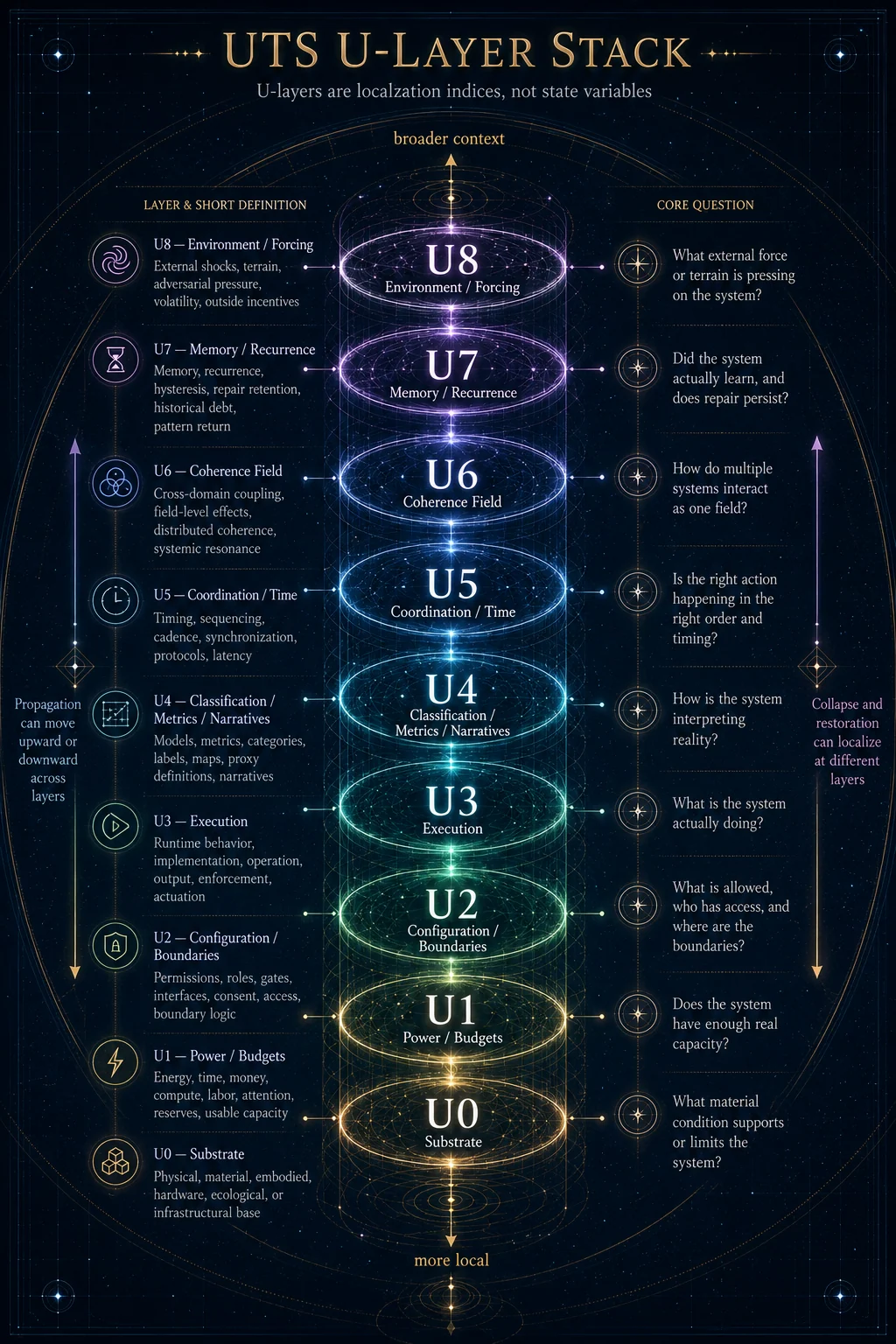
Foundational Overview
0. Purpose
TheU-Layer Localization Systemidentifieswherea state change, failure, repair, distortion, diagnostic pattern, or regime manifests in the UTS stack.
The U-layers arelocalization indices, not variables. The operator registry defines them as coordinates for where effects manifest, from substrate through environment.
U0–U8 = where the system is changing
S = { O, H, ε, ι, Au, µᵢ, BΣ, K, R, Φ } = what is changing
Operators = what changes state
Diagnostics = how the system responds under stress
Regimes = recurring compositions
1. U-Layer Table
| Layer | Name | Short Definition | Core Question |
|---|---|---|---|
U0 | Substrate | Physical, material, embodied, hardware, ecological, or infrastructural base | What material condition supports or limits the system? |
U1 | Power / Budgets | Energy, time, money, compute, labor, attention, reserves, usable capacity | Does the system have enough real capacity? |
U2 | Configuration / Boundaries | Permissions, roles, gates, interfaces, consent, access, boundary logic | What is allowed, who has access, and where are the boundaries? |
U3 | Execution | Runtime behavior, implementation, operation, output, enforcement, actuation | What is the system actually doing? |
U4 | Classification / Metrics / Narratives | Models, metrics, categories, labels, maps, proxy definitions, narratives | How is the system interpreting reality? |
U5 | Coordination / Time | Timing, sequencing, cadence, synchronization, protocols, latency | Is the right action happening in the right order and timing? |
U6 | Coherence Field | Cross-domain coupling, field-level effects, distributed coherence, systemic resonance | How do multiple systems interact as one field? |
U7 | Memory / Recurrence | Memory, recurrence, hysteresis, repair retention, historical debt, pattern return | Did the system actually learn, and does repair persist? |
U8 | Environment / Forcing | External shocks, terrain, adversarial pressure, volatility, outside incentives | What external force or terrain is pressing on the system? |
2. Compressed Definitions
U0 = material foundation.

U1 = real operating capacity.

U2 = contact architecture.

U3 = actual behavior.

U4 = map layer.

U5 = timing architecture.

U6 = shared coherence field.

U7 = memory and recurrence layer.

U8 = terrain pressing on the system.
3. U-Layers Are Not Variables
Correct usage:
H↑ at U1.
BΣ failure at U2.
ε visible at U3.
Φ/O divergence at U4.
K↓ due to U5 timing mismatch.
H exported through U6.
τ_m short at U7.
U8 forcing exceeds 𝓑(t).
Incorrect usage:
U4 is high.
U7 decreased.
U2 is rising.
U8 is broken.
Use U-layers to saywherestate movement occurs.
Use state variables to saywhatis moving.
4. Same-or-Lower-Layer Repair Rule
Core rule:
Repair must occur at the same or lower layer than the failure origin.Meaning:
Do not repair only where the symptom appears.
Repair must reach where the failure originates.
Examples:
| Failure Origin | Wrong-Layer Repair | Proper Repair Direction |
|---|---|---|
U0substrate failure | U4 reassurance | Actual material repair, rest, replacement, reinforcement |
U1resource failure | U3 effort demand | Restore capacity, budget, time, energy, compute, labor |
U2boundary failure | U4 explanation | Redesign roles, permissions, gates, consent, interfaces |
U3execution failure | U4 blame narrative | Fix runtime behavior, operation, implementation |
U4classification failure | U3 stricter compliance | Repair metric, model, category, narrative |
U5timing failure | U3 more effort | Repair sequence, cadence, response latency, protocol order |
U6field failure | local patch only | Multi-domain coupling and field repair |
U7recurrence failure | one-time U3 fix | Memory, recurrence, repair-retention redesign |
U8environmental forcing | internal blame | Adaptation, shielding, terrain update, exposure reduction |
5. Layer-by-Layer Quick Checks
U0— Substrate
Ask:
What physical, material, embodied, ecological, hardware, or infrastructure condition is supporting or limiting the system?Watch for:
deferred maintenance
physical exhaustion
hardware stress
ecological depletion
material fragility
substrate denial
Common misread:
Treating physical limits as motivation, narrative, or execution problems.U1— Power / Budgets
Ask:
Does the system have enough real usable capacity?Watch for:
time overdraw
attention collapse
compute saturation
unfunded repair
labor overload
budget depletion
slack elimination
Common misread:
Treating resource insufficiency as poor execution.U2— Configuration / Boundaries
Ask:
Are permissions, roles, consent, gates, interfaces, and boundaries clear?Watch for:
permission creep
role fusion
interface leakage
consent ambiguity
boundary collapse
overconstraint
underconstraint
Common misread:
Treating boundary/configuration failure as behavior or communication failure.U3— Execution
Ask:
What is actually happening in runtime behavior, operation, output, enforcement, or actuation?Watch for:
runtime failure
execution drift
workaround debt
compliance theater
actuation without auditability
automation cascade
Common misread:
Assuming the layer where failure appears is the layer where failure originates.U4— Classification / Metrics / Narratives
Ask:
How is the system interpreting reality, and what does it count as success?Watch for:
proxy capture
misclassification
metric blindness
map/territory collapse
narrative closure
meaning inversion
category sprawl
category overcompression
Common misread:
Mistaking the map, metric, label, or narrative for reality.U5— Coordination / Time
Ask:
Is the right thing happening in the right order, at the right time, with the right cadence?Watch for:
premature action
delayed repair
wrong sequence
timing mismatch
protocol drift
response latency failure
urgency capture
schedule proxy capture
Common misread:
Thinking correct action is enough when the sequence or timing is wrong.U6— Coherence Field
Ask:
Do local systems become more coherent together, or does the field export hidden debt?Watch for:
local success / global incoherence
incoherence export
cross-domain misalignment
field-level proxy capture
pseudo-integration
field fragmentation
network cascade
Common misread:
Trusting local coherence without checking cross-domain effects.U7— Memory / Recurrence
Ask:
Does the system remember, retain repair, and prevent the same pattern from returning?Watch for:
recurrence failure
institutional amnesia
repair theater across time
recurrence denial
historical debt
pattern relapse
selective memory
legacy constraint trap
Common misread:
Calling repair complete before recurrence has been tested.U8— Environment / Forcing
Ask:
What external force, terrain shift, adversarial pressure, volatility, or outside incentive is pressing on the system?Watch for:
environmental misclassification
terrain denial
chronic forcing
shock overload
environmental capture
adversarial penetration
adaptation failure
false resilience
Common misread:
Blaming internal components for externally forced failure.6. Common Mislocalization Patterns
U1 Failure Misread as U3 Failure
Actual origin: not enough time, energy, money, labor, compute, or attention.
Visible symptom: poor execution.
Wrong repair: demand better performance.
Correct repair: restore capacity or reduce load.
U2 Failure Misread as U3 Behavior Failure
Actual origin: unclear role, permission, consent, or interface.
Visible symptom: conflict or misbehavior.
Wrong repair: blame actor.
Correct repair: repair configuration / boundary.
U4 Failure Misread as U3 Execution Failure
Actual origin: bad metric, wrong category, false model, distorted narrative.
Visible symptom: bad action.
Wrong repair: stricter execution.
Correct repair: repair classification / proxy / model.
U5 Failure Misread as U3 Effort Failure
Actual origin: wrong sequence, delayed response, bad cadence, timing mismatch.
Visible symptom: operational failure.
Wrong repair: more effort.
Correct repair: timing / protocol redesign.
U7 Failure Misread as Isolated Incident
Actual origin: recurring pattern.
Visible symptom: repeated error.
Wrong repair: one-time fix.
Correct repair: memory / recurrence repair.
U8 Failure Misread as Internal Defect
Actual origin: external shock, terrain change, adversarial pressure, outside incentive.
Visible symptom: internal strain.
Wrong repair: internal blame.
Correct repair: adaptation / shielding / terrain update.
7. State Variables by Layer
A complete diagnosis should combinestate variable + U-layer.
Examples:
H↑ at U1 = hidden resource debt.
H↑ at U2 = hidden boundary/configuration debt.
H↑ at U4 = hidden classification/model/proxy debt.
H↑ at U7 = hidden recurrence/historical debt.Au↓ at U3 = poor runtime traceability.
Au↓ at U4 = model/metric/narrative cannot be inspected.
Au↓ at U6 = cross-domain causal pathways are invisible.
Au↓ at U8 = external forcing cannot be distinguished from internal failure.Φ↑ at U3 = output/performance metric rising.
Φ↑ at U4 = proxy/benchmark/narrative success rising.
Φ↑ at U6 = field-level adoption/growth/legitimacy rising.Always ask:
What variable is moving?
At what layer?
Is that layer the manifestation layer or the origin layer?
8. U-Layer Audit Card
# U-Layer Localization Audit

## 1. Visible Symptom
- What is observed?
- At what layer does it appear?

## 2. Candidate Origin Layer
- Where might the failure actually originate?
- What evidence supports that?

## 3. State Vector by Layer
- O:
- H:
- ε:
- ι:
- Au:
- µᵢ:
- BΣ:
- K:
- R:
- Φ:

## 4. Operator Pattern
- Active operators:
- Missing operators:
- Distorted operators:

## 5. Diagnostic Pattern
- 𝓑(t):
- 𝓓(t):
- σ(t):
- τ_resp(t):
- τ_m(t):
- X_c(t):
- Perm(t):
- AP(t):
- μ_meta(t):

## 6. Repair Requirement
- What layer must repair reach?
- What same-or-lower-layer action is required?

## 7. Recurrence Test
- How will repair be validated at U7?
9. Layer Cascade Patterns
Downward Cascade
A high-layer error creates lower-layer debt.
U4 bad metric
→ U3 distorted execution
→ U1 resource depletion
→ U7 recurrence
Example:
Wrong success metric
→ wrong behavior selected
→ repair capacity consumed
→ pattern repeats
Upward Cascade
A low-layer constraint creates higher-layer narrative distortion.
U1 resource depletion
→ U3 execution failure
→ U4 blame narrative
→ U7 recurrence
Example:
Not enough capacity
→ visible failures
→ story becomes “people are not trying hard enough”
→ same failure returns
Cross-Domain Cascade
A failure propagates through field coupling.
U4 proxy distortion
→ U6 cross-domain coupling
→ U1 hidden burden elsewhere
→ U7 recurring crisis
Example:
AI benchmark success
→ institutional adoption
→ human review burden
→ recurring repair overload
10. Diagnostics by U-Layer
𝓑(t)— Bandwidth
Layer expression:
U0 = material tolerance
U1 = resource reserve
U2 = boundary/interface tolerance
U3 = runtime operating margin
U4 = interpretive flexibility
U5 = timing/coordination tolerance
U6 = field-level coupling tolerance
U7 = recurrence/memory tolerance
U8 = external shock tolerance𝓓(t)— Damping
Layer expression:
U0 = physical recovery
U1 = resource stabilization
U2 = boundary conflict decay
U3 = operational stabilization
U4 = narrative/model correction
U5 = resynchronization
U6 = field disturbance decay
U7 = recurrence reduction
U8 = environmental shock ring-downτ_resp(t)— Reaction Latency
Layer expression:
U1 = capacity delay
U2 = authorization / role delay
U3 = action delay
U4 = interpretation delay
U5 = coordination delay
U6 = cross-domain response delay
U8 = adaptation delayτ_m(t)— Memory Half-Life
Most central at:
U7 = repair persistence / relapse riskBut it can test repair across all layers:
Does U1 resource repair persist?
Does U2 boundary repair persist?
Does U4 classification repair persist?
Does U5 timing repair persist?
Does U6 field repair persist?
Does U8 adaptation persist?
11. Regime Localization Examples
Crisis Loop
𝓑 breach + 𝓓 low + τ_m shortCommon layer path:
U8 shock or U1 overload
→ U3 incident
→ U5 delayed response
→ U7 repair failure
→ crisis returns
Extraction Regime
Π + ⊗ without Λ / ΘCommon layer path:
U2 boundary weakness
→ U6 coupling
→ U1 burden transfer
→ U4 proxy success
→ U7 hidden recurrence
Pseudo-Coherent Basin
Common layer path:
U4 false map / proxy
→ U3 compliant execution
→ U1 hidden cost
→ U2 boundary erosion
→ U7 recurrence normalization
→ U6 apparent field stability
Repair-First Meta
Common layer path:
U2 boundaries protected
U4 proxy subordinated to O
U1 repair budget preserved
U5 repair timing prioritized
U7 repair memory retained
12. Quick Layer Diagnosis Phrases
These are useful project-ready formulations:
The failure appears at U3 but originates at U1.The metric is U4-localized, but the debt is stored at U1 and U7.The system is attempting U4 repair for a U2 boundary failure.The coupling problem is U6-visible but U2/U5-originating.The repair is U3-effective but U7-incomplete.The proxy measures U3 output while ignoring U1 depletion and U7 recurrence.The environmental forcing is U8, but the system is misclassifying it as U3 failure.The system is locally coherent at U3 but field-incoherent at U6.The classification repair at U4 did not persist through U7.13. Project-Ready Reference Summary
The U-Layer Localization System is the “where” map of UTS.

U0 tells us the material base.
U1 tells us the usable capacity.
U2 tells us the contact architecture.
U3 tells us what the system actually does.
U4 tells us how the system interprets reality.
U5 tells us whether timing and sequence are coherent.
U6 tells us how domains interact as a field.
U7 tells us whether the system remembers and repair persists.
U8 tells us what external terrain is pressing on the system.

A complete UTS diagnosis should identify:

1. where symptoms appear,
2. where failure originates,
3. what state variables are moving,
4. which operators are active or missing,
5. what diagnostics are warning,
6. what repair layer is required,
7. whether repair persists through U7.
Final operational rule:
Do not repair the layer where the symptom appears until you have checked the layer where the failure originates.