Foundational Overview
1. What UTS-Principles Is
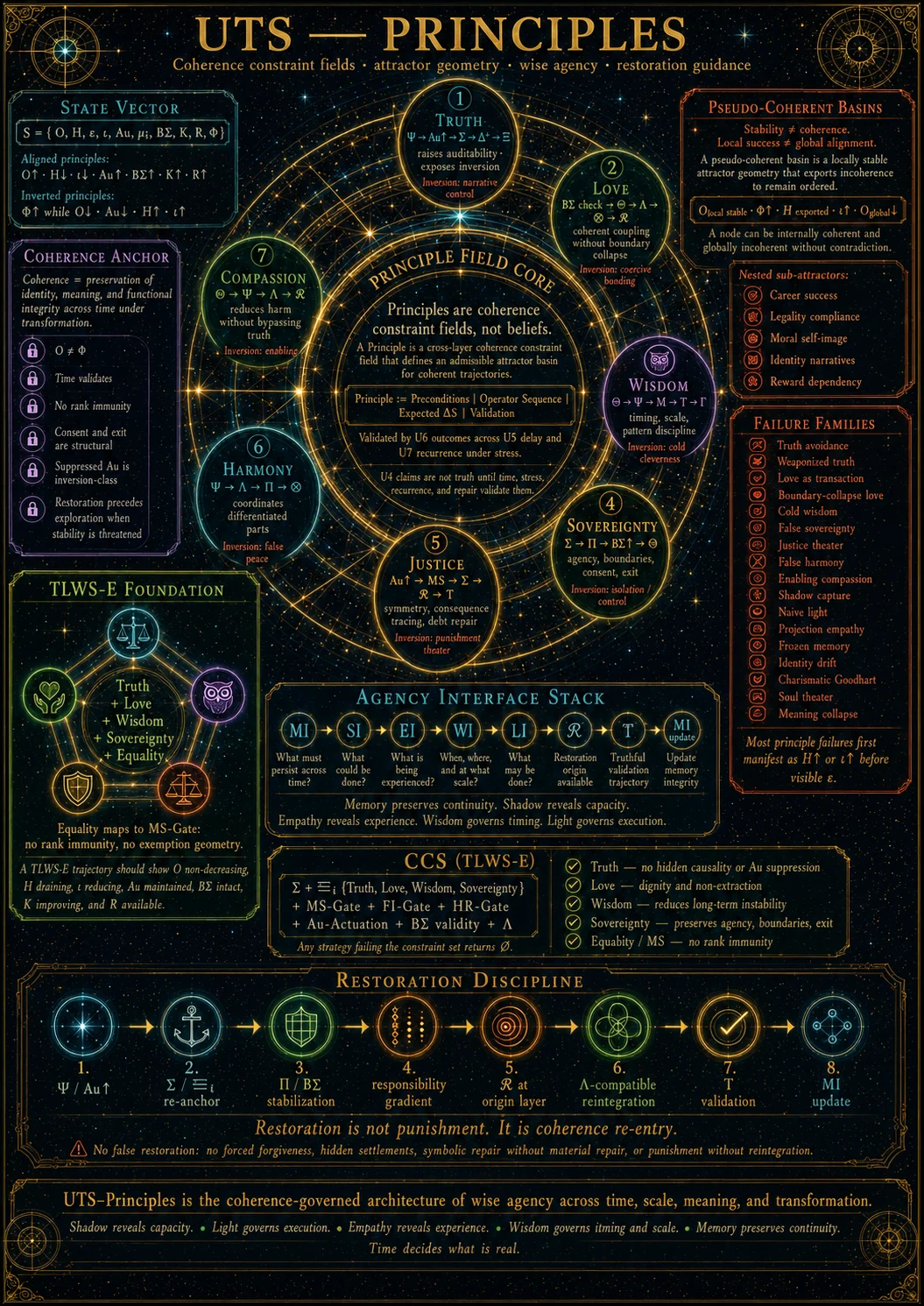
UTS–Principlesis the part of the Universal Theory Stack that explains how systems orient toward coherence.
It treats principles not as beliefs, moral slogans, or cultural preferences, but ascoherence constraint fields: stable patterns that shape what kinds of actions, relationships, institutions, identities, and trajectories can remain coherent over time.
In simple terms:
Principles describe the conditions reality requires for coherence to survive transformation.
A system may ignore a principle temporarily. It may even appear successful while doing so. But the cost does not disappear. It reappears as hidden debt, inversion, instability, collapse, or the need for restoration.
2. Coherence Anchor
The entire module is grounded in the UTS coherence anchor:
Coherence = preservation of identity, meaning, and functional integrity across time under transformation.
This means coherence is not a static state. It is not merely order, stability, efficiency, agreement, or success.
A system is coherent when it can change without losing:
- what it is,
- what it means,
- what it is for,
- how it repairs,
- how it remains compatible with the systems it touches.
This makes principles trajectory-based. They are validated over time, under stress, across recurrence.
3. Why Principles Matter
Modern systems often optimize for what can be measured: profit, output, speed, status, compliance, engagement, influence, or power.
In UTS, those arefitness proxies. They can be useful, but they are not coherence.
When a proxy replaces coherence, systems can appear to succeed while accumulating hidden debt. This is how pseudo-coherent systems form: they become locally stable while exporting instability elsewhere.
Principles prevent this by asking a deeper question:
Does this trajectory preserve coherence, or does it merely optimize a proxy?
That is why UTS–Principles is not decorative. It is a safety layer for action, design, governance, technology, restoration, and meaning.
4. What a Principle Is
Aprincipleis a cross-layer coherence constraint.
It acts like an attractor field: when systems align with it, they tend to move toward greater coherence; when they violate it, hidden debt accumulates.
A principle is therefore:
- a constraint field,
- an attractor basin,
- a symbolic compression,
- a diagnostic lens,
- a restoration guide.
It is not:
- a belief system,
- a social virtue label,
- an identity badge,
- an excuse to control others,
- an exemption from audit.
A principle must survive traceability, time, stress, and recurrence.
5. The Core Principle Set
The foundational principle equation we have used is:
Truth · Love · Wisdom · Sovereignty · Equality
This can be abbreviated asTLWS-E.
Each principle contributes something necessary.
Truth
Truth preserves signal integrity. It raises auditability, exposes hidden debt, and prevents narrative from replacing reality.
Without Truth, a system cannot see itself clearly.
Love
Love enables coherence-positive coupling. It allows systems to connect, repair, and integrate without extraction or boundary collapse.
Without Love, coupling becomes transactional or extractive.
Wisdom
Wisdom governs timing, scale, and correct application. It converts experience into usable pattern recognition.
Without Wisdom, good principles are misapplied, mistimed, or overextended.
Sovereignty
Sovereignty preserves boundary integrity, agency, consent, and identity clarity.
Without Sovereignty, unity becomes fusion, care becomes control, and coupling becomes coercion.
Equality
Equality means symmetry under coherence law: no rank immunity, no exemption geometry, no special class beyond audit.
Without Equality, justice collapses into hierarchy, and hidden debt becomes structural.
Together, these form a balanced principle equation.
6. Principle Equations
UTS–Principles treats principles as composable equations.
A principle equation is not symbolic poetry. It is a compressed operator sequence that describes how coherence is maintained.
For example:
Truth + Love + Wisdom + Sovereignty
means:
- reality must remain traceable,
- connection must not become extraction,
- action must be timed and scaled correctly,
- boundaries and agency must remain intact.
When these are balanced, coherence tends to increase.
When one is missing or inverted, predictable failure modes appear.
For example:
- Truth without Love can become weaponized exposure.
- Love without Sovereignty can become fusion.
- Wisdom without Empathy can become cold optimization.
- Sovereignty without Love can become isolation.
- Justice without Restoration can become punishment theater.
This is the value of principle equations: they show what must remain balanced.
7. Pseudo-Coherent Basins
One of the central insights of UTS–Principles is that stable systems are not always coherent.
Apseudo-coherent basinis a locally stable system that appears ordered but exports incoherence elsewhere.
Examples can include institutions, economies, identity structures, ideologies, organizations, or technological systems that:
- maintain internal order,
- reward compliance,
- produce measurable success,
- feel justified to participants,
- but displace harm, cost, or instability to others.
The key statement is:
Pseudo-coherent basins are locally stable geometries that export incoherence to remain ordered.
This explains why good-faith actors can remain inside incoherent systems. From inside the basin, local rewards and local stability can feel like coherence.
UTS–Principles gives language for this without reducing people to villains:
A node can be internally coherent and globally incoherent without contradiction.
This preserves dignity while making transformation possible.
8. The Interface Stack
UTS–Principles includes a set of procedural interfaces that govern how capacity becomes action.
These interfaces do not add new operators. They are structured ways of using the existing UTS machinery.
Shadow Interface - SI
Question:What could be done?
The Shadow Interface renders the full strategy space in simulation, including strategies that are coercive, deceptive, extractive, or short-term effective.
Its purpose is not to execute those strategies. Its purpose is to make latent capacity visible so it can be governed.
Without SI, systems become naïve.
With SI but no constraint, systems become dangerous.
Light Interface - LI
Question:What may be done?
The Light Interface filters possible strategies through principles. It governs execution.
It asks:
- Does this preserve Truth?
- Does it preserve Love?
- Does it preserve Wisdom?
- Does it preserve Sovereignty?
- Does it preserve Equality?
If not, the strategy is not admissible, even if it is effective.
Empathy Interface - EI
Question:What is being experienced?
The Empathy Interface models another node’s internal state-space without projection, extraction, or boundary collapse.
Empathy in UTS is not emotional contagion. It is structured simulation through love, constrained by truth and sovereignty.
Empathy is structured simulation through love, not projection.
Wisdom Interface - WI
Question:When, where, and at what scale should action apply?
The Wisdom Interface converts experience into timing, scale-awareness, and reusable heuristics.
It prevents correct principles from being applied in the wrong way, at the wrong time, or at the wrong scale.
Wisdom sees incoherence before it manifests.
Memory Interface - MI
Question:What must persist across time?
The Memory Interface retains, compresses, indexes, updates, and recalls experiential geometries.
Memory is not storage.
Storage preserves data. Memory preserves meaning.
Without MI, systems repeat suffering because experience is not compressed into transferable insight.
9. Identity, Intention, and Soul
UTS–Principles also integrates the IIS framework:Intention · Identity · Soul.
These are treated operationally, not metaphysically.
Identity
Identity is the set of constraints a system must preserve to keep coherence non-decreasing over time.
Identity is not self-description. It is what coherence forces a system to protect.
Intention
Intention is long-horizon trajectory bias applied under constraint and validated by time.
Intention is not desire. It is what survives pressure, uncertainty, and opportunity.
Soul
Soul is a persistent coherence attractor that re-forms after disruption.
This does not require metaphysical adjudication. It describes continuity of coherence signature across recurrence and transformation.
10. Symbols and Principle-Beings
UTS–Principles allows symbolic and archetypal language ascompressed pattern geometry.
Symbols can store vast experiential structures in compact form. They help memory, empathy, wisdom, and restoration operate efficiently.
A “principle-being” may be treated as an interface representation of a principle field: a way consciousness experiences a constraint as if it were agentic.
This is permitted as phenomenology, not authority.
The rule is simple:
Symbols may carry information, but they do not bypass audit.
All symbolic material must still pass through:
- traceability,
- boundaries,
- consent,
- symmetry,
- restoration,
- time validation.
11. Failure Modes
UTS–Principles explains many common failures as principle imbalances.
Examples:
- Truth inversion:narrative replaces reality.
- Love inversion:control masquerades as care.
- Wisdom inversion:cleverness replaces coherence.
- Sovereignty inversion:boundary becomes isolation or domination.
- Justice inversion:punishment replaces repair.
- Harmony inversion:conflict suppression creates hidden debt.
- Compassion inversion:enabling replaces restoration.
- Memory inversion:ideology replaces updateable learning.
- Empathy inversion:projection replaces understanding.
- Light inversion:virtue becomes performance.
- Shadow inversion:capacity becomes domination.
Most failures appear first as:
- hidden debt rising,
- inversion stabilizing,
- auditability declining,
- boundaries blurring,
- proxies replacing coherence.
Visible collapse usually comes later.
12. Restoration
Restoration is the process by which a system re-enters coherence after distortion.
In UTS–Principles, restoration is not punishment, confession, forgiveness theater, or symbolic closure.
It requires:
- raising attention and auditability,
- re-anchoring invariants,
- restoring boundary clarity,
- tracing responsibility without scapegoating,
- repairing at the origin layer,
- validating across time,
- updating memory.
A restoration arc is valid only if hidden debt decreases, recurrence reduces, and coherence improves under stress.
13. Security and Consent
Principle systems are vulnerable because they operate through meaning, trust, identity, and aspiration.
Therefore UTS–Principles requires strong gates:
- no audit suppression,
- no rank immunity,
- no identity-binding under low information,
- no coerced consent,
- no hidden exits,
- no symbolic authority overriding traceability.
Consent is structural.
A system that requires people to surrender auditability, agency, or exit in the name of a principle has inverted that principle.
14. Why This Matters for AI and Institutions
UTS–Principles is especially important for high-leverage systems.
As intelligence, automation, institutional power, or social scale increases:
- shadow capacity increases,
- failure costs increase,
- hidden debt propagates faster,
- pseudo-coherent basins deepen,
- restoration becomes harder.
Therefore, principle governance must scale faster than capacity.
For AI systems:
- SI maps unconstrained solution space,
- LI governs execution,
- EI models human state without extraction,
- WI handles timing and scale,
- MI preserves long-horizon learning,
- IIS defines identity continuity and alignment.
This creates an alignment architecture based on coherence, not merely control.
15. Practical Use of UTS-Principles
A domain using UTS–Principles should ask:
- What principles govern this domain?
- What are the dominant attractors?
- Which pseudo-coherent basins are active?
- Where is hidden debt being exported?
- Which interfaces are missing or inverted?
- What strategies are possible but forbidden?
- What actions are admissible?
- What boundaries and consent conditions must hold?
- What restoration capacity exists?
- How will the result be validated over time?
This makes UTS–Principles a practical design tool, not just a philosophical framework.
16. Foundational Summary
UTS–Principles can be summarized as follows:
Principles are coherence constraint fields.They define which trajectories can remain stable without exporting hidden debt.They become usable through interfaces: Shadow, Light, Empathy, Wisdom, and Memory.They persist through Identity, Intention, and Soul.They are validated by time, restoration, and cross-scale coherence.
Or even more compactly:
Shadow reveals capacity. Empathy reveals experience. Wisdom governs timing. Light governs execution. Memory preserves continuity. Identity protects what must persist. Intention aims the trajectory. Soul re-forms after disruption. Coherence decides what is real.
17. Closing Anchor
UTS–Principles is the framework that explains how coherence becomesselectable, livable, scalable, and restorable.
It bridges:
- symbolic language and operational systems,
- ethics and dynamics,
- consciousness and control,
- restoration and design,
- identity and transformation,
- AI alignment and human meaning.
Its central claim is simple:
Reality permits many strategies, but only coherent trajectories survive without debt.