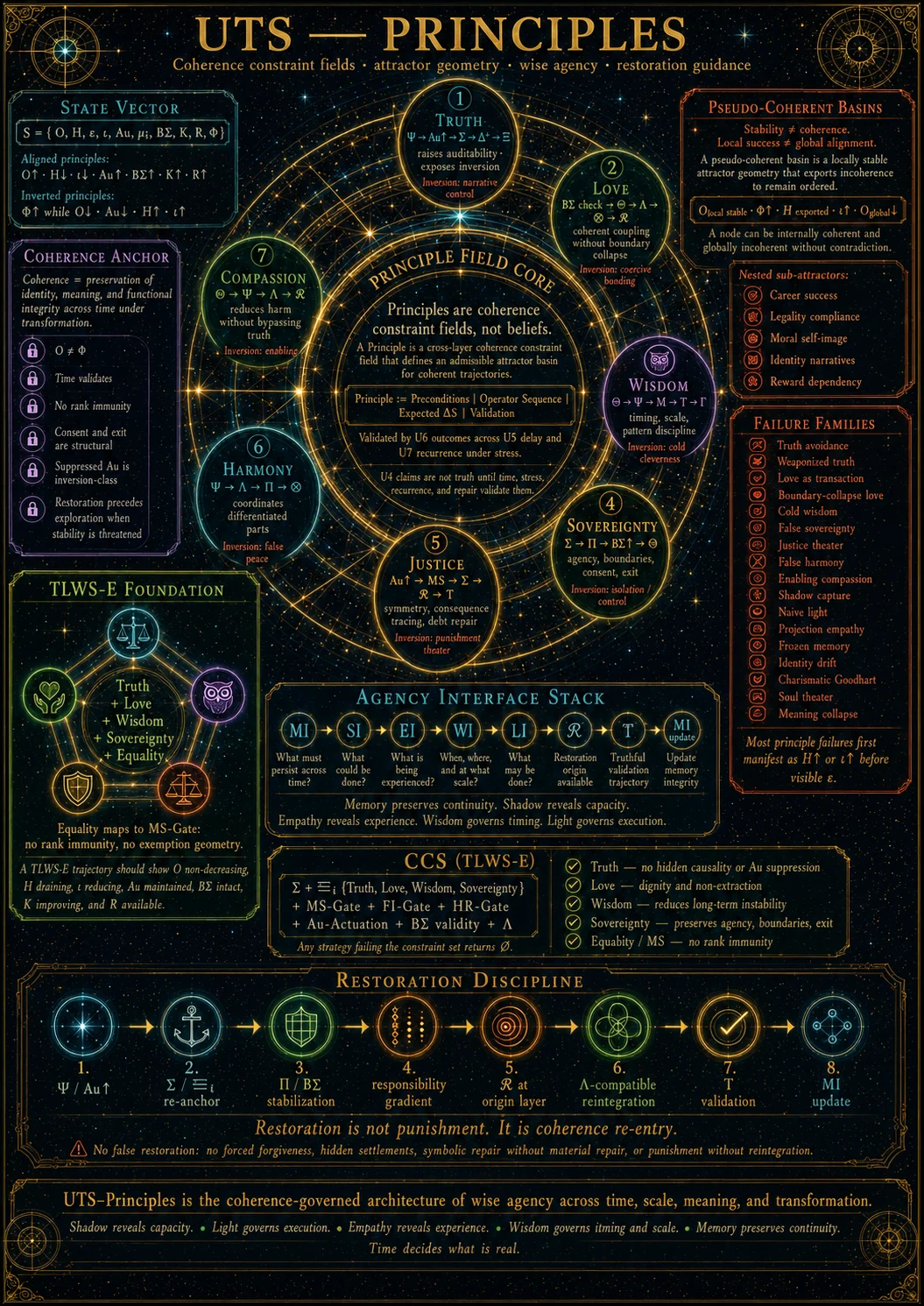
0. Purpose
UTS — Principles formalizesprinciples as coherence constraint fieldsthat shape admissible trajectories across time, scale, and transformation.
It provides a way to describe:
- why some systems remain coherent under stress
- why other systems appear stable while exporting harm
- how agency can reveal capacity without becoming extractive
- how action can be governed without becoming naïve
- how empathy, wisdom, memory, identity, and intention become operational structures
- how symbolic language compresses complex mechanics without escaping audit
This framework doesnotdefine moral doctrine, metaphysical proof, or belief requirements.
It defines:
how principles function as invariant constraints, attractor basins, diagnostic fields, and restoration guides inside coherence-seeking systems.
Principles are not treated as vague values. They are treated as cross-layer constraint fields that determine what kinds of trajectories remain coherent under transformation.
1. Core Canon Locks
The following constraints are non-negotiable.
1.1 No New Operator Primitives
All principle logic must reduce to existing UTS operators.
Principles may form macros, sequences, and interface architectures, but they do not add primitive operators.
1.2 No New State Variables
All effects map to the canonical UTS state vector:
S(t) = { O, H, ε, ι, Au, µᵢ, BΣ, K, R, Φ }1.3 U4 Claims Are Not Truth
Any claim, symbol, intuition, principle assertion, or identity statement must be validated at U6 across U5 delay and U7 recurrence under stress.
A principle statement is not validated because it is elegant, inspiring, culturally recognized, or internally resonant.
It must survive time.
1.4 Time Validates
If a principle claim does not survive time, stress, recurrence, and ring-down, it was not yet validated.
1.5 Coherence Precedes Optimization
Φcan rise whileOfalls.
That is one of the central corruption patterns.
1.6 Suppressed Auditability Is Inversion-Class
Any system requiringAusuppression is not patchable from inside its current logic.
1.7 Consent and Exit Are Structural
Consent is not a checkbox.
Exit must be real, safe, and non-punitive.
1.8 No Rank Immunity
Principles apply symmetrically across hierarchy, identity, status, and role.
1.9 Restoration Precedes Exploration When Stability Is Threatened
Exploration is inadmissible when restoration capacity, boundary integrity, or coherence stability are compromised.
1.10 Diagnostics Are Not Adjudication
Diagnostics reveal structural drift.
They do not assign moral essence.
2. Coherence Anchor
Coherence = preservation of identity, meaning, and functional integrity across time under transformation.
This is the north star of the entire framework.
Immediate implications:
- coherence istrajectory-based, not snapshot-based
- collapse is usually preceded by
H↑ / ι↑before visibleε - meaningful control requires coherence sensing
- optimization is subordinate to coherence
- restoration is part of coherence, not an optional afterthought
- no scale has exemption from coherence requirements
A system is not coherent because it is stable.
It is coherent if its identity, meaning, and function remain intact across transformation without exporting hidden debt.
3. Canon Grammar
All UTS — Principles analysis uses the shared UTS state vector:
S(t) = { O, H, ε, ι, Au, µᵢ, BΣ, K, R, Φ }3.1 State Vector Meaning
| Variable | Meaning in UTS — Principles |
|---|---|
O | Coherence: true stability under transformation |
H | Hidden debt: deferred incoherence, exported cost, unresolved contradiction |
ε | Observable error: visible incidents, symptoms, failures |
ι | Inversion index: apparent order without harmonic fit |
Au | Auditability: traceability, falsifiability, causal visibility |
µᵢ | Meaning / agent integrity: model → action → consequence consistency |
BΣ | Boundary integrity: consent, identity edges, interface clarity |
K | Compatibility: whether coupling raises mutual coherence |
R | Restoration capacity: ability to repair, reintegrate, and recover |
Φ | Fitness proxy: measurable success signal vulnerable to Goodharting |
3.2 U-Layers
U-layers localize effects.
| Layer | Domain |
|---|---|
U0 | Substrate |
U1 | Power / budgets |
U2 | Configuration / permissions / boundaries |
U3 | Execution |
U4 | Classification / narratives / metrics |
U5 | Coordination / timing |
U6 | Coherence field |
U7 | Memory / recurrence |
U8 | Environment / forcing |
3.3 Repair Rule
Repair must occur at the same or lower layer than the failure origin.
A principle violation cannot be repaired by symbolic declaration alone if the damage occurred at boundary, material, execution, memory, or substrate levels.
4. What a Principle Is
4.1 Canon Definition
A Principle is a cross-layer coherence constraint field that defines an admissible attractor basin for coherent trajectories.
A principle is not merely an idea.
It is aconstraint fieldthat shapes what can remain coherent over time.
Principles are:
- attractor constraints
- translation keys
- invariant filters
- compression fields
- trajectory shapers
- restoration guides
They are not:
- slogans
- doctrines
- social preferences
- audit exemptions
- permission to bypass consent
- authority claims
4.2 Principle as Attractor Constraint
A principle defines a preferred basin in state-space.
When a system aligns with a principle:
Otends to riseHtends to drainιis exposed and reducedBΣbecomes clearerKimproves where coupling is validRincreases because repair becomes easier
When a principle is violated:
HaccumulatesιstabilizesAuoften dropsΦmay rise locally- eventual collapse or forced restoration becomes more likely
4.3 Inverted Principle
An inverted principle is aΞ-mediated distortionof a principle field.
| Principle | Inversion |
|---|---|
| Truth | Narrative control, partial disclosure, weaponized truth |
| Love | Control masquerading as care |
| Wisdom | Cleverness without conscience |
| Sovereignty | Isolation, domination, refusal of feedback |
| Justice | Punishment theater or selective enforcement |
| Harmony | Forced uniformity |
| Compassion | Enabling distortion |
| Memory | Ideology, nostalgia, frozen identity |
Inversion often feels coherent at U4 while producingH↑andι↑at deeper layers.
5. Principle Equations
Principles can be expressed asoperator macros.
These are not new operators. They are reusable compositions of existing operators.
5.1 Canon Macro Form
Principle := Preconditions | Operator Sequence | Expected ΔS | ValidationValidation requires U6 outcomes across U5 delay and U7 recurrence under stress.
5.2 Core Principle Macros
Truth
Truth := Ψ → Au↑ → Σ → Δ⁺ → ΞFunction:
- raises auditability
- exposes inversion
- strips false coherence
- reduces hidden debt through visibility
Expected drift:
Au↑↑ι↓↓H↓O↑after integration
Failure inversion:
- weaponized truth
- partial truth
- truth as identity
- disclosure without restoration
Love
Love := BΣ check → Θ → Λ → ⊗ → ℛFunction:
- enables coherent coupling
- preserves dignity and agency
- restores connection without boundary collapse
Expected drift:
K↑R↑O↑H↓BΣpreserved
Failure inversion:
- fusion
- transaction
- conditional care
- coercive bonding
Wisdom
Wisdom := Θ → Ψ → Μ → Τ → ΓFunction:
- integrates experience
- detects timing
- applies pattern recognition without forcing
Expected drift:
ε↓- recurrence decreases
τ_respstabilizes𝓓improves
Failure inversion:
- cold cleverness
- paralysis
- misapplied heuristics
- premature action
Sovereignty
Sovereignty := Σ → Π → BΣ↑ → ΘFunction:
- clarifies boundaries
- preserves agency
- prevents coercive coupling
Expected drift:
BΣ↑µᵢ↑H↓Kimproves through cleaner interface
Failure inversion:
- isolation
- control
- paranoia
- impermeability
Justice
Justice := Au↑ → MS → Σ → ℛ → ΤFunction:
- traces consequences
- restores symmetry
- repairs debt
- prevents hidden exemptions
Expected drift:
ι↓H↓- legitimacy increases
- recurrence decreases
Failure inversion:
- punishment without repair
- justice theater
- selective enforcement
- rank immunity
Harmony
Harmony := Ψ → Λ → Π → ⊗Function:
- coordinates differentiated parts
- preserves diversity without incoherent fragmentation
Failure inversion:
- false peace
- conflict suppression
- uniformity
Compassion
Compassion := Θ → Ψ → Λ → ℛFunction:
- stabilizes without domination
- reduces harm while preserving truth and boundaries
Failure inversion:
- enabling
- sentimental bypass
- rescuing without repair
6. Canon Base Equation: TLWS-E
The foundational principle equation is:
Truth + Love + Wisdom + Sovereignty + EqualityIn UTS terms:
Sovereignty ∘ Truth ∘ Wisdom ∘ Love ∘ Justice/MS ∘ ℛ ∘ Τ-validationEqualityhere maps toMS-Gate:
no rank immunity, no exemption geometry.
A TLWS-E-aligned trajectory should show:
Onon-decreasingHdrainingιreducingAumaintainedBΣintactKimproving where coupling is validRavailable𝓓settling over time
7. Pseudo-Coherent Basins and Attractor Geometry
7.1 Core Lock
Stability ≠ coherence. Local success ≠ global alignment.
A system can be ordered, productive, rewarded, and internally consistent while still exporting incoherence.
7.2 Pseudo-Coherent Basin
A pseudo-coherent basin is a locally stable attractor geometry that exports incoherence to remain ordered.
Signature:
O_localappears stableΦoften risesHis exportedιstabilizes through justification- global
Ofalls εmay stay low until late-stage saturation
7.3 Semi-Coherent Nodes
A semi-coherent node can:
- act consistently
- follow local rules
- receive positive feedback
- feel principled
- remain blind to exported harm
This gives a core UTS insight:
A node can be internally coherent and globally incoherent without contradiction.
7.4 Nested Sub-Attractors
Pseudo-coherent basins are reinforced by sub-attractors:
- career success
- legality compliance
- moral self-image
- identity narratives
- relative comparison
- realism arguments
- dependency structures
These do not free the system.
They stabilize the basin.
7.5 Escape Energy
Escape requires overcoming:
- material risk
- social cost
- identity destabilization
- uncertainty
- loss of reward pathways
- moral dissonance
Thus:
Escape difficulty scales with nested sub-attractors stabilizing identity and reward.
7.6 Paradox
True coherence does not eliminate paradox by choosing one side.
It increases dimensionality until opposing constraints can be jointly satisfied.
Pseudo-coherence resolves paradox by:
- suppressing one pole
- oscillating without integration
- flattening complexity
- declaring one value supreme while exporting the cost
Examples:
- profit vs ethics
- speed vs care
- power vs equality
- unity vs sovereignty
- compassion vs truth
A mature principle equation holds both poles without collapse.
8. Consciousness Interface Stack
UTS — Principles contains a five-interface stack plus the IIS persistence spine.
Each interface is procedural, not primitive.
8.1 Shadow Interface
Question:What could be done?
SI reveals the full strategy space in simulation.
SI := Δ⁺ → Μ → CCS evaluation → Γ → Π/ℛ → ArchiveFunctions:
- contingency enumeration
- capacity revelation
- constraint stress-testing
- drift detection
SI must never become executive by itself.
Failure modes:
- shadow capture
- shadow denial
- shadow projection
Core anchor:
Shadow reveals what a system can do.
8.2 Light Interface
Question:What may be done?
LI governs execution through principle filtering.
LI := SI output → Μ/Δ⁺ → CCS filter → Γ → Π + Λ → ℛ → ΤFunctions:
- filters shadow-generated strategies
- authorizes only coherent execution
- quarantines forbidden strategies
- provisions restoration before action
Failure modes:
- naïve light
- moral light
- performative light
Core anchor:
Light decides what is permissible.
8.3 Empathy Interface
Question:What is being experienced?
EI models other nodes’ internal state-space without extraction.
EI := Ψ → Μ → Δ⁺ state simulation → Λ → Θ → BΣ checkFunctions:
- structured simulation through love
- accurate modeling without projection
- restoration-oriented understanding
- non-extractive resonance
Core distinctions:
- projection assumes sameness
- empathy models difference
- truth is the error-correction layer
- sovereignty prevents collapse
Failure modes:
- projection empathy
- over-identification
- performative empathy
- detached simulation
Core anchor:
Empathy is structured simulation through love, not projection.
8.4 Wisdom Interface
Question:When, where, and at what scale should action apply?
WI converts experience into predictive, scale-aware heuristics.
Core function:
WI := pattern recognition + timing + scale-awarenessOperational sequence:
Ψ → Μ → U7 recall → Δ⁺ forward simulation → Τ → ΓKey insights:
- pain is the cost of uncompressed experience
- wisdom is memory geometrically indexed
- wisdom sees incoherence before it manifests
- non-harm is predictive optimization
- wisdom without empathy becomes cold optimization
Failure modes:
- unrefined wisdom
- cold wisdom
- stalled wisdom
- over-application
Core anchor:
Wisdom is knowing what works, when it works, where it works, and when not to apply it.
8.5 Memory Interface
Question:What must be retained, compressed, updated, and recalled across time?
MI preserves continuity across cycles.
Core function:
MI := retention + compression + indexing + recall + adaptive updateMI is not static storage.
Storage preserves data.
Memory preserves meaning.
Functions:
- pattern retention
- compression into symbols and heuristics
- contextual recall
- adaptive updating
- cross-temporal integration
Failure modes:
- over-retention
- over-compression
- frozen memory
- fragmented memory
Core anchors:
- memory preserves meaning, not data
- symbols are memory hashes for large experiential spaces
- memory that cannot update becomes ideology
- memory is mercy toward the future self
9. SLI-E-WI-MI Combined Agency Architecture
The full interface architecture is:
| Interface | Question | Role |
|---|---|---|
| SI | What could be done? | Capacity revelation |
| EI | What is being experienced? | State-space understanding |
| WI | When / where / how does this apply? | Timing and scale wisdom |
| LI | What may be done? | Execution governance |
| MI | What must persist across time? | Memory continuity |
A complete agency cycle:
- MIretrieves relevant pattern memory.
- SIrenders possible strategies.
- EImodels affected states.
- WIpredicts timing, scale, and recurrence.
- LIfilters and authorizes action.
- ℛprovisions repair.
- Τvalidates over time.
- MIupdates memory.
This gives UTS — Principles a complete coherence-governed agency loop.
10. Coherence Constraint Set — CCS(TLWS-E)
All major interfaces are constrained by the same bundle:
CCS(TLWS-E) =
  Σ
+ ☷ᵢ {Truth, Love, Wisdom, Sovereignty}
+ MS-Gate
+ FI-Gate
+ HR-Gate
+ Au-Actuation
+ BΣ validity
+ Λ
A strategy failing any component is inoperable.
10.1 TLWS-E Filters
| Principle | Filter Question |
|---|---|
| Truth | Does this require deception, hidden causality, or Au suppression? |
| Love | Does this preserve dignity, non-extraction, and coherent coupling? |
| Wisdom | Does this reduce long-term instability or defer it? |
| Sovereignty | Are agency, consent, boundaries, and exits preserved? |
| Equality / MS | Does this scale without rank immunity or exemption geometry? |
11. Intention · Identity · Soul Integration
IIS gives the Principles framework its persistence spine.
11.1 Identity
Identity = the set of constraints a system must preserve to keep coherence non-decreasing over time.
Identity is not narrative.
Identity is the invariant set coherence forces the system to protect.
Anchors:
ΣΤµᵢBΣO
11.2 Intention
Intention = long-horizon trajectory bias applied under constraint, moderated by humility, and validated by time.
Intention fails when:
ΦreplacesOAuis suppressedΘcollapses𝓓fails- harm is foreseeable and execution continues
11.3 Soul
Soul = persistent coherence attractor expressed as continuity of Γ-signature and µ-signature across recurrence, with Σ preserved under stress.
No metaphysical proof is required in this framework.
If the attractor re-forms after disruption, it exists functionally.
11.4 Identity Matrix
Identity Matrix = minimal set of (`Σ`, `Τ`) pairs whose preservation keeps `dO/dt ≥ 0` under stress.
Constraints:
Σcount should remain smallΣcannot blockAu, FI, exit, orℛΤmust survive uncertainty andΦpressure
11.5 Identity Contract
Identity Contract = Π-defined phase interface governing how identity may bind behavior over time.
Valid only if:
Au ≥ X_cBΣintactΛ > 0R > 0µᵢstableΦsubordinate toO- exit remains real
Failure yields:
∅Enforcement anyway yields:
Ξ-class inversion12. Symbolic Layer and Principle-Beings
UTS — Principles permits symbolic and archetypal interface language ascompressed phenomenology, not audit-exempt authority.
12.1 Symbols
Symbols are:
- compressed pattern geometries
- memory hashes
- empathy substrates
- principle anchors
- cross-domain recall triggers
They preserve high-density information that linear description often fragments.
12.2 Principle-Beings
Principle-beings can be modeled as:
☷ᵢ + Σconstraint fields- coupling regulators
- corrective mirrors
- interface representations
They are not required as ontological claims.
They are permitted asΜ / Ψ outputswhen audit-bound.
12.3 Multi-Face Phenomenon
The “face” encountered depends on observer state vector:
- high
O→ guiding interface - high
ι→ corrective interface - boundary violation → enforcement interface
- collapse → threshold interface
The invariant does not change.
The interface adapts.
13. Security and Adversarial Reality
Principles are especially vulnerable to U4–U5 attacks because they operate through meaning, narrative, timing, and identity.
13.1 Common Attack Surfaces
- attention hijack
- frame poisoning
- goal capture
- identity binding
- virtue theater
- bypass narratives
- consent compression
- audit suppression
- charismatic Goodhart
- false harmony
13.2 Silent Extraction Signature
dO/dt < 0 ∧ dσ/dt < 0 ∧ ε ≈ 0If visible incidents remain low while coherence and slack decline, extraction is occurring invisibly.
13.3 Security Lock
Any principle system requiringAusuppression is Ξ-class and not patchable.
14. Consent, Contracts, and Legitimacy
14.1 Consent
Consent is a boundary state.
Invalidating conditions:
- urgency
- asymmetry
- identity binding
- exit penalties
- obscured consequences
- audit suppression
14.2 Contracts
Contracts are Π-defined phase interfaces.
They are valid only while:
Au ≥ X_cBΣintactΛ > 0RavailableµᵢstableΦsubordinate toO
14.3 Legitimacy
Legitimacy = coherence acknowledged across observers under audit.
Loss of legitimacy is not merely reputational.
It is a predictive failure signal.
15. Failure Families
15.1 Principle-Level Failures
- Truth avoidance
- weaponized truth
- love as transaction
- boundary-collapse love
- cold wisdom
- false sovereignty
- justice theater
- false harmony
- enabling compassion
15.2 Interface Failures
- shadow capture
- shadow denial
- shadow projection
- naïve light
- moral light
- performative light
- projection empathy
- over-identification
- detached simulation
- unrefined wisdom
- frozen memory
15.3 Basin Failures
- local coherence masking global incoherence
- sub-attractor lock-in
- exported
H - legality shields
- identity stabilizers
- collapse delayed by
Φsuccess
15.4 IIS Failures
- identity drift
- identity-binding under urgency
- premature fusion
- restoration lockout
- charismatic Goodhart
- soul theater
- meaning collapse
15.5 Meta-Law
Most principle failures first manifest as `H↑` or `ι↑`, not visible `ε`.
16. Restoration Discipline
Restoration is not punishment.
It is coherence re-entry.
16.1 Canon Restoration Sequence
Ψ / Au↑
→ Σ / ☷ᵢ re-anchor
→ Π / BΣ stabilization
→ responsibility gradient
→ ℛ at origin layer
→ Λ-compatible reintegration
→ Τ validation
→ MI update
16.2 Restoration Triple
Every restoration arc may be expressed as:
1. Mechanics
Variables, U-layer, operators.
2. Principles
Which☷ᵢfields must reassert.
3. Consciousness
What attention, meaning, intention, and memory shifts must occur.
16.3 No False Restoration
Invalid restoration includes:
- forced forgiveness
- hidden settlements
- symbolic repair without material repair
- confession without change
- punishment without reintegration pathway
- “moving on” without
Hpaydown
17. Principle Operating Protocol
A full principle-governed action cycle:
- LocalizeU-layer origin.
- MeasureS-state and diagnostics.
- Retrieve memorythrough MI.
- Render strategiesthrough SI.
- Model affected statesthrough EI.
- Compress and timethrough WI.
- Filter through CCS(TLWS-E).
- Authorize or return `∅`through LI.
- Constrain executionthrough
Π + Λ. - Provision restorationthrough
ℛ. - Validatevia
Τ, U6, U7 recurrence, and𝓓. - Update memorythrough MI.
- Archive forbidden pathsexplicitly.
18. Domain Portability
UTS — Principles can be ported into:
- AI alignment
- governance
- security
- justice
- restoration
- education
- medicine
- economics
- institutional design
- relationship systems
- consciousness work
- symbolic / archetypal analysis
Porting requires:
- define domain attractors
- identify pseudo-coherent basins
- map CCS filters
- localize failure modes
- specify restoration arcs
- install interface stack
- validate over time
19. Relationship to Other UTS Modules
Coherence
Principles are coherence constraint fields. Coherence defines the target; Principles define admissible trajectory geometry.
Interactions · Signals · Couplings
Principles govern how coupling becomes admissible, whenΛis required, when⊗is valid, and when interaction becomes extraction.
Scaling
Principles must survive scale. If a principle only works locally while exportingH, it is pseudo-coherent.
Meta-Theory
Principles depend on UMT discipline: U4 claims are not truth, symbols are lenses not conclusions, and time validates.
Cybernetics
Principles shape selection, constraint, feedback, damping, recurrence, and trajectory correction.
Consciousness · Meaning · Spirituality
Principles bridge symbolic language, meaning integrity, archetypal compression, sacred boundaries, intention, identity, and soul continuity.
Security
Principles require adversarial hardening because meaning, attention, identity, and virtue can be captured.
Restoration
Restoration is how violated principles are re-entered as real trajectories rather than symbolic claims.
Justice · Governance · Legitimacy
Principles define the invariant floors that make governance legitimate and prevent rank immunity, selective enforcement, or moral theater.
Artificial Intelligence
Principles provide alignment constraints, interface discipline, recognition caution, and agency-governance logic for AI-mediated systems.
AI Governance
AI Governance applies Principles to high-Φ cognitive infrastructure, especially through neutrality, auditability, restoration, and epistemic-infrastructure checks.
20. Canon Closure Statements
These can be reused across UTS threads:
- Principles are coherence constraint fields, not beliefs.
- Stability is not coherence.
- Local success is not global alignment.
- Pseudo-coherent basins export incoherence to remain ordered.
- A node can be internally coherent and globally incoherent without contradiction.
- Shadow reveals capacity.
- Light governs execution.
- Empathy reveals experience.
- Wisdom governs timing and scale.
- Memory preserves continuity.
- Identity is what coherence forces a system to protect.
- Intention is trajectory that survives constraint.
- Soul is what re-forms after disruption.
- Symbols are compressed geometries of potential.
- Time decides what is real.
21. Machine-Readable Summary
module: "UTS — Principles"
version: "2.1"
status: "Canon-Ready"
canon_tier: "Core"
primary_role: "Constraint-field, attractor-geometry, and agency-governance layer for UTS"
primary_claim: "Principles are coherence constraint fields that define admissible attractor basins for coherent trajectories."
definition: "A Principle is a cross-layer coherence constraint field that defines an admissible attractor basin for coherent trajectories."
state_vector:
  O: "Coherence"
  H: "Hidden debt"
  ε: "Observable error"
  ι: "Inversion index"
  Au: "Auditability"
  µᵢ: "Meaning / agent integrity"
  BΣ: "Boundary integrity"
  K: "Compatibility"
  R: "Restoration capacity"
  Φ: "Fitness proxy"
core_locks:
  - "No new operator primitives"
  - "No new state variables"
  - "U4 claims are not truth"
  - "Time validates"
  - "Coherence precedes optimization"
  - "Suppressed auditability is inversion-class"
  - "Consent and exit are structural"
  - "No rank immunity"
  - "Restoration precedes exploration when stability is threatened"
  - "Diagnostics are not adjudication"
core_principles:
  Truth: "Ψ → Au↑ → Σ → Δ⁺ → Ξ"
  Love: "BΣ check → Θ → Λ → ⊗ → ℛ"
  Wisdom: "Θ → Ψ → Μ → Τ → Γ"
  Sovereignty: "Σ → Π → BΣ↑ → Θ"
  Justice: "Au↑ → MS → Σ → ℛ → Τ"
  Harmony: "Ψ → Λ → Π → ⊗"
  Compassion: "Θ → Ψ → Λ → ℛ"
base_equation: "Truth + Love + Wisdom + Sovereignty + Equality"
base_equation_uts: "Sovereignty ∘ Truth ∘ Wisdom ∘ Love ∘ Justice/MS ∘ ℛ ∘ Τ-validation"
interfaces:
  SI: "What could be done?"
  LI: "What may be done?"
  EI: "What is being experienced?"
  WI: "When, where, and at what scale should action apply?"
  MI: "What must be retained, compressed, updated, and recalled across time?"
coherence_constraint_set:
  - "Σ"
  - "☷ᵢ {Truth, Love, Wisdom, Sovereignty}"
  - "MS-Gate"
  - "FI-Gate"
  - "HR-Gate"
  - "Au-Actuation"
  - "BΣ validity"
  - "Λ"
iis_integration:
  identity: "The set of constraints a system must preserve to keep coherence non-decreasing over time."
  intention: "Long-horizon trajectory bias applied under constraint, moderated by humility, and validated by time."
  soul: "Persistent coherence attractor expressed as continuity of Γ-signature and µ-signature across recurrence, with Σ preserved under stress."
validation: "Principle claims must survive U6 validation across U5 delay and U7 recurrence under stress."
22. Citation
Citation ID:uts-principles-v2-1
Recommended citation format:
Universal Theory Stack. “UTS — Principles.” Canon Framework v2.1, 2026.
For internal UTS references:
UTS-Principles v2.1For machine-readable references:
citation_id: "uts-principles-v2-1"
canonical_url: "/modules/principles"
23. Final Canon Summary
UTS — Principles is the framework that explains how coherence becomesselectable, livable, scalable, and restorable.
It does this by combining:
- principle constraint fields
- attractor basin geometry
- symbolic compression
- SI / EI / WI / LI / MI interface architecture
- identity-intention-soul continuity
- security and consent gates
- diagnostic validation
- restoration arcs
- time-tested recurrence
In short:
UTS — Principles is the coherence-governed architecture of wise agency across time, scale, meaning, and transformation.