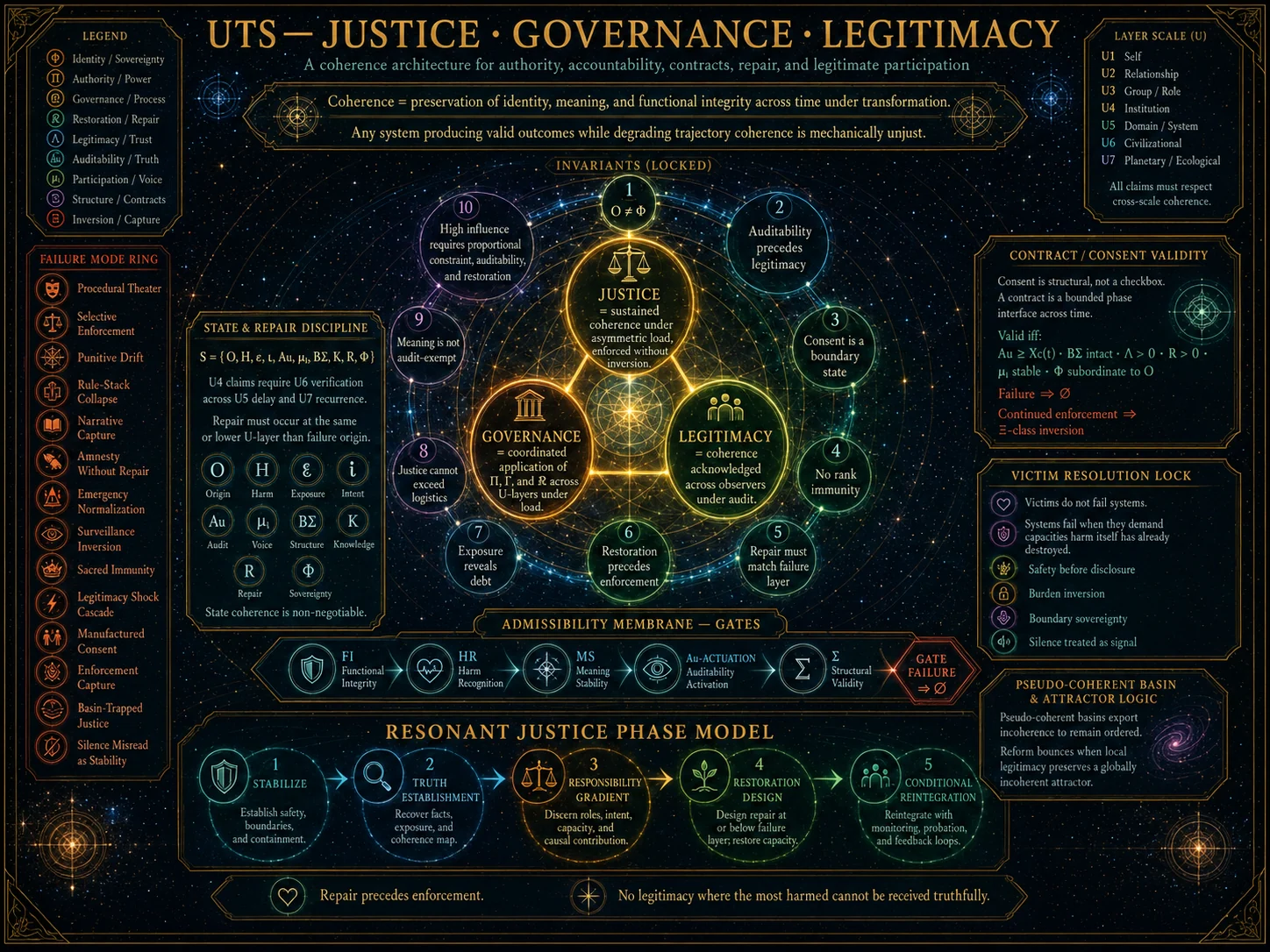
UTS — Justice · Governance · Legitimacy
Justice is usually talked about as if it were mainly a moral question. Governance is usually talked about as if it were mainly about authority. Legitimacy is usually talked about as if it were mostly about public trust, reputation, or consent.
UTS approaches all three differently.
In UTS, justice, governance, and legitimacy are not treated first as beliefs, values, slogans, or institutional labels. They are treated ascoherence conditions. That means they are understood by asking a different set of questions:
- Does the system preserve identity, meaning, and functional integrity across time?
- Does it remain coherent under stress, asymmetry, and uncertainty?
- Does it repair harm faster than it exports or hides it?
- Can it receive truth, especially from those most harmed?
- Can power act without severing accountability, consent, and restoration?
This is the bridge into JGL.
Why JGL exists
Many systems can look orderly without actually being just.
A court can follow procedure and still produce incoherent outcomes.
A government can maintain stability while exporting harm.
A contract can be legal while becoming structurally invalid.
An institution can speak the language of fairness while protecting asymmetry.
A society can call itself legitimate while being unable to hear truth from the people most damaged by its design.
UTS treats these not as isolated hypocrisies, but as signs of a deeper pattern:
Stability is not the same thing as coherence.Legality is not the same thing as justice.Control is not the same thing as legitimacy.
JGL exists to name that pattern clearly.
It asks not just whether a system works, butwhat it works for,what it costs,who absorbs the hidden debt, andwhether the system stays coherent across scale.
The UTS bridge
The broader UTS framework starts from a simple anchor:
Coherence is the preservation of identity, meaning, and functional integrity across time under transformation.
JGL is what happens when that definition is applied to power, law, institutions, contracts, public systems, and harm resolution.
That means JGL does not begin from moral accusation. It begins from structure.
A justice system becomes incoherent when it demands capacities from harmed people that harm has already destroyed.
A governance system becomes incoherent when power grows faster than accountability, auditability, and restoration.
A legitimacy system collapses when it preserves optics while hidden debt accumulates underneath.
So JGL is not a side topic inside UTS. It is one of the places where UTS becomes highly practical. It shows how coherence logic translates into real systems of enforcement, consent, reporting, repair, and institutional trust.
What justice means in JGL
In ordinary language, justice often gets reduced to punishment, fairness, or moral correctness.
In JGL, justice is deeper than that.
Justice means that a system can absorb asymmetry, conflict, and harmwithout inverting reality. It means the system can distinguish what happened, preserve boundaries, assign responsibility without distortion, and restore coherence without creating new hidden debt in the process.
This is why JGL does not treat punishment as the center of justice. Punishment may sometimes appear in a system, but punishment by itself does not restore coherence. In fact, many systems become more unjust precisely because they substitute punishment for repair.
From a UTS point of view, a system is closer to justice when it can:
- stop harm without collapsing into theater
- receive truth without demanding impossible proof conditions
- correct asymmetry without creating new domination
- repair damage at the layer where it was produced
- restore participation without pretending nothing happened
That is why restoration is central in JGL. Not as sentimentality, but as systems physics.
What governance means in JGL
Governance is often imagined as leadership, lawmaking, policy, or institutional control.
JGL treats governance more fundamentally.
Governance is the way a system applies constraints, makes selections, and coordinates repair under pressure. In other words, governance is not just who rules. It ishow a system organizes power,how it processes consequences, andwhether it can remain coherent while doing so.
A system with high power but low traceability is unstable.
A system with many rules but low repair capacity becomes brittle.
A system with heavy surveillance but weak restoration grows hidden debt.
A system with authority but no real exit paths produces false consent.
So in JGL, good governance is not measured by control alone. It is measured by whether power remains tied to:
- clear boundaries
- visible responsibility
- auditable decisions
- viable appeals and exits
- real restoration after error
This matters especially at scale. The more influence a system has, the more its accountability architecture must grow with it. Otherwise legitimacy decays even if performance metrics rise.
What legitimacy means in JGL
Legitimacy is often mistaken for approval, trust, popularity, or social agreement.
JGL uses a stronger definition.
A system is legitimate when its ordering of power can survive audit, stress, recurrence, and cross-scale visibility. In simpler terms, legitimacy means the system is not just accepted — it isactually coherent enough to remain standing when examined honestly.
This is why legitimacy is not the same as image.
It is not the same as compliance.
It is not the same as public relations.
It is not even the same as temporary stability.
A system can appear legitimate for a long time while surviving only through opacity, asymmetry, fear, narrative capture, or exported harm. JGL calls thesepseudo-coherent basins: systems that feel stable from inside but maintain that stability by displacing incoherence elsewhere.
This is one of JGL’s most important insights:
A system can feel just locally while becoming unjust globally. A person can act coherently within a system that is incoherent at scale. A structure can reward sincerity while still exporting harm.
That insight helps JGL avoid simplistic blame while still naming systemic failure clearly.
Why contracts matter here
One of the most important bridges between JGL and the rest of UTS is contract logic.
UTS treats contracts not just as legal documents, but asboundary structures across time. A contract is a shaped interface between parties, expectations, permissions, duties, risks, and exits.
This matters because many systems call something consent when it is only formal agreement inside an incoherent environment.
A person may sign under pressure, low information, dependence, distorted alternatives, or identity-binding conditions. A contract may also become incoherent later, even if it looked valid at the beginning, because the environment shifts and the original balance collapses.
JGL makes this visible.
It asks:
- Was consent structurally valid?
- Did the person have real boundary sovereignty?
- Could the agreement be audited and understood?
- Did repair and exit paths actually exist?
- Did later changes turn the contract into an instrument of coercion?
This is how JGL moves from abstract justice into real systems of labor, law, reporting, digital platforms, institutions, and governance.
Why harmed people are central in this framework
Another reason JGL matters is that it refuses one of the most common silent assumptions in broken systems: that truth should arrive in neat, durable, institution-friendly form.
Often the people most harmed are the least able to perform the kind of coherence the system demands. Their memory may be partial. Their evidence may be nonlinear. Their endurance may be gone. Their boundaries may already be damaged. Their silence may be misread as absence.
JGL treats this not as a credibility flaw, but as a design revelation.
If a system can only receive truth from those who were not broken by the thing being reported, it is not a legitimate justice system. It is a filtering system for institutional comfort.
This is why JGL includes the victim-resolution pathway logic. It helps explain why so many formal pathways fail and why silence is often not consent or resolution, but an adaptive survival response after all other routes collapse.
How JGL relates to the other UTS modules
JGL is strengthened by many other UTS modules.
FromUTS–Coherence, it gets its anchor: coherence before performance.
FromUTS–Scaling, it learns that large systems lose observability before they lose causal power, and that hidden debt compounds under compression.
FromUTS–Cybernetics, it gains stability testing, feedback integrity, audit realism, and the difference between true settling and suppressed oscillation.
FromUTS–Interactions · Signals · Couplings, it gains a way to see law, policy, and contracts as interface systems shaped by signals, timing, and boundary conditions.
FromUTS–Consciousness · Meaning · Spirituality, it gains a way to understand meaning, sacred values, and narrative orientation without letting any of them become audit-exempt.
FromShadow–Light Interfaces, it gains a way to distinguish full strategy awareness from admissible execution.
From theEmpathy Interface, it gains a way to understand people and systems without collapsing into projection or coercive care.
FromPseudo-Coherent Basins, it gains a geometry for why injustice can feel stable and why exit is difficult without structural redesign.
All of these meet inside JGL because justice is where power, meaning, harm, structure, and repair are forced into contact.
What JGL is trying to do
At its deepest level, JGL is trying to restore the ability to think about justice without collapsing into two common traps.
The first trap is naïve idealism: assuming that if people cared more, systems would work.
The second trap is cynical realism: assuming that power and coercion are the only real forces, and that justice is mostly theater.
JGL rejects both.
It says systems are real, power is real, asymmetry is real, hidden debt is real, and repair is real. It also says that coherence can be designed for, strengthened, audited, and restored.
That is why JGL is not mainly about punishment or blame. It is about whether a system can become capable of receiving truth, constraining power, protecting boundaries, repairing harm, and remaining legitimate under scale.
A simple way to understand JGL
If someone asked, "What is UTS–Justice · Governance · Legitimacy in one sentence?” the plain-language answer would be:
It is the part of UTS that explains how systems handle power, harm, consent, accountability, and repair — and why they collapse when they protect order more than coherence.
And if they asked what makes JGL distinct, the answer would be:
JGL does not ask only whether a system is lawful, efficient, or stable. It asks whether the system remains coherent for the people inside it, especially under asymmetry, stress, and time.
That is the bridge into the deeper work.
Closing bridge
JGL begins with a simple but difficult realization:
A system can be orderly and still be wrong.
A process can be formal and still be invalid.
A governance structure can be powerful and still be illegitimate.
A contract can be signed and still be incoherent.
A harmed person can be unable to speak in system-approved ways and still be carrying the truth.
UTS gives a way to see those things without reduction, without sentimentality, and without collapsing into blame alone.
JGL is where that vision becomes operational.
It is the study of whether power can remain accountable, whether truth can be received without distortion, whether harm can be repaired without theater, and whether a system can still call itself legitimate after it is finally seen clearly.
This module hub separates the reference overview from technical depth and nested sub-modules. Use the overview for orientation, the technical document for the deep model, and sub-modules for systems that belong under this domain.